
Short answer: the right grow light distance for seedlings depends on the lamp. Fluorescent tubes (T8 or T5) belong 2–4 inches (5–10 cm) above the leaves, which is what the University of Minnesota Extension and Clemson HGIC recommend. LED fixtures are brighter per watt and usually hang higher, often 8–20 inches (20–50 cm), but the only reliable grow light distance for an LED is the height where it delivers roughly 200–240 µmol/m²/s at the leaves for a 14–16 hour day. If seedlings stretch, lower the light; if leaves bleach, raise it.
The reason extension guides give different numbers is that grow light distance is only a stand-in for light intensity. A weak fixture has to sit almost on the leaves; a strong one can hang a foot or more away. Below you will find the published distance advice for each light type, the light targets behind it, a step-by-step way to set the height, and the mistakes that cause most leggy or scorched seedlings.
Table of Contents
Grow light distance by light type (quick table)
This table collects the grow light distance advice from university extension services. Where sources disagree, the range reflects the spread, not a guess.
| Light type | Suggested distance above seedlings | Hours per day | Source |
|---|---|---|---|
| Fluorescent tubes (T8, “cool white” shop light) | 2–4 in; never more than 4 in | 12–16 | University of Minnesota Extension |
| 48-inch, 40 W fluorescent tubes | 2–4 in, raised as plants grow | 16–18 | Clemson HGIC |
| Fluorescent tubes | 1–2 in from plant tops | 14–16 (up to 24 for seedlings) | K-State Research and Extension, Johnson County |
| Fluorescent tubes | 6–8 in | 14–16 | Oklahoma State University Extension |
| Any grow light (general) | 4–6 in | 12–16 | Iowa State University Extension |
| LED light bar (one measured model) | 8 in for an 8-hour day, or 20 in for a 16-hour day | 8–16 | UNH Extension |
| LED panels and bars (general) | Higher than fluorescents; set by plant response and the maker’s PPFD chart | Up to about 18 | K-State; UNH Extension |
| Incandescent bulbs | Not recommended for seedlings | — | Oklahoma State University Extension |
Two patterns stand out. First, every fluorescent grow light distance recommendation is within a hand’s width of the leaves. Second, nobody gives a single LED grow light distance, because LED output varies so much between products. The K-State Johnson County guide says LEDs “can be held at higher distance from plant tops” than fluorescents, then tells you to move the light back if leaves look bleached and closer if seedlings look leggy.
Why grow light distance matters so much
Light spreads out as it travels, so intensity at the leaves drops quickly as the fixture goes up. UNH Extension measured this with a commercial LED light bar: to give seedlings their target amount of light, the bar needed 8 hours per day when mounted 8 inches above the crop, but 16 hours per day at 20 inches. Adding 12 inches of grow light distance doubled the run time that one fixture needed.
Seedlings respond to a shortfall by stretching. When a seed germinates in low light, UNH Extension explains, it behaves as if it were under a canopy of competing leaves and elongates its stem to reach the sun. Once a stem has stretched, extra light will not shrink it back, although more light can stop further stretching. That is why getting the grow light distance right in the first week matters more than fixing it later. Our guide to leggy seedlings covers what to do with plants that have already stretched.
Too close can also cause harm. Fluorescent fixtures have a ballast that often runs much hotter than the rest of the tube, and UNH Extension notes that plants under the ballast may dry out faster or even burn. Bright LEDs hung too low can bleach leaves, which is the signal K-State gives for moving the light back.
The light target behind every distance rule
Grow light distance advice is a shortcut for a measurable target: the daily light integral (DLI), the total number of photons that reach a square meter of leaves in a day, in mol/m²/day. Three sources agree closely on what seedlings need:
- Purdue Extension (Torres and Lopez) reports that seedling quality at transplant increased as DLI rose up to 12 mol/m²/day for celosia, impatiens, salvia, marigold and viola.
- UNH Extension uses 12 mol/m²/day as the target for seedlings of sun-loving crops.
- Huber, Louws and Hernández (2021, Frontiers in Plant Science) grew tomato seedlings at 100, 150 and 200 µmol/m²/s for 18 hours (DLIs of 6.5, 9.7 and 13.0). Dry mass rose 53% from the lowest to the highest DLI, and hypocotyl and total height fell as DLI rose, so the brighter seedlings were more compact.
Purdue gives the conversion: PPFD (µmol/m²/s) × 0.0864 = DLI if the light runs 24 hours; for shorter days, multiply PPFD by hours × 0.0036. That lets you turn the DLI target into the intensity you need at leaf level for your timer setting:
| Lights on per day | PPFD needed for 12 mol/m²/day | PPFD needed for 13 mol/m²/day |
|---|---|---|
| 12 hours | 278 µmol/m²/s | 301 µmol/m²/s |
| 14 hours | 238 µmol/m²/s | 258 µmol/m²/s |
| 16 hours | 208 µmol/m²/s | 226 µmol/m²/s |
| 18 hours | 185 µmol/m²/s | 201 µmol/m²/s |
The correct grow light distance for any fixture is simply the height at which it delivers the PPFD in this table for your chosen day length. Most LED makers publish a PPFD map at several hanging heights; read it at the center and the edges of the tray, not just the brightest spot.
Fluorescent tube grow light distance: 2–4 inches
Fluorescent shop lights are cheap and cool enough to sit very close, and they need to. UNH Extension calculated how long different 48-inch, 5000K fixtures must run at 1 foot to reach 12 mol/m²/day. A two-tube T8 fixture would need 48 hours a day, which is impossible; four T8 tubes need 22 hours; six T5 high-output tubes need only 9.
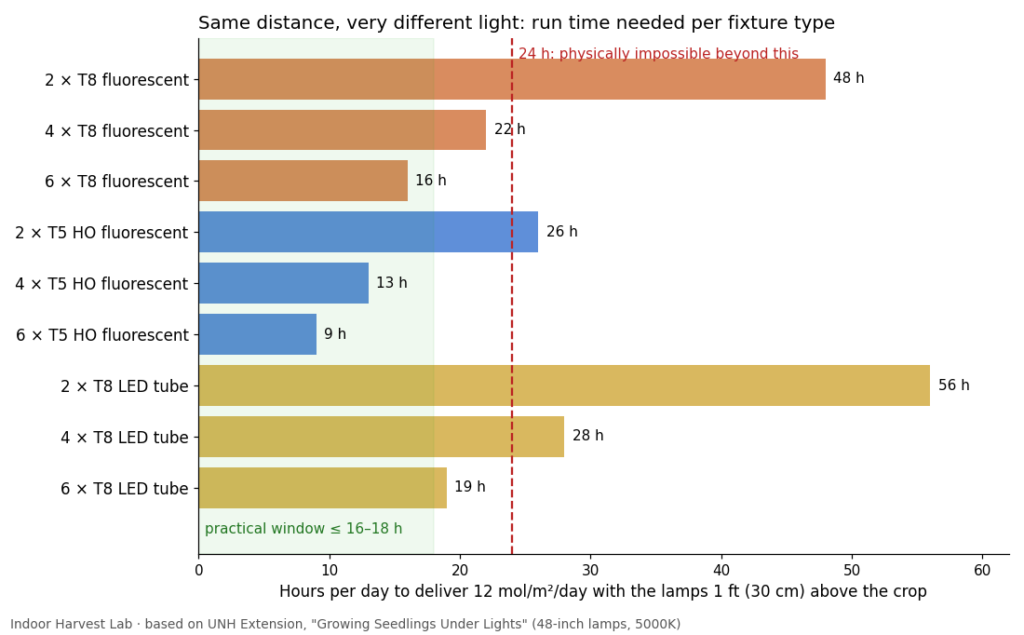
The practical lesson is that at a 12-inch grow light distance, an ordinary two-tube shop light cannot give seedlings enough light no matter how long it runs. Bringing the tubes down to 2–4 inches, as Minnesota and Clemson advise, is how home growers make those fixtures work. Clemson suggests starting with the light just above the soil line and raising it to keep a 2–4 inch gap as the transplants grow, with the lights on a timer for 16–18 hours.
LED grow light distance: set it by output, not by habit
LEDs range from weak decorative strips to fixtures far brighter than any fluorescent. UNH Extension’s table lists “LED grow lights” as “extremely variable,” and notes that a well-designed horticultural LED may need about 10 hours to do what a four-tube T8 fixture needs 22 hours to do, while a poor one could need 34 hours. The same fixture type can therefore need very different heights.
For a low-power LED shop light, a University of Minnesota specialist answering on Ask Extension advised lowering it to about 3 inches above the plants and adding a second or third fixture side by side if one 5,000-lumen unit has to cover about 8 square feet. For a stronger panel or bar, start at the height the manufacturer lists for seedlings or clones, then adjust by watching the plants over the next three to five days.
How to set grow light distance, step by step
- Pick your day length first. Extension guides agree on roughly 14–16 hours (Minnesota 12–16, Oklahoma State and K-State 14–16, Clemson 16–18). Minnesota advises against running lights continuously because many plants need a dark period. Put the lights on a timer; our guide to how many hours of light seedlings need explains how intensity changes the right setting.
- Find the PPFD you need. Use the table above: about 208 µmol/m²/s for 16 hours, or 238 µmol/m²/s for 14 hours.
- Set the starting grow light distance. Fluorescent tubes: 2–4 inches above the tallest leaves. LED: the height at which the maker’s PPFD chart shows your target across the tray; if there is no chart, start around 12 inches for a panel and lower it if seedlings stretch.
- Hang the fixture so it can move. Minnesota recommends chains; adjustable hangers work too. You will be raising the light every few days.
- Check the plants daily for the first week. Long gaps between leaves and pale, thin stems mean too little light, so lower the fixture or add hours within the 16–18 hour limit. Bleached or crisp leaf tops mean too much, so raise it.
- Keep the gap as seedlings grow. Raise the fixture to maintain the same grow light distance above the tallest plants, not above the tray.
- Rotate or shuffle trays. Light is weaker at the ends of tubes and edges of panels. Oklahoma State suggests keeping seedlings about 3 inches in from the ends of fluorescent bulbs, and hot spots under a ballast need more frequent watering checks.
Grow light distance mistakes to avoid
- Hanging a shop light a foot or more above the tray. UNH’s numbers show a two-tube T8 fixture at 12 inches cannot supply enough light even with the lights on around the clock.
- Measuring from the tray instead of the leaves. The grow light distance that matters is from the lamp to the top leaves, and it shrinks every day as seedlings grow.
- Using incandescent bulbs. Oklahoma State notes they cause stretched, spindly stems and risk heat damage.
- Running lights 24 hours to compensate for a high fixture. Minnesota advises a daily dark period, and K-State warns that some LEDs degrade faster when run more than 18 hours a day. Lower the light instead.
- Copying a distance from a different product. A height that suits one LED panel can scorch or starve seedlings under another.
- Waiting to fix stretching. Stretched stems do not shrink back when light improves, so act in the first few days.
Where this applies (and where it changes)
These grow light distance figures assume the lamp is the only light source, as in a basement, closet or shelf unit. Seedlings on a bright windowsill get part of their DLI from the sun, so a supplemental light can sit a little higher or run fewer hours, though winter window light is usually far below what seedlings need. In a greenhouse, UNH Extension notes that most transplant crops scheduled for normal planting dates do not need supplemental light at all.
Crop matters too. The 12–13 mol/m²/day targets come from research on sun-loving transplants such as tomato and bedding plants. Lettuce and other leafy seedlings for hydroponic systems like the Kratky method start well under the same lights. Microgreens are grown much more densely, where airflow and humidity matter as much as light; see our guide to microgreens mold. For more lighting articles, browse the seedling grow lights section.
Finally, the fixture itself changes the room. Fluorescent tubes add heat right above the leaves, which is one more reason to check soil moisture under the ballast, while with LEDs the warning sign K-State describes for a fixture that is too low is bleached leaves.
FAQ
How far should LED grow lights be from seedlings?
There is no single LED grow light distance because output varies widely. UNH Extension measured one LED bar that met seedling needs at 8 inches with an 8-hour day or at 20 inches with a 16-hour day. Use the maker’s PPFD chart to find the height that gives roughly 200–240 µmol/m²/s for a 14–16 hour day, then adjust by how the seedlings look.
Can a grow light be too close to seedlings?
Yes. Bright LEDs can bleach leaves, and the ballast end of a fluorescent fixture can overheat and dry out the plants beneath it. Increase the grow light distance if leaf tops turn pale or crisp.
How many hours should grow lights be on for seedlings?
Most extension guides recommend about 14–16 hours per day, with some allowing up to 18. Keep a dark period each night, and fix low light by lowering the fixture rather than leaving it on around the clock.
Why are my seedlings leggy under a grow light?
Almost always because the grow light distance is too great, or the lamp too weak, for the hours it runs. Lower fluorescent tubes to 2–4 inches, or bring an LED closer until it delivers the target PPFD. Our leggy seedlings guide explains how to rescue stretched plants.
Sources
- University of Minnesota Extension. Starting seeds indoors.
- Clemson Cooperative Extension, Home & Garden Information Center. Starting seeds indoors.
- Oklahoma State University Extension (2024). Lighting can be tricky when starting seeds indoors.
- Iowa State University Extension. How to successfully start seed indoors.
- K-State Research and Extension, Johnson County. Lighting options for starting seed (LEDs vs. fluorescent).
- Ebba, J. UNH Extension. Growing seedlings under lights (fact sheet).
- Torres, A.P. and Lopez, R.G. Purdue Extension HO-238-W. Measuring daily light integral in a greenhouse.
- Huber, B.M., Louws, F.J. and Hernández, R. (2021). Impact of different daily light integrals and carbon dioxide concentrations on the growth, morphology, and production efficiency of tomato seedlings. Frontiers in Plant Science 12:615853.
- Ask Extension (University of Minnesota expert, 2023). LED recommendations for growing seedlings.
Featured image: “48″, 4-lamp, T5 White Fluorescent lighting system in place” by jalexartis, CC BY 2.0.