
It’s late November. The farmers’ market has packed up, the supermarket chard looks tired by the time you get it home, and you’d love a bunch of glossy, red-stemmed leaves you can pick the same evening you cook them. Here’s the good news: chard is one of the most forgiving leafy greens you can grow inside, and one plant keeps giving for months.
Short answer: Yes, you can grow Swiss chard indoors. Sow seed ½ inch deep in a deep pot (at least 16 in / 40 cm for full-size plants), germinate it at 55–75°F, then grow it under LED light at roughly 230–250 µmol·m⁻²·s⁻¹ for 14 hours a day (a daily light integral near 12). Pick outer leaves from about four weeks for baby greens, and keep the centre intact so the plant keeps producing.
This guide pulls the numbers you need to grow Swiss chard indoors from university extension services and controlled-environment research into one plan. By the end you’ll know which pot, light, temperature and harvest routine to use, how to grow chard hydroponically, and how to fix the handful of problems that actually show up indoors.
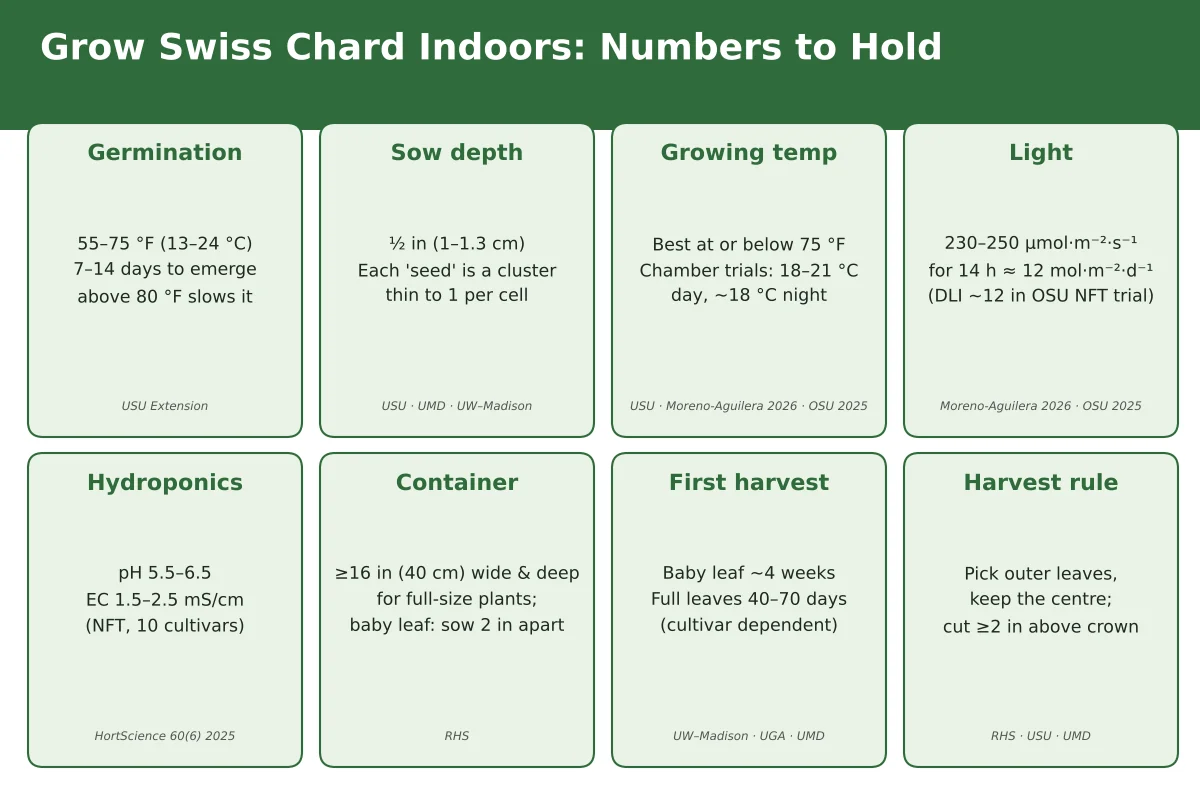
Can you grow Swiss chard indoors? Why it’s easier than spinach
Chard is the leaf-crop form of Beta vulgaris, the same species as beetroot. The University of Maryland Extension lists its other names as silverbeet, perpetual spinach and leaf beet, and that last pair tells you why it suits an indoor garden: you pick it a few leaves at a time, over and over, instead of harvesting it once.
Two pieces of plant biology make it a better indoor bet than spinach. First, chard is a biennial. According to University of Minnesota Extension, it won’t flower until the plant has lived through a winter, so bolting is triggered by cold, not by long days. Second, unlike spinach, chard isn’t day-length sensitive. That means you can run your grow light for 14–16 hours without pushing it into flower, which is exactly the problem that makes spinach frustrating under lights (see our guide to growing spinach indoors without bolting).
It also handles warmth better. UW–Madison Extension notes that chard tolerates heat better than spinach and rarely bolts the way spinach does. A centrally heated home sits comfortably inside its range.
| Trait | Swiss chard | Spinach | Why it matters indoors |
|---|---|---|---|
| Life cycle | Biennial; flowers after a winter (UMN) | Annual | Chard can stay leafy for months under lights |
| Day-length trigger | Not day-length sensitive (UMN) | Bolts under long days | You can use long light hours for faster growth |
| Heat tolerance | Better than spinach; rarely bolts (UW–Madison) | Bolts in warmth | Warm rooms are fine for chard |
| Harvest style | Outer leaves, repeatedly (RHS, USU) | Often one main cut | One pot gives many pickings |
| Plant size | Full-size leaves can reach 30 cm / 1 ft tall (RHS) | Smaller rosette | Needs a deeper, wider pot |
Numbers to hold: light, temperature, pH and spacing
Print this table or keep it open on your phone. Every number links back to its source in the Sources list at the end. Where research came from greenhouses or growth chambers, we say so, because your living room will be a bit less controlled.
| What | Target | Source |
|---|---|---|
| Germination temperature | 55–75°F (13–24°C); above 80°F (27°C) reduces germination | USU Extension |
| Days to emergence | 7–14 days | USU Extension |
| Sowing depth | ½ inch (about 1.3 cm) | USU, UGA |
| Seed type | Each ‘seed’ is a cluster with several embryos; thin seedlings | UMD, UW–Madison |
| Growing temperature | Best growth when temperatures stay at or below 75°F (24°C) | USU Extension |
| Growth-room setpoint (research) | 18–20°C (64–68°F), 60–70% RH | Moreno-Aguilera et al. 2026 |
| Greenhouse NFT setpoint (research) | 21°C day / 18°C night (70/64°F) | HortScience 60(6), 2025 |
| Light (research) | 230–250 µmol·m⁻²·s⁻¹ for 14 h (DLI ≈ 11.6–12.6, our calculation) | Moreno-Aguilera et al. 2026 |
| DLI in hydroponic cultivar trial | 12.4 ± 2.1 mol·m⁻²·d⁻¹ | HortScience 60(6), 2025 |
| Seedling light set-up | Lights about 6 in above plants, ~14 h a day | UGA Extension |
| Hydroponic pH | 5.5–6.5 (one LED study targeted 6.3 ± 0.2) | HortScience 2025, Moreno-Aguilera 2026 |
| Hydroponic EC | 1.5–2.5 mS/cm | HortScience 60(6), 2025 |
| Soil pH | Can go as low as 6 (more acid-tolerant than spinach) | UMN Extension |
| Container | At least 40 cm (16 in) wide and deep | RHS |
| Spacing | 30 cm (1 ft) for full-size plants; 5 cm (2 in) for cut-and-come-again leaves | RHS |
| Storage after picking | 32°F (0°C), 95% RH; 1–2 weeks in the fridge | UMD, USU |
How to grow Swiss chard indoors in 7 steps
This 7-step routine to grow Swiss chard indoors combines the extension advice on sowing and thinning with the light and temperature numbers from controlled-environment research. It works in soil; the hydroponic version follows in the next section.
Step 1: Pick a deep pot, a free-draining mix and a proven variety
Most failures when people grow Swiss chard indoors start before the first seed goes in: a pot that’s too shallow. Chard grows a big taproot. UMD describes it as “very large and woody on mature plants”, and the RHS recommends containers at least 40 cm (16 in) wide and deep for full-size plants.
Choose your pot by the harvest you want:
| Goal | Container | Spacing | When you’ll pick |
|---|---|---|---|
| Baby salad leaves | Wide trough or window box | Sow about 5 cm (2 in) apart (RHS) | Young leaves up to ~5 cm long (RHS); about 4 weeks (UW–Madison) |
| Full-size leaves for cooking | 40 cm (16 in) wide and deep pot (RHS) | One plant per pot, or 30 cm (1 ft) apart | 40–70 days depending on cultivar (UGA, UMD, UW–Madison) |
| Hydroponic heads | NFT channel, DWC tote or Kratky bucket | One plant per site | Trial plants measured 37 days after transplant (HortScience 2025) |
Potting mix. Use a peat-free or standard multi-purpose potting mix with good drainage; the RHS uses peat-free multi-purpose compost for container chard, and UW–Madison stresses good drainage and high organic content. UMN notes chard tolerates a slightly more acidic soil than spinach, down to about pH 6, so ordinary bagged potting mix suits it. If you start seeds in trays, a fine mix works best: our seed starting mix recipe gives a simple formula.
Varieties. Extension services keep naming the same reliable cultivars. UGA lists ‘Bright Lights’, ‘Rhubarb’ and ‘Lucullus’ at about 40 days to maturity and ‘Fordhook’ at 42. UW–Madison gives ‘Bright Lights’ and ‘Lucullus’ 55 days, and lists ‘Silverado’ as a compact 14–16 in plant, a sensible pick for a smaller pot.
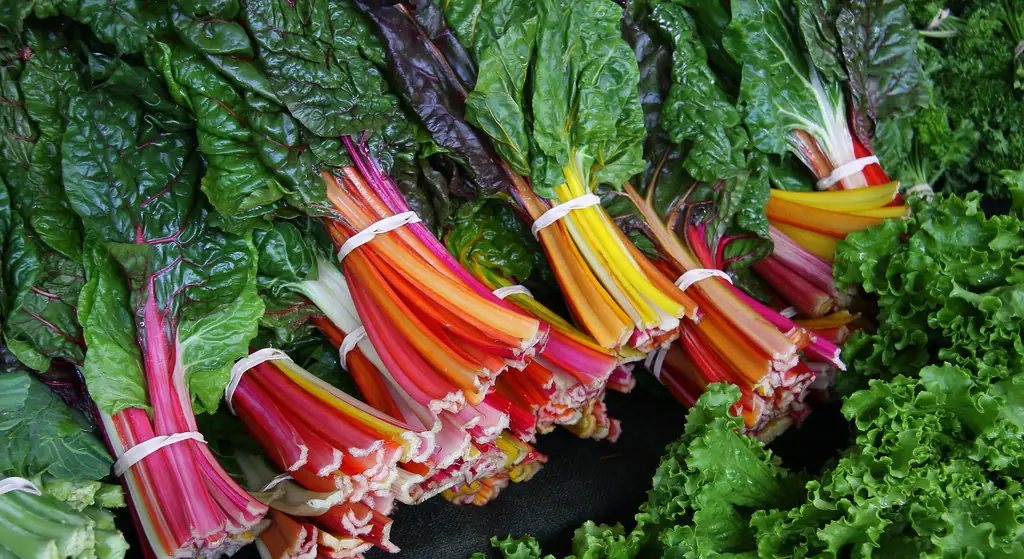
If you plan to grow hydroponically, an Oklahoma State University NFT trial of ten cultivars found shoot fresh weight was greatest in ‘Peppermint’, ‘Sea Foam’ and ‘Bright Yellow’, and leaf provitamin A was highest in ‘Fordhook Giant’. Coloured-stem types aren’t just pretty, either; they give you something to look at on a grey windowsill.
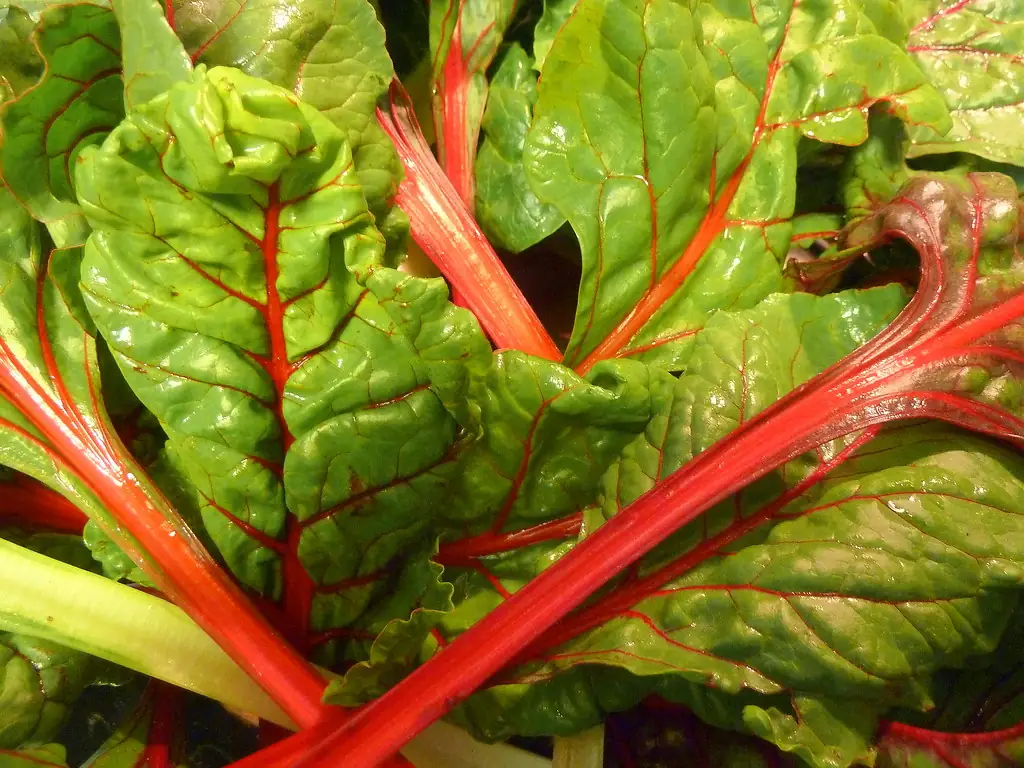
Step 2: Sow ½ inch deep and hold 55–75°F
Sow seed ½ inch deep (USU, UGA). In a seed tray, the RHS suggests one or two seeds per module. Water gently and keep the mix evenly moist, not soggy. USU gives 55–75°F as the best germination range and warns that temperatures above 80°F reduce germination. Don’t park the tray on a hot radiator. Expect seedlings in 7–14 days; a cool room sits at the slow end.
Step 3: Thin each cluster to one seedling
Here’s the step that surprises new growers. A chard “seed” is a seed ball with several embryos (UMD), so two or three seedlings often pop up from one spot. Thin when plants have 3–4 true leaves (USU) or are about 2 inches tall (UMD). Snip the extras at soil level with scissors instead of pulling them, so you don’t disturb the keeper’s roots. Eat the thinnings.
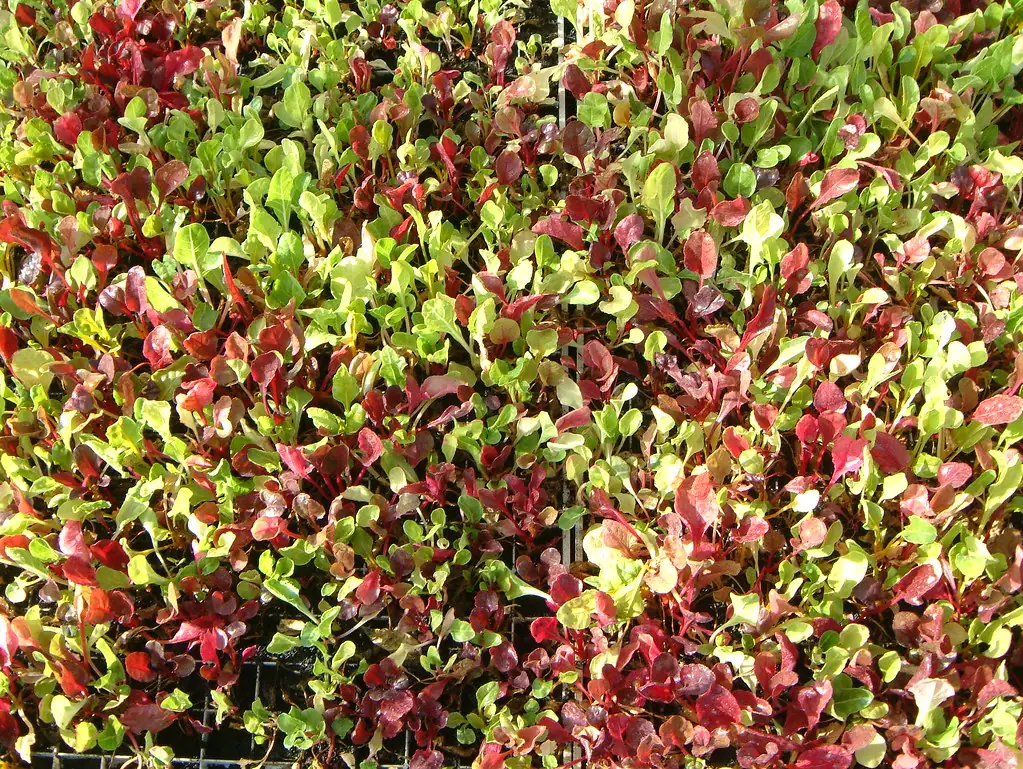
Step 4: Light them hard from day one
UGA’s indoor seed-starting advice is to keep lights about 6 inches above plants for around 14 hours a day. For growing on, aim for a daily light integral (DLI) of roughly 12 mol·m⁻²·d⁻¹. That’s what a 2026 LED growth-room study (230–250 µmol·m⁻²·s⁻¹ for 14 hours) and the Oklahoma State greenhouse trial (12.4 mol·m⁻²·d⁻¹ average) both delivered. Our PPFD chart explains how to measure and convert these values.
Step 5: Move to the final pot at 4–6 leaves
USU describes a transplant-ready chard plant as having 4–6 mature leaves and a developed root system, usually 5–6 weeks from sowing. The RHS transplants when seedlings are at least 5 cm (2 in) tall. Indoors there’s no hardening off needed; just keep the transplant out of direct heat for a day.
Step 6: Water deeply, feed steadily
UMD calls chard a crop with a “high requirement for nutrients”. In a pot, nutrients wash out with every watering, so use a balanced liquid feed at label rate every couple of weeks once plants are growing strongly. Water when the top inch of mix is dry, and empty saucers so roots never sit in water.
Step 7: Start picking outer leaves
Start picking once leaves are about 3 inches long, about 4 weeks after planting (UW–Madison), or let them grow on for full-size leaves. The full method is in the harvest section below.
Getting the light right: windowsill vs grow light
Light is the one factor you can’t fake. Chard grown outdoors does best with 6–8 hours of direct sun and tolerates 4–6 hours of partial shade (UMD); UGA asks for 8–10 hours of sunlight. A winter windowsill rarely gets near that, which is why indoor chard often comes out pale, with long, floppy stalks.
If you want to grow Swiss chard indoors through winter, a full-spectrum LED solves it. Use the chart below to set your timer: pick a target DLI, read across to the hours you’ll run the light, and you have the PPFD to aim for at leaf height.
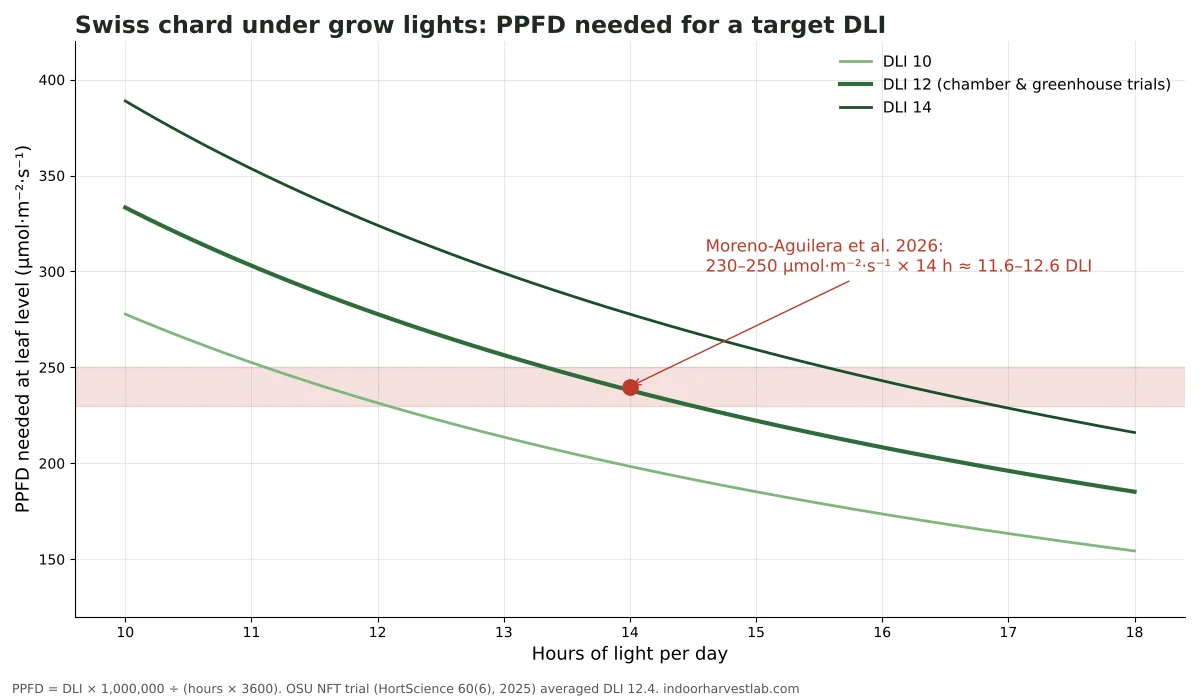
| Hours of light | PPFD for DLI 10 | PPFD for DLI 12 | PPFD for DLI 14 |
|---|---|---|---|
| 12 h | 231 | 278 | 324 |
| 14 h | 198 | 238 | 278 |
| 16 h | 174 | 208 | 243 |
| 18 h | 154 | 185 | 216 |
Values are µmol·m⁻²·s⁻¹, calculated as PPFD = DLI × 1,000,000 ÷ (hours × 3,600). They are planning targets, not cultivar-specific optima.
Does the light colour matter? In the Moreno-Aguilera et al. (2026) study, two LED fixtures were set to the same light intensity. Leaf area was significantly larger under the red/blue/far-red bar lights than under the broad white panels, and those plants had higher carbohydrate, protein and mineral levels. Most other growth measures didn’t differ. A 2025 Acta Horticulturae study also found that cultivar choice changed biomass more consistently than adding UV, green or far-red light. The practical takeaway: get the intensity and hours right first, then worry about spectrum.
Growing Swiss chard hydroponically
Growing Swiss chard indoors without soil works well: chard is a natural for NFT, deep water culture and Kratky containers. The best published recipe for home growers comes from the Oklahoma State trial in HortScience (2025): ten cultivars in NFT, with pH held at 5.5–6.5 and EC between 1.5 and 2.5 mS/cm, a 21/18°C day/night setpoint and a natural DLI averaging 12.4. Seeds were sown on 31 October and transplanted four weeks later.
| Setting | Research value | Home-grower translation |
|---|---|---|
| pH | 5.5–6.5 (HortScience 2025); 6.3 ± 0.2 target (Moreno-Aguilera 2026) | Hold 5.8–6.2 so drift stays in range |
| EC | 1.5–2.5 mS/cm (HortScience 2025) | Start seedlings near 1.5, raise toward 2.0–2.5 as plants size up |
| Air temperature | 21/18°C day/night (HortScience); 18–20°C growth room (Moreno-Aguilera) | A cool to normal room is ideal |
| Light | DLI ~12 (both studies) | ~240 µmol·m⁻²·s⁻¹ for 14 h |
| Starter cubes | Rockwool gave higher leaf weight than Oasis foam (Egilla et al. 2012) | Use conditioned rockwool |
| Solution management | Full renewal beat top-up replenishment for leaf count and area (Egilla et al. 2012) | Change the reservoir regularly |
That last row deserves a closer look. In an ASHS conference study by Egilla and colleagues with ‘Lucullus’ chard in NFT, renewing the nutrient solution increased leaf number and leaf area compared with simply topping it up. For a home reservoir, that’s a strong argument for a regular full change; our guide on how often to change hydroponic water sets out a schedule. Check your numbers against our hydroponic pH chart if you’re growing chard alongside other crops.
Harvesting indoor chard for months of leaves
When you grow Swiss chard indoors, one plant can produce for months if you pick well. Pick badly and you’ll stall it in a week. The rule from every source we checked is the same: take the outside, protect the middle.
- Pick outer leaves first. The RHS says to pull outer leaves cleanly at the base of the stalk and keep several central leaves on the plant.
- Never damage the growing point. USU notes that if the growing point is undamaged, you can cut all leaves to within 2 inches of the soil and the plant regrows. UMD likewise suggests snipping leaves 2 inches above the crown to rejuvenate plants.
- Baby leaves: leaves smaller than 4 inches are tender enough to eat raw (UMD).
- Full leaves: UGA harvests when leaves are about 12 inches long, usually 4–6 weeks after planting outdoors.
- Storage: keep unwashed leaves at 32°F and 95% relative humidity in a vented bag (UMD); they keep 1–2 weeks (USU, UW–Madison).
Two notes for the kitchen. UGA lists raw chard leaves at 19 calories per 100 g, and UMD points out that all parts of the plant contain oxalic acid. Cooking the stalks and leaves is the usual way people eat larger leaves.
Problems when you grow Swiss chard indoors: symptoms and fixes
Indoors you avoid slugs, deer and most leaf miners, but you trade them for a few house-specific issues. Use this triage table.
| What you see | Likely cause | What to do |
|---|---|---|
| Long, pale, floppy stalks | Too little light | Move to a grow light; aim for DLI ~12 (see chart above) |
| Clumps of 2–3 seedlings per spot | Multigerm seed cluster (UMD) | Snip extras at soil level at 3–4 true leaves |
| Seed slow or patchy to emerge | Too warm or too cold | Hold 55–75°F; above 80°F reduces germination (USU) |
| Small flying insects around the pot | Fungus gnats in wet mix | Let the surface dry; see our fungus gnat guide |
| Sticky leaves, clusters of tiny insects | Aphids | Spray off with water or use insecticidal soap (USU) |
| Pale tunnels or blotches inside leaves | Leafminer larvae (UW–Madison, RHS) | Remove and bin affected leaves |
| Round spots with pale centres | Cercospora leaf spot (UMD, UMN) | Remove spotted leaves, keep foliage dry, improve air flow |
| Plant sends up a tall flower stalk | Cold exposure (biennial trigger, UMN) or heat stress (RHS) | Cut the stalk off; the plant can keep producing for a while (RHS) |
| Hydroponic leaves yellowing | pH outside 5.5–6.5 or EC too low | Re-check pH/EC; change the solution |
From the lab bench
Strip away the details, and the evidence says you need three things to grow Swiss chard indoors well: root room, light and patience with the centre of the plant. Here’s what the evidence adds up to.
The root, not the leaf, sets the ceiling. A taproot that UMD calls “very large and woody” explains why the RHS asks for a 40 cm deep container. A shallow pot doesn’t kill chard; it simply caps leaf size and makes the plant dry out between waterings. If space is tight, grow baby leaves densely in a trough instead of squeezing a full-size plant into a small pot.
DLI 12 is a sensible target, not a magic number. Two very different set-ups, an Oklahoma greenhouse under natural light and a Mexican LED growth room, both landed near 12 mol·m⁻²·d⁻¹ and both grew marketable chard. That convergence makes 12 a reasonable home target. Going higher should add growth, but neither study tested it, so treat extra light as an experiment.
Biennial biology is your friend. Because flowering needs a winter’s chill (UMN), a heated home effectively keeps chard in permanent vegetative mode. The one trap is a cold, draughty windowsill, which is the closest thing indoors to the trigger you’re trying to avoid. Keep pots off glass that gets icy at night.
Cultivar choice matters more than gadgets. Both the Oklahoma State trial and the 2025 Acta Horticulturae LED study found big differences between cultivars, while spectrum tweaks had mixed effects. Pick a proven cultivar before you buy a specialist light.
FAQ: growing Swiss chard indoors
Can you grow Swiss chard indoors year-round?
Yes. Chard is a biennial that only flowers after a winter’s cold and isn’t day-length sensitive (UMN Extension), so in a heated home under a grow light it keeps producing leaves for months. Pick outer leaves and leave the centre to regrow.
How much light does Swiss chard need indoors?
Aim for a daily light integral of about 12 mol·m⁻²·d⁻¹. One LED study used 230–250 µmol·m⁻²·s⁻¹ for 14 hours, which works out to roughly 11.6–12.6. A winter windowsill rarely gives that much light.
What size pot does Swiss chard need?
The RHS recommends a container at least 40 cm (16 in) wide and deep for full-size plants. For baby salad leaves, a shallower wide trough works, with seeds sown about 5 cm (2 in) apart.
How long does Swiss chard take to grow indoors?
Seeds emerge in 7–14 days at 55–75°F. Baby leaves can be picked about 4 weeks after planting, and full-size leaves take roughly 40–70 days depending on the cultivar.
Can you grow Swiss chard hydroponically?
Yes. A HortScience trial grew ten chard cultivars in NFT at pH 5.5–6.5 and EC 1.5–2.5 mS/cm. Rockwool starter cubes and regular full solution changes gave better results than foam cubes and top-ups in another study.
Why are several seedlings coming up from one chard seed?
A chard seed is actually a seed ball containing several embryos. Thin each cluster to one seedling when plants have 3–4 true leaves or are about 2 inches tall, snipping the extras at soil level.
Should I start Swiss chard indoors?
You can. Start seeds indoors about 4–6 weeks before transplanting (UMN, UMD), with lights about 6 inches above the seedlings for around 14 hours a day (UGA). Or simply grow them to harvest indoors.
Sources
- Drost, D. (2020). How to Grow Swiss Chard in Your Garden. Utah State University Extension.
- University of Maryland Extension (2023). Growing Swiss Chard in a Home Garden. Home and Garden Information Center.
- Westerfield, B. & Florkowska, M. (2022). Home Garden Swiss Chard (Circular 1039). University of Georgia Cooperative Extension.
- Mahr, S. Swiss Chard. University of Wisconsin–Madison Division of Extension.
- Schuh, M. & MacKenzie, J. (2022). Growing spinach and Swiss chard in home gardens. University of Minnesota Extension.
- RHS Advice Team. How to grow chard. Royal Horticultural Society.
- Provitamin A, Nutrient Analysis, and Plant Growth of Hydroponically Grown Swiss Chard Cultivars. HortScience 60(6): 967 (2025). Oklahoma State University.
- Moreno-Aguilera, C.Y., et al. (2026). Evaluation of LED Spectral Treatments on Morphological and Nutritional Parameters of Swiss Chard (Beta vulgaris var. cicla) in a Controlled Environment Agriculture System. Agriculture 16(2): 165. doi:10.3390/agriculture16020165.
- Moll, M.D., Elfers, J., Stoddart, D. & Pude, R. (2025). Addition of UV, green and far-red spectra in sole-source LED cultivation of Beta vulgaris L. var. cicla. Acta Horticulturae 1441: 149–156.
- Egilla, J.N., Ogutu, R. & Nyirakabibi, I. (2012). Mineral Nutritional Status and Yield of Swiss Chard in Hydroponic Culture as Influenced by Nutrient Solution Management and Seed Propagation Substrate. ASHS Annual Conference abstract.