
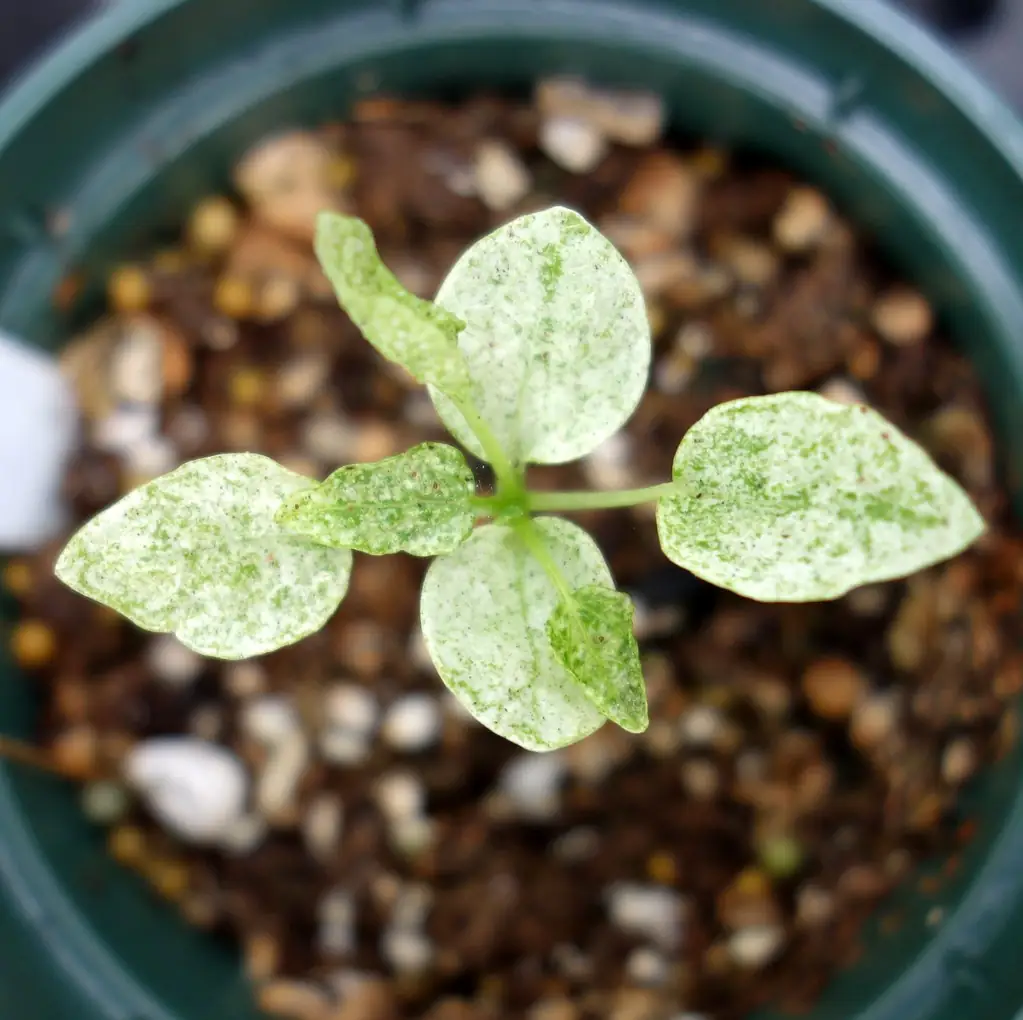
The heating has been on for a few weeks. Your rosemary on the kitchen windowsill, the basil under the grow light and the pepper plant you brought in for winter all looked fine in October. Now the leaves have a dusty, faded look, and when you tilt one toward the light you see hundreds of tiny pale freckles. Look closer at the leaf tips and there may even be a fine, glittering web.
Short answer: Spider mites on indoor plants are almost always twospotted spider mites, tiny arachnids that suck out leaf cells and thrive in warm, dry winter air. To get rid of them, isolate the plant, rinse the undersides of the leaves hard with water, then spray a ready-to-use insecticidal soap or horticultural oil that covers every leaf underside. Repeat every 5–7 days for at least three rounds, because sprays do not kill the eggs (UC IPM; UMass Amherst).
This guide shows you how to confirm it really is spider mites, why they explode indoors from November onward, a step-by-step plan that works on edible herbs and vegetables, how the treatment options compare, and how to stop the mites coming back next winter.
How to Spot Spider Mites on Indoor Plants
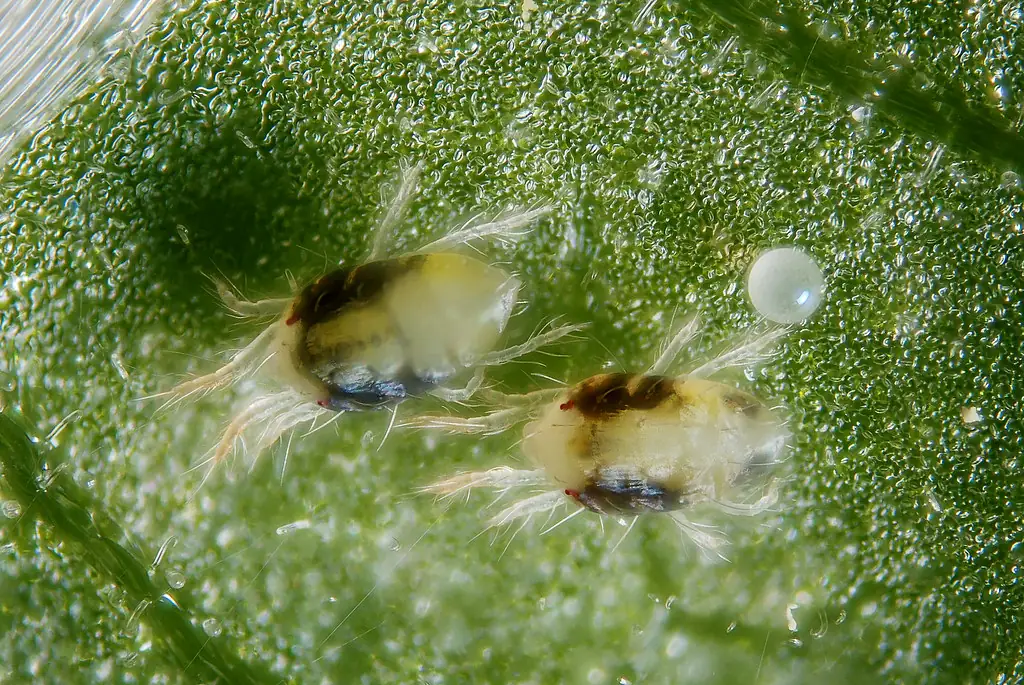
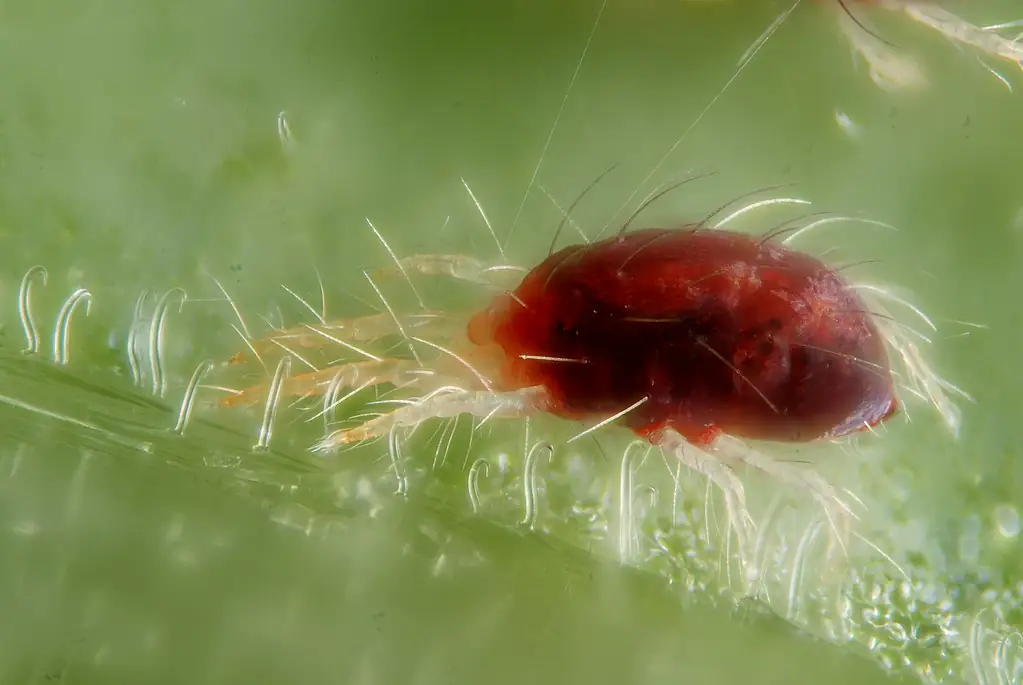
With spider mites on indoor plants, most people notice the damage before they notice the mites. Twospotted spider mites (Tetranychus urticae) are only about 1/50 inch (0.5 mm) long, so to the naked eye they look like moving specks of dust (UW–Madison Extension). They live in colonies on the undersides of leaves, and a single colony can hold hundreds of mites (UC IPM).
The four signs to look for
- Stippling: fine pale or yellow dots on the upper leaf surface, where mites below have emptied cells of chlorophyll. Over time leaves look bleached, bronzed or dull.
- Webbing: fine silk on leaf undersides, in leaf axils and across shoot tips. Webbing is the easiest way to tell spider mites apart from aphids and thrips, which also hide under leaves (UC IPM).
- Moving dots: yellow-green to orange specks with two dark patches on the body. In autumn some turn orange-red, which is why the British name is “red spider mite” (RHS).
- Eggs and cast skins: tiny round, translucent eggs and white shed skins on the leaf underside, easiest to see with a 10x hand lens.
The white paper test (30 seconds)
Hold a sheet of white paper under a suspect leaf and tap the leaf sharply. Spider mites drop onto the paper and start running around as tiny moving dots (University of Minnesota Extension). If the specks smear green or red when you wipe them, they were alive. Dust doesn’t move and doesn’t smear.
Check the older, middle-aged leaves first, especially along the midrib. That’s where mites usually build up before they move to new growth (UW–Madison).
Spider mites or something else?
Pale, speckled leaves have a few lookalikes. Use this quick triage before you start spraying.
| What you see | Most likely cause | How to confirm |
|---|---|---|
| Fine pale stippling, webbing at leaf tips, moving dots under leaves | Spider mites | White paper tap test; 10x lens on leaf undersides |
| Silvery streaks with tiny black specks (droppings), no webbing | Thrips | Slender insects that run or fly; no silk |
| Curled new leaves, sticky honeydew, soft green or black insects | Aphids | Visible clusters on shoot tips; no webbing |
| Even wilting and dull leaves, dry potting mix, no specks | Drought stress | Plant recovers after watering. UMN notes mite damage is often mistaken for drought |
| Small flies around the pot, healthy leaves | Fungus gnats | Yellow sticky card at soil level; see our fungus gnat guide |
Why Spider Mites on Indoor Plants Explode in Winter
Spider mites look like a summer pest, so a December outbreak feels unfair. But your living room in winter is close to their ideal climate. UW–Madison Extension puts it plainly: on houseplants, spider mites often become a problem in November, when the heat comes on and the air gets drier (UW–Madison).
Warm air shortens their life cycle
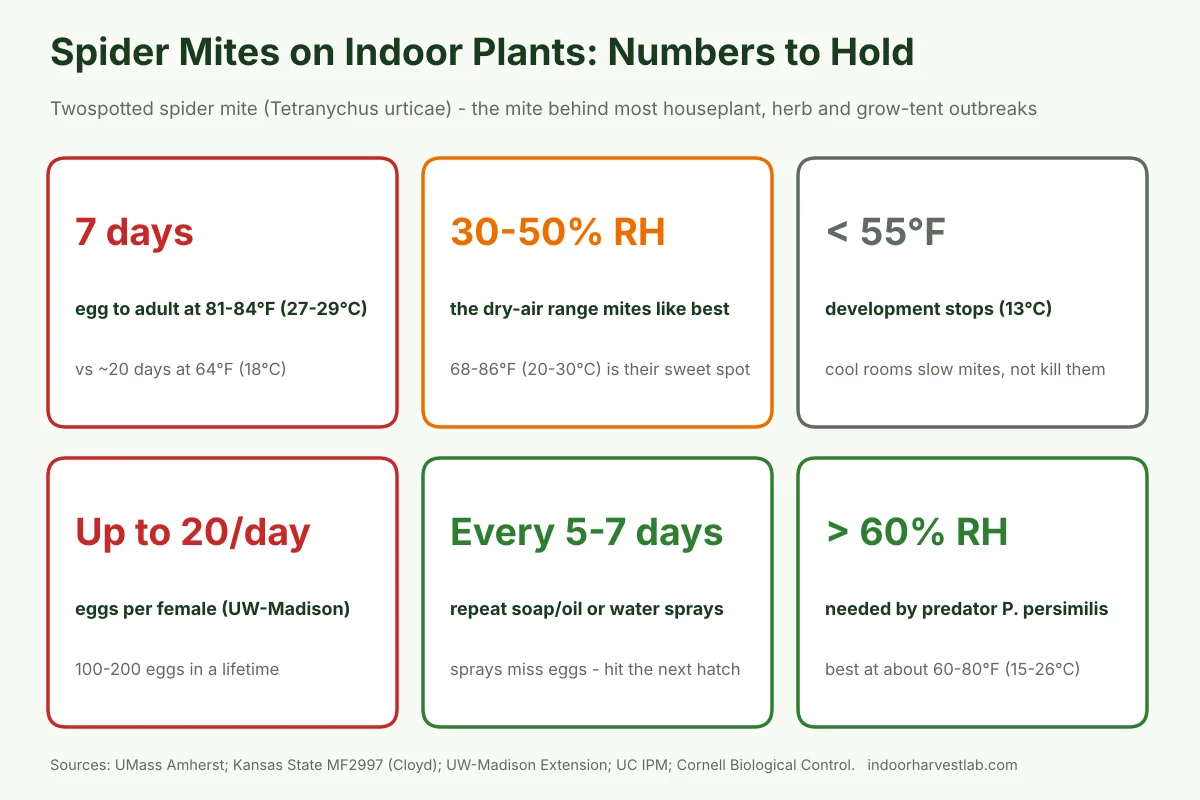
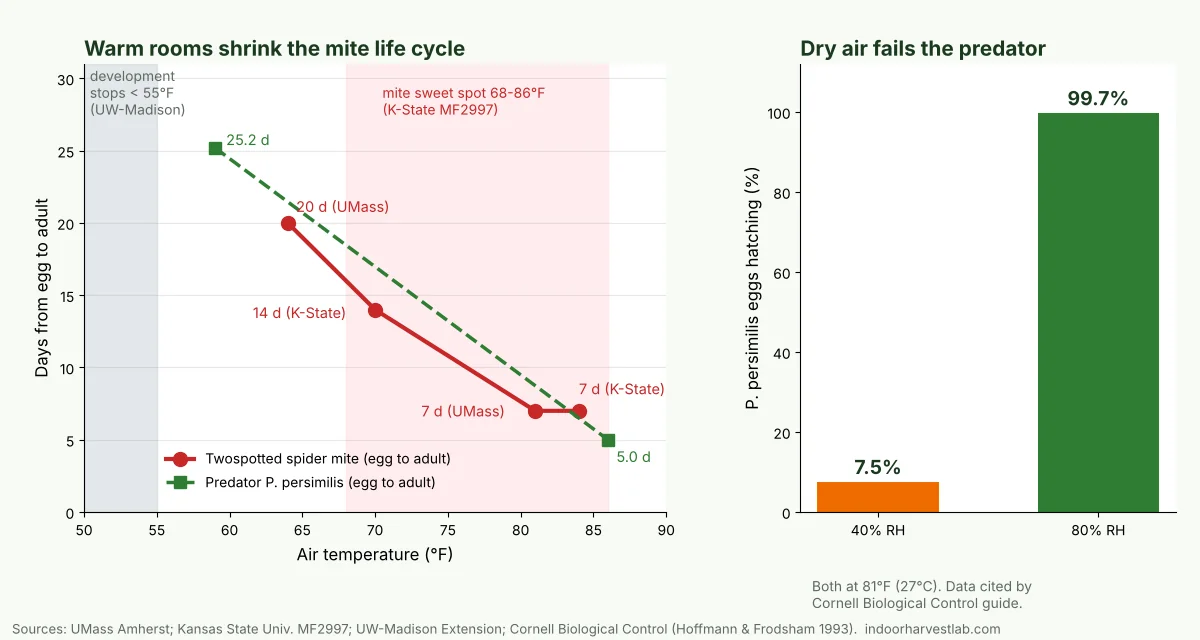
Twospotted spider mites develop best between 68°F and 86°F (20–30°C) (Kansas State University MF2997). The life cycle from egg to adult takes about 20 days at 64°F (18°C) but only about 7 days at 81°F (27°C) (UMass Amherst). Kansas State gives a similar picture: 14 days at 70°F (21°C) and 7 days at 84°F (29°C).
A female can lay up to 20 eggs a day and up to 120 in total (UW–Madison), and Kansas State reports up to 200 eggs over about two weeks. Mating is not required, because unfertilized eggs simply produce males (UMass). Put those numbers together and one overlooked mite on a new plant can become a visible infestation within a few weeks.
Dry air is the other half of the story
UMass Amherst notes that twospotted spider mites are most prolific above 80°F and at low humidity (20–40%). Kansas State gives an optimum of 30–50% relative humidity. Heated homes in winter often sit in that range, and the air right next to a radiator, heat vent or grow light is warmer and drier still. UMass also observes that greenhouse infestations usually start near steam pipes and other objects that radiate heat, which is a useful clue for where to look first in a house.
Stressed and overfed plants feed them better
Mites are worse on water-stressed plants (UC IPM). Kansas State explains why: drought-stressed plants build up soluble sugars and amino acids, which makes them more nutritious for mites. Too much nitrogen fertilizer has a similar effect, because the soft, protein-rich growth helps female mites develop and reproduce. Indoor herbs that dry out between irregular waterings, or that are fed heavily to push growth in low winter light, are a perfect target.
Numbers to hold
| Factor | Value | Source |
|---|---|---|
| Adult size | About 1/50 inch (0.3–0.5 mm) | UW–Madison; K-State |
| Mite sweet spot | 68–86°F (20–30°C), 30–50% RH | K-State MF2997 |
| Egg to adult | ~20 days at 64°F (18°C); 14 days at 70°F (21°C); ~7 days at 81–84°F (27–29°C) | UMass; K-State |
| Development stops | Below about 55°F (13°C) | UW–Madison |
| Eggs per female | Up to 20 a day; 100–200 per lifetime | UW–Madison; UMass; K-State |
| Egg hatch | 3–15 days, depending on temperature | UW–Madison |
| Repeat spray interval | Every 5–7 days | UMass |
| Don’t spray soap or oil | Above 90°F (32°C) or on water-stressed plants | UC IPM |
| Predator P. persimilis needs | 60–80°F (15–26°C) and above 50–60% RH | K-State; Cornell |
| Predator-to-pest guideline | 1 predatory mite per 10 spider mites | UC IPM |
How to Get Rid of Spider Mites on Indoor Plants: Step by Step
This plan for clearing spider mites on indoor plants is built for edible crops: herbs, leafy greens, peppers, tomatoes and strawberries grown on a windowsill, under lights or in a hydroponic unit. It relies on water, soap and oil, the options extension services recommend first for home growers.
Step 1: Isolate the plant and check its neighbors
Move the infested plant away from the others right away. Mites crawl along their webbing from plant to plant when leaves touch, and they also hitch a ride on clothing and tools (UW–Madison; K-State). Then do the paper tap test on every plant nearby. If you have a grow tent or shelf, check the plants closest to the light and any heat source first.
Step 2: Cut off the worst leaves and stems
Leaves that are mostly bleached, bronzed or matted with webbing won’t recover, and they carry most of the eggs. Snip them off, bag them and put them in the trash, not the compost. On a heavily infested herb, cutting the whole plant back can be faster than trying to save every stem, as long as some healthy growth remains.
Step 3: Rinse hard with water
Take the plant to the shower or sink, tilt the pot (cover the soil with a bag or cloth) and spray the leaves, especially the undersides, with a firm stream of lukewarm water. A forceful spray washes off mites and breaks up their webbing (UMN Extension). UC IPM suggests that on infested plants you can apply a water spray or mist to the leaf undersides at least once a day. For small infestations, regular rinsing alone can be enough.
Step 4: Water the plant well, then spray soap or oil
If rinsing doesn’t keep numbers down, step up to a ready-to-use insecticidal soap (potassium salts of fatty acids) or a horticultural oil (petroleum, plant oils such as canola, or neem). UW–Madison calls insecticidal soap the first choice for most spider mite problems. Both work only on contact and leave no residue that keeps killing, so coverage is everything (UMN).
- Water the plant thoroughly a few hours before spraying. Soap and oil can injure water-stressed plants (UC IPM).
- Spray early in the morning or in the evening, never in direct hot sun or above 90°F (32°C) (UC IPM; UMN). Turn grow lights off or raise them while leaves are wet.
- Test the product on a few leaves and wait a few days before treating the whole plant, because some plants are sensitive (UC IPM).
- Turn every leaf over. Spray until the undersides are wet, plus stems and leaf axils.
- Use only a product whose label lists your crop (or edible herbs and vegetables). Follow the label’s waiting time before harvest, and rinse leaves before eating.
- Skip homemade dish-soap mixes. UMN Extension warns they can burn and damage plants.
Step 5: Repeat every 5–7 days, at least three times
This is the step most people skip, and it’s why mites “come back”. Most sprays don’t kill eggs, so UMass recommends repeat applications every 5–7 days to catch each new hatch (UMass Amherst). In a warm room the mites can go from egg to egg-laying adult in about a week, so a gap of two weeks lets a new generation start.
Step 6: Check, then keep checking
A week after your last spray, repeat the paper test and look at new growth with a hand lens. Old stippled leaves won’t turn green again, so judge success by clean new leaves and no moving dots. After that, check weekly through the winter (UMass recommends weekly monitoring in greenhouses).
Treatments for Spider Mites on Indoor Plants Compared
Here is how the common options for spider mites on indoor plants stack up for edible crops grown inside. “Effort” assumes a handful of pots or a small grow tent.
| Option | How it works | Best for | Watch-outs |
|---|---|---|---|
| Water rinse / daily mist on undersides | Knocks mites and webbing off | Early or light infestations; any plant | Must be frequent; protect soil from waterlogging |
| Insecticidal soap (ready-to-use) | Kills mites it touches | First-choice spray for most indoor plants (UW–Madison) | No residual effect; repeat every 5–7 days; test for leaf burn |
| Horticultural or neem oil | Smothers mites on contact | Tougher-leaved plants; alternate with soap | Not on stressed plants or above 90°F; use summer-weight, not dormant oil |
| Predatory mites (e.g. Phytoseiulus persimilis) | Eat all spider mite stages | Greenhouses, conservatories, larger humid grow rooms | Need humidity above 60–70%; starve when prey runs out |
| Broad-spectrum insecticides (pyrethroids, carbaryl) | Kill many insects | Not recommended for mites | Often make outbreaks worse by killing predators; many mites resistant (UC IPM; UMN) |
When predatory mites work indoors (and when they don’t)
Phytoseiulus persimilis is the classic biological control. It is an orange, teardrop-shaped predator that eats 5–20 spider mites or eggs a day and, at 86°F (30°C), develops from egg to adult in just 5 days (Cornell Biological Control). Roughly 75% of European greenhouse vegetable production relies on it, according to the same source.
The catch is humidity. In one study cited by Cornell, only 7.5% of its eggs hatched at 40% relative humidity, compared with 99.7% at 80% (both at 81°F/27°C). Kansas State lists its needs as 60–80°F (15–26°C) and relative humidity above 50%, and UW–Madison says predators in hobby greenhouses work only when humidity is generally above 70%. UW–Madison also does not recommend them for heavy indoor infestations or for problems on individual houseplants.
So for a few pots in a heated living room, soap and water are the practical route. Predators make more sense in a humid grow room, a conservatory or a larger hydroponic setup. Other species, such as Neoseiulus californicus and Galendromus occidentalis, tolerate warmer, drier conditions (above 85°F and 30–40% RH) than P. persimilis (UMass). If you do release predators, UC IPM’s rule of thumb is one predator per ten spider mites, and you should knock a heavy population down first with water or soap. Don’t spray soap or oil while predators are working, because contact sprays can kill them too.
How to Prevent Spider Mites on Indoor Plants Coming Back
Once you’ve cleaned up an outbreak of spider mites on indoor plants, a few habits make the next one far less likely. Most of them cost nothing.
- Quarantine new plants. Keep new or gifted plants, and anything coming in from outdoors (like a pepper you’re overwintering), apart for two weeks and check them with a hand lens. UMass stresses that incoming plants are the usual way mites get in.
- Water consistently. Mites prefer drought-stressed plants (UC IPM). A steady routine matters more than any spray.
- Go easy on nitrogen in winter. Heavy feeding produces soft growth mites love (K-State). In low winter light, plants need less fertilizer anyway.
- Keep plants away from direct heat. Don’t park pots on radiators, beside heat vents or touching the hot side of a light.
- Rinse foliage now and then. UMass notes that occasional overhead watering washes mites off, and the RHS says regular spraying with water and higher humidity reduce the risk (though humidity alone won’t control an outbreak).
- Space plants out. Leaves that touch are bridges for mites (K-State).
- Check weekly. Tap a few leaves over white paper every week from November to March.
If you’re setting up a winter windowsill from scratch, our guide to growing herbs indoors in winter covers light and temperature targets that keep plants strong enough to shrug off a few mites. Crops like rosemary, tomatoes and peppers that spend winter in warm, dry rooms are worth checking most often.
Hydroponic growers have a particular risk: drip and NFT systems keep foliage dry, and UMass notes that mite numbers can be higher where only drip irrigation is used. Grow tents also concentrate heat near the lights. If your hydroponic plants droop as well as speckle, rule out root problems with our hydroponic wilting checklist before blaming the mites alone.
From the Lab Bench
If you look at spider mites on indoor plants as a population problem rather than a spraying problem, a few things become clear.
Timing beats strength. Contact sprays kill the mites that are moving, not the eggs. At around 70–80°F the egg-to-adult cycle runs 7–14 days, so a spray every 5–7 days hits each generation before it can lay eggs. Three or four well-timed, thorough rounds of a mild soap will usually do more than one heavy dose of something stronger.
Coverage is the real active ingredient. Spider mites live under leaves and behind webbing, and soap or oil only works where it lands. Most “the spray didn’t work” stories turn out to be coverage problems. Treat the leaf undersides as the target and the upper surfaces as a bonus.
Broad-spectrum sprays backfire. UC IPM points out that some pyrethroids and carbaryl not only miss mites but also remove their predators, and can even raise leaf nitrogen or stimulate mite reproduction. Indoors there are few natural predators to lose, but the resistance problem remains: UW–Madison notes that most insecticides no longer work against spider mites. Stick with soap, oil and water.
Change the climate, not just the plant. You can’t make a heated room cool and humid, but you can move plants away from heat sources and avoid letting them dry out. Even a few degrees cooler slows the mites’ cycle, and a well-watered plant is a poorer meal. Think of the environment as the long-term treatment and the spray bottle as the short-term one.
Know when to cut your losses. A $4 basil plant that’s covered in webbing is often better composted in a sealed bag than nursed for a month while it seeds mites onto everything else. Save your effort for long-lived plants like rosemary, bay, citrus and overwintered peppers.
FAQ
What causes spider mites on indoor plants?
Spider mites usually arrive on a new plant, a plant brought in from outdoors, or on clothing and tools. They then multiply fast in warm, dry indoor air. UW–Madison notes houseplant outbreaks often start in November when the heating comes on. Drought-stressed and heavily fertilized plants are most at risk.
Can spider mites live in a house without plants?
Twospotted spider mites feed only on plant cells, so they can’t build a population without host plants. Kansas State notes that without hosts they may go dormant in cracks and crevices until plants return, so clean shelves and trays after a bad outbreak.
Do spider mites spread from plant to plant?
Yes. They crawl across their webbing between plants whose leaves touch and are carried on clothing, tools and air currents (UW–Madison; Kansas State). Isolate infested plants and check neighbors with the white paper test. Catching spider mites on indoor plants early is far easier than clearing a webbed-over shelf.
How long does it take to get rid of spider mites?
Plan on at least three treatments 5–7 days apart, so about 2–3 weeks, because most sprays don’t kill eggs (UMass Amherst). Keep checking weekly afterward, since one surviving mite can restart the cycle.
Is insecticidal soap safe for edible herbs?
Many ready-to-use insecticidal soaps are labeled for vegetables and herbs, but check that the label lists your crop and follow its waiting period before harvest. Test on a few leaves first, spray when plants are well watered and below 90°F, and rinse leaves before eating.
Does increasing humidity kill spider mites?
No. Higher humidity and regular rinsing slow them down, but the RHS says humidity alone won’t control an infestation. Use it alongside rinsing and soap or oil sprays.
Are red spider mites different from twospotted spider mites?
Usually not. The RHS calls the twospotted spider mite the glasshouse red spider mite. It is normally yellowish-green with two dark patches, but can turn reddish-orange in autumn (RHS; UMass).
Sources
- UC Statewide IPM Program. Pest Notes: Spider Mites (Home and Landscape). University of California Agriculture and Natural Resources.
- UMass Amherst Center for Agriculture, Food, and the Environment. Twospotted Spider Mites (Greenhouse & Floriculture fact sheet).
- Mahr, S. Twospotted Spider Mite, Tetranychus urticae. University of Wisconsin–Madison Extension, Wisconsin Horticulture.
- Cloyd, R. A. Twospotted Spider Mite Management in Greenhouses and Nurseries (MF2997). Kansas State University Agricultural Experiment Station and Cooperative Extension Service.
- Hoffmann, M. P. and Frodsham, A. C. (1993). Phytoseiulus persimilis. In Natural Enemies of Vegetable Insect Pests, via Cornell University Biological Control: A Guide to Natural Enemies in North America.
- Royal Horticultural Society. Glasshouse red spider mite (RHS Advice).
- Royal Horticultural Society. Indoor plants: sap feeders (RHS Advice).
- Hahn, J. and Wold-Burkness, S. Twospotted spider mites in home gardens. University of Minnesota Extension (reviewed 2020).