
It’s late November. The garden beds are frozen, the seed catalogues are arriving, and you’re wondering whether that empty shelf under your grow light could give you something crunchier than another round of lettuce. Can you grow carrots indoors? You can, as long as you respect one thing above all: depth.
Short answer: You can grow carrots indoors in any pot at least 1.5 times as deep as the mature root, filled with loose, stone-free potting mix. Sow short varieties ¼ inch deep, keep the mix evenly moist at about 55–75 °F (13–24 °C), thin to 2–3 inches apart, and give them 8–10 hours of bright light or roughly 16 hours under LEDs. Baby and round types are ready in about 55–75 days.
This guide pulls together university extension advice and carrot research into one indoor plan. By the end you’ll know which varieties fit which pot, how to get stubborn seed to sprout, how much light the roots really need, and how to fix forked, hairy or bitter carrots before they happen.
Can you grow carrots indoors? What to expect
Yes, but go in with honest expectations. The University of Saskatchewan’s gardening team says growing carrots indoors in a container is “possible, but not very practical”, mainly because carrots need a lot of light and you’ll need supplemental lighting to get it (USask Gardening). That’s a fair warning, not a stop sign. It simply means the indoor crop is about quality and fun, not bulk.
Here’s the trade-off in plain numbers. Outdoors, Utah State University expects about 1 lb of roots per foot of row (USU Extension). Indoors, every square inch of lit pot costs electricity, so you’ll get the most value from short, fast varieties pulled young, when they’re at their sweetest anyway.
Two myths to clear up before you start:
- Carrot tops won’t grow a new carrot. Oregon State University Extension explains that cutting off the top removes the growing point of the taproot. The top can regrow leaves and thin fibrous roots, but never a new taproot (OSU Extension). Grow tops for greens if you like, the way you’d regrow green onions, but sow seed for roots.
- Carrots don’t transplant. Every extension source we checked says to sow carrots where they’ll grow. South Dakota State warns that transplanting makes roots fork (SDSU Extension). So skip seed trays and sow straight into the final pot.
If you’re new to growing food inside, our indoor vegetable garden setup guide covers shelves, lights and timers. Carrots slot neatly into that setup next to leafy greens.
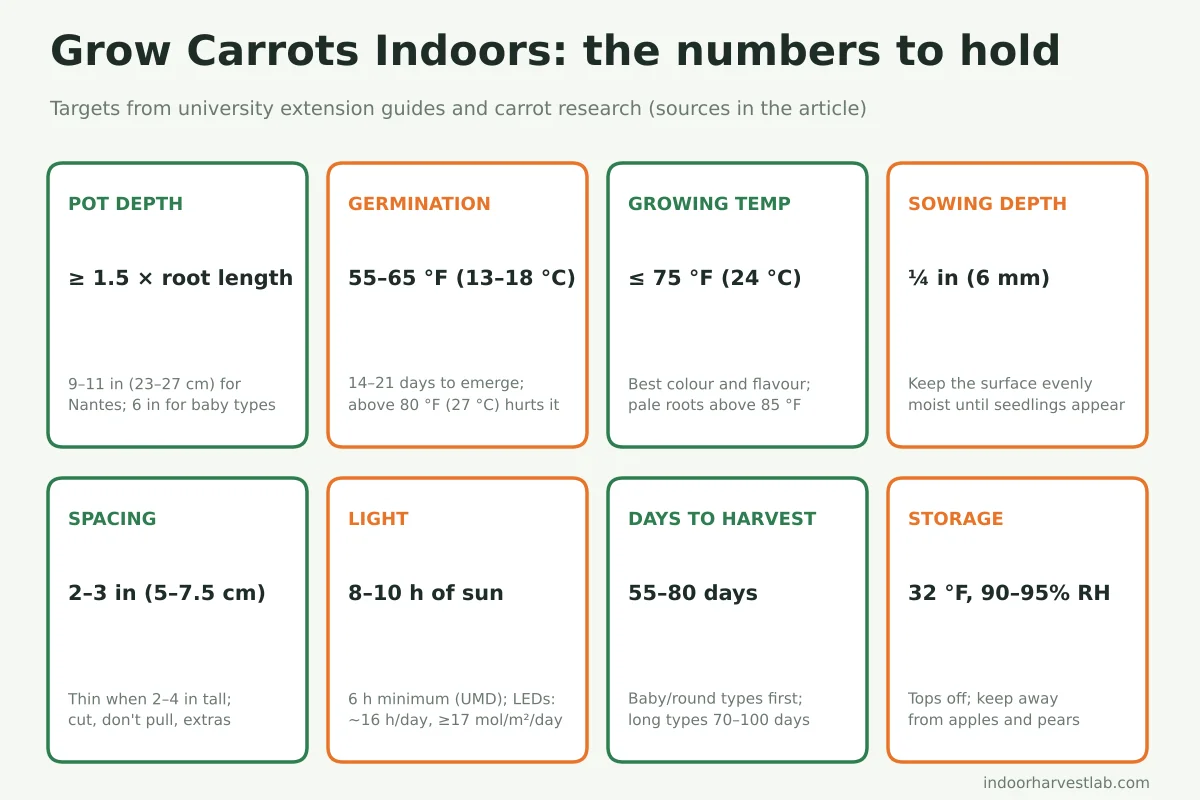
Numbers to hold when growing carrots indoors
Pin these to the wall next to your grow shelf. Every figure comes from the sources listed at the end.
| What | Target | Source / why it matters |
|---|---|---|
| Pot depth | At least 1.5 × the mature root length (6 in / 15 cm for a 4-in baby carrot) | Shallower pots give smaller carrots (UMD Maryland Grows) |
| Sowing depth | ¼ in (6 mm); ¼–½ in at most | USU; UMD; SDSU |
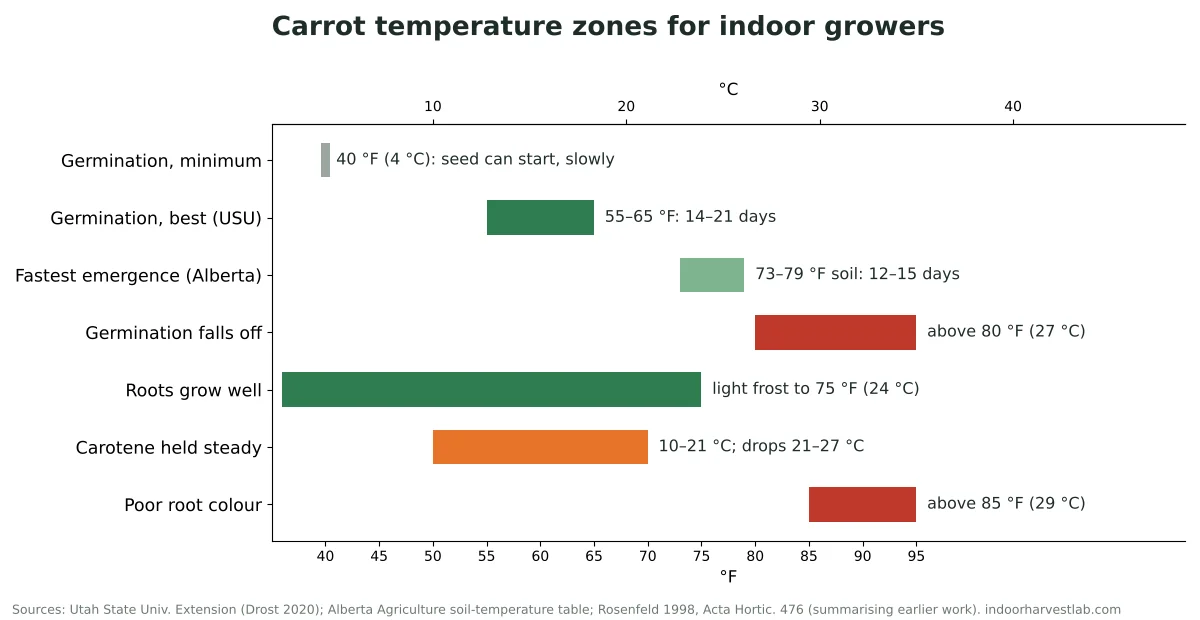
| Best germination temperature | 55–65 °F (13–18 °C) mix temperature | 14–21 days to emerge (USU) |
| Fastest emergence | 73–79 °F (23–26 °C) soil; 12–15 days | Alberta Agriculture table |
| Germination falls off | Above 80 °F (27 °C) | USU |
| Growing temperature | Up to 75 °F (24 °C); light frost tolerated | Hotter = slower growth, off-flavours (USU) |
| Pale roots | Above 85 °F (29 °C) | USU |
| Carotene | Steady at 10–21 °C (50–70 °F); falls from 21 to 27 °C | Rosenfeld 1998, summarising earlier studies |
| Spacing after thinning | 2–3 in (5–7.5 cm) | USU; RHS; SDSU |
| Light | At least 6 h direct sun, ideally 8–10 h | UMD |
| Days to harvest | 55–80 days (variety); 70–100 for full-size roots | SDSU; UMD; USU |
| Storage | 32 °F (0 °C), 90–95% RH, tops removed | Up to 4–5 months (UMD) |
Best carrot varieties for pots, and how deep each needs
Variety choice is where most indoor carrot projects succeed or fail. A long Imperator root sown in a 6-inch window box will twist, stunt or fork. A round Paris Market type in the same box will look like it was made for it.
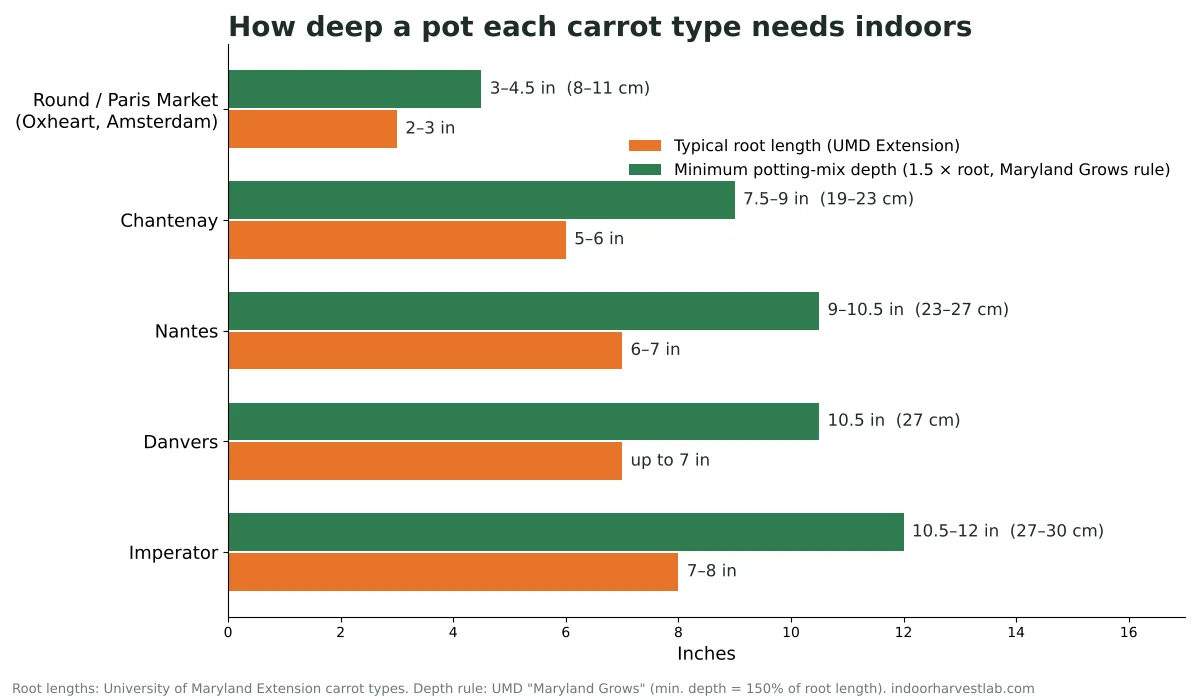
The University of Maryland Extension describes five main carrot types (UMD Extension), and its Maryland Grows blog adds a simple rule for containers: the pot needs to be at least 150% as deep as the carrot you want to grow (Maryland Grows). Combine the two and you get this:
| Carrot type | Root size (UMD) | Minimum mix depth | Indoor verdict |
|---|---|---|---|
| Round / Oxheart / Amsterdam (baby) | 2–3 in long, ~2 in across | 3–4.5 in (8–11 cm) | Best for window boxes and shallow troughs |
| Chantenay | 5–6 in long, 2–2½ in at the shoulder | 7.5–9 in (19–23 cm) | Stout, forgiving; good in a 2–3 gallon pot |
| Nantes | 6–7 in long, 1½ in across, blunt tip | 9–10.5 in (23–27 cm) | Sweet, small core; needs a deep container |
| Danvers | Up to 7 in, conical | About 10.5 in (27 cm) | Works in deep pots; fibrous if left too long |
| Imperator | 7–8 in long | 10.5–12 in (27–30 cm) | Skip indoors unless you’ll harvest it young |
Maryland Grows names container-friendly cultivars including ‘Orbit’ and ‘Thumbelina’ (small and round), ‘Baby Spike’, ‘Little Finger’, ‘Mini Cor’ and ‘Short ‘n Sweet’ (baby), and ‘Red-Cored Chantenay’ and ‘Royal Chantenay’ (Maryland Grows). The RHS adds that small, round-rooted varieties suit most containers, and that long types can still be grown in shallow pots if you pull them young as baby veg (RHS).
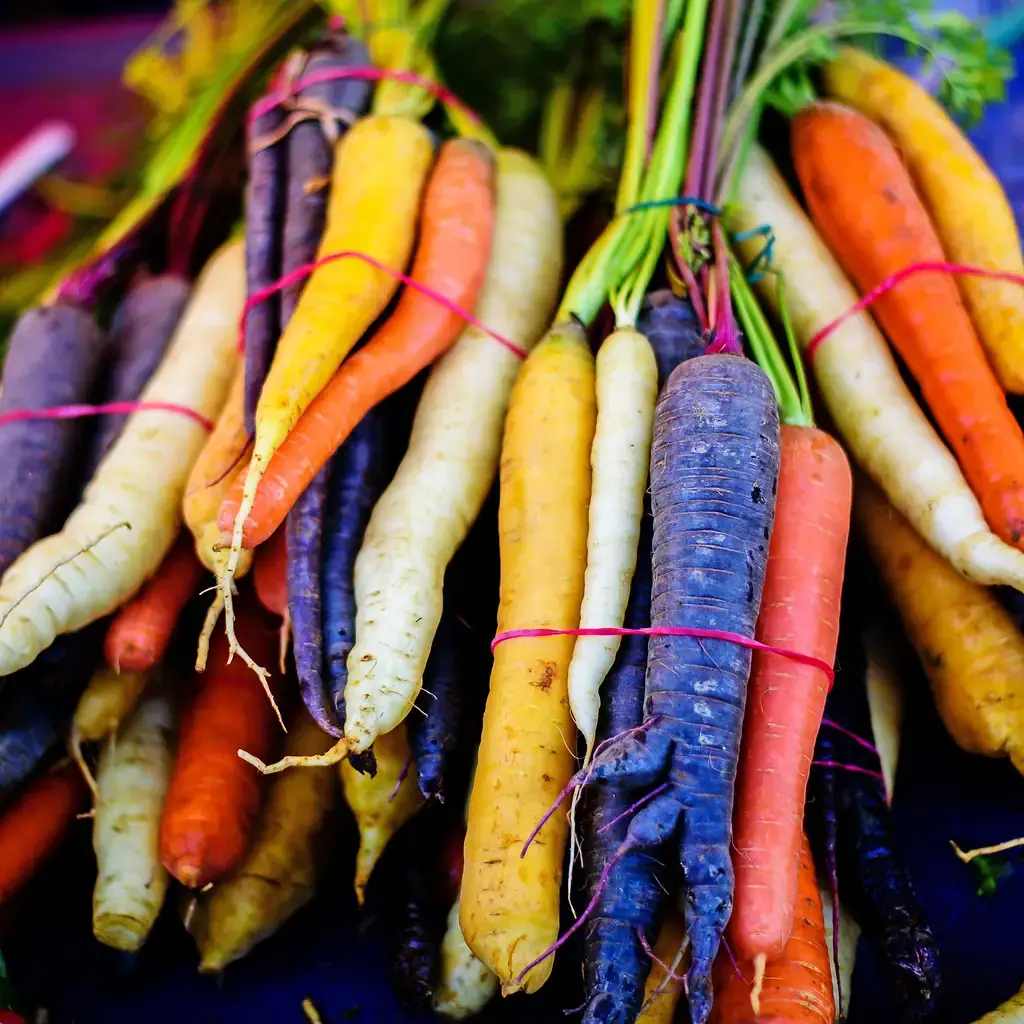
Want colour? Purple, yellow, red and white carrots are widely sold, and South Dakota State notes that purple carrots tend to be very sweet (SDSU Extension). Treat them like any other carrot: check the seed packet for root length and match it to your pot.
How to grow carrots indoors, step by step
To grow carrots indoors successfully, follow these seven steps in order. The method assumes a deep pot or trough on a shelf under LEDs or in your sunniest window. It takes about 20 minutes to set up, then a few minutes a day.
Step 1: Choose a deep container with drainage
Pick the depth from the table above, then add an inch of headroom so you can top up the mix later. Width matters less than depth, but wider pots hold moisture more evenly. USask suggests a large, very deep container with drainage holes, and calls a 5-gallon pail ideal (USask Gardening). For baby carrots, a 6-inch-deep window box works.
Step 2: Fill with loose, stone-free potting mix
Carrots need deep, loose, well-drained ground free of rocks and clods (UMD Extension). In a pot, that means a soilless potting mix, never garden soil. If you make your own blend, our seed starting mix recipe is a good base; some growers add sand for weight and drainage.
There’s research behind that sand tip. In a University of Minnesota undergraduate study of carrots in static hydroponic totes, sand-dominated substrates (especially a 75% sand mix) gave the longest roots and the highest fresh weight, while perlite-heavy mixes tended to give hairy carrots (Trịnh, UMN MURAJ). It was a small study, so treat it as a hint, not a rule.
Step 3: Sow thinly and shallowly
Moisten the mix first, then scatter seed thinly over the surface. Cover with ¼ inch of fine mix, sieved compost or fine sand. Utah State suggests covering seed with compost or fine sand because crusting surfaces stop seedlings emerging (USU Extension). Indoors, crust forms fast under a fan or a warm light.
Pelleted seed or seed tape makes spacing much easier, as SDSU points out (SDSU Extension). Carrot seed is tiny, and thinning a carpet of seedlings is fiddly work.
Step 4: Keep the surface moist until they emerge
This is the step where most indoor carrot sowings fail. Carrots can take up to three weeks to germinate, and the mix must stay moist the whole time (SDSU Extension). Mist daily or cover the pot loosely with a clear lid or plastic until the first seedlings show, then uncover.
Keep the mix in the cool-to-moderate range. Utah State gives 55–65 °F (13–18 °C) as the best germination temperature, with emergence in 14–21 days, and warns that temperatures above 80 °F (27 °C) reduce germination (USU Extension). Alberta Agriculture’s soil table lists 23–26 °C (73–79 °F) as the optimum for speed, with emergence in 12–15 days (Alberta Agriculture). Practically, a normal heated room is fine; just don’t put the pot on a heat mat set high and forget it. Our seed germination temperature chart compares carrots with other crops.
Step 5: Thin to 2–3 inches
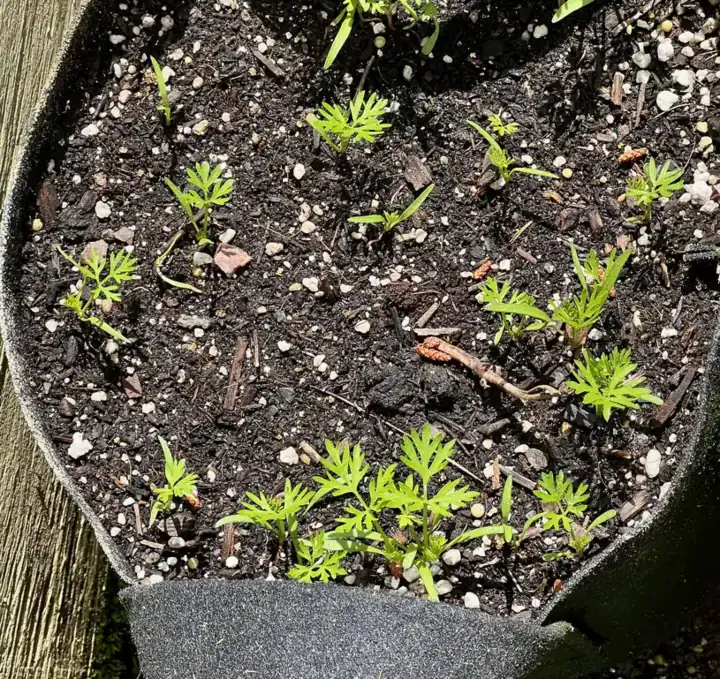
When seedlings are 2–4 inches tall, thin them to 2–3 inches (5–7.5 cm) apart (USU Extension; RHS). Snip the extras at soil level with scissors instead of pulling them. Maryland Extension recommends cutting rather than pulling to avoid disturbing the neighbouring roots (UMD Extension).
Don’t skip this step to “get more carrots”. SDSU notes that lots of tops with small or no roots is usually caused by planting too close or not thinning (SDSU Extension). If you’re growing only round or baby types, Maryland Grows uses a tighter spacing of about one seedling per square inch, and the thinnings go in a salad (Maryland Grows).
Step 6: Water evenly and feed lightly
Uniform moisture is critical to producing sweet, crisp carrots (UMD Extension). Pots dry faster than garden beds, so check them every day or two and water when the top inch feels dry. Water deeply, then let the excess drain.
Overwatering is just as bad as drought. Utah State warns that over-watering causes hairy roots and forking, while wet–dry swings cause cracking and bitterness (USU Extension). Constantly wet mix also invites fungus gnats.
For feeding, SDSU suggests an all-purpose fertilizer such as 10-10-10 or 10-15-15 at label rates for container carrots, and warns that too much nitrogen decreases root growth (SDSU Extension). Lush, dark tops with skinny roots are the classic sign of overdoing it.
Step 7: Top up the mix as shoulders rise
As the roots swell, their orange shoulders often push above the surface. Light turns them green. SDSU calls it sunburning and recommends mounding soil over the roots (SDSU Extension). Indoors, just sprinkle a little extra mix over any exposed shoulders, which is why you left that inch of headroom.
Light and temperature for indoor carrots
Carrots are cool-season, full-sun plants. When you grow carrots indoors, that combination is easier to provide than you’d think, because a grow shelf in a cool room gives bright light without summer heat.
How much light carrots need
Maryland Extension says carrots need at least 6 hours of direct sun a day and prefer 8–10 hours (UMD Extension). In a northern winter, even a south-facing window rarely delivers that, so plan on a grow light.
Extension guides don’t publish a carrot-specific PPFD or DLI target for home growers, so here’s a reasoned starting point. Light is converted to DLI with DLI = PPFD × hours × 0.0036, as explained in our PPFD chart guide. Cornell’s lettuce work finishes heads at about 17 mol/m²/day, and a full-sun root crop shouldn’t get less than a lettuce crop. That points to roughly 300 µmol/m²/s for 16 hours. The University of Minnesota carrot trial used 16-hour days at 21 °C, and roots matured in about 12 weeks (Trịnh, UMN MURAJ).
| PPFD at the leaves (µmol/m²/s) | 12 h on | 14 h on | 16 h on | Verdict for carrots |
|---|---|---|---|---|
| 150 | 6.5 | 7.6 | 8.6 | Too dim: leggy tops, slow roots |
| 200 | 8.6 | 10.1 | 11.5 | Workable for baby carrots, slow |
| 300 | 13.0 | 15.1 | 17.3 | Good target |
| 400 | 17.3 | 20.2 | 23.0 | Fast growth; watch the mix drying out |
Mount the light so the whole pot sees similar intensity. The edges of a fixture’s footprint can get half the light of the centre, and carrots on the edge will lag.
Temperature: cool rooms make sweeter roots
Utah State’s carrot fact sheet says carrots grow best when temperatures don’t exceed 75 °F (24 °C), tolerate down to 32 °F (0 °C) without serious damage, and develop poor colour above 85 °F (29 °C) (USU Extension). That makes a cool spare room, basement or unheated (but frost-free) porch under lights a better spot than a warm kitchen.
Colour research agrees. A 1998 Acta Horticulturae review summarised studies showing that carotene stays unchanged between 10 and 21 °C (50–70 °F) and falls as temperature rises from 21 to 27 °C (Rosenfeld 1998). Earlier Dutch work found roots grown at 18 °C had more carotenoids than roots grown at 8 °C (Banga & de Bruyn 1964). So the sweet spot is moderate: not cold, not hot.
Troubleshooting forked, hairy, bitter or green carrots
When people grow carrots indoors and get odd-looking roots, the cause is nearly always one of three things: a mix that’s too firm or stony, water that swings between soaked and dry, or heat. Use this table to work backwards from what you see.
| What you see | Most likely cause | Fix |
|---|---|---|
| Forked or twisted roots | Stones, clods or compacted mix; transplanting; damaged root tip | Use loose, sieved potting mix; sow in place; never transplant (USU; SDSU) |
| Hairy roots with many fine rootlets | Over-watering; perlite-heavy mix | Let the top inch dry between waterings; add sand (USU; Trịnh) |
| Cracked or split roots | Wet–dry swings; heavy watering near harvest | Water little and often; ease off near harvest (UMD; USU; RHS) |
| Bitter or off-flavoured roots | Heat; water stress; stored near apples or pears | Keep below 75 °F; water evenly; store away from fruit (USU) |
| Pale yellow instead of orange | Temperatures above 85 °F (29 °C) | Move to a cooler spot; mulch the surface (USU) |
| Green tops on the roots | Light hitting exposed shoulders | Top up with mix over the shoulders (SDSU; UMD) |
| All leaves, tiny roots | Seedlings too crowded; excess nitrogen | Thin to 2–3 in; cut back on nitrogen (SDSU) |
| Patchy or no emergence | Dry or crusted surface; seed too deep; too hot | Cover with fine sand or compost; keep moist; ¼ in deep (USU) |
| Plants flower instead of making roots | Cold chilling triggered bolting | Avoid long periods in a cold garage or porch (USU) |
Outdoors, carrot fly maggots and leafhopper-spread aster yellows are major worries (USU Extension). Indoors they’re rare, which is one genuine advantage of growing on a shelf. Your more likely pests are fungus gnats and, in dry, warm rooms, spider mites.
Harvesting and storing indoor carrots
Start checking at the days printed on the packet. Maryland Extension suggests pulling carrots for fresh use before they exceed 1 inch across, or about 65–75 days after planting (UMD Extension). The RHS says baby carrots can be pulled in as little as four to six weeks, while larger carrots usually take three months or more (RHS).
Brush back the mix to check the shoulder width before you pull. Water the pot an hour before harvest so the roots slide out cleanly, then twist and pull from the base of the leaves. Pull the biggest first and leave the rest to size up; Maryland Grows found a ‘Short ‘n Sweet’ left in 12 inches of mix for weeks still sweet and not fibrous (Maryland Grows).
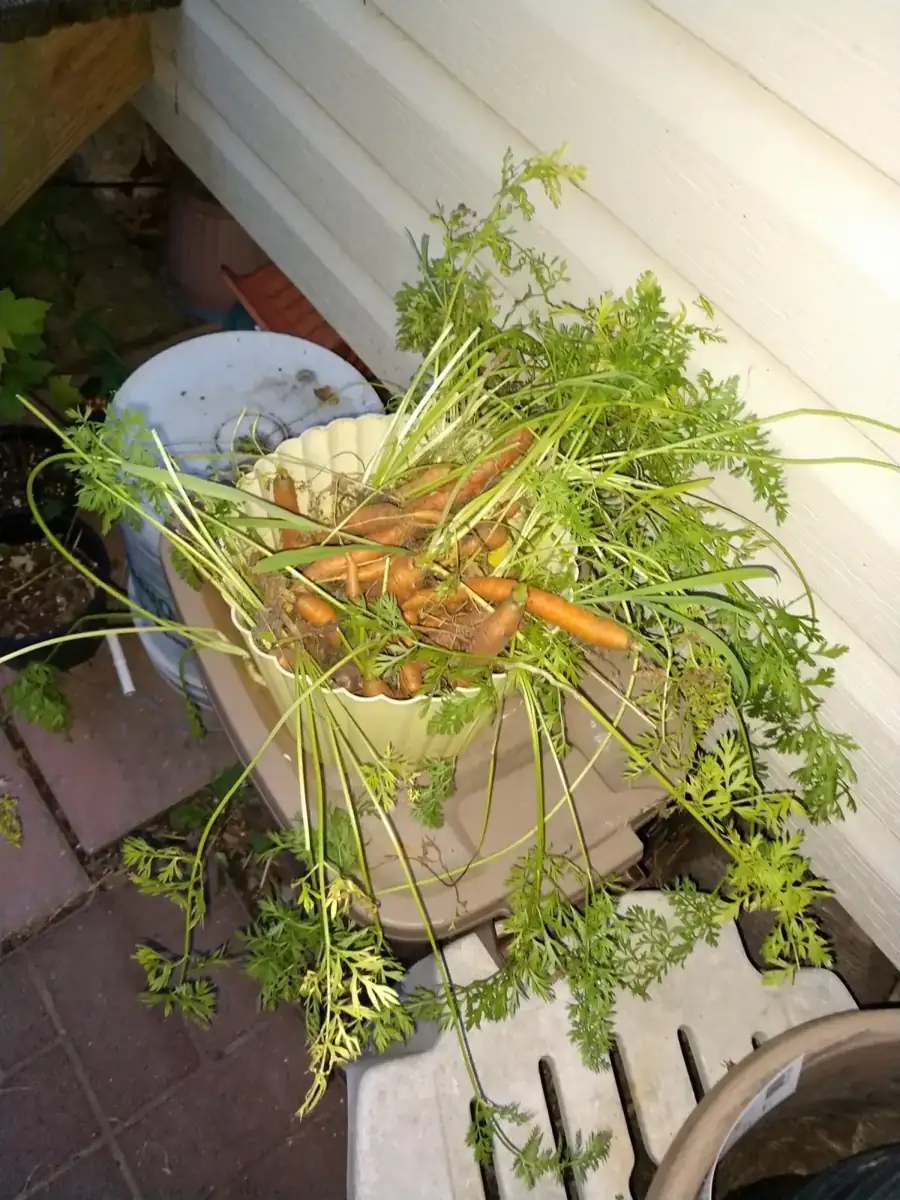
Cut the tops off straight away; Maryland Extension notes this reduces moisture loss so roots stay crisp. Topped carrots keep up to 4–5 months at 32 °F (0 °C) and 90–95% relative humidity (UMD Extension). In a home fridge, a sealed bag in the crisper is the closest you’ll get. Keep them away from apples and pears, whose gases can make carrots bitter (USU Extension).
From the lab bench
Here’s how we’d interpret the research if you’re deciding whether it’s worth the shelf space to grow carrots indoors.
A carrot is a storage organ, so it lives on surplus light. The root only swells once the leaves are making more sugar than they need. Banga and de Bruyn concluded that the carotenoid content carrots can reach depends primarily on adequate photosynthesis (Banga & de Bruyn 1964). Under a weak light you’ll get feathery tops and pencil-thin roots. That’s why we’d rather run fewer pots under strong light than many pots under a dim one.
Oxygen in the root zone is underrated. The same study found that the benefit of warmer temperatures for colour disappeared when oxygen in the soil air fell to 6% or less. A waterlogged pot is a low-oxygen pot. That fits Utah State’s warning that over-watering causes hairy, forked roots, and it’s why drainage holes and an open, sandy mix matter more for carrots than for leafy greens.
Hydroponic carrots are possible, but awkward. USask says carrots aren’t typically suited to most hydroponic methods (USask Gardening). Still, researchers have done it: Tuskegee University grew eight cultivars in NFT and a porous-tube system for NASA’s food program, where ‘Baby Spike’ had the highest β-carotene in NFT and was the consumers’ favourite of the hydroponic carrots tested (Gichuhi et al. 2005). Utah State’s Crop Physiology Lab grew nine cultivars for 60 days in a growth chamber, sowing at 180 plants per m² and thinning to 90 per m² on day 45 (Pinnock & Bugbee 2002). The lesson for home growers is that a deep, sandy medium you can drain is far simpler than a water culture system.
Pick time over size. Indoors, the cost is lit shelf-days. A round or baby variety harvested at 55–75 days turns those shelf-days into roots faster than a long type taking 100 days. If you want continuity, the RHS advice to sow small batches every three to four weeks works just as well under lights (RHS).
FAQ
Can you grow carrots indoors in winter?
Yes. You can grow carrots indoors in winter because they’re a cool-season crop, so a cool room suits them. Give them a pot 1.5 times as deep as the mature root, keep them below 75 °F (24 °C), and add a grow light, because winter windows rarely supply the 6–10 hours of direct sun carrots need.
How deep does a pot need to be for carrots?
At least 1.5 times the length of the mature root. A 4-inch baby carrot needs about 6 inches of mix; a 6–7 inch Nantes needs 9–10.5 inches. Round types such as ‘Paris Market’ can grow in 4–5 inches.
Can you regrow carrots from carrot tops?
Only the leaves. Oregon State University Extension explains that cutting off the top removes the growing point of the taproot, so a carrot top can regrow greens and thin fibrous roots but never a new carrot. Sow seed for roots.
How long do carrots take to grow indoors?
Most varieties take 55–80 days from sowing. Baby and round types can be pulled sooner, while full-size long types can take 70–100 days. Seed alone can take 14–21 days to emerge.
Do carrots need a grow light indoors?
Usually, yes. Carrots need at least 6 hours of direct sun and prefer 8–10 hours. Indoors, an LED delivering about 300 µmol/m²/s for 16 hours (about 17 mol/m²/day) is a sensible target.
Can you grow carrots hydroponically?
It’s possible but awkward. Research teams have grown carrots in NFT and in hydroponic totes, but a deep, sandy, free-draining medium is simpler at home. In one Minnesota study, sand-heavy substrates gave longer, heavier carrots than perlite-heavy ones.
Why are my indoor carrots hairy or forked?
Hairy roots usually mean too much water or a very airy, perlite-heavy mix. Forking comes from stones, compacted mix, transplanting or damage to the root tip. Use loose, sieved mix, sow in place and let the top inch dry between waterings.
Sources
- University of Maryland Extension (2023). Growing Carrots in a Home Garden.
- University of Maryland Extension, Maryland Grows blog. Growing carrots in containers.
- Drost, D. (2020). How to Grow Carrots in Your Garden. Utah State University Extension (peer-reviewed fact sheet).
- Burrows, R. Carrots: How to Grow It. South Dakota State University Extension.
- Royal Horticultural Society. How to Grow Carrots (RHS Grow Your Own guide).
- Spencer, R. Soil Temperature and Field Vegetable Germination. Alberta Agriculture and Forestry (rev. 2017).
- University of Saskatchewan Gardening. Carrots: growing in containers and indoors.
- Stoven, H. (2022, reviewed 2025). Can I regrow carrots by planting the tops? Oregon State University Extension Service.
- Banga, O. & de Bruyn, J. W. (1964). Carotenogenesis in carrot roots. Netherlands Journal of Agricultural Science 12(3): 204–220.
- Rosenfeld, H. J. (1998). Acta Horticulturae 476 (carrot sensory and chemical quality; review of temperature effects on carotene).
- Trịnh, P. Optimizing Carrot Growth in Static Hydroponic Systems. Minnesota Undergraduate Research & Academic Journal 5(4), University of Minnesota.
- Pinnock, D. R. & Bugbee, B. (2002). Carrot Cultivar Evaluation: Soilless Media vs. Hydroponics. Utah State University Crop Physiology Lab.
- Gichuhi, P., Mortley, D., Bromfield, E., Kpomblekou-A, K., et al. (2005). Evaluation of Carrots (Daucus carota L.) Grown in Two Hydroponic Systems for Inclusion in NASA’s Advanced Food Systems. SAE Technical Paper 2005-01-3114.