
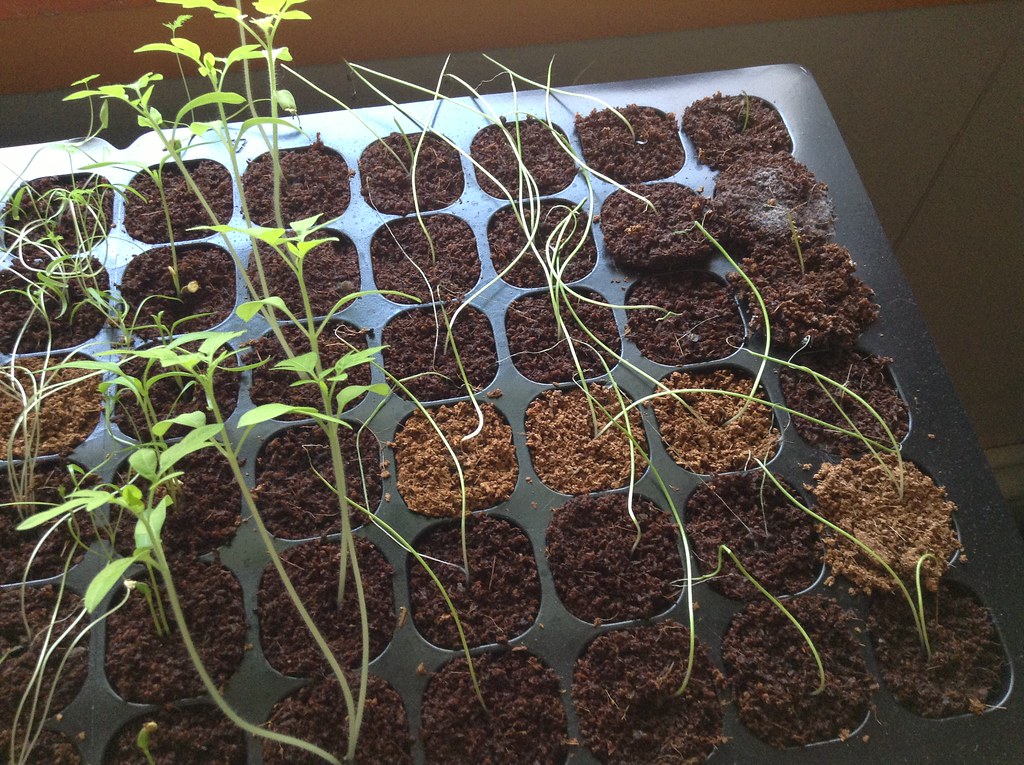
Short answer: leggy seedlings are almost always short of light. The stems stretch toward a weak or distant light source, and warm temperatures, crowding and a slow move from the germination spot into the light make it worse. University of Minnesota Extension recommends keeping lights 4 to 6 inches above seedlings for 16 to 18 hours a day, and Purdue University sets a daily light target of 10 to 20 mol/m²/day depending on the crop. You cannot shrink a stretched stem, but you can stop the stretch within a day, strengthen the stem, and bury tomato stems deeper at potting-up time.
This guide explains what makes leggy seedlings, how to tell a light problem from a temperature or crowding problem, how to rescue the plants you already have, and how to set up your lights so the next tray grows short and sturdy.
Table of Contents
What leggy seedlings look like
Leggy seedlings have long, thin, pale stems with wide gaps between the leaves. University of Minnesota Extension describes them as stems that “become long and thin and appear to be reaching toward the source of light,” with long spaces between the leaf nodes. Plant scientists call the same thing etiolation or stretch.
Typical signs:
- The first stem section, below the seed leaves (the hypocotyl), is several times longer than the leaves are wide.
- Stems lean toward a window or toward the brightest part of the light.
- The seed leaves are small and pale green rather than deep green.
- Plants flop over when watered and cannot hold themselves up.
It matters because a weak stem is more than a cosmetic problem. Natalie Hoidal of University of Minnesota Extension notes that leggy seedlings are more susceptible to damping-off and can collapse with small changes in watering. West Virginia University Extension adds that leggy seedlings do not establish well once they are planted out.
What causes leggy seedlings
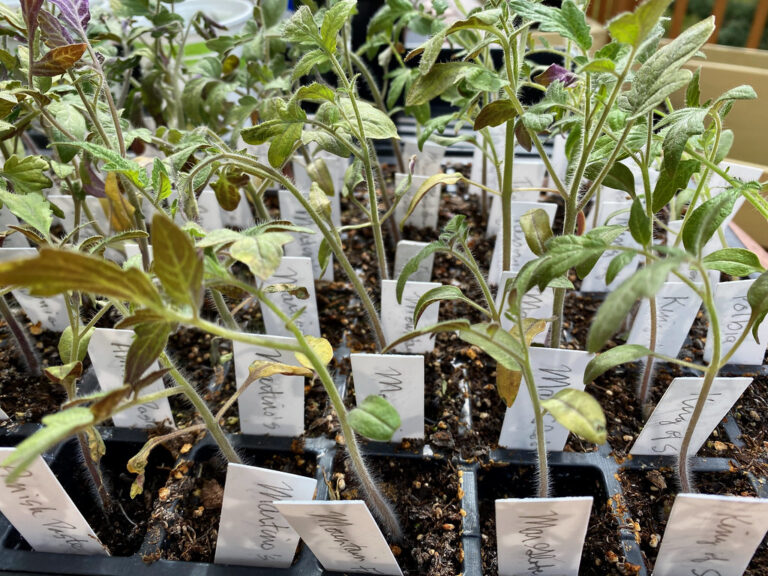
Four things cause leggy seedlings, and they often act together. The table starts with the most common one and shows how to tell them apart.
| Cause | How to recognise it | Fix |
|---|---|---|
| Too little light (most common) | Whole tray stretched and pale; plants lean toward a window or the centre of the lamp | Lower the light, add hours, or add a brighter fixture |
| Late move into light after germination | Tall white or pale stems that appeared overnight under a dome or on a heat mat | Move trays under lights as soon as the first seedlings emerge |
| Warm temperatures, especially warm days | Stretch even under decent light; worse near heaters or on heat mats | Remove heat mats after germination; keep days near 70 °F |
| Crowding | Thick clumps in each cell; plants in the middle taller than plants at the edge | Sow a few seeds per cell and thin early |
1. Not enough light: the main cause of leggy seedlings
University of Illinois Extension calls insufficient light “the most common cause” of long, leggy seedlings. A bright-looking windowsill in late winter, the classic source of leggy seedlings, is often far dimmer than it looks to the eye, and the day is short. Lamps can also be the problem: Illinois Extension points out that lights hung too far away, and aging fluorescent tubes that “lose some of their brightness,” both leave plants short of light.
The research behind this is clear. In a study of tomato seedlings grown at 6.5, 9.7 and 13.0 mol/m²/day, Huber, Louws and Hernández (2021, Frontiers in Plant Science) found that hypocotyl length fell steadily as the daily light integral rose, and stem diameter increased. More light gave shorter, thicker stems.
2. A slow move from germination to light
Most seeds do not need light to germinate, so many growers start trays in a warm, dark spot. The risk is the gap afterwards. Hoidal warns that the window between germination and the point where seedlings need light is narrow, and advises moving emerged seedlings into a lighted area quickly. A tray left in the dark for a day or two after emergence can turn into leggy seedlings before the first true leaf appears.
3. Warm temperatures stretch seedlings
Heat speeds up stem elongation, so warm rooms produce leggy seedlings even under decent lamps. The New England Vegetable Management Guide advises that keeping day temperatures cool, around 70 °F, helps keep transplants shorter. A heat mat that is ideal for germination keeps pushing stem growth if it stays on after the seedlings are up.
4. Crowding
When many seedlings share one cell, they shade each other, compete for light, and turn into leggy seedlings. Illinois Extension’s fix is simple: sow only a few seeds per cell and thin seedlings once they start germinating.
How to fix leggy seedlings you already have
A stem that has already stretched will not get shorter. The goal is to stop further stretch today and make the plant strong enough to transplant. Work through these steps in order.
- Move the light closer, today. Hang the fixture 4 to 6 inches above the leaves (UMN) or 2 to 4 inches for fluorescent tubes (Illinois Extension). If the leaves bleach or curl at the edges, raise it an inch.
- Put the lights on a timer for 16 to 18 hours. UMN Extension recommends this range for seedlings. A timer keeps the day length the same every day.
- Turn off the heat mat. Once most seeds are up, the mat only drives stem growth.
- Thin crowded cells. Snip extra seedlings at soil level with scissors rather than pulling them, so you do not disturb the roots of the one you keep.
- Start gentle brushing. Stroke the tops of the plants with your hand or a piece of card 10 to 40 times a day (details below).
- Bury tomato stems when you pot up. Tomatoes root along any part of the stem that is covered. Move leggy tomato seedlings into a deeper pot and set them in up to the seed leaves.
- Stake anything that is flopping. A toothpick or bamboo skewer and a loose twist tie will hold a stem upright while it thickens.
Burying leggy tomato seedlings
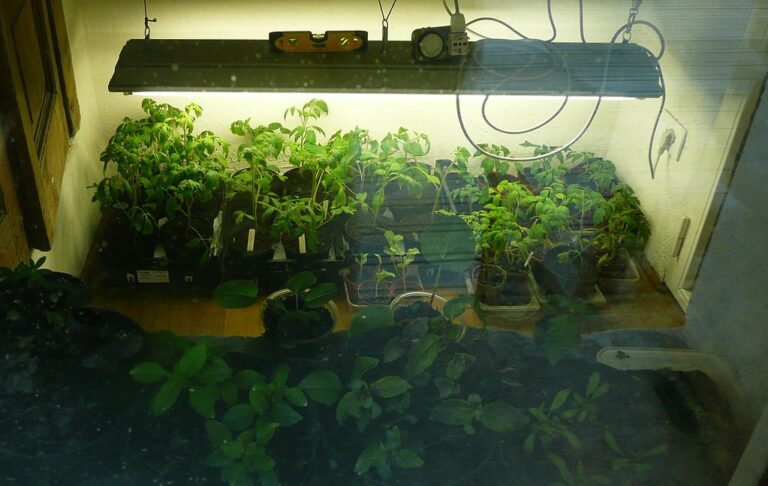
Penn State Extension explains that “tomatoes are unique in that any portion of the stem that touches the ground can root,” and recommends removing the lower leaves and planting 5 to 6 inches deep in the garden. It adds that horizontal or trench planting “is a good planting method if your plants are leggy.” The same habit lets you deal with leggy tomato seedlings indoors: each time you pot up, set the plant deeper so the stretched part of the stem is below the surface.
Do not assume every crop tolerates this. The rooting-along-the-stem habit is the reason the trick works for tomatoes. For other leggy seedlings, correct the light first, keep them at the same soil depth, and stake them if they need it. With fast crops such as lettuce, resowing under good light is often quicker than nursing a weak tray along.
Brushing and airflow: making leggy seedlings stronger
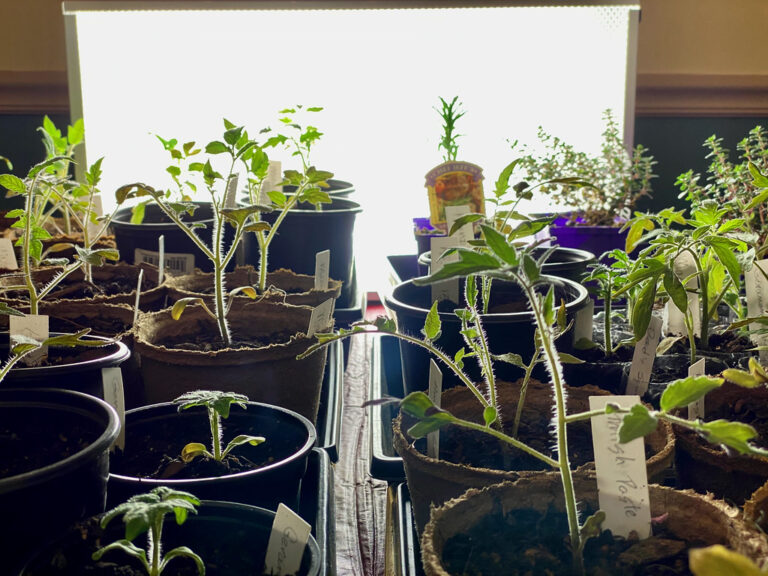
Seedlings respond to being touched or moved by growing shorter, thicker stems. Growers use this on purpose, and the numbers are well documented:
- The UConn Extension height-management fact sheet cites a Cornell recommendation of 10 to 40 strokes per day for tomato, starting when plants are about 2.5 inches tall, and reports height reductions of 20 to 50% with more uniform plants.
- For cucumber, the same sheet suggests brushing as soon as the seed leaves open and continuing for about 5 days.
- The New England Vegetable Management Guide reports that brushing twice a day for 18 days, with about 40 strokes back and forth, reduced stem elongation by as much as 30%. Plants resumed normal growth about 3 days after brushing stopped, so keep going until transplanting.
Brush only when the leaves are dry, since UConn notes that wet foliage can spread disease from plant to plant. A small fan that makes the seedlings sway gently is a hands-off option, and moving air also helps the surface of the mix dry, which is useful against the problems described in our guide to mold on microgreens.
How much light prevents leggy seedlings
“Close to the light” is useful advice, but light intensity is what the plant actually responds to. Purdue University’s Vegetable Crops Hotline gives daily light integral (DLI) targets for transplants:
| Crop group | Target DLI (mol/m²/day) | PPFD needed at 16 h/day | PPFD needed at 18 h/day |
|---|---|---|---|
| Lettuce, cabbage, cucumber, squash | 10–15 | 174–260 µmol/m²/s | 154–231 µmol/m²/s |
| Tomato, pepper, eggplant | 15–20 | 260–347 µmol/m²/s | 231–309 µmol/m²/s |
The PPFD columns are calculated with the standard conversion DLI = PPFD × hours × 0.0036. Purdue notes that seedlings at a good DLI have “compact growth with short and thick hypocotyls,” while low DLI gives “stretched and weak hypocotyls.” It also points out that natural spring DLI ranges from about 5 to 25 mol/m²/day across most of the United States, which is why a windowsill in March so often produces leggy seedlings.
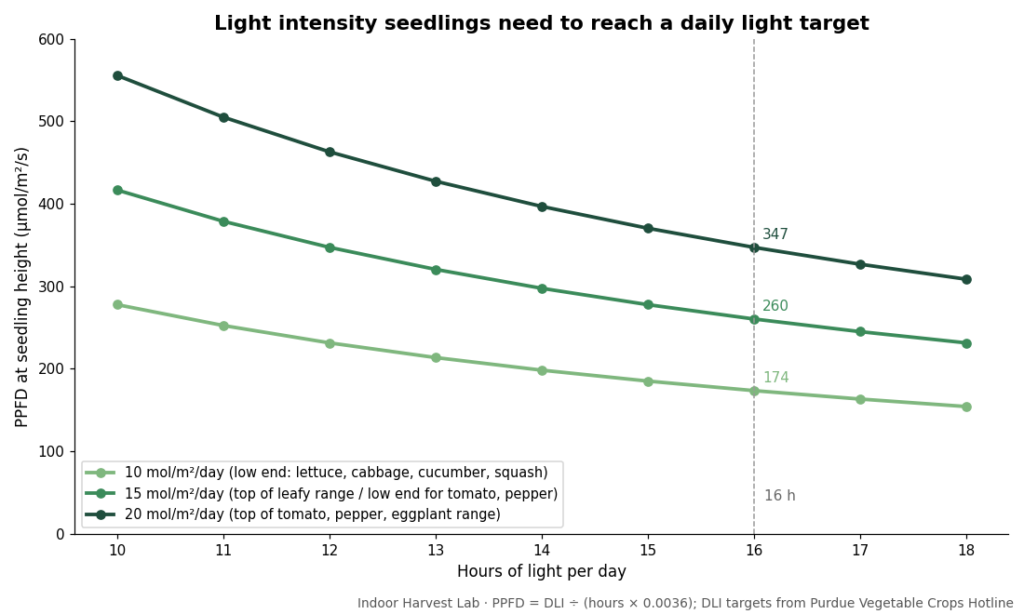
If you do not own a light meter, use the distance guidance from UMN and Illinois Extension as your starting point and watch the plants. Short internodes, deep green leaves and no leaning mean the light is right; new leggy seedlings mean it is still too dim. Pale, bleached patches on the top leaves mean it is too close or too strong.
Does light colour matter?
Yes, but less than intensity. In a study of tomato seedlings under different red and blue LED mixes, Hernández, Eguchi, Deveci and Kubota (2016, Scientia Horticulturae) found that hypocotyl length decreased as the blue share rose, up to 75% blue, and that plants under 30% blue were 42% more compact than under 10% blue. The authors rated 30 to 50% blue as the best spectrums for tomato seedlings. Most white LED grow lights sold for seed starting include a blue share, so choosing a brighter fixture, not a different colour, is usually the bigger win.
Temperature tricks for shorter seedlings
Commercial transplant growers control height with temperature as well as light. The principle, often called DIF, is that warmer days than nights promote stretch, and cooler days give more compact plants. The practical version is a short cool period at the start of the day:
- The New England Vegetable Management Guide says the critical window is the first 2 to 3 hours after sunrise, starting about 30 minutes before, and that lowering the temperature “by a few degrees” then helps manage height.
- UConn Extension suggests lowering morning temperatures by 5 to 10 °F at dawn, then returning to daytime temperatures of 60 to 70 °F.
Indoors under lights, the same logic applies to the start of the light period, so a cooler room in the first hours after the lamps switch on can help. Crops differ in how much they respond: the New England guide lists tomato, brassicas, eggplant and melon as very responsive, and squash, cucumber and pepper as much less so. Avoid chilling: UConn warns that tomatoes held below 60 °F can develop deformed fruit later.
Mistakes to avoid with leggy seedlings
- Adding more fertiliser to “feed” a weak plant. Leggy seedlings are short of light, not food. UConn notes that growers use low phosphorus feeding to keep tomato transplants compact, so a rich feed can make stretch worse.
- Leaving trays under a dome and on a heat mat after emergence. This is the fastest route to tall, pale stems.
- Relying on a window alone in late winter. The light is too weak and too short, and the plants will lean.
- Raising the lights too early. Move the fixture up only as the plants grow, keeping the same gap to the top leaves.
- Sowing a pinch of seed in every cell and never thinning. Crowded cells give leggy seedlings.
- Brushing wet plants. It can spread disease through the tray.
- Using growth regulators at home. Commercial products such as Sumagic carry strict label limits and are not needed on a home tray.
Where this applies
The light numbers in this guide are for seedlings grown indoors under electric lights, where you control the whole light supply. On a windowsill or in a small greenhouse, the outdoor season decides how much help you need: Purdue notes that greenhouse structures can cut light transmission by up to 60%, and winter and early spring days are short at higher latitudes. Growers nearer the equator or starting seeds in late spring may get enough daylight in a bright, unshaded spot, while anyone starting peppers and tomatoes in mid-winter should plan on lights.
Temperature advice is the same everywhere: the warmer the room, the more light seedlings need to stay compact. If you start seeds for a hydroponic system, the same rules apply before the plants go into the reservoir; see our hydroponic EC chart for gentle starting nutrient levels and our Kratky method guide for a simple system to move them into. More seed-starting articles are collected in the leggy seedlings category.
FAQ
Will leggy seedlings survive?
Many do, especially if the light is fixed early and the stems are strengthened before transplanting. Very thin, collapsed seedlings are weaker and more prone to damping-off, so resowing is sometimes the better choice.
Can you fix leggy seedlings by burying them?
For tomatoes, yes: they root along the buried stem, so potting up deeper hides the stretch and adds roots. For other crops, fix the light and support the stem instead.
How far should a grow light be from seedlings?
UMN Extension recommends 4 to 6 inches, moved up as the plants grow. Illinois Extension suggests 2 to 4 inches for fluorescent tubes. Very powerful LED fixtures may need more distance; follow the maker’s guidance and watch for bleaching. Our grow light distance guide compares the published advice for each light type.
Do fans prevent leggy seedlings?
A fan helps by moving the plants, which works like brushing and gives thicker stems. It does not replace light: leggy seedlings under a fan but in dim light will still stretch.
Related guides: How Many Hours of Light Do Seedlings Need? (14–16 Is the Sweet Spot)
Sources
- University of Minnesota Extension. Lighting for indoor plants and starting seeds.
- Hoidal, N. University of Minnesota Extension. Troubleshooting seedling issues.
- University of Illinois Extension. What’s wrong with my seedlings? Troubleshooting seed starting problems (2022).
- West Virginia University Extension. Common abiotic and biotic problems encountered in indoor-grown seedlings and transplants.
- Purdue University Vegetable Crops Hotline. Managing daily light integral to improve vegetable transplant quality.
- Huber, B.M., Louws, F.J., Hernández, R. (2021). Impact of different daily light integrals and carbon dioxide concentrations on the growth, morphology, and production efficiency of tomato seedlings. Frontiers in Plant Science 12:615853.
- Hernández, R., Eguchi, T., Deveci, M., Kubota, C. (2016). Tomato seedling physiological responses under different percentages of blue and red photon flux ratios using LEDs and cool white fluorescent lamps. Scientia Horticulturae 213: 270–280.
- New England Vegetable Management Guide (UMass Amherst and partners). Plant culture and height management.
- UConn Extension. Managing plant height of vegetable transplants (2020).
- Penn State Extension. Tomatoes: from seedlings to fruit.
Featured image: “leggy seedlings” by bellemarematt, CC BY-SA 2.0.