
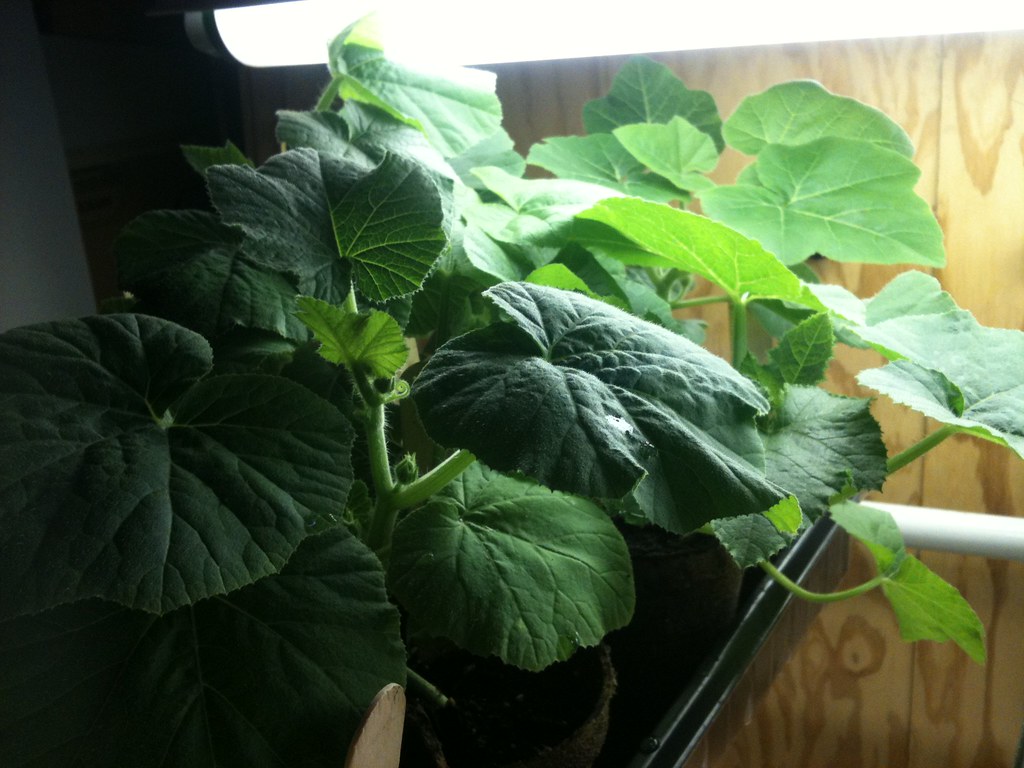
Short answer: most vegetable and flower seedlings do best with 14 to 16 hours of light per day under grow lights, followed by 8 to 10 hours of darkness. Extension services give ranges from 12 to 18 hours of light, and none recommend running lights 24 hours. The hours of light only work if the light is bright enough: a weak lamp needs far more time to deliver the same daily dose as a strong one.
That last point is why two growers can follow the same timer setting and get very different seedlings. This guide explains the numbers behind the advice, shows how to convert light intensity and time into a daily light total, and gives a simple schedule you can set on a plug-in timer today.
Table of Contents
How many hours of light do seedlings need?
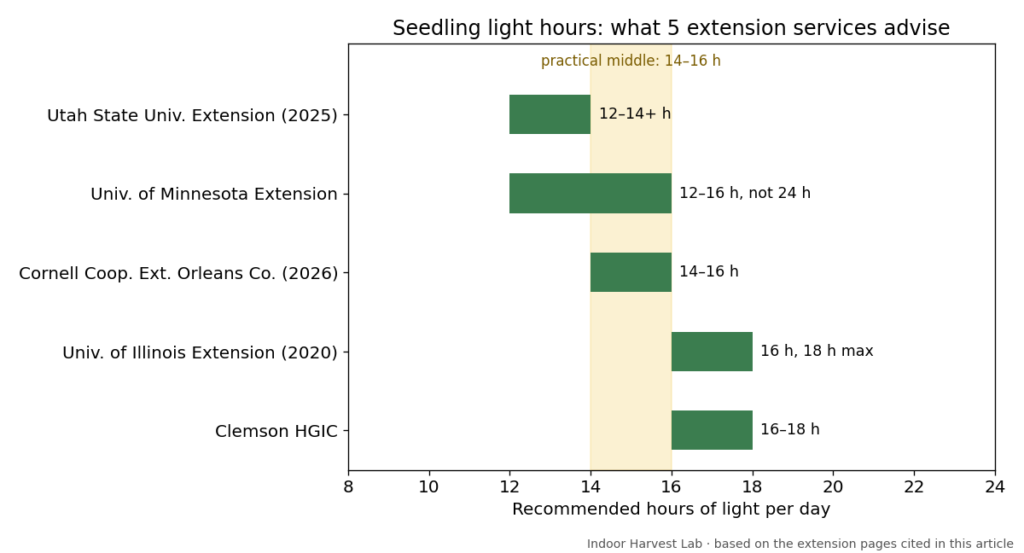
Five university extension services give overlapping answers. University of Minnesota Extension says plants need 12 to 16 hours of light daily and warns not to leave lights on continuously, because many plants need a dark period each night to develop properly. Cornell Cooperative Extension of Orleans County gives 14 to 16 hours. Utah State University Extension says an actively growing seedling benefits from 12 to 14 or more hours of light each day.
At the upper end, Clemson’s Home & Garden Information Center says indoor transplants need 16 to 18 hours of bright light, counting natural and artificial light together. University of Illinois Extension (Christopher Enroth, 2020) runs 16 hours of supplemental light and treats 18 hours as the maximum for seedlings.
Put together, the practical middle is 14 to 16 hours, with 16 hours the most common single setting. Go toward 16 to 18 hours when your fixture is modest or sits farther from the plants, and toward 14 when the light is strong and close.
Seedlings still need a dark period
Every one of these recommendations leaves room for darkness. A 16-hour setting gives 8 hours of night, which matches how most gardeners run a timer: lights on in the early morning, off in the late evening. The dark hours are part of the schedule, not wasted time.
Why hours of light depend on light intensity
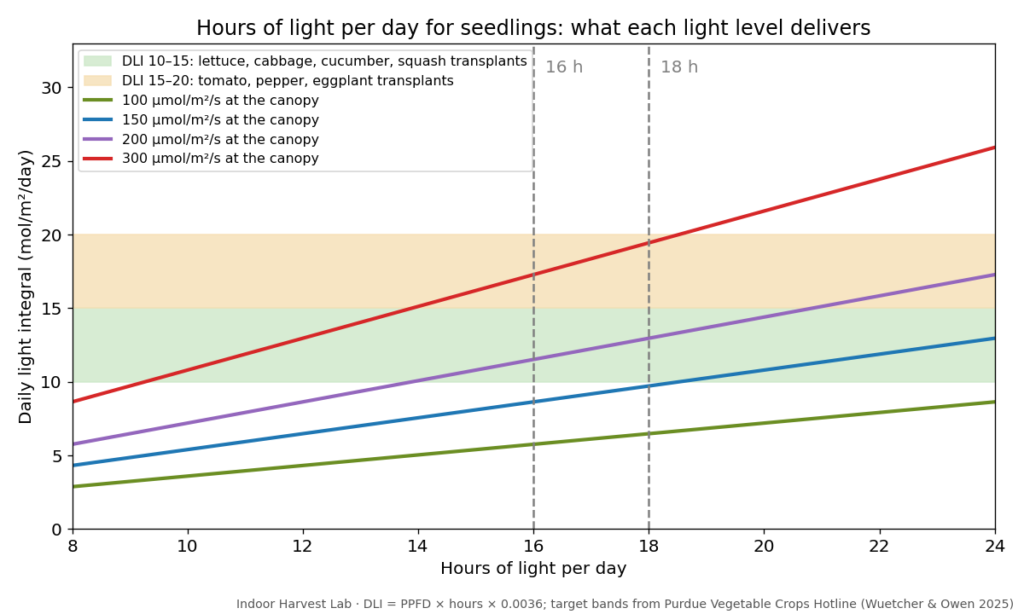
Plants respond to the total amount of light they collect in a day, called the daily light integral (DLI), measured in moles of light per square meter per day (mol/m²/day). DLI is simply intensity multiplied by time. If you know the photosynthetic photon flux density (PPFD, in µmol/m²/s) at leaf level, the conversion is:
DLI = PPFD × hours of light × 0.0036
The 0.0036 factor converts seconds to hours and micromoles to moles (3,600 seconds per hour divided by 1,000,000). Purdue Extension’s DLI bulletin (HO-238) uses the same arithmetic for a full 24-hour day, where the factor is 0.0864.
| PPFD at the canopy (µmol/m²/s) | 12 hours of light | 14 hours | 16 hours | 18 hours |
|---|---|---|---|---|
| 100 | 4.3 | 5.0 | 5.8 | 6.5 |
| 150 | 6.5 | 7.6 | 8.6 | 9.7 |
| 200 | 8.6 | 10.1 | 11.5 | 13.0 |
| 250 | 10.8 | 12.6 | 14.4 | 16.2 |
| 300 | 13.0 | 15.1 | 17.3 | 19.4 |
The table shows why extra hours cannot fully rescue a dim fixture. At 100 µmol/m²/s, even 18 hours delivers only 6.5 mol/m²/day. At 250 to 300 µmol/m²/s, 14 to 16 hours of light already reaches the range recommended for vegetable transplants.
The UNH example: same target, very different hours of light
UNH Extension’s fact sheet on growing seedlings under lights works through exactly this problem using a target of 12 mol/m²/day. To hit it, fluorescent shop lights needed 22 hours per day, a high-quality horticultural LED needed about 10 hours, and a commercial LED light bar needed 8 hours when mounted 8 inches above the crop but 16 hours when raised to 20 inches. Distance changes the required hours of light as much as the choice of lamp does. Our guide to grow light distance for seedlings covers the height side of that equation.
Hours of light by crop
Crops differ in how much daily light they need. In a 2025 Purdue Vegetable Crops Hotline article, Lark Wuetcher and W. Garrett Owen list target DLIs for vegetable transplants: 10 to 15 mol/m²/day for lettuce, cucumber, squash and cabbage, and 15 to 20 for eggplant, pepper and tomato. The table below turns those targets into hours of light at three common intensities.
| Crop group | Target DLI (mol/m²/day) | Hours at 150 µmol/m²/s | At 200 | At 300 |
|---|---|---|---|---|
| Lettuce, cabbage, cucumber, squash | 10–15 | 18.5–28 (too long) | 14–21 | 9–14 |
| Tomato, pepper, eggplant | 15–20 | 28–37 (not possible) | 21–28 (too long) | 14–18.5 |
Two lessons follow. Leafy crops and cucurbits can reach their target at a moderate 200 µmol/m²/s with 14 to 16 hours. Tomatoes and peppers need a brighter setup, roughly 300 µmol/m²/s at the leaves, if you want to stay within 16 to 18 hours. If your light cannot do that, lower it closer to the plants rather than running it longer than 18 hours. Starved tomato seedlings stretch, as explained in our guide to leggy seedlings.
Do seeds need light to germinate?
Most do not. Penn State Extension notes that most seeds germinate best in darkness, and some, such as Phacelia and onion-family (Allium) seeds, can even be inhibited by light. A smaller group, including begonia, primula and coleus, needs light to germinate and should be pressed onto the surface rather than covered.
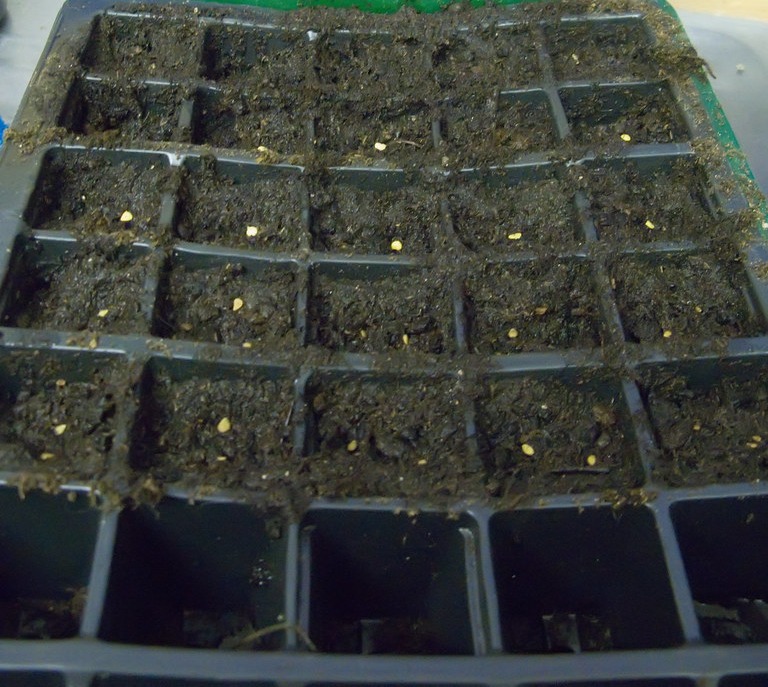
For most vegetables, then, the hours of light only start to matter at emergence. Keep sown trays warm and moist, check them daily, and switch the timer on the day the first seedlings break the surface. A delay of even a day or two in low light is enough to start stretching.
Can you leave grow lights on 24 hours?
You can, but you should not. Minnesota Extension advises against continuous light for seedlings, and research on tomato explains why. Tomato is one of the species known to suffer “continuous light injury”: leaves turn pale and mottled (chlorosis) and can curl downward (epinasty).
- Pham and Chun (2020, Scientia Horticulturae 269) grew tomato seedlings for 14 days under continuous light. Raising the constant light intensity increased leaf curling. Varying the intensity through the 24-hour day, rather than keeping it constant, reduced the chlorosis. The authors concluded that disruption of the plant’s daily rhythm, rather than sugar build-up, drives the injury.
- A 2024 study in Frontiers in Plant Science lists tomato and eggplant among photoperiod-sensitive species, notes that cucumber is more tolerant, and reports that continuous light reduces the leaf area and height of young transplants, producing an overly compact plant.
For a home grower the takeaway is simple: 24 hours of light adds electricity cost and risk, while a stronger or closer light at 16 hours gives the same daily total without the injury.
Window light versus grow lights
A sunny window can supply part of the day’s light, but not a reliable amount. Clemson’s 16 to 18 hours counts natural and artificial light together, so a south window plus a lamp in the evening is acceptable. The trouble is that window light comes from one side, falls off sharply a short distance from the glass, and varies with cloud cover. Seedlings on a sill lean and stretch toward the glass even when the day length looks long enough.
If you rely on a window, turn trays daily and add a lamp for the hours before sunrise or after sunset to reach a 16-hour day. If you use grow lights, the window becomes a bonus rather than the plan.
How to set the hours of light for seedlings: step by step
- Wait for emergence. Most vegetable seed needs warmth, not light. Turn the lights on the day the first seedlings appear.
- Buy a plug-in timer. Utah State Extension recommends an inexpensive wall timer so the schedule is the same every day without manual switching.
- Start at 16 hours on, 8 hours off. For example, lights on at 6:00 and off at 22:00. This is the midpoint of the extension recommendations.
- Set the height before you adjust the hours. Follow the fixture guidance in our grow light distance guide. Lamps that are too high cost more light than any extra hours can replace.
- Check intensity if you can. A PPFD meter or a phone-app estimate at leaf height lets you use the table above. Aim for roughly 200 µmol/m²/s or more for leafy crops and about 300 µmol/m²/s for tomatoes and peppers at 16 hours of light.
- Watch the plants for 5 to 7 days. Long, pale stems mean too little light: lower the lamp first, then extend toward 18 hours. Bleached or scorched leaf tops under a strong LED mean too much: raise the lamp or drop to 14 hours.
- Keep the schedule until transplanting. Keep the same timer until the plants go outside; hardening off then introduces them gradually to full sun.
Mistakes to avoid
- Running lights 24 hours. It is not recommended by extension services, and tomato and eggplant are prone to continuous light injury.
- Using hours to compensate for a distant lamp. As the UNH example shows, raising a fixture from 8 to 20 inches doubled the time needed. Lower the lamp instead.
- Switching lights on and off by hand. Missed evenings and irregular days add up. A timer costs little and removes the guesswork.
- Waiting too long after emergence. Seedlings under a dome in a dark room start stretching within a day or two of germination.
- Trusting a window in winter. Short, cloudy days and side lighting rarely add up to 14 to 16 useful hours.
- Judging a lamp by watts alone. Watts measure electricity used, not light delivered. The hours of light you need depend on the PPFD at leaf level.
Where this applies
These hours of light are for seedlings raised indoors under electric light, which is how most home gardeners start tomatoes, peppers, brassicas and flowers in late winter and early spring. The recommendations above come from U.S. extension services, but the physics of DLI is the same everywhere.
Your location mostly changes how much the window contributes. Far from the equator, winter days are short and the sun is low, so seedlings depend almost entirely on the lamp. Closer to the equator, day length stays near 12 hours all year, and a bright window can supply more of the total, although it still lights plants from one side. Greenhouse growers work with a different problem, supplementing variable sunlight, and usually manage DLI directly rather than fixed hours of light.
Microgreens follow a different light plan again because they are harvested within days; see our guide to growing microgreens without soil. More seed-starting lighting guides are collected in our grow lights category.
FAQ
Do seedlings need darkness at night?
Yes. Minnesota Extension advises against continuous light because many plants need a dark period to develop properly. A 16-hour-on, 8-hour-off schedule is the usual choice.
How many hours of light do tomato seedlings need?
Tomato seedlings do well with 16 hours of light, and no more than 18, under a light bright enough to reach roughly 15 to 20 mol/m²/day, the range Purdue gives for tomato transplants. That works out to about 300 µmol/m²/s at 16 hours.
Is 12 hours of light enough for seedlings?
Twelve hours is the low end of the extension recommendations. It can work under a strong, close LED, but most home setups do better with 14 to 16 hours of light.
Can seedlings get too much light?
Yes. Continuous light can injure tomato and eggplant, and a very strong LED hung too close can bleach leaves. Keep a dark period and follow the fixture’s distance guidance.
Related guides: Microgreens Seeding Density Chart (Grams per 10×20 Tray)
Sources
- University of Minnesota Extension. Starting seeds indoors.
- Cornell Cooperative Extension of Orleans County (2026). From seed to seedling: what every indoor grower should know.
- Crump, W., Beddes, T., Caron, M. and Oliveira, M. (2025). Starting vegetable seeds indoors. Utah State University Extension.
- Clemson Cooperative Extension, Home & Garden Information Center. Starting seeds indoors.
- Enroth, C. (2020). Supplemental lighting for indoor seed starting. University of Illinois Extension.
- UNH Extension. Growing seedlings under lights (fact sheet).
- Wuetcher, L. T. and Owen, W. G. (2025). Managing daily light integral to improve vegetable transplant quality. Purdue Vegetable Crops Hotline.
- Torres and Lopez. Measuring daily light integral in a greenhouse (HO-238). Purdue Extension.
- Penn State Extension. Seed and seedling biology.
- Pham and Chun (2020). Growth and leaf injury in tomato plants under continuous light at different settings of constant and diurnally varied photosynthetic photon flux densities. Scientia Horticulturae 269.
- Frontiers in Plant Science (2024). Tomato and mini-cucumber tolerance to photoperiodic injury involves photorespiration and the engagement of nighttime cyclic electron flow from dynamic LEDs.
Featured image: “Pumpkin Vine Seedlines Under Grow Lights I” by apple_pathways, CC BY 2.0.