
You sowed a pinch of basil seed three weeks ago and tucked the seedlings into a jar of nutrient solution on the counter. The roots have reached the water and look clean and white. But the plants seem stuck: a few pale leaves, long gaps between them, nothing like the dense, glossy bunches you get in a clamshell at the supermarket. Is it the pH? The nutrients? Did you buy the wrong system?
Short answer: Hydroponic basil is one of the most forgiving crops you can grow in water, and most slow plants are short of light or warmth, not nutrients. Hold the solution at pH 5.5–6.0 and EC 1.0–1.6 mS/cm (Oklahoma State University Extension), keep the air at 70–84°F (21–29°C), and give the plants a strong grow light for about 16 hours a day. In university trials basil yielded the same from EC 0.5 to 4.0 and from pH 4.5 to 6.5, but about four times more in a bright, warm greenhouse than under modest indoor light.
By the end of this guide you’ll know which system suits basil at home, the exact numbers to hold, how to go from seed to first harvest in about six weeks, how far apart to space plants, and how to read the handful of problems that actually stop basil in water.
Why hydroponic basil is the easiest herb to start with
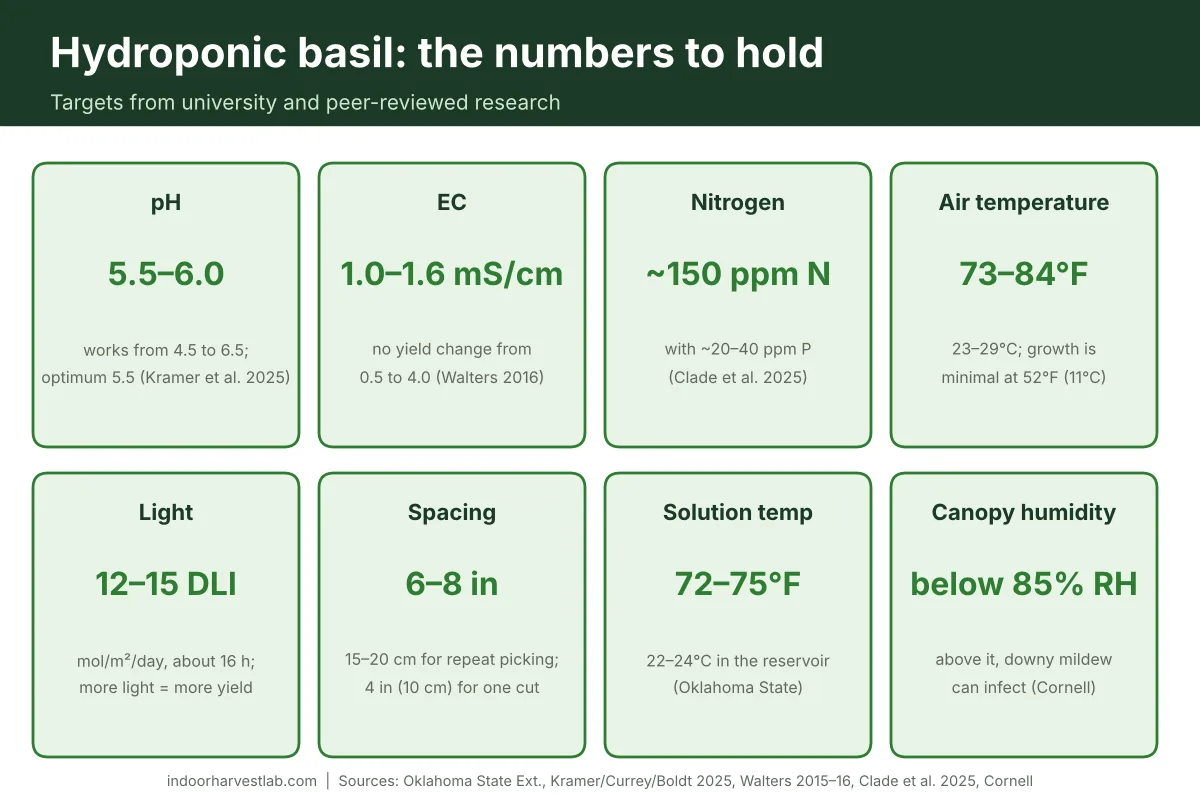
Here’s something that surprises most beginners: basil barely cares which hydroponic system you choose. Researchers at Iowa State University grew 35 basil cultivars side by side in nutrient film technique (NFT) channels and deep-flow (raft) systems. Plants in the deep-flow system averaged just 2.6 grams more fresh weight each, and the authors concluded that yield depends more on the cultivar than on the system (Walters and Currey 2015, HortTechnology, via ASHS).
That matches what extension educators see in home setups. A University of Illinois Extension horticulture educator reported that basil “did exceptionally well” in a simple home system, while fruiting crops like tomatoes are unlikely to thrive in the same setup (Illinois Extension 2020). University of Florida extension lists basil among the leafy greens and herbs that work best in the passive Kratky method, which needs no pump at all (UF/IFAS Extension 2025).
Which system should you use at home?
| System | What it is | Best for | Watch out for |
|---|---|---|---|
| Kratky jar or tote | Still solution, no pump; roots follow the falling water level and an air gap forms | One to four plants on a counter or shelf; the cheapest start | Clear jars grow algae: UF/IFAS says to use a dark container or cover clear ones with foil or paint |
| Deep water culture (DWC) | Roots hang in aerated solution; an air pump runs all the time | A tote of 4–8 plants you harvest for months | Pump failure and warm solution in summer |
| NFT channel | A thin film of solution flows past the roots | Many plants in a row along a wall or rack | A stopped pump dries roots quickly |
| Countertop pod garden | Small reservoir, built-in light and pump | Convenience; a few plants at a time | Low-output lights and a small reservoir limit plant size |
If you want one recommendation for hydroponic basil at home: start with a light-proof Kratky jar or a small aerated tote, and put the money you save into a good light.
Hydroponic basil pH, EC and nutrients: the numbers to hold
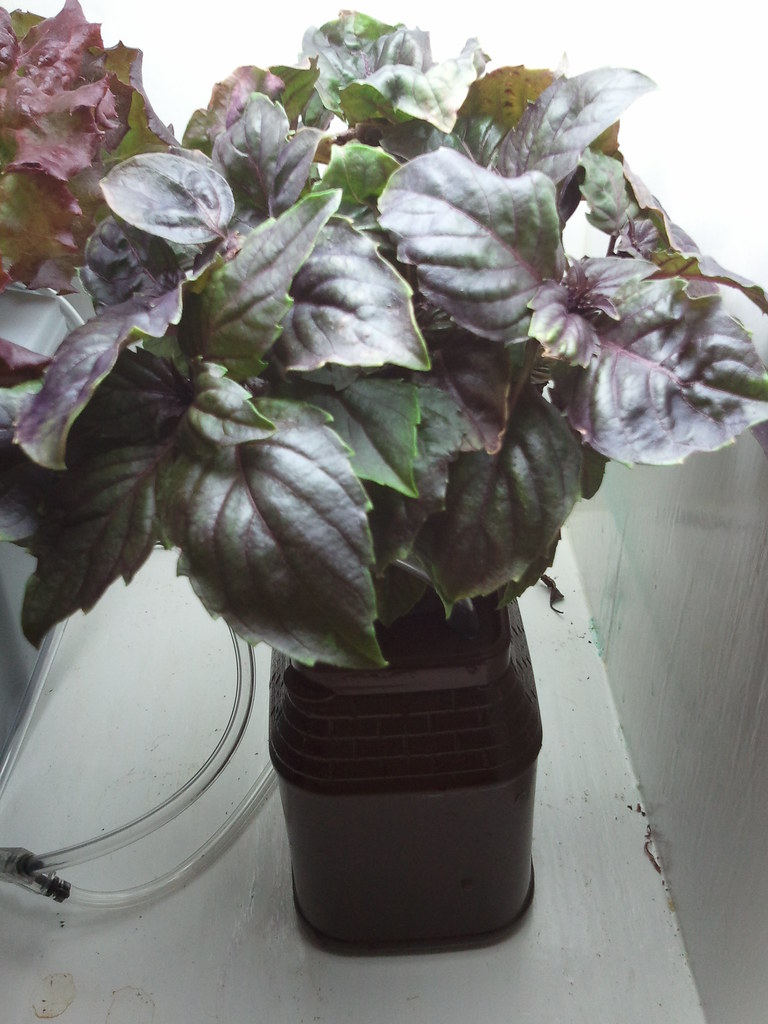
Type “hydroponic basil nutrient requirements” into a search bar and you’ll find tables that disagree by a factor of two. The research explains why: basil tolerates a very wide range, so many different recipes “work”. The table below gives a sensible target for hydroponic basil and shows how much room you really have on either side.
| Factor | Target to hold | What the research found | Source |
|---|---|---|---|
| Solution pH | 5.5–6.0 | Shoot growth of ‘Nufar’ basil was unaffected from pH 4.5 to 7.0, but roots were shorter at 4.5 and 7.0; the authors set 5.5 as optimum with a workable range of 4.5–6.5 | Oklahoma State; Kramer, Currey and Boldt 2025 |
| EC | 1.0–1.6 mS/cm | No significant growth difference between EC 0.5, 1, 2, 3 and 4 mS/cm in NFT | Oklahoma State; Walters 2016 |
| Nitrogen | About 150 ppm N | 150 mg/L N recommended for visually healthy plants | Clade et al. 2025, HortScience |
| Phosphorus | 20–40 ppm P | 40 mg/L P was optimal; the authors add that growers may consider 20 mg/L | Clade et al. 2025 |
| Potassium | About 100 ppm K | Greatest dry mass at 96 mg/L K; 300 and 450 mg/L gave 19% and 29% less | Clade et al. 2025 |
| Solution temperature | 72–75°F (22–24°C) | Stated as the optimal water temperature for hydroponic solutions | Oklahoma State |
| Air temperature | 70–84°F (21–29°C) | Growth rose in a straight line from 52°F to 84°F and dipped slightly at 95°F | Greenhouse Grower basil series |
| Light | DLI 12–15 mol/m²/day (about 210–260 µmol/m²/s for 16 hours) | Growth was higher at a DLI of about 15 than at about 7 in every species tested | Walters 2016 |
| Canopy humidity | Below 85% RH | The downy mildew pathogen needs wet leaves or at least 85% humidity in the canopy to infect | McGrath, Cornell 2021 |
EC: hydroponic basil forgives a lot, but stay out of the extremes
In the Iowa State EC trial, sweet, holy and lemon basil all grew the same whether the solution sat at 0.5 or 4.0 mS/cm. What did change was what ended up in the leaves: nitrogen, phosphorus and sulfur rose as EC rose, while calcium and magnesium fell (Walters 2016). A later herb-nutrition primer that cites the Iowa State work advises avoiding both ends anyway, because a very weak solution can drift into nutrient imbalance more quickly (Produce Grower 2024).
For a home reservoir, that points to the middle: mix to about 1.0–1.6 mS/cm and don’t panic if it reads 1.9 after a hot week. If you’re not sure how your meter’s ppm reading maps onto EC, the hydroponic EC chart has the conversions.
pH: aim for 5.5, check it weekly
Two independent studies make the same point. At Ohio State, ‘Nufar’ basil in deep water culture grew just as well at pH 4.0 as at 5.5 over three weeks (Gillespie, Ohio State University). At Iowa State and USDA-ARS, basil shoots weighed the same from pH 4.5 to 7.0, though roots were shorter at both ends (Kramer, Currey and Boldt 2025).
So why bother holding 5.5–6.0? Two reasons. First, the Iowa State team replaced about a third of their solution every week, and they caution that growers who change solution less often may see growth suppressed above pH 6.0–6.5. Second, a small home reservoir drifts faster than a 66-gallon research tank. A weekly check and a small correction is cheap insurance.
Magnesium: the one nutrient basil runs short of
The Produce Grower primer notes that magnesium deficiency is fairly common in basil, because the crop has a higher-than-average magnesium requirement and the high calcium in many fertilizers suppresses magnesium uptake. If older leaves turn yellow between green veins while new growth looks fine, magnesium is the first suspect. The cal-mag guide explains how to correct it without overdoing calcium.
How to grow hydroponic basil step by step
The whole hydroponic basil cycle is short. In the studies behind this guide, seedlings were transplanted two to three weeks after sowing and cut three to four weeks after that. Here is the same sequence scaled down for a kitchen.
| Stage | Typical timing | Source |
|---|---|---|
| Sowing to transplant | 14–22 days | Walters 2016; Solis-Toapanta et al. 2020 |
| Transplant to first full harvest | 3–4 weeks | Walters 2015; Kramer et al. 2025 |
| First leaves you can pick | As early as 6 weeks after sowing | Solis-Toapanta et al. 2020 |
| Productive life with repeat harvests | At least 8 weeks in a small system | Solis-Toapanta et al. 2020 |
Step 1: Start seeds in a soilless plug
Sow basil in rockwool cubes, foam plugs or peat pellets and keep them warm. The University of Florida team germinated their basil at 73°F (23°C) and high humidity before moving it into hydroponics (Solis-Toapanta, Fisher and Gómez 2020). Sowing several seeds per plug is normal for basil: one university trial sowed six seeds per cell (Clade et al. 2025), which gives a bushy clump instead of a single stem.
Step 2: Transplant when roots show at the bottom of the plug
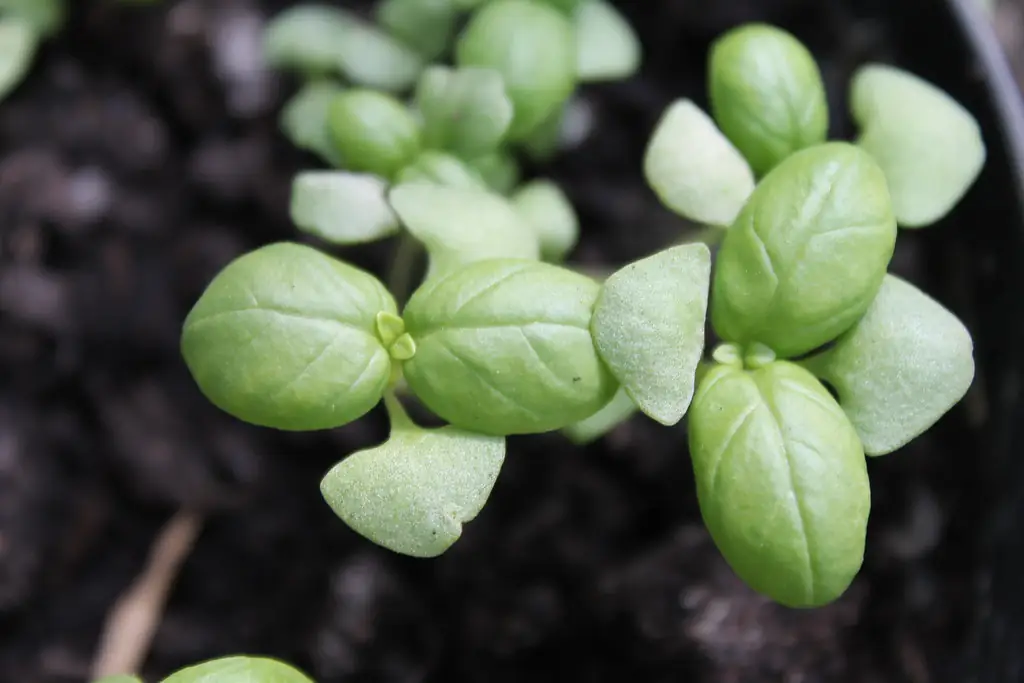
Researchers moved their seedlings at two weeks (Iowa State) to about three weeks (Florida) after sowing. At home, the practical signal is simple: the first true leaves are open and white roots are poking out of the plug. Set the plug in a net pot so its base just touches the solution.
Step 3: Mix the solution and set the pH
Use a complete hydroponic fertilizer, mixed to 1.0–1.6 mS/cm, then adjust to pH 5.5–6.0. A complete fertilizer matters more than the brand. The Florida study used one supplying 178 ppm nitrogen and kept pH between 5.5 and 6.5, and the 2025 HortScience nutrient trials recommend about 150 ppm nitrogen, so anything in that neighbourhood is on target.
Step 4: Give it real light for 16 hours
This is the step that separates supermarket-quality basil from a pale, stretched plant. The Iowa State trials ran 16-hour days, and growth was clearly higher at a daily light integral of about 15 than at about 7. To reach a DLI of 12–15 in 16 hours you need roughly 210–260 µmol/m²/s at the leaf tips. The PPFD chart shows how to check that against your light’s specifications.
Step 5: Top up, and replace the solution on a schedule
Plants drink water faster than they take up nutrients, so the level drops and the remaining solution gets stronger. Top up with plain water or weak solution between changes, and check EC before you add more fertilizer. Oklahoma State’s general guidance is to replace the nutrient solution every two weeks.
How strict do you need to be? In the Florida study, indoor systems that were never emptied, only topped up with fertilizer every two weeks, yielded the same as systems replaced every two weeks. But their EC climbed to 4.8 mS/cm by the end, with a peak of 5.5. Basil coped for eight weeks; it’s not a habit to copy for a plant you want to keep longer.
Step 6: Harvest by cutting above a pair of leaves
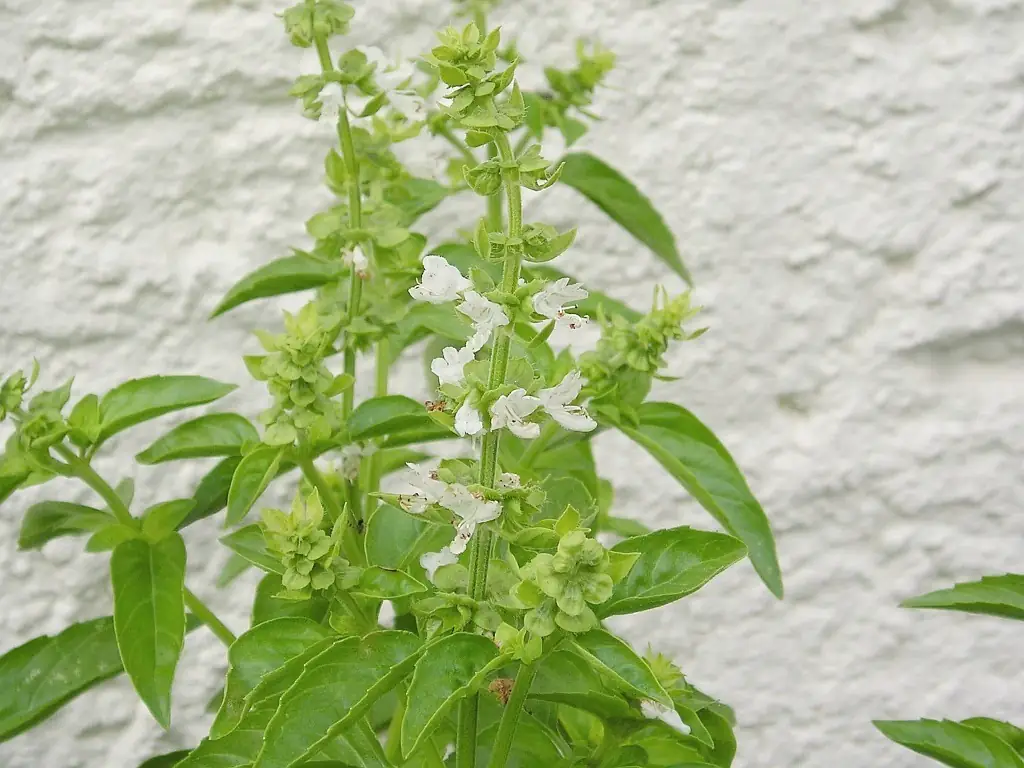
Once a stem has several pairs of leaves, cut it just above a leaf pair. The two buds at that node grow out as new shoots, which is how one plant keeps producing. Remove flower spikes as soon as they appear. The pinching routine is the same as for potted plants, and it’s laid out in detail in the guide to growing basil indoors.
Light and temperature decide your hydroponic basil yield
If you remember one chart from this article, make it the one below. The University of Florida team grew the same basil variety in the same small hydroponic systems in two places: indoors under LEDs at a DLI of 9 and a constant 70°F (21°C), and in a greenhouse at a DLI of 26.1 and about 84/75°F (29/24°C) day and night.
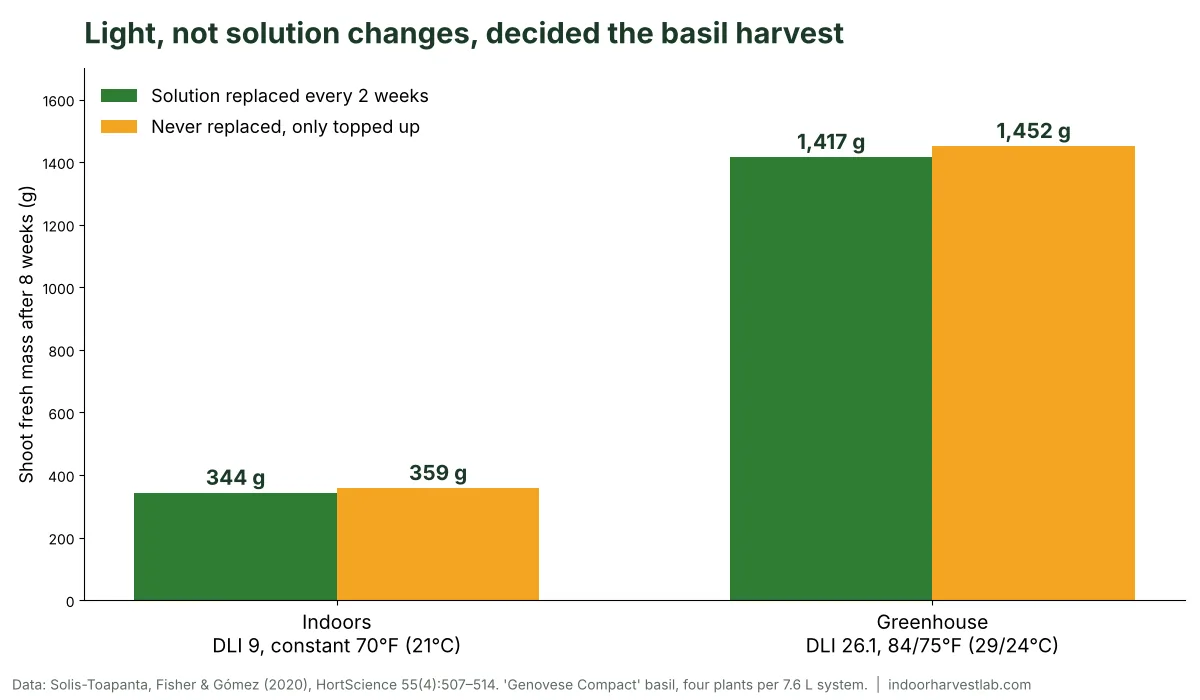
After eight weeks the indoor systems had produced about 344–359 g of fresh shoots and the greenhouse systems about 1,417–1,452 g. How the solution was managed made no difference within either location. Light and warmth made a fourfold difference between them (Solis-Toapanta, Fisher and Gómez 2020).
The indoor result is still a respectable harvest, and the authors note that basil will grow at a DLI as low as 4. But it tells you where to spend money: a stronger light will do more for hydroponic basil than any additive.
Keep basil warm, especially at night
Basil is a warm-season plant, and the temperature data are blunt. In growth-chamber trials at constant 52, 63, 73, 84 and 95°F, growth increased in a straight line from 52°F to 84°F. Sweet basil weighed about an ounce more at 84°F than at 52°F, growth at 52°F was minimal, and some plants showed visible cold damage (Greenhouse Grower basil series).
For a home grower in winter, that means keeping hydroponic basil off cold windowsills and away from draughty doors. A reservoir on a cold floor chills the roots even when the room feels comfortable.
There’s a trade-off at the warm end. In the same trials, nearly every plant flowered at 73°F and 84°F, while plants at 52°F showed little or no flowering. Warm basil grows fast and tries to flower fast, which is why regular cutting matters more in a warm room.
Spacing and varieties for hydroponic basil
How close can you plant hydroponic basil? Closer than you’d think, if you plan to cut everything at once. In Iowa State’s density trial, ‘Nufar’ sweet basil was set 4, 6, 8, 10 or 12 inches apart in a deep-flow system. Individual plants weighed the same at every spacing, so the tightest spacing gave the most basil per square foot (Walters 2015).
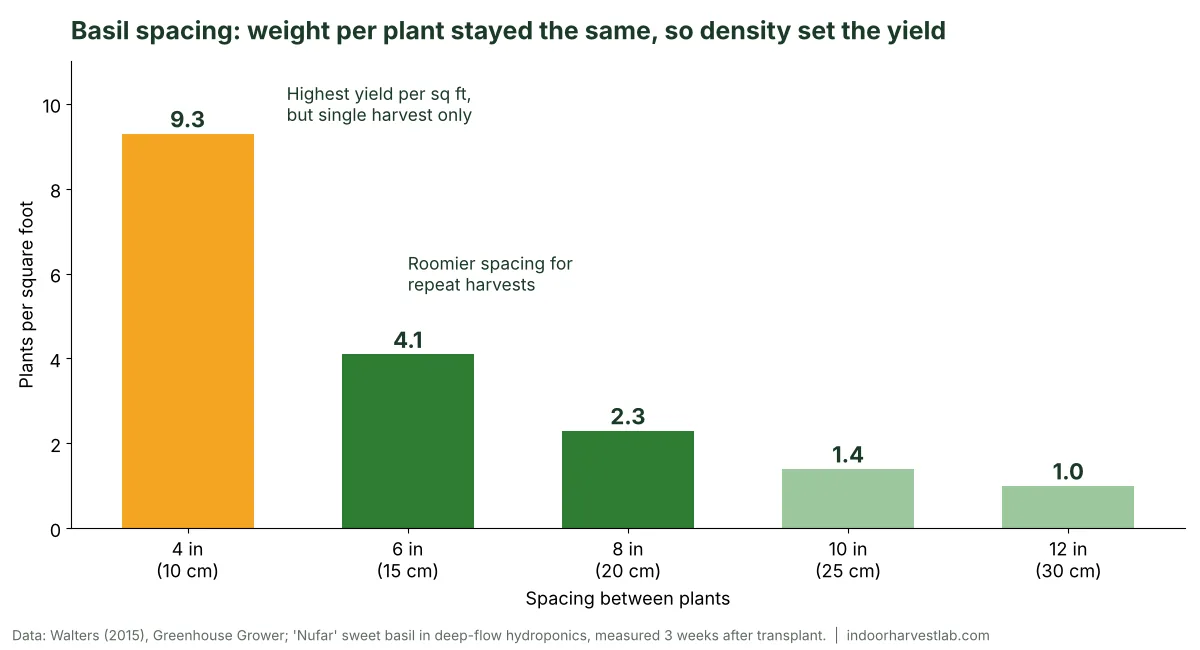
The catch is in the author’s own caveat: that result applies to single-harvest basil, and she suggests a 4-inch spacing would be too close for plants harvested several times (Walters 2015, Greenhouse Grower). A home plant you’ll cut for two months needs room to branch. Reasoning from the spacings tested, 6–8 inches (15–20 cm) between net pots is a sensible middle for repeat harvests.
Which basil types yield most in water?
In the 35-cultivar comparison, holy, lemon and sweet basil types gave moderate to high fresh weight; bush, cinnamon, large-leaf and Thai types were moderate; and purple cultivars yielded least (Walters and Currey 2015). If you want volume for pesto, grow a green sweet type. Purple basil is worth growing for colour, but plant more of it.
If downy mildew has ever wiped out your basil, choose a resistant variety from the start. Cornell lists Rutgers Devotion DMR, Obsession DMR, Passion DMR and Thunderstruck DMR as giving good to excellent suppression and Amazel and Prospera as highly suppressive, with Prospera Compact DMR suited to pots (McGrath, Cornell 2021).
Can you grow hydroponic basil from grocery store plants or cuttings?
Yes, and it’s the fastest way to start. A basil cutting placed in a cup of water on a windowsill “will produce roots in days or weeks at the most”, according to UC Master Gardeners (UC Agriculture and Natural Resources 2024). Cut just below a node, strip the lower leaves so none sit under water, and move the cutting into your system once it has a small brush of roots.
“Living basil” sold with its root ball attached is already a hydroponic plant. As a matter of reasoning, not a tested protocol, the kindest treatment is to rinse the roots, set them in a light-proof container of mild nutrient solution, and thin the crowded clump by harvesting the weakest stems first. Keep it out of the fridge: the temperature trials above show how badly basil takes to cold.
Hydroponic basil problems and how to fix them
Most hydroponic basil problems trace back to light, temperature, humidity or a neglected reservoir. Match what you see to the table, then make one change at a time so you can tell what worked.
| What you see | Most likely cause | What to do |
|---|---|---|
| Tall, pale plants with long gaps between leaves | Too little light | Lower the light or add a stronger one; aim for about 210–260 µmol/m²/s for 16 hours |
| Slow growth in winter, dark or damaged patches on leaves | Cold air or cold solution | Move off cold sills and floors; hold air at 70°F (21°C) or warmer |
| Older leaves yellow between green veins | Magnesium running short | Check EC and pH, refresh the solution, add a magnesium supplement if it persists |
| Yellow bands between the main veins, grey-purple fuzz underneath | Basil downy mildew | Remove the plant; lower humidity and add air movement; replant a resistant variety |
| Flower spikes forming, leaves getting smaller | Warm conditions and no pinching | Cut stems back above a leaf pair and remove every spike |
| Green slime on the plug or in the reservoir | Light reaching the solution | Cover clear containers and unused net-pot holes |
| Brown, slimy roots and wilting in wet solution | Low oxygen, warm solution, root disease | Refresh the solution, improve aeration, keep the reservoir near 72–75°F |
Downy mildew: the problem to take seriously
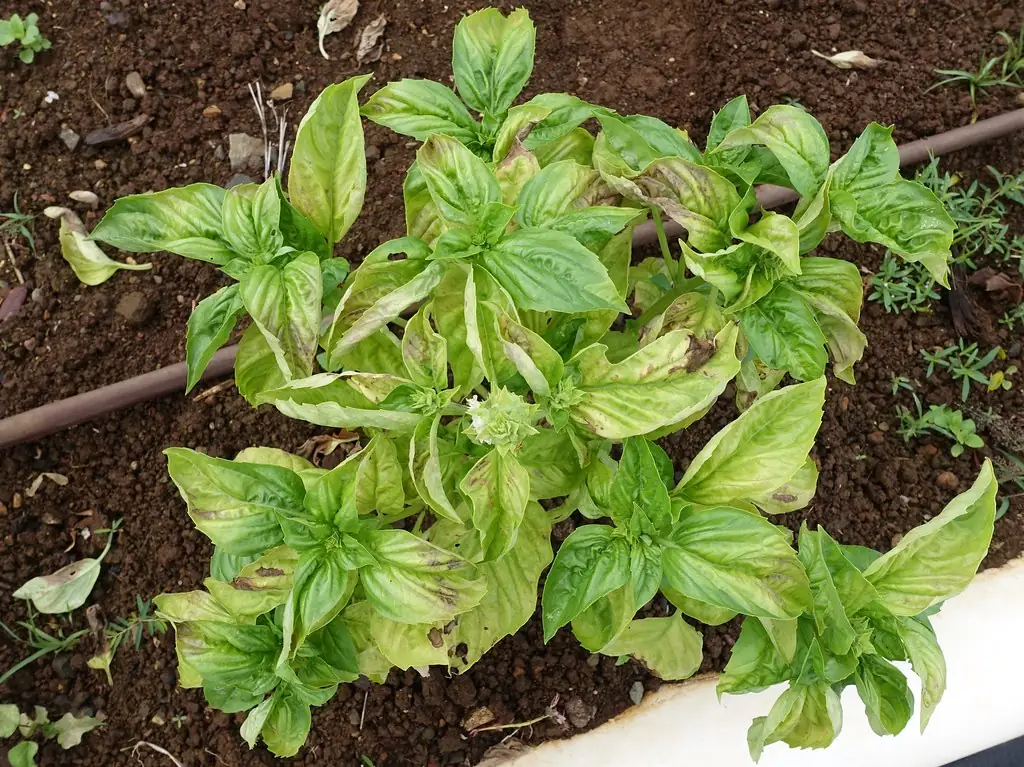
Downy mildew is the one disease that can end a hydroponic basil crop in days. The first sign is yellowing in bands bordered by the leaf veins; turn the leaf over and you’ll find fuzzy dark grey to purple growth (UMass Extension 2024). On wet leaves, spores can germinate within 2 hours and infect within 4, and symptoms follow 5–10 days later.
Humidity is the lever you control. The pathogen needs wet leaves or at least 85% relative humidity inside the canopy to infect (Cornell), and it produces spores at 50–78°F above 85% humidity (UMass). Space plants so air moves through them, run a small fan, and never mist basil. UMass suggests fans that switch on at 70% humidity and off below 65%, running at night in particular.
Cornell’s guidance for commercial growers is that there is no tolerance for any amount of this disease on fresh herbs and that affected plants should be destroyed. At home the same logic holds: bag and bin an infected plant instead of trying to nurse it, because it will seed spores onto every basil nearby.
From the lab bench
The pattern across these studies is unusually consistent, and it’s worth saying plainly. Hydroponic basil is hard to hurt with chemistry and easy to starve of energy. Solution strength could be changed eightfold and pH by two and a half units with no change in shoot weight. Light and temperature, on the other hand, moved yield every time they were tested.
That makes sense physiologically. A leafy herb harvested young is almost entirely new leaf tissue, and leaf tissue is built from carbon the plant fixes in the light. Nutrients only have to keep pace. When light is low, the plant takes up less water and fewer nutrients, which is exactly what the Florida team saw: indoor systems needed 7 refills against 22 in the greenhouse. Adding more fertilizer to a low-light plant doesn’t feed it; it just raises the EC of the water it isn’t drinking.
A useful rule of thumb follows from that. If your hydroponic basil is slow, check in this order: light at the leaf tips, air temperature at night, solution temperature, then pH and EC. Most problems are solved before you reach the meter.
One caution on the tolerance data. “No difference in shoot weight over three or four weeks” isn’t the same as “no difference over three months”. The pH trials found shorter roots at the extremes even when shoots looked the same, and the EC trial found calcium and magnesium falling in the leaves as EC rose. For a plant you intend to keep and cut repeatedly, the conservative middle of each range is the right place to sit.
FAQ
What pH and EC does hydroponic basil need?
Oklahoma State University Extension lists pH 5.5–6.0 and EC 1.0–1.6 mS/cm for basil. Research shows wide tolerance: shoot growth was unchanged from pH 4.5 to 7.0 and from EC 0.5 to 4.0 mS/cm, but the middle of each range is safest for plants you keep for months.
How long does hydroponic basil take to grow?
About six weeks from seed to the first pickable leaves. In university trials, seedlings were transplanted 2–3 weeks after sowing and harvested 3–4 weeks later. Plants in a small system kept producing for at least 8 weeks.
Can you grow hydroponic basil from grocery store basil?
Yes. Stem cuttings root in water within days to a few weeks, according to UC Master Gardeners. Cut below a node, strip the lower leaves and move the rooted cutting into your system. Living basil sold with roots can go straight into mild nutrient solution.
Does basil need an air pump in hydroponics?
Not always. University of Florida extension lists basil among the herbs that suit the passive Kratky method, where an air gap forms as the solution level drops. An air pump helps in a deep reservoir that you keep topped up to the same level.
How many hours of light does hydroponic basil need?
About 16 hours a day under a grow light, which is the day length used in the Iowa State basil trials. Aim for a daily light integral of 12–15 mol/m²/day, roughly 210–260 µmol/m²/s over 16 hours. More light gave more growth in every trial.
How far apart should hydroponic basil plants be?
For a single cut-everything harvest, 4 inches (10 cm) gave the highest yield per square foot in an Iowa State trial. For plants you harvest repeatedly, the author considered that too close; 6–8 inches (15–20 cm) leaves room to branch.
Why is my hydroponic basil turning yellow?
Pale new growth on stretched plants usually means too little light. Yellowing between green veins on older leaves points to magnesium, which basil needs in above-average amounts. Yellow bands bordered by veins with grey-purple fuzz underneath are downy mildew, and the plant should be removed.
For more herb guides, browse the indoor herbs category.
Sources
- Singh, H. and Dunn, B. Electrical Conductivity and pH Guide for Hydroponics. Oklahoma State University Extension.
- Kramer, H. L., Currey, C. J. and Boldt, J. K. (2025). pH optima: Determining the optimal pH for hydroponic herb production in controlled environments. Produce Grower, September/October 2025.
- Gillespie, D. P. Influence of nutrient solution pH on hydroponic basil (Ocimum basilicum) plant growth and nutrient content. The Ohio State University, Department of Horticulture and Crop Science.
- Walters, K. J. (2016). Managing Electrical Conductivity (EC) for Hydroponic Basil Production. Greenhouse Grower, 14 January 2016.
- Walters, K. J. (2015). Increase Planting Densities to Increase Hydroponic Basil Yields. Greenhouse Grower, 26 December 2015.
- Managing Air Temperatures for Basil Growth and Development. Greenhouse Grower (final article in the four-part hydroponic basil series).
- American Society for Horticultural Science (2015). Best basil varieties for hydroponic greenhouse production. News release on Walters, K. J. and Currey, C. J., HortTechnology, October 2015.
- Solis-Toapanta, E., Fisher, P. and Gómez, C. (2020). Growth Rate and Nutrient Uptake of Basil in Small-scale Hydroponics. HortScience 55(4):507–514.
- Clade, D., Veazie, P., Boldt, J., Hicks, K., Currey, C., Walters, K., Flax, N., Owen, W. G. and Whipker, B. (2025). Nutrient Disorder Symptomology and Refining Leaf Tissue Nutrient Standards of Basil (Ocimum basilicum L.). HortScience 60(11):1860–1874.
- Fresh-cut culinary herb production: mineral nutrients in hydroponic systems. Produce Grower, September 2024.
- McGrath, M. T. (updated 2021). Managing Basil Downy Mildew in the Greenhouse. Cornell University, Cornell Vegetables.
- Scheufele, S. B., Wick, R. L. and Dicklow, M. B., updated by Madeiras, A. (2024). Basil Downy Mildew. UMass Extension Vegetable Program.
- Rezazadeh, A. (2025). Kratky Hydroponic Method: A Simple Way to Grow Plants Without Soil. UF/IFAS Extension St. Lucie County.
- Enroth, C. (2020). Hold on to summer with home hydroponics. University of Illinois Extension.
- Farr, J. (2024). Plant Propagation for Home Gardeners: A Comprehensive Guide. UC Master Gardeners of Alameda County, UC Agriculture and Natural Resources.