
It’s the middle of winter, the shops want a small fortune for three limp heads of baby bok choy, and you have a sunny windowsill or a spare shelf with a grow light. You wonder whether this crisp, fast Asian green could actually grow inside. It can, and it’s one of the quickest leafy crops you can raise at home.
Short answer: You can grow bok choy indoors in a pot or a simple hydroponic container if you keep it cool (about 64–68°F / 18–20°C is ideal), give it 15–18 hours of LED light, and never let seedlings sit below 50°F (10°C). Baby leaves are ready in about four weeks, and full heads in roughly 40–50 days.
Bok choy (pak choi, Brassica rapa subsp. chinensis) suits indoor growing because it’s compact, grows fast and doesn’t need pollination. Its one weakness is bolting: under stress it runs to flower and turns bitter. By the end of this guide you’ll know the exact numbers to aim for, how to sow and feed it in soil or water, how to stop bolting, and when to harvest so it stays sweet.
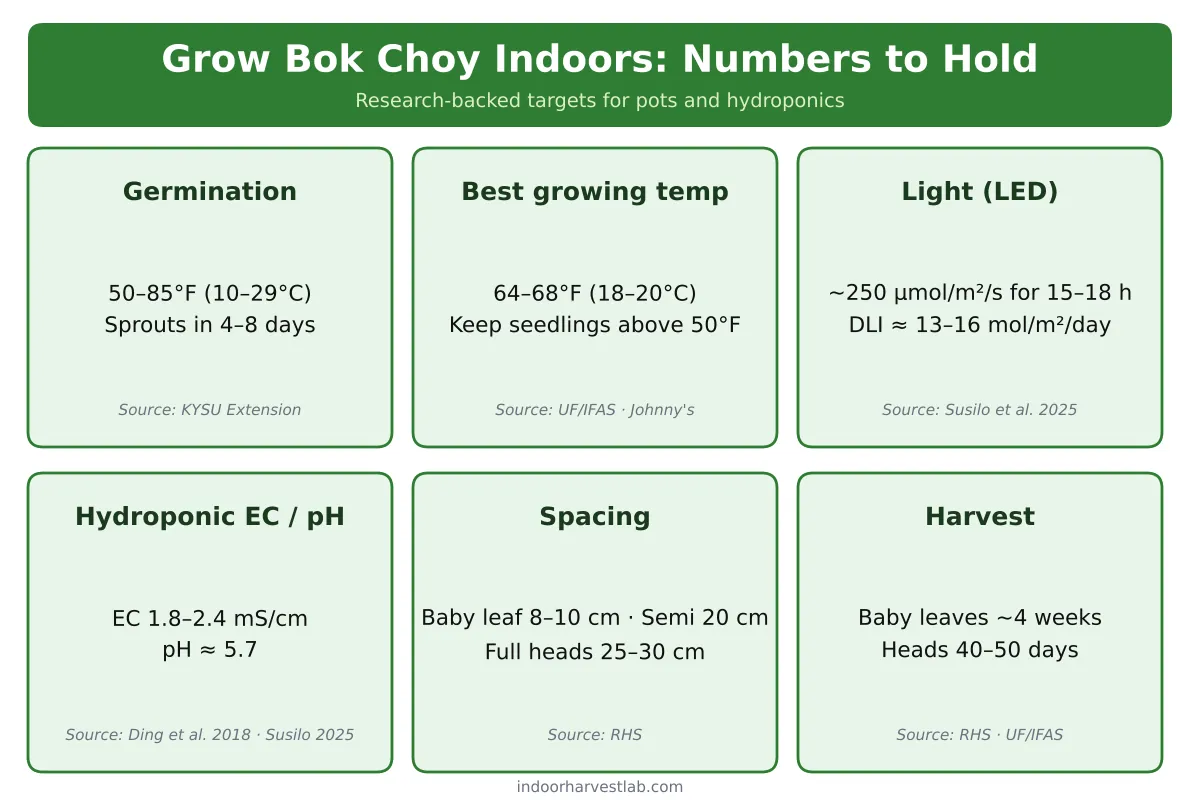
Numbers to hold for indoor bok choy
When you grow bok choy indoors, most failures come from one number being off: a cold windowsill at night, a lamp on for too few hours, or a nutrient solution that’s too strong. Here are the targets, each traced to a published source, so you can check your setup against them.
| What | Target | Source |
|---|---|---|
| Germination temperature | 50–85°F (10–29°C); seedlings emerge in 4–8 days | Kentucky State Univ. Extension |
| Best growing temperature | 64–68°F (18–20°C); tolerates 27–95°F (−3 to 35°C) | UF/IFAS HS1337 |
| Bolting danger for seedlings | Below 50°F (10°C), especially several nights in a row | Johnny’s Selected Seeds |
| Sowing depth | ¼–½ in (0.6–1.3 cm) | NC State Extension |
| Start-to-transplant time | 2–4 weeks in 128- or 72-cell trays | Johnny’s |
| Soil pH | 6.0–7.5 (UF gives 5.5–7.0) | NC State, UF/IFAS |
| Hydroponic EC | 1.8–2.4 mS/cm (≈ 900–1,200 ppm on a 500-scale meter) | Ding et al. 2018 |
| Hydroponic pH | ≈ 5.7 (used in a 2025 LED trial) | Susilo et al. 2025 |
| LED light | ≈ 250 µmol/m²/s for 15–18 h (DLI 13.5–16.2 mol/m²/day) | Susilo et al. 2025 |
| Final spacing | 8–10 cm baby leaf; 20 cm semi-mature; 25–30 cm full size | RHS |
| Harvest | Baby leaves ≈ 4 weeks; heads 40–50 days at the 10–15-leaf stage | RHS, UF/IFAS |
Two of these matter more than the rest. Temperature decides whether your plants bolt, and light decides how fast they bulk up. Get both right and the other numbers rarely cause trouble.
Light: how to grow bok choy indoors under LEDs or a window
Outdoors, bok choy is forgiving about light. NC State Extension notes it grows in full sun to part shade and can get by with as little as two hours of direct sun, although it grows more slowly. Indoors in winter, a window gives far less light than that sounds, because glass, short days and a low sun all cut the dose. If you want proper heads rather than a few thin leaves, plan on a grow light.
How much light bok choy needs
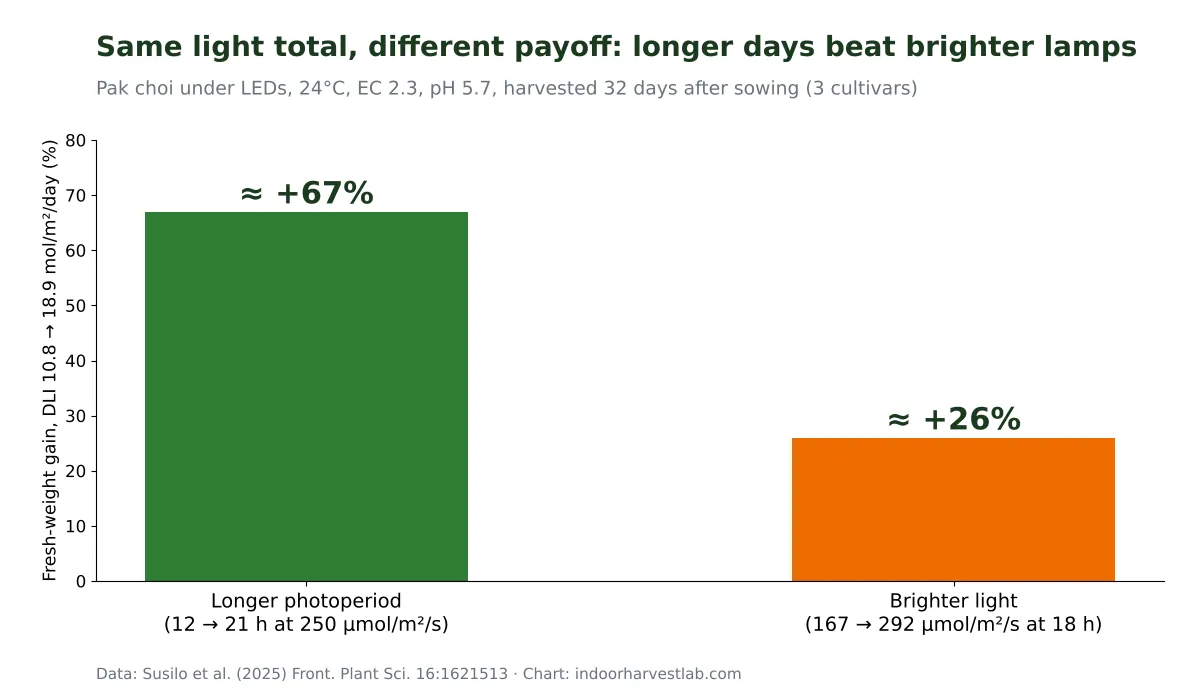
The best data for anyone trying to grow bok choy indoors come from a 2025 Wageningen University study that grew three pak choi cultivars under white LEDs at 24°C (75°F) with EC 2.3 and pH 5.7 (Susilo et al., 2025). The plants received daily light integrals (DLI) of 10.8 to 18.9 mol/m²/day and were harvested 32 days after sowing. Fresh weight rose with every step up in DLI, and vitamin C was about 25% higher at the top DLI than at the bottom.
The surprise was how the light was delivered. When the researchers raised DLI by keeping the lamps on longer (12 to 21 hours at 250 µmol/m²/s), fresh weight went up by about 67%. When they raised the same DLI by turning the lamps brighter at a fixed 18 hours, fresh weight rose by only about 26%. Longer, gentler light was also more energy-efficient.
A practical light plan
- Target: about 200–250 µmol/m²/s at leaf height for 16–18 hours a day. That gives a DLI of roughly 13–16 mol/m²/day, the middle of the tested range.
- Use a timer. Consistency beats intensity. A cheap plug-in timer often does more for yield than a bigger lamp.
- Measure if you can. If you don’t own a PAR meter, our PPFD chart shows how to estimate light from hanging height and convert PPFD into DLI.
- Window-only? Grow it for baby leaves rather than full heads, use the brightest south-facing window you have (north-facing in the Southern Hemisphere), and keep the pot away from cold glass at night.
Containers, soil and step-by-step sowing
If you grow bok choy indoors in soil, remember that it hates having its roots disturbed or cramped, and that stress is a common bolting trigger. Johnny’s advises planting out before seedlings become rootbound for exactly this reason. So choose the container first, then sow.
Step 1: Pick the pot and the variety
The RHS recommends pots at least 30 cm (12 in) wide for baby leaves, because smaller containers dry out too fast. NC State Extension gives a minimum container of 1 gallon for a plant. In practice, a 12-inch pot holds one full-size head or several baby-leaf plants.
Variety matters more than most people think. The RHS lists ‘Summer Breeze’, ‘Glacier’ and ‘Red Choi’ as Award of Garden Merit varieties, and both ‘Summer Breeze’ and ‘Glacier’ are noted for good bolting resistance. Compact or ‘baby’ types are the easiest fit for shelves.
Step 2: Sow shallow and warm
Fill a cell tray or the final pot with a fine, free-draining seed mix and sow seeds ¼–½ inch deep (NC State). Keep the mix moist and between 50 and 85°F; seedlings normally appear in 4–8 days (Kentucky State University). Sow two seeds per cell and thin to the strongest one with scissors rather than pulling, so you don’t disturb its neighbour’s roots.
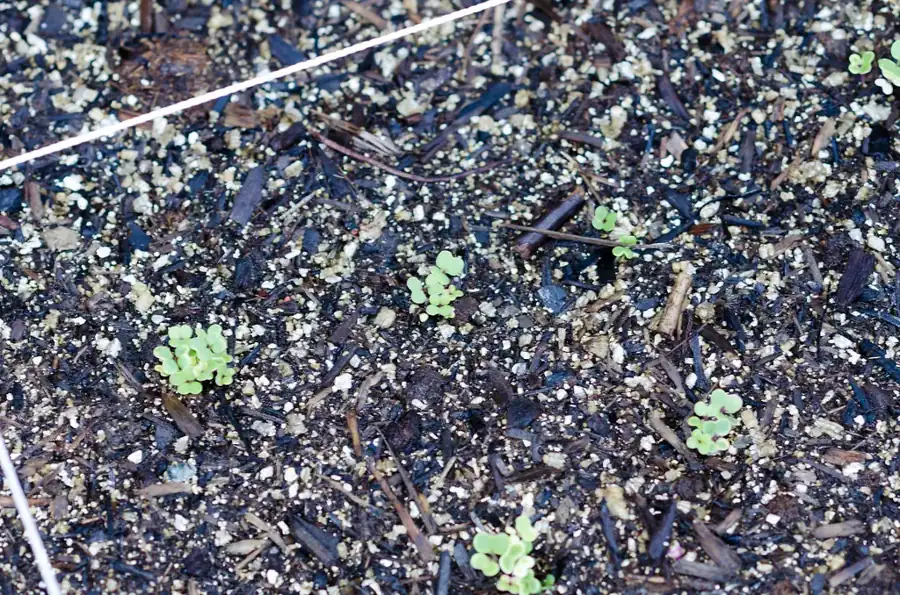
Step 3: Get seedlings under light immediately
As soon as the seed leaves open, the light should be on. Seedlings that hunt for light stretch, flop and never catch up. Hold the 16–18-hour photoperiod from day one.
Step 4: Transplant early, or sow in place
If you started in cells, move seedlings within 2–4 weeks while they’re still small (Johnny’s). For pots, sowing directly into the final container avoids the transplant shock altogether. Final spacing depends on what you want to eat: 8–10 cm apart for baby leaves, 20 cm for semi-mature plants and 25–30 cm for full heads (RHS).
Step 5: Water and feed steadily
Keep the mix evenly moist but never waterlogged. Bok choy is a fast leafy crop, so it needs steady nitrogen: a balanced liquid fertiliser at the label rate works well in potting mix, and because dry spells stress the plant, keep watering even. Soggy mix, on the other hand, invites fungus gnats.
Growing bok choy in water: a hydroponic or Kratky setup
One of the most-searched questions is whether you can grow bok choy indoors in water. You can, and it’s arguably easier than soil because you control nutrients exactly. A passive Kratky container (a lidded tote with net pots and no pump) is enough for a few heads.
The EC sweet spot
A greenhouse study in Shanghai tested eight nutrient strengths, from plain water up to EC 9.6 mS/cm (Ding et al., 2018). Very weak (EC 0–0.6) and very strong (EC 9.6) solutions both cut fresh weight, leaf size and photosynthesis, and lowered the taste score. EC 1.8 and 2.4 gave the best balance of growth and quality. As EC rose, leaf nitrate and vitamin C climbed, while sugars and fibre fell.
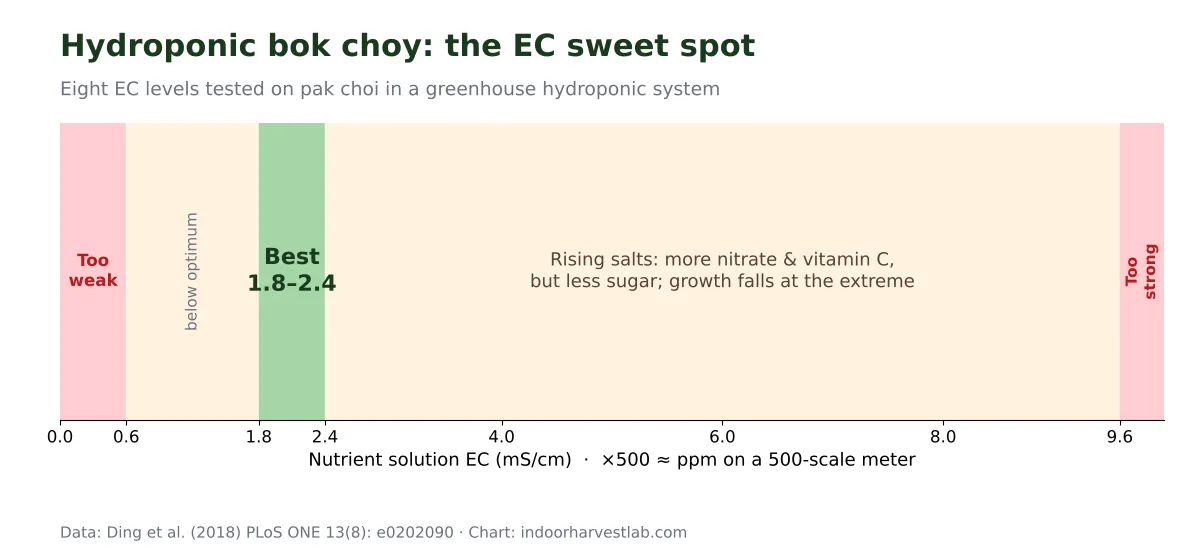
On a 500-scale ppm meter, 1.8–2.4 mS/cm reads roughly 900–1,200 ppm. If your meter uses a different scale, our hydroponic EC chart has the conversions. Start seedlings at the lower end and move up as plants fill out.
pH and temperature
The Wageningen LED trial held the solution at pH 5.7 (Susilo et al., 2025), which sits inside the general range on our hydroponic pH chart. Check pH every few days in small containers, because it drifts quickly in a few litres of water. Keep the solution out of direct light to limit algae.
Can you regrow bok choy from the base?
You’ll see videos of a store-bought bok choy base sitting in a saucer of water and sprouting new leaves. It does work as a fun project, but the stump only has the energy stored in it, so expect a handful of small leaves rather than a new head. For real harvests, start from seed.
Why indoor bok choy bolts, and how to fix common problems
Bolting is the main reason people give up on bok choy. The plant suddenly sends up a stalk, sets yellow flowers, and the leaves turn tough and sharp. The RHS lists overly hot or cold temperatures and dry conditions as triggers. Johnny’s is more specific: seedlings exposed to temperatures below 50°F (10°C), especially for several nights, may bolt early, while older plants are much less sensitive to cold.
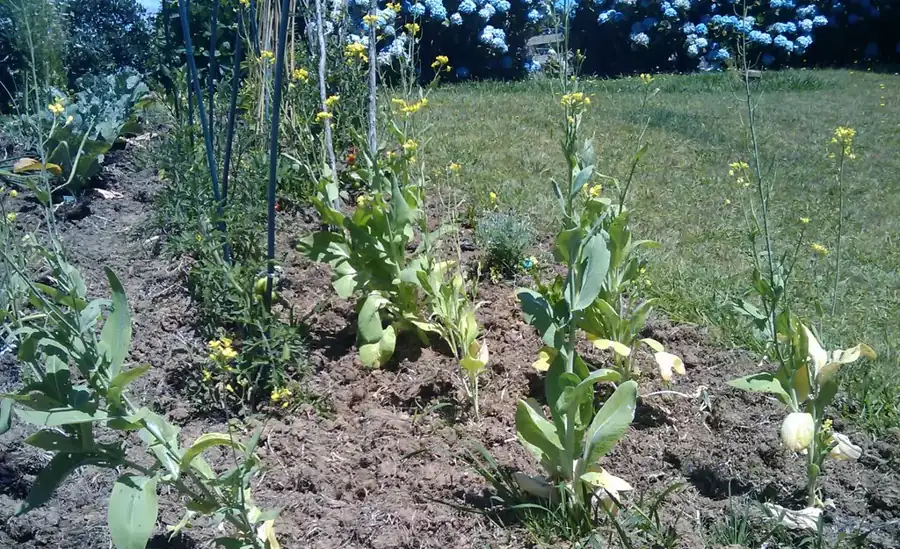
When you grow bok choy indoors, that cold exposure usually happens without you noticing: a tray left on a windowsill where the glass cools the air overnight, a cold garage, or a draughty floor. Put a cheap min/max thermometer next to the plants for a week. If the minimum dips below 50°F, move them.
| What you see | Likely cause | What to do |
|---|---|---|
| Flower stalk in the centre, leaves turning bitter | Cold seedlings (below 50°F), heat or drought stress, rootbound transplants | Harvest now; next time keep seedlings above 50°F, water evenly, transplant early and choose a bolt-resistant variety |
| Tall, pale, floppy seedlings | Too little light or lamp too far away | Lower the light, raise intensity or hours, and keep to 16–18 h |
| Bitter, tough leaves on otherwise healthy plants | Harvested too late (more than ~15 leaves) | Pick at the 10–15-leaf stage (UF/IFAS) |
| Small, pale plants in hydroponics | Nutrient solution too weak | Raise EC towards 1.8–2.4 mS/cm |
| Stunted plants, dark small leaves in hydroponics | Nutrient solution far too strong | Top up with plain water and bring EC back into range |
| Clusters of small insects under leaves | Aphids, a listed bok choy pest (UF/IFAS) | Rinse off, wipe leaves, or use insecticidal soap per the label |
| Tiny black flies over damp mix | Fungus gnats | Let the surface dry between waterings and use yellow sticky traps |
For more help with brassica greens indoors, our guide to growing kale indoors covers a close cousin with very similar light and temperature needs.
When and how to harvest bok choy
Timing changes the flavour more than anything else you do when you grow bok choy indoors. UF/IFAS notes that bok choy is normally harvested 40–50 days after seeding, at the 10–15-leaf stage, and that plants with more than 15 leaves become a little bitter. Under good LEDs it can be faster: the Wageningen plants were harvested 32 days after sowing (Susilo et al., 2025).
- Baby leaves: the RHS says pak choi can give cut-and-come-again baby leaves in as little as four weeks. Snip outer leaves at about 6 inches tall and let the centre keep growing.
- Baby heads: Kentucky State University suggests harvesting baby bok choy when plants are about 6 inches tall.
- Full heads: cut the whole plant at the base with a sharp knife when it has 10–15 leaves. Semi-mature and full-size heads take about eight to ten weeks outdoors (RHS); indoors under steady light it’s often quicker.
- If it starts to bolt: harvest immediately. NC State notes you can still use the head as normal if you cut it before the flowers open.
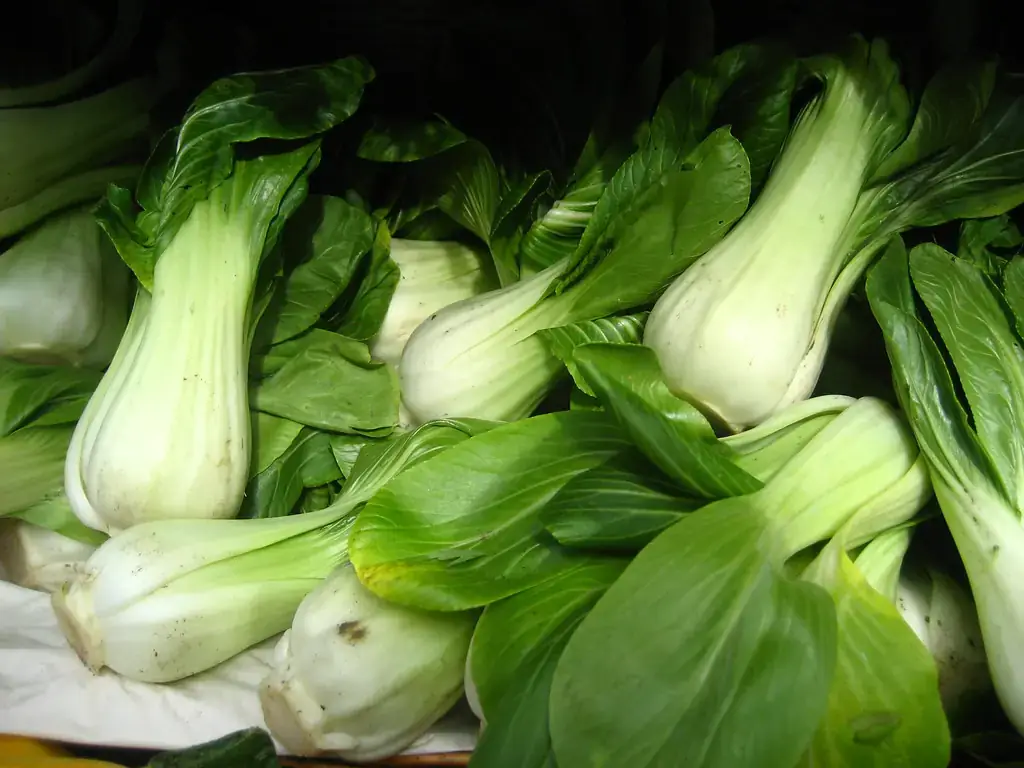
Freshly cut bok choy keeps only 1–2 days at room temperature, but 5 days or more in the fridge at about 39°F (4°C), according to UF/IFAS. Because it loses quality quickly, small successive sowings every two or three weeks give a steadier supply than one big tray.
From the lab bench
Here’s how to read the research if you’re setting up a shelf of bok choy this winter, and the rules of thumb that follow from it.
Spend on hours, not watts. The Wageningen result fits basic leaf physiology. Photosynthesis is most efficient at moderate light, and each extra photon gives less return as intensity climbs. Stretching a moderate light over a longer day lets the leaves use more of what you pay for. For anyone who wants to grow bok choy indoors, this is great news: a modest LED on an 18-hour timer can beat a bigger lamp running 12 hours.
Treat 50°F as a hard line for seedlings. Cold-triggered flowering is a well-known trait in Brassica rapa, and the seed-company warning about sub-50°F nights matches it. Indoors, the risk isn’t the room temperature you see at noon; it’s the coldest hour by the window at 5 a.m. Measure that hour.
Don’t chase the highest EC. Ding and colleagues found that stronger solutions raised leaf nitrate and lowered sugars. For a crop you eat raw or lightly cooked, the middle of the range (1.8–2.4 mS/cm) is where taste and yield meet. More fertiliser past that point mostly buys you higher nitrate.
Harvest young and often. The 10–15-leaf rule from UF/IFAS is the easiest quality control you’ll ever use. Count leaves, cut on time, sow again. That rhythm also keeps you a few weeks ahead of any bolting problem.
FAQ
Can you grow bok choy indoors?
Yes. Bok choy is compact, fast and needs no pollination, so it grows well indoors in a 12-inch pot or a small hydroponic container. Give it 15–18 hours of LED light, keep it around 64–68°F, and keep seedlings above 50°F to prevent bolting.
How long does bok choy take to grow indoors?
Baby leaves can be picked in about four weeks. Full heads are usually ready 40–50 days after sowing, at the 10–15-leaf stage. Under strong LEDs, researchers harvested pak choi just 32 days after sowing.
Can you grow bok choy indoors in water?
Yes. Bok choy grows well hydroponically, including in a simple Kratky container. Research found an EC of 1.8–2.4 mS/cm gave the best growth and quality, and a 2025 LED trial used a pH of about 5.7.
Why is my indoor bok choy bolting?
The most common causes are cold seedlings (below 50°F, especially for several nights), heat or drought stress, and rootbound transplants. Keep seedlings warm, water evenly, transplant early and choose a bolt-resistant variety such as ‘Glacier’ or ‘Summer Breeze’.
How many hours of light does bok choy need indoors?
Aim for 16–18 hours a day at around 200–250 µmol/m²/s. A 2025 study found that extending the photoperiod increased pak choi growth more than making the light brighter for the same daily light total.
What size pot does bok choy need?
Use a pot at least 12 inches (30 cm) wide. That holds one full-size head or several baby-leaf plants spaced 8–10 cm apart. Smaller pots dry out quickly, and drought stress encourages bolting.
Can you regrow bok choy from the base?
A store-bought base in water will push out a few small leaves, which makes a fun project. It won’t produce a full new head, though, so sow seed for proper harvests.
Sources
- Liu, H. & Liu, G. (2019, rev.). Bok Choy, an Asian Leafy Green Vegetable Emerging in Florida. HS1337. University of Florida IFAS Extension.
- Johnny’s Selected Seeds. Pac Choi (Bok Choy): Key Growing Information.
- Royal Horticultural Society. How to grow pak choi.
- NC State Extension Gardener Plant Toolbox. Brassica rapa (Chinensis Group), bok choy.
- Mofikoya, O. & Nzaramyimana, T. (2025). Bok Choy (Brassica rapa subsp. chinensis) fact sheet. Kentucky State University Cooperative Extension.
- Ding, X., Jiang, Y., Zhao, H., et al. (2018). Electrical conductivity of nutrient solution influenced photosynthesis, quality, and antioxidant enzyme activity of pakchoi in a hydroponic system. PLoS ONE 13(8): e0202090. doi:10.1371/journal.pone.0202090.
- Susilo, K. R., Eu, A., Besemer, B., Heuvelink, E., de Vos, R. C. H. & Marcelis, L. F. M. (2025). Extended photoperiod improves growth and nutritional quality of pak choi under constant daily light integral. Frontiers in Plant Science 16: 1621513. doi:10.3389/fpls.2025.1621513.
Browse more guides in Indoor Leafy Greens.