
You bought a grow light, hung it over the tray, and the box promised a big number: “up to 800 µmol!” Two weeks later your lettuce seedlings are pale and stretched, or your tomato leaves are bleaching at the top. The light isn’t broken. You just don’t know what number the plants actually needed, or how long to give it to them.
Short answer: a PPFD chart tells you how much light (in µmol/m²/s) should land on the leaves of each crop. Research-based targets run from about 100–200 µmol/m²/s for tomato seedlings on an 18-hour day, to roughly 225–295 µmol/m²/s for finishing lettuce and 350–520 µmol/m²/s for fruiting tomatoes on a 16-hour day. Always pair PPFD with hours on, because the daily total (DLI) is what drives growth.
This guide gives you one PPFD chart built from university and peer-reviewed numbers, shows you how to convert any PPFD into a daily light integral, and walks you through measuring and adjusting your own setup. By the end you’ll know exactly what to aim for, crop by crop, and what to change when plants tell you the light is wrong.
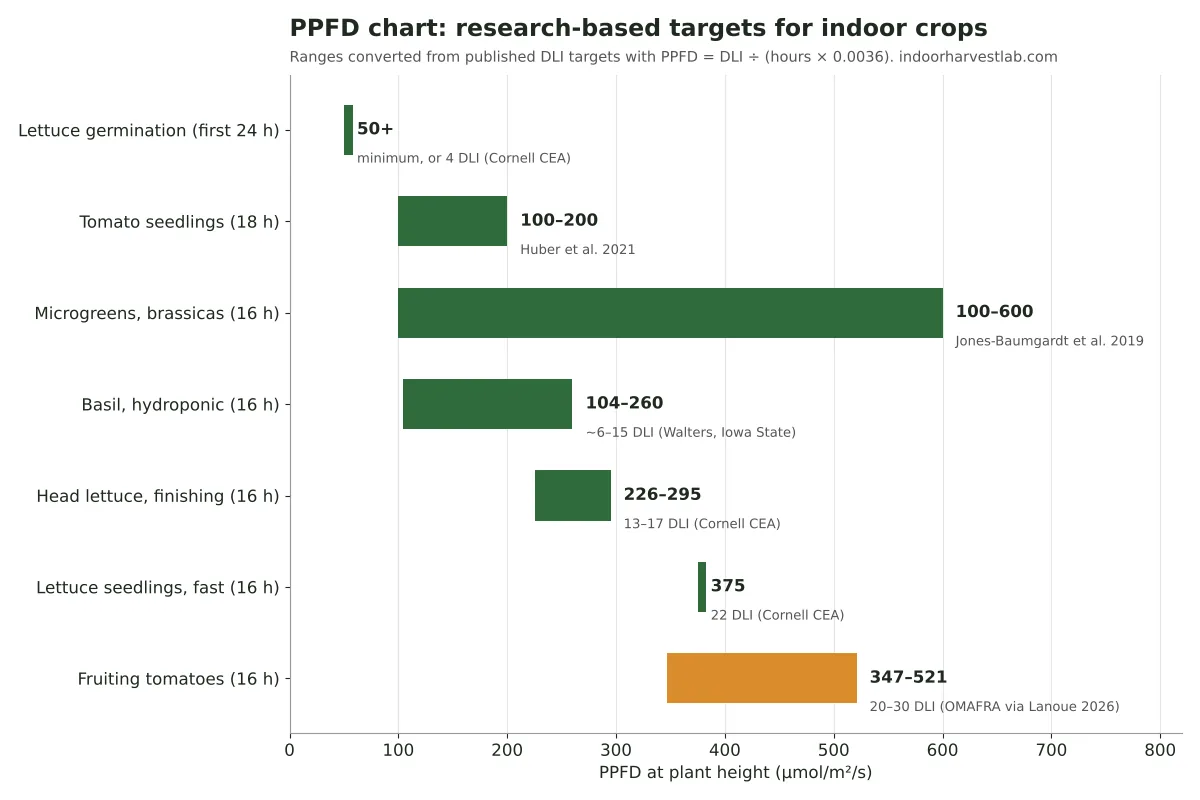
PPFD chart at a glance: targets by crop and stage
Here’s the whole chart in one place. Each row comes from a published study or extension guide, and where the source gave a daily light integral (DLI) instead of an intensity, we converted it with the standard formula from the next section. That makes it a PPFD chart you can check, not a list of round numbers someone made up.
| Crop and stage | Target PPFD (µmol/m²/s) | Hours on | Daily light (DLI, mol/m²/day) | Source |
|---|---|---|---|---|
| Lettuce, germination (first 24 h) | 50 minimum | — | 4 | Cornell CEA |
| Lettuce seedlings, fast transplant | ≈375 (or ≈250 on 24 h) | 16 | 22 | Cornell CEA |
| Tomato seedlings | 100–200 | 18 | 6.5–13 | Huber et al. 2021 |
| Brassica microgreens | 100–600 (yield rose across the whole range) | 16 | 5.8–34.6 | Jones-Baumgardt et al. 2019 |
| Basil, hydroponic | ≈260 for the high-light result | 16 | ~15 beat ~6 | Walters, Iowa State |
| Head lettuce, finishing | ≈225–295 | 16 | 13–17 | Cornell CEA |
| Fruiting tomatoes | ≈350–520 | 16 | 20–30 | OMAFRA, cited in Lanoue et al. 2026 |
Numbers to hold
If you only remember a handful of figures, make it these. They come straight from the sources listed at the end of the article.
| What | Number | Why it matters |
|---|---|---|
| PPFD → DLI conversion | DLI = PPFD × hours × 0.0036 | Turns a meter reading into the daily dose (UNH Extension) |
| Lettuce germination light | ≥50 µmol/m²/s, 68 °F (20 °C) | Prevents stretch without drying the surface (Cornell CEA) |
| Lettuce seedling climate | 75/66 °F (24/19 °C) day/night | Paired with 22 mol/m²/day, transplant-ready in ~11 days (Cornell CEA) |
| Lettuce finishing DLI | 17 mol/m²/day (13–14 without vertical airflow) | 5–6 oz heads 24 days after transplant; higher DLI risks tipburn (Cornell CEA) |
| Half the DLI | ≈ twice the crop time | Lettuce at 8.5 mol/m²/day took 48 days instead of 24 (Cornell CEA) |
| Tomato seedling DLI | 13 mol/m²/day was the efficient point | Gains above ~23 mol/m²/day were slight (Fan et al. 2013, cited in Huber et al. 2021) |
| Fruiting tomato DLI | 20–30 mol/m²/day | Optimal range for production (OMAFRA, cited in Lanoue et al. 2026) |
| Tomato photoperiod | Avoid 24 h continuous light | Continuous light causes interveinal chlorosis (Lanoue et al. 2026) |
PPFD vs DLI: why the hours matter as much as the intensity
Most confusion about grow lights comes from mixing up two different numbers. PPFD is a snapshot. DLI is the whole day added up. You need both.
PPFD: light intensity at the leaf
PPFD (photosynthetic photon flux density) counts how many photons in the 400–700 nm photosynthetic range hit one square metre every second, in micromoles (µmol/m²/s). University of New Hampshire Extension notes that you measure it with a PAR or quantum meter, and that lux, lumens and foot-candles describe human brightness perception, so they aren’t useful for plant light (UNH Extension).
The key word is at the leaf. A fixture’s PPFD drops fast as you raise it and falls off toward the edges of the footprint, which is why our guide to grow light distance for seedlings matters as much as the fixture you buy.
DLI: the daily dose plants actually grow on
Daily light integral is the total photosynthetic light received in a day, in moles per square metre per day (mol/m²/day). Michigan State’s Erik Runkle explains that it’s a cumulative number, so it can’t be read from a single instant (Runkle, MSU). Growth tracks DLI closely: Cornell found that lettuce growth is directly proportional to light received, so halving the DLI roughly doubled the time to harvest (Mattson, Cornell CEA).
The conversion formula (and a quick table)
To convert, multiply PPFD by the hours the light is on and by 0.0036 (3,600 seconds per hour divided by 1,000,000 micromoles per mole). UNH Extension uses exactly this constant in its lighting run-time worksheet. Turn it around and you get the PPFD you need for a target DLI: PPFD = DLI ÷ (hours × 0.0036).
| PPFD (µmol/m²/s) | 12 h on | 16 h on | 18 h on | 24 h on |
|---|---|---|---|---|
| 100 | 4.3 | 5.8 | 6.5 | 8.6 |
| 200 | 8.6 | 11.5 | 13.0 | 17.3 |
| 300 | 13.0 | 17.3 | 19.4 | 25.9 |
| 400 | 17.3 | 23.0 | 25.9 | 34.6 |
| 500 | 21.6 | 28.8 | 32.4 | 43.2 |
Notice what this table says: 300 µmol/m²/s for 12 hours gives the same daily dose as 200 µmol/m²/s for 18 hours. Longer days let you run a light lower or dimmer, which is useful when a fixture can’t reach the PPFD a crop needs. Our article on how many hours of light seedlings need covers the photoperiod side in more detail.
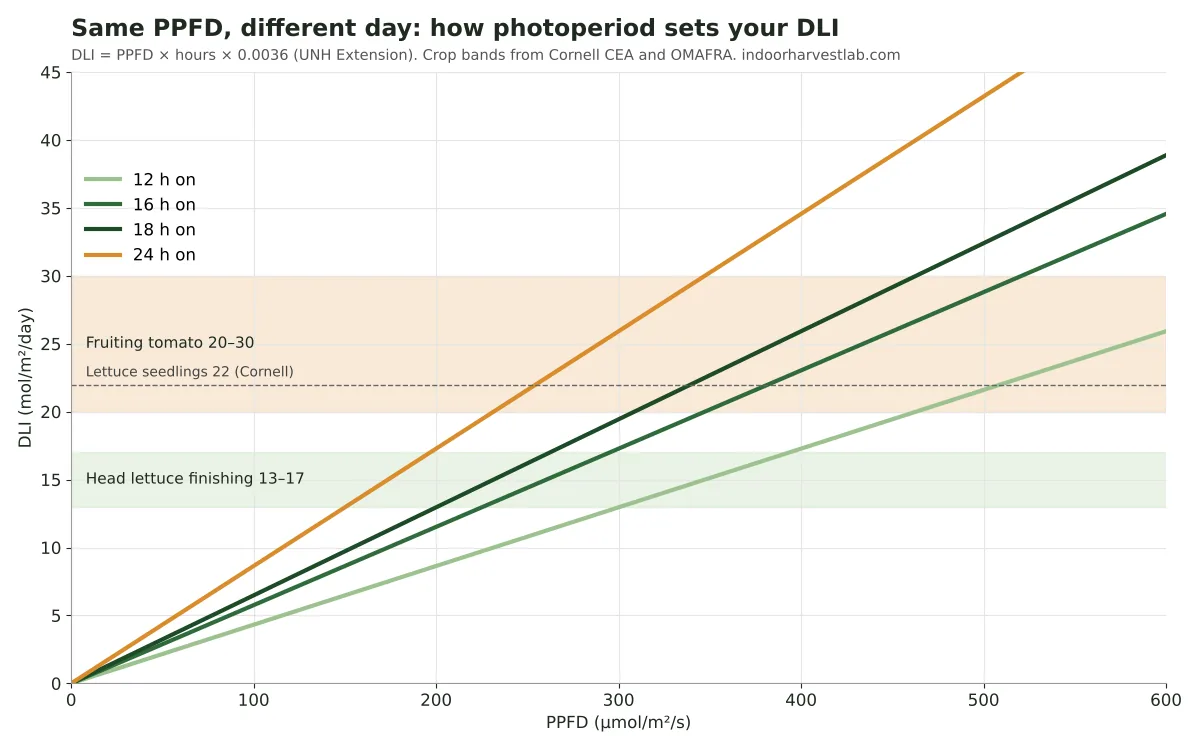
Reading the PPFD chart by crop and growth stage
A single “best PPFD” doesn’t exist. Seedlings, leafy greens and fruiting plants sit at very different points on the chart, and the same crop needs more light as it grows. Here’s what the research behind each row of the PPFD chart says, group by group.
PPFD for seedlings
Seedlings are where most indoor growers start, and where too little light shows up fastest as long, floppy stems. Cornell’s hydroponic lettuce protocol uses at least 50 µmol/m²/s (or a DLI of 4) during the first 24 hours of germination at 68 °F (20 °C). The researchers note that this level prevents stretching while limiting how much supplemental light dries out the surface of the medium (Cornell CEA).
Once seedlings emerge, Cornell pushes them hard: a DLI of 22 mol/m²/day, delivered as 250 µmol/m²/s over 24 hours or 375 µmol/m²/s over 16 hours, at 75/66 °F day/night. Under those conditions lettuce seedlings reached three to four true leaves and were ready to transplant at about day 11. With half the DLI they took twice as long, about 22 days.
Tomato seedlings were tested at 100, 150 and 200 µmol/m²/s on an 18-hour photoperiod, giving DLIs of 6.5, 9.7 and 13 mol/m²/day. Growth rate rose with each step up in DLI (Huber, Louws and Hernández, 2021). The same paper summarises earlier work: Fan and colleagues (2013) found 13 mol/m²/day was the best level for tomato transplants, because going beyond 23 mol/m²/day added only slight dry mass, and O’Carrigan and colleagues (2014) found that raising DLI from 17 to 27 increased shoot dry mass by just 7%.
So, reading the seedling rows of the PPFD chart together, a practical PPFD for seedlings is roughly 150–250 µmol/m²/s on a 16–18 hour day. That lands you at about 9–16 mol/m²/day, right in the zone the tomato research rewards, without paying for light the plants can’t use. If you’re still choosing a fixture, our buyer’s guide to grow lights for seed starting explains how to read a PPFD map.
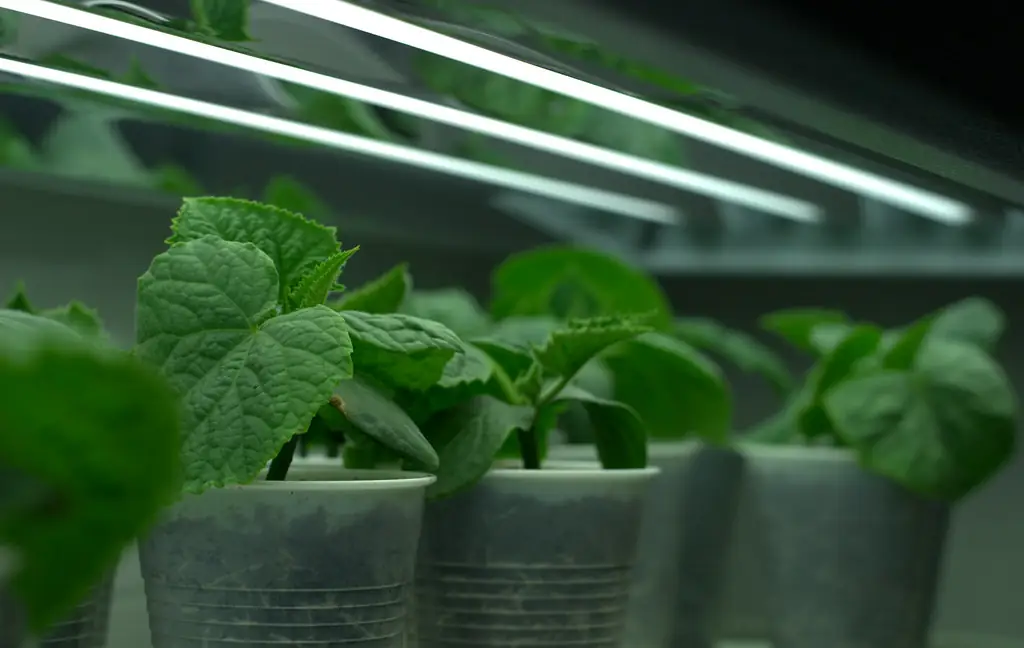
PPFD for microgreens
Microgreens are harvested within days, so light mostly changes yield, height and colour. In a University of Guelph study, kale, cabbage, arugula and mustard microgreens were grown under 100 to 600 µmol/m²/s with a 16-hour photoperiod. As light rose from 100 to 600, fresh weight increased by 36% (kale), 56% (cabbage), 76% (arugula) and 82% (mustard), while hypocotyls got shorter in every crop (Jones-Baumgardt et al., 2019).
In plain terms: more light gave heavier, more compact trays. Lower light gave taller, leggier greens. Most home growers sit at the bottom of that range, and that’s fine for a family supply, but if your microgreens flop over, light is the first thing to check. See our full guide to microgreens light requirements for tray-level setup.
PPFD for lettuce and leafy greens
For head lettuce in hydroponics, Cornell targets a DLI of 17 mol/m²/day, which produced 5- to 6-ounce heads 24 days after transplanting. On a 16-hour day that’s about 295 µmol/m²/s; on 18 hours, about 260. There’s a catch, though. Pushing head lettuce with more light raises the risk of tipburn, a calcium-supply disorder at the growing point. Cornell recommends vertical airflow fans and, without them, a lower target of 13–14 mol/m²/day (Cornell CEA), or roughly 225–245 µmol/m²/s on 16 hours.
That trade-off is why our lettuce tip burn guide puts airflow ahead of more light. Cornell lists arugula, upland cress, kale, mizuna and mustard as crops that also suit hydroponic baby-leaf production.
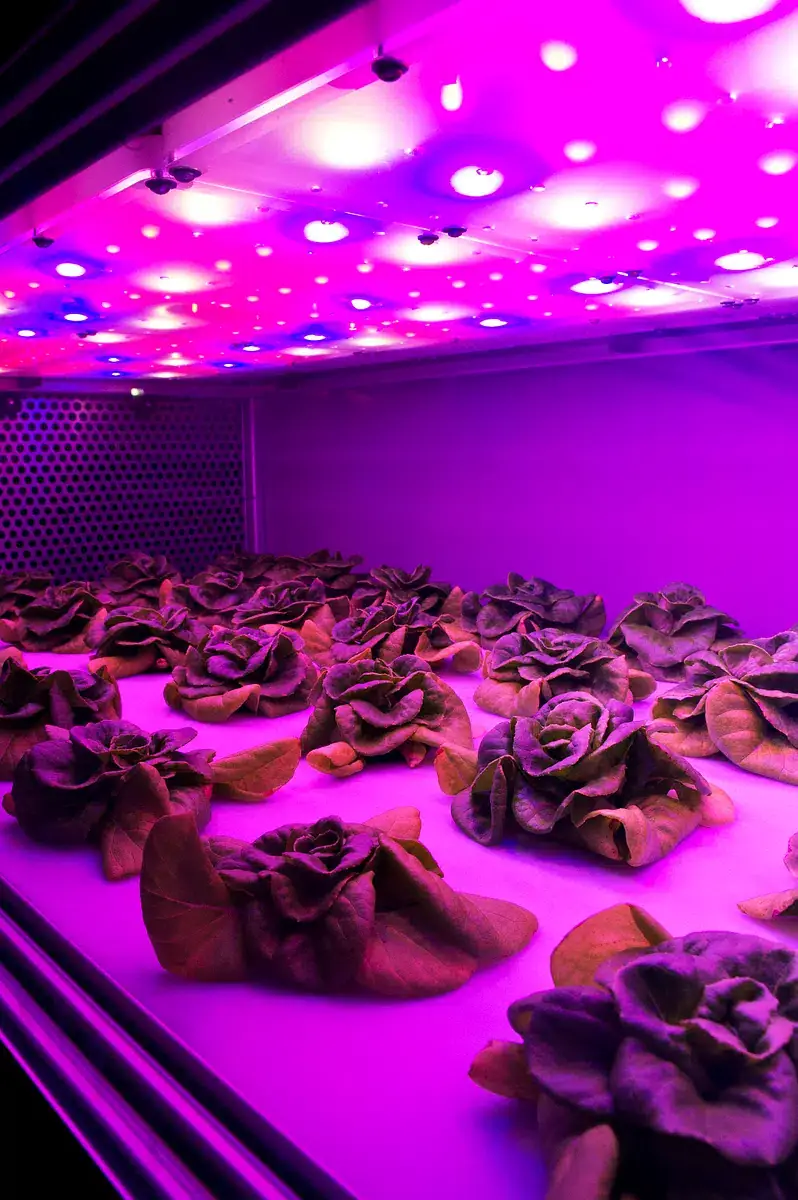
PPFD for herbs such as basil
Basil is a little hungrier than lettuce. In Iowa State hydroponic trials reported in Greenhouse Grower, sweet basil was grown under a low DLI of about 6 or a high DLI of about 15 mol/m²/day with a 16-hour day. Each plant weighed 0.3–0.4 ounces more under the high DLI, and yield per square foot rose further when plants were spaced more closely (Walters, Iowa State University).
A DLI of 15 on a 16-hour day works out to about 260 µmol/m²/s. That makes 200–260 µmol/m²/s a sensible target for leafy culinary herbs, while 100 µmol/m²/s (about 6 DLI on 16 hours) will keep basil alive but leave it lighter and slower.
PPFD for fruiting crops like tomatoes
Fruiting plants are the light-hungriest crops most people try indoors. A 2026 study of greenhouse tomatoes cites Ontario’s agriculture ministry (OMAFRA) for an optimal production DLI of 20–30 mol/m²/day. It also notes that winter DLI is typically only 5–15 mol/m²/day outdoors at northern latitudes, and that the DLI inside a greenhouse may be half of what’s outside (Lanoue et al., 2026).
Indoors under lights, 20–30 mol/m²/day means about 350–520 µmol/m²/s across the canopy for 16 hours, or 310–465 for 18 hours. That’s a serious fixture for even a single plant. Don’t try to solve the gap by leaving lights on around the clock: the same study notes that continuous 24-hour lighting is known to cause interveinal chlorosis in tomato, reducing photosynthetic capacity and yield. Our guide to growing tomatoes indoors covers pollination and variety choice for those lower-light winter setups.
How to hit your target PPFD, step by step
A PPFD chart is only useful if you can match it on your own shelf. This five-step routine turns a fixture, a meter and the PPFD chart above into a known daily dose.
Step 1: Measure at canopy height, not at the bulb
Use a quantum (PAR) meter that reads µmol/m²/s, as UNH Extension recommends. Hold the sensor flat at leaf height and take readings in a grid across the tray, including the corners, because edges are usually the dimmest spots. Average the readings and note the lowest one.
Step 2: Pick your photoperiod
Choose the hours first, because they set the PPFD you’ll need. For most seedlings, greens and herbs, 16–18 hours is a common working range. For tomatoes, stay below 24 hours.
Step 3: Calculate the PPFD you need
Take the DLI from the PPFD chart and divide by hours × 0.0036. For example, lettuce at 17 mol/m²/day on a 16-hour day: 17 ÷ (16 × 0.0036) = about 295 µmol/m²/s. Every converted value in our PPFD chart was worked out the same way, so you can redo the maths for any photoperiod you prefer.
Step 4: Adjust height, dimmer or hours
If you’re short, lower the fixture or turn up the dimmer and re-measure. If the light is already as close as it can safely go, add hours instead, using the conversion table to check the new DLI. If you’re over the target, raise the light or dim it rather than shortening the day too much.
Step 5: Re-measure as plants grow
The canopy gets closer to the light every day, so PPFD at the leaf creeps up. Re-check every week or so, and every time you move the fixture or change trays.
Too much or too little light? A symptom triage table
Plants show you when your light doesn’t match the PPFD chart. Use this table as a first check before blaming nutrients or water.
| What you see | Likely light cause | What to do |
|---|---|---|
| Long, thin, pale seedling stems | PPFD or DLI too low (Cornell’s ≥50 µmol/m²/s germination floor exists to prevent stretch) | Lower the light or add hours; aim for roughly 150–250 µmol/m²/s once seedlings are up. |
| Tall, floppy microgreens with light colour | Low PPFD; hypocotyls lengthened as light dropped toward 100 µmol/m²/s | Increase intensity; Jones-Baumgardt et al. saw shorter, heavier greens up to 600 |
| Lettuce growing slowly, small heads | DLI well below 17 mol/m²/day | Half the DLI roughly doubled crop time in Cornell’s trials; raise PPFD or hours |
| Brown, dead edges on young inner lettuce leaves | Tipburn from fast growth at high DLI without airflow | Add vertical airflow or drop to 13–14 mol/m²/day |
| Yellowing between veins on tomato leaves under 24 h light | Photoperiodic injury from continuous lighting | Give tomatoes a daily dark period |
| Dry surface on germination trays | Strong light drying the medium during germination | Keep germination light modest (about 50 µmol/m²/s) until emergence |
From the lab bench
Here’s how we read this research, and the rules of thumb that fall out of it.
Think in DLI, set in PPFD. Every source behind this PPFD chart ultimately ties growth to the daily total, not the instantaneous number. The intensity on the fixture’s box is only half the story; the timer is the other half. Pick the DLI from the research (or straight from the PPFD chart), then work backward to the PPFD your setup can deliver on a sensible day length.
There’s a point of diminishing returns, and seedlings hit it early. The tomato transplant data show steep gains from low light up to around 13 mol/m²/day and much smaller gains above about 23. For a home grower paying for electricity, that’s a strong argument for moderate light on seedlings and saving the big fixture for fruiting plants.
More light can create new problems. Lettuce is the classic example: growth rises with DLI, but so does tipburn risk unless airflow keeps pace. In a small grow tent, a cheap clip fan may be worth more than a brighter light.
Measure the corners. A fixture that delivers the target in the centre can leave the edges well below it. If plants at the edge of a tray are taller and paler than the middle, you’re looking at a PPFD map, not a nutrient problem.
Use the published numbers as starting points. Most of these values come from commercial greenhouses or growth chambers with controlled temperature and, sometimes, CO₂. Your kitchen shelf will be cooler or drier, so treat the chart as a target band and let plant response fine-tune it.
FAQ
What is a good PPFD for seedlings?
For most vegetable seedlings, about 150–250 µmol/m²/s on a 16–18 hour day is a practical target. Tomato seedlings grew faster at each step from 100 to 200 µmol/m²/s on 18 hours, and Cornell grows lettuce seedlings at about 375 µmol/m²/s on 16 hours for very fast transplants.
How do I convert PPFD to DLI?
Multiply PPFD by the number of hours the light is on and by 0.0036. For example, 250 µmol/m²/s for 16 hours gives 250 × 16 × 0.0036 = 14.4 mol/m²/day.
What PPFD does lettuce need?
Cornell’s hydroponic lettuce target is a DLI of 17 mol/m²/day, which is about 295 µmol/m²/s on a 16-hour day. Without vertical airflow, a lower DLI of 13–14 (about 225–245 µmol/m²/s on 16 hours) helps reduce tipburn.
Can I use a lux meter or phone app instead of a PAR meter?
Not reliably. UNH Extension notes that lux, lumens and foot-candles measure human brightness perception, not photosynthetic light. A quantum (PAR) meter reading in µmol/m²/s gives you the number this PPFD chart uses.
Is more PPFD always better?
No. Microgreen yield kept rising up to 600 µmol/m²/s, but tomato seedlings gained little above about 23 mol/m²/day, and high DLI raises tipburn risk in head lettuce. Match light to the crop and stage.
Should I run grow lights 24 hours a day?
Some crops tolerate it: Cornell used 24-hour lighting for lettuce seedlings. Tomatoes don’t, because continuous light causes interveinal chlorosis. For most home setups, 16–18 hours is a safer default.
Sources
- Mattson, N. (2016). Hydroponic production of leafy greens (Cornell Controlled Environment Agriculture). Greenhouse Product News, October 2016. cea.cals.cornell.edu
- Ebba, J. Supplemental Lighting Run Time Worksheet. University of New Hampshire Cooperative Extension. extension.unh.edu
- Huber, B.M., Louws, F.J. and Hernández, R. (2021). Impact of different daily light integrals and carbon dioxide concentrations on the growth, morphology, and production efficiency of tomato seedlings. Frontiers in Plant Science 12:615853. doi:10.3389/fpls.2021.615853
- Jones-Baumgardt, C., Llewellyn, D., Ying, Q. and Zheng, Y. (2019). Intensity of sole-source light-emitting diodes affects growth, yield, and quality of Brassicaceae microgreens. HortScience 54(7):1168–1174. doi:10.21273/HORTSCI13788-18
- Walters, K.J. (Iowa State University) (2015). Increase planting densities to increase hydroponic basil yields. Greenhouse Grower. greenhousegrower.com
- Lanoue, J., St. Louis, S., Little, C. et al. (2026). Dynamic lighting mitigates photoperiodic injury in greenhouse tomatoes. Frontiers in Plant Science. doi:10.3389/fpls.2026.1731972
- Runkle, E. (2010). DLI and annuals. Michigan State University / Greenhouse Grower. canr.msu.edu