
You mixed a fresh reservoir on Saturday, dialled it to a perfect 6.0, and by Tuesday the meter reads 6.9. The lettuce looks fine, the basil’s new leaves are going pale, and every chart you find online gives a slightly different number. Which one do you trust?
Short answer: a hydroponic pH chart for vegetables puts most crops between pH 5.5 and 6.5, with a working set point of about 5.8–6.0. Fruiting crops such as cucumber, pepper and basil sit at the lower end (5.0–6.0), while brassicas, leeks and pak choi tolerate the upper end (6.5–7.0). Outside that band, plants rarely suffer from the pH itself; they suffer because iron, manganese, calcium and phosphorus become harder to take up.
Below you’ll find a crop-by-crop hydroponic pH chart from university extension, what newer research says about herbs and lettuce, a “numbers to hold” cheat sheet, and a step-by-step routine for keeping pH where it belongs. By the end you’ll know which number to aim for, how far it can drift before you act, and how to read the leaves when it does.
Why a Hydroponic pH Chart Matters More Than a Soil One
Soil is a giant buffer. Clay, organic matter and lime hold pH steady for weeks, so a gardener can get away with testing once a season. A hydroponic reservoir has almost none of that buffering. Oklahoma State University Extension puts it plainly: in soilless culture the buffer is absent, so you have to maintain a suitable environment artificially (Singh & Dunn, OSU HLA-6722).
The scale also misleads people. pH runs from 0 to 14, with 7 neutral, but it is logarithmic. Penn State Extension notes that each whole unit is a 10-fold change, so pH 5 is 100 times more acidic than pH 7 (Penn State Extension). A drift from 6.0 to 7.0 looks small on the meter. Chemically, it isn’t.
It’s about nutrient availability, not root damage
Here’s the part most charts skip. Researchers at The Ohio State University, citing Bugbee (2004), point out that pH within a sensible range is not directly harmful to roots. Problems arise because nutrient availability shifts outside roughly 5.5–6.5, and even then a reduced availability does not always produce a visible disorder (Gillespie, OSU).
Penn State’s nutrient-availability chart shows the classic pattern: nitrogen is most available between pH 6.0 and 7.5, while iron, manganese and the other micronutrients become scarce as pH rises. Their troubleshooting notes list high pH as the most common cause of iron deficiency and a frequent cause of magnesium deficiency, while low pH can contribute to calcium deficiency (Penn State Extension). That is why the leaves, not the roots, usually tell you pH has wandered, and why every hydroponic pH chart clusters crops in the mildly acidic zone.
Hydroponic pH Chart for Vegetables, Herbs and Fruit
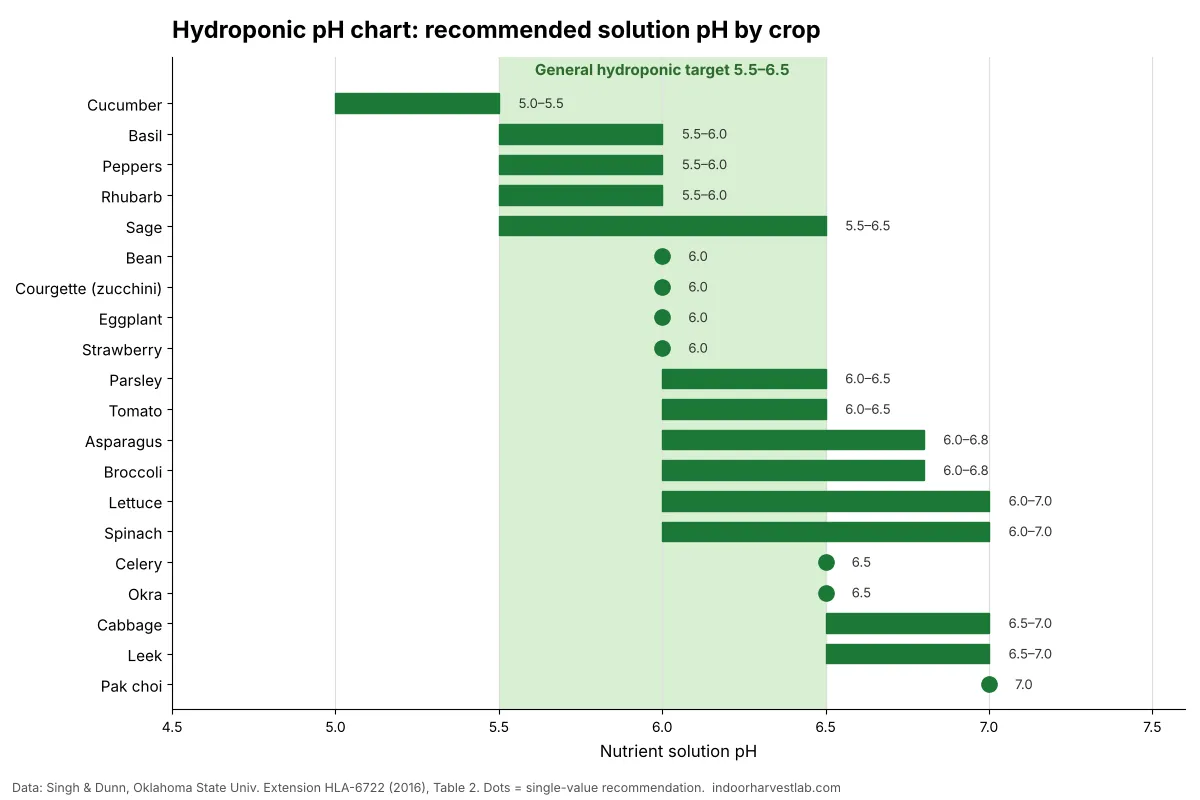
The table below is the most widely used hydroponic pH chart from a university source, taken from Oklahoma State University’s EC and pH guide. We’ve kept the EC column because pH and EC are always managed together, and added a column of practical notes drawn from the other research cited in this article.
| Crop | pH range (OSU) | EC, mS/cm (OSU) | Practical note |
|---|---|---|---|
| Cucumber | 5.0–5.5 | 1.7–2.0 | Lowest pH in the table; keep an eye on calcium at the low end. |
| Basil | 5.5–6.0 | 1.0–1.6 | Iowa State trials found the best growth at 5.5 and a usable range of 4.5–6.5. |
| Peppers | 5.5–6.0 | 0.8–1.8 | Aim mid-range; see our hydroponic EC chart for fruiting-stage EC. |
| Sage | 5.5–6.5 | 1.0–1.6 | Iowa State optimum was 6.0. |
| Strawberry | 6.0 | 1.8–2.2 | Single value; treat 6.0 as the set point. |
| Bean | 6.0 | 2.0–4.0 | Single value. |
| Eggplant | 6.0 | 2.5–3.5 | Single value. |
| Courgette (zucchini) | 6.0 | 1.8–2.4 | Single value. |
| Parsley | 6.0–6.5 | 1.8–2.2 | Iowa State found the best growth at 5.5, range 5.0–6.0. |
| Tomato | 6.0–6.5 | 2.0–4.0 | High EC tolerance; pH at the low end of this range is fine. |
| Asparagus | 6.0–6.8 | 1.4–1.8 | Rarely grown hydroponically at home. |
| Broccoli | 6.0–6.8 | 2.8–3.5 | Brassicas tolerate the upper end. |
| Lettuce | 6.0–7.0 | 1.2–1.8 | Cornell trials: pH 7.0 gave 26% less fresh weight than pH 5.8, so stay near 5.8–6.0. |
| Spinach | 6.0–7.0 | 1.8–2.3 | Grown well at 5.7–6.0 in the UNH/UF case study. |
| Celery | 6.5 | 1.8–2.4 | Single value. |
| Okra | 6.5 | 2.0–2.4 | Single value. |
| Cabbage | 6.5–7.0 | 2.5–3.0 | Tolerates near-neutral solutions. |
| Leek | 6.5–7.0 | 1.4–1.8 | Tolerates near-neutral solutions. |
| Pak choi | 7.0 | 1.5–2.0 | Highest value in the table. |
| Rhubarb | 5.5–6.0 | 1.6–2.0 | Single-source value. |
How to read this chart (and why other charts disagree)
Notice that lettuce and spinach are listed up to 7.0, yet controlled trials show lettuce losing yield at 7.0. That’s not a contradiction so much as a difference in purpose. Extension tables tell you what a crop tolerates; trials tell you where it performs best. OSU’s own text recommends a nutrient-solution pH of 5 to 6, “usually 5.5”, so that the root-zone pH settles around 6 to 6.5 (OSU HLA-6722).
Most online hydroponic pH chart graphics copy this same table, sometimes with values rounded or swapped. If a chart doesn’t name its source, treat it with suspicion. And if you grow several crops in one reservoir, ignore the extremes and run the shared middle: around 5.8–6.2.
Numbers to Hold: pH Targets and Action Points
If you remember nothing else from this hydroponic pH chart guide, keep this table taped to the reservoir lid. Each number comes from the sources listed at the end.
| What | Number | Source |
|---|---|---|
| General optimum for hydroponic vegetables | pH 5.5–6.5 | OSU Greenhouse primer; Gillespie (OSU) |
| Tighter target for most crops | pH 5.6–6.2 | Dickson & Fisher (2017) |
| Starting pH for a fresh solution | about 6.0 | Dickson & Fisher (2017) |
| Nutrient-solution pH recommended by OSU | 5.0–6.0 (usually 5.5) | OSU HLA-6722 |
| Broad acceptable range for vegetables | pH 5.0–7.0 | Penn State Extension |
| Lettuce yield loss at pH 7.0 vs 5.8 | −26% fresh weight, −18% dry weight | Anderson et al. (2017) |
| Arugula at pH 7.0 (lettuce/spinach/basil at 5.7–6.0) | Iron deficiency developed | Dickson & Fisher (2017) |
| Water alkalinity that pushes pH up | above 75 ppm | OSU HLA-6722 |
| Meter calibration buffers | pH 4, 7 (and 10) | OSU HLA-6722 |
| Low-pH root-rot strategy (experimental) | pH 4.0–4.5 | Gillespie et al.; Bates (2022), via HortiDaily |
Translate that into action points. Between 5.6 and 6.2, leave it alone. Between 5.5 and 6.5, note the trend and correct at the next top-up. Outside 5.5–6.5 for more than a day, correct now, and check whether something in the system (fresh media, a new water source, a dying plant) is pushing it.
What the Research Says About Herbs and Lettuce
Many an old hydroponic pH chart was built for soil or from grower consensus. Recent controlled trials let us check them crop by crop, and the results are reassuring for anyone who worries about every 0.1 on the meter.
Culinary herbs: Iowa State and USDA-ARS, 2025
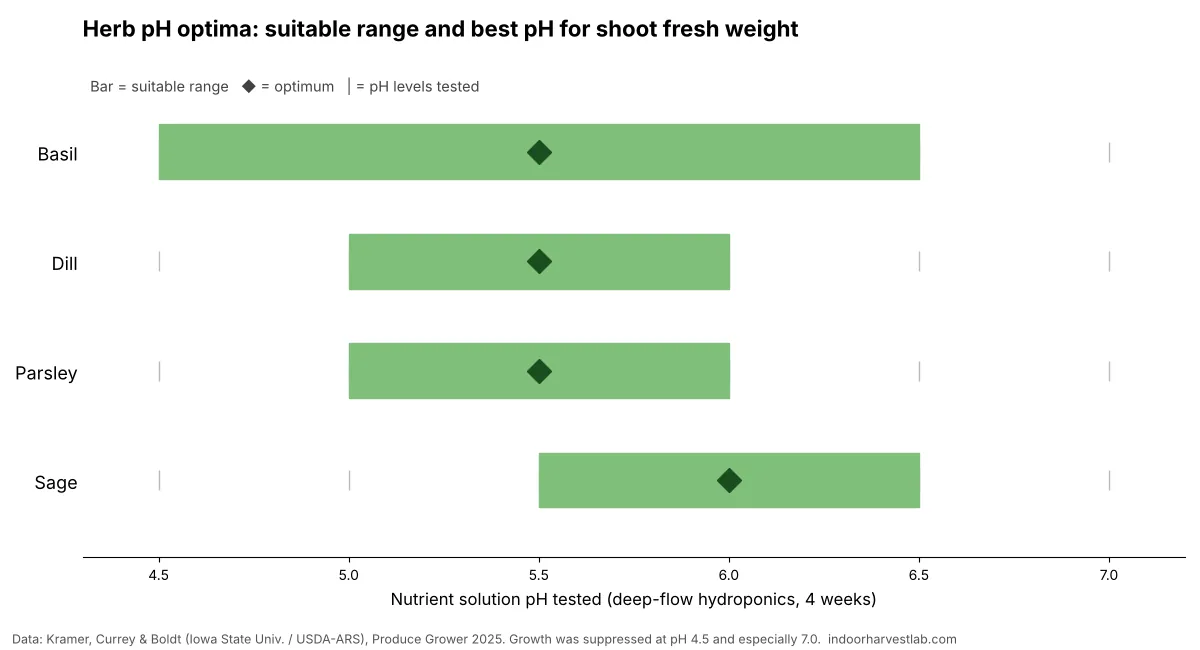
Hannah Kramer and Christopher Currey (Iowa State University) with Jennifer Boldt (USDA-ARS) grew basil ‘Nufar’, dill ‘Hera’, parsley ‘Giant of Italy’ and sage in deep-flow hydroponics at six pH levels, from 4.5 to 7.0, for four weeks. Shoot fresh weight peaked at pH 5.5 for basil, dill and parsley, and at 6.0 for sage. Basil had the broadest suitable range (4.5–6.5); dill and parsley preferred 5.0–6.0; sage 5.5–6.5 (Kramer, Currey & Boldt, Produce Grower).
Two details matter for home growers. First, roots of all four herbs were shorter at pH 4.5 and 7.0 than at 5.0–6.0. Second, in a follow-up study at pH 6.0, 7.0 and 8.0, higher pH reduced dill, parsley and sage growth, and doubling the micronutrients did not fix it (Kramer thesis, Iowa State). In other words, you can’t simply feed your way out of a high pH.
Basil at very low pH: Ohio State
Ohio State researchers tested basil at pH 5.5, 5.0, 4.5 and 4.0. To their surprise, plants grew at pH 4.0 without a significant reduction in shoot mass, root mass, height or leaf number, and showed no nutrient-disorder symptoms (Gillespie, OSU). Later OSU work used pH 4.0–4.5 to suppress Pythium root rot: basil roots at pH 4.0 stayed healthy while those at 5.5 showed disease (HortiDaily, citing e-GRO). That’s a specialist tool, not a default setting, but it shows basil is far more forgiving than charts suggest.
Lettuce: Cornell, 2017
Cornell engineers compared butterhead lettuce in hydroponic solution at pH 5.8 and 7.0. In their earlier trial the pH 7.0 plants produced 26% less shoot fresh weight and 18% less dry weight than plants at 5.8 (Anderson, de Villiers & Timmons, 2017). For lettuce, then, “tolerates 7.0” and “grows best at 7.0” are very different statements. Hold it near 5.8–6.0, and if you’re fighting brown leaf edges, read our guide to lettuce tip burn.
Why Your Reservoir pH Keeps Drifting
pH that won’t stay put is the number-one complaint from new growers. It’s rarely a faulty meter. Usually the system is doing exactly what chemistry says it should.
pH creeping up
- Alkaline water. Bicarbonate in tap or well water raises pH. OSU flags water above 75 ppm alkalinity as a cause of rising solution pH and advises checking more often when you use it (OSU HLA-6722). Our guide to tap water for hydroponics explains how to read a water report.
- Nitrate-heavy feeding. Fertiliser nitrogen form drives root-zone pH. In the UNH/UF case study, a nutrient with 90% nitrate and 10% ammonium let arugula’s solution drift to pH 7.0; the authors note most crops need 10–30% ammonium for a stable pH, and arugula about 35% (Dickson & Fisher, Produce Grower).
- Fast-growing plants in a small reservoir. The less water per plant, the faster any shift happens.
pH dropping
- Ammonium-rich nutrients, the reverse of the nitrate effect above.
- Decaying roots or organic matter in the reservoir. A sudden, unexplained drop is worth a root check; see hydroponic root rot.
- Over-correction with pH Down, especially in small tanks.
Different crops also push pH differently. Dickson and Fisher found that arugula drove its solution up to 7.0 while lettuce, spinach and basil on the same fertiliser and EC (1.8 mS/cm) stayed at 5.7–6.0. If you mix crops in one tank, expect the most “alkalising” crop to set the direction.
How to Check and Adjust pH, Step by Step
Step 1: Calibrate the meter
Calibrate with fresh buffer solutions, usually pH 7 and 4 (OSU also lists 10). A drifting probe is a common source of phantom pH problems. Our pH meter for hydroponics guide covers calibration and probe storage.
Step 2: Add nutrients first, then measure
Fill the reservoir, add nutrients to the EC you want, stir well and let the reading stabilise for a couple of minutes, as OSU recommends for EC. Nutrients change pH, so adjusting pH before feeding wastes effort.
Step 3: Adjust in small doses
Add pH Up or pH Down a few drops at a time, mix, wait, and re-read. Aim for about 6.0 on a fresh mix, as Dickson and Fisher suggest, so the solution has room to drift either way. Step-by-step methods and household options are in our guides to lowering pH and raising pH.
Step 4: Re-check on a schedule
Check daily for the first week of a new setup to learn how your system behaves, then settle into whatever rhythm keeps you inside 5.5–6.5. Alkaline water or a crop like arugula means more frequent checks.
Step 5: Fix the cause, not just the number
If you’re dosing pH Down every single day, the long-term fix is upstream: treat high-alkalinity water with acid or reverse osmosis (both OSU options), or switch to a nutrient with a slightly higher ammonium share. Changing the solution on a regular schedule also resets drift; see how often to change hydroponic water.
pH Symptom Triage: What the Leaves Are Telling You
Use this table alongside the hydroponic pH chart above when a crop looks off and you suspect pH. Always confirm with a calibrated meter before acting, because the same symptoms can come from low EC, cold roots or root disease.
| Symptom | Likely pH link | What to do |
|---|---|---|
| Yellowing between veins on the newest leaves | High pH limiting iron (Penn State; arugula at pH 7.0) | Bring pH to 5.8–6.0; check alkalinity of source water. |
| Yellowing between veins on older leaves | High pH can also cause magnesium deficiency (Penn State) | Lower pH; check that your feed supplies magnesium (see cal-mag). |
| Brown, burnt tips on young leaves | Low pH is one cause of calcium deficiency (Penn State); humidity and airflow also matter | Raise pH into range; improve air movement. |
| Short, stubby roots | pH 4.5 or 7.0 shortened herb roots (Kramer et al.) | Return to 5.0–6.0 for herbs. |
| Slow growth, no obvious symptoms | Lettuce at pH 7.0 lost about a quarter of its yield (Anderson et al.) | Hold lettuce near 5.8. |
| pH rises fast after every adjustment | Alkaline water or nitrate-dominant feed | Acidify or RO-filter water; consider a nutrient with more ammonium. |
From the Lab Bench
Step back and the research tells a consistent story. Plants are less fussy about pH than the internet is. Basil grew normally at 4.0; four herbs barely changed shoot growth between 5.0 and 6.5. What separates good crops from poor ones is the long stretch at the edges, especially the high edge, where iron and manganese slip away and extra micronutrients don’t rescue growth.
So think of pH as a guard-rail, not a dial you tune to two decimals. A sensible rule of thumb: set a fresh solution near 6.0, let it wander between 5.6 and 6.2, and act when it leaves 5.5–6.5. Skew lower for basil, cucumber, peppers, dill and parsley; tolerate a little higher for brassicas, leeks and pak choi.
The other lesson is that drift is information. A reservoir that climbs every day is telling you about your water’s alkalinity or your fertiliser’s nitrogen balance. A reservoir that suddenly falls may be telling you about roots. Chasing the number without asking why is how growers end up dumping a cup of acid into a 20-litre tank.
Finally, don’t read any hydroponic pH chart in isolation. pH and EC interact, and both depend on temperature and how big the reservoir is relative to the plants. If a crop looks hungry, check EC against the EC chart before you blame pH.
FAQ
What is the best pH for hydroponics?
For most hydroponic vegetables and herbs, keep the nutrient solution between pH 5.5 and 6.5, with a set point of about 5.8–6.0. University research (Dickson and Fisher, 2017) suggests a tighter 5.6–6.2 window for most crops.
What pH is best for hydroponic lettuce?
Aim for about 5.8–6.0. Extension tables say lettuce tolerates 6.0–7.0, but Cornell trials found lettuce at pH 7.0 produced 26% less fresh weight than lettuce at pH 5.8.
What pH do hydroponic tomatoes need?
Oklahoma State University Extension lists pH 6.0–6.5 for hydroponic tomatoes, with an EC of 2.0–4.0 mS/cm. Peppers sit slightly lower, at 5.5–6.0.
What is the best pH for hydroponic basil?
Oklahoma State lists 5.5–6.0. Iowa State trials found basil grew best at pH 5.5 and stayed productive from 4.5 to 6.5, and Ohio State found basil grew normally even at pH 4.0.
Can I grow different plants in one reservoir if their pH needs differ?
Yes. Most common crops overlap between pH 5.8 and 6.2, so run the shared middle rather than the extremes of any one crop. Group high-pH-tolerant crops such as cabbage, leek and pak choi separately if you can.
Why does my hydroponic pH keep rising?
The usual causes are alkaline source water (OSU flags alkalinity above 75 ppm) and a nitrate-heavy nutrient. Acidifying or RO-filtering the water, or using a nutrient with a slightly higher ammonium share, addresses the cause.
How often should I check pH in hydroponics?
Check daily for the first week of a new system to learn how it drifts, then as often as needed to stay within pH 5.5–6.5. Systems with hard water or fast-growing crops need more frequent checks.
Sources
- Singh, H. & Dunn, B. (2016). Electrical Conductivity and pH Guide for Hydroponics. Oklahoma Cooperative Extension Service, HLA-6722.
- Sánchez, E., Di Gioia, F., Berghage, R. et al. Hydroponics Systems and Principles of Plant Nutrition: Essential Nutrients, Function, Deficiency, and Excess. Penn State Extension.
- Kramer, H. L., Currey, C. J. & Boldt, J. K. (2025). pH optima: Determining the optimal pH for hydroponic herb production in controlled environments. Produce Grower.
- Kramer, H. L. (2025). Quantifying the effects of pH on the growth of fresh-cut hydroponic culinary herbs. MS thesis, Iowa State University.
- Anderson, T. S., de Villiers, D. & Timmons, M. B. (2017). Growth and Tissue Elemental Composition Response of Butterhead Lettuce (Lactuca sativa, cv. Flandria) to Hydroponic and Aquaponic Conditions. Horticulturae 3(3):43.
- Gillespie, D. P. Influence of nutrient solution pH on hydroponic basil (Ocimum basilicum) plant growth and nutrient content. The Ohio State University Knowledge Bank.
- Dickson, R. & Fisher, P. (2017). Edible crop species differ in their pH effect in hydroponics. Produce Grower.
- HortiDaily (citing e-GRO). Considerations for lowering pH to suppress root rot diseases in hydroponics.
- Greenhouse Industry Roundtable of the Midwest, The Ohio State University. Hydroponic Vegetable Growth: A Graphical Primer.