
It’s late October. The garden kale is getting battered by frost, the supermarket bunches are limp by Thursday, and you start wondering whether that sunny shelf by the kitchen window could keep you in fresh leaves until spring. You scatter a few seeds in a pot. Three weeks later you have a row of pale, floppy seedlings leaning hard toward the glass, and you’re not sure what went wrong.
Short answer: Yes, you can grow kale indoors all year, and it is one of the easiest leafy greens to keep going. Give it a cool room of about 60–70°F (16–21°C), a grow light that delivers roughly 12–14 mol/m²/day of light, and a pot at least 12 inches (30 cm) wide and deep per plant. Pick baby leaves after about 3–4 weeks, or let plants size up and harvest the outer leaves for months.
This guide pulls together extension advice and controlled-environment research into one plan. By the end you’ll know which varieties fit indoors, the exact temperature, light and nutrient numbers to aim for, how to grow kale indoors in soil or a simple hydroponic setup, and how to fix the problems that usually show up in the first month.
Can you grow kale indoors? Why it’s easier than spinach
Kale (Brassica oleracea) is a cool-season leafy green from the cabbage family. Utah State University Extension says it grows best when temperatures don’t go above 75°F, and that high temperatures reduce growth and cause bitter or off flavours (USU Extension). Johnny’s Selected Seeds gives a growing range of 55–75°F (13–24°C) with an optimum of 60–70°F (16–21°C) (Johnny’s Seeds). A cool spare room or a spot away from radiators sits right in that window.
The bigger advantage is how kale flowers. The RHS notes that most kale varieties are biennial: they keep cropping until they flower in their second year (RHS). That is a very different life cycle from spinach, which is pushed into bolting by long days. If you’ve read our guide to growing spinach indoors, you’ll remember the strict 10–12 hour light cap. Kale doesn’t need that cap, so you can run a longer light schedule and use a gentler, cheaper light to reach the same daily dose.
Kale is also more forgiving of low light than lettuce. In a growth-chamber trial published in HortScience, kale, leaf lettuce and spinach were grown for 28 days at daily light integrals (DLI) of 8, 10, 12 and 14 mol/m²/day. Raising the DLI from 8 to 14 increased lettuce dry weight by 203%, but kale by only 47% (Baumbauer et al., 2019). In plain terms: kale still makes a usable crop when your light is modest, which is exactly the situation most indoor growers are in.
Numbers to hold: indoor kale targets at a glance
Here are the targets that matter most, with the source for each. Treat them as ranges to stay inside, not single numbers to hit exactly.
| What | Target for indoor kale | Source |
|---|---|---|
| Germination (soil) temperature | 68–77°F (20–25°C) gives fast emergence; Johnny’s suggests keeping soil above 75°F (24°C) until seeds sprout | Oregon State (cabbage data); Johnny’s |
| Days to emerge | About 15 days at 50°F, 9 at 59°F, 6 at 68°F, 4 at 77°F (cabbage, same species) | Oregon State Extension |
| Seedling temperature | About 55°F (13°C) at night, 65°F (18°C) by day | USU Extension |
| Growing temperature | 55–75°F (13–24°C); best 60–70°F (16–21°C); keep below 75°F | Johnny’s; USU |
| Daily light integral (DLI) | 12–14 mol/m²/day is a good target; kale was still productive at 8–10 | Baumbauer et al. 2019; Currey et al., Iowa State |
| Light intensity (PPFD) | About 210–280 µmol/m²/s for 14–16 hours (calculated from the DLI target) | Calculated: DLI ÷ (hours × 0.0036) |
| Soil pH | 6.0–7.5 | Johnny’s |
| Hydroponic EC | At least 1.0 mS/cm; no extra yield above that in trials up to 5.0 | Currey et al., Iowa State |
| Hydroponic pH | 5.8 was used in the Iowa State trials | Currey et al. |
| Container size | At least 12 in (30 cm) wide and deep for one mature plant; baby leaves 3 in (7.5 cm) apart | RHS |
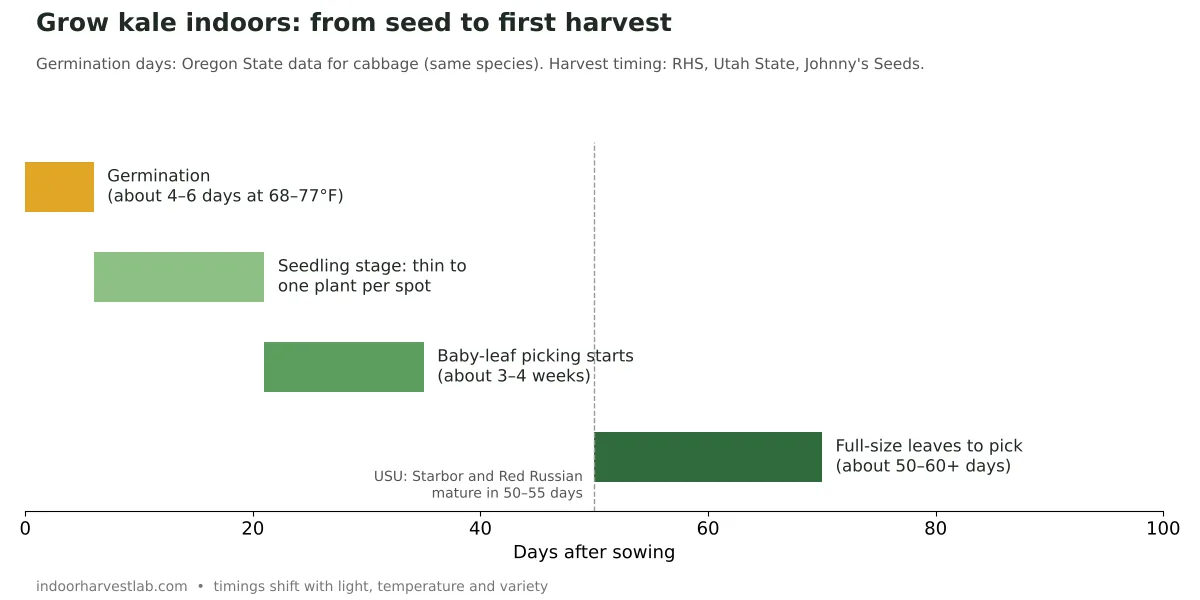
| Days to harvest | Baby leaves from about 3–4 weeks; full-size leaves about 50–55 days for fast varieties | Baumbauer; USU |
A quick note on that germination row. Oregon State’s classic germination table doesn’t list kale separately, but it does list cabbage, which is the same species. It’s the closest controlled data we have, and it matches what seed companies print on kale packets.
How to grow kale indoors in pots, step by step
This is the core method to grow kale indoors. It works on a bright windowsill in spring and autumn, and under a grow light in the darker months. The steps run in order from choosing seed to your first harvest.
Step 1: Choose a compact kale variety
Full-size kale can reach 3 feet (90 cm) tall, which is a lot of plant for a shelf. The RHS points container growers toward compact types such as ‘Dwarf Green Curled’, and lists ‘Starbor’ (compact) and ‘Yurok’ F1 (a compact Tuscan type) among its Award of Garden Merit varieties (RHS). For quick baby leaves, it suggests salad-friendly varieties such as ‘Red Russian’. Utah State rates ‘Starbor’ (55 days), ‘Red Russian’ (50 days) and ‘Scarlet’ (55 days) for production and eating quality (USU Extension).
| Variety | Leaf type | Why it suits indoors | Source |
|---|---|---|---|
| Dwarf Green Curled | Tightly curled, green | Compact; RHS names it for containers | RHS |
| Starbor | Curled, green | Compact; 55 days to maturity | RHS; USU |
| Red Russian | Flat, oak-like, purple veins | Tender salad leaves; 50 days | RHS; USU |
| Yurok F1 | Narrow, puckered (Tuscan) | Compact Tuscan type | RHS |
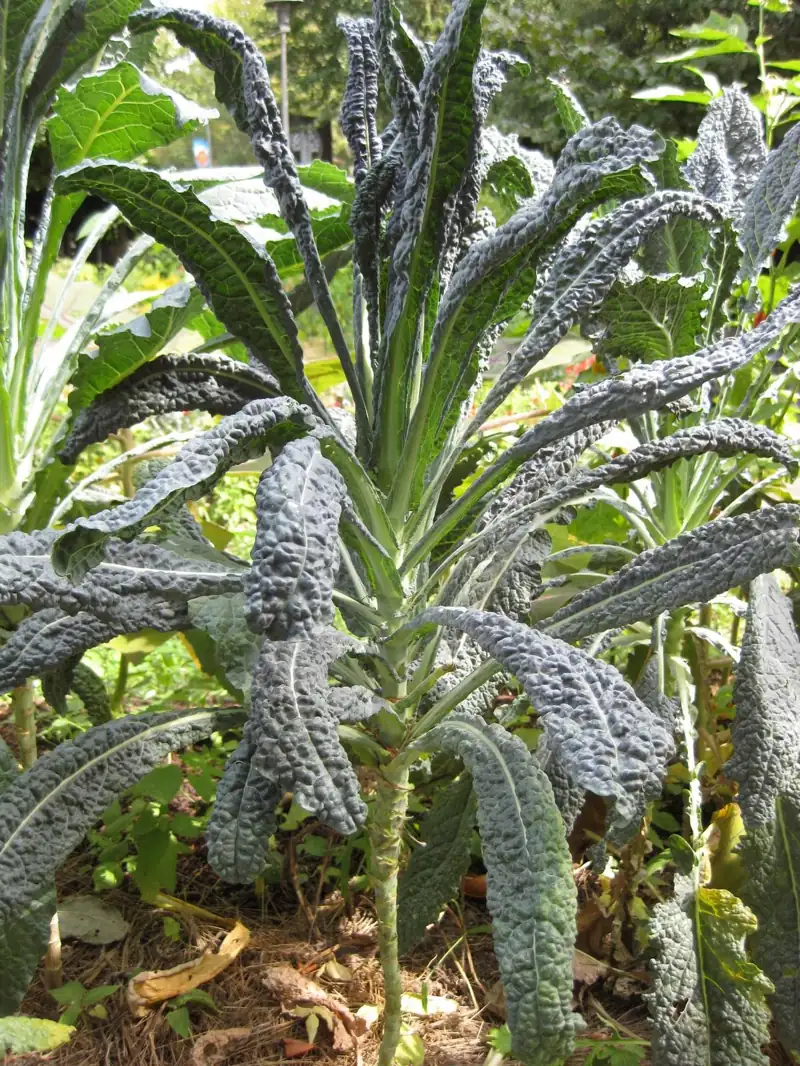
| Nero di Toscana / Lacinato | Long, dark, blistered | Tall and upright; best as baby leaf or in a deep pot | RHS |
Step 2: Pick the right pot and mix
For one mature plant, use a pot at least 12 inches (30 cm) wide and deep, which is the RHS recommendation for container kale (RHS). For baby leaves, a window box or shallow trough works well, with plants about 3 inches (7.5 cm) apart. Fill it with a fresh peat-free or peat-based potting mix, not garden soil. Johnny’s lists a pH range of 6.0–7.5 and notes that consistent moisture gives the highest-quality leaves (Johnny’s). Make sure the pot drains freely; a saucer of standing water is how fungus gnats get started.
Step 3: Sow and germinate warm
Sow seeds ¼–½ inch (6–12 mm) deep (USU Extension). The RHS suggests two seeds per spot, removing the weaker seedling if both come up (RHS). Then think about temperature. Johnny’s recommends keeping the soil above 75°F (24°C) until germination (Johnny’s), and Oregon State’s data for cabbage show emergence in about 4 days at 77°F but about 15 days at 50°F (Oregon State). A cold windowsill in November can easily sit in the 50s, so a heat mat or the top of a warm appliance speeds things up a lot.
Step 4: Cool it down as soon as seedlings appear
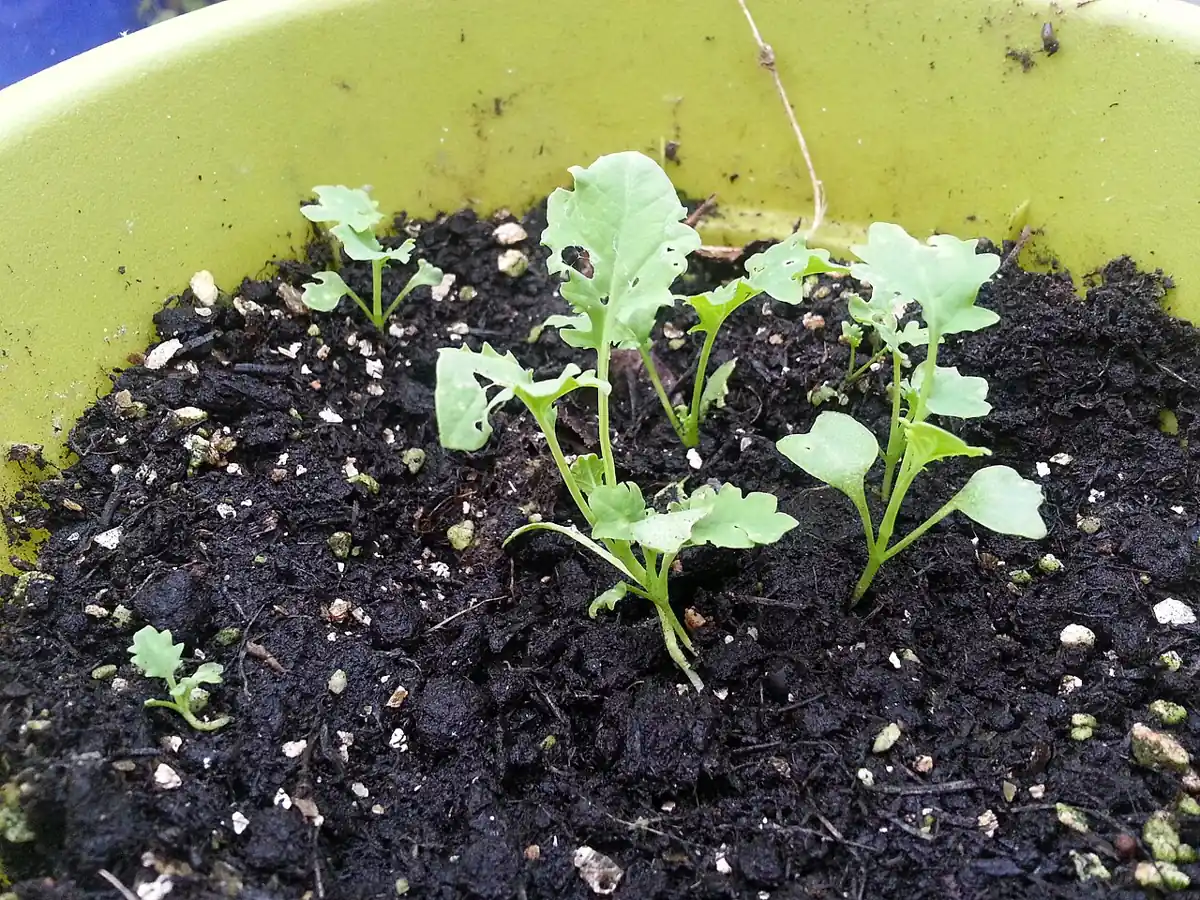
This is the step most people miss, and it’s the reason for those pale, floppy seedlings in the opening scene. Utah State says cool-season crops such as kale prefer about 55°F at night and 65°F by day, and that warmer conditions give spindly plants (USU Extension). Take the pot off the heat mat the day the first loops appear, and give it strong light straight away. If yours have already stretched, our guide to leggy seedlings explains how to rescue them.
Step 5: Thin, then feed lightly
Thin seedlings when they have 3–4 true leaves (USU Extension), leaving one plant per spot for full-size kale. Snip the extras at soil level with scissors so you don’t disturb the roots of the plant you keep, and eat the thinnings. About 3–4 weeks after sowing, start a balanced liquid feed at the label rate every couple of weeks. Potting mix holds only a limited supply of nutrients, and a fast-growing leafy crop uses it up.
Step 6: Water evenly
Water when the top inch of mix feels dry, then water until it drains. Utah State warns that moisture fluctuations make kale leaves tough and off-flavoured (USU Extension). In a warm, dry room in winter, that can mean checking every day or two. Bottom watering in a tray until the surface of the mix darkens is an easy way to wet the whole root ball evenly.
Step 7: Harvest from the outside in
Start picking baby leaves once plants have several leaves the size of a spoon. For bigger plants, Johnny’s advises harvesting by clipping individual leaves, starting about 2 months after planting (Johnny’s). Always take the oldest, outer leaves and leave the central growing point alone; the RHS notes that regular picking encourages more leaves to grow (RHS). As a rule of thumb, leave at least 5–6 leaves on the plant so it can keep photosynthesising.
Light needed to grow kale indoors: DLI, PPFD and hours
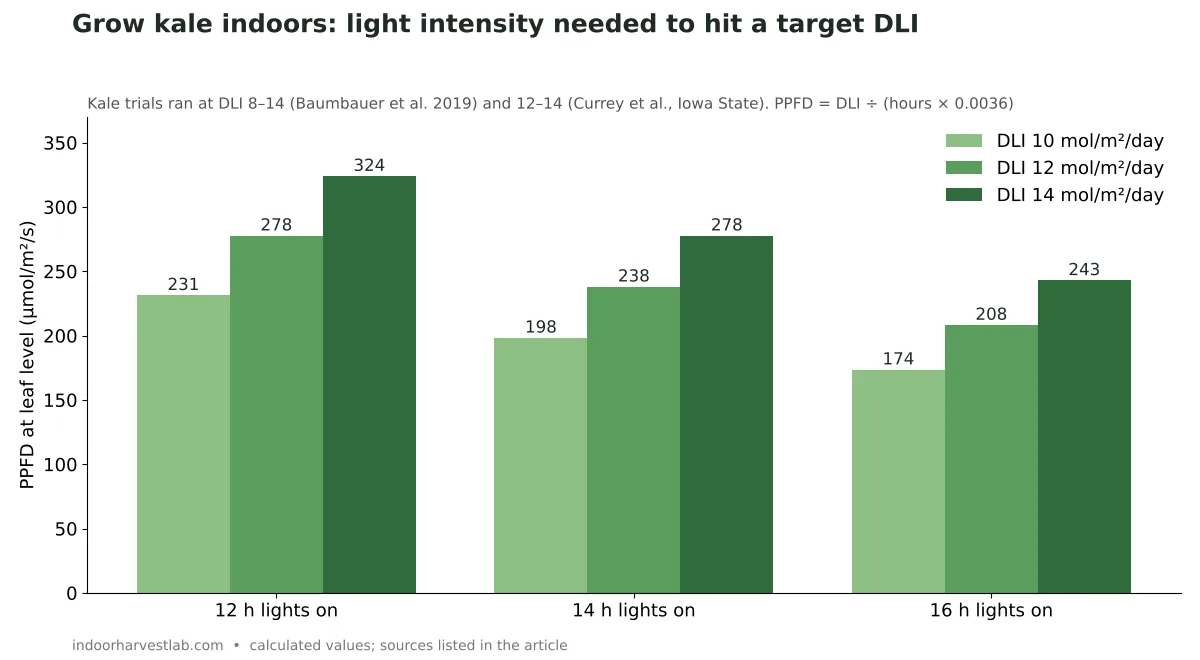
Light is the factor that decides whether you get thick, dark leaves or thin, pale ones. The most useful number is the daily light integral (DLI): the total amount of photosynthetic light a plant receives in a day. In the HortScience growth-chamber trial, kale grew at every DLI from 8 to 14 mol/m²/day, and dry weight kept rising up to 14 (Baumbauer et al., 2019). In the Iowa State hydroponic trials, kale was finished in a greenhouse at a DLI of 12–14 (Currey et al.). That makes 12–14 mol/m²/day a sensible target for indoor kale.
To turn a DLI target into a light setting, divide it by the hours the light is on, times 0.0036. The chart below does the maths for you.
| Lights on | PPFD for DLI 12 | PPFD for DLI 14 |
|---|---|---|
| 12 hours | ≈ 278 µmol/m²/s | ≈ 324 µmol/m²/s |
| 14 hours | ≈ 238 µmol/m²/s | ≈ 278 µmol/m²/s |
| 16 hours | ≈ 208 µmol/m²/s | ≈ 243 µmol/m²/s |
Because kale isn’t held back by the day-length trigger that makes spinach bolt, a 14–16 hour schedule is a sensible choice: it lets a modest LED panel reach the target. There is also a nutrition angle. When ‘Winterbor’ kale was grown at light levels from 125 to 620 µmol/m²/s, the highest lutein, β-carotene and chlorophyll levels were found at 335 µmol/m²/s (Lefsrud et al., 2006). You don’t need to chase that number at home, but it shows that brighter light improves more than just the size of the leaves.
A south-facing window can work from spring to early autumn. In a northern winter it rarely gets close to a DLI of 12, and that’s when indoor kale stretches and fades. A basic full-spectrum LED, hung at the height where the maker’s PPFD map shows roughly 200–280 µmol/m²/s, solves this; our buyer’s guide to grow lights for seed starting explains how to compare panels by PPFD rather than watts.
Growing kale hydroponically indoors
If you want to grow kale indoors without soil, it does well in simple water-culture systems. The best data come from Iowa State University, where Christopher Currey’s team grew ‘Starbor’ kale in deep-flow hydroponics at nutrient strengths from 0.5 to 5.0 mS/cm, with pH held at 5.8 (Currey, Yost and Sporer, GPN 2020). Kale fresh weight was the same anywhere from 1.0 to 5.0 mS/cm, but lower at 0.5 mS/cm, where the plants also showed sulfur deficiency. Their conclusion: keep kale at an EC of at least 1.0 mS/cm, because going higher doesn’t add yield.
That’s good news for home growers. It means kale can share a reservoir with lettuce and other greens without a special recipe. A mid-strength leafy-green solution, around 1.2–1.8 mS/cm, keeps kale above its threshold and stays gentle on companions such as lettuce.
| Setting | Kale target | Notes |
|---|---|---|
| EC | ≥ 1.0 mS/cm (500+ ppm on the 500 scale) | No yield gain above 1.0 in Iowa State trials (GPN) |
| pH | 5.8 in trials; 5.5–6.5 is a common hydroponic range | Check twice a week |
| Seedlings | Ready to transplant about 17 days after sowing in foam plugs | Currey et al. |
| Seedling feed | Growth increased with fertilizer up to 200 ppm N | Currey et al. |
| Finish time | About 4 weeks after transplanting into deep-flow | Currey et al. |
For a first attempt, the Kratky method is hard to beat: a lidded tub, a net pot and no pump. If you want bigger plants over a longer harvest, a deep water culture bucket with an air stone gives the roots the oxygen they need. Most home meters show ppm; on the common 500 scale, 1.0 mS/cm reads as 500 ppm.
Troubleshooting indoor kale: symptoms and fixes
When people grow kale indoors and it struggles, the cause is usually one of three things: too little light, too much warmth, or uneven water. Use the table to match what you see to the likely cause.
| What you see | Likely cause | What to do |
|---|---|---|
| Tall, pale, floppy seedlings | Too warm after germination and/or too little light | Drop to about 55–65°F; lower the light or raise PPFD; see leggy seedlings guide |
| Bitter, tough leaves | Room above 75°F, or wet–dry swings in the pot | Move somewhere cooler; water on a regular schedule |
| Lower leaves turning yellow | Old leaves ageing, or nitrogen running low in a long-used mix | Pick yellow leaves off; start or increase liquid feed |
| Pale new growth in hydroponics | EC below 1.0 mS/cm (sulfur and nitrogen run short) | Top up nutrients to at least 1.0 mS/cm |
| Small, slow plants under a light | DLI well below 10 | Increase PPFD or hours; aim for 12–14 mol/m²/day |
| Crinkled, curled leaves with tiny insects underneath | Aphids | Wash off with a strong spray or use insecticidal soap |
| Tiny black flies around the pot | Fungus gnats breeding in wet mix | Let the surface dry; use sticky traps and BTI |
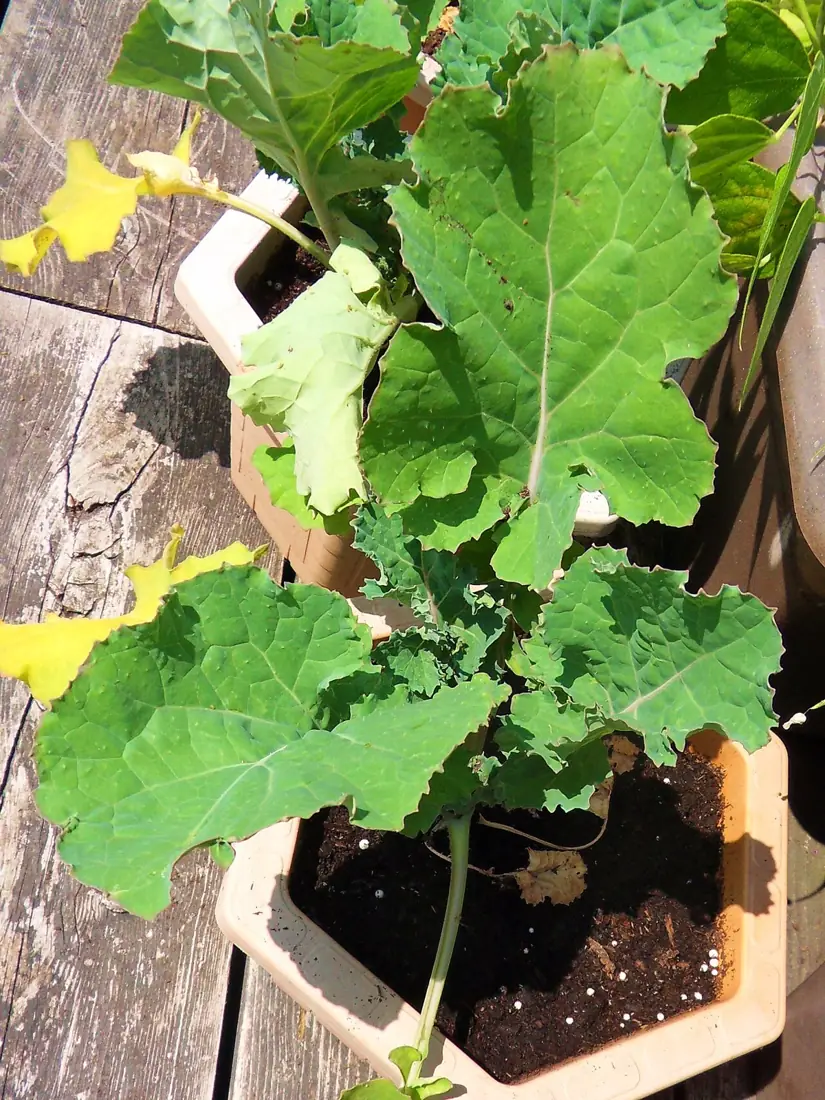
Aphids are the pest Utah State lists first for kale; they feed on the undersides of leaves and make them crinkle and curl (USU Extension). Indoors, a strong spray in the sink or insecticidal soap usually clears them. Small flying insects around the soil are almost always fungus gnats, which is a watering problem rather than a kale problem; our fungus gnat guide walks through the fix.
From the lab bench: why cool kale tastes sweeter
Gardeners have long said that kale tastes better after a frost. Johnny’s notes that eating quality improves into late autumn with light frost (Johnny’s), and the research explains why. In a controlled study from Norway, curly kale was grown at 15/9°C or 21/15°C under 12- or 24-hour photoperiods and then given a cold-acclimation period. Cold acclimation raised soluble sugars, which the authors say can improve taste, while some glucosinolates and unsaturated fatty acids fell (Steindal et al., 2015).
When you grow kale indoors, you can borrow that effect without a freezer. A plant kept in a cool room in the low 60s°F by day and the 50s at night will usually taste milder than one sitting next to a radiator. And if you want a sweeter final harvest, a week in an unheated porch or garage (above freezing) before you pick is a reasonable experiment. Young plants are not seriously damaged down to 25°F, according to Utah State, so a cool spell won’t hurt them.
There is a trade-off worth knowing. In a separate growth-chamber study, the lutein and β-carotene content of ‘Winterbor’ kale rose steadily as air temperature went from 15 to 30°C (Lefsrud et al., 2005). Warmth raised these pigments, while cold raised sugar. For a home grower, the practical middle ground is the range the extension services already recommend: 60–70°F for growth, with cool nights. You get good growth and good flavour, and you avoid the bitterness Utah State links to heat.
The second lesson is about where to spend your money. Since kale gained 47% in dry weight between a DLI of 8 and 14, compared with 203% for lettuce in the same trial (Baumbauer et al.), a mediocre light costs kale much less than it costs lettuce. If your light is limited, give the brightest spot to lettuce and let kale have the edges. If you’d rather grow both side by side, our guide to growing lettuce indoors covers the companion crop.
FAQ
Can you grow kale indoors year-round?
Yes. Kale is a biennial that normally flowers only in its second year, so it doesn’t bolt under long indoor days the way spinach does. Keep it at 60–70°F (16–21°C), give it 12–14 mol/m²/day of light, and pick the outer leaves regularly.
How much light does kale need indoors?
Aim for a daily light integral of 12–14 mol/m²/day. That works out to about 240–280 µmol/m²/s for 14 hours, or 210–245 µmol/m²/s for 16 hours. Kale was still productive at a DLI of 8–10 in trials, but leaves will be smaller.
How long does kale take to grow indoors?
Seeds emerge in about 4–6 days at 68–77°F. Baby leaves can be picked from about 3–4 weeks, and fast varieties such as Red Russian and Starbor reach maturity in about 50–55 days.
What size pot do I need to grow kale indoors?
The RHS recommends a container at least 12 inches (30 cm) wide and deep for one mature plant. For baby leaves, a window box or shallow trough with plants about 3 inches (7.5 cm) apart works well.
Can kale grow without direct sunlight?
Yes, under a grow light. A bright south-facing window can work in spring and autumn, but in winter most windows give far too little light. An LED that delivers about 200–280 µmol/m²/s for 14–16 hours a day replaces the sun.
What EC and pH does hydroponic kale need?
Iowa State research found kale needs an EC of at least 1.0 mS/cm; yields did not rise from 1.0 up to 5.0 mS/cm. The trials held pH at 5.8, and 5.5–6.5 is a safe range.
Why is my indoor kale bitter?
Usually because the room is too warm or watering is uneven. Utah State Extension says kale grows best below 75°F and that heat and moisture swings cause bitter, tough leaves. Move it somewhere cooler and water on a regular schedule.
More guides on indoor greens are in our indoor leafy greens section.
Sources
- Royal Horticultural Society. How to grow kale. RHS Grow Your Own.
- Utah State University Extension. How to Grow Kale in Your Garden. Yard and Garden.
- Crump, W., Beddes, T., Caron, M. and Oliveira, M. (2025). Starting Vegetable Seeds Indoors: IV. Seedling Culture and Transplanting. Utah State University Extension.
- Harrington, J.F. Soil temperature conditions for vegetable seed germination. Oregon State University Extension Service.
- Johnny’s Selected Seeds. Kale: Key Growing Information. Grower’s Library.
- Baumbauer, D.A., Schmidt, C.B. and Burgess, M.H. (2019). Leaf lettuce yield is more sensitive to low daily light integral than kale and spinach. HortScience 54(12): 2159–2162.
- Currey, C.J., Yost, J.O. and Sporer, R.M. (2020). Fertilizing specialty leafy greens. Greenhouse Product News, August 2020 (Iowa State University research).
- Lefsrud, M.G., Kopsell, D.A., Kopsell, D.E. and Curran-Celentano, J. (2006). Irradiance levels affect growth parameters and carotenoid pigments in kale and spinach grown in a controlled environment. Physiologia Plantarum 127(4): 624–631.
- Lefsrud, M.G., Kopsell, D.A., Kopsell, D.E. and Curran-Celentano, J. (2005). Air temperature affects biomass and carotenoid pigment accumulation in kale and spinach grown in a controlled environment. HortScience 40(7): 2026–2030.
- Steindal, A.L.H., Rødven, R., Hansen, E. and Mølmann, J. (2015). Effects of photoperiod, growth temperature and cold acclimatisation on glucosinolates, sugars and fatty acids in kale. Food Chemistry 174: 44–51.