
You’ve got the seed packets lined up, the trays are washed, and the bag of “seed starting mix” at the store costs more per quart than you expected. Then you notice the ingredients list: peat, perlite, vermiculite, lime. That’s it. Surely you can mix that yourself?
Short answer: yes. The most reliable seed starting mix recipe is 1 part sphagnum peat (or rinsed coco coir), 1 part vermiculite and 1 part fine perlite by volume, the blend recommended by UGA and Utah State extension. If you use peat, add dolomitic lime (about 1 lb per 30 gallons of finished mix) to lift its pH from roughly 4 to the 5.5–6.2 range seedlings want. Skip fertilizer and garden soil: seeds carry their own food for the first days, and soil brings disease.
By the end of this guide you’ll be able to mix a batch for one tray or fifty, adjust it for coir or worm castings, test it with a cheap pH/EC meter, and fix the three mistakes that cause most seedling failures in homemade mixes.
What a Seed Starting Mix Has to Do (and Why Garden Soil Fails)
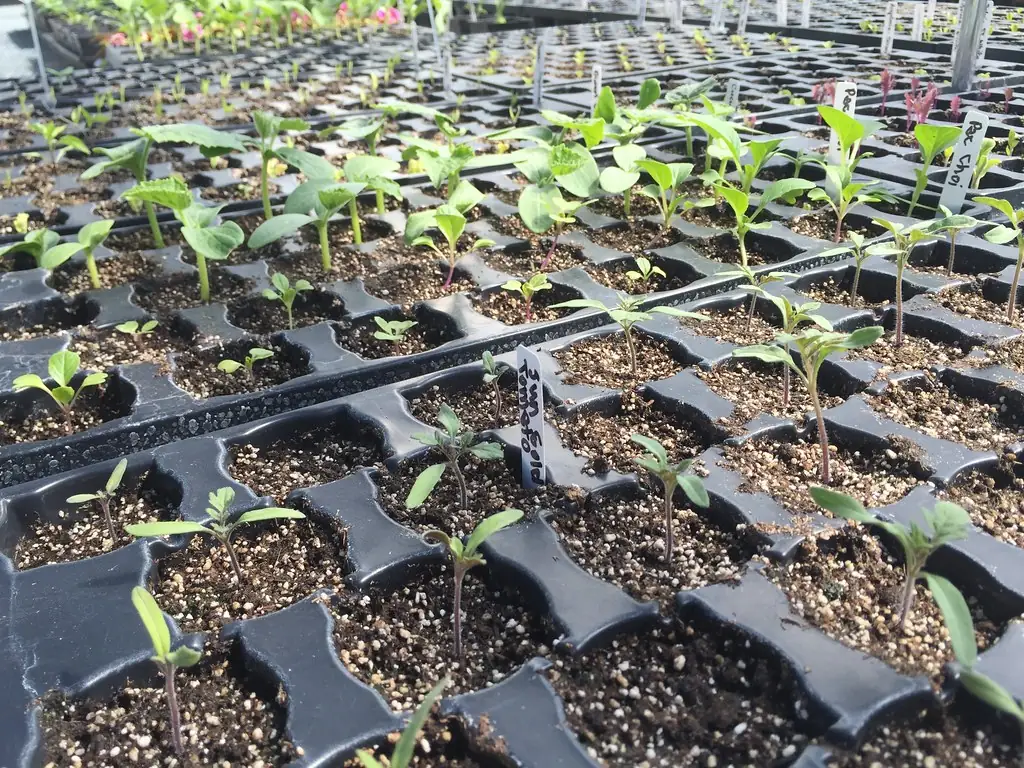
A seed starting mix has a narrower job than potting soil. It only needs to hold a seed in steady moisture, let air reach the new root, and stay clean until the seedling is big enough to move. University of Georgia Extension sums up the spec in four words: fine, light, clean and low in fertility (UGA Extension, 2025).
- Fine and uniform. Big chunks block tiny seeds and leave air gaps where a radicle dries out.
- Light and loose. Seedling roots need micro-pores full of air, not a dense, wet sponge.
- Free of weed seeds, insects and disease. That’s why garden soil is out.
- Low in nutrients. Seeds carry their own reserves; extra fertilizer can burn tender roots and encourage damping-off.
Garden soil fails on almost every count. On its own it’s heavy and poorly aerated, gets waterlogged and sticky when wet, then shrinks into a brick when it dries, and it can carry seedling diseases (MOFGA Fact Sheet #9). In a cell the size of your thumb, those problems are magnified. That’s why every serious mix you’ll see is “soilless”.
Bagged potting soil isn’t ideal either. It’s often coarser, may contain bark chunks, and is usually pre-charged with fertilizer. Utah State’s seed-starting guide says to avoid mixes with larger wood chips and choose products labelled “seed” or “plug” mix (USU Extension, 2025).
The Basic Seed Starting Mix Recipe (1:1:1)
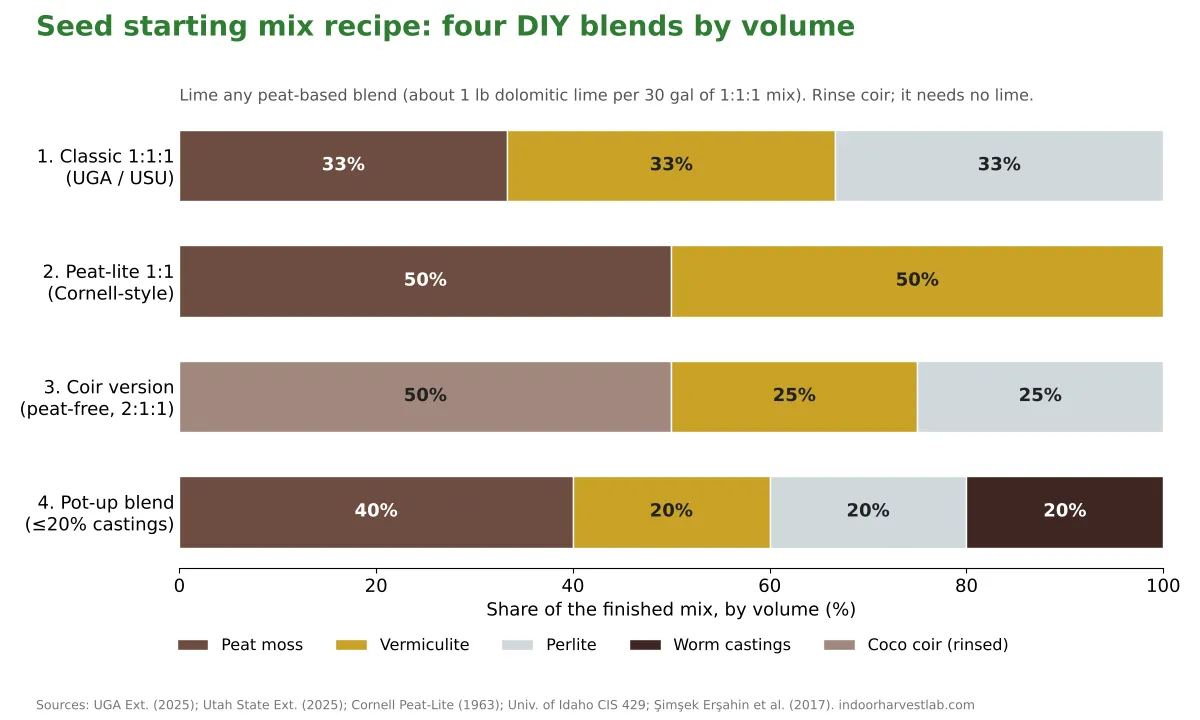
Here’s the workhorse recipe. Both UGA and Utah State extension publish it in almost identical form, and it’s essentially the home-scale version of the soilless mixes greenhouses have used since the 1960s (UGA); (USU).
| Ingredient | Parts by volume | For one 10×20 tray (≈ 5 qt) | For a 3-gallon bucket batch | What it does |
|---|---|---|---|---|
| Sphagnum peat moss or coco coir | 1 | ≈ 1⅔ qt | 1 gal | Holds water like a sponge |
| Vermiculite (fine/medium) | 1 | ≈ 1⅔ qt | 1 gal | Holds water and nutrients, adds some aeration |
| Perlite (fine grade) | 1 | ≈ 1⅔ qt | 1 gal | Drainage and air; keeps the mix loose |
| Dolomitic lime (peat versions only) | — | ≈ ⅔ oz (19 g) | ≈ 1.6 oz (45 g) | Raises pH; supplies calcium and magnesium |
Why each ingredient earns its place
Peat is the water reservoir. Partially decomposed sphagnum peat has 89–96% pore space, and at field capacity roughly half of that holds water and 40% holds air, which gives you a forgiving margin when you’re late with the watering can (Widmer, University of Minnesota). The catch is its acidity, which we’ll fix with lime in a moment.
Vermiculite is a heat-expanded mineral that holds water and nutrients (it has a high cation exchange capacity), has a near-neutral pH, and adds a little magnesium and potassium (MOFGA). Many greenhouse growers sow straight into vermiculite because it’s clean and drains well (UGA).
Perlite is puffed volcanic glass. It holds no nutrients and has no buffering, but it keeps air in the mix. Use fine perlite for seed starting; coarse pieces act like roadblocks for tiny roots (UGA).
Honest note on cost
Extension sources disagree a little here, and both are right. UGA points out that making your own costs a fraction of small bagged mixes when you seed lots of trays, while Utah State warns hobbyists not to expect to save money (USU). The math depends on scale: if you start one or two trays a year, a bag is simpler. If you start ten or more, or want control over what’s in the mix, buying full-size bales of peat, vermiculite and perlite wins.
Numbers to Hold: pH, EC, Moisture and Temperature
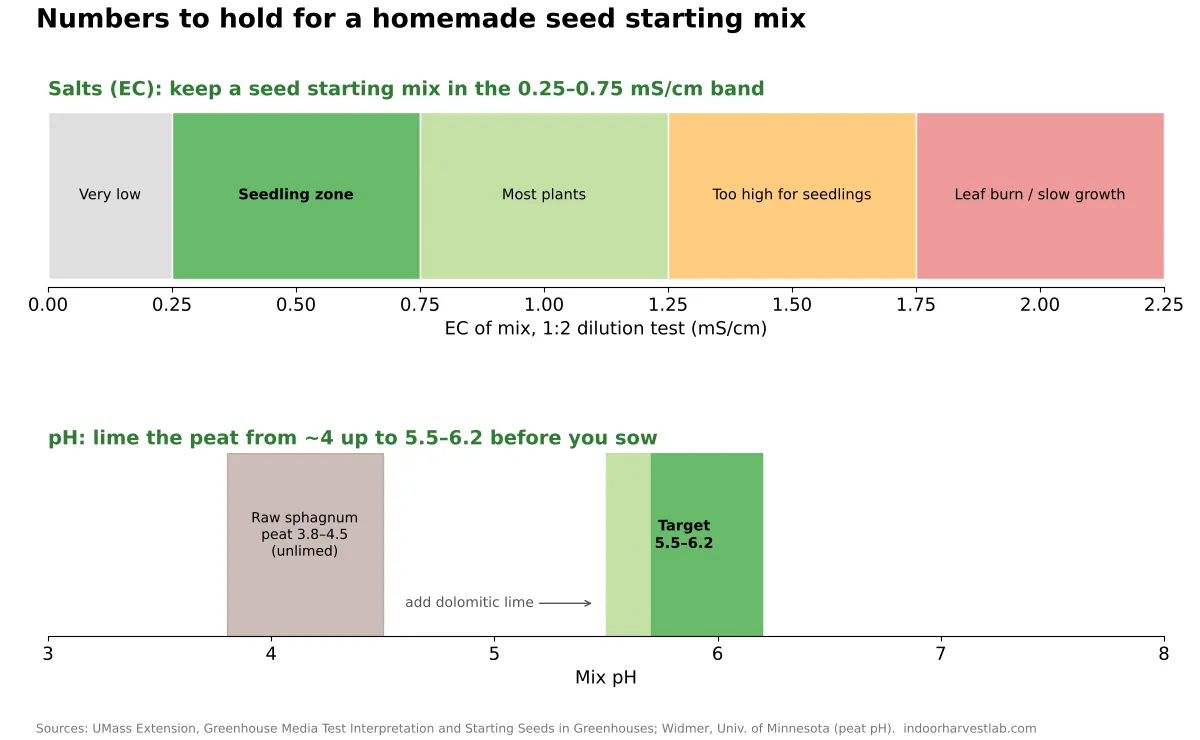
Any seed starting mix recipe is only as good as the numbers it lands on. These are the targets that matter, taken from university greenhouse guidance.
| What to check | Target | Why it matters | Source |
|---|---|---|---|
| Mix pH (soilless) | 5.5–6.0 general; 5.7–6.2 best for germination | Outside this range, nutrient uptake and root growth suffer | UMass media tests; UMass seeds |
| Raw sphagnum peat pH | 3.8–4.5 | Far too acidic until limed | Widmer, U. Minnesota |
| EC (1:2 dilution test) | 0.25–0.75 mS/cm | Above 1.25 mS/cm is too salty for seedlings | UMass media tests |
| Moisture before filling trays | About 2 parts water : 1 part dry mix (≈ 67% moisture) | Pre-wetted mix swells, stays airy and settles less | UMass seeds |
| Squeeze test | No drips when squeezed; holds shape, crumbles when poked | Too wet = rot; too dry = uneven germination | UMass seeds |
| Germination temperature | ≈ 70 °F (21 °C) suits most cool- and warm-season crops | Cold mix slows germination | USU Extension |
| Seedling light | 200–400 µmol/m²/s PPFD, 12–14 h/day | Weak light = leggy seedlings | USU Extension |
| First feeding | At cotyledons: 25–50 ppm N; first true leaves: 50–100 ppm N | Mix has little fertility by design | UMass seeds |
If you want crop-by-crop germination temperatures, our seed germination temperature chart lists them, and the grow lights for seed starting guide covers how to hit that PPFD range on a budget.
How to Make Seed Starting Mix, Step by Step
Mixing this seed starting mix recipe takes about ten minutes. The two steps people skip, liming and pre-wetting overnight, are exactly the ones that make a homemade mix behave like a professional one.
Step 1: Gather and sanitize
You need a clean bucket or tote, a scoop, a dust mask and gloves. Perlite in particular is very dusty, so UGA recommends a mask when pouring it (UGA). Reused trays should be scrubbed and sanitized with a quaternary ammonium product or a 10% bleach solution (USU).
Step 2: Measure by volume
Use the same scoop for every ingredient. Accuracy doesn’t need to be lab-grade for the bulky parts; the University of Idaho’s mix guide notes that extreme accuracy matters only in research settings, but additives such as lime and fertilizer should be measured carefully (University of Idaho CIS 429).
Step 3: Add lime to peat-based mixes
Sphagnum peat starts at pH 3.8–4.5 (Widmer), so it needs calcium. Published rates fall in a fairly tight band:
- University of Idaho: 1 lb dolomitic lime per 30 gallons of a 1:1:1 peat-vermiculite-perlite mix (that’s 1 lb for every 10 gallons of peat) (CIS 429).
- University of Minnesota: about 200 g ground limestone per bushel of peat for propagation mixes, with dolomitic lime needed at roughly double the rate of calcitic lime for the same calcium (Widmer).
- MOFGA: lime at 2–3% of the peat’s weight, mixed in at least five days before planting (MOFGA).
Practically, that works out to roughly 20–45 g (a scant 1–3 tablespoons) of dolomitic lime per gallon of dry peat. Start in the middle, then test, because peat batches vary. Lime reacts slowly, which is why the next step matters.
Step 4: Pre-wet and rest overnight
Dry peat repels water at first. UMass Extension recommends moistening the mix, blending it, and letting it sit overnight (or at least a couple of hours) before filling trays, aiming for about 2 parts water to 1 part dry mix (UMass). Warm water speeds it up. Do the squeeze test: no drips, holds a shape, falls apart when poked.
Step 5: Fill loosely and don’t tamp
Fill cells lightly, brush off the excess, and resist pressing it down. Compaction squeezes out air space, and UMass lists compacted media as a cause of seedlings that corkscrew or lie down instead of rooting in (UMass). Don’t stack filled trays on top of each other either.
Step 6: Sow and cover thinly
Cover seeds that need darkness with a thin layer of medium or coarse vermiculite, which keeps humidity high right at the seed. Fine vermiculite can bury small seed too deeply. Light-requiring seeds stay uncovered or barely covered (UMass). Our paper towel germination guide is handy for checking old seed before you commit a whole tray.
DIY Seed Starting Mix Variations: Coir, Peat-Lite and Worm Castings
The basic seed starting mix recipe is a starting point, not a law. Here’s how the common swaps change the way the mix behaves, and what you have to do differently.
| Recipe (by volume) | Best for | Watch out for | Fix |
|---|---|---|---|
| Classic 1:1:1 peat : vermiculite : perlite + lime | Almost everything; first-timers | Low pH if you skip lime | Lime and rest overnight |
| Peat-lite 1:1 peat : vermiculite + lime | Small seeds, open flats, plug trays | Holds more water; easier to overwater | Bottom-water and let the surface dry slightly |
| Coir version 2:1:1 rinsed coir : vermiculite : perlite | Peat-free growers | Salts and potassium vary by batch; low calcium and magnesium | Buy washed/buffered coir, rinse, feed with Ca/Mg |
| Pot-up blend 2:1:1 base + up to 20% worm castings | Potting up after true leaves | Higher EC; can slow emergence if used for sowing | Keep castings out of the germination layer |
Coco coir instead of peat
Coir is the most common peat substitute, and it works, but it isn’t a drop-in swap. A study of 13 coir dusts from Asia, the Americas and Africa found their pH was slightly acidic (so no lime is needed), but salinity ranged enormously, from 0.39 to 5.97 dS/m in a saturated extract. Potassium, sodium and chloride were high, while calcium and magnesium were low (Abad et al., 2002, Bioresource Technology).
A companion study found coir is extremely porous (above 94%) and, at a particle size similar to peat, holds less water and more air (Abad et al., 2005, HortScience). That’s why our coir version uses more coir and less perlite (2:1:1): you’re already getting plenty of air. In practice, buy “washed” or “buffered” coir, rinse it again, and check the EC of the runoff before you sow. Once seedlings need feeding, use a fertilizer that supplies calcium and magnesium.
Peat-lite (just peat and vermiculite)
This is the classic Cornell Peat-Lite approach: 50% peat and 50% vermiculite plus limestone. Nassau County Parks adopted it for its entire bedding-plant seedling production after 1962 trials (NY State Flower Growers Bulletin 211, 1963). It holds more water than the 1:1:1 blend, so it suits fine seeds and open flats where drying out is the bigger risk.
Worm castings and compost
Worm castings are popular in “seed starting mix recipe with worm castings” searches, and the research is mixed. In a tomato trial, replacing 10%, 20% and 30% of the medium with vermicompost delayed and reduced emergence at every rate, improved seedling growth up to 20%, and hurt both emergence and growth above 20%, which the authors linked to the vermicompost’s high EC (Şimşek Erşahin et al., 2017).
Compost cuts both ways too: its microbes may help suppress seedling disease, but it can also introduce the pathogens you’re trying to avoid (UGA). If you use compost, MOFGA’s spec is mature compost with pH 6–6.5, low salts, and a C:N ratio of 15–25:1 (MOFGA). Our advice: sow into plain mix, then use castings in the potting-up mix once seedlings have true leaves.
Common Homemade Mix Problems and How to Fix Them
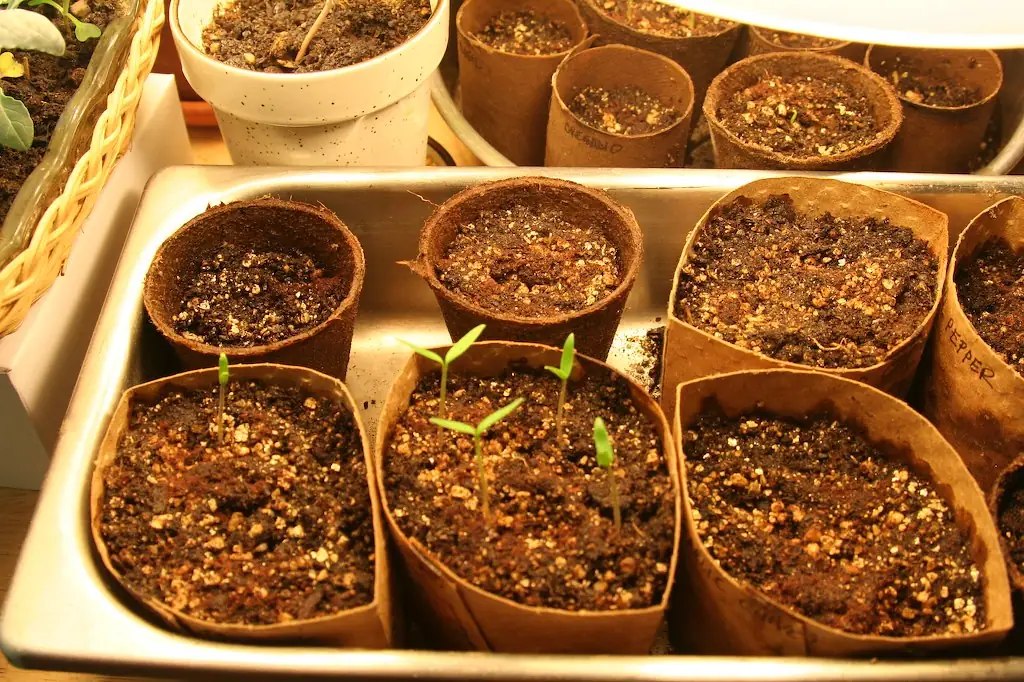
Most failures with a homemade seed starting mix recipe trace back to four things: pH, salts, compaction or moisture. This table helps you work backwards from the symptom.
| What you see | Likely cause in the mix | What to do |
|---|---|---|
| Seedlings collapse at the soil line | Damping-off; mix kept too wet; reused dirty trays or soil/compost | Sanitize trays, water from below, add airflow; see our damping-off guide |
| Roots corkscrew or seedlings lie flat | Compacted mix, high salts or high pH | Fill loosely; test EC and pH (UMass) |
| Upward-cupped leaves, thick stubby roots | High soluble salts, mix too dry, or sodium in water | Flush with plain water; rinse coir; check water source (UMass) |
| Pale, slow seedlings after 2–3 weeks | No nutrients left (normal for soilless mix) | Start dilute feeding: 25–50 ppm N, then 50–100 ppm N (UMass) |
| Water beads and runs off the surface | Dry peat that was never pre-wetted | Pre-wet with warm water, rest overnight; bottom-water |
| Uneven or patchy germination | Patches too dry, seeds buried in fine vermiculite, or cold mix | Squeeze-test moisture; use medium vermiculite to cover; keep near 70 °F |
| Tiny black flies around trays | Constantly wet surface, organic-rich mix | Let the top dry between waterings; see fungus gnats |
If seedlings stretch toward the light, that’s rarely the mix’s fault. Our leggy seedlings fixes cover light and temperature.
Test your homemade mix with a pH/EC meter
You don’t need a lab to check a batch. The quick 1:2 dilution test that UMass’s interpretation chart is built on uses one part mix to two parts distilled water by volume (UMass).
- Scoop 1 cup of moist mix into a clean jar and add 2 cups of distilled water.
- Stir well, let it stand, then stir again.
- Dip a calibrated pH meter and an EC meter into the liquid (or strain it first).
- Compare: pH 5.5–6.2 and EC 0.25–0.75 mS/cm means you’re ready to sow.
If pH reads below 5.5, mix in a little more lime, re-wet and test again after a day or two. If EC is high (common with coir or castings), rinse the material with plain water and retest. If you don’t own a meter yet, our pH meter buying and calibration guide explains what’s worth paying for. The same pen works for your hydroponic reservoir later.
From the Lab Bench
Strip a seed starting mix down to physics and chemistry and it gets much simpler. For its first days the seedling barely feeds from the mix at all; it’s living off the reserves in the seed. So the mix’s whole job in week one is water plus oxygen at a stable pH. Every ingredient decision is really a decision about the air-to-water ratio in those tiny pores.
That’s why the swaps aren’t symmetrical. Coir, at the same particle size, drains to a wetter-air balance than peat (Abad 2005), so it tolerates less perlite. Peat holds more water, so it benefits from more. And because the cell is so small, a mix that is only slightly too salty or too acidic for a garden bed becomes a real problem for a root that’s two centimetres long. That’s the logic behind the narrow EC band (0.25–0.75 mS/cm) for seedlings in the UMass chart.
The worm-castings data shows the same principle from the other side. Castings add nutrients and salts. That helps a seedling with true leaves and hurts a germinating seed. So time your inputs: a plain, clean, limed mix for sowing; a richer mix for potting up. If you remember one rule from this page, make it that one.
Finally, consistency beats cleverness when you tweak any seed starting mix recipe. MOFGA notes that the weakness of homemade mixes is that they aren’t always dependably consistent. Pick one recipe, write down exactly what you did, test pH and EC once per batch, and change one thing at a time.
Seed Starting Mix FAQ
What is the best seed starting mix recipe?
For most home growers, equal parts sphagnum peat (or rinsed coco coir), vermiculite and fine perlite by volume. With peat, add dolomitic lime (about 1 lb per 30 gallons of finished mix) so the pH lands near 5.5–6.2.
Can I use potting soil to start seeds?
You can, but it’s not ideal. Potting soil is often coarser, may contain bark chunks and usually contains fertilizer. If it’s all you have, sift out the large pieces and lighten it with extra vermiculite or fine perlite.
Do I need to sterilize homemade seed starting mix?
Not if it’s only peat or coir, vermiculite and perlite, which are clean from the bag. If you add compost or garden soil, MOFGA suggests heating it in the oven until the material reaches about 180 °F for 30 minutes.
Is coco coir better than peat moss for seed starting?
Neither is strictly better. Coir is renewable and needs no lime, but batches vary widely in salts, potassium and sodium, and it’s low in calcium and magnesium. Buy washed or buffered coir and rinse it before use. Peat is more uniform but very acidic and needs lime.
Should I add worm castings to seed starting mix?
Not to the germination mix. In a tomato trial, vermicompost delayed emergence at every rate tested (10–30%) and hurt growth above 20%. Use castings, at no more than about 20%, when you pot up seedlings instead.
Does seed starting mix need fertilizer?
No. Seeds supply their own food at first. Start dilute feeding when cotyledons open (about 25–50 ppm nitrogen) and raise it to 50–100 ppm when the first true leaves appear.
How long can I store homemade seed starting mix?
Dry peat, coir, vermiculite and perlite keep for years in a sealed bag or bin. Mix only what you need, or store the dry blend and wet it the night before sowing.
Sources
- LaTora, G. (2025). Cut veggie garden costs by making your own seed starting mix. University of Georgia Cooperative Extension, Fulton County.
- Crump, W., Beddes, T., Caron, M., & Oliveira, M. (2025). Starting vegetable seeds indoors: II. Materials. Utah State University Extension.
- Smith, T., & Cox, D. (2016). Starting seeds in greenhouses. UMass Extension Greenhouse Crops and Floriculture Program.
- UMass Extension (2016). Greenhouse media test interpretation: what do the numbers mean? (PDF).
- Boe, A. A. (1978). Idaho soil mix for container-grown plants. University of Idaho Current Information Series No. 429 (PDF).
- Sideman, E. (2007). Soil-less mixes for vegetable seedling production. MOFGA Fact Sheet #9 (PDF).
- Widmer, R. E. (1972). Moss peat: for propagation and plant growth. University of Minnesota, Agricultural Experiment Station (PDF).
- Fries, H. (1963). Cornell Peat-Lite mixes find ready acceptance at Nassau County Parks. New York State Flower Growers Bulletin 211 (PDF).
- Abad, M., Noguera, P., Puchades, R., Maquieira, A., & Noguera, V. (2002). Physico-chemical and chemical properties of some coconut coir dusts for use as a peat substitute for containerised ornamental plants. Bioresource Technology, 82(3), 241–245. doi:10.1016/S0960-8524(01)00189-4
- Abad, M., Fornes, F., Carrión, C., et al. (2005). Physical properties of various coconut coir dusts compared to peat. HortScience, 40(7), 2138–2144. doi:10.21273/HORTSCI.40.7.2138
- Şimşek Erşahin, Y., Ece, A., & Karnez, E. (2017). Differential effects of a vermicompost fertilizer on emergence and seedling growth of tomato plants. Turkish Journal of Agriculture – Food Science and Technology, 5(11), 1360–1364. doi:10.24925/turjaf.v5i11.1360-1364.1458