
It’s the middle of November. The outdoor beds are done, salad greens at the store cost more every week, and you keep looking at that empty shelf by the window and thinking: could I grow some of this myself? You can, and you don’t need a greenhouse or a basement full of gear to do it.
Short answer: An indoor vegetable garden works when you get four things right: enough light (4–6 hours of direct sun for greens and herbs, or a grow light running 12–16 hours a day), a free-draining peat-and-perlite potting mix in containers with drainage holes, a room around 70–75°F (21–24°C), and watering only when the top ½–1 inch of mix is dry. Start with leafy greens, herbs and radishes; save tomatoes, peppers and strawberries for when you have a stronger light.
This guide pulls together university extension research into one plan. By the end you’ll know which crops to start with, how much light each one really needs, what size pot to buy, and how to set up a small indoor vegetable garden step by step, including how to hand-pollinate a tomato that has no bees to help it.
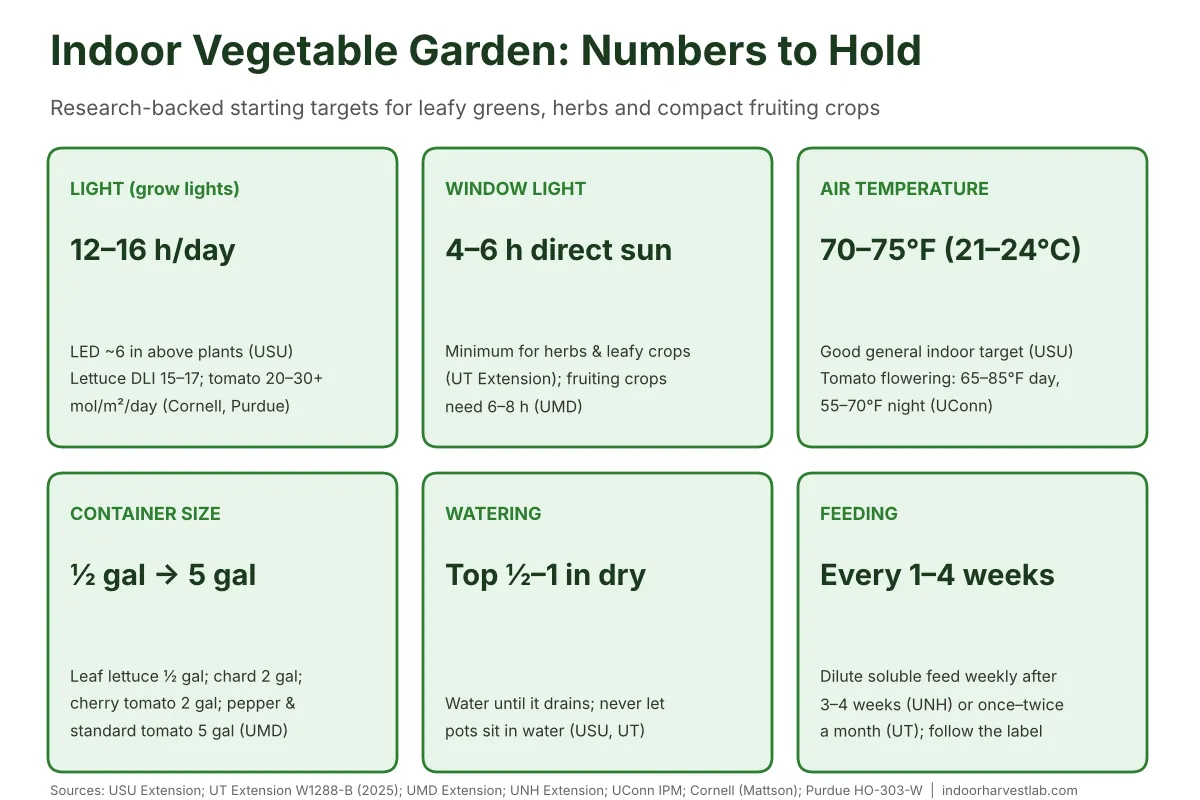
Numbers to hold at a glance
| What | Target | Source |
|---|---|---|
| Grow-light hours | 12–16 hours a day, full-spectrum LED about 6 in (15 cm) above plants | USU Extension |
| Window light | At least 4–6 h direct sun for herbs and leafy crops; 6–8 h for tomatoes and peppers | UT Extension, UMD |
| Daily light integral (DLI) | Lettuce 15–17 mol/m²/day; tomatoes 20–30+ mol/m²/day | Cornell, Purdue |
| Air temperature | About 70–75°F (21–24°C) for most crops | USU Extension |
| Tomato flowering | 65–85°F (18–29°C) by day, 55–70°F (13–21°C) at night, 50–80% relative humidity | UConn Extension |
| Root-zone pH | 6.2–6.8 for vegetables in soil-based mixes | Cornell |
| Watering trigger | Top ½–1 in (1–2.5 cm) of mix is dry | USU Extension |
| Feeding | Dilute soluble fertilizer weekly after 3–4 weeks, or once or twice a month; follow the label | UNH, UT Extension |
Best vegetables to grow in an indoor vegetable garden
Here’s the most common mistake: starting with tomatoes. They’re the crop everyone wants, and they’re also the one most likely to disappoint indoors. University of Tennessee Extension puts herbs, microgreens and baby greens at the top of the list because they’re the quickest crops and need the least light (Bumgarner et al., 2025). UF/IFAS Extension agrees: lettuce, leafy greens and some herbs grow well under simple lights, while tomatoes, peppers and strawberries need much more light and the right temperatures to fruit (UF/IFAS, 2020).
The logic is simple. You eat the leaves of a lettuce plant, so every bit of light becomes food. A tomato has to build leaves, then flowers, then fruit, and it needs roughly twice the light to do it. Use the table below to match crops to the light and space you have.
| Crop | Difficulty indoors | Light need | Minimum container | Days to maturity* |
|---|---|---|---|---|
| Leaf lettuce, salad mixes | Easy | Low–medium (3–5 h sun) | ½ gal; 4 in deep | Cut-and-come-again; regrowth cut in 25–30 days |
| Radishes | Easy | Low–medium | 1 pint; 4–6 in deep | 25–35 |
| Spinach | Easy | Low–medium | 8 in deep | 40–50 |
| Swiss chard, kale | Easy | Medium | 2 gal per plant; 8 in deep | Chard 50–60; kale 60–70 |
| Basil, parsley | Easy–moderate | Medium (basil ≈ Bibb lettuce) | 8 in deep; small herbs 2–5 gal | Pick leaves as needed |
| Bush beans | Moderate | High (flowering crop) | 2 gal | 60–70 |
| Carrots | Moderate | Low–medium (root crop) | 2 gal; 8 in deep | 70–90 |
| Strawberries | Hard | High (≈2,000 fc at 16 h) | — | Variety-dependent |
| Cherry tomatoes | Hard | Highest | 2 gal (standard tomato 5 gal) | 60–85 |
| Peppers | Hard | High | 2–5 gal | 80–100 |
Some crops just aren’t worth the room. Utah State University Extension points out that pumpkins, squash and corn need too much space and root depth, while cabbage and broccoli prefer cool conditions that most living rooms don’t offer (Hagevik & Trundle, USU). Look for words like dwarf, bush, compact or patio on the seed packet; Cornell and UNH both recommend these for containers.
If you want food on the plate within two weeks, microgreens are the fastest win. Our guide to the best microgreens for beginners ranks eight easy crops by speed and yield.
Light: the make-or-break factor for growing vegetables indoors
Nearly every failed indoor garden comes down to light. Plants stretch, go pale and stop producing, and owners blame the water or the fertilizer. Here’s why the window is so often the culprit, and how to fix it.
Why a winter windowsill usually isn’t enough
Cornell’s Neil Mattson gives two numbers that explain the whole problem for a winter indoor vegetable garden. On a sunny summer day in Ithaca, New York, plants outdoors get about 65 mol/m²/day of light. On a cloudy winter day, they get about 1 mol/m²/day (Mattson, Cornell). That’s outdoors. Glass, screens and the angle of the sun cut the light further, so a plant a few feet back from a north- or east-facing window may get only a small share of even that winter figure.
Now compare that with what crops need. Hydroponic lettuce grows best at 15–17 mol/m²/day, and tomatoes need 20–30 or more for good yields (Mattson; Maynard et al., Purdue, 2019). Even vegetable transplants want 10–12. A bright south-facing window can grow herbs and greens, which is what USU Extension recommends, but in winter it rarely carries fruiting crops on its own.
Choosing grow lights for an indoor vegetable garden
You don’t need anything exotic. UT Extension recommends thin-profile fluorescent or LED fixtures for home use and warns that metal halide and high-pressure sodium lamps are expensive, bulky and hot (UT Extension). UF/IFAS notes that T5 high-output fluorescents suit lettuce and leafy greens, and that LEDs are the most efficient option (UF/IFAS).
- Hours: 12–16 hours a day on a plug-in timer (USU Extension). A timer matters more than people think, because consistency is what plants respond to.
- Height: USU suggests about 6 inches above the plants for full-spectrum LEDs. UF/IFAS adds that some fixtures can hang 1 foot above the crop while powerful ones may need 4 feet, so check the maker’s recommended distance.
- Coverage: buy for the area you’ll actually plant. One strong bar light over a 2 × 4 ft shelf beats three weak bulbs scattered around a room.
For a deeper buying walk-through, see our grow lights buyer’s guide; the same rules apply to greens and herbs.
How much light each crop needs (and the simple DLI math)
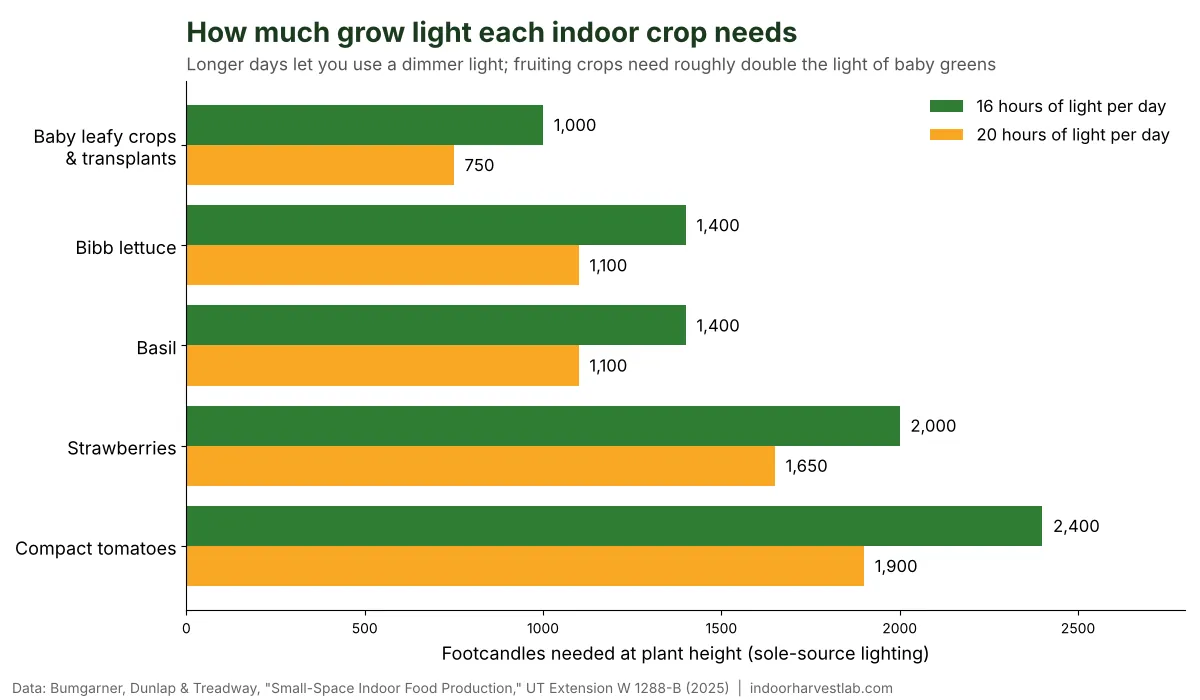
UT Extension gives footcandle targets for sole-source lighting that make the crop hierarchy obvious. At 16 hours of light a day, baby leafy crops need about 1,000 footcandles, Bibb lettuce and basil 1,400, strawberries 2,000 and compact tomatoes 2,400. Stretch the day to 20 hours and each target drops (to 750, 1,100, 1,650 and 1,900) because the plant collects light for longer.
If your light lists its PPFD (µmol/m²/s), use Cornell’s formula: DLI = PPFD × 3,600 × hours ÷ 1,000,000. Work it backwards and lettuce at 15–17 mol/m²/day needs roughly 260–295 µmol/m²/s at canopy height for 16 hours. A tomato at 20 mol/m²/day needs about 350 µmol/m²/s over the same 16 hours. Our PPFD chart for indoor crops has a ready-made conversion table if you’d rather not do the math.
Containers, potting mix, watering and feeding
Once the light is sorted, the root zone is where most indoor vegetable gardens go wrong, and it’s usually from kindness: too much water, too much fertilizer, too-heavy soil.
Pick the right pot size
Bigger pots hold more water and buffer mistakes. UMD Extension lists minimum volumes of ½ gallon for leaf lettuce, 1 pint for radishes, 2 gallons for chard, carrots, bush beans and cherry tomatoes, and 5 gallons for peppers and standard tomatoes (UMD Extension). Cornell adds minimum depths: 4 inches for lettuce, 4–6 inches for radishes and Asian greens, and 8 inches for spinach, kale, chard, basil and parsley (Brewer, Cornell, 2016). Every container in an indoor vegetable garden needs drainage holes and a tray underneath.
Use a light potting mix, never garden soil
USU Extension recommends a light indoor mix based on peat moss and perlite and warns against heavy garden soil. Garden soil packs down in a pot, holds too much water and can bring in pests. UMD Extension says topsoil should make up no more than 10% of the volume, and only in very large containers. Plan on a 2 cu ft bag of mix filling about three 5-gallon buckets. If you’d like to mix your own, UNH Extension publishes a peat-vermiculite recipe with lime and fertilizer (UNH Extension).
Water by feel, not by the calendar
USU Extension calls overwatering the most common mistake in an indoor vegetable garden. Push a finger into the mix and water only when the top ½–1 inch feels dry. Then water slowly until a little drains from the bottom, and empty the saucer so the pot never sits in water (UT Extension). Wet, stagnant mix is also how fungus gnats get started.
Feed lightly and regularly
Potting mixes contain only a small starter charge of nutrients. UNH Extension suggests starting a dilute liquid feed after 3–4 weeks of growth and applying it about once a week; UT Extension recommends controlled-release or soluble fertilizer once or twice a month. Use a leafy or “grow” formula for greens and a bloom formula for fruiting crops, and always follow the label rate. If you’re growing in water rather than mix, you’ll need a fertilizer made for hydroponics; our Kratky method guide is the simplest place to start.
Temperature, airflow and hand-pollinating fruiting crops
Most homes are already close to what an indoor vegetable garden wants. USU Extension gives about 70–75°F (21–24°C) as a good indoor target for most plants. The bigger risk is local hot and cold spots: UT Extension advises keeping plants and fixtures away from heating and air-conditioning vents, and a cold window pane at night can chill leaves that touch it.
A small fan on low pays for itself. UF/IFAS notes that fans help moderate temperature while keeping plants transpiring, and USU recommends gentle airflow, yellow sticky traps and a dry mix surface to keep fungus gnats down. Moving air also helps stems grow sturdier.
Why indoor tomatoes need your help to set fruit
Tomato flowers can pollinate themselves, but the pollen has to be shaken loose. Outdoors, wind and bumblebees do that job. Indoors, nothing does. UConn Extension’s guidance for greenhouse growers works just as well at home (Pundt, UConn):
- Start as soon as the first flower opens.
- Touch a vibrating electric toothbrush to the flower stem (not the flower itself) for a few seconds on each cluster with open blooms.
- Repeat every other day, ideally around midday when humidity is lowest and pollen moves most freely.
- Keep days at 65–85°F (18–29°C), nights at 55–70°F (13–21°C) and relative humidity at 50–80% while plants are flowering.
Poor pollination shows up as flowers that drop, or as small, misshapen fruit. Peppers and strawberries also benefit from a gentle shake or a soft brush. For the full tomato routine, read our guide to growing tomatoes indoors.
How to set up an indoor vegetable garden in 7 steps
Here’s a realistic plan for a first indoor vegetable garden on a single shelf. Expect to spend a weekend afternoon on it and then a few minutes a day.
Step 1: Pick your spot
Choose a place for your indoor vegetable garden with a power outlet, a floor that can take the odd drip and a steady temperature, away from vents. A wire shelving unit with adjustable shelves (USU suggests a baker’s rack) lets you raise lights as plants grow.
Step 2: Decide window or grow light
If you have a bright south-facing window, start with herbs and greens there. If not, or if you want tomatoes, budget for an LED fixture and a timer from day one.
Step 3: Choose 3–4 easy crops
A good starter mix for an indoor vegetable garden is leaf lettuce, spinach or kale, one herb such as basil or chives, and radishes. You’ll get a harvest within weeks, which keeps you motivated while you learn.
Step 4: Get containers and mix
Match pot sizes to the table above, check that every pot drains, and fill with a peat-perlite mix to within about an inch of the rim (UMD Extension).
Step 5: Sow or transplant
Sow seeds at the depth on the packet. UMD Extension notes that germination slows when the mix is below 50°F or above 80°F, so keep trays warm but not hot. Lettuce typically sprouts in 6–10 days and spinach, chard and basil in 7–10 days. If you start seedlings in cells, move them on before they get root-bound; see our guide to potting up seedlings.
Step 6: Set the light timer and water routine
Set the timer to 12–16 hours. Check moisture daily with your finger for the first two weeks until you learn how fast each pot dries.
Step 7: Harvest little and often
Pick outer lettuce and kale leaves and leave the center growing. UMD Extension’s salad-table trials cut greens at 4–8 inches tall, about 1 inch above the mix, and got a second cut 25–30 days later. UNH Extension suggests resowing fast greens and herbs every 3–4 weeks so there’s always something coming on.
Indoor vegetable garden troubleshooting
When something looks wrong, check light first, water second and feeding third. That order fixes most problems.
| What you see | Most likely cause | What to do |
|---|---|---|
| Tall, pale, floppy stems leaning to the window | Too little light | Add a grow light or lower it toward the canopy; run 12–16 h a day |
| Yellowing lower leaves, soggy mix | Overwatering, poor drainage | Water only when the top ½–1 in is dry; empty saucers; check drainage holes |
| Small black flies around pots | Fungus gnats in wet mix | Let the surface dry, add yellow sticky traps, run a fan on low |
| Slow growth, overall pale green | Mix has run out of nutrients | Start a dilute liquid feed per the label |
| Tomato flowers fall off without fruit | No pollination, or temperatures out of range | Vibrate flower stems every other day; keep days 65–85°F, nights 55–70°F |
| Leaf edges crisp and brown near a vent | Hot, dry air | Move plants away from heating or AC vents |
| Seeds slow or patchy to sprout | Mix too cold (below 50°F) or too hot (above 80°F) | Move trays to a warmer or cooler spot |
For crop-specific problems, our guides to growing lettuce indoors and growing herbs indoors in winter go deeper.
From the lab bench
If you take one idea from this article, make it this: indoors, light is the budget and everything else is spending. Water, fertilizer and warmth can only help a plant use the light it gets. They can’t make up for light it doesn’t get. That’s why adding fertilizer to a pale, stretched plant on a dim windowsill does nothing, while moving the same plant under an LED often transforms it within a week.
The second rule follows from the first: grow the crop your light can pay for. The UT footcandle figures show a fruiting tomato needs about 2.4 times the light of baby greens at the same day length. Under a modest shelf light, a tray of lettuce is a full return on the electricity; a single tomato plant under the same light is a long, slow struggle. When people say an indoor vegetable garden “doesn’t work,” they’ve usually picked the hardest crop for their setup.
Third, use the day length to your advantage. Because DLI is intensity × time, a weaker light can still reach a crop’s target if it runs longer. That’s exactly what UT’s 16- versus 20-hour columns show. For leafy crops, running a moderate light for 16 hours is often cheaper and gentler than blasting a powerful light for 10.
Finally, keep the system boring. Same timer, same water check, same feeding rhythm. Plants respond to consistency, and a steady, unexciting routine is what turns an indoor vegetable garden from a winter experiment into a habit that keeps salad on the table.
FAQ
What vegetables are easiest to grow indoors?
Leafy greens such as leaf lettuce, spinach, kale and chard, herbs such as basil and chives, radishes and microgreens are easiest. UT Extension notes herbs, microgreens and baby greens are the quickest crops and need the least light.
Can you grow vegetables indoors without grow lights?
Yes, but only lower-light crops. A bright south-facing window giving at least 4–6 hours of direct sun can grow herbs and leafy greens. Tomatoes, peppers and strawberries need 6–8 hours of direct sun or a strong grow light, which most windows can’t supply in winter.
How many hours of light does an indoor vegetable garden need?
Run grow lights 12–16 hours a day on a timer. Total daily light matters most: lettuce does best at about 15–17 mol/m²/day, while tomatoes need 20–30 mol/m²/day or more.
How far should grow lights be from vegetable plants?
USU Extension suggests about 6 inches above plants for full-spectrum LEDs, but fixtures vary. Some can hang 1 foot above the crop and stronger lights may need up to 4 feet, so follow the manufacturer’s recommended distance.
What is the best temperature for growing vegetables indoors?
About 70–75°F (21–24°C) suits most indoor crops. Flowering tomatoes do best at 65–85°F by day and 55–70°F at night. Keep plants away from heating and air-conditioning vents.
Do indoor tomatoes need to be pollinated?
Yes. Tomato flowers self-pollinate only when shaken. Touch a vibrating electric toothbrush to the flower stem for a few seconds every other day, around midday, once the first flowers open.
How often should I water an indoor vegetable garden?
Water when the top ½–1 inch of mix feels dry rather than on a fixed schedule. Water until it drains from the bottom and empty the saucer. Overwatering is the most common indoor mistake.
Sources
- Bumgarner, N., Dunlap, A. & Treadway, H. (2025). Small-Space Indoor Food Production. University of Tennessee Extension, W 1288-B.
- Hagevik, R. & Trundle, K. C. (2026). Creating Sustainable School and Home Gardens: Gardening Indoors. Utah State University Extension.
- University of Maryland Extension. Growing Vegetables in Containers and Salad Tables. Home & Garden Information Center.
- University of New Hampshire Extension (2018, updated 2025). Growing Vegetables in Containers [fact sheet].
- Brewer, L. J. (2016). Vegetable and Herb Gardening in Containers. Cornell Garden-Based Learning, Cornell University.
- Mattson, N. Greenhouse Lighting. Cornell University Cooperative Extension.
- Maynard, E., O’Donnell, M., Kong, N. N. & Li, Y. (2019). Seasonal Daily Light Integrals Across and Along Indiana. Purdue Extension, HO-303-W.
- Pundt, L. (2017, revised 2024). Pollination of Greenhouse Tomatoes. UConn Extension Greenhouse IPM.
- UF/IFAS Extension Orange County (2020). Artificial Lighting for Growing Vegetables at Home.