
Short answer: the best seed germination temperature for most vegetables is a soil (not air) temperature of about 65–75°F (18–24°C). Cool-season crops such as lettuce, spinach, peas and cabbage sprout well from the 50s°F, while tomatoes, peppers, eggplant, cucumbers and squash want 75–85°F in the mix and stall below 60°F. The chart below gives the minimum, optimum and maximum seed germination temperature for 24 crops, plus how many days each one takes to emerge at each temperature.
The numbers come from one of the most reused data sets in vegetable growing: the soil temperature trials of J.F. Harrington at the University of California, Davis, now published by Oregon State University Extension. Below you will find how to read them indoors, where the mix is often cooler than the room, and what to change once the seedlings are up.
Table of Contents
Seed germination temperature chart (°F and °C)
This seed germination temperature table lists the minimum, the optimum range, the single best temperature and the maximum for each crop. “Minimum” means some seeds will still sprout, but slowly and unevenly; “maximum” means germination falls away sharply above it. Temperatures are for the growing medium, measured around seed depth.
| Crop | Minimum | Optimum range | Best | Maximum |
|---|---|---|---|---|
| Asparagus | 50°F (10°C) | 60–85°F (16–29°C) | 75°F (24°C) | 95°F (35°C) |
| Bean | 60°F (16°C) | 60–85°F (16–29°C) | 80°F (27°C) | 95°F (35°C) |
| Beet | 40°F (4°C) | 50–85°F (10–29°C) | 85°F (29°C) | 95°F (35°C) |
| Cabbage | 40°F (4°C) | 45–85°F (7–29°C) | 85°F (29°C) | 100°F (38°C) |
| Carrot | 40°F (4°C) | 45–85°F (7–29°C) | 80°F (27°C) | 95°F (35°C) |
| Cauliflower | 40°F (4°C) | 45–85°F (7–29°C) | 80°F (27°C) | 100°F (38°C) |
| Swiss chard | 40°F (4°C) | 50–85°F (10–29°C) | 85°F (29°C) | 95°F (35°C) |
| Sweet corn | 50°F (10°C) | 60–95°F (16–35°C) | 95°F (35°C) | 105°F (41°C) |
| Cucumber | 60°F (16°C) | 60–95°F (16–35°C) | 95°F (35°C) | 105°F (41°C) |
| Eggplant | 60°F (16°C) | 75–90°F (24–32°C) | 85°F (29°C) | 95°F (35°C) |
| Lettuce | 35°F (2°C) | 40–80°F (4–27°C) | 75°F (24°C) | 95°F (35°C) |
| Muskmelon | 60°F (16°C) | 75–95°F (24–35°C) | 90°F (32°C) | 100°F (38°C) |
| Onion | 35°F (2°C) | 50–95°F (10–35°C) | 75°F (24°C) | 95°F (35°C) |
| Parsley | 40°F (4°C) | 50–85°F (10–29°C) | 75°F (24°C) | 90°F (32°C) |
| Parsnip | 35°F (2°C) | 50–70°F (10–21°C) | 65°F (18°C) | 85°F (29°C) |
| Pea | 40°F (4°C) | 40–75°F (4–24°C) | 75°F (24°C) | 85°F (29°C) |
| Pepper | 60°F (16°C) | 65–95°F (18–35°C) | 85°F (29°C) | 95°F (35°C) |
| Pumpkin | 60°F (16°C) | 70–90°F (21–32°C) | 95°F (35°C) | 100°F (38°C) |
| Radish | 40°F (4°C) | 45–90°F (7–32°C) | 85°F (29°C) | 95°F (35°C) |
| Spinach | 35°F (2°C) | 45–75°F (7–24°C) | 70°F (21°C) | 85°F (29°C) |
| Squash | 60°F (16°C) | 70–95°F (21–35°C) | 95°F (35°C) | 100°F (38°C) |
| Tomato | 50°F (10°C) | 60–85°F (16–29°C) | 85°F (29°C) | 95°F (35°C) |
| Turnip | 40°F (4°C) | 60–105°F (16–41°C) | 85°F (29°C) | 105°F (41°C) |
| Watermelon | 60°F (16°C) | 70–95°F (21–35°C) | 95°F (35°C) | 105°F (41°C) |
Source: Harrington, UC Davis, as published by Oregon State University Extension. Celsius values are rounded conversions.
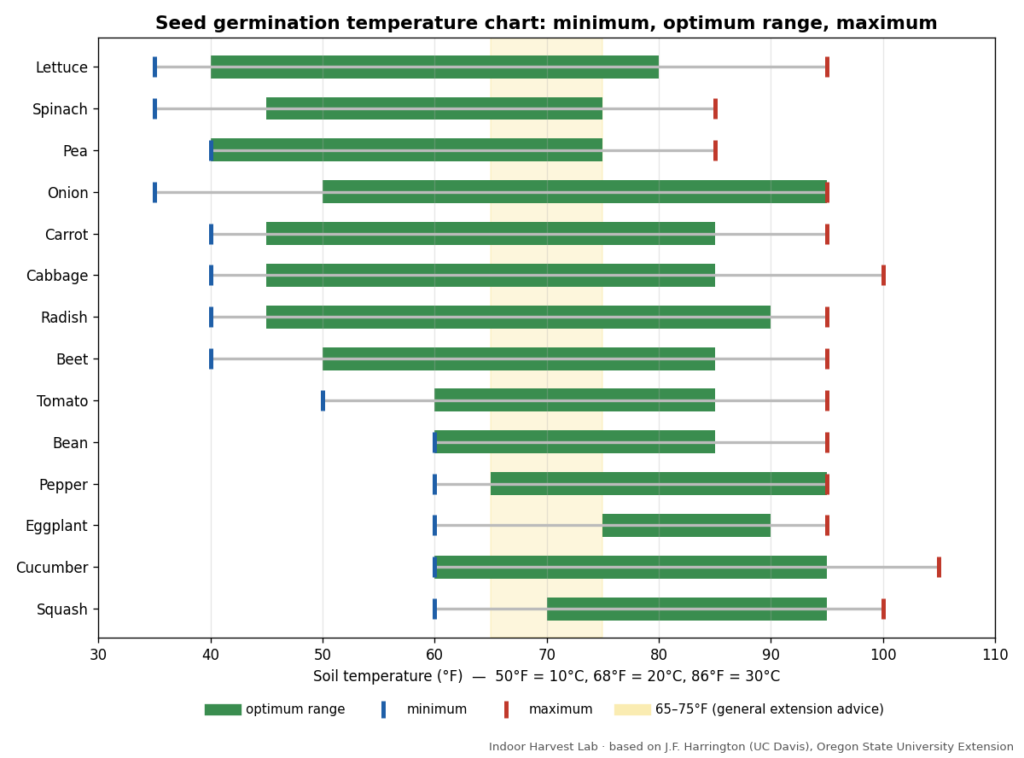
Two patterns stand out in the seed germination temperature ranges. Cool-season crops have a low minimum (35–40°F) and a wide optimum, so an unheated room is fine for them. Warm-season crops have a hard floor of 50–60°F, and below it almost nothing happens. That minimum seed germination temperature is the main reason pepper and eggplant trays sit for weeks on a cold windowsill.
Days to emergence at each seed germination temperature
A seed germination temperature chart is more useful when it also shows speed. In the same trials, seeds were sown half an inch deep and kept at constant soil temperatures from 32°F to 104°F. The table gives days until seedlings appeared; “none” means no emergence, and a dash means the temperature was not tested.
| Crop | 50°F (10°C) | 59°F (15°C) | 68°F (20°C) | 77°F (25°C) | 86°F (30°C) | 95°F (35°C) |
|---|---|---|---|---|---|---|
| Lettuce | 7 | 4 | 3 | 2 | 2 | none |
| Spinach | 12 | 7 | 6 | 5 | 6 | none |
| Pea | 13 | 9 | 7 | 6 | 6 | – |
| Radish | 11 | 6 | 4 | 3 | 3 | – |
| Cabbage | 15 | 9 | 6 | 4 | 3 | – |
| Onion | 13 | 7 | 5 | 4 | 4 | 12 |
| Carrot | 17 | 10 | 7 | 6 | 6 | 8 |
| Beet | 17 | 10 | 6 | 5 | 4 | 4 |
| Parsley | 29 | 17 | 14 | 13 | 12 | – |
| Tomato | 43 | 14 | 8 | 6 | 6 | 9 |
| Pepper | none | 25 | 12 | 8 | 8 | 9 |
| Eggplant | – | 13 | 8 | 5 | – | – |
| Cucumber | none | 13 | 6 | 4 | 3 | 3 |
| Bean | none | 16 | 11 | 8 | 6 | 6 |
| Sweet corn | 22 | 12 | 7 | 4 | 4 | 3 |
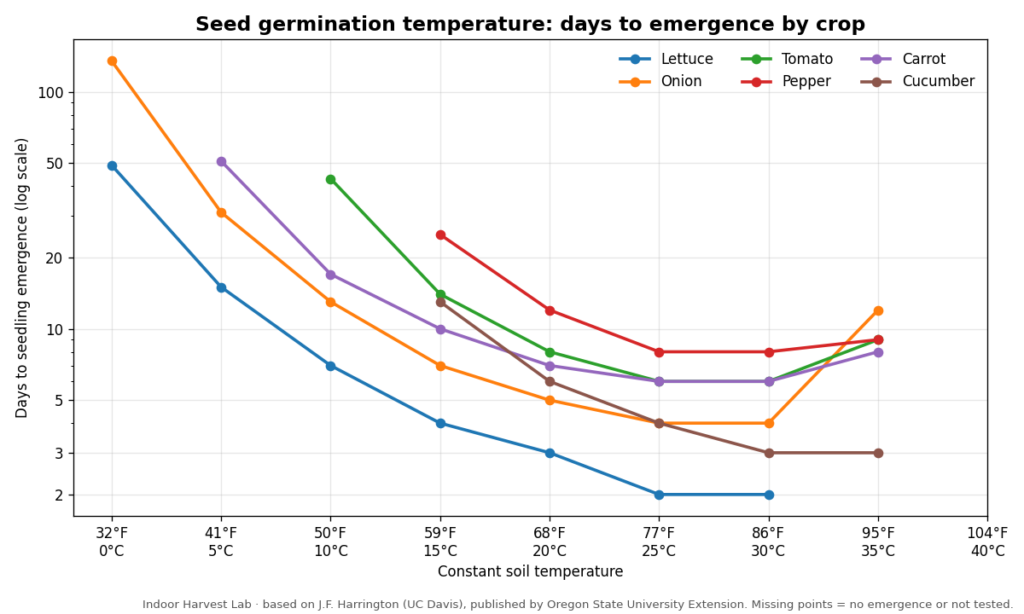
Look at tomato: 43 days at 50°F, 14 days at 59°F and 6 days at 77°F. Pepper does not come up at all at 50°F and takes 25 days at 59°F. Lettuce, in contrast, is up in a week even at 50°F. This is why raising the seed germination temperature pays off for warm crops and matters far less for cool ones.
Why published charts disagree
If you compare seed germination temperature tables online, you will see small differences. The University of California Master Gardener handout (Sacramento County), which also credits Harrington, lists lettuce at 60–75°F optimum and pepper at 65–75°F, while the Oregon State version gives 40–80°F and 65–95°F. The UC handout also notes a special case: celery needs about 85°F by day and 70°F at night with diffuse light.
The differences come from rounding and from how each publisher summarised the original ranges. The practical message does not change: warm crops need warm mix, cool crops tolerate cold mix, and very hot mix hurts lettuce, spinach and peas.
The simple seed germination temperature rule extension services give
You do not need a different seed germination temperature for every packet. Extension guides boil it down to three groups:
- Most seeds: 65–75°F soil. Clemson Extension (HGIC) calls a soil temperature of 65–75°F “ideal for germination”, and University of Missouri Extension (G6570) says 65–75°F is generally best.
- Cool-season crops (broccoli, cabbage, spinach): Utah State University Extension says they prefer 55–65°F.
- Heat lovers (tomato, pepper, eggplant): the same USU guide recommends a heating mat when the room is cool, and pairing it with a thermostat so trays do not overheat.
| Group | Crops | Target mix temperature | Heat mat? |
|---|---|---|---|
| Cool-season | Lettuce, spinach, peas, cabbage family, onion, parsley | 55–70°F (13–21°C) | Rarely needed |
| Middle | Tomato, beet, chard, carrot, herbs such as basil | 65–75°F (18–24°C) | Helpful in a room below 65°F |
| Warm-season | Pepper, eggplant, cucumber, squash, melons | 75–85°F (24–29°C) | Yes, with a thermostat |
Seed germination temperature indoors: soil vs air
Your thermostat reads air, but seeds feel the mix, and the mix sets the seed germination temperature. University of Minnesota Extension notes that potting mix in indoor containers can be as much as 5°F cooler than the room air. Evaporation from wet mix cools it further, and trays near a window drop at night.
So a room at 68°F may give a seed germination temperature of only 63°F in the cells, which is enough for lettuce but slow for peppers. The UMN guide also says bottom heat helps most indoor seeds germinate sooner with healthier roots and can help prevent damping-off. Keep air above 60°F in any case.

How to hit the right seed germination temperature: step by step
- Sort your seeds by group using the tables above. Put peppers and eggplant in one tray, lettuce and brassicas in another, so each gets its own temperature.
- Pre-moisten the mix with room-temperature water, not cold tap water, so you do not chill the cells on day one.
- Place a probe thermometer in one cell at seed depth (about 1/4–1/2 inch). This reading is your real seed germination temperature.
- Add bottom heat only for warm crops. Set a mat with a thermostat to about 80°F for peppers and eggplant, 75°F for tomatoes. Without a thermostat, check the probe after 24 hours; mats can run hot.
- Cover the tray with a dome or plastic to hold moisture and warmth, and keep it out of cold drafts.
- Check daily from the day the chart predicts emergence. At 77°F expect lettuce in about 2 days, tomato in 6 and pepper in 8.
- Remove the dome and heat as soon as most seedlings are up, and move the tray under lights. Warmth after emergence makes stems stretch.
Temperature after germination
The ideal seed germination temperature is not the ideal growing temperature. Once seedlings appear, drop the heat. Utah State University Extension recommends night temperatures of 60–65°F for most vegetables, with days about 10 degrees warmer, and around 55°F nights and 65°F days for cool-season crops such as broccoli, cabbage, kale and spinach. It warns that too much warmth gives weak, spindly plants.
Missouri’s guide lists similar growing temperatures: 50–60°F for broccoli, cabbage, cauliflower and head lettuce, and 62–65°F for tomato, pepper and eggplant. Warm mix plus weak light is the classic recipe for leggy seedlings, so pair the cooler room with enough hours of light at the right grow light distance.
Lettuce and spinach: when a high seed germination temperature stops sprouting
Lettuce is the crop most likely to fail because it is too warm, not too cold. A 2024 review in Plants by Wei and colleagues gives an optimal germination temperature for most lettuce varieties of 15–22°C (59–72°F) and describes “thermoinhibition”: above that range germination declines, and at high temperatures many seeds stay dormant. Varieties differ widely, and red light raised the upper limit in the studies it reviews.
The Harrington data agree: lettuce and spinach produced no seedlings at 95°F. If you start lettuce in summer or on a heat mat shared with peppers, move it off the mat and keep the mix near 60–70°F.
Mistakes to avoid
- Trusting the room thermostat. Measure the mix; it can run several degrees cooler than the air.
- Putting every tray on one heat mat. Lettuce, spinach and peas do worse, not better, when the seed germination temperature climbs past the low 80s°F.
- Running a mat without a thermostat. USU specifically recommends one to stop containers overheating.
- Leaving heat and domes on after emergence. This causes stretching and raises disease risk.
- Giving up too early. Parsley takes 12–14 days even at 68–86°F, and peppers at 59°F can take over three weeks. Check the days table before re-sowing.
- Sowing warm crops into cold, wet mix. Below 60°F, pepper and cucumber seed sits in wet medium for weeks, which invites rot.
Where this applies
The seed germination temperature chart describes soil temperature, so it works indoors, in a greenhouse and outdoors. Indoors under lights, the room and any bottom heat set the seed germination temperature, whatever the climate outside. Outdoors, the same numbers tell you when to direct sow: wait until a soil thermometer at seed depth reads at least the minimum, and ideally the optimum range, in the morning.
In hot climates or summer rooms above 80°F, the limit flips: sow lettuce, spinach and peas in the coolest spot you have, or start them in the evening. For microgreens, most crops are brassicas, peas and sunflowers, so a normal room of 65–75°F is enough.
More guides on starting seeds indoors are in our germination section.
FAQ
What seed germination temperature is too cold?
It depends on the crop. Lettuce, spinach, onion and parsnip can emerge near 35°F, but slowly. Tomato needs at least 50°F, and pepper, eggplant, beans, cucumber and squash need at least 60°F, according to the Oregon State chart.
Do seeds germinate faster in heat?
Up to a point. Tomato emerged in 6 days at 77–86°F versus 14 days at 59°F, but at 95°F it slowed to 9 days, and lettuce failed completely. Aim for the optimum seed germination temperature, not the maximum.
What seed germination temperature should a heat mat hold?
For peppers and eggplant, about 80–85°F at seed depth fits the Harrington optimum; for tomatoes, 75–80°F. Always use a thermostat and turn the mat off once seedlings are up.
Is seed germination temperature the same as growing temperature?
No. After emergence most vegetables grow best with nights of 60–65°F and days about 10°F warmer, and cool-season crops cooler still.
Related guides: Paper Towel Germination: How to Sprout and Test Seeds Step by Step · How to Grow Lettuce Indoors Under Lights (Light, Temperature and Harvest)
Sources
- Harrington, J.F. Soil temperature conditions for vegetable seed germination. Oregon State University Extension Service (reviewed 2024).
- University of California Cooperative Extension, Sacramento County. Vegetable seed germination data (from the California Master Gardener Handbook).
- Crump, W., Beddes, T., Caron, M. & Oliveira, M. (2025). Starting Vegetable Seeds Indoors: III. Germination and IV. Seedling Culture and Transplanting. Utah State University Extension.
- University of Minnesota Extension. Starting seeds indoors.
- Davenport, M. (2019). FAQs about Starting Vegetable Seeds Indoors. Clemson Cooperative Extension HGIC.
- Trinklein, D. Starting Plants Indoors From Seeds (G6570). University of Missouri Extension.
- Wei, J. et al. (2024). Advance in the thermoinhibition of lettuce (Lactuca sativa L.) seed germination. Plants 13(15): 2051.
Featured image: “The effect of temperature on lettuce germination” by photofarmer, CC BY 2.0.