
You decide to grow spinach indoors this winter, sow a pot in October and picture fresh salads until spring. Three weeks later the seedlings are up, a little thin, and the room you put them in is the warmest one in the house. By week six a few plants have shot up a tall stalk, the leaves have turned narrow and pointed, and the taste has gone from sweet to sharp. Nothing was wrong with your seed. Spinach just plays by different rules from lettuce and basil.
Short answer: You can grow spinach indoors all year if you keep it cool and give it bright light for a limited number of hours. Aim for 60–70°F (15–20°C), keep the lights on for no more than about 12 hours a day, sow straight into a container at least 12 inches (30 cm) wide and deep, and pick the outer leaves as soon as they are big enough. Warm rooms and long days are what make indoor spinach bolt.
By the end of this guide you will know the exact temperatures, light hours and grow-light intensity spinach needs, how to sow it in soil or set it up in a simple hydroponic system, and how to keep cutting leaves for weeks before the plant runs to seed.
Why spinach is trickier to grow indoors than lettuce
Spinach (Spinacia oleracea) is a cool-season leafy green. Utah State University Extension says it grows best when temperatures stay at or below 75°F, and that plants grown above 75°F tend to develop a bitter flavour (USU Extension). The RHS gives an ideal range of 15–20°C (60–70°F) and warns that both hot, dry conditions and cold snaps can push plants into flowering early (RHS). Most living rooms sit right at the top of that window, or above it, near a radiator or under a hot light. That is the first reason people who try to grow spinach indoors end up with bitter leaves.
The second issue is day length. Cornell greenhouse specialist Neil Mattson describes spinach as an obligate long-day plant: it flowers only when days are long, and the critical day length is about 13–14 hours, depending on the cultivar (Mattson, e-GRO 2017). Lettuce, by contrast, is only a facultative long-day plant. A plant-breeding study from the Chinese Academy of Agricultural Sciences calls spinach “a typical light-sensitive plant” in which long days induce early bolting (Meng et al., 2022).
That matters indoors because the standard advice for leafy greens under lights is 14–16 hours a day. For growing lettuce indoors, that schedule works well. For spinach, it pushes the plant past its flowering trigger. The fix is simple once you see it, and it is the core of how to grow spinach indoors successfully: keep spinach cool, give it shorter days, and make each of those hours brighter.
Spinach numbers to hold: temperature, light, pH and EC
Bookmark this table. Every figure comes from the sources listed at the end, and each row tells you what to do if your setup drifts out of range.
| What | Target | Why it matters | Source |
|---|---|---|---|
| Germination temperature | 55–65°F (13–18°C); emergence in 7–10 days | Above 80°F (27°C), germination falls | USU Extension |
| Growing temperature | 60–70°F (15–20°C) | Cool, steady temperatures keep leaves sweet and plants leafy | RHS |
| Upper limit | Keep below 75°F (24°C) | Above 75°F, leaves turn bitter; above 80°F (27°C), bolting can be quick | USU; e-GRO |
| Cold tolerance | Young plants survive 32°F (0°C) | A cool windowsill or porch is fine; a hot room is not | USU Extension |
| Photoperiod | ≤12 hours of light (critical day length 13–14 h) | Long days trigger flowering in this obligate long-day crop | e-GRO |
| Daily light integral (DLI) | Up to ~17 mol/m²/day | Cornell’s target for fast baby-leaf crops; yield rises with DLI | Cornell CEA |
| Hydroponic EC | 1.8–2.3 mS/cm (≈900–1,150 ppm on the 500 scale) | Spinach is a heavier feeder than lettuce (1.2–1.8) | Oklahoma State Ext. |
| Hydroponic pH | 6.0–7.0 | Spinach tolerates a higher pH than many hydroponic crops | Oklahoma State Ext. |
| Nutrient solution temperature | 64–68°F (18–20°C) | Cooling the solution limited Pythium root rot in Cornell trials | Cornell CEA |
| Container | At least 12 in (30 cm) wide and deep | A deep pot stops the mix drying out quickly | RHS |
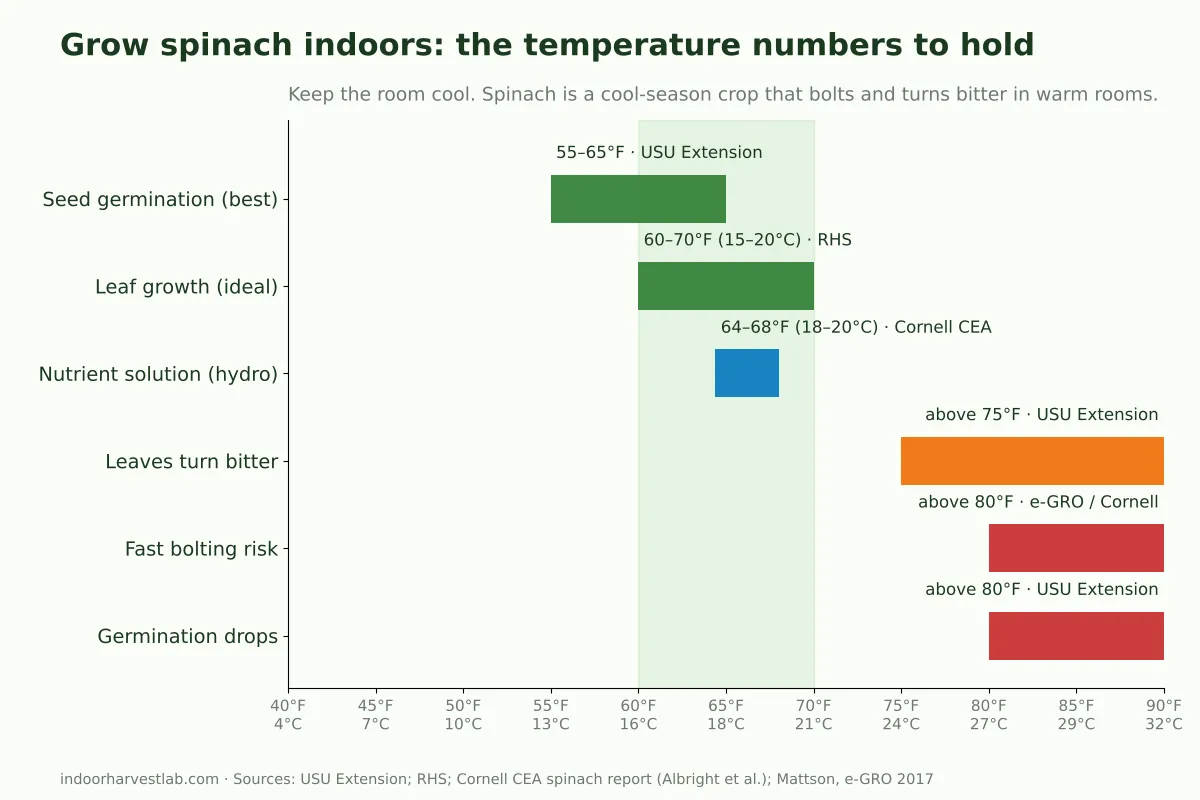
If you only remember one line, make it the temperature row: to grow spinach indoors well, temperature matters more than anything else. If you can’t keep a room under about 75°F, grow spinach in the coolest spot you have (a back bedroom, an unheated porch that stays above freezing or a basement shelf) and save the warm windowsill for heat-loving herbs.
Light for indoor spinach: hours, PPFD and DLI
Here is the trade-off that most indoor spinach guides miss. Spinach likes plenty of light, but it does not want long days. You solve that by delivering the light in a shorter window at a higher intensity.
Keep the photoperiod at 12 hours or less
Because the critical day length is 13–14 hours (e-GRO), a timer set to 10–12 hours keeps you safely below the trigger. Research on spinach transplants by Chun, Tominaga and Kozai found that short photoperiods during seedling growth delayed bolting after the plants were moved on (Chun et al., 2001). So the short-day habit pays off from the very first week.
Use the DLI to pick a light intensity
Daily light integral (DLI) is the total amount of light a plant receives in a day. Cornell’s hydroponic spinach project recommended a DLI of about 17 mol/m²/day for baby-leaf crops and found that productivity rose in a straight line with DLI (Cornell CEA report). To turn a DLI target into a grow-light setting, use this formula:
PPFD (µmol/m²/s) = DLI × 1,000,000 ÷ (hours of light × 3,600)
| Hours of light | PPFD for DLI 12 | PPFD for DLI 15 | PPFD for DLI 17 |
|---|---|---|---|
| 10 h | 333 | 417 | 472 |
| 11 h | 303 | 379 | 429 |
| 12 h | 278 | 347 | 394 |
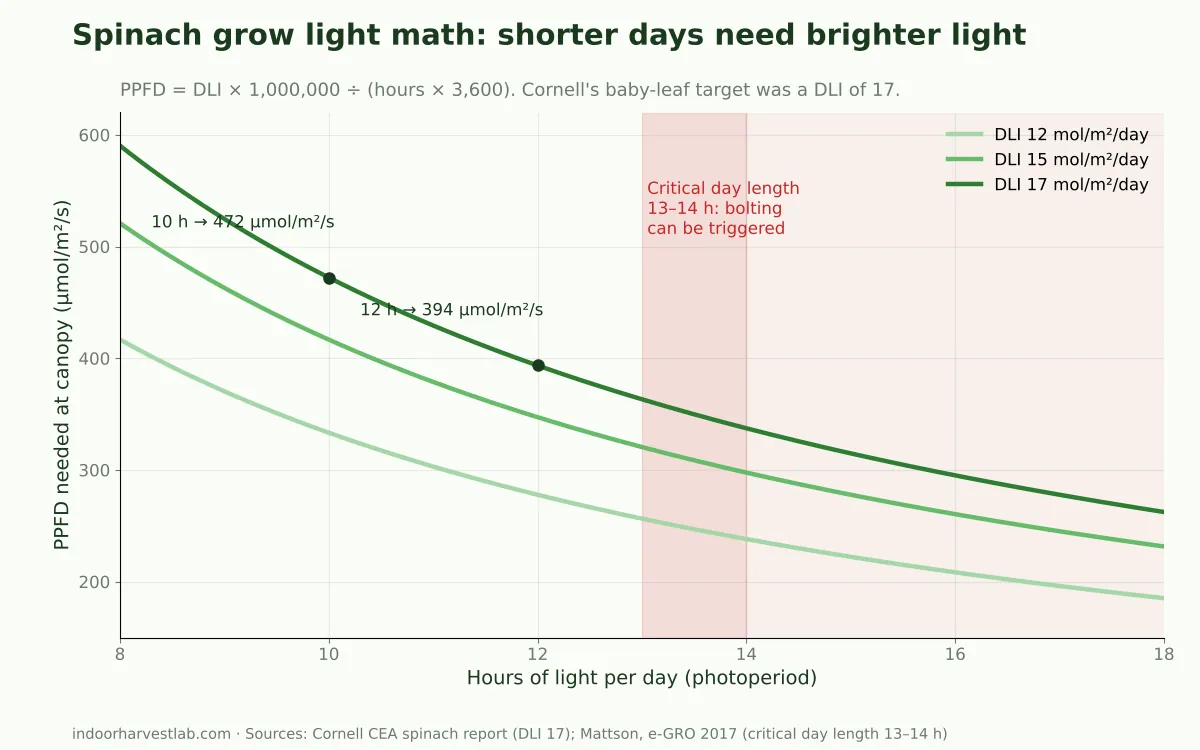
You don’t have to hit 17. That figure was set for commercial speed, and a DLI of 12–15 will still grow good spinach, only more slowly. The point is to choose a light that can deliver roughly 300–400 µmol/m²/s at the canopy, rather than running a weak light for 16 hours. Our grow-light buyer’s guide explains how to read a fixture’s PPFD map before you buy.
Can a window be enough?
A bright, cool, south-facing window (north-facing in the Southern Hemisphere) can grow spinach in spring and autumn. In midwinter, though, the days are short and the sun is low, so growth slows sharply. That isn’t a bolting risk, because natural winter days are well under 13 hours, but the plants will be small. A light fixture on a 10–12 hour timer is the most reliable way to grow spinach indoors in winter.
How to grow spinach indoors from seed, step by step
This is the soil (or potting mix) method, which suits most home growers. If you’d rather grow in water, skip to the hydroponics section below, though steps 1 and 2 still apply.
Step 1: Choose a slow-bolting variety
Cultivars vary a lot in how quickly they bolt. Mattson notes that both lettuce and spinach cultivars differ in bolting speed and heat sensitivity (e-GRO), and the RHS lists varieties bred for resistance to bolting and downy mildew (RHS). Look for “slow bolting” or “long standing” on the packet. In University of Alaska Fairbanks Extension trials under extreme long days, growers singled out varieties such as Escalade for holding longer before bolting (UAF Extension).
Step 2: Sow straight into the final container
The RHS points out that spinach is usually best sown where it will grow, because the disruption of transplanting can make it more likely to bolt (RHS). Use a pot or trough at least 12 inches (30 cm) wide and deep, filled with fresh peat-free multipurpose mix, and make sure it has drainage holes. Sow seeds about ½ inch (1 cm) deep (USU Extension).
Step 3: Germinate cool, not warm
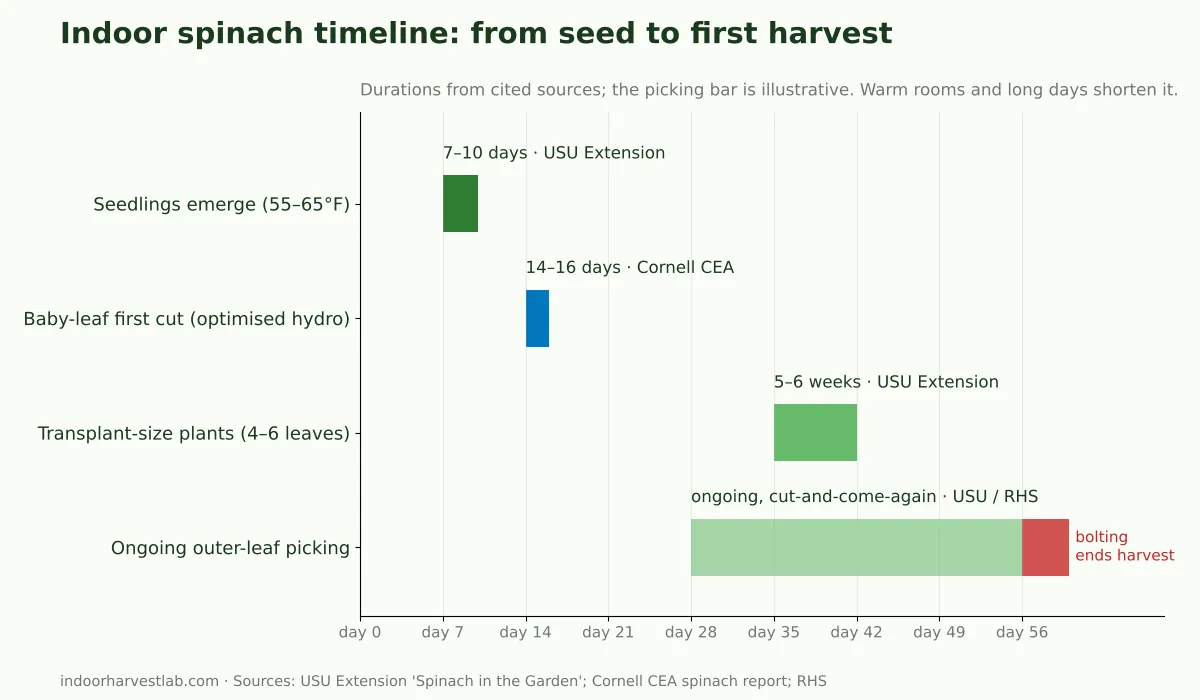
This is the opposite of most seed starting. Spinach germinates best at 55–65°F (13–18°C) and usually emerges in 7–10 days; above 80°F (27°C), germination falls (USU Extension). Skip the heat mat. Keep the mix evenly moist but not soggy. Cool, wet mix with poor airflow is the classic setup for damping off, so run a small fan and water from below if you can.
Step 4: Thin to give each plant room
When seedlings have 3–4 true leaves, thin them (USU Extension). The RHS suggests thinning to about 3 inches (7.5 cm) apart, then harvesting every other plant a few weeks later so the rest have room (RHS). Crowded, damp foliage invites downy mildew, so this step matters more than it looks. Eat the thinnings: they are baby spinach.
Step 5: Water steadily and feed lightly
Uneven watering is a hidden bolting trigger. USU Extension notes that moisture swings make leaves tough and cause off-flavours, and the RHS lists lack of water as a cause of premature flowering (USU; RHS). Water when the top inch (2.5 cm) of mix feels dry, and empty the saucer after 20 minutes. Spinach responds to nitrogen: once the plants have several true leaves, a half-strength balanced liquid feed every 2–3 weeks keeps the leaves growing quickly.
Step 6: Harvest outer leaves, then cut and come again
You can pick individual leaves any time before a flower stalk forms, taking the older outer leaves first so the young centre keeps growing. If the growing point isn’t damaged, you can cut the whole plant back to about 2 inches (5 cm) above the mix (USU Extension). Cornell’s researchers found a clear benefit from a second cutting of the same stand of baby spinach (Cornell CEA). Once you see the stem lengthen and the leaves turn from oval to arrowhead-shaped, the plant is bolting (e-GRO). Harvest everything that day, because the leaves turn bitter quickly from then on.
Freshly cut spinach keeps 1–2 weeks at 32°F (0°C) and 95% relative humidity (USU Extension). In a home fridge, store it in a closed container lined with a dry paper towel and use it within a week for the best texture.
Growing spinach indoors in hydroponics
If you want to grow spinach indoors without soil, water culture works well and grows it quickly, but spinach has a reputation for trouble in hydroponics. Cornell’s spinach report explains why hydroponic spinach was not produced commercially in the US at the time: uneven, inconsistent germination and early outbreaks of Pythium aphanidermatum root rot (Cornell CEA). Both problems can be managed at home.
Set your EC and pH
Oklahoma State University Extension lists an optimum EC of 1.8–2.3 mS/cm and a pH of 6.0–7.0 for hydroponic spinach, compared with 1.2–1.8 mS/cm for lettuce (Oklahoma State Extension). In practice, start seedlings near the low end and raise the EC as the plants fill out. If your meter reads in ppm, our hydroponic EC chart covers the conversions.
Keep the root zone cool and clean
Cornell’s disease protocol for spinach in deep-flow ponds relied on disease-free seedlings, nutrient solution chilled to about 18–20°C (64–68°F), and very strict cleaning between crops (Cornell CEA). The researchers also advised keeping each crop cycle as short as possible as a safety measure. At home, that means:
- Keep the reservoir in the coolest part of the room and out of direct light; insulate it if your grow light warms it.
- Use an air stone in deep water culture to keep oxygen up; warm, still water is where Pythium thrives.
- Scrub and sanitise the reservoir, net pots and media between crops.
- Check the roots weekly. White and crisp is good; brown, slimy and smelly means hydroponic root rot.
Which system suits spinach?
For a first try, a passive Kratky jar or tub is ideal, because spinach is a short crop and you harvest before the water runs low. Deep water culture with an air pump suits continuous cutting. Germinate seeds in rockwool or another plug at cool temperatures, then move them into the system once roots show through the bottom.
Indoor spinach problems: symptoms and fixes
When you grow spinach indoors, most problems come down to heat, day length or water. Use this table to go from what you see to what you should change.
| What you see | Most likely cause | What to do |
|---|---|---|
| Tall central stalk; leaves turn narrow and pointed | Bolting: warm room (>80°F), long days (>13 h) or stress | Harvest everything now; next crop, shorten the light to ≤12 h and grow cooler |
| Bitter or sharp-tasting leaves | Temperatures above 75°F, or plant starting to bolt | Move to a cooler spot; pick young leaves; check for a lengthening stem |
| Few seeds come up | Mix too warm (>80°F) or old seed | Germinate at 55–65°F with no heat mat; use fresh seed |
| Seedlings pinch at the soil line and collapse | Damping off (cool, wet, still air) | Water from below, add a fan, use fresh sterile mix |
| Pale, slow, small leaves | Too little light or too little nitrogen | Raise PPFD toward 300–400 µmol/m²/s; feed half-strength every 2–3 weeks |
| Yellow patches on top, grey-purple fuzz underneath | Downy mildew | Remove affected leaves, thin plants, improve airflow, avoid wetting foliage |
| Brown, slimy roots in hydroponics | Pythium root rot (warm solution) | Cool the solution to 64–68°F, aerate, sanitise and restart with clean seedlings |
| Tough leaves with off-flavour | Irregular watering | Water on a schedule; mulch or use a self-watering pot |
If you see tiny black flies around damp pots, those are fungus gnats rather than a spinach problem; our fungus gnat guide covers the fix.
From the lab bench: why the timer matters more than the light
The most useful idea in the research is that the same knob, day length, has two opposite effects. Cornell’s baby-leaf trials actually recommended a photoperiod long enough to trigger bolting, because it increased productivity (Cornell CEA). That sounds like it contradicts everything above, but it doesn’t. Their crop cycle was only 14–16 days at 20–25°C, so the plants were harvested before flowering could show. Flower initiation inside the plant is invisible; the stalk comes later.
When you grow spinach indoors at home, you usually want something different: a pot that can be picked for weeks. The longer you want the harvest window to last, the more important it is to keep the days short and the room cool. If you are growing a fast tray of baby leaves to cut once, long days and warmth do no harm. If you want a pot of spinach that keeps giving through December, short days and cool air are what give you that time.
The second lesson is about temperature as a dose. Mattson notes that in lettuce, the number of hot days matters more than how hot they get (e-GRO). It is reasonable to apply the same thinking to spinach: one warm afternoon won’t ruin a crop, but a week beside a radiator may. Watch the trend, not the single reading. A cheap min/max thermometer at leaf height tells you more than the thermostat on the wall.
Finally, germination is the step where spinach catches people out. Cornell’s team describes how spinach was traditionally germinated at a low 15–20°C, and they achieved fast, even emergence only by tightly controlling the moisture and temperature of the medium (Cornell CEA). At home, the practical version is simple: sow a little thicker than you need, keep the mix cool and evenly moist, and thin the extras.
FAQ
Can you grow spinach indoors year-round?
Yes. Keep it at 60–70°F (15–20°C), give it 10–12 hours of bright light a day, and sow a new pot every 3–4 weeks so a fresh crop is ready when the old one starts to bolt.
How many hours of light does spinach need indoors?
Give spinach 10–12 hours a day. It is an obligate long-day plant with a critical day length of about 13–14 hours, so the 14–16 hours often recommended for lettuce can make it bolt. Make up for the shorter day with a brighter light: about 300–400 µmol/m²/s at the leaves.
Why is my indoor spinach bolting?
Warmth and long days are the usual causes. Temperatures above about 80°F (27°C), more than 13 hours of light, transplant shock and uneven watering can all trigger a flower stalk. Harvest the leaves straight away and grow the next crop cooler with a shorter light schedule.
How long does spinach take to grow indoors?
Seedlings appear in 7–10 days at 55–65°F. In optimised hydroponics, Cornell harvested baby-leaf spinach 14–16 days after sowing. In pots at home under modest light, expect to start picking baby leaves a few weeks after sowing, with full-size leaves taking longer.
What pH and EC does hydroponic spinach need?
Oklahoma State University Extension lists an EC of 1.8–2.3 mS/cm and a pH of 6.0–7.0 for hydroponic spinach. Keep the nutrient solution cool, around 64–68°F (18–20°C), to reduce the risk of Pythium root rot.
Will spinach regrow after cutting?
Yes, if you leave the growing point intact. Pick the outer leaves, or cut the plant back to about 2 inches (5 cm) above the mix. Cornell’s research found a clear benefit from a second cutting of baby spinach. Regrowth stops once the plant bolts.
What size pot do I need for spinach?
The RHS recommends a container at least 12 inches (30 cm) wide and deep, so the mix doesn’t dry out too fast. A window box or a shallow trough of similar depth works well for several plants spaced about 3 inches apart.
Sources
More leafy greens guides: Indoor Leafy Greens.
- Utah State University Extension. Spinach in the Garden. Yard and Garden.
- Royal Horticultural Society. How to grow spinach. RHS Grow Your Own.
- Albright, L.D., de Villiers, D.S., Langhans, R.W., Katzman, L., Johnson, C. et al. Hydroponic spinach production: final report. Cornell University Controlled Environment Agriculture, for NYSERDA and NYSEG.
- Mattson, N. (2017). Bolting of Hydroponic Lettuce and Spinach. e-GRO Veg Alert 2(1).
- Singh, H. and Dunn, B. Electrical Conductivity and pH Guide for Hydroponics. Oklahoma State University Extension fact sheet.
- Chun, C., Tominaga, M. and Kozai, T. (2001). Floral development and bolting of spinach as affected by photoperiod and integrated photosynthetic photon flux during transplant production. HortScience 36(5): 889–892.
- Meng, Q., Liu, Z., Feng, C. et al. (2022). Quantitative trait locus mapping and identification of candidate genes controlling bolting in spinach (Spinacia oleracea L.). Frontiers in Plant Science 13: 850810.
- Rader, H. (2022). Bolting: the challenge with growing spinach in the land of the midnight sun. University of Alaska Fairbanks Cooperative Extension, It Grows in Alaska.