
You’ve just cut your first full tray, piled the greens on the kitchen scale, and the number looks… small. Maybe 4 ounces. Meanwhile a seed catalogue says the same crop should give 10 or 11. Did you do something wrong, or is that catalogue number just optimistic?
Short answer: A standard 10×20 inch (1020) tray of small-seeded microgreens such as broccoli, kale, arugula or mustard typically yields about 4 to 11 ounces (115–325 g) of fresh greens, and radish yields roughly 6 to 11.5 ounces. Microgreens yield per tray depends mostly on the crop, the harvest stage, the light and the seeding density. Home growers should plan on the lower half of that range, while trial-farm numbers sit at the top.
Those ranges aren’t guesses. Below, three independent data sets are lined up side by side: Johnny’s Selected Seeds’ 2017 trial of 29 varieties, a 2023 peer-reviewed study of 17 species, and Mississippi State University Extension’s home-grower guide. By the end you’ll know the realistic microgreens yield per tray for each crop, why published numbers disagree by a factor of two, and which levers actually push your own harvest up.
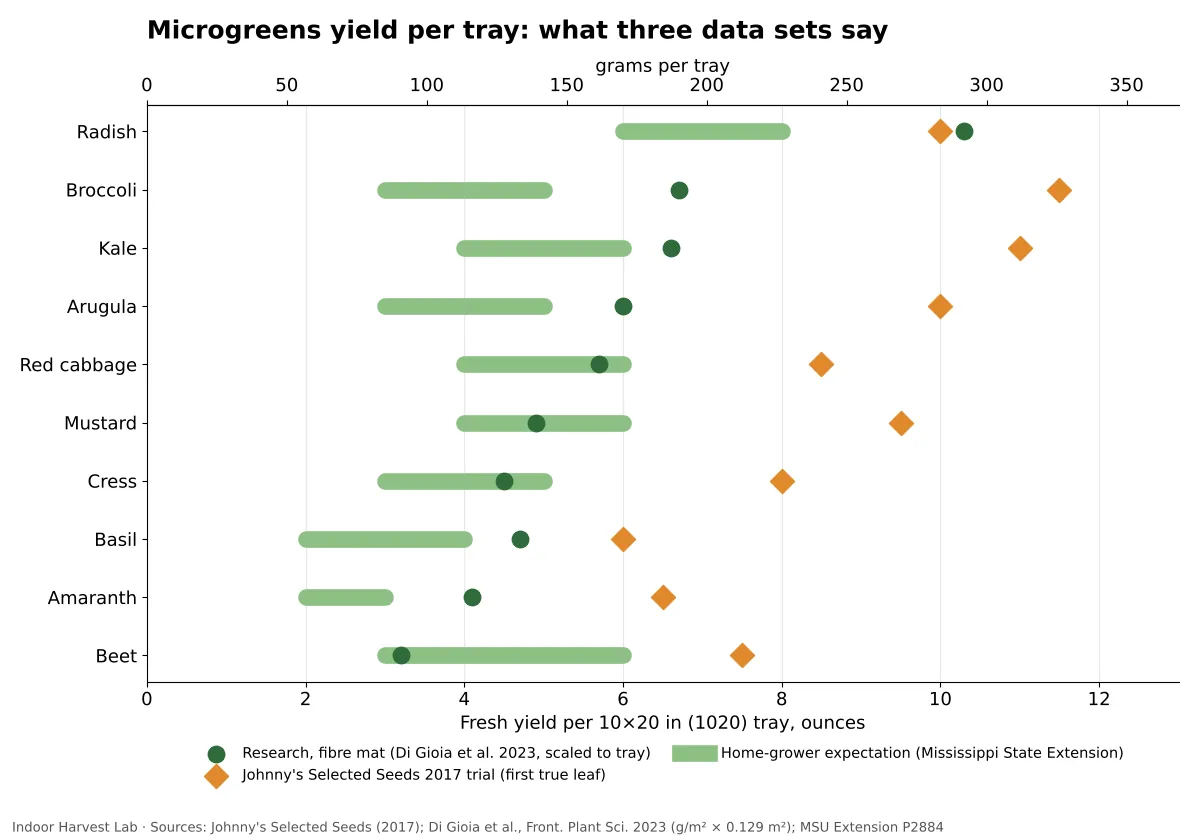
Microgreens yield per tray: the comparison chart
The cleanest public data set is the Johnny’s Selected Seeds 2017 yield trial. Their research farm sowed each variety in 1020 flats at least three times between mid-August and late October, weighed the seed used, and harvested at the first true-leaf stage. A peer-reviewed study by Di Gioia and colleagues (Frontiers in Plant Science, 2023) grew 17 species on natural-fibre mats fed with half-strength Hoagland solution and reported fresh yield in grams per square metre. And Mississippi State University Extension (Publication 2884) gives the yield a home gardener can expect from a 10×20 inch tray.
To put all three on the same scale, we converted Di Gioia’s g/m² figures to a nominal 10×20 inch tray area of 0.129 m² (200 square inches). That conversion is our own arithmetic, so treat those values as estimates; your tray’s actual growing area is a little smaller once you allow for the rounded corners.
| Crop | Johnny’s 2017 trial (oz per 1020 tray) | Di Gioia 2023 (g/m²) → per tray | MSU home-grower expectation (oz) | Days to harvest (Johnny’s / Di Gioia) |
|---|---|---|---|---|
| Radish (‘Red Arrow’) | 10 | 2,259 → about 10.3 oz | 6–8 | 8 / 10 |
| Sunflower (‘Black Oil’) | not trialled | 1,657 → about 7.5 oz | not listed | – / 10 |
| Broccoli | 11.5 | 1,461 → about 6.7 oz | 3–5 | 12.5 / 11 |
| Kale (‘Red Russian’) | 11 | 1,444 → about 6.6 oz | 4–6 | 13.5 / 11 |
| Arugula | 10 | 1,319 → about 6.0 oz | 3–5 | 14 / 14 |
| Red cabbage | 8.5 | 1,251 → about 5.7 oz | 4–6 | 13.5 / 13 |
| Mizuna | 10 | 1,212 → about 5.5 oz | not listed | 12 / 14 |
| Mustard (‘Garnet Giant’) | 9.5 | 1,082 → about 4.9 oz | 4–6 | 12.5 / 12 |
| Cress | 8 | 995 → about 4.5 oz | 3–5 | 13 / 11 |
| Basil (‘Dark Opal’) | 6 | 1,024 → about 4.7 oz | 2–4 | 25.5 / 18 |
| Amaranth (‘Garnet Red’) | 6.5 | 897 → about 4.1 oz | 2–3 | 17 / 18 |
| Beet (‘Bull’s Blood’) | 7.5 | 698 → about 3.2 oz | 3–6 | 17 / 18 |
| Tokyo Bekana | 15 | not trialled | not listed | 10 / – |
| Pea shoots | not trialled | not trialled | 6–8 (from 6 oz seed) | – / – |
Three patterns jump out when you compare microgreens yield per tray across sources. First, radish is the heavyweight among small-seeded crops in every data set, and Johnny’s (10 oz) and Di Gioia’s converted figure (about 10.3 oz) for the same ‘Red Arrow’ variety agree almost exactly. Second, Johnny’s brassica numbers run well above the other two sources. Third, the slow, fine-seeded crops (basil, amaranth, beet) are light everywhere. If you want a heavy tray, pick fast, large-seeded crops; our best microgreens for beginners guide ranks them by speed and forgiveness too.
Why published yield numbers disagree
A twofold gap between Johnny’s broccoli (11.5 oz) and the extension range (3–5 oz) looks like a contradiction. It isn’t. Each source measured microgreens yield per tray in a slightly different way, and microgreens gain weight fast enough that small differences in method add up.
Harvest stage changes everything
Johnny’s harvested every variety at the first true-leaf stage and notes plainly that “each day can make a big difference in plant size and yield totals.” University of Florida Extension (Treadwell et al., HS1164) also defines microgreens as harvested at the first true leaf, usually about 2 inches tall. Di Gioia’s team cut most species between the fully expanded cotyledon stage and the first true leaves, 10 to 19 days after sowing. They note their yields were lower than studies that used higher seed densities or harvested at a more advanced stage. Cut a day or two early and you can lose a meaningful share of the tray’s weight.
Seed per tray is not the same everywhere
Johnny’s sowed 13 g of broccoli and 10 g of kale or arugula per 1020 flat. Di Gioia sowed by seed count instead: 2.7 broccoli seeds per cm², 4 arugula seeds per cm², 1 sunflower seed per cm². Different seed rates give different stand densities, and density changes microgreens yield per tray. Our microgreens seeding density chart compares the published rates crop by crop.
Substrate, feeding and light
Johnny’s grew in germination mix in flats; Di Gioia grew on fibre mats fed with a nutrient solution under natural light; Mississippi State’s ranges are written for home gardeners. A Virginia Tech study (Nolan, 2019) that tracked three years of microgreens on burlap in an NFT system found that seed density did not correlate with yield as expected; light exposure and season mattered more. In that study the mustard blend and arugula yielded less in spring and summer than in winter, while basil did better in the warm months.
Tray area and rounding
A “1020” tray is nominally 10×20 inches, but the flat growing area inside is smaller. Johnny’s also rounds its figures to the nearest half ounce and excludes obvious outliers such as flats with poor germination. That’s sensible for a planning chart, but it means you’re looking at a good tray, not an average one.
Microgreens yield numbers to hold
Pin these next to your shelf. Every figure comes from the sources in the table, and the per-tray and per-square-foot conversions are our own arithmetic, marked with an asterisk.
| What | Number | Source |
|---|---|---|
| Nominal 1020 tray area | 10×20 in = 200 in² ≈ 0.129 m² (1,290 cm²)* | MSU Extension uses 10×20 in trays |
| Average fresh yield across 17 species | 1,176 g/m² ≈ 152 g (5.4 oz) per tray*, ≈ 109 g (3.9 oz) per ft²* | Di Gioia et al., 2023 |
| Yield range across 17 species | 409 g/m² (lemon balm) to 2,259 g/m² (radish) | Di Gioia et al., 2023 |
| Highest-yielding small-seeded crop | Radish: 10–11.5 oz per 1020 tray | Johnny’s 2017; Di Gioia 2023* |
| Highest yield in Johnny’s trial | Tokyo Bekana: 15 oz from 14 g seed in 10 days | Johnny’s 2017 |
| Typical brassica seed rate | 8–14 g seed per 1020 tray | Johnny’s 2017 |
| Pea shoots | 6 oz seed → 6–8 oz yield; can be recut once | MSU Extension P2884 |
| Light intensity effect | 100 → 600 µmol/m²/s PPFD raised fresh weight 36–82% | Jones-Baumgardt et al., 2019 |
| Fertilizer effect | Biomass × 1.6 with fertilizer vs without | Cowden et al., 2024 |
| Seeding density effect | High density 37% more productive per unit area | Cowden et al., 2024 |
| Harvest timing | 10–19 days after sowing (research); 8–25.5 days (Johnny’s) | Di Gioia 2023; Johnny’s 2017 |
Seed-to-yield ratios: how much you get back per gram
Dividing Johnny’s yield by the seed sown shows why small seeds look like a bargain on the scale. These ratios are our calculation from the trial table (1 oz = 28.35 g).
| Crop | Seed per tray (g) | Yield per tray (g) | Grams of greens per gram of seed* |
|---|---|---|---|
| Red veined sorrel | 3.5 | 184 | ≈ 53 |
| Mustard ‘Garnet Giant’ | 8 | 269 | ≈ 34 |
| Basil ‘Italian Large Leaf’ | 6.5 | 213 | ≈ 33 |
| Kale ‘Red Russian’ | 10 | 312 | ≈ 31 |
| Tokyo Bekana | 14 | 425 | ≈ 30 |
| Arugula | 10 | 283 | ≈ 28 |
| Broccoli | 13 | 326 | ≈ 25 |
| Radish ‘Hong Vit’ | 28.5 | 326 | ≈ 11 |
| Beet ‘Bull’s Blood’ | 23 | 213 | ≈ 9 |
| Cilantro | 26 | 170 | ≈ 6.5 |
Big seeds give a heavier tray but fewer grams back per gram of seed, because much of what you paid for is stored food the seedling burns through. Di Gioia found the same logic at the single-plant level: shoot fresh weight tracked seed weight closely (r = 0.92). Sunflower shoots averaged about 390 mg each, compared with about 17 mg for amaranth.
How to estimate your microgreens yield per tray before you sow
You don’t need a spreadsheet, just four minutes and a kitchen scale. Here’s the method we’d suggest for setting a realistic target instead of chasing a catalogue number.
Step 1: Measure your real growing area
Measure the inside of the tray, not the rim. Multiply length by width in inches and divide by 200 to get your fraction of a nominal 1020 tray. A 10×10 tray is 0.5; a 5×5 is 0.125. Scale every number in the tables by that fraction.
Step 2: Pick a benchmark range, not a single number
Use the MSU range as your floor and Johnny’s figure as your ceiling. For kale, that’s 4 to 11 oz; the Di Gioia conversion (about 6.6 oz) sits sensibly in between. Under a modest shelf light, aim for the middle of that range on your first few trays.
Step 3: Decide your harvest stage
If you cut at open cotyledons, expect the lower half. If you wait for the first true leaf, as Johnny’s did, expect more weight, and also more stretch and a stronger flavour in brassicas. Our guide on how to harvest microgreens shows how to judge each stage.
Step 4: Weigh and log every tray
Cut, weigh straight away (before washing), and note the seed weight, days, light hours and harvest stage. After three trays of the same crop, your own average beats any published chart, because it reflects your seed lot, your light and your hands. Johnny’s says the same thing: treat their table as a starting point and refine it with your own notes.
Six levers that raise microgreens yield per tray
Once you know your baseline, these are the factors with the strongest evidence behind them, roughly in order of how easy they are to change at home.
1. Choose heavier-yielding crops
Crop choice dwarfs everything else when it comes to microgreens yield per tray. In Di Gioia’s study, fresh yield ranged more than fivefold across species under identical conditions, from lemon balm to radish. If tray weight is the goal, grow radish, Tokyo Bekana, broccoli, kale or sunflower microgreens rather than basil or amaranth.
2. Give them more light
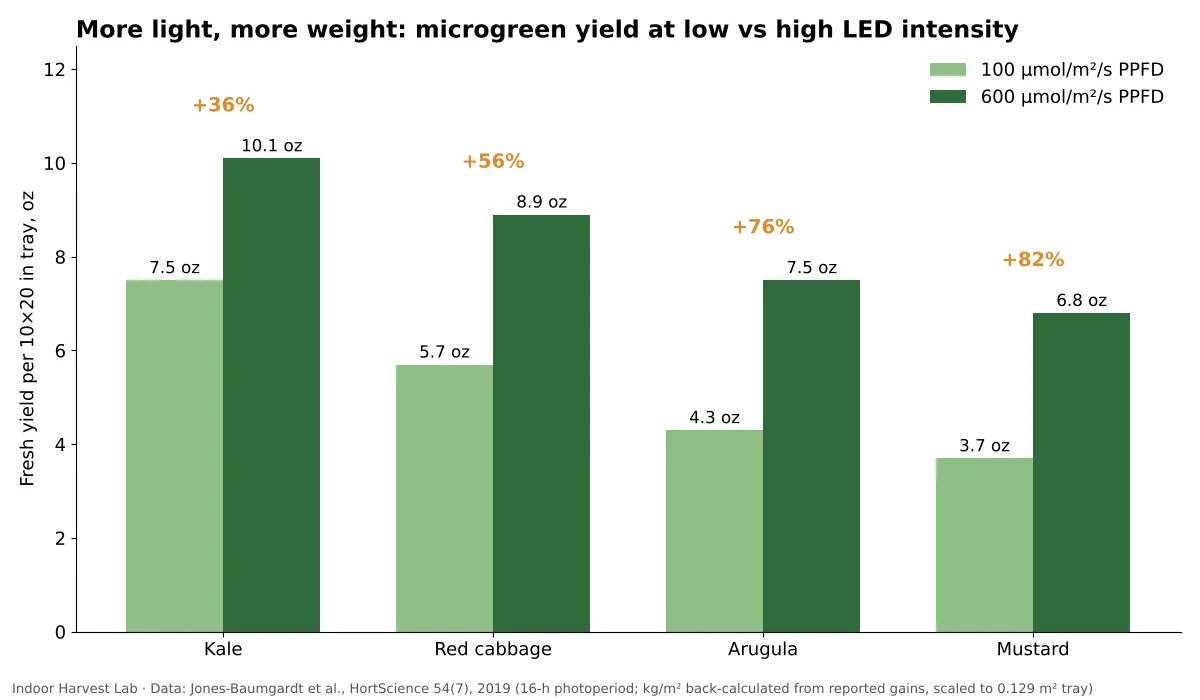
In a Canadian walk-in growth-chamber study (Jones-Baumgardt et al., HortScience 2019), raising sole-source LED intensity from 100 to 600 µmol/m²/s on a 16-hour photoperiod increased fresh weight by 36% in kale, 56% in cabbage, 76% in arugula and 82% in mustard. In absolute terms that was an extra 0.59–0.71 kg/m², or roughly 2.7–3.2 oz per tray by our conversion. Higher light also gave shorter hypocotyls (stems), so the gain came with more compact plants rather than stretch.
Don’t read that as “buy a 600 µmol light.” At 16 hours, 600 µmol/m²/s is a daily light integral of about 34.6 mol/m²/day, far above what most home shelves deliver, and electricity costs climb with it. The practical lesson is that pale, floppy trays under a weak bulb are leaving weight on the table. Our microgreens light requirements guide gives sensible home targets.
3. Sow at the right density, not the maximum
In a 2024 University of Copenhagen study (Cowden et al., Plants), the high seeding density was 37% more productive per unit area than the low one across kohlrabi, mustard and radish. Note that the authors describe a very short growing period of only four days, and Nolan’s three-year Virginia Tech data found no clear link between density and yield. The sensible reading: sow to the published rate for your crop, and don’t assume piling on extra seed buys extra weight. Overcrowded trays stay wet and invite microgreens mold.
4. Feed a little
Cowden’s team found fertilizer raised biomass by a factor of 1.6 across species. Di Gioia’s crops were fertigated with half-strength Hoagland solution after germination. For crops grown on mats or in plain water, a light nutrient feed is one of the cheapest ways to add weight. A good potting or seed-starting mix already supplies some nutrients for a single short crop.
5. Harvest at the right day
Because Johnny’s numbers are at the first true leaf, an extra day or two of growth often closes much of the gap between your tray and their chart. Push too far, though, and quality suffers: leaves crowd, lower stems yellow, and flavour sharpens. Watch the tray, not the calendar.
6. Count the regrowth (for the few crops that do)
Most microgreens don’t regrow after cutting, but pea shoots can be recut once (MSU Extension), adding to the tray’s total. See our guides to pea shoots and microgreens that regrow before you count on a second cut.
Troubleshooting a low-yield tray
If your microgreens yield per tray consistently falls below the MSU floor for that crop, one of these is usually the reason.
| What you see | Likely cause | What to do next tray |
|---|---|---|
| Bare patches, uneven stand | Uneven sowing, old seed or poor germination | Weigh seed to the published rate; spread from edges inwards; check seed viability |
| Tall, pale, floppy stems | Too little light, or cover left on too long | Move the light closer, extend hours, uncover as soon as shoots lift the cover |
| Tray full but light on the scale | Harvested too early (cotyledon stage) | Wait for the first true leaf on fast crops; compare with Johnny’s stage |
| Fuzzy growth at the base, collapsing patches | Overcrowding plus wet substrate | Reduce density slightly, bottom-water, add airflow |
| Yellowing lower leaves near harvest | Left too long, or nutrients exhausted on mats | Cut a day earlier, or add a dilute nutrient feed |
| Slow, small growth in winter | Cool room | Raise air temperature; note that some crops (basil) yielded more in warm months in Nolan’s study |
From the lab bench
Here’s how we’d read these numbers if we were planning a shelf from scratch.
Trust the agreement, question the outliers. When two independent sources land on the same value, as Johnny’s and Di Gioia do for ‘Red Arrow’ radish at about 10 oz per tray, that’s a number you can plan around. When one source sits far above the others, as Johnny’s brassicas do, look for the methodological reason (here, harvest at first true leaf and outliers removed) before you blame your own growing.
Microgreens yield per tray is a ratio, not a trophy. A 10-oz radish tray needs about 25–29 g of seed; a 10-oz arugula tray needs about 10 g. If seed cost or seed supply is your constraint, grams of greens per gram of seed matter more than raw tray weight. If shelf space is the constraint, raw weight per tray per day is the better metric, and fast crops like radish and Tokyo Bekana win.
Light is the lever most home growers underuse. The growth-chamber data show weight rising steadily with intensity across four brassicas. You don’t have to chase research-chamber levels; even moving from a dim window to a decent LED shelf typically shifts a tray from the bottom to the middle of the range.
Weigh fresh, weigh the same way every time. Microgreens lose water quickly after cutting. If you compare trays, weigh them at the same point (straight after cutting, unwashed), or your own log will mislead you more than any chart.
FAQ
How many ounces of microgreens are in a 1020 tray?
Microgreens yield per tray for most small-seeded crops is about 4 to 11 ounces (115–325 g) per 10×20 inch tray. Mississippi State Extension gives home-grower ranges such as 3–5 oz for broccoli and arugula and 6–8 oz for radish, while Johnny’s 2017 trial recorded 10–11.5 oz for the same crops harvested at the first true leaf.
Which microgreens have the highest yield per tray?
Among small-seeded crops, radish is consistently heaviest: about 10 oz per tray in both Johnny’s trial and Di Gioia et al. (2023). In Johnny’s trial, Tokyo Bekana topped the list at 15 oz. Sunflower and borage were also high in Di Gioia’s study.
What is the yield of broccoli microgreens per tray?
Broccoli yields roughly 3 to 11.5 oz per 10×20 tray depending on the source: 3–5 oz (MSU Extension), about 6.7 oz converted from Di Gioia et al. (2023), and 11.5 oz from 13 g of seed in Johnny’s 2017 trial.
What is the yield of sunflower microgreens per tray?
Di Gioia et al. (2023) measured 1,657 g/m² for ‘Black Oil’ sunflower harvested 10 days after sowing, which works out to about 210 g (7.5 oz) per nominal 10×20 inch tray.
How much do microgreens yield per square foot?
Across 17 species, Di Gioia et al. (2023) measured an average of 1,176 g/m², which is about 109 g (3.9 oz) per square foot. Individual crops ranged from about 38 g per square foot (lemon balm) to about 210 g (radish).
Does more seed mean a bigger harvest?
Only up to a point. One study found a higher seeding density was 37% more productive per area, but a three-year Virginia Tech study found seed density did not correlate with yield as expected. Overcrowding also raises mold risk, so sow at the published rate for each crop.
Why is my microgreens yield lower than the seed company says?
Seed-company trials often harvest at the first true leaf, exclude poor trays and round to the nearest half ounce. Lower light, earlier harvest, uneven sowing and unfed substrates all reduce weight at home.
Sources
- Johnny’s Selected Seeds. (2017). Micro Greens Yield Trial 2017: Comparison Chart for 29 Popular Varieties (tech sheet, rev. 11/15/2017).
- Di Gioia, F., Hong, J. C., Pisani, C., Petropoulos, S. A., Bai, J., & Rosskopf, E. N. (2023). Yield performance, mineral profile, and nitrate content in a selection of seventeen microgreen species. Frontiers in Plant Science, 14, 1220691. doi:10.3389/fpls.2023.1220691
- Bachman, G. R. (2024). Microgreen Varieties for the Mississippi Gardener (Publication 2884). Mississippi State University Extension.
- Mississippi State University Extension. Growing Microgreens for the Mississippi Gardener (Publication 2857).
- Jones-Baumgardt, C., Llewellyn, D., Ying, Q., & Zheng, Y. (2019). Intensity of sole-source light-emitting diodes affects growth, yield, and quality of Brassicaceae microgreens. HortScience, 54(7), 1168–1174. doi:10.21273/HORTSCI13788-18
- Cowden, R. J., Markussen, B., Ghaley, B. B., & Henriksen, C. B. (2024). The effects of light spectrum and intensity, seeding density, and fertilization on biomass, morphology, and resource use efficiency in three species of Brassicaceae microgreens. Plants, 13(1), 124. doi:10.3390/plants13010124
- Nolan, D. A. (2019). Effects of Seed Density and Other Factors on the Yield of Microgreens Grown Hydroponically on Burlap. Virginia Tech.
- Treadwell, D., Hochmuth, R., Landrum, L., & Laughlin, W. Microgreens: A New Specialty Crop (HS1164). University of Florida IFAS Extension.