
You’re standing in the lighting aisle (or scrolling a shopping site) with a seed order on the way and a shelf waiting in the basement. One box says “full spectrum, 1000 W equivalent”. Another says “6500 K, 4,000 lumens”. A third just shows purple light and a very happy tomato. None of them tells you the one thing your seedlings care about.
Short answer: the best grow lights for seed starting are LED fixtures that publish their PPF (in µmol/s), a PPFD map at your hanging height and an efficacy of about 2.5 µmol/J or better. Plain white LED shop lights work well; you don’t need purple light. Aim for roughly 200–250 µmol/m²/s at leaf level for 16 hours a day, hung about 4–6 inches above the seedlings and raised as they grow.
This buyer’s guide skips brand hype and gives you the numbers instead. By the end you’ll be able to read a spec sheet, work out how many watts your trays need, choose between LED and fluorescent, and set the lights up so your seedlings come out short, green and sturdy instead of tall and floppy.
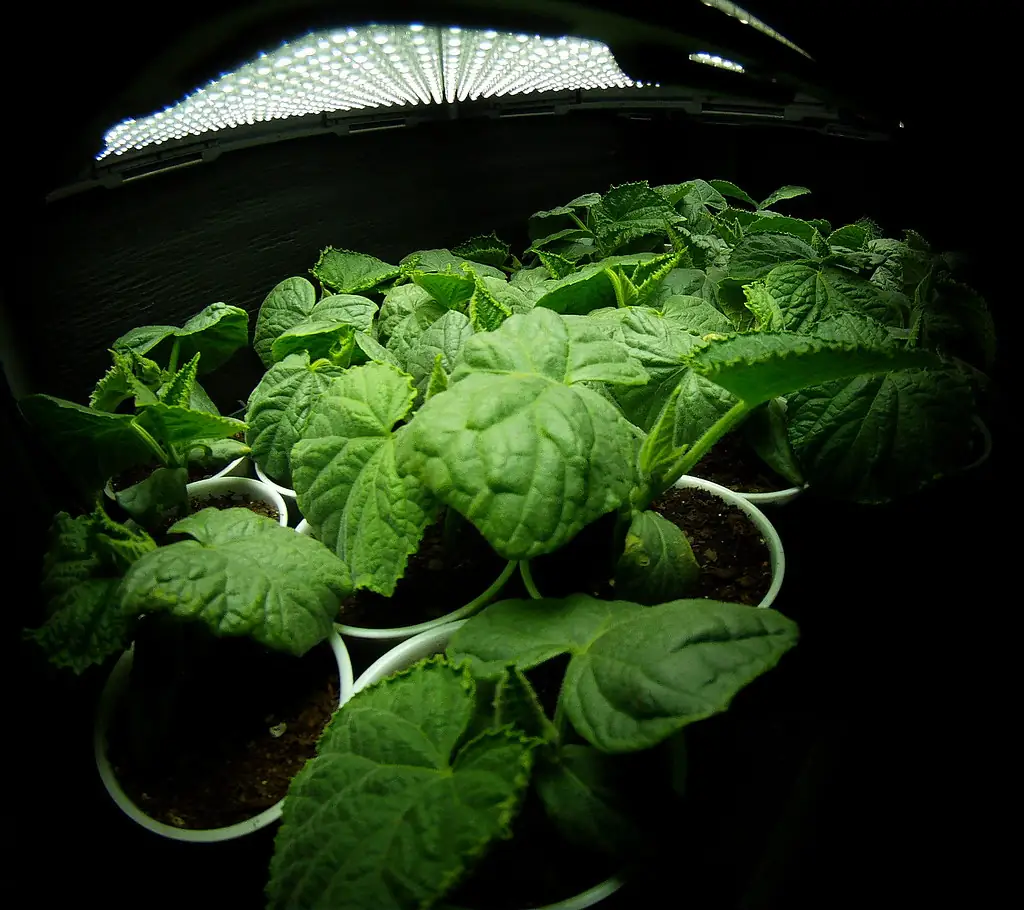
What grow lights for seed starting actually need to do
A seedling under a lamp has one job: build leaves and roots with the sugar it makes from light. If it doesn’t get enough light, it pours its energy into stretching toward the source. University of Minnesota Extension describes the result plainly: stems grow long and thin with long gaps between leaves, and the leaves go pale. That’s the classic leggy seedling.
So the job of a seed-starting light is simple to state: deliver enough plant-usable light, evenly, across the whole tray, for long enough each day. Three numbers describe that, and good manufacturers publish all three:
- PPF (µmol/s): the total plant-usable light (400–700 nm) the fixture emits every second. Think of it as the size of the light “budget”.
- PPFD (µmol/m²/s): how much of that light actually lands on each square metre of leaf at a given distance. This is what your seedlings feel, and it drops as you raise the lamp.
- Efficacy (µmol/J): how many micromoles of light the fixture makes for each joule of electricity. Higher means more light for the same power bill.
Then there’s DLI, the daily light integral: the total light a plant receives over a day, in mol/m²/day. It’s PPFD multiplied by the hours the light is on. University of Missouri Extension’s grow-light guide shows the arithmetic: multiply average PPFD by 3,600 seconds per hour and divide by 1,000,000 to get moles per hour, then multiply by your hours of light.
Why watts, lumens and Kelvin mislead you
Watts tell you how much electricity a lamp uses, not how much light it delivers; University of Minnesota Extension makes exactly this point. Lumens and lux are weighted to human vision, which is most sensitive to green-yellow light. Missouri Extension’s advice is blunt: when shopping for grow lights, focus on PAR and avoid comparing lights by lumens, lux, candelas or Kelvin colour temperature. A “1000 W equivalent” label is a marketing comparison, not a measurement.
Numbers to hold for seed-starting lights
Pin this table above your seed shelf. Each value comes from the sources listed at the end; where we did the arithmetic ourselves, it says so.
| What | Target | Source |
|---|---|---|
| Light level that is not enough for seed starting | 50–150 µmol/m²/s (a north window or dim corner) | UMN Extension |
| “Medium” light (east window) | 150–250 µmol/m²/s; still needs supplemental lights for seedlings | UMN Extension |
| Practical PPFD target at leaf level | About 200–250 µmol/m²/s | Our calculation from the DLI targets below |
| Daily light integral tested for tomato seedlings | 6.5, 9.7 and 13 mol/m²/day; growth rose as DLI rose | Huber et al. 2021 |
| Hours of light per day | 16–18 h (UMN); about 16 h (NDSU) | UMN; NDSU Extension |
| Lamp height above seedlings | 4–6 in (10–15 cm), raised as plants grow | UMN; NDSU Extension |
| Efficacy of a good modern LED fixture | Over 2.5 µmol/J | Missouri Extension; Kusuma et al. 2020 |
| Efficacy of a T8 fluorescent fixture | 0.84 µmol/J (best fluorescent tested: 0.95) | Nelson & Bugbee 2014 |
| DLI from 225 µmol/m²/s for 16 h | ≈13 mol/m²/day (225 × 16 × 0.0036) | Our calculation; formula from Missouri Extension |
Notice the pattern. A tray needs a PPFD in the low hundreds, sustained for most of the day. That’s far more than a typical room lamp delivers at a few feet, but far less than what a fruiting tomato wants. It’s also why we cover how many hours of light seedlings need in a separate guide: hours and intensity trade off against each other.
LED vs fluorescent vs everything else: an honest comparison
Ten years ago, a pair of T8 or T5 fluorescent tubes on chains was the default seed-starting rig, and it still works. The real question when you compare grow lights for seed starting is cost per unit of light, and here the research is clear.
Utah State University researchers tested 22 fixtures in 2014. The 60 W T8 fluorescent fixture delivered 0.84 µmol/J, the best fluorescent (an induction lamp) 0.95, and the common mogul-base high-pressure sodium (HPS) fixtures 1.02. The best LEDs of that year reached about 1.70 µmol/J (Nelson & Bugbee 2014). By 2020 the same lab reported independently tested LED fixtures at 2.5–2.8 µmol/J for white + red and 3.0 µmol/J for blue + red, with a plain 5000 K white fixture at 2.43 (Kusuma, Pattison & Bugbee 2020).
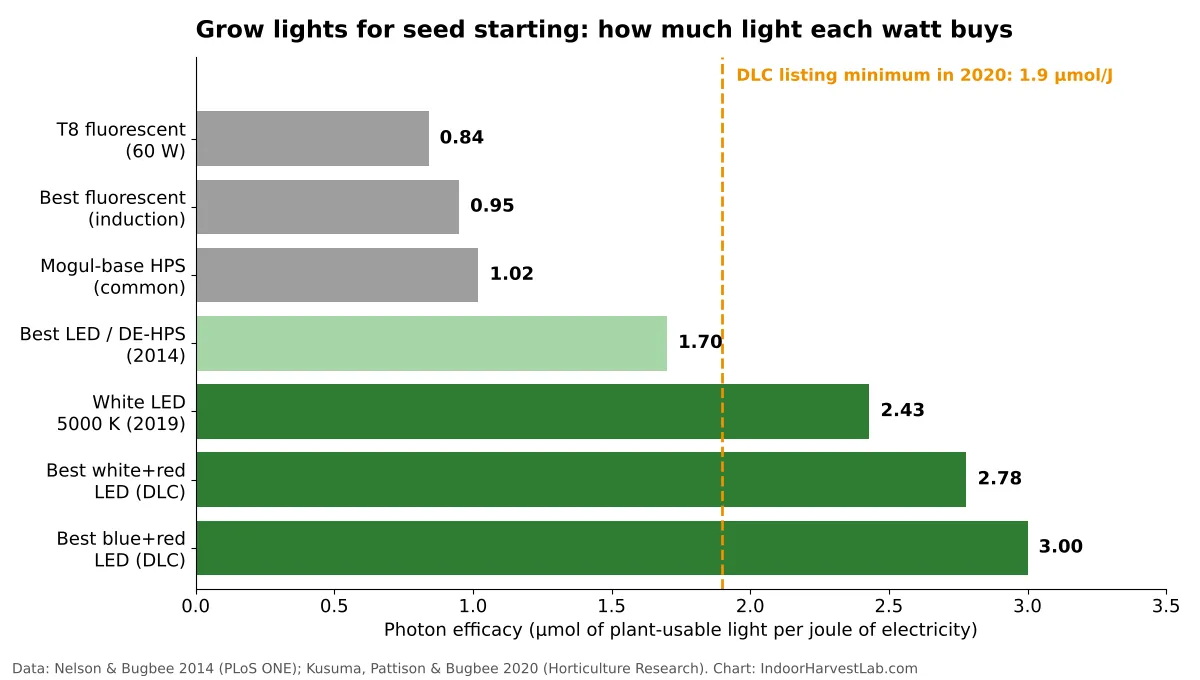
In practical terms, a good LED gives you roughly three times the light of a T8 tube for the same electricity. Here’s how the options stack up for a home seed shelf:
| Light type | Efficacy (µmol/J) | Heat near plants | Upfront cost | Verdict for seed starting |
|---|---|---|---|---|
| LED bar, panel or shop light | ≈2.1–3.0 (good fixtures) | Low at the leaf; heat sinks get warm | Moderate | Best all-round choice |
| T5 / T8 fluorescent tubes | ≈0.84–0.95 | Low; can sit 2–4 in away | Low (if you already own fixtures) | Works, but costs more to run; tubes need replacing |
| High-pressure sodium (HPS) | ≈1.0–1.7 | High radiant heat | Moderate | Too hot and bulky for shelves |
| Incandescent bulbs | Very low (not tested as grow lights) | High | Low | Avoid: heat and far-red light cause stretching |
Missouri Extension notes that HPS lamps are a poor fit for vertical or shelf systems because their radiant heat can burn plants and they are too bulky. University of Minnesota Extension lists incandescent bulbs as inefficient and heat-producing, with high far-red light that makes plants stretch. NDSU Extension agrees that incandescents don’t work well for seedlings.
Should you replace working fluorescent fixtures?
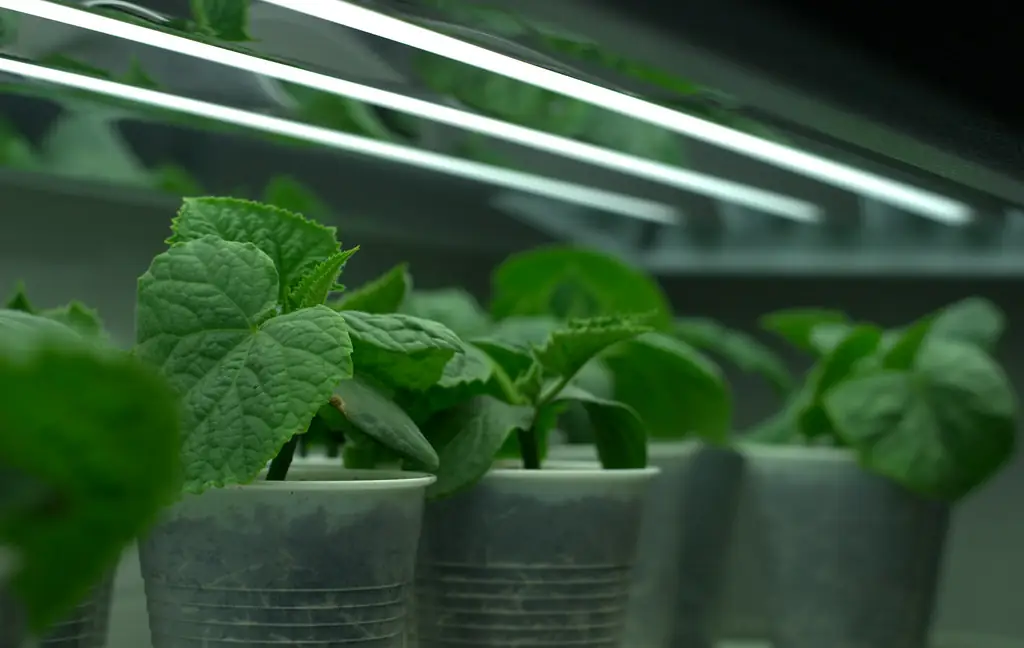
Not necessarily. Mississippi State University Extension points out that standard fluorescent tubes work when they’re close enough to the plants and left on long enough, while LEDs use less energy, last longer and run cooler. If your tubes are working, use them this season. When a ballast or tube fails, replace the fixture with an LED rather than buying new tubes.
Do you need a “grow light”, or will a white shop light do?
Here’s the surprise for many first-time buyers: for seedlings, a plain white LED shop light is a perfectly good grow light. Mississippi State Extension says so directly: you don’t need special grow lights, and shop LEDs or fluorescents will work fine.
The old reason for magenta “blurple” fixtures was efficiency. Early blue + red LEDs were more efficient than white ones, and many people assumed plants only use red and blue. Kusuma and colleagues explain that green photons have long been known to drive photosynthesis, and that spectral effects on photosynthesis are remarkably similar across species. White LEDs have become so cheap (about 20% of the cost of red LEDs) that they now make up more than 60% of the LEDs in some horticultural fixtures.
University of Minnesota Extension sums it up for home growers: white or mixed/balanced lights suit most plants at any stage of growth, and blue or mixed light suits seedlings and leafy greens. There’s a practical bonus too. Under white light you can see your seedlings’ true colour, so you’ll notice yellowing, purpling or mould early. Under purple light, everything looks odd.
Colour temperature: 3000 K or 5000 K? Kelvin only describes how the light looks to you. In the Utah State data, a 5000 K white fixture measured 2.43 µmol/J and a 3000 K one 2.13. Cooler whites tend to be slightly more efficient, but either will grow seedlings. Choose by efficacy and PPF, not by Kelvin.
What about UV and far-red? Missouri Extension notes that red and far-red light promotes stem and tissue expansion, while blue and UV can increase phytonutrients but excess blue stunts growth. For seedlings you want compact growth, so a fixture heavy in far-red isn’t an advantage. You don’t need UV for seed starting.
How much grow light do your seed trays need?
This is where most buyer’s guides go vague. Let’s size grow lights for seed starting with numbers instead. A standard 10 × 20 inch seed tray covers about 0.129 m². To hold 225 µmol/m²/s across it (≈13 mol/m²/day over 16 hours), about 29 µmol/s of light has to land on the tray.
Not all the light a fixture makes lands on your tray; some spills past the edges and onto the shelf. If we assume about 70% of the output lands where you want it (a working assumption for a fixture roughly the size of the tray area), the fixture needs a PPF of about 41 µmol/s per tray. Divide by efficacy to get wall-plug watts:
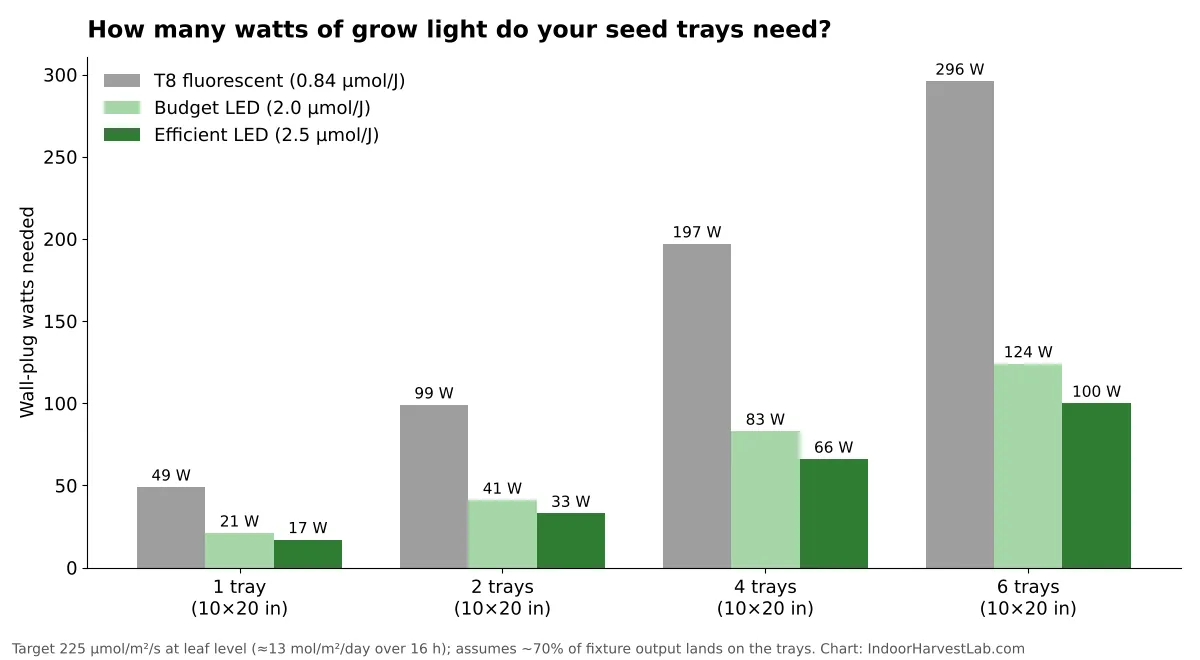
| Trays (10 × 20 in) | Fixture PPF needed | Efficient LED (2.5 µmol/J) | Budget LED (2.0 µmol/J) | T8 fluorescent (0.84 µmol/J) |
|---|---|---|---|---|
| 1 | ≈41 µmol/s | ≈17 W | ≈21 W | ≈49 W |
| 2 | ≈83 µmol/s | ≈33 W | ≈41 W | ≈99 W |
| 4 (one shelf) | ≈166 µmol/s | ≈66 W | ≈83 W | ≈197 W |
| 6 | ≈249 µmol/s | ≈100 W | ≈124 W | ≈296 W |
Two things jump out. First, a single shelf of four trays needs a fixture in the 60–100 W real-draw range, not a 15 W desk lamp. Second, the fluorescent column is about three times the LED column, and that difference lands on your power bill.
Running cost, worked example
Take the four-tray shelf on a 16-hour timer for a six-week seed-starting season (42 days). An efficient LED drawing 66 W uses 66 × 16 × 42 ÷ 1,000 ≈ 44 kWh. T8 tubes drawing 197 W use about 132 kWh. Multiply by your own electricity rate; at an illustrative 15 cents per kWh, that’s roughly $7 versus $20 for the season. Missouri Extension’s guide includes a downloadable calculator if you want to model your own fixtures and rates.
Check your result with the manufacturer’s PPFD map
Better fixtures publish a PPFD map at several hanging heights. Missouri Extension recommends averaging the four corners and the centre of the map (or of your own meter readings) before you calculate DLI. That average matters: in their worked example, the centre read 612 µmol/m²/s while the corners sat around 492–496. Your seedlings at the tray edges get the corner number, not the headline centre value.
How to choose grow lights for seed starting: a 6-step checklist
Use these steps in order. If a product fails step 2, you can stop there.
Step 1: Measure your growing area
Count the trays per shelf and measure the shelf width and depth. A fixture should cover the whole footprint; a light that’s shorter than the tray row leaves the end cells dim. For a standard 48-inch wire shelf, 4-foot LED bars or shop lights are a natural fit.
Step 2: Demand PPF, PPFD and a spectrum graph
Missouri Extension’s advice is to avoid buying a light if the maker doesn’t provide a spectrum graph and PPF or PPFD figures. Kusuma and colleagues add that manufacturers should be able to supply results from certified third-party test labs. No numbers, no sale.
Step 3: Check efficacy (µmol/J)
Divide PPF by actual watts drawn if the efficacy isn’t stated. Missouri Extension puts current LEDs above 2.5 µmol/J. When Kusuma et al. wrote in 2020, the DesignLights Consortium (DLC) required at least 1.9 µmol/J for its horticultural product list, and the DLC raised its requirements again in version 3.0 (2023). A DLC listing is a useful shortcut for checking a fixture’s claims.
Step 4: Prefer white or broad-spectrum light
As covered above, white LEDs grow excellent seedlings and let you see plant health. Skip fixtures sold mainly on extra UV or far-red; seedlings don’t need them.
Step 5: Make height adjustment easy
You’ll raise the light every few days as seedlings grow. Chains, ratchet hangers or a shelf with adjustable clips save frustration. Light bars that link together (daisy-chain), a feature Missouri Extension mentions, reduce the number of outlets you need.
Step 6: Plan for a timer and safety
NDSU Extension recommends an automatic timer to manage the daily on-off chore, and UMN Extension also advises setting one. Choose fixtures rated for damp locations if they’ll hang over humidity domes or a misting area, keep cords off the floor, and use a grounded power strip.
Setting up your lights, and what your seedlings are telling you
Once the light is bought, hanging height and hours decide whether you get stocky transplants. University of Minnesota Extension suggests 4–6 inches above seedlings, moved up regularly, and 16–18 hours of light a day. NDSU Extension says lights should almost touch seedlings after germination and stay no more than 4–6 inches away. That close spacing was written with fluorescent tubes and modest LEDs in mind; a powerful LED panel may need more distance, so follow its PPFD map. Our grow light distance guide covers heights by fixture type in detail.
Light also links to the rest of seed starting. Bright, even light with good air movement helps the seedling surface dry between waterings, which matters for preventing damping-off. Strong seedlings also handle potting up better. Use this table to read what the plants are showing you:
| What you see | Likely light cause | What to do |
|---|---|---|
| Tall, thin, pale stems with long gaps between leaves | Too little light (PPFD or hours) | Lower the lamp toward 4–6 in, check the 16-hour timer, add a fixture if the shelf is under-lit |
| Edge cells stretched, centre cells compact | Uneven coverage; corners get less light | Rotate trays daily, use a wider fixture or add a second bar |
| Seedlings leaning one way | Light coming from a window or one side | Move the tray fully under the lamp; rotate trays |
| Bleached or scorched patches on leaves | Too much light (lamp too close for its power) | Raise the lamp and check the PPFD map at that height |
| Stretching under a warm household bulb | Incandescent light: heat plus far-red | Replace with an LED or fluorescent fixture |
| Slow, small but compact seedlings | Low daily light (DLI) or a cool room | Increase PPFD or hours within the 16–18 h range; check germination and growing temperatures |
From the lab bench: how to think about seed-starting light
Here’s the mental model that makes every buying decision easier: you are buying photons, and you are paying for them twice. Once at the checkout (the fixture) and again every month (the electricity). PPF tells you how many photons you’re buying; efficacy tells you what each one costs to run. Everything else on the box is decoration.
The second rule: DLI is the currency plants spend. The tomato seedling study by Huber and colleagues is a nice illustration. Across daily light integrals of 6.5, 9.7 and 13 mol/m²/day, growth rate rose with DLI. The seedlings didn’t care whether that light came from an expensive fixture or a cheap one, only how much arrived. That’s why, among grow lights for seed starting, a well-placed shop light can beat a pricey “grow light” hung too high.
Third, uniformity beats peak intensity. A tray is only as good as its weakest cells. A fixture that pours light on the centre and starves the corners gives you a tray of mixed seedlings that are hard to water and transplant on one schedule. Two modest bars spread across the shelf often give a more even tray than one bright square panel in the middle.
Finally, a word on marketing claims. Phrases like “full spectrum”, “1000 W equivalent” and “sunlike” have no agreed definition. A measured PPF, an honest wattage and a PPFD map do. If you remember nothing else from this guide, remember to buy the light that shows its numbers.
FAQ
What are the best grow lights for seed starting?
LED fixtures that publish their PPF, a PPFD map and an efficacy of about 2.5 µmol/J or better. White LED shop lights or LED bars that cover the whole shelf are an excellent, affordable choice for seedlings.
Can I use regular LED shop lights to start seeds?
Yes. Mississippi State University Extension says you don’t need special grow lights; shop LEDs or fluorescents work fine as long as they’re close enough to the seedlings and on for long enough.
How many hours a day should grow lights be on for seedlings?
About 16 hours. University of Minnesota Extension recommends 16–18 hours and NDSU Extension about 16. Use a timer and give plants a dark period each day.
How close should grow lights be to seedlings?
About 4–6 inches for fluorescent tubes and modest LEDs, raised as the plants grow (UMN and NDSU Extension). Powerful LED panels may need more distance, so check the maker’s PPFD map at your hanging height.
Are LED grow lights better than fluorescent for seedlings?
Both grow good seedlings, but LEDs are about three times more efficient. Tested T8 fluorescent fixtures delivered 0.84 µmol/J, while good modern LED fixtures deliver 2.5 µmol/J or more, so LEDs cost far less to run.
Do seedlings need red and blue (purple) grow lights?
No. Green light also drives photosynthesis, and white LEDs are now efficient and inexpensive. University of Minnesota Extension notes that white or balanced light suits most plants at any stage.
How many watts of grow light do I need for a seed tray?
For a 10 × 20 inch tray at about 225 µmol/m²/s, plan on roughly 17–21 W of actual draw from an efficient LED, or about 49 W from T8 fluorescent tubes, assuming most of the light lands on the tray.
Sources
- Weisenhorn, J. & Hoidal, N. Lighting for indoor plants and starting seeds. University of Minnesota Extension (reviewed 2026).
- Cabrera-Garcia, J. (2025). Controlled Environment Agriculture: Understanding Grow Lights (G6987). University of Missouri Extension.
- Knutson, C. (2021). Dakota Gardener: Grow Lights for Seed Starting. North Dakota State University Extension.
- LED Lights for Starting Seeds Indoors. Mississippi State University Extension Service, Extension for Real Life blog.
- Kusuma, P., Pattison, P. M. & Bugbee, B. (2020). From physics to fixtures to food: current and potential LED efficacy. Horticulture Research 7: 56. doi:10.1038/s41438-020-0283-7.
- Nelson, J. A. & Bugbee, B. (2014). Economic analysis of greenhouse lighting: light emitting diodes vs. high intensity discharge fixtures. PLoS ONE 9(6): e99010.
- Huber, B. M., Louws, F. J. & Hernández, R. (2021). Impact of different daily light integrals and carbon dioxide concentrations on the growth, morphology, and production efficiency of tomato seedlings. Frontiers in Plant Science 12: 615853.