
You’ve seen the little trays of bright green grass at the juice bar, or your cat has started chewing the spider plant again, and you think: surely I can grow that myself. You can. Wheatgrass is one of the most forgiving things you’ll ever grow indoors, but it has two quirks that catch almost everyone out: sour-smelling mold in a too-crowded tray, and a harvest that turns tough if you wait too long.
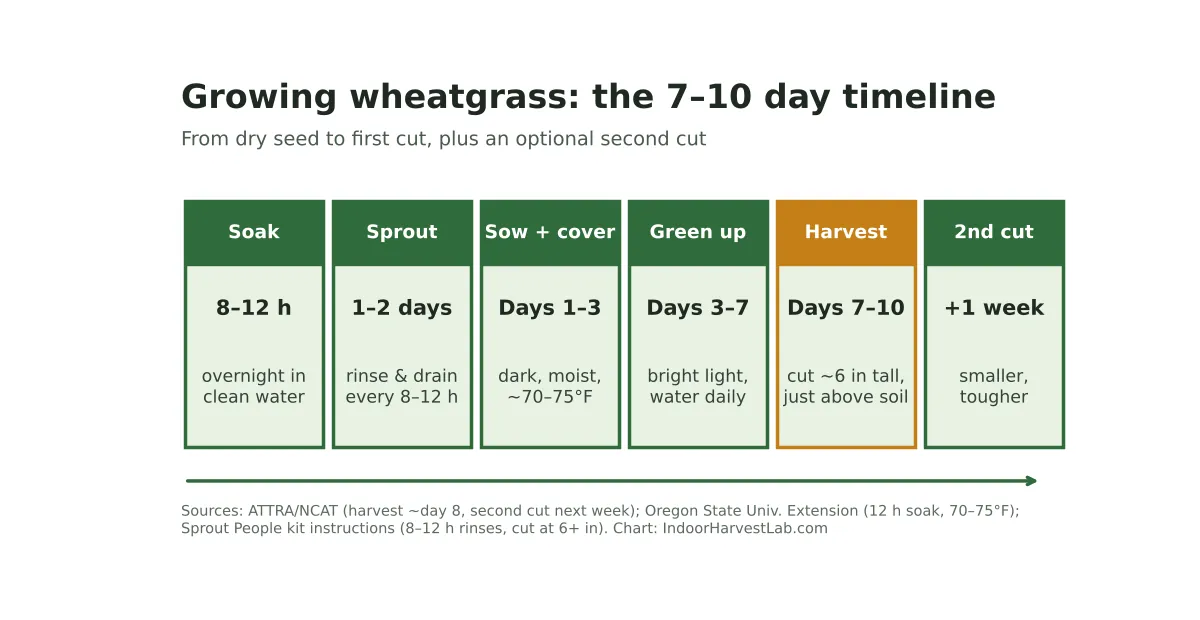
Short answer: Growing wheatgrass at home takes about 7 to 10 days from seed to first cut. Soak hard wheat berries for 8–12 hours, let them sprout for a day or two, then spread them one layer thick on about an inch of moist soil or mix, keep them covered for two to three days, and move the tray into bright light at roughly 68–75°F (20–24°C). Cut when the grass is about 6 inches tall, just above the soil, and you can often get a second, smaller cut a week later.
By the end of this guide you’ll know exactly how much seed to use, the temperature and light numbers that give the heaviest trays, how to tell mold from harmless root hairs, and how to grow a safe pot of cat grass. The steps for growing wheatgrass are the same whether it’s for juicing, smoothies, pet grass or an Easter centerpiece.
What you need before you start growing wheatgrass
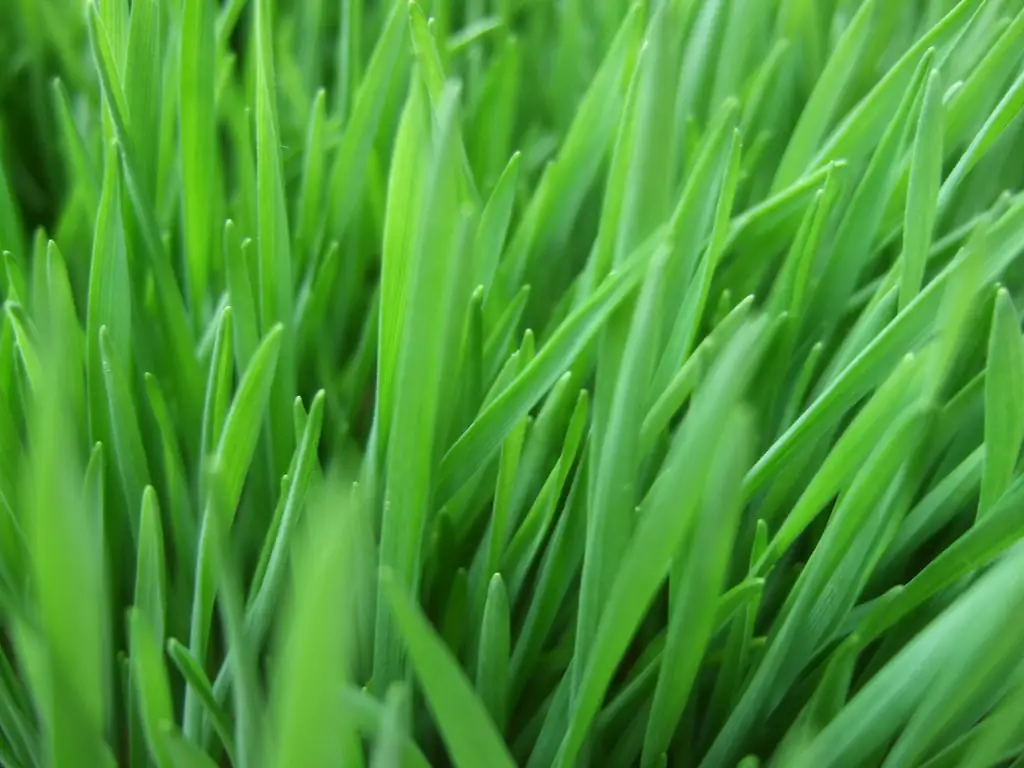
Wheatgrass is simply young common wheat, Triticum aestivum, cut at the seedling stage. The “wheat berries” you buy are whole grains. Oregon State University Extension notes that most home kits use hard red winter wheat seed, and seed sellers also offer hard red spring wheat for the same job.
Buy grain that’s sold for sprouting or wheatgrass, not farm seed meant for drilling into a field. Field seed is often coated with fungicide, and you’ll be eating (or your cat will be eating) the leaves a week later.
Basic supplies for growing wheatgrass
- Seed: hard red wheat berries for sprouting. A tablespoon fills a small jar or pot; about 1 cup per 10×10 inch tray (see the numbers below).
- A jar and a mesh lid or sieve for soaking and rinsing.
- A tray or pot with drainage, at least 2½–3 inches deep for pots, or a shallow 10×10 or 10×20 inch tray set inside a solid drip tray.
- Growing medium: potting mix, compost-based mix, coco coir or vermiculite.
- A cover (a second tray, a damp towel or a sheet of cardboard) for the first two or three days.
- Light: a bright window or a simple LED grow light.
- Clean scissors for harvest.
Soil, soilless mix or no medium at all?
People search for growing wheatgrass without soil a lot, and it does work, but there’s a trade-off. In a Croatian trial comparing ways to sow wheat for wheatgrass, Grubišić et al. (2019) found the highest incidence of mildew when wheatgrass was grown without any substrate, while a commercial peat substrate gave the most plants per pot and the heaviest plants.
| Method | What you use | Best for | Watch out for |
|---|---|---|---|
| Soil or potting mix | About 1 inch of moist mix (ATTRA) | Heaviest, most even trays; cat grass pots | Fungus gnats if mix stays soggy |
| Vermiculite or coco coir | About 3 cups vermiculite per 10×10 tray (Sprout People) | Clean, light trays; easy to compost | Dries fast near heaters |
| No medium (mesh, jar or hydro mat) | Sprouts sit on a mesh or wet mat | Small batches, no mess | Highest mildew risk in trials (Grubišić et al., 2019) |
If you’re new to soil-free trays, our guide to growing microgreens without soil walks through mats and media in more detail. For wheatgrass, a thin layer of mix is the safer bet.
How to grow wheatgrass step by step
Here’s the full routine for growing wheatgrass, from dry grain to first cut. Each step tells you why it matters, because once you understand the reasons you can adapt the method to any container.
Step 1: Measure the seed
Sprout People’s wheatgrass instructions call for 1 cup of seed per 10×10 inch tray. For a standard 10×20 inch tray that scales to roughly 2 cups. For a small pot or jar, Oregon State University Extension uses about 1 tablespoon. Dense sowing is the goal, but not so dense that seeds pile up two or three layers deep.
Step 2: Soak for 8–12 hours
Cover the grain with clean water and leave it overnight. Sprout People suggest 8–12 hours; Oregon State says at least 12. Soaking lets the dry kernels take up water and wakes up germination, so they start evenly instead of in fits and starts.
Step 3: Rinse, drain and let them sprout
Drain the jar, rinse, and tip it at an angle so water can run out. Repeat every 8–12 hours. Plant when most seeds show tiny white roots about 1/8 to 1/4 inch long, which usually takes two or three rinse-and-drain cycles (Sprout People). ATTRA’s wheatgrass production guide describes the same cue: soak until the root tip pokes through the seed coat.
Why bother pre-sprouting? Sprouted grain roots down into the mix within a day, so you lose fewer seeds to drying out on the surface.
Step 4: Spread one layer on moist mix
Fill the tray with about an inch of pre-moistened mix (ATTRA). Scatter the sprouted grain evenly so every seed touches the medium, one or two seeds deep at most (OSU). Press gently with your palm. Don’t bury them; wheatgrass grows from seed sitting on the surface.
Step 5: Cover for two to three days
Cover the tray, or set an upside-down tray on top, and keep it at room temperature. ATTRA notes that seedlings start in the dark and are exposed to light after two or three days. The cover holds humidity around the seeds and pushes the shoots to stretch evenly. It’s the same idea as the microgreens blackout period, just shorter.
Keep the mix damp but not waterlogged; Oregon State suggests misting a few times a day if you have a spray bottle. By about day three the grass should be actively growing.
Step 6: Uncover and give it light
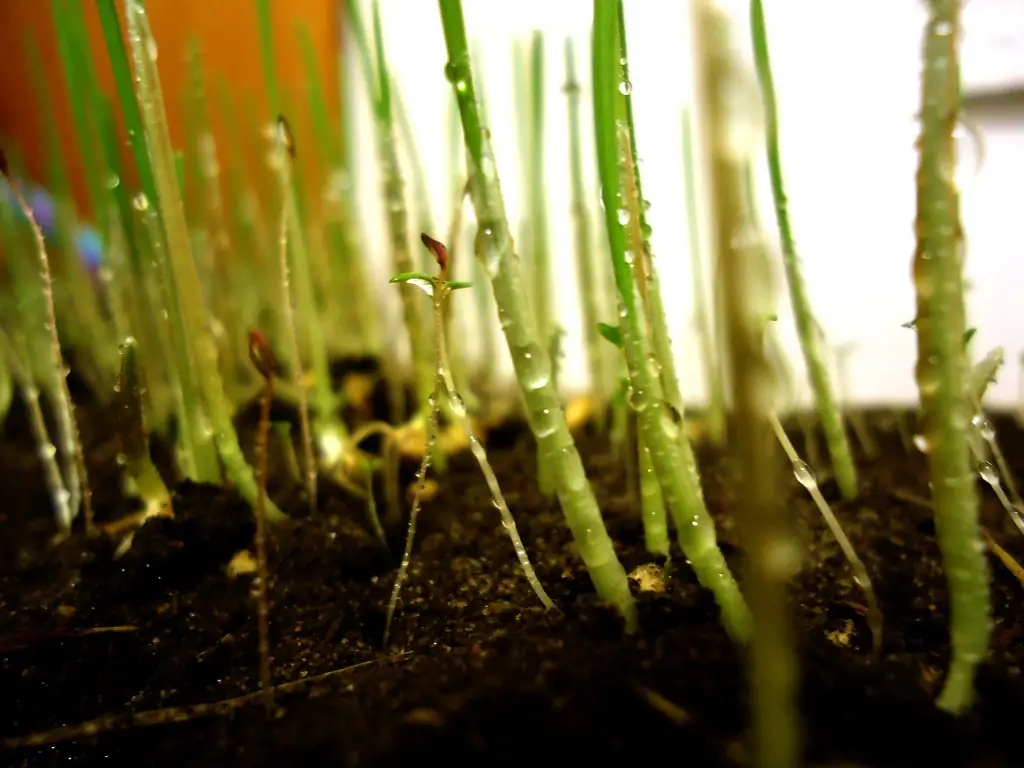
Once shoots are 1–2 inches tall (Sprout People say this takes 3–4 days), remove the cover and move the tray to a bright window or under a grow light. Water once or twice a day, ideally from below by pouring a cup or two into the drip tray, so the leaves stay dry. Wet leaves in a dense canopy are what molds first.
Step 7: Harvest at about 6 inches
ATTRA says harvest usually begins around day eight, just before the second leaf appears, and that bed-grown wheatgrass is typically cut at about one week to ten days. Sprout People suggest cutting when the grass reaches 6 inches or more. Cut with clean scissors just above the medium.
Light and temperature for growing wheatgrass: the numbers to hold
Most wheatgrass guides stop at “keep it somewhere warm and bright.” The research gives you something sharper. In a growth-chamber study, Islam, Park and Lee (2021) grew wheat and barley grass at three day/night temperatures under LED light, then weighed the harvest.
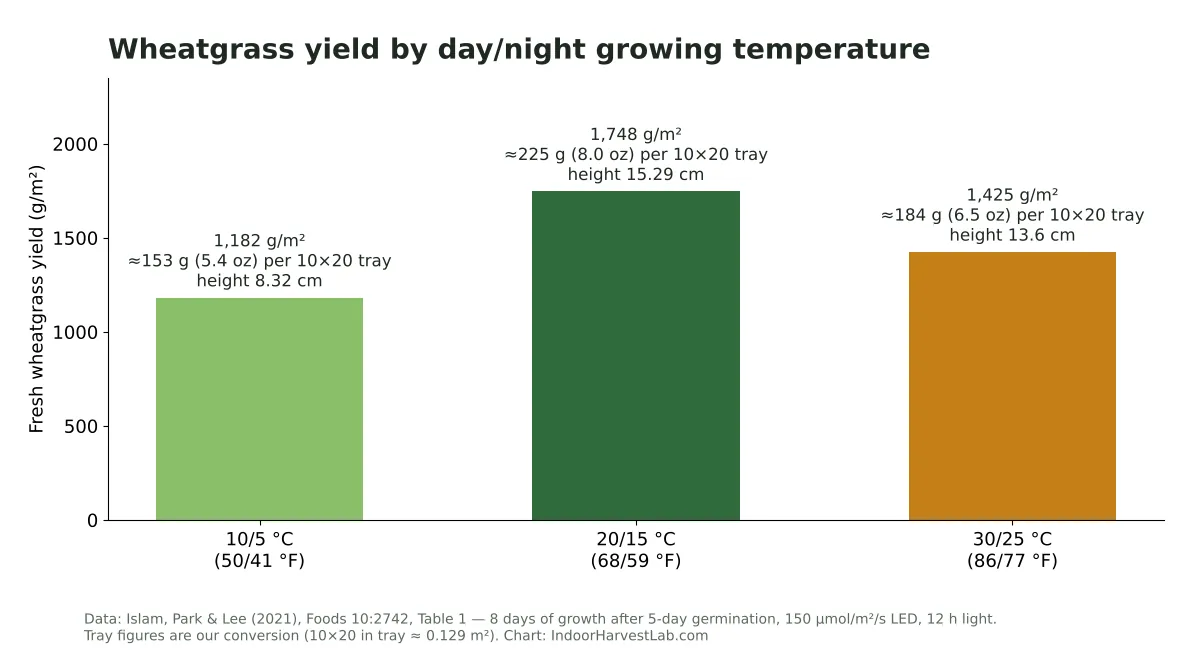
The 20/15°C (68/59°F) treatment gave the tallest grass (15.3 cm, about 6 inches) and the highest yield, about 1,748 g per square meter. That works out to roughly 225 g, or 8 ounces, per 10×20 inch tray by our conversion. The cold 10/5°C (50/41°F) treatment grew only 8.3 cm tall and yielded about a third less, although it did contain more phenolic compounds. Hot 30/25°C (86/77°F) conditions also cut the yield.
A second study by Jung and Lee (2025) grew wheatgrass seedlings between 18 and 32°C and found that about 25°C (77°F) gave the best plant height, shoot weight and isoorientin (a flavonoid) content. Put the two together and the sweet spot for growing wheatgrass is a normal, comfortable room: mid-60s to mid-70s °F.
| What to hold | Target | Source |
|---|---|---|
| Soak time | 8–12 hours (OSU: at least 12) | Sprout People; Oregon State Extension |
| Rinse interval while sprouting | Every 8–12 hours, 2–3 cycles | Sprout People |
| Seed rate | About 1 cup per 10×10 in tray (≈2 cups per 10×20); 1 tbsp per small pot | Sprout People; Oregon State Extension |
| Medium depth | About 1 inch; pots at least 2½–3 in deep | ATTRA; Oregon State Extension |
| Covered (dark) phase | 2–3 days | ATTRA |
| Room temperature | 70–75°F (21–24°C) | Oregon State Extension |
| Best-yielding temperature in trials | 20/15°C day/night (68/59°F); ~25°C (77°F) for height and isoorientin | Islam et al. 2021; Jung & Lee 2025 |
| Light used in trial | 150 µmol/m²/s for 12 h a day (≈6.5 mol/m²/day DLI) | Islam et al. 2021 (DLI is our calculation) |
| Harvest | Days 7–10, about 6 in tall | ATTRA; Sprout People |
| Second cut | About a week after the first | ATTRA |
About that light figure: 150 µmol/m²/s is modest. A bright, unobstructed south or west window in spring can supply it, but in a dim November kitchen a small LED fixture is the reliable way to get dark green, upright blades. Our guide to microgreens light requirements explains PPFD and DLI if those terms are new.
Harvesting, second cuts and storage
Wheatgrass is at its sweetest and most tender at first cut. Here’s how to get the most out of each tray.
When and how to cut
Cut just above the soil line with clean scissors or a sharp knife. Sprout People point out that height is really a matter of yield: you can cut whenever you like, but taller grass simply weighs more. ATTRA ties the ideal moment to plant development: just before the second leaf appears, usually around day eight. Wait much longer and the blades get fibrous and bitter.
Will it grow back?
Yes, once. ATTRA notes there’s often a second harvest during the following week if the grass is cut rather than pulled. Sprout People say a second and even third crop is possible, but each is less tender and usually smaller. If you’re curious which other crops regrow, see our guide to microgreens that regrow.
Yield per tray
Expect roughly as much grass by weight as the grain you planted (Sprout People), or 5–10 ounces of juice from a 10×10 inch tray. The temperature trial above suggests a well-grown 10×20 tray can reach about 8 ounces of fresh grass. For comparisons with other crops, see microgreens yield per tray.
Storing cut wheatgrass
ATTRA calls the product “very perishable.” Let the leaves dry on the surface for the last several hours before cutting (Sprout People’s tip), then refrigerate in a lidded container. If you juice it, Sprout People recommend freezing the juice in small portions, because refrigerated juice turns harsh in about a day.
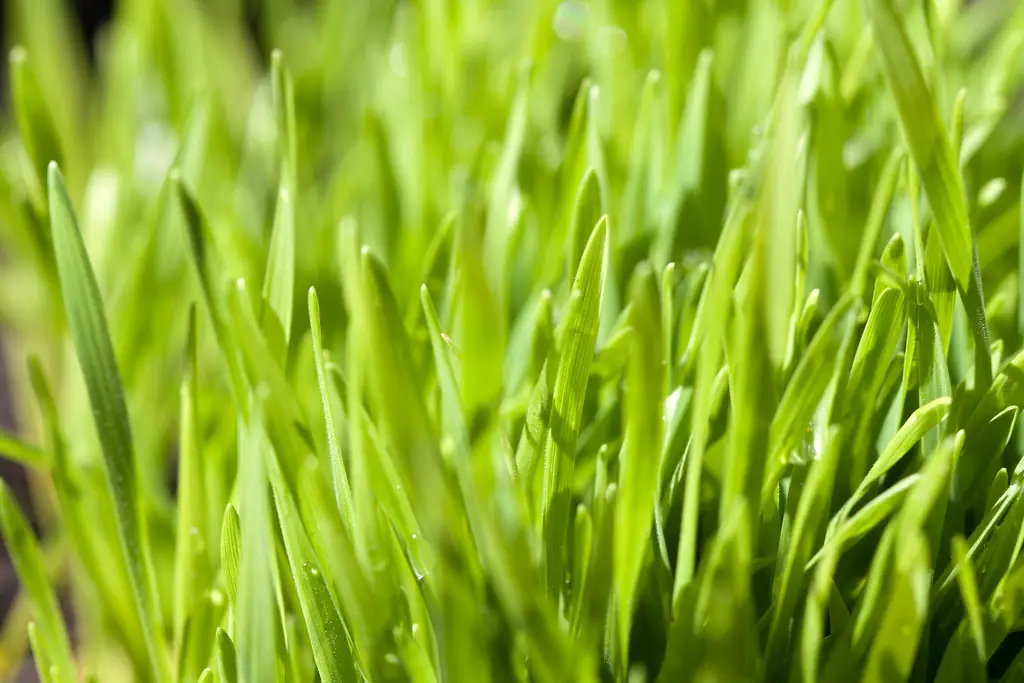
Growing wheatgrass for cats
A pot of wheatgrass is the same thing pet stores sell as “cat grass.” Texas A&M’s veterinary college explains that cat grass isn’t one species but can be a mix of rye, barley, oat and wheat, and that it’s a good source of environmental enrichment, especially for indoor cats.
It isn’t required in a well-balanced diet, and the reasons cats chew grass aren’t fully understood. The college suggests fiber may act as a mild laxative or trigger vomiting, which is why a cat may bring some back up. That’s normal in small amounts. The real safety concern, the vets say, is a cat confusing its grass with a toxic houseplant, so keep risky plants out of reach. If your cat eats grass voraciously, it’s worth asking your veterinarian.
How to grow a cat-grass pot
- Use a heavy, wide pot at least 2½–3 inches deep so it doesn’t tip over when your cat leans in (OSU depth guidance).
- Soak and sprout about 1 tablespoon of seed per small pot, or a few tablespoons for a 6-inch pot.
- Sow densely on potting mix, cover for two or three days, then place it in bright light.
- Offer it once the grass is a few inches tall, and start a new pot every week or two so there’s always fresh grass.
- Trim off any yellowing or moldy blades before your cat gets to them.

Troubleshooting: mold, yellowing and other problems
Most failures when growing wheatgrass come from the same few causes: too much seed, too much water, too little air or not enough light. Use this table to work out what’s going wrong.
| What you see | Likely cause | What to do |
|---|---|---|
| Fine white fuzz on roots only, gone after watering | Root hairs, not mold | No action needed; they reappear when the surface dries |
| Grey-white cobwebby growth on seeds and the base of stems, sour smell | Mold from crowding and wet seeds | Sow less seed, water from below, add a small fan; compost badly affected trays |
| Patchy, uneven germination | Uneven soak, seeds stacked in layers, or dry surface | Soak the full 8–12 h, spread one layer, keep covered for 2–3 days |
| Pale yellow, floppy blades | Too little light or kept covered too long | Uncover at 1–2 inches and move under a grow light |
| Tips browning, grass tough and bitter | Harvest left too long, or the second/third cut | Cut around day 7–10 at about 6 inches |
| Small black flies around the tray | Fungus gnats in wet mix | Let the surface dry between waterings; see our fungus gnat guide |
| Slow growth, short grass | Room too cold | Aim for 68–75°F; cold trays grew about half as tall in trials |
Mold deserves a closer look, because it’s the problem that ends most first attempts. ATTRA warns that the warm, moist conditions that make wheatgrass grow also favour fungal and bacterial contaminants, so sanitation matters. Sprout People’s first fix is to plant less grain to improve air flow. To tell mold from root hairs with confidence, see our microgreens mold guide; if tiny flies show up, our fungus gnats guide will help.
A quick word on food safety
ATTRA notes that the US FDA issued an advisory in 1998 against eating raw sprouts, especially for children, older adults and anyone with a weakened immune system. Wheatgrass leaves cut above the soil are a different product from whole sprouts, but the same basics apply: clean seed, clean water, clean containers, and throw away anything that smells off. Our microgreens vs sprouts article covers the difference in risk.
From the lab bench
Wheatgrass looks like a simple crop, but a tray is really a crowded canopy of seedlings running almost entirely on the starch stored in their seeds. That explains most of the rules above. The kernel feeds the first week of growth, so you don’t need fertilizer for a single cut. Light mostly sets colour and stiffness, and temperature sets the pace.
The temperature trial gives a useful lesson. Cold grass was short and light in weight, but it held more phenolics and antioxidant activity. That’s a classic stress response, and it means “bigger” and “more concentrated” aren’t the same goal. For most home growers, a normal room temperature is the right compromise: you get a full, heavy tray in a week instead of a sparse one in two.
Mold is a density problem as much as a hygiene problem. Every extra layer of grain adds wet surface area and blocks air from reaching the base of the stems, where mold starts. That’s why cutting the seed rate a little often fixes a mold problem faster than any rinse or spray. If you change one thing after a failed tray, change the seed amount.
Finally, be realistic about health claims. Reviews such as Bar-Sela et al. (2015) found reported benefits in small clinical trials with methodological problems, and concluded that larger studies are needed before recommendations can be made. A 2025 narrative review by Bangera et al. reached a similar view. Wheatgrass is a fresh, green, easy crop. Grow it for that, and treat bigger promises with caution. Because wheat grain contains gluten, anyone with coeliac disease should check with their clinician before using homegrown wheatgrass.
FAQ
How long does it take to grow wheatgrass?
About 7 to 10 days from sowing to first cut. ATTRA says harvest usually starts around day eight, and True Leaf Market gives 7–10 days. Add 1–2 days beforehand for soaking and sprouting.
Can you grow wheatgrass without soil?
Yes, on vermiculite, coco coir, a hydroponic mat or a mesh tray. A sowing trial by Grubišić et al. (2019) found the most mildew when wheatgrass was grown without any substrate, so a thin layer of mix gives more reliable results.
How much wheatgrass seed do I need per tray?
About 1 cup of soaked seed per 10×10 inch tray (Sprout People), which is roughly 2 cups for a standard 10×20 tray. Use about 1 tablespoon for a small pot. Spread it one layer thick.
Does wheatgrass need sunlight?
It needs bright light once it’s uncovered. Oregon State Extension keeps the pot away from direct sun while the seeds sprout, then moves it to a spot in bright sunlight once shoots appear. A small LED grow light works well indoors in winter.
Will wheatgrass grow back after cutting?
Usually once. ATTRA reports a second harvest often follows in the next week if you cut rather than pull. The regrowth is smaller and tougher, so many growers start a fresh tray instead.
Is wheatgrass safe for cats?
Texas A&M’s veterinary college says cat grass, which can include wheat, can be a source of enrichment, and that the bigger safety concern is a cat confusing it with a toxic houseplant. Some cats vomit after eating grass. Keep risky plants out of reach and ask your vet if your cat eats grass voraciously.
Why does my wheatgrass smell sour or look moldy?
Too much seed, too much water and too little airflow. Sow fewer seeds, water from below, add gentle airflow and keep the room around 68–75°F. Fine fuzz on the roots that disappears after watering is usually just root hairs.
Want more crops for the same windowsill? Browse our microgreens growing guides or learn how to harvest microgreens cleanly.
Sources
- Beetz, A. E. (2002). Wheatgrass Production. ATTRA – National Sustainable Agriculture Information Service, National Center for Appropriate Technology (CT176). PDF (archived)
- Oregon State University Extension. Directions for How to Grow a Wheatgrass Pet Pal. PDF
- Islam, M. Z., Park, B.-J., & Lee, Y.-T. (2021). Influence of temperature conditions during growth on bioactive compounds and antioxidant potential of wheat and barley grasses. Foods, 10(11), 2742. doi:10.3390/foods10112742
- Jung, D. H., & Lee, J. (2025). Establishing a quadratic regression model of the growth characteristics and isoorientin contents of wheatgrass seedlings in response to different temperature conditions. Horticultural Science and Technology, 43(1), 61–69. doi:10.7235/HORT.20250008
- Grubišić, S., Orkić, V., Guberac, S., Petrović, S., Lisjak, M., Kristić, M., & Rebekić, A. (2019). Optimal method of sowing wheat (Triticum aestivum L.) for growing wheatgrass. Poljoprivreda, 25(2), 31–37. doi:10.18047/poljo.25.2.5
- Texas A&M School of Veterinary Medicine & Biomedical Sciences (2019). Eating Your Greens: The Basics of Cat Grass. vetmed.tamu.edu
- Bar-Sela, G., Cohen, M., Ben-Arye, E., & Epelbaum, R. (2015). The medical use of wheatgrass: review of the gap between basic and clinical applications. Mini Reviews in Medicinal Chemistry, 15(12), 1002–1010. doi:10.2174/138955751512150731112836
- Bangera, D., et al. (2025). Therapeutic potential of wheatgrass juice: a comprehensive narrative review. Journal of Pharmacy & Bioallied Sciences, 17(Suppl 1), S152–S154. doi:10.4103/jpbs.jpbs_179_25
- Sprout People. Wheatgrass: Instructions for a Wonderful Crop (grower instructions). PDF
- True Leaf Market. Wheat – Hard Red Spring (Organic) Grass Seeds (product growing notes). trueleafmarket.com
- Utah State University Extension. Get Your Easter Grass Growing! Here’s How to Sprout This Holiday Staple. extension.usu.edu