
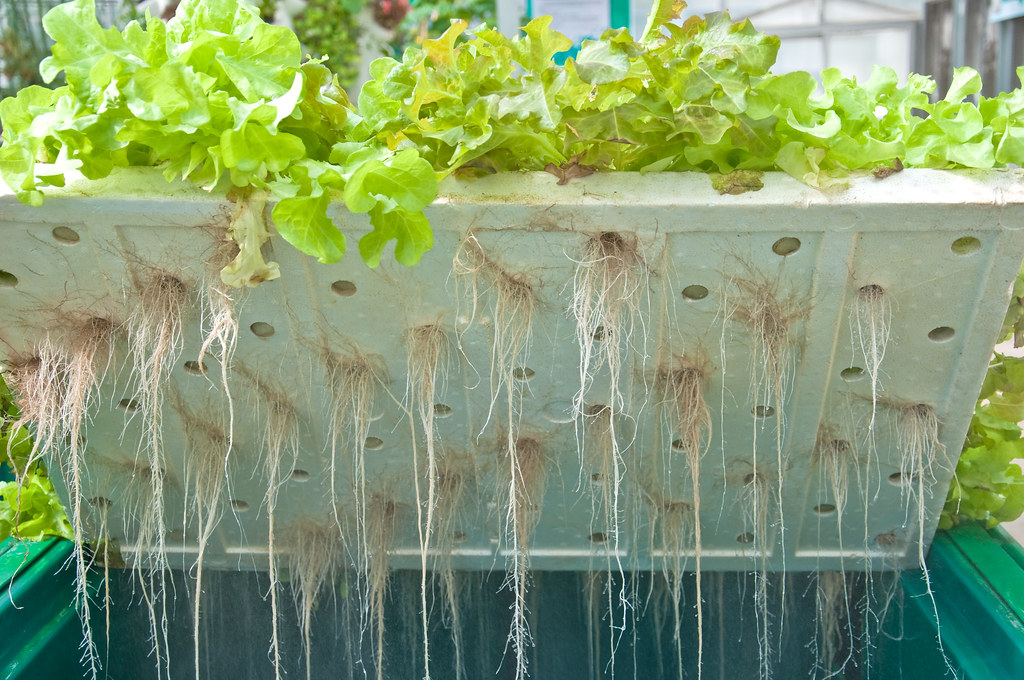
Short answer: for most small recirculating home systems, change hydroponic water completely about every 2 weeks, and top it up with full-strength nutrient solution (not plain water) in between. Oklahoma State University advises replacing the solution completely every two weeks, and University of Illinois Extension says every 2 to 3 weeks. Non-circulating Kratky tanks and quick lettuce crops are the exception: they often run a whole crop on one fill of hydroponic water.
The interval is only a starting point. What really decides when to dump the tank is what is happening inside it: salts the plants don’t use build up, nutrients they do use run out, and a reading on your EC meter can look normal the whole time. This guide gives you a schedule by system size, the warning signs that override the calendar, and a step-by-step routine for a clean change.
Table of Contents
How often to change hydroponic water: the schedule by system
Published advice falls into a clear pattern. Systems that pump and recirculate a small volume of hydroponic water need the most frequent changes. Large or non-circulating reservoirs, and short crops, can go much longer.
| System | Typical full change | Top up between changes? | What the source says |
|---|---|---|---|
| Small recirculating system (DWC bucket, ebb and flow, drip) | Every 2 weeks | Yes, with nutrient solution | Oklahoma State HLA-6722: replace completely every two weeks; check pH and EC daily |
| General home hydroponics | Every 2–3 weeks | Yes | University of Illinois Extension handout |
| Countertop unit | Every 4–6 weeks | Yes, when the pump light or level says so | AeroGarden’s own FAQ |
| NFT with leafy greens | Rarely during one crop | Yes, with nutrient solution | UMN Extension: fast leafy crops “rarely need a nutrient solution change out” |
| Kratky tank (lettuce) | After each crop, or at least every 3 crops | Usually no | Kratky, University of Hawaii CTAHR |
| Very small raft system | Every couple of months | Yes, with nutrient solution | UNH Extension |
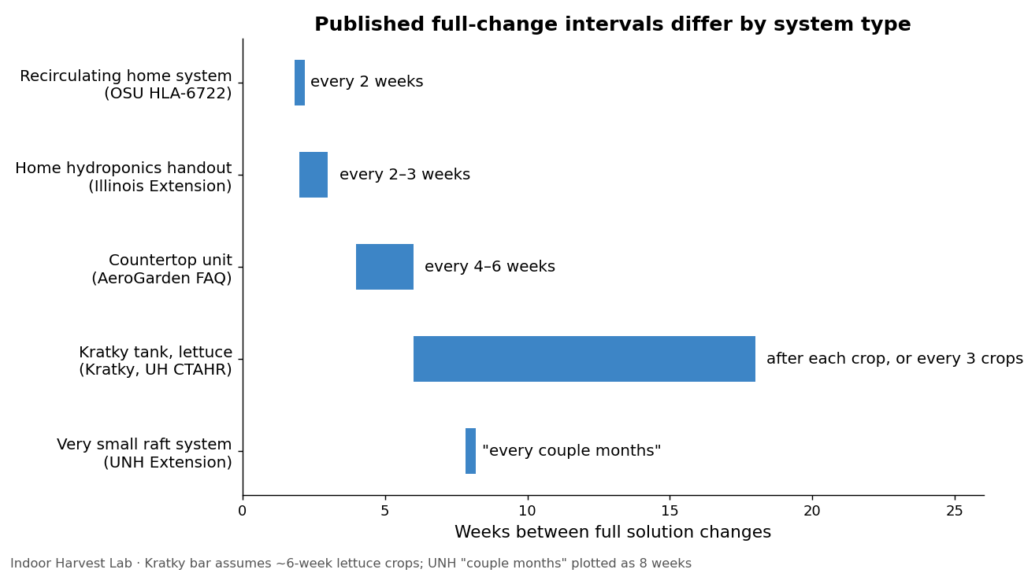
Notice the UNH Extension wording on size: a very small raft system “may need a nutrient solution change every couple months, while a very large raft system may last years.” Bigger volumes dilute the drift, so they hold their balance longer. A 5-gallon bucket of hydroponic water does not.
Why hydroponic water goes off even when EC looks fine
EC measures total dissolved salts. It cannot tell you which salts are there. Plants take up some nutrients quickly (nitrogen and potassium) and leave others behind (sulfate, and in many tap waters, sodium and chloride). Every top-up adds more of everything, so the leftovers pile up while the useful ions are drawn down.
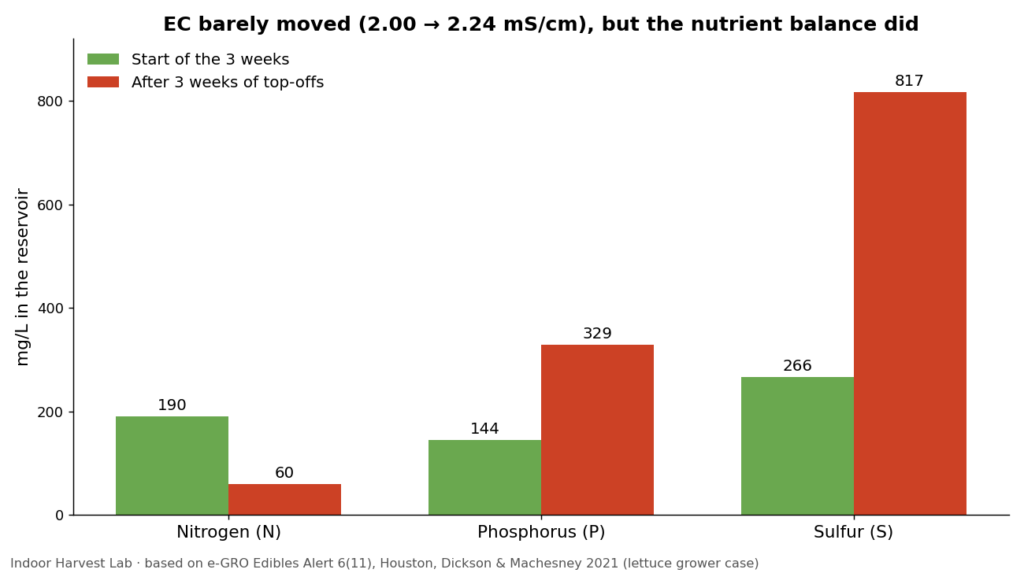
A 2021 e-GRO Edibles Alert from the University of Arkansas (Houston, Dickson and Machesney) shows this plainly. A lettuce grower held EC at 1.8–2.2 mS/cm with daily top-offs. Over three weeks the EC rose only from 2.00 to 2.24, yet nitrogen fell from 190 to 60 mg/L, phosphorus climbed from 144 to 329 mg/L and sulfur from 266 to 817 mg/L, and yield dropped. The authors’ point: maintaining a constant EC “does not guarantee an adequate, long term nutrient supply.”
Other things build up too:
- Sodium chloride. Oklahoma State notes that table salt in the source water “will increase in concentration with the constant addition of water and nutrient adjustments, resulting in toxicities.”
- Root exudates. Researchers at Seoul National University found organic acids accumulated in reused nutrient solutions and were phytotoxic to lettuce; in lab tests, 25–200 µM of these acids slowed growth (Lee, Lee and Lee, Scientia Horticulturae, 2006).
- Concentration as water is used. In a Kratky tank, water with a starting EC of 0.5 mS/cm “may concentrate to 2.0 mS when 25 percent of the original nutrient solution remains,” according to Kratky.
A regular full change of hydroponic water resets all of this at once. That is the real job of the schedule.
Topping off hydroponic water vs a full change
Plants drink water faster than they take up nutrients, so the level of hydroponic water in the reservoir drops every day. Oklahoma State says water “may need to be added daily” depending on tank size. What you add matters:
- Top up with nutrient solution, not plain water. UMN Extension says any water added “should include nutrients at the recommended concentration on the label,” and UNH Extension says to top off “with nutrient solution (not just water) when it gets low.”
- Or add plain water, then correct the EC. The e-GRO alert notes that topping off with clear water and then adding fertilizer to reach the target EC gives the same result as topping off with premixed solution.
- Read the EC after every top-up. Oklahoma State: a higher EC means more salt; lower it by diluting with water and raise it by adding concentrate. Our hydroponic EC chart lists targets for 20 crops, and the ppm to EC guide helps if your meter reads in ppm.
If EC keeps creeping up after each top-up while the plants look fine, unused salts are accumulating. If you need more and more concentrate to hold the same EC, the plants are using nutrients faster than you replace them. Either way, a fresh batch of hydroponic water is due.
Schedules by system size
Kratky and other non-circulating tanks
Kratky’s method is designed not to be changed. The plant roots follow the falling water line, and the air gap above it supplies oxygen, so topping up can drown roots that have adapted to the gap. He writes that “some growers drain and refill the tanks after each crop; other just ‘top off’,” and recommends draining and refilling after every 3 crops or sooner. See our Kratky method guide for container sizes.
DWC buckets and small raft systems
A single 3–5 gallon deep water culture bucket is the classic case for the two-week rule. The volume is small, the roots sit in it around the clock, and the water warms quickly. UNH’s “every couple months” applies to small raft beds, which usually hold far more water per plant than a bucket.
NFT channels and towers
For NFT with lettuce and other quick greens, UMN Extension says a full change-out is rarely needed. Top up with nutrient solution and keep checking EC and pH. Longer crops such as tomatoes are different: UMN suggests you “may decide to switch out the solution entirely once or twice” during the crop.
Countertop units
AeroGarden’s FAQ says to empty the bowl and refill it with fresh water and plant food every 4–6 weeks, while its nutrient reminder flashes every 14 days. Treat any other brand’s manual the same way: its schedule was written for its bowl size and nutrient.
Tomatoes and other long crops
A University of Florida study grew tomatoes for 12 weeks in 6.5-gallon home-scale systems (Solis-Toapanta, Fisher and Gómez, HortTechnology, 2020). Compared with replacing the solution every two weeks, simply adding fertilizer with no replacement left the EC higher than desired, with more blossom-end rot, delayed ripening and lower fruit weight.
Signs you need to change hydroponic water now
Change the hydroponic water early, whatever the calendar says, if you see any of these:
- EC keeps rising after top-ups, or you have to keep adding concentrate to hold it.
- pH swings more than usual after adjustments (see lowering pH and raising pH).
- Roots turn brown or slimy, or the tank smells sour. Cornell’s Neil Mattson advises tossing infected plants “at the first sign of Pythium” (e-GRO Alert, 2018).
- The hydroponic water is green, or the lid, walls and tubing are coated in algae.
- New leaves show deficiency symptoms although EC is on target.
- The hydroponic water has overheated. Mattson’s target root-zone temperature is 68–75 °F (20–24 °C).
How to change hydroponic water: step by step
- Mix the new batch first. Fill a clean bucket with fresh hydroponic water, let it reach room temperature, add nutrients at label strength, then adjust pH (5.5–6.5 for most crops). Our nutrient solution guide covers the mixing order.
- Move the plants. Lift net pots or the raft into a spare tub with a little of the old solution so roots stay wet. Work quickly and keep roots out of direct sun.
- Drain the old hydroponic water. UMN Extension: “don’t dump it down the drain, empty it into your garden or into a houseplant.” UNH suggests using old solution as fertilizer on gardens and lawns.
- Remove debris, then sanitize. Wipe out root fragments and algae first; Mattson notes organic matter must be removed before sanitizing. Between crops UMN uses bleach at 150–200 ppm: 1 tablespoon of unscented 5.25–6% bleach per gallon of water.
- Rinse well. UMN runs fresh water through the system for 2–3 hours after bleaching. For a quick change mid-crop, a thorough rinse of the tank is enough; save the bleach for between crops.
- Refill and return the plants. Pour in the new batch, restart pumps and air stones, and put the plants back.
- Check EC and pH after an hour, then log the date so you know when the next change of hydroponic water is due.
How big should the reservoir be?
More hydroponic water per plant means slower drift and fewer emergency changes. UF/IFAS Extension says each lettuce plant needs 1–1.5 gallons of water from seed to harvest (Eason, HS1488, 2025). Kratky suggests 4 to 8 liters of solution per lettuce plant before planting, and notes a 200 g head uses about 3–4 liters. Fruiting crops use far more, which is why tomato systems need both bigger tanks and more frequent attention.
| Crop | Solution per plant | Source |
|---|---|---|
| Lettuce (whole crop) | 1–1.5 gal (about 4–6 L) | UF/IFAS HS1488 |
| Lettuce (Kratky, filled once) | 4–8 L | Kratky, CTAHR |
| Tomato (research setup) | 6.5 gal per system | Solis-Toapanta et al. 2020 (study design, not a rule) |
What not to do
- Don’t top up only with plain water for weeks. Nutrients run down while EC drifts; UMN and UNH both say to add nutrient solution.
- Don’t trust EC alone. EC reads the total salt in hydroponic water, not the mix. The e-GRO case held EC near target while nitrogen fell by two-thirds.
- Don’t skip changes to save nutrients. A fresh batch for a 5-gallon system costs little compared with a lost crop.
- Don’t pour old hydroponic water down the drain. Use it on garden beds, lawns or houseplants, as UMN and UNH suggest.
- Don’t leave bleach residue. Rinse until there is no chlorine smell before plants go back.
- Don’t top up a Kratky tank to the brim once roots have adapted to the air gap.
Where this applies
Your source water changes how often you need fresh hydroponic water. Oklahoma State warns that water with alkalinity above 75 ppm will push pH up, so hard-water homes will fight pH drift sooner. Softened or salty well water carries sodium that concentrates with every top-up; test it before you blame the schedule. Warm rooms speed everything up: a reservoir above Mattson’s 68–75 °F range holds less oxygen and favours Pythium, so summer grows may need earlier changes.
Commercial growers are the other end of the scale. Utah State’s Bruce Bugbee argues that routinely replacing the whole solution is wasteful and unnecessary in a well-managed recirculating system (Acta Horticulturae 648, 2004). That approach depends on a feed formula matched to what the crop takes up. A home grower with a bottled nutrient and an EC pen is better served by the two-to-three-week rule.
FAQ
Can I just keep topping off hydroponic water instead of changing it?
For a short lettuce crop, often yes; UMN says “set it and forget it” should only be practiced for short-lived crops such as lettuce, harvested in 6 to 7 weeks. For longer crops, unused ions build up and a full change is the simple fix.
How often should I change hydroponic water in a DWC bucket?
Every two weeks is the usual starting point for a small recirculating or aerated system, following Oklahoma State’s advice. Change sooner if roots discolor or the water warms up.
Do I need to clean the reservoir every time I change the water?
Rinse it every time you change the hydroponic water, and sanitize between crops. UNH Extension says components should be cleaned between crops when possible.
Is it bad to reuse old hydroponic water?
Not on outdoor plants. Old hydroponic water still contains nutrients, and UMN and UNH both suggest using it on gardens, lawns or houseplants rather than pouring it away.
More reservoir guides are in our nutrients, pH and EC section.
Related guides: Do You Need Cal-Mag in Hydroponics? Signs, Targets and Doses
Sources
- Dunn, B. and Singh, H. Electrical Conductivity and pH Guide for Hydroponics (HLA-6722). Oklahoma State University Extension.
- University of Illinois Extension. Hydroponics handouts.
- Hoidal, N., Reardon, C., Worth, M. and Rogers, M. Small-scale hydroponics. University of Minnesota Extension.
- Ebba, J. Hydroponics at Home. University of New Hampshire Extension, 2023.
- Kratky, B. A. Three Non-Circulating Hydroponic Methods for Growing Lettuce. University of Hawaii CTAHR, 2009.
- Houston, L., Dickson, R. and Machesney, L. e-GRO Edibles Alert 6(11), 2021.
- Lee, J. G., Lee, B. Y. and Lee, H. J. Accumulation of phytotoxic organic acids in reused nutrient solution during hydroponic cultivation of lettuce. Scientia Horticulturae 110(2), 2006.
- Solis-Toapanta, E., Fisher, P. and Gómez, C. Effects of Nutrient Solution Management and Environment on Tomato in Small-scale Hydroponics. HortTechnology 30(6), 2020.
- Mattson, N. e-GRO Alert on Pythium root rot in hydroponics, 2018.
- Eason, H. “Set It and Forget It” Hydroponic Lettuce (HS1488). UF/IFAS Extension, 2025.
- Bugbee, B. Nutrient Management in Recirculating Hydroponic Culture. Acta Horticulturae 648, 2004.
- Scotts Miracle-Gro. AeroGarden FAQs.
Featured image: “Root Of Hydroponic Vegetables” by aqua.mech, CC BY 2.0.