
Short answer: To lower pH in hydroponics, mix your nutrients into the water first, then add a diluted acid (phosphoric-acid “pH Down” is the usual choice) a little at a time, stir, wait and re-test until the solution reads about 5.5 to 6.5 for most crops, or 5.6 to 6.0 for lettuce. How much acid you need depends mainly on your water’s alkalinity, not on the starting pH number, so small doses and repeat readings are the safe way to lower pH in hydroponics without overshooting.
This guide covers which acids work, why vinegar and lemon juice are poor substitutes, how to estimate a dose from your water test, and the handling rules that keep the job safe. It is written for anyone who needs to lower pH in hydroponics at home, in small systems such as Kratky jars, deep water culture tubs and NFT channels.
Table of Contents
What pH to aim for before you lower pH in hydroponics
University of Missouri Extension gives 5.5 to 6.5 as the optimum pH for most hydroponic crops, with some exceptions. Cornell’s controlled environment agriculture (CEA) program treats pH 5.8 as optimum for its lettuce system, with 5.6 to 6.0 acceptable, and warns that deficiencies can appear outside that band. Cornell’s home guide suggests 5.5 to 6.0 for leafy greens.
Crop-specific targets vary. The Oklahoma State University fact sheet lists basil and peppers at 5.5 to 6.0, tomato at 6.0 to 6.5 and cucumber at 5.0 to 5.5. Our hydroponic EC chart puts those pH ranges next to EC targets for 20 food crops.
| Source | Recommended pH | Applies to |
|---|---|---|
| University of Missouri Extension | 5.5–6.5 | Most hydroponic crops |
| Cornell CEA lettuce handbook | 5.8 (5.6–6.0 acceptable) | Floating-raft lettuce |
| Cornell CEA home guide | 5.5–6.0 | Leafy greens at home |
| Oklahoma State University HLA-6722 | 5.0–7.0 depending on crop | 26 crops, crop by crop |
In practice, if your meter reads above 6.5 for leafy greens or herbs, it is time to lower pH in hydroponics. If it reads 6.2 and the plants look healthy, a correction can usually wait until the next check.
Why hydroponic pH rises in the first place
Rising pH is normal, and it is the reason nearly every grower has to lower pH in hydroponics sooner or later. Cornell’s home hydroponics guide explains that fertilizers with nitrate nitrogen tend to push pH up as plants take up the nitrate, while ammoniacal nitrogen tends to pull it down. Most hydroponic fertilizers are nitrate-heavy, so the reading creeps upward between checks.
Your water decides how hard it is to lower pH in hydroponics. Missouri Extension notes that alkalinity (bicarbonates and carbonates, measured as ppm CaCO3) is what resists pH change. Water above about 160 ppm alkalinity needs more acid, while water below about 40 ppm swings easily and needs frequent checks. Alkalinity cannot be read with a pH meter; it takes a titration test or a water lab report.
Organic nutrients are a special case. In Cornell’s side-by-side trial, organic nutrient solutions drifted to pH 8 and above, which is why the guide advises checking and adjusting them several times a week.
Acids that lower pH in hydroponics, compared
Missouri Extension lists four common choices, from most to least expensive: citric or acetic acid, phosphoric acid, nitric acid and sulfuric acid. Citric and acetic acids are the safest to handle, and nitric acid is the most hazardous. Some acids also add a nutrient, which you should count in your feeding plan whenever you lower pH in hydroponics this way.
| Acid | Typical strength | Hazard | Nutrient added (per fl oz in 100 gal) | Notes |
|---|---|---|---|---|
| Phosphoric | 75% | Moderate | 25.6 ppm phosphorus | Base of most retail pH Down liquids; home-grower default |
| Nitric | 63% | High | 14.6 ppm nitrogen | Used by commercial growers with hard water |
| Sulfuric | 93% | High | 43.6 ppm sulfur | Strongest per mL; not compatible with calcium fertilizers in concentrated form |
| Citric | 100% (dry) | Low | None | Safe to handle, but breaks down quickly |
The strengths, hazard ratings and nutrient values above come from UMass Amherst Extension’s acid table. For a home reservoir, a retail phosphoric-acid pH Down is the simplest way to lower pH in hydroponics. Researchers at Iowa State used a phosphoric and citric acid pH Down to hold basil at pH 6.0 ± 0.2 in their HortTechnology study.
Vinegar and lemon juice: do they work?
Kitchen acids do move the needle, but the evidence says they are a poor way to lower pH in hydroponics. A 2019 Oklahoma State University study in the Journal of Horticultural Research grew lettuce, basil and Swiss chard in ebb-and-flow systems and held pH between 5.5 and 6.5 using pH Down, lime juice or vinegar.
- pH Down gave the most stable pH and needed the least product.
- With lime juice and vinegar, the solution pH reached 7.5 by harvest.
- Vinegar reduced the yield of all three crops compared with pH Down.
- Lime juice reduced basil and Swiss chard yield but not lettuce yield.
The authors concluded that lime juice is an acceptable backup for lettuce only, and vinegar is not recommended for any of the crops tested. Organic acids are consumed by microbes and roots, so their effect fades and pH climbs again.
How much acid do you need to lower pH in hydroponics?
There is no fixed “drops per gallon” answer to how much acid it takes to lower pH in hydroponics, because the dose depends on how much alkalinity your water carries. UMass gives a factor for each concentrated acid: 0.70 mL of 75% phosphoric acid, 0.56 mL of 63% nitric acid or 0.23 mL of 93% sulfuric acid per ppm of alkalinity neutralized, per 100 gallons.
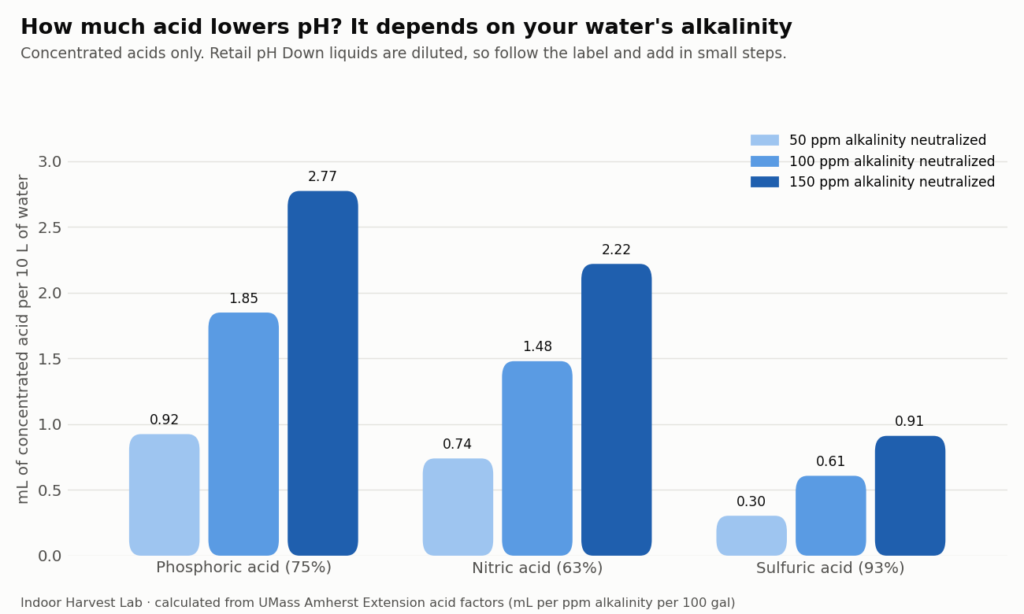
Worked example: a 20-liter (5.3-gallon) tub, where you want to neutralize 80 ppm of alkalinity with 75% phosphoric acid, needs about 0.70 × 80 × 5.3 ÷ 100 ≈ 3 mL. Retail pH Down liquids are more dilute than 75% acid, so they need more volume; read the label rather than using these numbers directly.
If you have a water report, the e-GRO alkalinity calculator that Missouri Extension recommends estimates the acid dose for a target pH. Without a report, lower pH in hydroponics in small steps, as described next.
How to lower pH in hydroponics step by step
- Measure your source water. Note its pH and EC before adding anything, so you know what the tap or well is contributing.
- Mix the nutrients first. Fertilizer salts change pH, so adjust only the finished solution. Dissolve each part fully before adding the next, as Missouri Extension advises for hand mixing.
- Stir, then read. Use a calibrated meter, not paper strips; Missouri Extension notes that fertilizer dyes can distort strip colors.
- Add a small first dose. Start with roughly a quarter of your estimated amount, added to the water rather than splashed on roots or media.
- Circulate for a few minutes. Run the pump or air stone, or stir a Kratky container by hand, then read again.
- Repeat in smaller steps. Stop at the top of your target band (around 6.0 for greens) rather than chasing the bottom, because overshooting means adding pH Up and extra salts.
- Record the dose. Write down mL per liter; after two or three mixes you will know your water’s usual dose.
- Re-check on schedule. Oklahoma State recommends checking pH and EC daily in active systems; Cornell’s home guide suggests at least once a week for small setups with buffered fertilizers.
Calibrate the meter before you lower pH in hydroponics
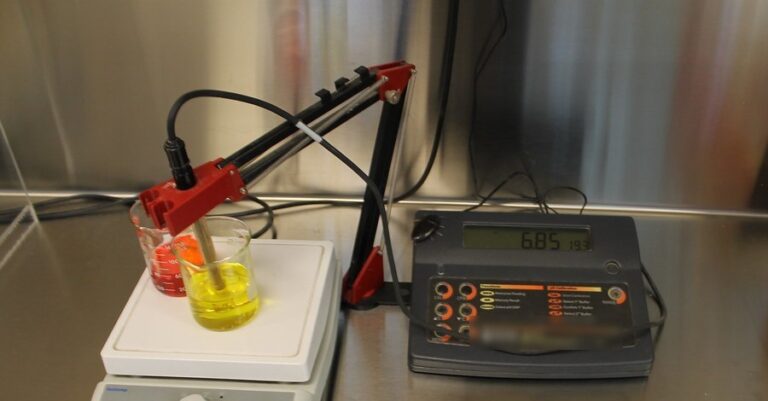
A drifting meter is the most common reason people overshoot when they lower pH in hydroponics. Missouri Extension recommends a two-point calibration at pH 4 and pH 7 once a week, rinsing the probe with distilled or deionized water between readings, and storing the probe in storage solution or pH 4 buffer, never in plain water. A pH probe lasts about 1 to 2 years and should be replaced when it no longer calibrates.
Safety when handling acids
Concentrated acids release heat when mixed with water, so treat every attempt to lower pH in hydroponics with the same care you would give any corrosive product. UMass Extension’s rules are simple: use acid-resistant containers, add acid to water (never water to acid), pour slowly into the center of the water surface, stir as you go, and avoid splashing. Wear eye protection and gloves, keep acids away from children and pets, and store them upright and separate from pH Up.
For home growers, buying a pre-diluted pH Down is safer than diluting concentrated nitric or sulfuric acid yourself. Never mix sulfuric acid with concentrated calcium nitrate stock; UMass notes they are incompatible in concentrated form.
Mistakes to avoid when you lower pH in hydroponics
- Adjusting before adding nutrients. The fertilizer will shift the reading, so the earlier correction is wasted.
- Adding acid to nutrient concentrate. Dilute nutrients first; acid only goes into the final solution.
- Big single doses. Overshooting to pH 4.5 and then adding pH Up raises EC and wastes product.
- Chasing tiny drifts daily. A move from 5.8 to 6.1 is still in range; frequent swings stress roots more than a slightly high reading.
- Using vinegar as your main pH Down. It cut yields of lettuce, basil and chard in the Oklahoma State trial.
- Trusting test strips in colored nutrient water. Use a calibrated meter instead.
- Ignoring alkalinity. If your pH climbs back within a day, test the water’s alkalinity; very hard water may justify a filter or mixing with rain or reverse-osmosis water.
If you keep plants in a passive system, see the Kratky method guide for how to top up without disturbing the air gap, and the deep water culture guide for aerated tubs where an air stone mixes each dose for you.
Where this applies
The steps to lower pH in hydroponics hold for any recirculating or still-water system, but your water source changes the work. Growers on hard, alkaline well or tap water (above about 160 ppm alkalinity) will add more acid, more often. Growers using rain, distilled or reverse-osmosis water (below about 40 ppm alkalinity) need very little acid, yet pH can swing quickly, so they should dose in the smallest steps. In warm rooms, evaporation concentrates the solution and plants take up nitrate faster, so expect pH to rise sooner. Your local water utility or a lab test will tell you your alkalinity; the same numbers apply in any country.
Browse more guides on hydroponic nutrients, pH and EC.
FAQ
What is the safest way to lower pH in hydroponics?
A retail phosphoric-acid pH Down, added in small doses to fully mixed nutrient solution, with gloves and eye protection. Citric acid is safer to handle but its effect fades quickly.
Can I use vinegar to lower pH in hydroponics?
It works briefly, but in the Oklahoma State trial vinegar reduced the yield of lettuce, basil and Swiss chard compared with pH Down, and pH climbed to 7.5 by harvest.
Can I use lemon or lime juice?
Lime juice was acceptable for lettuce in that study but reduced basil and Swiss chard yields. It is a short-term backup, not a routine choice.
Why does my hydroponic pH keep going up?
Plants taking up nitrate raise pH, and alkaline water adds buffering that pushes it back up after each correction. Test your water’s alkalinity if the rise is fast.
How often should I check pH and lower pH in hydroponics?
Daily in active systems, according to Oklahoma State; at least weekly for small home setups with buffered fertilizers, according to Cornell’s home guide.
Sources
- Cabrera-Garcia, J. Hydroponic Nutrient Solutions (G6984). University of Missouri Extension.
- UMass Amherst Extension. Adjusting Alkalinity with Acids.
- Singh, H., Dunn, B. and Payton, M. (2019). Hydroponic pH modifiers affect plant growth and nutrient content in leafy greens. Journal of Horticultural Research.
- Cornell CEA. A Guide to Home Hydroponics for Leafy Greens.
- Cornell CEA. Hydroponic Lettuce Handbook.
- Dunn, B. and Singh, H. Electrical Conductivity and pH Guide for Hydroponics (HLA-6722). Oklahoma State University Extension.
- Walters, K.J. and Currey, C.J. (2015). Hydroponic greenhouse basil production: comparing systems and cultivars. HortTechnology 25(5).
- e-GRO. Alkalinity and acid addition calculator.
Featured image: “Hydroponics” by Oregon State University, CC BY-SA 2.0.