
Short answer: Yes, you can use tap water for hydroponics in most homes, as long as you check five things first: the disinfectant (chlorine or chloramine), alkalinity, starting EC, sodium and chloride, and hardness. US tap water may legally carry up to 4 mg/L of chlorine or chloramine, while lettuce roots in one hydroponic study were harmed by chloramine at 0.3 to 0.5 mg/L. Chlorine fades if water stands for a few days; chloramine does not, so it needs vitamin C, a conditioner or a carbon filter. Aim for source water under about 1.0 mS/cm EC, 30 to 100 ppm alkalinity and under 50 ppm sodium.
When tap water causes trouble, the cause is almost always one of the five items below, and each has a cheap fix. Here they are in the order to check them, with the limits extension specialists use for greenhouse water.
Table of Contents
Is tap water safe for hydroponics?
Drinking-water rules protect people from germs, so utilities add a disinfectant. They do not limit alkalinity, which pushes pH up, or sodium, which plants dislike. That is why the same water can be perfect for your kettle and still cause slow pH drift in a deep water culture bucket.
The Oklahoma State University fact sheet on source water quality for hydroponics (HLA-6722) lists the limits most growers use.
The five checks at a glance
| Check | Good range for hydroponics | Why it matters | Usual fix |
|---|---|---|---|
| Disinfectant | As low as possible before roots touch it | Chlorine and chloramine are oxidisers that can damage roots | Let chlorine stand; neutralise chloramine |
| Alkalinity | 30–60 ppm CaCO3 optimum, up to about 100 (UMass) | Bicarbonate keeps pushing pH up | Add acid (pH Down) |
| Starting EC | Below about 1.0 mS/cm; 0.2–0.8 ideal (Missouri) | Salts already in the water leave less room for fertilizer | Blend with RO or rainwater |
| Sodium and chloride | Sodium under 50 ppm; chloride under 140 ppm | Not nutrients; they build up in recirculating systems | Avoid softened water; dilute |
| Hardness (Ca and Mg) | Calcium 40–100 ppm, magnesium 30–50 ppm (UMass) | Useful nutrients, but they change how much cal-mag you need | Adjust or skip cal-mag |
Chlorine vs chloramine in tap water
US utilities disinfect with one of two chemicals. The US EPA’s National Primary Drinking Water Regulations cap both chlorine and chloramines at a maximum residual disinfectant level of 4.0 mg/L (as Cl2). The CDC explains the difference in one line that matters for growers: you can remove chlorine by letting water sit out for a few days, but you cannot remove chloramine that way.
Chloramine is chlorine bonded to ammonia and lasts longer in the pipes. The Water Quality Association’s chloramine fact sheet puts typical levels in treated tap water at around 2 mg/L, with a range of 1.5 to 2.5 mg/L.
How do you know which one your city uses? Read the annual water quality report. The EPA’s Consumer Confidence Report page says community water systems must deliver this report to customers each year by July 1. It names the disinfectant and lists detected contaminants. If it only says “total chlorine”, call the utility and ask whether they use chloramine.
How much chlorine do roots tolerate?
Research on hydroponic lettuce gives a clear picture. In a hydroponic study, Date and colleagues (2005, Scientia Horticulturae) added sodium hypochlorite at 0.3 mg Cl/L to a nutrient solution containing ammonium (which forms chloramine). That was enough to inhibit lettuce growth significantly. A one-hour exposure to chloramine at 0.5 mg/L also reduced growth.
Free chlorine seems gentler at low doses. In an Argentine trial, Premuzic and colleagues (2007, Journal of Applied Horticulture) chlorinated a closed lettuce system at 0.55, 5.5 and 11 mg/L. The 0.55 mg/L treatment gave the highest fresh weight, while 11 mg/L caused chlorosis and necrosis and cut fresh weight by 40% in one variety. For irrigation water in general, the Clean WateR3 research project warns never to apply more than 5 ppm total chlorine or 2 ppm free chlorine to plants.
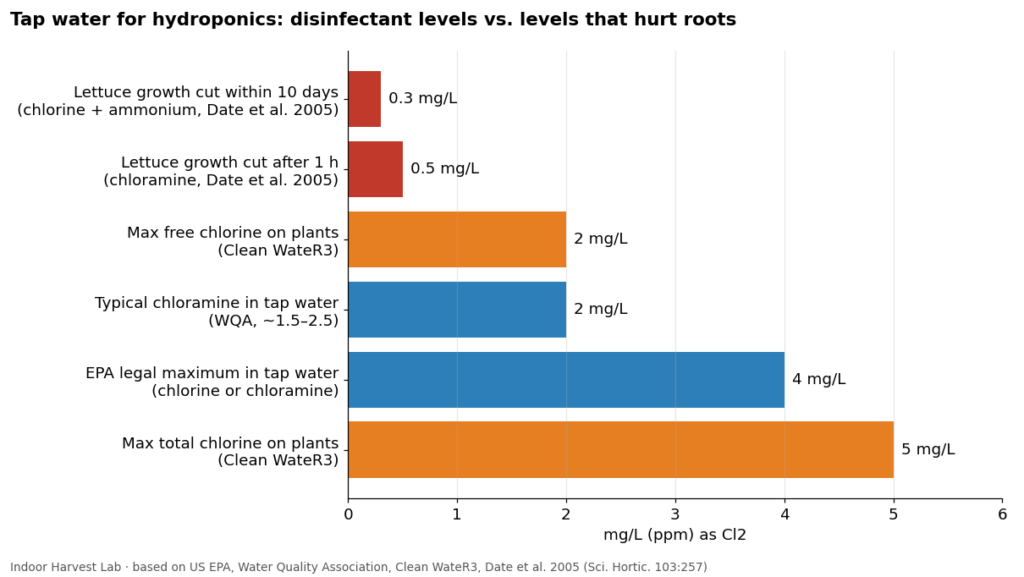
The practical rule: remove or neutralise the disinfectant in tap water before it reaches roots, especially chloramine.
How to dechlorinate tap water for hydroponics
- Chlorine only: let it stand. Fill the reservoir or a clean bucket, leave the lid off and wait. The CDC says “a few days”. An air stone speeds gas exchange, but no fixed time is published, so give it at least 24 to 48 hours with aeration and test with a pool or aquarium chlorine strip if you have one.
- Chlorine or small volumes: vitamin C. The USDA Forest Service technical note Using Vitamin C to Neutralize Chlorine in Water Systems says one gram of ascorbic acid neutralises 1 mg/L of chlorine in 100 gallons of water, and the reaction is very fast. About 2.8 parts sodium ascorbate neutralise 1 part chlorine. Ascorbic acid is mildly acidic, so recheck pH afterwards; sodium ascorbate is pH-neutral.
- Chloramine: use a conditioner or catalytic carbon. The CDC notes that pet-store water conditioners remove chlorine or chloramine. The WQA says activated carbon removes chloramine by acting as a catalyst, and complete catalysis can require a bed contact time of 10 minutes or more. A quick pass through a pitcher filter is not the same thing.
- Then add nutrients. Mix the hydroponic nutrient solution into treated water, not the other way round, and only then adjust pH.
Vitamin C dose for common reservoir sizes
These amounts are calculated from the USDA figure (1 g per 100 gallons per 1 mg/L chlorine). A cheap 0.01 g jewellery scale makes them easy to weigh.
| Reservoir | At 1 mg/L chlorine | At 2 mg/L | At 4 mg/L (EPA maximum) |
|---|---|---|---|
| 5 gal (19 L) | 0.05 g | 0.10 g | 0.20 g |
| 10 gal (38 L) | 0.10 g | 0.20 g | 0.40 g |
| 20 gal (76 L) | 0.20 g | 0.40 g | 0.80 g |
| 50 gal (189 L) | 0.50 g | 1.00 g | 2.00 g |
Note that the USDA note covers chlorine; it gives no dose for chloramine, so for chloraminated tap water use a product labelled for chloramine or a catalytic carbon filter with a long contact time.
Alkalinity: why tap water pushes pH up
Alkalinity (mostly bicarbonate) is the water’s ability to neutralise acid. It is not pH: water at pH 7.2 can still carry enough bicarbonate to drag your solution back up every day.
Oklahoma State’s HLA-6722 puts it plainly: water with alkalinity above 75 ppm will cause the pH to increase in nutrient solutions. The UMass Extension greenhouse water-quality guide calls 0 to 100 ppm (as calcium carbonate) desirable and 30 to 60 ppm optimum. The University of Missouri guide G6984 gives a wider working range of 40 to 160 ppm.
If your tap water sits above about 100 ppm alkalinity, plan on adding acid at every top-up. Our guide on how to lower pH in hydroponics covers how much acid to add. If your water is very soft and low in alkalinity, pH can swing the other way, which is covered in how to raise pH in hydroponics.
Starting EC: how much room is left for nutrients
Before you add a gram of fertilizer, measure the EC of plain tap water. Your meter reads the total of everything dissolved, so salts already in the water take up part of your target.
- Missouri G6984: source water EC of 0.2 to 0.8 dS/m (same as mS/cm), ideally below 1.
- UMass: no higher than 1.5 mS/cm, and below 1 for seedlings and plugs.
- NC State: the irrigation water quality guide rates water under 0.25 dS/m as low salinity hazard.
Example: if your tap water reads 0.6 mS/cm and your crop target is 1.4, the fertilizer can only add 0.8. That is workable for lettuce and herbs. If the tap reads 1.2, there is little room left and some of those salts are probably sodium, chloride or bicarbonate, not nutrients. Look up crop targets in our hydroponic EC chart, and if your meter shows ppm instead of EC, convert with the ppm to EC guide.
Sodium, chloride and boron in tap water
Plants leave most sodium and chloride behind, so every top-up with tap water adds a little more. That is one reason reservoirs need a full refresh; see how often to change hydroponic water.
| Ion | Suggested limit in source water | Source |
|---|---|---|
| Sodium | Under 50 ppm | OSU HLA-6722, UMass, Missouri G6984 |
| Chloride | Under 140 ppm | OSU HLA-6722, UMass |
| Chloride (listed as “chlorine”) | Under 70 ppm | Missouri G6984 |
| Boron | Under 0.5 ppm | Missouri G6984 |
| Sulfate | Under 100 ppm | OSU HLA-6722 |
For comparison, the EPA’s non-enforceable secondary drinking water standards allow chloride up to 250 mg/L and total dissolved solids up to 500 mg/L. So tap water that is fine to drink can still be over the hydroponic limit for chloride.
Hard tap water: calcium, magnesium and cal-mag
Hardness is mostly calcium and magnesium, expressed as calcium carbonate. The US Geological Survey classifies water hardness as soft at 0 to 60 mg/L, moderately hard at 61 to 120, hard at 121 to 180 and very hard above 180 mg/L.
Hard water is not bad for plants. Calcium and magnesium are nutrients, and UMass lists calcium at 40 to 100 ppm and magnesium at 30 to 50 ppm as desirable in irrigation water. The catch is that hard water usually also brings high alkalinity, and it changes how much supplement you need. If your tap water already supplies 60 ppm calcium, a full dose of cal-mag on top can overshoot. Our cal-mag guide shows how to subtract what the water already carries.
Never use softened water
A household water softener swaps calcium and magnesium for sodium. UMass warns that the usual softening unit uses sodium, and high sodium may be harmful to plants; if you must soften, use a potassium-based unit. An NC State bulletin titled Softened Water May Ruin Your Crop says softened water is suitable for laundry but not for irrigating plants. If your softener has a bypass valve or an unsoftened outdoor tap, fill the reservoir from that.
When to switch from tap water to RO, rain or distilled water
Switch, or blend, when your tap water fails one of the checks and the fix is awkward: EC above about 1.0, sodium above 50 ppm, or alkalinity so high that you add acid several times a week.
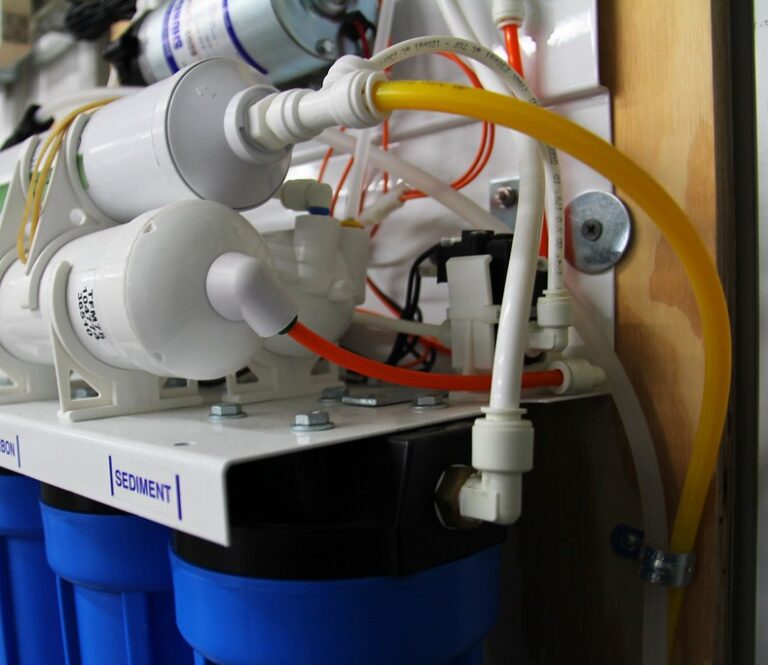
- Reverse osmosis (RO): UMass says RO removes 95 to 99 percent of dissolved salts. Chlorine damages RO membranes, so these units include a carbon pre-filter. RO water has almost no calcium or magnesium, so you will need a nutrient that supplies them, or cal-mag.
- Rainwater: UMass notes a natural pH of about 5.6 and very low minerals. Collect from a clean roof, keep it covered, and use it within a reasonable time.
- Distilled water: works like RO; practical for countertop units.
- Blending: a 50:50 mix of tap and RO water roughly halves the starting EC, sodium and alkalinity. This is often the cheapest fix.
Step by step: preparing tap water for a new reservoir
- Get the numbers. Read your utility’s report for disinfectant type, hardness and sodium. Measure EC and pH of cold tap water yourself.
- Run the tap for 30 seconds so you are not testing water that sat in the pipes overnight.
- Remove the disinfectant. Chlorine: stand 24 to 48 hours with an air stone. Chloramine: a labelled conditioner or catalytic carbon. Small volumes: vitamin C at the dose in the table above.
- Check the starting EC. Subtract it from your crop target to see how much nutrient you can add.
- Add nutrients (part A, then part B, stirring between) and read EC again.
- Adjust pH last, to about 5.5 to 6.0 for most crops; OSU recommends pH 5 to 6 (usually 5.5) in the solution.
- Recheck pH after 24 hours. If it has climbed well above target, your tap water alkalinity is high; plan on regular acid additions or blending.
Mistakes to avoid with tap water
- Assuming standing water removes chloramine. It does not. This is the most common error.
- Using softened water from a sodium softener, even “just for top-ups”.
- Adjusting pH before adding nutrients. Fertilizer changes pH, so you adjust twice.
- Adding a full cal-mag dose to hard water without knowing how much calcium is already there.
- Topping up for months without a full change. Sodium and chloride from tap water keep building.
- Skipping the plain-water EC reading. Without it you cannot tell how much of your EC is fertilizer and how much came from the tap.
Where this applies
The numbers above assume US municipal tap water under EPA rules. Other countries set their own limits and some utilities use neither chlorine nor chloramine, so check your local supplier’s report. Private wells are usually not chlorinated but are more likely to be hard, high in iron or high in sodium, and there is no utility report, so a lab test is the only reliable way to know. Retest your tap water EC and pH if plants suddenly behave differently.
FAQ
How long should tap water sit before using it for hydroponics?
If your utility uses chlorine, the CDC says a few days removes it; an air stone helps. If it uses chloramine, standing does not work at all, and you need a conditioner, catalytic carbon or vitamin C.
Is bottled or distilled water better than tap water for hydroponics?
Not automatically. Distilled and RO water remove the problem salts, but also calcium and magnesium, which you then have to add back. Good tap water is often the better choice once the disinfectant is dealt with.
Does tap water cause root rot?
Tap water itself does not; warm, low-oxygen water does. Disinfectant damage can brown roots, though, and damaged roots are easier for pathogens to attack.
Related guides: all nutrient, pH and EC guides · Kratky method · EC chart
Sources
- US EPA. National Primary Drinking Water Regulations (chlorine and chloramine MRDL 4.0 mg/L).
- US EPA. Secondary Drinking Water Standards.
- US EPA. Consumer Confidence Report information for consumers.
- CDC. About Water Disinfection with Chlorine and Chloramine.
- Water Quality Association. Chloramine fact sheet.
- USDA Forest Service SDTDC (2005). Using Vitamin C to Neutralize Chlorine in Water Systems.
- Date, S., Terabayashi, S., Kobayashi, Y., Fujime, Y. (2005). Effects of chloramines concentration in nutrient solution and exposure time on plant growth in hydroponically cultured lettuce. Scientia Horticulturae 103: 257–265.
- Premuzic, Z. et al. (2007). Chlorine disinfection: effects on hydroponics lettuce. Journal of Applied Horticulture 9(1): 62–65.
- Clean WateR3. Decontaminating irrigation water.
- Oklahoma State University Extension. HLA-6722, source water quality for hydroponics.
- UMass Extension. Water Quality for Crop Production.
- University of Missouri Extension. G6984, hydroponic nutrient solutions.
- NC State Extension. Irrigation Water Quality Problems and Softened Water May Ruin Your Crop.
- USGS Water Science School. Hardness of Water.
Featured image: “Aerated tap water” by Nikthestoned, CC BY-SA 3.0.