
You check the system after work and something’s off. The lettuce that stood up crisp this morning is lying flat over the edge of the net pot, and the basil looks like it hasn’t had a drink in days. The odd part? Its roots are hanging in water. How can a plant with its feet in a full reservoir look thirsty?
Short answer: hydroponic plants wilting in a full reservoir almost always means the roots can’t move water, not that water is missing. The usual culprits are warm nutrient solution with too little dissolved oxygen, Pythium root rot, an EC so high that salts pull water back out of the roots, or a pump or timer that has quietly stopped. Check the roots and the reservoir temperature first, because those two clues point to the cause in most cases.
By the end of this guide you’ll be able to diagnose the cause in about ten minutes, rescue the plants that can still be saved, and set up your system so wilting doesn’t come back.
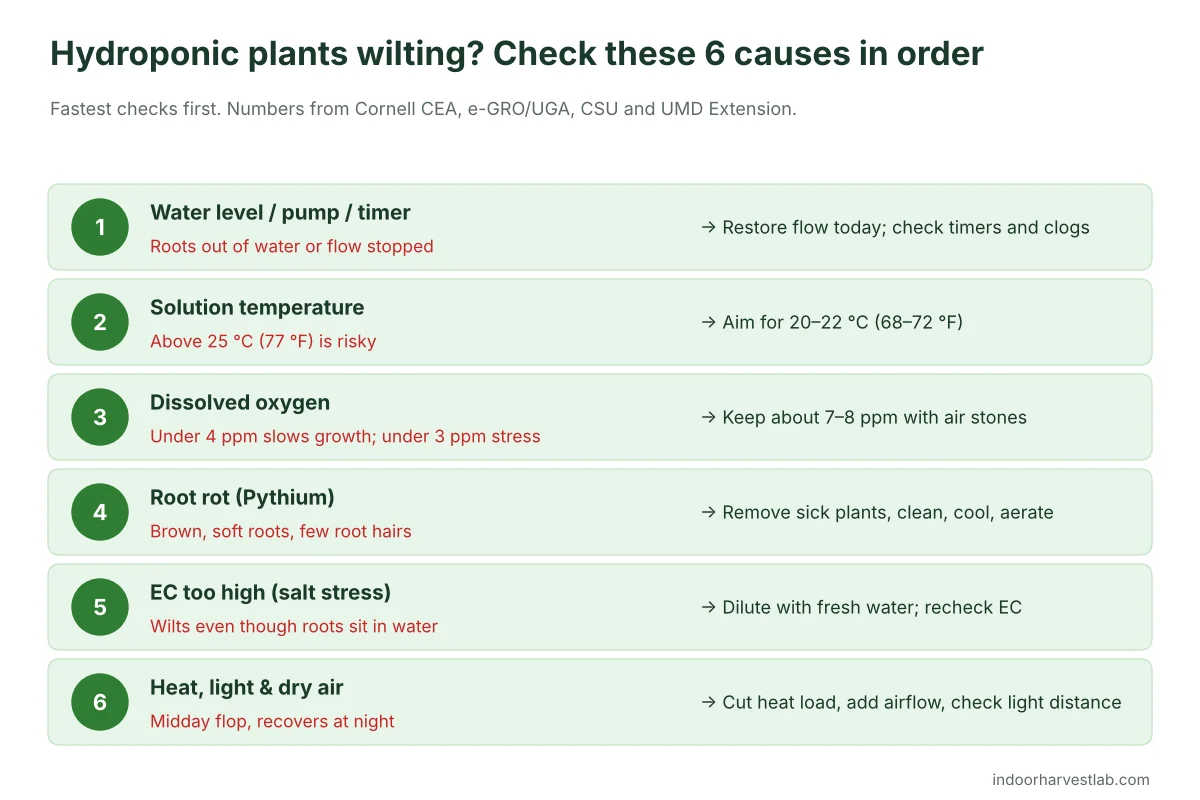
Why hydroponic plants wilt even when their roots are in water
Wilting is a plumbing problem inside the plant. Leaves lose water through their pores all day, and roots have to replace it just as fast. When roots can’t keep up, cells lose pressure and the leaves sag. In soil, the usual reason is dry soil. In hydroponics, water is everywhere, so the bottleneck has to be the roots themselves.
Roots need oxygen to do their job. They burn sugar to power water and nutrient uptake, and that takes oxygen dissolved in the solution around them. Cut the oxygen and the roots slow down, then start to die back at the tips. Dead root tips can’t absorb water, so the top of the plant wilts while sitting in a full tank.
The same end result can come from a few other directions. A disease can rot the roots. Salt build-up can make it physically harder for water to move into them. Or the plant can lose water faster than healthy roots can supply on a hot, bright, dry day. Colorado State University Extension notes that root disease in hydroponics is usually first noticed as wilting or tip burn, which is why a droopy plant always deserves a look below the raft.
Numbers to hold: the root-zone targets that prevent wilting
Before you start troubleshooting, it helps to know what “normal” looks like. These are the targets from university hydroponic programs. Keep this table handy, because most cases of hydroponic plants wilting come from one of these numbers drifting.
| What to measure | Target | Warning sign | Source |
|---|---|---|---|
| Nutrient solution temperature | 20–22 °C (68–72 °F) | Above 25 °C (77 °F) | e-GRO/UGA; CSU; Cornell CEA |
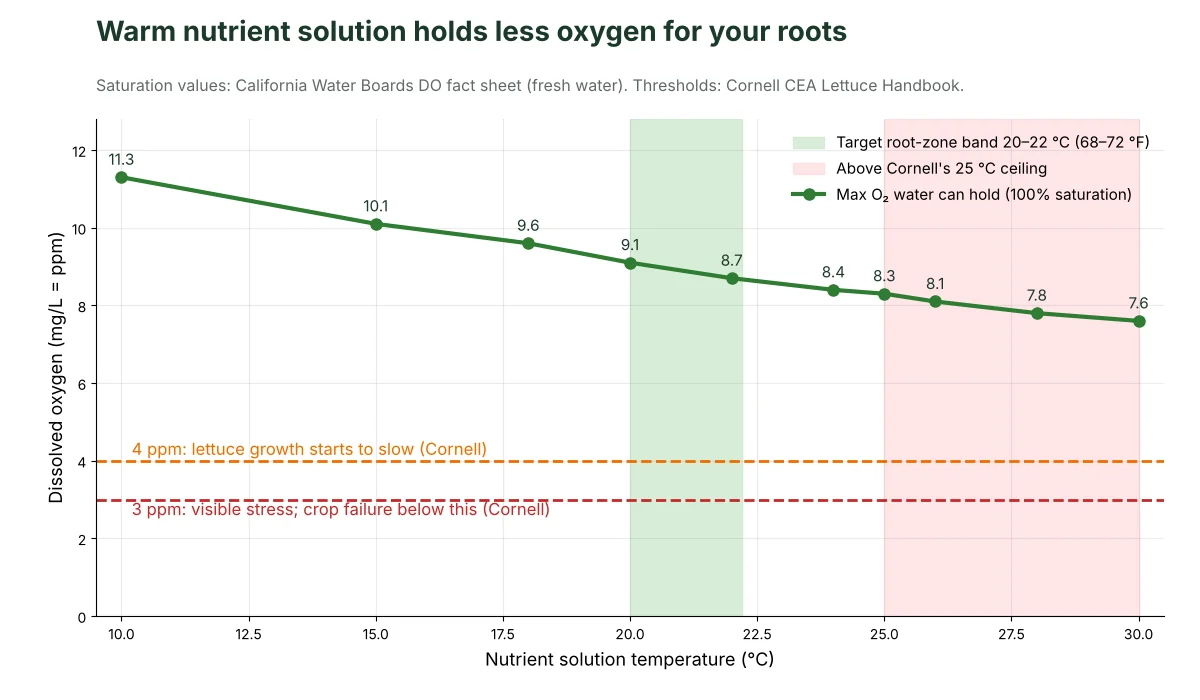
| Dissolved oxygen (DO) | About 8 ppm (7–10 ppm range) | Below 4 ppm slows lettuce; 3 ppm visible stress | Cornell CEA Lettuce Handbook |
| DO crop-failure line | — | Below 3 ppm | Cornell CEA Lettuce Handbook |
| Max DO water can hold at 20 °C / 25 °C | 9.1 / 8.3 mg/L | Falls to 7.6 mg/L at 30 °C | California Water Boards DO fact sheet |
| EC for lettuce (Cornell system) | 1,150–1,250 µS/cm above source water | Rising EC without topping up with plain water | Cornell CEA Lettuce Handbook |
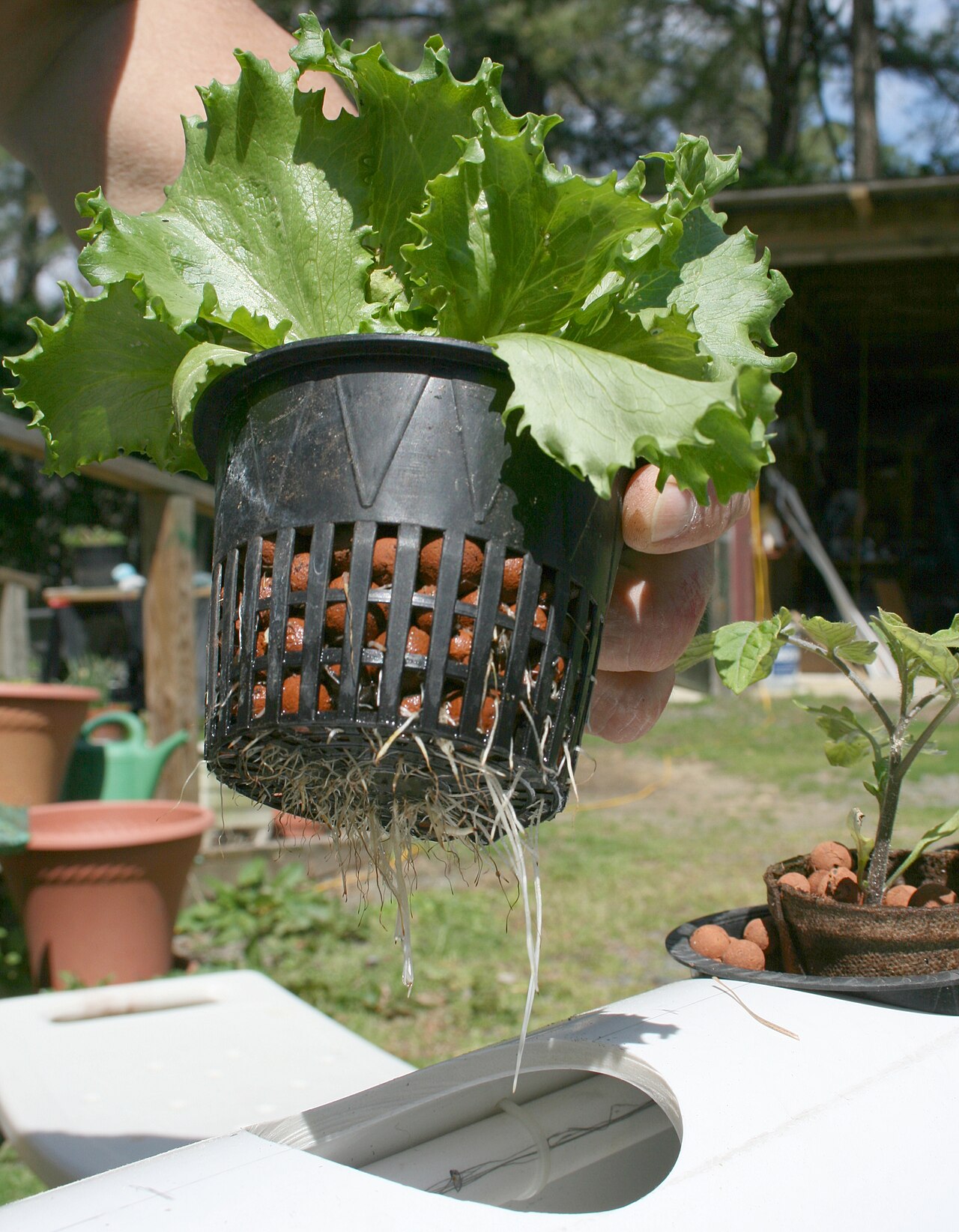
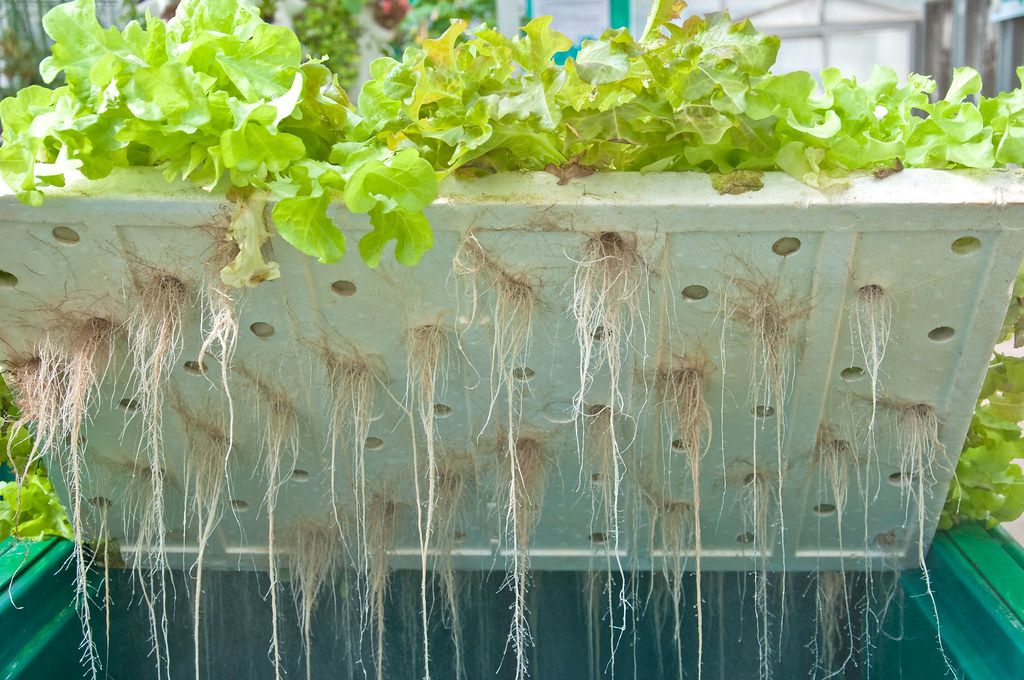
| Roots | White to cream, firm, plenty of fine root hairs | Brown or honey-brown, soft, few root hairs | CSU; e-GRO/UGA |
One number explains a lot of summer wilting. Cornell’s lettuce handbook says lettuce grows fine at a DO of at least 4 ppm, that visible stress may show at 3 ppm, and that crop failure follows below 3 ppm. It also warns that if no oxygen is added to a pond, DO can fall to nearly 0 ppm. That’s why an air pump failure can turn into a wilting crisis within a day or two.
6 causes of hydroponic plants wilting (and how to tell them apart)
When you see hydroponic plants wilting, work through these in order. The first three take seconds to check and fix. The last three need a closer look at the roots and your meter readings.
1. The pump, timer or water level failed
This is the most common cause and the easiest to miss. In NFT, ebb and flow or drip systems, plants depend on the pump running on time. A clogged emitter, a tripped outlet or a timer set wrong can leave roots dry for hours. In Kratky and other non-circulating setups, the water level drops as plants drink. If it falls faster than the roots grow down, the lower roots dry out.
How to tell: the whole tray wilts at once, roots look dry or crusty at the tips, and the plants perk up within hours of restoring flow.
2. Nutrient solution is too warm
Warm water is a double hit. It holds less oxygen, and it favours root disease. At 20 °C, water can hold at most 9.1 mg/L of oxygen. At 30 °C, that drops to 7.6 mg/L (California Water Boards). Cornell’s guide for home growers puts it simply: colder water is able to have a higher dissolved oxygen content.
Cornell’s lettuce system keeps the water no higher than 25 °C and starts cooling at 26 °C. The e-GRO alert by University of Georgia plant pathologist Jean Williams-Woodward recommends chilling water to 68–72 °F (20–22 °C), especially in summer. Small reservoirs warm up fast under lights or near a window, so check the water itself, not the room.
How to tell: wilting gets worse in the afternoon or during heat waves, and a thermometer in the reservoir reads above about 25 °C (77 °F).
3. Low dissolved oxygen
Even in cool water, roots can run short of oxygen if nothing mixes air into the solution. A dead air pump, a clogged air stone, a kinked line or overcrowded roots can all drop DO. Deep, still reservoirs are most at risk. That’s why deep water culture relies on constant aeration.
How to tell: few or no bubbles, a stale or sour smell, and roots that look tan rather than bright white. A DO meter takes the guesswork out: below 4 ppm is a problem for lettuce, per Cornell.
4. Pythium root rot (and other root diseases)
Once roots are stressed by heat or low oxygen, disease often moves in. Colorado State University Extension calls Pythium the most common root disease in hydroponic systems, with Fusarium, Phytophthora and Rhizoctonia showing up less often. The e-GRO alert adds that Pythium infects root tips, especially those damaged by low oxygen and/or high EC, and that infected roots are soft and honey-brown.
Pythium spreads easily. Its swimming spores can move through a whole recirculating system, and University of Arkansas researchers note that fungus gnats, shore flies, tools, infected media and pond water can all carry it in. For the full rescue routine, see our guide to hydroponic root rot.
How to tell: roots are brown, slimy or soft, the outer layer slips off when you pull gently, and root hairs are sparse. Plants wilt even after you fix temperature and aeration.
5. EC too high (salt stress)
This one surprises people. Too much fertilizer can make a plant wilt in a full tank. A University of Minnesota bulletin on soluble salts explains that when salt concentration around the roots is higher than inside the root cells, water can no longer move into the roots. It describes the first sign as wilting even though the plant was recently watered, caused by root tips dying back. University of Georgia Extension calls the same effect “physiological drought.”
In a hydroponic system, EC climbs when plants drink water faster than they use nutrients and you top up with nutrient solution instead of plain water. It also climbs when a new batch is mixed too strong. Check your crop’s range on our hydroponic EC chart.
How to tell: EC reads well above your target, leaf edges may brown, and roots look stubby with burned tips. Diluting with fresh water usually helps within a day.
6. Heat, strong light and dry air
Sometimes the roots are fine, and the plant is simply losing water faster than they can replace it. Hot grow rooms, lights hung too close, and dry winter air from heating all speed up water loss from the leaves. Large-leaved crops like lettuce, basil and cucumbers show it first.
How to tell: plants flop in the middle of the light period and recover overnight or when lights go off. Roots look white and healthy, and the reservoir numbers are on target.
Quick diagnosis table: match the symptom to the cause
| What you see | Most likely cause | First thing to do |
|---|---|---|
| Whole tray wilts suddenly; roots dry at the tips | Pump, timer or water level failure | Restore flow; check timer, outlet and emitters |
| Wilting worse in afternoons; reservoir feels warm | Warm solution | Measure water temp; cool to 20–22 °C (68–72 °F) |
| No bubbles; tan roots; stale smell | Low dissolved oxygen | Fix or add air pump and air stones |
| Brown, slimy, soft roots; few root hairs | Pythium root rot | Remove badly affected plants; clean, cool and aerate |
| Wilting with crispy brown leaf edges; EC high | Salt stress (EC too high) | Dilute with plain water; recheck EC |
| Midday flop, recovers at night; roots white | Heat, light or dry air | Raise lights, add airflow, lower room temperature |
| Wilting a day after a water change | Mixing error, temperature shock or root damage | Recheck EC, pH and water temp of the new batch |
Hydroponic plants wilting after a water change
This is one of the most searched versions of the problem, and it has its own short list of suspects. Changing the solution is supposed to help, so a droop afterwards feels unfair. Usually one of three things went wrong.
- The new batch was mixed too strong or too weak. A double dose of concentrate sends EC high enough to pull water out of the roots. Measure EC and pH of every new batch before it reaches the plants. Our guide to changing hydroponic water covers the routine.
- The water temperature changed sharply. Fresh tap water can be much colder or warmer than the old solution. Let a new batch reach room temperature, or match it to the old solution, before filling. (This is a practical rule of thumb rather than a published threshold.)
- Roots were damaged during handling. Lifting net pots, untangling roots or letting them dry out on the bench for too long can break or dry the fine root hairs. Plants usually recover within a day or two if the rest of the system is healthy.
If plants are still wilting two days after the change and the numbers look right, check the roots for rot. A water change won’t remove Pythium that’s already in the roots, the plumbing or the rafts.
How to rescue wilting hydroponic plants: step by step
When you find hydroponic plants wilting, act the same day. Roots can recover from a short spell of low oxygen, but rot spreads quickly in warm, still water. Here’s the order that works best.
Step 1: Restore water and air
Check the pump, timer, air pump and air stones. Top up the reservoir with plain water if the level has dropped. If the air pump has failed, even a spare aquarium pump will do until you replace it. Cornell keeps DO at about 8 ppm in its lettuce ponds, so aim for strong, steady bubbling.
Step 2: Take the water temperature
Put a thermometer in the reservoir, not the air. If it reads above 25 °C (77 °F), cool it. Options include moving the reservoir off a warm floor or away from lights, shading or insulating it, adding frozen bottles of water as a short-term fix, or using a chiller for larger systems. The target is 20–22 °C (68–72 °F).
Step 3: Measure EC and pH
If EC is well above your crop’s range, replace part of the solution with plain water and recheck. Bring pH back into range using our hydroponic pH chart. Avoid big swings: correct gradually over a few hours rather than all at once.
Step 4: Inspect the roots
Lift one or two plants and look closely. White, firm roots mean the problem was water, air or heat, and the plant should recover in a day. Brown, soft roots mean disease. The e-GRO alert advises discarding infected plants as soon as symptoms appear, because they keep releasing spores into the shared water.
Step 5: Clean and restart if rot is confirmed
Drain the system and clean the reservoir, lines, trays and rafts. Colorado State University Extension mentions 10% solutions of chlorine bleach or hydrogen peroxide–based products made for hydroponics, and says to follow all label instructions. Rinse well before refilling. The e-GRO alert notes that foam rafts are porous, so roots grow into them; wash them, then heat-treat or disinfect them before reuse.
Step 6: Watch for 48 hours
Reduce stress while roots regrow. Lower the light intensity slightly, keep the room cool and keep air moving. New white root tips are the best sign that the system is back on track.
Prevention plan: keep the root zone cool, oxygen-rich and clean
Rescuing plants is stressful. Stopping hydroponic plants wilting before it starts is mostly a matter of a few habits.
| Habit | Why it matters | How often |
|---|---|---|
| Check reservoir temperature | Warm water holds less oxygen and favours Pythium | Daily in warm weather |
| Check bubbles, pump and timer | Cornell notes DO can drop to nearly 0 ppm without added oxygen | Daily |
| Measure EC and pH | High EC damages root tips and can lead to wilting | Every 1–3 days |
| Top up with plain water, not full-strength solution | Stops salts building up as plants drink | Whenever the level drops |
| Look at the roots | Catches early browning before wilting starts | Weekly |
| Control algae, fungus gnats and shore flies | The e-GRO alert lists them as spore spreaders | Ongoing |
| Clean between crops | Removes spores hiding in rafts and plumbing | Every crop cycle |
Light also matters here. Keeping the reservoir opaque helps stop algae in hydroponics, which competes for oxygen at night and attracts the flies that carry root pathogens. If fungus gnats are already flying, our fungus gnats guide shows how to break their cycle.
Don’t count on fertilizer tweaks to stop root rot. University of Arkansas researchers tested raising copper, iron, manganese, zinc and silicon in hydroponic lettuce (Helms et al., 2023). Copper did reduce Pythium severity, but it also reduced lettuce growth and yield, and the other elements had no significant effect on root disease. The authors concluded that managing micronutrients and silicon is not an effective strategy against Pythium.
From the lab bench
Here’s the way to think about hydroponic plants wilting: it’s almost never a shortage of water. It’s a shortage of working roots. Every cause on this list comes back to that point. Low oxygen stops roots working, Pythium kills them, salt makes their job harder, and heat asks more of them than they can give. So the root is where your diagnosis should start and end.
The research also shows these causes rarely act alone. The e-GRO alert says Pythium goes after root tips already damaged by low oxygen or high EC. Colorado State calls most root pathogens opportunists that do the most damage on already stressed plants. In practice, that means a warm reservoir is often the first domino. It lowers oxygen, stresses roots, and opens the door to rot. Fixing temperature first often solves two or three problems at once.
One honest warning: there’s no magic additive. Sanitation helps, but the University of Arkansas explainer quotes a University of Guelph paper saying even extraordinary sanitation doesn’t destroy the pathogens, and spores can hide in nooks in the plumbing. The most reliable defence is a system that never gives Pythium an opening: cool water, strong aeration, steady EC, and quick removal of any plant that turns brown at the roots.
If you only buy one extra tool, make it a cheap reservoir thermometer. It’s the earliest warning you’ll get.
FAQ
Why are my hydroponic plants wilting when the roots are in water?
Because the roots can’t take up water, not because water is missing. Low dissolved oxygen, warm solution, root rot or high EC all damage or block the roots. Check the reservoir temperature, aeration, EC and root colour first.
Can wilted hydroponic plants recover?
Yes, if the roots are still white and firm. Restore flow and aeration, cool the water and correct EC, and plants often perk up within a day. Plants with brown, soft roots from Pythium rarely recover and are best removed so they don’t spread spores.
What water temperature stops hydroponic plants from wilting?
Aim for 20–22 °C (68–72 °F), the range recommended by University of Georgia and Colorado State University Extension. Cornell’s lettuce system keeps water no higher than 25 °C (77 °F).
How much dissolved oxygen do hydroponic roots need?
Cornell’s CEA program keeps lettuce ponds at about 8 ppm (7–10 ppm). Growth slows below 4 ppm, visible stress can appear at 3 ppm, and crops can fail below that.
Why are my hydroponic plants wilting after a water change?
The usual causes are a new batch mixed too strong, a big temperature difference between old and new water, or roots damaged while handling. Check the EC, pH and temperature of the new solution, then look at the roots.
Can too many nutrients cause wilting in hydroponics?
Yes. When salt concentration around the roots is higher than inside the root cells, water can’t move in, so plants wilt even with roots in water. Dilute the solution with plain water and recheck EC.
Does hydrogen peroxide fix wilting hydroponic plants?
It doesn’t fix the cause. Hydrogen peroxide–based products are used to disinfect systems and treat water, but you still need to cool the solution, restore aeration and remove infected plants. Always follow the product label.
Sources
- Brechner, M., Both, A.J. and CEA staff (2013). Cornell Controlled Environment Agriculture Hydroponic Lettuce Handbook. Cornell University CEA Program.
- Ronzoni, R. and Mattson, N. (2020). A Guide to Home Hydroponics for Leafy Greens. Cornell University.
- Williams-Woodward, J. (2022). Root disease management in hydroponic systems. e-GRO Edible Alert 7(6), University of Georgia.
- Colorado State University Extension. Root Disease Problems & Management in Hydroponic Systems (PlantTalk Colorado 2043).
- Lovett, J. (2022). Why Pythium-resistant spinach and arugula is such a big deal. University of Arkansas System Division of Agriculture.
- Helms, K.M., Dickson, R.W., Bertucci, M.B., Rojas, A.A. and Gibson, K.E. (2023). Metal micronutrient and silicon concentration effects on growth and susceptibility to Pythium root rot for hydroponic lettuce. Horticulturae 9(6): 670.
- Schwane, D. (1994). Soluble Salts. Minnesota Flower Growers Bulletin 43(6), University of Minnesota.
- Sonon, L.S., Saha, U. and Kissel, D.E. Soil Salinity: Testing, Data Interpretation, and Recommendations (Circular 1019). University of Georgia Cooperative Extension, reviewed 2022.
- Little, N. and Ristvey, A. (2020). Salinity Matters for High Tunnels and Growing Media (FS-1128). University of Maryland Extension.
- Clean Water Team, California State Water Resources Control Board (2004). Dissolved Oxygen Fact Sheet 3.1.1.0.