
You counted the trusses, you watched the fruit swell, and for two weeks now the biggest tomatoes in your grow tent have been sitting there, glossy, full-sized and stubbornly green. Or worse: they finally coloured, but they came out a washed-out orange with hard yellow shoulders. You check the pH, you check the EC, and everything looks fine. So what gives?
Short answer: hydroponic tomatoes not ripening is almost always a temperature problem, not a nutrient one. Tomatoes colour best when the fruit itself sits at 68–72°F (20–22°C); above 85°F (29°C) the plant stops making lycopene, the red pigment, and below about 55°F (13°C) ripening crawls. Fruit also has to reach the mature-green stage first, which takes roughly 40–50 days after fruit set, and a shortage of potassium causes blotchy, uneven colour.
This guide walks you through why tomatoes stall, how to tell an immature fruit from a stuck one, the exact numbers to hold, and a step-by-step rescue plan for fruit in a tent, a Dutch bucket or a windowsill system. By the end you’ll know which of the six common causes you’re dealing with, and how many days you’re realistically waiting.
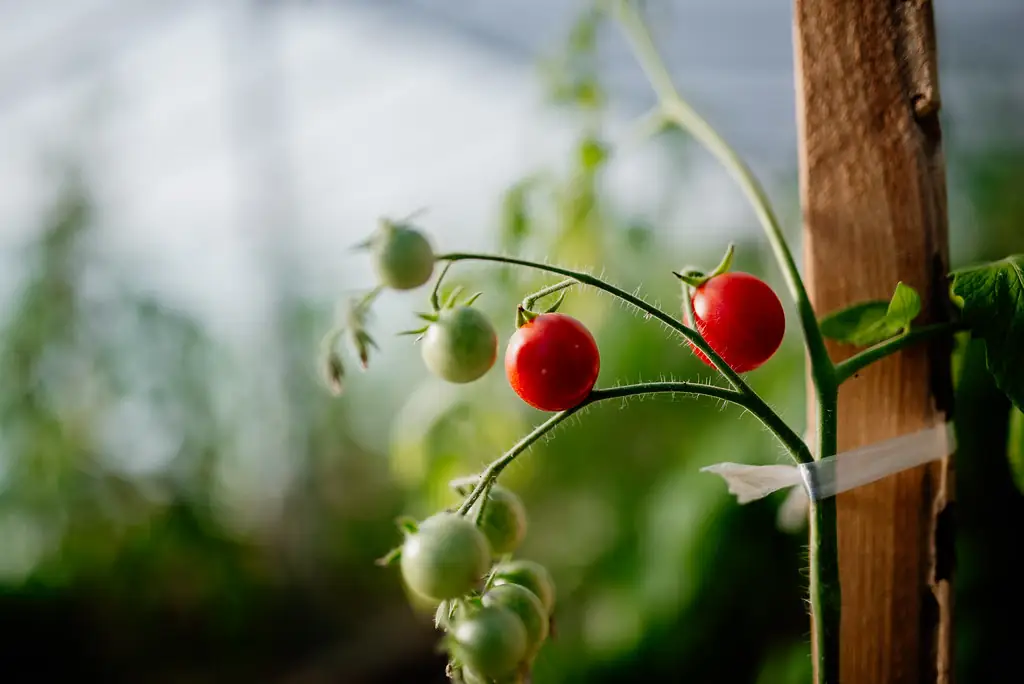
How Tomato Ripening Works (and Why It Stalls Indoors)
Ripening isn’t one switch; it’s a chain. A tomato first grows to full size while it’s still green, then hits a stage called mature green, when the seeds are fully formed and the inside starts turning jelly-like. Only then does the fruit start making its own ethylene, the gaseous ripening hormone, and that ethylene turns on the genes that break down chlorophyll, build red lycopene and soften the flesh (Sargent et al., UF/IFAS).
Purdue Extension puts the green-growth phase at 40–50 days before the fruit reaches full size, and notes that temperature and ethylene are the two factors that govern what happens next (Lerner, Purdue). That’s the first reality check: if your fruit set three or four weeks ago, nothing is wrong yet. It simply isn’t old enough.
Indoors, the chain breaks in predictable places, which is why hydroponic tomatoes not ripening is such a common complaint in winter. Grow lights heat the canopy, so fruit near the lamp can run far hotter than the room. Winter nights in a spare room or windowsill drop too low. And a hydroponic plant carrying a heavy fruit load can run short of potassium even when the reservoir looks fine. Each of those knocks out a different link.
The six USDA colour stages
Growers and researchers describe ripening with six standard colour stages. Knowing them helps you judge progress and decide when to pick.
| Stage | Name | Surface showing colour | What it means for you |
|---|---|---|---|
| 1 | Green | No external colour change | May be immature or mature green; check size and age |
| 2 | Breaker | Not more than 10% | Ripening has started; it will finish off the vine |
| 3 | Turning | More than 10%, up to 30% | Safe to pick and finish indoors |
| 4 | Pink | More than 30%, up to 60% | A few days from full colour |
| 5 | Light red | More than 60%, up to 90% | Nearly ready; flavour still building |
| 6 | Red | More than 90% | Fully ripe; best flavour if vine-ripened |
The breaker stage matters most. Commercial greenhouse growers who ship long distances pick beefsteaks around breaker, while those selling locally or growing cluster types wait for more than 90% colour to get the best flavour (Currey, Iowa State). At home, you have the luxury of waiting.
Hydroponic Tomatoes Not Ripening: 6 Common Causes
Before you change anything, run through this list. When growers report hydroponic tomatoes not ripening, most stalled fruit comes down to the first two causes, and they’re the cheapest to fix.
1. The fruit simply isn’t mature yet
This is the most common “problem” and the least worrying. A tomato that looks full-sized can still be immature. UF/IFAS postharvest specialists note that fruit needing more than 5 days of ethylene to reach breaker “were immature when harvested; they will never ripen to normal color and flavor” (Sargent et al.). Purdue says the same: immature green fruit will never ripen, while mature green fruit will (Lerner). The sign you’re looking for is a shift from deep, glossy green to a lighter, slightly whitish or yellowish green, especially at the blossom end.
2. The fruit is too hot
Heat is the number-one reason indoor tomatoes colour badly. Lycopene “ceases to form at temperatures over 85 degrees Fahrenheit,” while carotene is a bit more heat-tolerant, which is why hot fruit comes out yellow-orange with yellow shoulders instead of red (Burrows, SDSU Extension). A controlled study found that raising fruit temperature from 27 to 32°C reduced lycopene, while a rise from 21 to 26°C cut total carotene but left lycopene unaffected (Gautier et al., 2008).
Here’s the part people miss: the air thermometer isn’t telling you the fruit’s temperature. UF/IFAS notes that tomatoes left in the sun for an hour can become as much as 25°F hotter than fruit in the shade (Sargent et al.). A tomato hanging a few inches under an LED or HPS lamp is in a similar position, absorbing radiant energy all day.
3. The fruit is too cold
Winter is the other side of the coin. Tomatoes ripen best between 55°F and 77°F; below 55°F colour and flavour development slow down, and chilling injury starts to show as abnormal colour, water-soaked spots and pitting (Sargent et al.). The UF/IFAS greenhouse handbook warns that night temperatures below 62°F reduce fruit set, and that fruit kept below 50°F risks chilling injury (Hochmuth, UF/IFAS). A windowsill system on a cold glass pane can easily fall into that range overnight.
4. Potassium is running short
Potassium is the ripening nutrient. The UF/IFAS fertilizer chapter states plainly that potassium deficiencies “lead to blotchy ripening of tomatoes” (Hochmuth, UF/IFAS). University of Maryland’s vegetable specialist found plant tissue “low to very low” in potassium even where soil tests were adequate, and in a small trial, removing half the fruit dropped ripening problems from about 20% to almost zero (Brust, UMD). That was a field crop, but the logic holds for hydroponics: too much fruit on one plant splits the potassium supply too thin.
5. Low light combined with cool nights
Blotchy ripening, where patches stay green or yellow, is linked to low light and low night temperatures in greenhouse tomatoes (Hochmuth). Ohio State’s vegetable lab adds that extreme air temperatures (below 60°F and/or above 90°F) during mid-to-late ripening, high humidity and low light all make it worse (Ohio State VegProLab). Light also helps quality directly: more light on the fruit raised lycopene and vitamin C in the Gautier study.
6. Too much light and heat on exposed fruit
The opposite problem shows up as greenback (a hard green ring at the shoulder) and whitewall (pale internal tissue). The RHS links both mainly to excess light, high temperatures and insufficient feeding, and lists greenback-resistant cultivars such as ‘Alicante’, ‘Shirley’ and ‘Craigella’ (RHS). This is why heavy deleafing under a strong lamp can backfire.
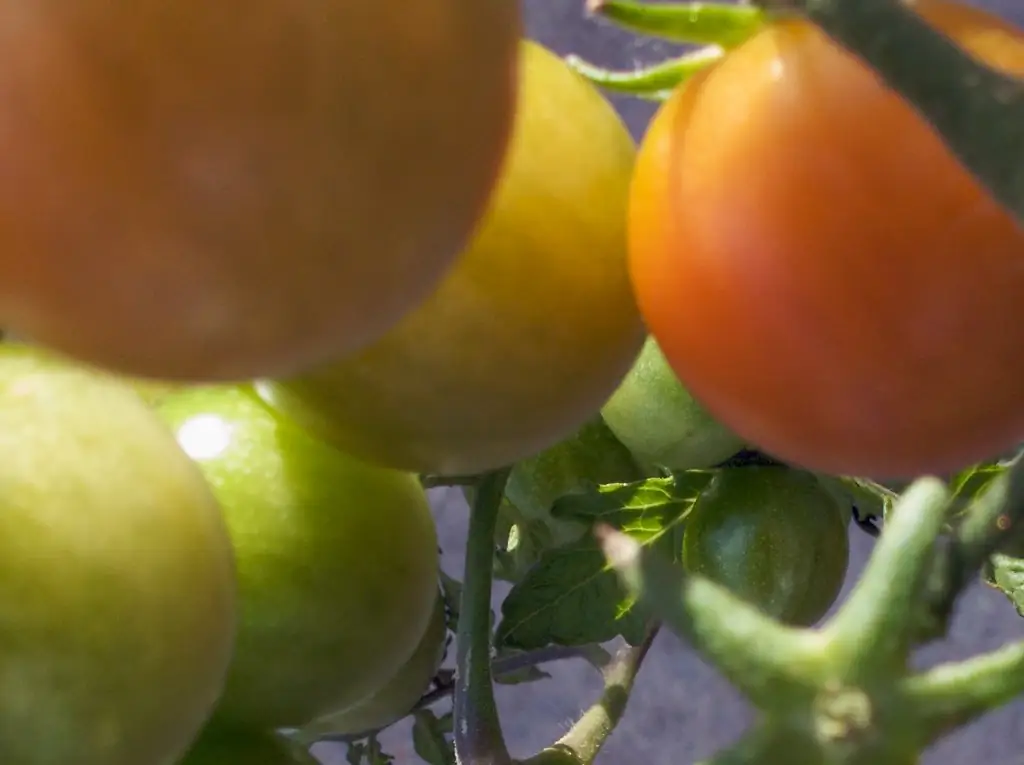
Numbers to Hold for Ripening Tomatoes Indoors
Print this table and stick it on your tent. Every figure comes from extension or peer-reviewed sources, and it’s the fastest way to check whether your setup is inside the ripening window.
| Factor | Target | Problem zone | Source |
|---|---|---|---|
| Fruit temperature for best red colour | 68–72°F (20–22°C) | Above 77°F (25°C): more orange, softer fruit | UF/IFAS VH079 |
| Lycopene formation stops | Keep fruit below 85°F (29°C) | Above 85°F: yellow-orange fruit, yellow shoulders | Purdue; SDSU |
| Ripening slows sharply | Keep fruit above 55°F (13°C) | Below 55°F: colour and flavour retarded | UF/IFAS VH079 |
| Chilling injury | Never below 50°F (10°C) | Pitting, water-soaked spots, uneven colour | UF/IFAS CV266; Cantwell |
| Greenhouse day air temperature | 80–85°F (27–29°C) | Above 90°F (32°C): poor pollination and set | UF/IFAS CV266 |
| Greenhouse night air temperature | 62–72°F (17–22°C) | Below 62°F: fruit set reduced | UF/IFAS CV266 |
| Time from fruit set to mature green | 40–50 days | Picked earlier: will never ripen | Purdue |
| Mature green to full red at 68°F | About 10 days | 18 days at 55°F | Cantwell, UC Davis |
| Humidity for ripening off the vine | 85–95% RH | Lower: shrivel after about 3% weight loss | UF/IFAS VH079 |
Notice the slight gap between the 80–85°F day air target for the plant and the 68–72°F target for the fruit. They aren’t contradictory. Leaves and flowers want warmth to grow and set fruit; the fruit, once it’s mature green, colours best a bit cooler. Indoors, the simplest compromise is to keep the canopy in the plant’s range while shading and venting so the fruit itself doesn’t bake.
If you need the full feeding schedule by growth stage, our hydroponic nutrients for tomatoes guide covers ppm, EC and pH targets in detail, and the hydroponic water temperature guide explains how to keep roots in range when the room swings.
How long should it take? Days to ripen by temperature
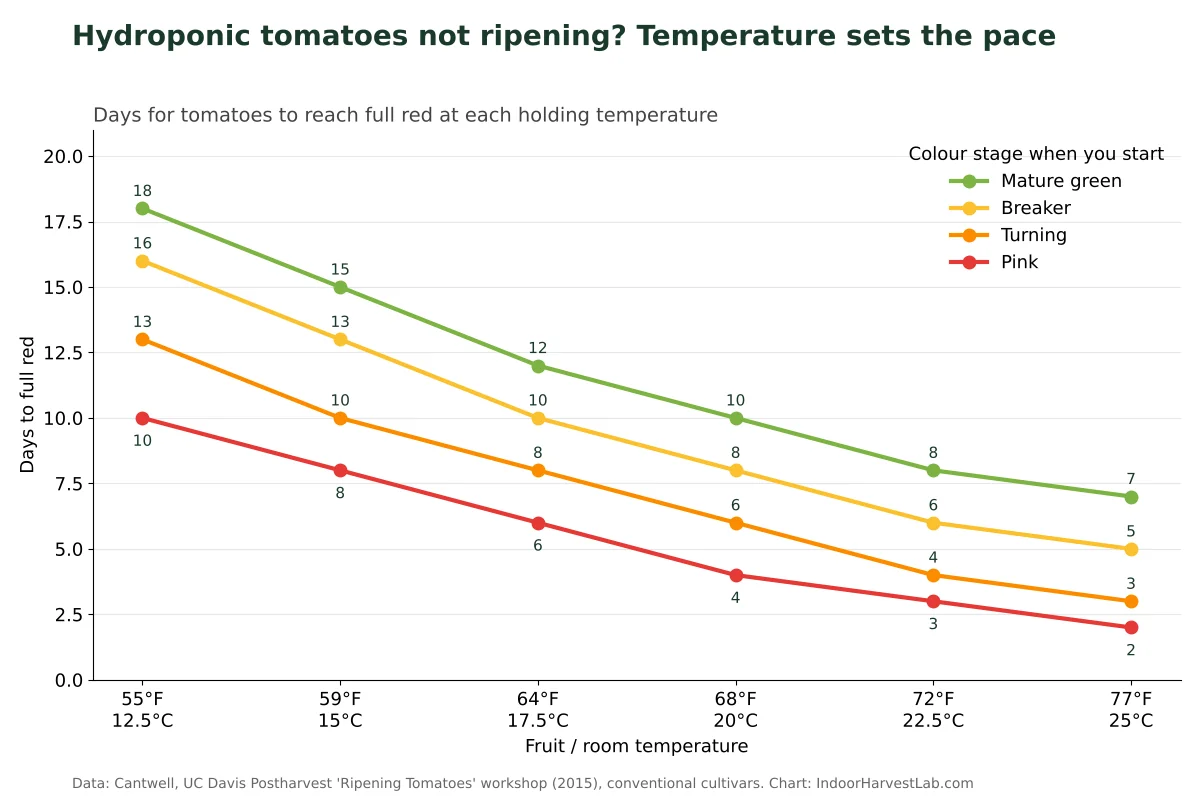
Once a tomato is mature green, temperature decides how fast it reaches full red. UC Davis postharvest data give a clear picture: at 68°F (20°C), a mature-green tomato takes about 10 days, a breaker about 8 and a pink fruit about 4. Drop to 55°F (12.5°C) and the same mature-green fruit takes 18 days (Cantwell, UC Davis).
| Starting stage | 55°F / 12.5°C | 64°F / 17.5°C | 68°F / 20°C | 72°F / 22.5°C | 77°F / 25°C |
|---|---|---|---|---|---|
| Mature green | 18 days | 12 days | 10 days | 8 days | 7 days |
| Breaker | 16 days | 10 days | 8 days | 6 days | 5 days |
| Turning | 13 days | 8 days | 6 days | 4 days | 3 days |
| Pink | 10 days | 6 days | 4 days | 3 days | 2 days |
Two lessons jump out. First, warmer is faster only up to a point: 77°F ripens quickest, but UF/IFAS warns that above 77°F fruit turns more orange and softens early. Second, a cold room roughly doubles your wait. If your tent sits at 60°F at night in December, a two-week stall is normal, not a disease.
Fixing Heat and Cold: The Ripening Temperature Window
Since temperature is the main lever behind hydroponic tomatoes not ripening, it deserves its own plan. Use the chart below as your mental model, then measure where your fruit actually sits.
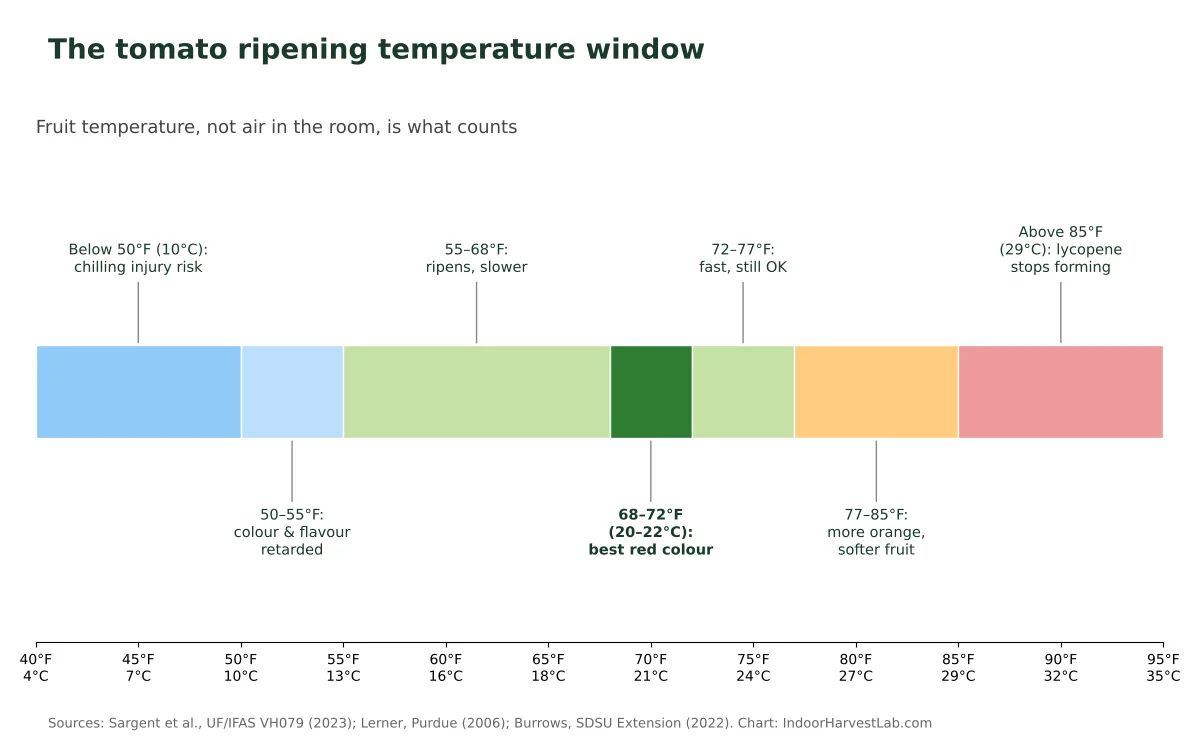
Step 1: Measure the fruit, not the room
Hang a thermometer or a cheap probe at fruit height, in the canopy, for 24 hours. Better still, use an infrared thermometer on the fruit skin at the hottest point of the light cycle. If fruit closest to the lamp reads above 85°F while the room reads 75°F, you’ve found your problem.
Step 2: Cool hot fruit without chilling the plant
- Raise the light or dim it slightly so the top trusses aren’t sitting in the hottest zone. Our PPFD chart shows the light levels fruiting crops actually need.
- Leave a few leaves over the ripening truss instead of stripping everything. The RHS recommends deleafing no higher than the lowest truss.
- Add an oscillating fan to move hot air out of the canopy, and vent the tent during the light period.
- Run the lights at night when the house is cooler, if your schedule allows, so the heat load lands in the coolest hours.
Step 3: Warm cold fruit in winter
- Move windowsill systems away from cold glass at night, or slip insulating board between the pots and the pane.
- Keep night air at 62°F (17°C) or above, as the UF/IFAS greenhouse handbook recommends for fruit set.
- Use a small thermostatically controlled heater in a tent rather than relying on lamp heat alone, because the temperature crashes when lights switch off.
A short heat spike isn’t a disaster, by the way. In a classic study, fruit held at 38°C (100°F) stopped producing ethylene, colour and softening, but all three resumed once the fruit returned to 20°C (Lurie et al., 1996). The inhibition was reversible. So if a heatwave stalled your fruit, fixing the temperature usually restarts ripening.
Nutrition Fixes: Potassium, Fruit Load and EC
If temperatures are in range and you still have hydroponic tomatoes not ripening evenly, look at nutrition next. The usual pattern in hydroponics is a solution that suited the vegetative stage but hasn’t kept up with a plant carrying four or five trusses.
Raise potassium as trusses build
UF/IFAS greenhouse feeding programs increase potassium as the crop moves from transplant to later fruit clusters, because fruit is a heavy potassium sink (Hochmuth, UF/IFAS). If you’re still running a seedling or lettuce-strength solution on a fruiting plant, that’s a likely cause of blotchy ripening. Switch to a fruiting or “bloom” formula, or follow a stage-by-stage recipe such as the one in our tomato nutrient guide.
Don’t overcorrect
More isn’t better. The same UF/IFAS chapter warns that excess potassium, especially in hydroponics and rockwool, can inhibit the uptake of calcium and magnesium, and the RHS notes that heavy use of high-potassium feeds can lead to magnesium deficiency and blossom-end rot. Ohio State adds that above-optimal nitrogen is also linked to blotchy ripening (Ohio State VegProLab). The goal is balance, not a potassium flood. If older leaves are yellowing between the veins, check our yellow leaves in hydroponics diagnosis chart before adding anything.
Lighten the fruit load
The Maryland result is worth borrowing: thinning fruit sharply reduced ripening problems in that trial (Brust, UMD). Indoors, that might mean topping the plant once it carries as many trusses as your light can support, or nipping the smallest fruit off each beefsteak truss so the plant can finish what it has.
Symptom triage table: ripening problems at a glance
Match what you see to the likely cause, then jump to the fix. Rule out whitefly and tomato mosaic virus first if you see blotchy fruit, since Ohio State notes both can mimic blotchy ripening.
| What you see | Likely cause | What to do |
|---|---|---|
| Full-sized fruit stays dark, glossy green | Not yet mature (under 40–50 days from set) | Wait; check for a lighter green blossom end |
| Fruit turns yellow-orange, never deep red | Fruit above 85°F (29°C) | Shade the truss, raise lights, vent the canopy |
| Hard green or yellow shoulders | Heat and direct light on the shoulders (greenback, yellow shoulder) | Keep leaf cover over fruit; cool the canopy; consider resistant varieties |
| Green or yellow blotches on red fruit | Low potassium, heavy fruit load, low light and cool nights | Increase K in a balanced fruiting formula; thin fruit; check night temperature |
| Very slow colour, dull flavour | Fruit below 55°F (13°C) | Warm the night period to 62°F or above |
| Pitting, water-soaked spots, uneven colour | Chilling injury below 50°F (10°C) | Never store or grow fruit that cold; damage is lasting |
| Pale internal tissue when cut | Whitewall: excess light, heat or low feeding | Same fixes as greenback; review feeding |
| Rotten patch on blossom end | Blossom-end rot (calcium, transpiration), not a ripening issue | Steady watering, good airflow, avoid excess K |
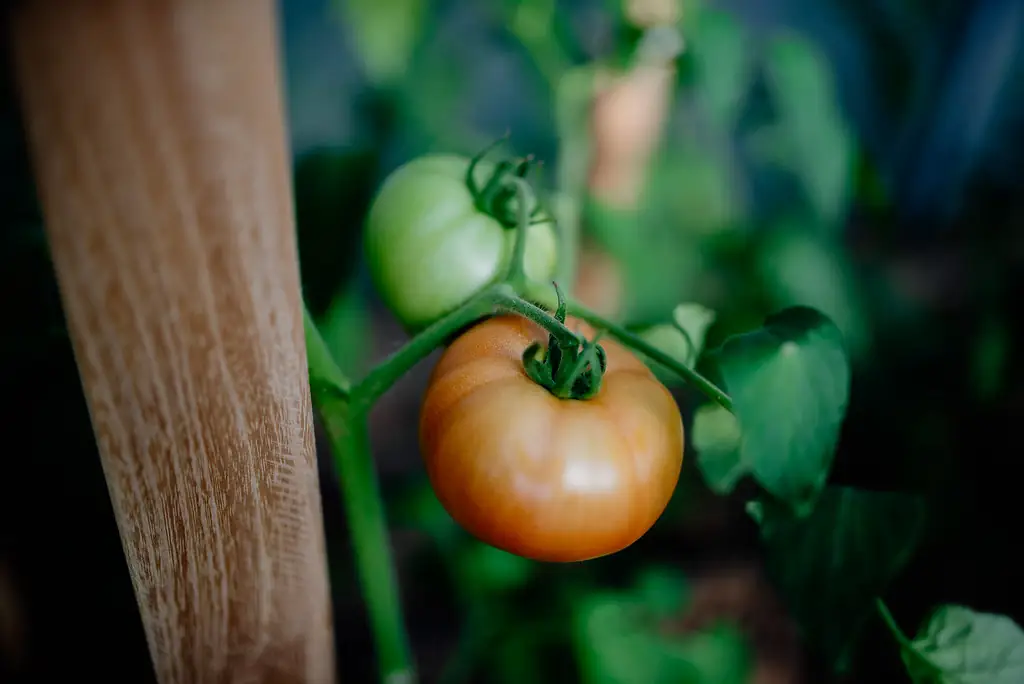
Should You Pick Green Tomatoes and Ripen Them Indoors?
Sometimes the smartest move is to stop fighting the plant. Once fruit reaches breaker, it finishes ripening just as well off the vine. UC Davis notes that mature-green and breaker fruit with internal colour ripen well without any ethylene treatment (Cantwell). Picking also frees the plant to push its energy and potassium into the next trusses.
Step 1: Check the fruit is mature green or later
Look for that lighter, slightly whitish green, or the first pink blush at the blossom end. Fruit still dark green and hard is probably immature and won’t colour properly off the plant.
Step 2: Pick with a short stem
Snip or twist the fruit off with the calyx attached. Cluster types can be cut as a whole truss.
Step 3: Ripen at the right temperature
Purdue suggests holding mature-green to lightly blushed fruit at 60–65°F, or warmer for faster ripening, and warns that a home refrigerator is too cold (Lerner). For best colour, aim for 68–72°F. Keep the fruit out of direct sun on a counter or in a single layer in a box.
Step 4: Keep humidity up
UF/IFAS recommends 85–95% relative humidity during ripening to limit weight loss, since shrivel can appear after as little as 3% weight loss (Sargent et al.). A loosely closed paper bag or a box with a damp (not wet) towel works fine at home.
Step 5: Group ripening fruit together if you want
Ripening tomatoes give off ethylene themselves, and putting a ripening fruit next to green ones in a closed container concentrates it. This is optional; temperature matters far more than ethylene for mature fruit.
For flavour, fruit left on the vine to more than 90% colour still wins, which is why greenhouse growers selling locally wait that long (Currey). Pick early when temperature, space or a hungry plant forces your hand.
From the Lab Bench
If you take one idea away from this article about hydroponic tomatoes not ripening, make it this: ripening is a temperature-driven process sitting on top of a maturity clock. Nutrition and light shape the quality of the colour; temperature decides whether colour happens at all. That’s why the first instrument to buy when indoor tomatoes stall isn’t a new nutrient line but a cheap probe thermometer clipped next to the fruit.
The second idea is that the plant’s comfort zone and the fruit’s comfort zone overlap but aren’t identical. The research reviewed here puts good greenhouse day temperatures in the low to mid-80s °F, but best fruit colour at 68–72°F. In a small grow tent, where the top truss can be a hand’s width from a lamp, that difference is enough to tip fruit over the 85°F lycopene ceiling while the room thermometer looks perfectly normal. Think in terms of microclimates, not room averages.
Third, be suspicious of the ‘more potassium’ reflex. The evidence clearly links potassium shortage to blotchy ripening, but the same sources warn that excess potassium blocks calcium and magnesium uptake. In recirculating systems, where ions accumulate, overshooting is easy. A balanced fruiting formula, a sensible fruit load and steady EC usually beat a bottle of potassium booster.
Finally, patience is a legitimate strategy. With 40–50 days to mature green and another 7–18 days to colour, a beefsteak can take two months from fruit set to slicing. If your plant is healthy, your temperatures are in range and your fruit is still green at week five, the most likely diagnosis is simply ‘not yet.’
FAQ
Why are my hydroponic tomatoes not ripening?
Most often the fruit is too hot (above 85°F / 29°C, where lycopene stops forming), too cold (below 55°F / 13°C), or not yet mature. Fruit needs about 40–50 days after set to reach mature green before it can colour. Low potassium and a heavy fruit load cause blotchy, uneven ripening.
Do tomatoes need light to ripen?
Mature fruit doesn’t need light to turn red: mature-green and breaker tomatoes ripen well on a counter at 60–72°F. On the plant, though, more light on the fruit raised lycopene and vitamin C in research by Gautier et al. (2008), and low light is linked to blotchy ripening.
What temperature do tomatoes need to ripen?
UF/IFAS reports tomatoes ripen between 55°F and 77°F, with the best red colour at 68–72°F (20–22°C). Above 77°F fruit turns more orange, and above 85°F lycopene production stops.
How long does it take a green tomato to turn red?
At 68°F (20°C), a mature-green tomato takes about 10 days to reach full red, a breaker about 8 days and a pink fruit about 4 days, according to UC Davis data. At 55°F the mature-green fruit takes about 18 days.
Why are my indoor tomatoes turning orange instead of red?
Orange or yellow-orange fruit usually means the fruit was too hot while ripening. Carotene still forms at high temperatures, but lycopene, the red pigment, stops above about 85°F. Shade the fruit, raise the light and improve airflow.
Does potassium help tomatoes ripen?
Yes, within limits. UF/IFAS states potassium deficiency leads to blotchy ripening, and feeding programs raise potassium as fruit loads increase. Too much potassium can block calcium and magnesium uptake, though, so use a balanced fruiting formula rather than a booster.
Can I ripen green tomatoes in the fridge?
No. Purdue Extension says a home refrigerator is too cold for ripening. Green and ripening fruit are prone to chilling injury below 50–55°F, which causes pitting, poor colour and poor flavour.
Keep going: start from the basics in how to grow tomatoes indoors in winter, build a simple system with our Dutch bucket hydroponics guide, or browse more fixes in Hydroponic Problems.
Sources
- Sargent, S.A., Brecht, J.K., Wang, Q. and Olczyk, T. (2023). Handling Florida Tomatoes: Round and Roma Types. UF/IFAS Extension, SS-VEC-928/VH079.
- Cantwell, M. (2015). Ripening Tomatoes. Fruit Ripening and Ethylene Management Workshop, UC Davis Postharvest Technology Center.
- Lerner, R. (2006). Tomatoes Not Ripening? Indiana Yard and Garden, Purdue Consumer Horticulture.
- Burrows, R. (2022). Heat Causes Problems With Garden Produce. SDSU Extension.
- Hochmuth, G.J. Production of Greenhouse Tomatoes: Florida Greenhouse Vegetable Production Handbook, Vol. 3. UF/IFAS Extension, HS788/CV266.
- Hochmuth, G.J. Fertilizer Management for Greenhouse Vegetables: Florida Greenhouse Vegetable Production Handbook, Vol. 3. UF/IFAS Extension, HS787/CV265.
- Ohio State University Vegetable Production Systems Laboratory (2015). Blotchy Ripening of Tomato Fruit: Definition, Contributing Factors and Steps to Limiting its Occurrence.
- Brust, G. (2024). Tomato Ripening Problems and the Role of Potassium. University of Maryland Extension.
- RHS Advice Team. Tomatoes: fruit ripening problems. Royal Horticultural Society.
- Gautier, H. et al. (2008). How does tomato quality (sugar, acid, and nutritional quality) vary with ripening stage, temperature, and irradiance? Journal of Agricultural and Food Chemistry 56(4): 1241–1250 (via PubMed).
- Lurie, S., Handros, A., Fallik, E. and Shapira, R. (1996). Reversible inhibition of tomato fruit gene expression at high temperature. Plant Physiology 110(4): 1207–1214 (via PubMed).
- Currey, C.J. (2018). Tomatoes 101, part II: a production guide. Produce Grower.