
Your hydroponic tomato plant has flowers on it at last. But the leaves are curling down, the stem is as thick as your thumb, and the first truss has only set two fruit. Or maybe the opposite: the plant set a big cluster and then the fruit came up with leathery black bottoms. Either way, you start to suspect the nutrient bottle isn’t the whole story.
Short answer: the best hydroponic nutrients for tomatoes are a complete, calcium-rich hydroponic fertilizer fed in stages. Start at about 70–90 ppm nitrogen after transplant and raise it to 150–190 ppm N once five or more trusses are setting. Raise potassium from about 120–145 ppm up to 200–350 ppm as you go. Keep the EC near 2.0 mS/cm at first and about 2.4 in heavy fruiting, and hold the pH at 5.8–6.2. Tomatoes are heavy feeders, but feeding them too hard too early is the most common mistake.
By the end of this guide you’ll have the stage-by-stage targets used by the University of Florida and Ohio State, a “numbers to hold” table, an honest comparison of one-part, two-part and DIY salt programs, a step-by-step mixing routine and a symptom table you can use when the plant starts to look wrong.
Why hydroponic nutrients for tomatoes change as the plant grows
Lettuce is easy to feed: one recipe from seedling to harvest. Tomatoes aren’t like that. A young tomato plant is all leaf and stem, and an older one is carrying several trusses of fruit at once. Those two plants want different things from the water, so good hydroponic nutrients for tomatoes follow the crop’s stage instead of staying the same.
Ohio State’s greenhouse team (Kroggel and Kubota, fact sheet HYG-1437) explains the risk plainly. Too much nitrogen early makes an “overly vegetative” plant with thick stems, curled leaves, fewer flowers and poorer fruit. In their example, a truss set only 2 fruit where 6–8 were expected. That is the classic “bull” tomato plant, and it is usually a feeding problem, not a variety problem.
Later, the logic flips. Once fruit is swelling, the plant moves large amounts of potassium into it for sugar loading and flavour. It also needs steady calcium to protect the fruit from blossom-end rot. So the program is built around three ideas:
- Nitrogen starts low and climbs, so early growth stays compact and flowers set.
- Potassium rises sharply once fruit is loading, which supports fruit quality.
- Calcium stays high and steady (and rises at the end in the Ohio State program) to help prevent blossom-end rot.
The easiest way to tell what stage you’re in is to count open flower trusses, not days. Ohio State’s Stage 1 runs from the seed leaves to the 2nd open truss, which usually appears after 9–15 leaves. Stage 2 runs to the 5th open truss (usually after 18–24 leaves), and Stage 3 is everything after that.
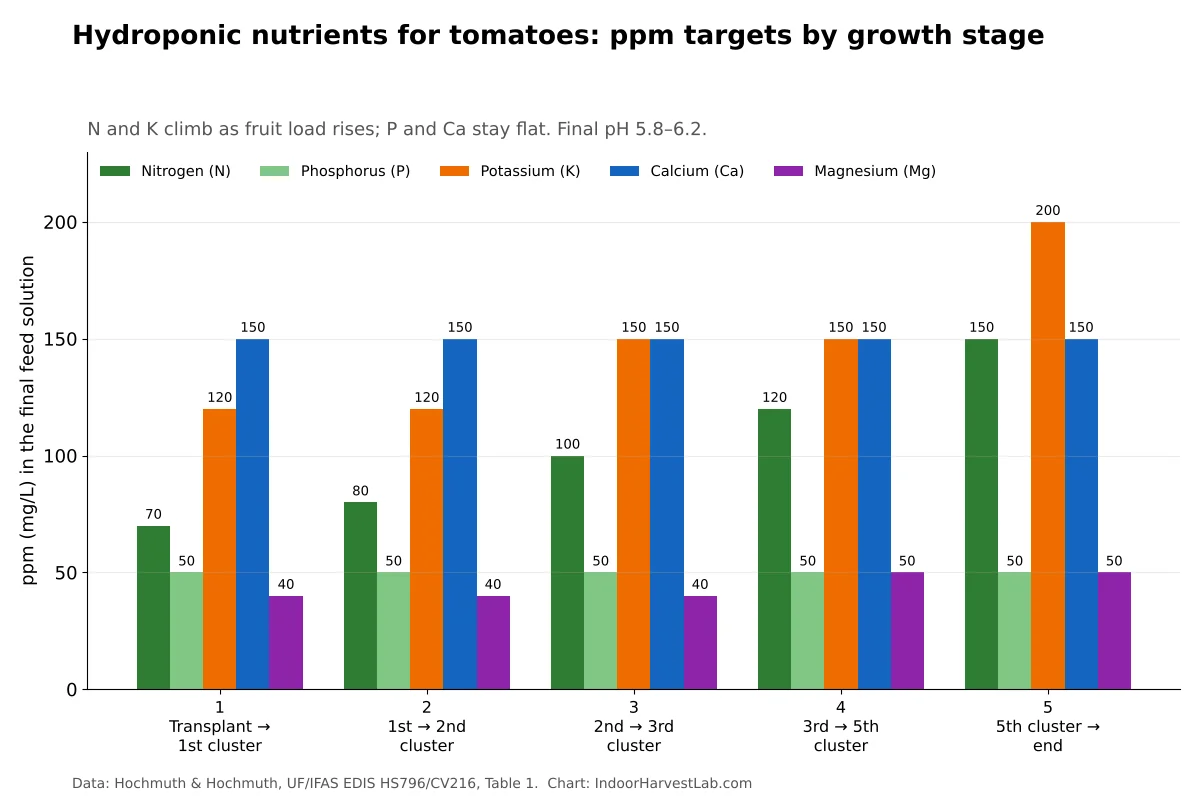
Stage-by-stage tomato nutrient targets (ppm)
Two university programs give complete, element-by-element targets for hydroponic tomatoes. The University of Florida table by George and Robert Hochmuth (EDIS HS796/CV216) uses five stages tied to fruit clusters. Ohio State’s three-stage program uses targets from the University of Arizona CEA program. Both are written for greenhouse growers using perlite, rockwool or NFT, but the ppm targets work just as well for a home bucket or a recirculating system.
| Nutrient (ppm) | UF Stage 1 transplant → 1st cluster | UF Stage 3 2nd → 3rd cluster | UF Stage 5 5th cluster → end | Ohio State Stage 1 → 2 → 3 |
|---|---|---|---|---|
| Nitrogen (N) | 70 | 100 | 150 | 90 → 120 → 190 (as nitrate-N) |
| Phosphorus (P) | 50 | 50 | 50 | 47 all stages |
| Potassium (K) | 120 | 150 | 200 | 144 → 350 → 350 |
| Calcium (Ca) | 150 | 150 | 150 | 144 → 160 → 200 |
| Magnesium (Mg) | 40 | 40 | 50 | 60 all stages |
| Sulfur (S) | 50 | 50 | 60 | 10–200 |
| Iron (Fe) | 2.8 | 2.8 | 2.8 | 2 |
| Manganese (Mn) | 0.8 | 0.8 | 0.8 | 0.55 |
| Zinc (Zn) | 0.3 | 0.3 | 0.3 | 0.33 |
| Boron (B) | 0.7 | 0.7 | 0.7 | 0.4 |
| Copper (Cu) | 0.2 | 0.2 | 0.2 | 0.05 |
| Molybdenum (Mo) | 0.05 | 0.05 | 0.05 | 0.05 |
Notice what the two programs agree on. Nitrogen roughly doubles from the first stage to the last. Potassium rises the most. Phosphorus barely moves. Micronutrients stay the same throughout. Where they differ, Ohio State pushes potassium much higher once fruit is loading (350 ppm against Florida’s 200), which reflects its focus on fruit quality in a long greenhouse crop.
UF adds an important footnote: the calcium, magnesium and sulfur numbers can change depending on how much calcium and magnesium your water already holds and how much sulfuric acid is used to bring the pH down. Well water can contribute 40–60 ppm calcium on its own, so test your source water first (our guide to tap water for hydroponics shows how).
The numbers to hold: EC, pH and temperature
Ppm targets tell you what your hydroponic nutrients for tomatoes should deliver. The numbers below tell you whether the reservoir is actually where it should be. Print this table or keep it on your phone next to the meter.
| Measure | Target | Source |
|---|---|---|
| pH of the feed solution | 5.8–6.2 (practical range 5.5–6.5) | UF HS796; Ohio State HYG-1437 |
| EC, Stage 1 (to 2nd open truss) | about 2.0 mS/cm (≈1,000 ppm on a 0.5 meter) | Ohio State HYG-1437 |
| EC, heavy fruiting (5th truss on) | about 2.4 mS/cm (≈1,200 ppm on a 0.5 meter) | Ohio State HYG-1437 |
| EC, outer optimum range | 2.0–4.0 mS/cm | Oklahoma State Extension |
| Nitrogen | 70–90 ppm early → 150–190 ppm late | UF HS796; Ohio State HYG-1437 |
| Potassium | 120–145 ppm early → 200–350 ppm late | UF HS796; Ohio State HYG-1437 |
| Calcium | about 150 ppm (up to 200 in late stage) | UF HS796; Ohio State HYG-1437 |
| Seedling feed before transplant | about 75 ppm N | University of Missouri Extension |
| Nutrient solution temperature | 72–75°F (22–24°C) | Oklahoma State Extension |
| Air temperature | 70–80°F (21–27°C) day, 60–70°F (16–21°C) night | University of Missouri Extension |
| Check pH and EC | daily, at the same time of day | Oklahoma State Extension |
| Full reservoir change (small systems) | about every 2 weeks | Oklahoma State Extension |
One subtle point from Ohio State: the pH around the roots matters more than the pH of the solution you pour in. Tomatoes take up nitrate quickly, which tends to push root-zone pH up over time. If the drain or reservoir keeps creeping above 6.5, aim the fresh feed toward the bottom of the range rather than chasing it every day. Our hydroponic pH chart explains why iron and manganese lock up above that line.
Getting EC right for hydroponic tomatoes
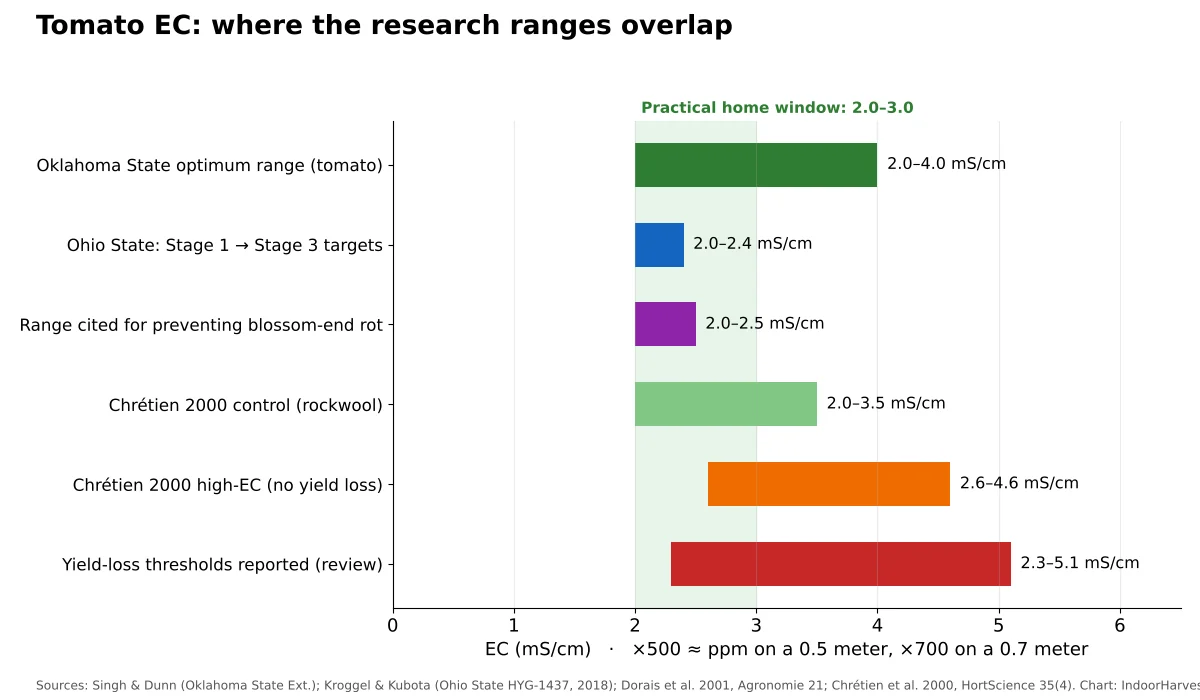
EC is where tomatoes differ most from leafy greens. Lettuce does well around 1.2–1.8 mS/cm. Tomatoes are routinely grown at 2.0 or higher, and Oklahoma State lists 2.0–4.0 mS/cm as the optimum range. That wide band hides a real trade-off between yield and flavour.
A review by Dorais, Papadopoulos and Gosselin (2001, Agronomie 21:367–383; summary here) pulled together decades of greenhouse work. Higher EC raises sugars, acids and other flavour compounds in the fruit. But in the studies it reviewed, yield dropped to unacceptable levels once EC passed thresholds anywhere between 2.3 and 5.1 mS/cm, depending on cultivar and conditions. Mostly, the fruit just got smaller.
A controlled rockwool trial at Laval University shows how gentle that effect can be. Chrétien, Gosselin and Dorais (HortScience 35(4), 2000) compared a control EC of 2.0–3.5 mS/cm with a higher 2.6–4.6 mS/cm raised with salt. Marketable yield wasn’t significantly affected. The higher EC did shift more fruit into the smaller Class 2 grade, but it also cut cracking and russeting by 68%.
What does that mean at home? A practical window is 2.0–3.0 mS/cm: start at about 2.0, let it rise toward 2.4–2.5 as fruit loads, and only go higher deliberately if you want more flavour and accept smaller fruit. Our hydroponic EC chart compares tomatoes with other crops.
One-part, two-part or DIY salts: which nutrients to buy
Once you know the targets, the question becomes which product gets you there. There’s no single “best” brand. The best hydroponic nutrients for tomatoes are the ones that can actually hit the stage targets with your water. Here’s how the three common approaches compare.
| Approach | How it works | Pros | Cons | Best for |
|---|---|---|---|---|
| One-part complete powder or liquid | Everything in one bottle; you vary the dose | Simplest; hard to mix wrong | Can’t raise K without raising N; often low in Ca, so cal-mag is added | 1–4 plants, beginners |
| Two- or three-part (A/B or grow/bloom/micro) | Calcium nitrate kept separate from sulfates and phosphates | Change the ratio by stage; no precipitation in the concentrate | More measuring; must add parts in order | Most home growers |
| DIY salts (calcium nitrate, potassium nitrate, MKP, Epsom salt, micronutrient mix) | Weigh each salt to a recipe such as UF’s or Ohio State’s | Cheapest per gallon; full control of each element | Needs a scale and a recipe calculator; mistakes are easy | Larger systems, experienced growers |
The reason most serious programs use at least two parts is chemistry. Ohio State notes that calcium reacts with sulfate and phosphate in concentrated form, forming gypsum and insoluble calcium phosphate. That is why calcium nitrate always sits in its own stock tank (the “B” tank) and never goes into the same concentrate as Epsom salt or monopotassium phosphate.
If you’re using a one-part feed and your tomatoes show calcium or magnesium problems, a separate calcium-magnesium supplement is the usual fix. Our cal-mag guide explains when you actually need it and how much to add.
Honestly, if you can’t run separate recipes for each stage, Ohio State offers a fallback: use the late-stage (Stage 3) recipe at half strength for Stage 1 and three-quarter strength for Stage 2. They call it “not optimal” but much better than doing nothing, and it is exactly how a home grower with one bloom-type formula can mimic a staged program.
How to mix a tomato nutrient solution step by step
Whatever brand of hydroponic nutrients for tomatoes you choose, the mixing routine is the same. The steps below work for a bucket, a Dutch bucket line or a small recirculating system. Always follow the label rates on your own product. The point here is the order of operations and the checks.
Step 1: Test your water first
Measure the EC and pH of your plain water. Oklahoma State suggests testing alkalinity too, because water above about 75 ppm alkalinity pushes pH up and means more frequent pH checks. If your tap water already reads 0.4–0.5 mS/cm, that’s dissolved minerals you need to count, not ignore.
Step 2: Add the parts in the right order
Fill the reservoir with most of the water. Add Part A (or the grow base) and stir well. Then add the calcium part and stir again. Never pour concentrates into each other. Micronutrients and iron go in last if they’re separate.
Step 3: Bring EC to the stage target
Check the EC against your stage: about 2.0 mS/cm before the 2nd open truss and about 2.4 once five trusses are setting. If it’s too high, add plain water. If it’s too low, add more concentrate in equal proportions. Re-measure after each change.
Step 4: Adjust pH last
Oklahoma State’s rule is to fix pH only after EC is right, because adding nutrients changes pH. Bring it to 5.8–6.2 in small doses, wait a few minutes and measure again. See how to lower pH in hydroponics for the safest acids.
Step 5: Top up, check daily and refresh
Check EC and pH every day at the same time of day. Top up with plain water or a weaker solution as the plants drink. Replace the whole reservoir about every two weeks in a small system, because unused ions such as sodium and chloride build up. Our guide on how often to change hydroponic water covers the details.
Troubleshooting: what your tomato leaves and fruit are telling you
Even well-chosen hydroponic nutrients for tomatoes can go wrong in the reservoir. Most tomato feeding problems show up in a predictable place on the plant. Use this table as a first diagnosis, then check your EC and pH before adding anything new. Many “deficiencies” turn out to be a pH problem.
| What you see | Likely cause | What to do |
|---|---|---|
| Thick stems, leaves curling down, few flowers, poor fruit set on the first trusses | Too much nitrogen too early (a vegetative “bull” plant) | Drop to Stage 1 levels (70–90 ppm N); keep EC near 2.0; let the plant shift to fruiting |
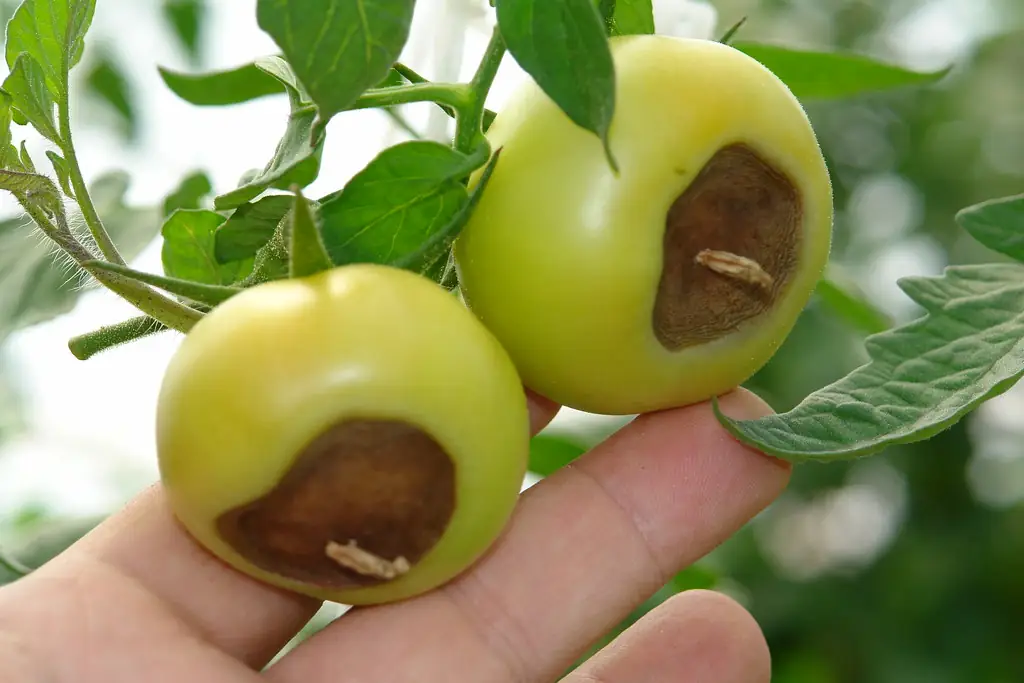
| Dark, sunken, leathery patch on the bottom of the fruit | Blossom-end rot: calcium not reaching the fruit, often with high EC or uneven water | Keep Ca at about 150 ppm; avoid very high EC; keep watering steady; avoid very dry air |
| Yellowing between the veins of older, lower leaves | Magnesium short (Mg is mobile, so old leaves go first) | Check Mg is at 40–60 ppm; add magnesium sulfate if low |
| Yellowing between the veins of the newest leaves | Iron lock-out, usually pH above 6.5 | Lower pH to 5.8–6.2 before adding more iron |
| Pale, evenly yellow lower leaves; slow growth in late stage | Nitrogen too low for the fruit load | Move up to the next stage’s N level (120–190 ppm) |
| Leaf edges scorched; plants wilt at midday in a full reservoir | EC too high (osmotic stress) | Dilute with plain water and re-measure |
| Blotchy, uneven ripening | Often linked to low potassium | Raise K toward 200+ ppm in fruiting stages |
A closer look at blossom-end rot
Blossom-end rot isn’t usually a lack of calcium in the tank. It is a failure to move calcium into the fast-growing fruit. The Dorais review notes that blossom-end rot increases as EC rises, especially in the first 7–21 days after flowering. One study it cites recommends an EC of 2.0–2.5 mS/cm with about 7 mM calcium (roughly 280 ppm) to prevent it, and higher daytime humidity also helped.
That’s one more reason not to push EC to the top of the range just to chase flavour. If your plants are in the indoor tomato setup with dry winter heating air, keep EC moderate and watering consistent.
On potassium and ripening, Chrétien and colleagues cite earlier research in which raising solution potassium from 180 to 380 mg/L cut unevenly coloured fruit from 40% to 12%. That fits Ohio State’s decision to push K hard once fruit is loading.
From the lab bench
Here’s how I’d read all of this as a plant scientist. The two university programs look different on paper, but they’re telling the same story: a tomato is a vegetative plant first and a fruit factory second, and the solution has to follow that switch. If you remember only one thing, remember that early restraint pays off later. A plant that gets 190 ppm nitrogen at transplant grows fast, looks impressive and then sets poorly.
The second lesson is about where the numbers come from. Both tables of hydroponic nutrients for tomatoes were built for commercial greenhouses in good light. Indoors under modest LEDs, a tomato can’t use as much fertilizer, because growth is limited by light, not nutrients. In that situation, staying at the lower end of each range (EC near 2.0, N toward the Florida numbers) is the safer bet. Pushing EC higher won’t make up for weak light; it just adds salt stress.
Third, read EC and pH as a pair and treat them as trends, not single readings. A rising EC with a falling water level means the plant is drinking more water than it’s taking up nutrients, so top up with plain water. A falling EC means it is eating faster than you’re feeding, so it’s time for the next stage. Root-zone pH drifting upward is normal for a nitrate-fed tomato. Those patterns tell you more than any one snapshot.
Finally, don’t skip pollination and pruning. Missouri Extension suggests tapping the trellis wire twice a day at least three days a week, or a 5-second daily puff from a blower, and removing suckers and the leaves below the first fruit cluster. A perfectly fed plant that isn’t pollinated still won’t give you fruit.
FAQ
What are the best hydroponic nutrients for tomatoes?
A complete hydroponic fertilizer that contains calcium and micronutrients, ideally a two- or three-part program so you can raise potassium and nitrogen as fruit sets. Aim for about 70–90 ppm N early and 150–190 ppm N late, with pH 5.8–6.2.
What EC should hydroponic tomatoes be at?
About 2.0 mS/cm until the second truss opens and about 2.4 mS/cm during heavy fruiting, per Ohio State. Oklahoma State lists 2.0–4.0 as the wider optimum range; higher EC improves flavour but can shrink fruit.
What pH is best for hydroponic tomatoes?
The University of Florida recommends a final solution pH of 5.8–6.2. Most nutrients stay available between 5.5 and 6.5. Above 6.5, iron and manganese become less available.
How many ppm should hydroponic tomatoes get?
On a 0.5 (NaCl) meter, EC 2.0 reads about 1,000 ppm and EC 2.4 about 1,200 ppm. On a 0.7 meter the same solutions read about 1,400 and 1,680 ppm, so always check which scale your meter uses.
Can I use lettuce or general-purpose nutrients for tomatoes?
You can start with them, but tomatoes need much more potassium and calcium once fruit sets. A grow formula alone often stays too high in nitrogen, which encourages leafy plants with poor fruit set.
Do hydroponic tomatoes need cal-mag?
Only if your nutrient and water don’t supply enough. Targets are about 150 ppm calcium and 40–60 ppm magnesium. Soft or RO water with a one-part nutrient often needs a cal-mag supplement.
How often should I change the nutrient solution for tomatoes?
In a small home system, about every two weeks, with daily EC and pH checks and plain-water top-ups in between, as Oklahoma State Extension advises.
Sources
- Hochmuth, G.J. and Hochmuth, R.C. Nutrient Solution Formulation for Hydroponic (Perlite, Rockwool, NFT) Tomatoes in Florida. UF/IFAS Extension, EDIS HS796/CV216 (revised 2025).
- Kroggel, M. and Kubota, C. (2018). Hydroponic Nutrient Solution for Optimized Greenhouse Tomato Production. Ohio State University Extension, HYG-1437.
- Singh, H. and Dunn, B. Electrical Conductivity and pH Guide for Hydroponics. Oklahoma State University Extension, HLA-6722.
- Chrétien, S., Gosselin, A. and Dorais, M. (2000). High electrical conductivity and radiation-based water management improve fruit quality of greenhouse tomatoes grown in rockwool. HortScience 35(4):627–631.
- Dorais, M., Papadopoulos, A.P. and Gosselin, A. (2001). Influence of electric conductivity management on greenhouse tomato yield and fruit quality. Agronomie 21:367–383. Summary by University of Tennessee Protected Agriculture
- Aufdenberg, D. and Cabrera, J. Hydroponics for Beginners (tomato section). University of Missouri Extension, via SARE.