
It’s October, the last garden tomatoes are sitting on the counter, and the thought hits you: why does this have to end? Store tomatoes in January taste like wet cardboard. If you could grow tomatoes indoors, a pot, a light and a little know-how should fix that, right?
Short answer: Yes, you can grow tomatoes indoors through winter, but only if you treat light, temperature and pollination as the three non-negotiables. Pick a dwarf variety, give it a strong grow light that delivers at least 20 mol/m²/day (about 350 µmol/m²/s for 16 hours), keep nights at 60°F (16°C) or warmer and days at or below 85°F (29°C), and shake the flower clusters every other day. Skip any one of those and you get a nice houseplant with no fruit.
Table of Contents
Table of Contents
This guide pulls together greenhouse tomato research and university extension advice into one plan for a living room, basement or spare bedroom. By the end you’ll know which varieties to buy, exactly how much light to supply, how to pollinate by hand, how to feed in soil or hydroponics, and how to diagnose the problems that stop indoor plants from fruiting.
Can You Really Grow Tomatoes Indoors? What to Expect
Let’s set expectations first, because this is where most indoor tomato projects go wrong. A tomato is a high-light, warm-season fruiting crop. Commercial growers produce them under glass all winter, but they do it with greenhouse-level light and climate control. Your job is to recreate a small slice of that.
Utah State University Extension is refreshingly honest here: small indoor varieties are “mainly a novelty” and may give you only enough fruit for an occasional salad or sandwich, while larger, well-kept plants yield more but need more care (USU Extension). That’s the trade-off in one sentence.
So who should grow tomatoes indoors? You, if you want fresh cherry tomatoes in the dead of winter, you enjoy tinkering, and you’re willing to buy a proper light. If you only have a windowsill, read the light section carefully before you buy seed. Honestly, a dim window is the single biggest reason indoor tomatoes flower and then drop every blossom.
Numbers to Hold for Indoor Tomatoes
Pin this table near your setup. Every value comes from the extension and research sources listed at the end.
| Factor | Target | Why it matters | Source |
|---|---|---|---|
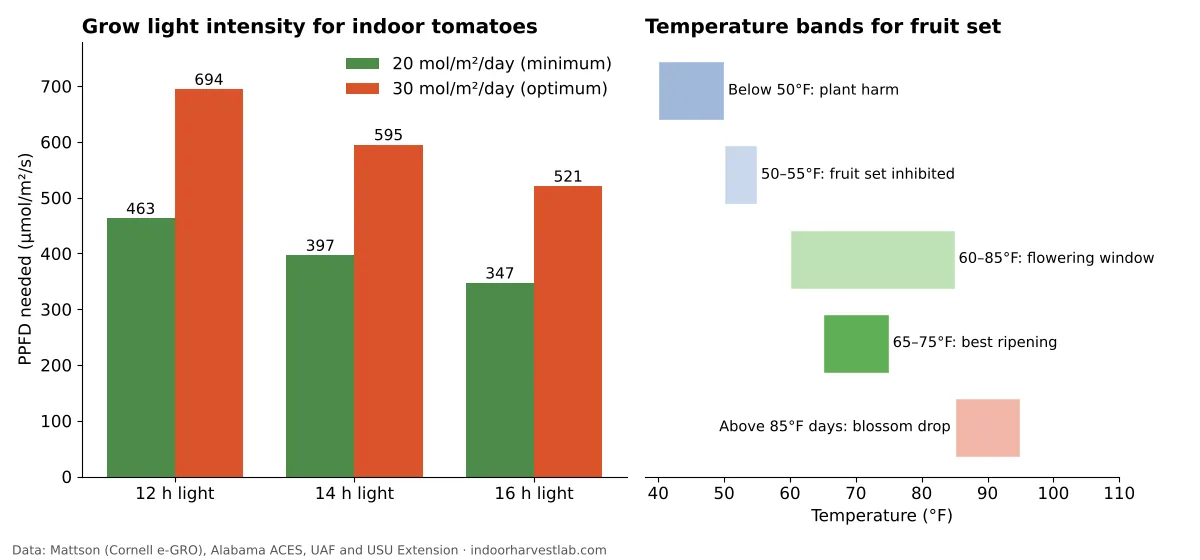
| Daily light integral (DLI) | Minimum 20 mol/m²/day; optimum above 30 | Below this, flowering and fruit load suffer | Mattson, Cornell e-GRO |
| Night temperature | 60°F (16°C) or warmer | Pollen germination drops off on cool nights | UAF Extension |
| Day temperature | 85°F (29°C) or cooler | Above 85°F days (with nights above 72°F/22°C), flowers often abort | Alabama ACES; UAF |
| Absolute cold limit | Avoid below 50°F (10°C); fruit set inhibited below 55°F (13°C) | Chilling harm and poor set | USU; Alabama ACES |
| Ripening temperature | 65–75°F (18–24°C) | Best red colour development | UAF Extension |
| Relative humidity | About 70% | Too dry or too damp and pollen won’t transfer well | UAF Extension |
| Pollination | Vibrate clusters at least every other day | Releases pollen from newly opened flowers | UAF Extension |
| Pot size | 1 gallon (dwarf) to 2–3 gallons (larger) | Root volume limits plant size and yield | USU Extension |
| Hydroponic pH | 5.5–6.5 | Keeps nutrients available | Ohio State HYG-1437 |
| Hydroponic EC | About 2.0 dS/m early, rising to about 2.4 dS/m in heavy fruiting | Matches feeding to fruit load | Ohio State HYG-1437 |
| Photoperiod | Never 24 hours of light | Most tomatoes develop leaf injury under continuous light | Velez-Ramirez et al. 2014 |
Best Tomato Varieties to Grow Indoors
Variety choice decides half your success before the seed is even wet. Big indeterminate slicers like ‘Brandywine’ can reach the ceiling and need far more light than a home fixture can spread across them. Dwarf and micro types stay compact, flower young, and fit under a single light.
USU Extension specifically suggests ‘Tiny Tim’, ‘Micro Tom’, ‘Terenzo’ and ‘Lizzano’ for indoor growing, noting that these smaller types usually spread about 1–2 feet and are mostly sold as seed rather than transplants (USU Extension).
| Type | Examples | Indoor fit | Trade-off |
|---|---|---|---|
| Micro dwarf | ‘Micro Tom’ | Excellent: tiny, fits a shelf, 1-gallon pot | Small harvest; a novelty crop |
| Compact cherry | ‘Tiny Tim’ | Very good for windowsill-plus-light setups | Modest yield |
| Trailing/basket cherry | ‘Terenzo’, ‘Lizzano’ | Good in hanging baskets or 2–3 gallon pots | Needs space around the pot for trailing stems |
| Indeterminate cherry | Typical vining cherries | Possible in a tent or basement with a strong light | Needs pruning, staking and much more light |
| Large slicers and heirlooms | Beefsteak types | Poor | High light demand; heirlooms are more prone to blossom drop (Alabama ACES) |
One practical tip: buy seed of a determinate or dwarf cherry for your first winter. Cherry fruit sets in bigger trusses and ripens faster than large fruit, so you see a payoff sooner, which keeps you motivated through February.
How to Grow Tomatoes Indoors Step by Step
Here’s the full sequence to grow tomatoes indoors, from seed to first ripe fruit. Each step explains the reason behind it, so you can adapt if your space is different.
Step 1: Start seeds warm
Sow seeds about ¼ inch deep in a sterile seed-starting mix. Tomatoes germinate fastest in warm media, so a heat mat helps in a cool winter house; check our seed germination temperature chart for the ideal range. Keep the mix moist, not soggy, to avoid damping off.
Step 2: Put seedlings under light immediately
The moment the hooks break the surface, they need bright light. A seedling that has to reach for a dim window turns thin and floppy within days. If yours already look stretched, our guide to leggy seedlings explains the fix (tomatoes are forgiving: you can bury the stem deeper at potting up).
Step 3: Pot up into the final container
Move each plant into its final pot once it has a couple of true leaves. USU recommends a 1-gallon pot for the smallest varieties and 2–3 gallons for larger ones, adding that an oversized pot is better than one that’s too small. Use a peat-based potting mix (never garden soil) and make sure the container drains (USU Extension).
Step 4: Set the light and timer
Run the light on a timer, typically 14–16 hours a day, and size it to hit at least 20 mol/m²/day at the top of the plant (details in the next section). Never leave it on around the clock.
Step 5: Water and feed for fruit, not leaves
Let the top of the mix dry moderately between waterings; USU warns against overwatering indoor tomatoes. Use a balanced fertilizer at label rates, and don’t overdo nitrogen: excess nitrogen pushes leafy growth at the expense of flowers, and salt buildup from heavy feeding can itself trigger blossom drop (Alabama ACES).
Step 6: Pollinate every other day once flowers open
Indoors there’s no wind and no bees. Without your help, most flowers simply dry up and fall. The method is covered in full below.
Step 7: Support, prune lightly and ripen warm
Stake or cage anything taller than a micro dwarf. On vining types, pinch some side shoots so the light reaches flowers rather than a jungle of leaves. As fruit colours up, keep the room in the 65–75°F (18–24°C) band where red colour develops best (UAF Extension).
Grow Lights: How Much Light Indoor Tomatoes Need
This is the make-or-break section when you grow tomatoes indoors. Lettuce and herbs are happy with modest light. Tomatoes are not. Cornell’s Neil Mattson lists tomatoes as needing a minimum daily light integral (DLI) of 20 mol/m²/day, with the optimum above 30 mol/m²/day, the same as peppers (Mattson, e-GRO Edible Alert). For comparison, many leafy greens are grown at far lower targets, and at the forgiving end of the scale growing ginger indoors needs less light still than a fruiting tomato.
DLI is simply the total light a plant receives in a day. You convert it to the light intensity (PPFD) your fixture must deliver with Mattson’s formula:
PPFD (µmol/m²/s) = DLI × 1,000,000 ÷ (hours on × 3,600)
| Hours of light per day | PPFD for 20 mol/m²/day (minimum) | PPFD for 30 mol/m²/day (optimum) |
|---|---|---|
| 12 hours | 463 µmol/m²/s | 694 µmol/m²/s |
| 14 hours | 397 µmol/m²/s | 595 µmol/m²/s |
| 16 hours | 347 µmol/m²/s | 521 µmol/m²/s |
Notice what longer days buy you: the same DLI at a lower, cheaper intensity. That’s why 16 hours is a sensible default. So why not 20 or 24 hours? Because tomatoes are unusual. Researchers at Wageningen University noted that most tomato plants develop leaf injury under continuous light, a problem first described in the 1920s; only lines carrying a tolerance locus from wild relatives handle it (Velez-Ramirez et al., 2014). Give your plants a dark period every day.
Choosing and placing the fixture
- Check the PPFD map, not the wattage. Reputable LED makers publish PPFD at set hanging heights. Pick a fixture that reaches 350–500 µmol/m²/s across the area your plants occupy.
- Old-school fluorescents work for micro types only. USU suggests cool-white fluorescent tubes or compact bulbs (at least 100-watt-equivalent) held 3–6 inches above the plants. That suits tiny varieties, but fluorescents struggle to light a larger plant.
- Hang LEDs at the maker’s recommended height. Our grow light distance guide explains how distance changes intensity.
- Use a window as a bonus, not the main source. USU recommends a bright, draft-free south- or west-facing window, but in winter that light is short-lived and weak for a fruiting crop.
Temperature, Humidity and Airflow
Here’s a surprising fact: night temperature matters more than daytime for pollination. The University of Alaska Fairbanks advises keeping nights at or above 60°F and days at or below 85°F while plants flower, because pollen germination and pollen-tube growth fall off outside that window, and nights matter most (UAF Extension).
Heat is a problem too, especially in a small grow tent. Alabama Extension reports that flowers often abort when days pass 85°F and nights pass 72°F, and that brief heat of about a week or less usually causes little trouble while longer spells cause bigger problems (Alabama ACES). Below 55°F, fruit set is inhibited.
- Cold windowsill? Glass gets frigid at night. Pull pots back from the window after dark, or lift them off a cold sill.
- Hot tent? Add a small exhaust fan or run the lights during the cooler night hours.
- Low light days: UAF suggests keeping day temperatures no more than 10–15°F above the night minimum when light is limited, to reduce blotchy ripening.
- Humidity: About 70% relative humidity is optimal for pollination and fruit set; very damp air makes pollen sticky (UAF). Dry winter homes often sit far lower, so a humidifier nearby helps.
- Airflow: A gentle oscillating fan strengthens stems and slightly shakes flowers, though it doesn’t replace hand pollination.
Hand Pollination: The Step Most Indoor Growers Miss
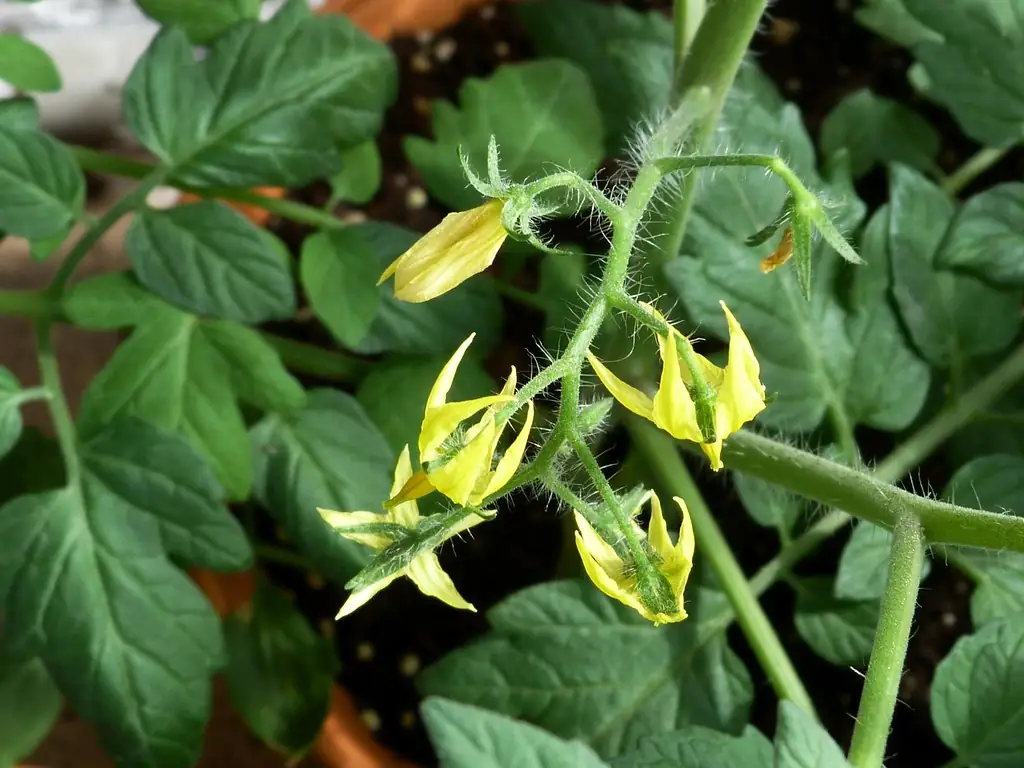
Tomato flowers are self-fertile, but the pollen sits inside a closed cone of anthers. Outdoors, wind and bumblebees vibrate it loose. Indoors, nothing does, so the flower dries up and drops even though it was “perfectly healthy”. If your plant is covered in yellow flowers but makes no fruit, start here.
How to pollinate indoor tomatoes
- Wait for open flowers. Petals fold back and the yellow cone is exposed.
- Vibrate the cluster’s stem. UAF recommends holding a vibrating probe briefly against the branch of the flower cluster so it shakes with moderate vigour. An electric toothbrush is the classic home version.
- Repeat at least every other day. New flowers open constantly, and UAF says branches must be vibrated at least every other day to keep releasing pollen.
- Watch for swelling. A pollinated flower’s ovary starts to swell behind the wilting petals within days.
Be realistic about tools. Mississippi State Extension notes that an electric toothbrush will pollinate some flowers but won’t match a commercial electric pollinator for yield (MSU Extension). For a few pots at home, the toothbrush is fine. UAF also notes that in a small greenhouse, tapping or vibrating clusters should be enough, so a firm flick of each truss works in a pinch. The same flick-or-brush routine is what growing strawberries indoors relies on too, since there are no bees indoors.
Soil vs Hydroponics for Indoor Tomatoes
Both work when you grow tomatoes indoors. Soil (really, potting mix) is forgiving and cheap. Hydroponics gives faster growth and tighter control, but it punishes neglect. Here’s an honest comparison.
| Potting mix in containers | Hydroponics (DWC, Kratky, Dutch bucket) | |
|---|---|---|
| Startup cost | Low | Moderate (bucket, air pump or reservoir, meters) |
| Daily effort | Water when the top dries | Check pH and EC, top up reservoir |
| Feeding | Balanced fertilizer at label rate | Complete hydroponic nutrient; EC about 2.0 rising to 2.4 dS/m |
| pH target | Handled by the mix | 5.5–6.5 |
| Main risks | Overwatering, fungus gnats | Root rot, pH drift, algae |
| Best for | First-time growers and micro varieties | Growers who already run a system |
For hydroponic tomatoes, Ohio State’s Mark Kroggel and Chieri Kubota describe staged nutrient recipes based on the University of Arizona CEAC formula, with EC around 2.0 dS/m at the first stage and closer to 2.4 dS/m at the final stage, and a drip-solution pH of 5.5–6.5 (Ohio State HYG-1437). Their tables keep phosphorus and magnesium steady (47 and 60 ppm) while nitrogen climbs from 90 to 190 ppm and potassium from 144 to 350 ppm as fruit load builds.
If you’re new to the numbers, start with our hydroponic EC chart and our guide to mixing a hydroponic nutrient solution. Tomatoes are heavy calcium users, so read up on cal-mag if your water is soft. A 5-gallon deep water culture bucket handles one compact plant well.
Troubleshooting: Flowers but No Fruit and Other Problems
When indoor tomatoes misbehave, the cause is almost always light, temperature, pollination or feeding. Use this table as a quick triage.
| Symptom | Likely cause | What to do |
|---|---|---|
| Lots of flowers, they dry and drop | No pollination; nights below 60°F or days above 85°F | Vibrate clusters every other day; fix the temperature range |
| Huge leafy plant, few flowers | Too much nitrogen; low light | Switch to a lower-nitrogen feed; raise DLI toward 20–30 |
| Tall, pale, stretched stems | Light too weak or too far away | Lower the light or upgrade the fixture |
| Mottled, yellowing leaves under long light days | Possible continuous-light injury | Make sure there is a daily dark period |
| Fruit stays green or colours unevenly | Room too cool or too hot; low light | Ripen at 65–75°F; keep day temperature within 10–15°F of night on dull days |
| White crust on mix, leaf edges browning | Salt buildup from over-fertilizing | Flush the pot with plain water; feed at label rates |
| Tiny flies around the pot | Fungus gnats from wet mix | Let the surface dry; see our fungus gnats guide |
| Brown, slimy roots in hydroponics | Root rot from warm, low-oxygen water | See our hydroponic root rot guide |
From the Lab Bench
If you take one idea about how to grow tomatoes indoors, make it this: a tomato fruit is built from light. Every gram of sugar in that cherry tomato started as photons hitting a leaf. That’s why the research puts tomatoes in the same high-light class as peppers and cucumbers, and why a plant under a weak light will happily grow leaves but abandon its flowers. When light is scarce, the plant protects its vegetative growth first; fruit is the luxury it drops.
The second idea is that pollination indoors is a mechanical problem, not a biological one. The flower has everything it needs; the pollen just can’t get out. Once you see it that way, the toothbrush trick stops feeling like folklore. Combine it with the temperature window (nights at 60°F or warmer), because a perfectly shaken flower still fails if the pollen tube can’t grow on a cold night.
Third, resist the urge to “help” with extra fertilizer. Extension sources consistently link excess nitrogen and salt buildup to blossom drop. A lush, dark-green plant with no fruit is usually overfed, not underfed. The rule of thumb is to feed at label strength, and if leaves are racing ahead of flowers, ease off nitrogen rather than adding more.
Finally, the continuous-light finding is a good reminder that more isn’t always better. The Wageningen work shows the injury is genetic, linked to a light-harvesting protein, and that only tolerant lines thrive without darkness. Unless you know your variety carries that trait, a 16-hour day with 8 hours of dark is the safe, efficient choice.
FAQ
Can you grow tomatoes indoors without a grow light?
Only in a very bright, south- or west-facing window, and only with micro varieties, and yields will be small. Tomatoes need a minimum DLI of about 20 mol/m²/day for fruit, which a winter window rarely supplies. A grow light is strongly recommended.
How many hours of light do indoor tomatoes need?
Most growers run lights for 14–16 hours. The real target is total daily light: at 16 hours you need about 347 µmol/m²/s to reach 20 mol/m²/day. Don’t run lights 24 hours a day, because most tomatoes develop leaf injury under continuous light.
Do indoor tomatoes need to be pollinated?
Yes. The flowers are self-fertile but need vibration to release pollen. Gently vibrate each flower cluster’s stem, with an electric toothbrush or a firm tap, at least every other day while flowers are open.
What is the best tomato to grow indoors?
Dwarf and compact varieties such as ‘Micro Tom’, ‘Tiny Tim’, ‘Terenzo’ and ‘Lizzano’ are suggested by Utah State University Extension. They stay around 1–2 feet across and fit in 1- to 3-gallon pots.
What temperature do tomatoes need indoors?
Keep nights at 60°F (16°C) or above and days at 85°F (29°C) or below while plants flower. Fruit set is inhibited below 55°F, temperatures below 50°F can harm plants, and fruit colours best at 65–75°F.
Why are my indoor tomato flowers falling off?
Usually because they were never pollinated, or because nights were too cold or days too hot. Excess nitrogen, salt buildup, water stress and low light also cause blossom drop.
Can you grow tomatoes indoors hydroponically?
Yes. Keep pH at 5.5–6.5 and EC around 2.0 dS/m, rising toward 2.4 dS/m as the plant carries more fruit, as recommended by Ohio State University. A single 5-gallon DWC or Dutch bucket suits one compact plant.
Sources
- Mattson, N. (2017). How Many Light Fixtures Do I Need? e-GRO Edible Alert, Vol. 2, No. 5. Cornell University.
- da Silva, A., East, C., Kemble, J., Sikora, E., & Smith, K. (2023). Blossom Drop in Tomato (ANR-2717). Alabama Cooperative Extension System.
- Karlsson, M. (rev. 2016). Pollination & Fruit Development in Tomatoes (HGA-00435). University of Alaska Fairbanks Cooperative Extension Service.
- Beddes, T. (2015). Growing Tomatoes in Winter. Utah State University Extension.
- Kroggel, M., & Kubota, C. Hydroponic Nutrient Solution for Optimized Greenhouse Tomato Production (HYG-1437). The Ohio State University.
- Mississippi State University Extension. Can I use a vibrating toothbrush rather than the expensive electric pollinators? Greenhouse Tomatoes FAQ.
- Velez-Ramirez, A. I., van Ieperen, W., Vreugdenhil, D., van Poppel, P. M. J. A., Heuvelink, E., & Millenaar, F. F. (2014). A single locus confers tolerance to continuous light and allows substantial yield increase in tomato. Nature Communications, 5, 4549.