
You topped up the reservoir on Saturday and everything looked lush. By Tuesday the bottom leaves on your lettuce have gone pale, or the newest basil leaves are coming in a washed-out lemon colour with bright green veins. Nothing else seems to have changed, so what happened?
Short answer: Yellow leaves in hydroponics almost always come from one of six things: pH drifting too high (which locks out iron), too little nitrogen, magnesium or potassium in the solution, a calcium transport problem, or sick, oxygen-starved roots. The quickest way to tell them apart is to note which leaves turned yellow first (old or new) and how (all over or between the veins), then check pH, EC and the roots.
This guide walks you through that diagnosis step by step. By the end you’ll be able to read a yellow leaf like a lab report, match it to a cause, and fix it without dumping the whole reservoir or guessing with random additives.
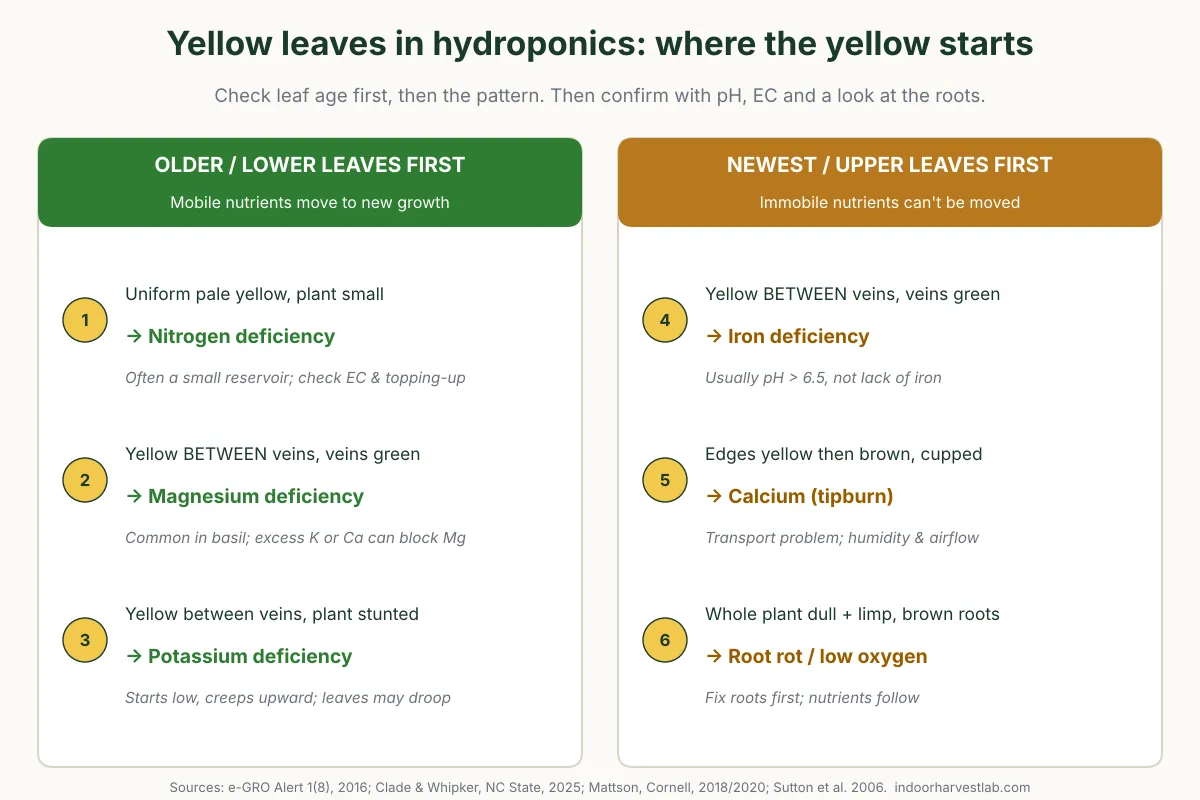
How to Diagnose Yellow Leaves in Hydroponics
Start with leaf age
Before you touch the pH pen, look closely at the plant. Where the yellow starts tells you more than any single meter reading.
Plants can move some nutrients around and not others. Nitrogen, magnesium and potassium are mobile: when supply runs short, the plant strips them from older leaves and sends them to new growth. That is why their deficiencies show up on the lower, older leaves first. Iron and calcium are effectively immobile: once they’re locked into a leaf they stay put, so a shortage shows up on the newest leaves at the top or centre of the plant. The Cornell-led e-GRO team and NC State’s basil research both use exactly this old-versus-new split to sort out deficiencies (e-GRO, 2016; Clade & Whipker, 2025).
The second clue is the pattern. Is the whole leaf evenly pale, or are the veins still green while the tissue between them turns yellow (called interveinal chlorosis)? Put those two observations together and you can narrow the causes of yellow leaves in hydroponics down to one or two in under a minute.
| Where yellow starts | Pattern | Most likely cause | First check |
|---|---|---|---|
| Older, lower leaves | Even pale yellow over the whole leaf; plant small | Nitrogen deficiency | EC; how long since a full solution change |
| Older, lower leaves | Yellow between veins, veins stay green | Magnesium deficiency | Recipe Mg; excess K or Ca |
| Older, lower leaves | Yellow between veins, stunting, leaves curl down | Potassium deficiency | EC and recipe K |
| Newest, upper leaves | Yellow between veins, veins green; can go almost white | Iron deficiency (usually high pH) | pH, then iron in the recipe |
| Newest leaves, centre of head | Edges yellow, then brown and crispy; cupped leaves | Calcium transport (tipburn) | Humidity, airflow, light level |
| Whole plant | Dull, slow, wilting at midday; roots brown or slimy | Root rot or low dissolved oxygen | Root colour, water temperature, aeration |
Numbers to hold before you change anything
Most yellowing starts with one number drifting out of range. Write these down and compare them with your own readings before you add anything to the tank.
| Parameter | Target for leafy greens and herbs | Why it matters for yellowing | Source |
|---|---|---|---|
| Solution pH | 5.5–6.0 | Above 6.5, iron becomes unavailable and new leaves yellow | e-GRO, 2016 |
| pH drift | Can move 1–2 units a day; test at least daily | A tank that was fine on Monday can lock out iron by Wednesday | e-GRO, 2016 |
| EC (lettuce) | About 1.5 mS/cm (Cornell recipe); 1.15–1.25 mS/cm in RO-water research trials | Low EC means hungry plants; rising EC in a small tank hides a nitrogen shortage | Mattson, 2016; Both |
| Nitrogen | 150 ppm N (Cornell lettuce recipe) | Too little gives pale lower leaves and small plants | Mattson, 2016 |
| Magnesium | 24 ppm Mg (Cornell lettuce recipe) | Too little gives interveinal yellowing on lower leaves | Mattson, 2016 |
| Iron | 1–3 ppm Fe | Rarely the problem on its own; pH usually is | e-GRO, 2016 |
| Dissolved oxygen | Target 7–8 ppm; crop failure seen below 3 ppm | Starved roots can’t take up nutrients, so the whole plant pales | Mattson, 2016 |
| Root-zone temperature (lettuce) | Below 20 °C (68 °F) | Warm water holds less oxygen and favours Pythium | Both |
| Air temperature (head lettuce) | 75/66 °F (24/19 °C) day/night | Out-of-range air temperatures stress plants and slow uptake | Mattson, 2016 |
If your pH meter hasn’t been calibrated in a while, do that first. A pen that reads 6.0 when the real value is 6.8 will send you hunting for the wrong problem. Our guide to choosing and calibrating a pH meter covers the two-point routine.
Cause 1: High pH Locking Out Iron (New Leaves Yellow)
This is the classic hydroponic yellowing, and it fools a lot of growers into buying iron supplements they don’t need. The newest leaves come in pale yellow with a fine net of green veins. In bad cases they turn nearly white.
The e-GRO alert on hydroponic leafy greens and herbs is blunt about it: most often, iron deficiency is caused by high nutrient solution pH, not by a lack of iron in the tank. Above about pH 6.5, iron oxidises and precipitates, so it’s sitting in the water but the roots can’t use it (e-GRO, 2016). In Cornell’s trials where iron was removed entirely, lettuce showed symptoms within 10 days and arugula and basil within 14–21 days.
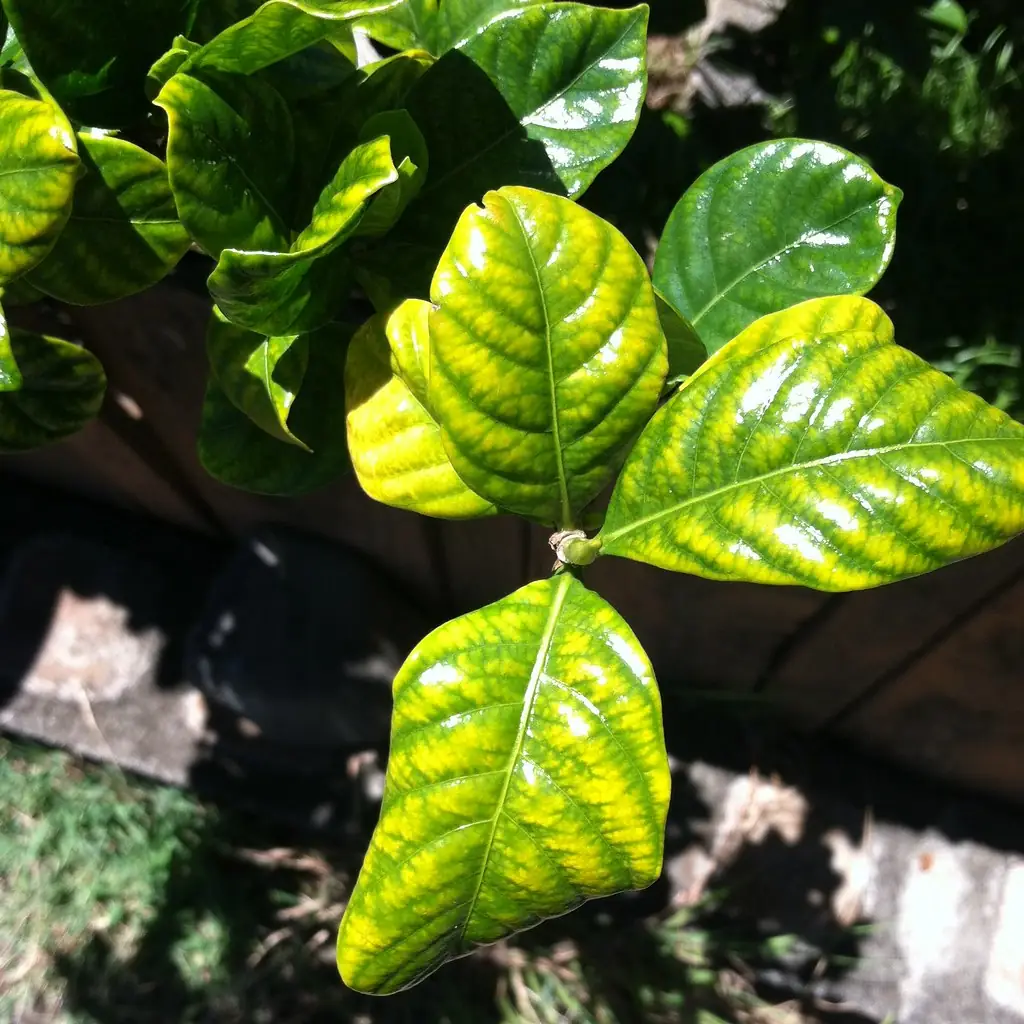
Two details help you confirm it. First, the Cornell team notes that iron deficiency is seen more often in arugula and basil than in lettuce, and that it can also signal root disease, because damaged roots can’t absorb iron well (Greenhouse Grower, 2020). Second, don’t confuse it with manganese deficiency, which also hits young leaves but usually adds small scattered dead spots (e-GRO, 2016).
Step 1: Measure pH properly
Calibrate the meter, then test the reservoir. If you’re above 6.5, you’ve very likely found your problem.
Step 2: Bring pH back to 5.5–6.0
Add pH-down in small doses, stir or let the pump circulate for 15–20 minutes, and retest. Don’t crash it to 5.0 in one go. Our step-by-step guide to lowering pH in hydroponics shows how to dose safely.
Step 3: Find out why pH keeps climbing
Hard tap water is the usual culprit. Purdue Extension points out that water alkalinity, not water pH, is what pushes the root zone up over time, and that water with about 120 ppm calcium carbonate alkalinity is likely to cause high-pH problems (Lopez, Mickelbart & Pasian, Purdue). If your tap water is hard, see our tap water guide for options.
Step 4: Check your iron chelate
Iron in nutrient mixes is held in a chelate, and each one gives up at a different pH. If your pH often wanders high, a sturdier chelate gives you a safety margin. The chart below shows the limits.
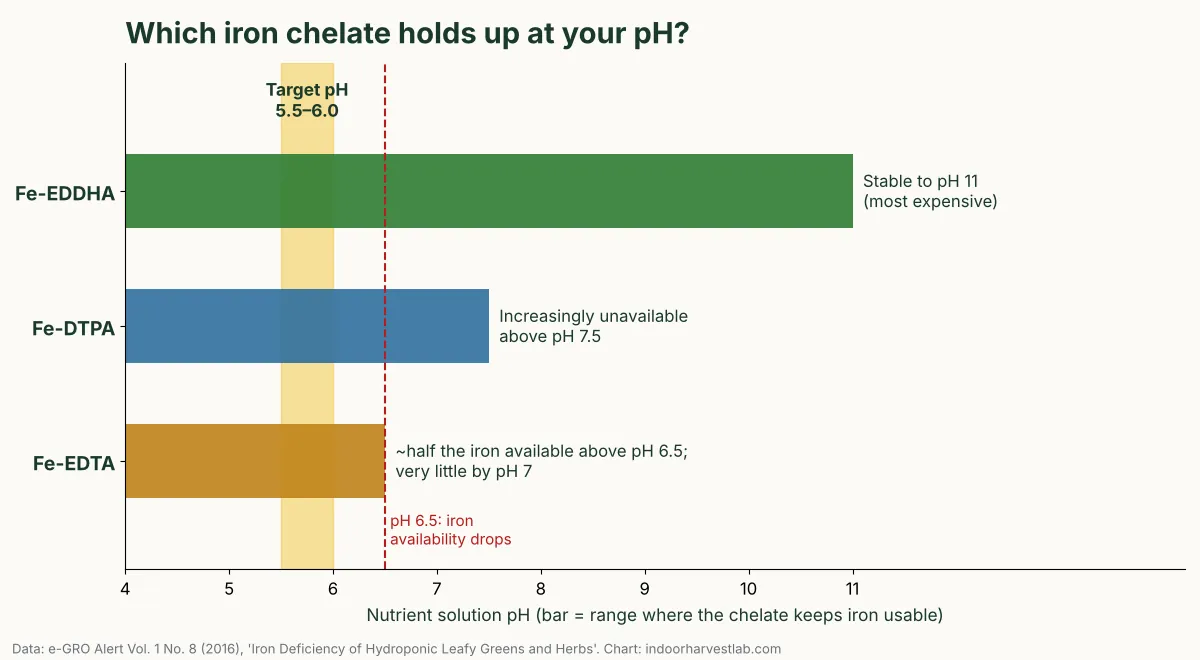
Note that switching chelates is a backup plan, not a fix. Purdue’s advice applies here too: iron products can green up a crop but don’t solve the root of the problem, which is high pH.
Cause 2: Nitrogen Deficiency (Old Leaves Evenly Pale)
If the oldest leaves are turning uniformly pale yellow and the whole plant looks a size smaller than it should, think nitrogen. NC State’s basil work describes it as stunted growth with overall yellowing that starts on older leaves and, if ignored, spreads until the entire plant is evenly chlorotic (Clade & Whipker, 2025).
Here’s the twist that catches people out. Cornell’s Neil Mattson has noted that nitrogen deficiency in lettuce tends to show up in systems with a small reservoir, where salts build up over time and push EC up (Greenhouse Grower, 2020). So your EC meter can read normal or even high while the plants are starving for nitrogen. The meter only counts total salts; it can’t tell you which ones are left.
How to fix it
- Do a full solution change rather than topping up again. Topping up only with nutrients keeps adding what the plants aren’t using. Our guide to changing hydroponic water gives a practical schedule.
- Mix fresh solution at the right strength for the crop. For lettuce, the Cornell recipe supplies 150 ppm nitrogen at an EC of about 1.5 (Mattson, 2016). See hydroponic nutrients for lettuce for the full recipe.
- Top up between changes with plain water when EC is rising, and with half-strength solution when it is falling.
- Expect new growth to green up within days. Badly yellowed old leaves won’t fully recover, so pick them off.
Cause 3: Magnesium and Potassium Deficiency (Old Leaves, Between the Veins)
When the lower leaves turn yellow between the veins while the veins stay green, you’re usually looking at magnesium. Mattson describes the first sign in basil as a slight interveinal yellowing on old and recently mature leaves, and notes that basil is particularly sensitive (Mattson, 2018). As it worsens, dead patches spread in from the leaf edges and the yellowing climbs up the plant (Clade & Whipker, 2025).
Plants need magnesium in larger amounts than any other element except nitrogen and potassium, so a weak or unbalanced recipe runs out of it faster than you might expect (Mattson, 2018).
Magnesium vs. potassium: telling them apart
Potassium deficiency also starts on the older foliage with interveinal yellowing and stunting, then moves upward. NC State’s basil trials add a useful tell: potassium-starved plants grow with leaves curling downward in an ‘umbrella’ shape (Clade & Whipker, 2025). Magnesium-deficient plants generally don’t do that.
How to fix it
- Check that your nutrient is a complete hydroponic formula, not a soil fertiliser. Soil feeds often rely on the soil to supply magnesium and micronutrients.
- Don’t overdo potassium or calcium additives. Excess K and Ca can block magnesium uptake (Clade & Whipker, 2025).
- If you use RO or soft water, a cal-mag supplement can fill the gap. Our cal-mag guide explains when you need it and when you don’t.
Cause 4: Calcium Problems and Tipburn (Newest Leaf Edges)
Yellowing that starts at the edges of the youngest leaves and quickly turns brown and crispy is usually calcium, but not because the tank is short of it. Rutgers’ A.J. Both explains that tipburn is mostly a translocation issue: calcium moves with water through transpiration, and fast-growing inner leaves that barely transpire don’t get enough (Greenhouse Grower, 2020). In basil, calcium shortage shows as yellow, then dead margins on the newest leaves, which cup and can’t open fully (Clade & Whipker, 2025).
Cornell’s research on lettuce found that keeping the daily light integral at no more than 17 mol·m⁻²·d⁻¹ helped avoid tipburn, and that without airflow fans a lower target of 13–14 was needed (Both; Mattson, 2016). Our full guide to lettuce tip burn covers the airflow and humidity fixes in detail.
Cause 5: Root Rot and Low Oxygen (Whole Plant Dull)
Sometimes every leaf is a bit pale, growth stalls, and plants flop on warm afternoons. Before you blame nutrients, pull a plant and look at the roots. Healthy roots are white or cream and crisp; rotting ones are brown, slimy or stubby.
A peer-reviewed review of Pythium root rot in hydroponic crops found that the disease stunts shoot growth long before the foliage wilts or turns chlorotic, and that wilting is often temporary at first, linked to high daytime temperatures, before becoming permanent (Sutton et al., 2006). Roots are colonised well before they visibly brown. In other words, by the time leaves yellow from root rot, the roots have been struggling for a while.
Oxygen and temperature go hand in hand. Cornell recommends dissolved oxygen of about 7–8 ppm and has seen crop failure below 3 ppm (Mattson, 2016). Lettuce research summarised by Both found that keeping the root zone below 20 °C (68 °F) was important, and that severe plant stress occurred at dissolved oxygen below 2 mg/L (Both).
Rescue steps
- Trim away brown, mushy roots with clean scissors and move the plant to clean, fresh solution.
- Add or upgrade aeration: a bigger air pump, a second air stone, or a larger gap between the water surface and net pot in a deep water culture system.
- Cool the reservoir if it sits above 20 °C (68 °F): move it off warm floors, shade it, or use a chiller in summer.
- Clean and disinfect the reservoir before restarting. Our hydroponic root rot guide walks through it.
If the plants are also drooping, see our companion piece on hydroponic plants wilting, which shares the same root-zone checks.
Cause 6: Normal Ageing, Light and Other Look-Alikes
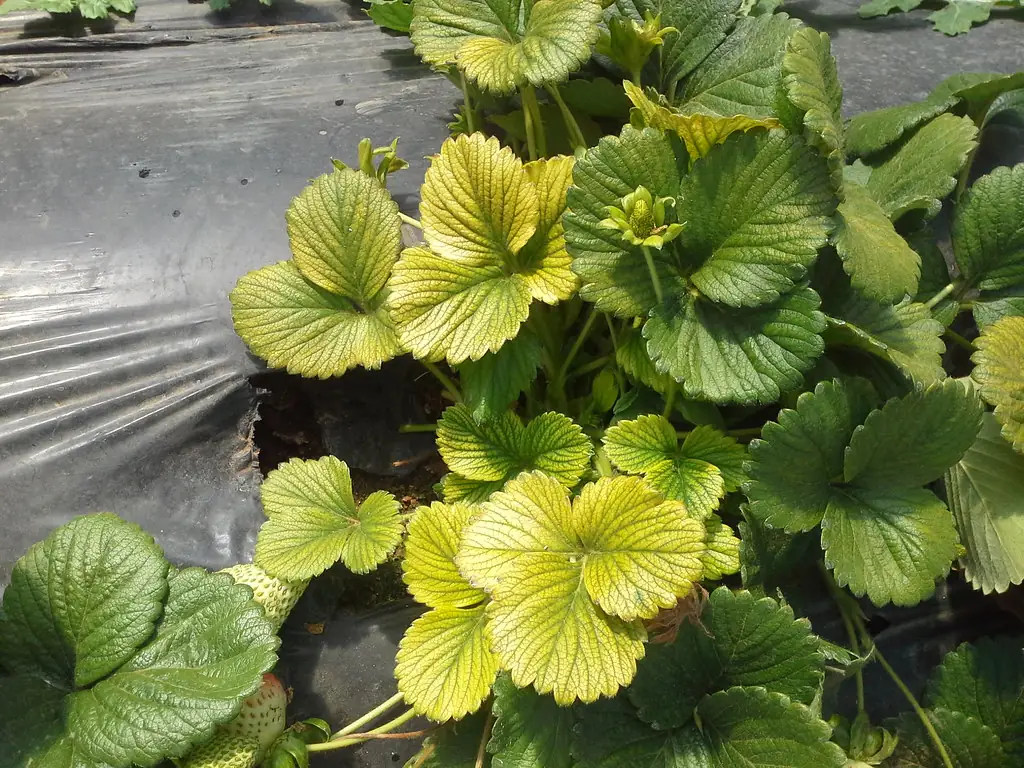
Not all yellow leaves in hydroponics point to a problem. A plant will naturally let its oldest, most shaded bottom leaf or two yellow and die back, especially in a crowded tray. If it’s one or two leaves at the base and new growth is green and vigorous, just remove them.
Other look-alikes worth ruling out:
- Light that’s too weak. Pale, stretched plants with small leaves often need more light, not more nutrients. Cornell’s head lettuce targets a DLI of 17 mol·m⁻²·d⁻¹; halving that roughly doubles the time to harvest (Mattson, 2016). Check your setup against our PPFD chart.
- Light that’s too strong or close. Bleached, whitish patches on the leaves nearest the lamp, often on the upper surface only, point to light stress rather than a deficiency.
- Algae competing in the tank. Green, light-exposed reservoirs encourage algae, which can foul the roots. See algae in hydroponics.
Leaves that are yellowing and developing burnt brown tips across the plant usually mean the opposite of a deficiency: too-strong solution. Check the EC chart for your crop and dilute if you’re well above it.
From the Lab Bench: Reading Yellow Leaves in Hydroponics Like a Scientist
Here’s the mindset that saves the most plants: treat yellow leaves in hydroponics as a symptom of a system, not a missing ingredient. In soil, the potting mix buffers mistakes for days or weeks. In water culture there’s almost no buffer, which is why pH can swing one to two units in a single day (e-GRO, 2016). That speed cuts both ways. Problems appear fast, but they also correct fast once you fix the actual cause.
The most common error is reaching for a bottle. Iron supplements for iron chlorosis caused by pH 7, more cal-mag for tipburn caused by still air, or a stronger feed for plants with rotting roots. Each of those adds salts to the reservoir without addressing the cause, and in a small tank that can push EC high enough to create a second problem on top of the first.
A good rule of thumb is to change one thing at a time and give it three to five days. New leaves are your scoreboard: old yellow leaves rarely turn green again, but if the next leaves come in a healthy colour, you’ve fixed it. If they don’t, move to the next most likely cause on the triage table.
Finally, if a problem keeps coming back, a lab test is cheap insurance. Cornell’s Mattson recommends sampling the nutrient solution every one to two weeks, plus periodic plant tissue tests (Greenhouse Grower, 2020). For a home grower, even one solution test and one water test give you a baseline that ends the guesswork.
FAQ
Why are the bottom leaves on my hydroponic lettuce turning yellow?
Yellow bottom leaves usually mean a mobile nutrient is running short, most often nitrogen (evenly pale leaves) or magnesium (yellow between green veins). Small reservoirs that are only ever topped up are a common cause. Do a full solution change at the right strength; one or two old leaves yellowing at the base can also be normal ageing.
Why are the new leaves on my hydroponic plants yellow with green veins?
That’s interveinal chlorosis on young leaves, the classic sign of iron deficiency. In hydroponics it’s usually caused by pH above about 6.5 rather than a lack of iron. Calibrate your meter and bring pH back to 5.5–6.0 before adding any iron product.
Can yellow leaves turn green again in hydroponics?
Mildly yellow leaves sometimes recover partly once the cause is fixed, but badly yellowed or older leaves rarely do. Judge success by the new growth: if new leaves come in a healthy green within a few days, the problem is solved. Remove old yellow leaves to tidy the plant.
Does too much light cause yellow leaves in hydroponics?
Yes, it can. Leaves closest to a strong lamp may bleach to a pale yellow or whitish colour, often only on the upper surface. That pattern differs from a deficiency, which follows leaf age. Raise the light or dim it and see whether new growth stays green.
What pH causes yellow leaves in hydroponics?
Problems become likely when pH rises above about 6.5, because iron becomes unavailable. For leafy greens and basil, Cornell’s e-GRO team recommends pH 5.5 to 6.0, checked at least once a day because hydroponic pH can drift 1–2 units daily.
Should I add cal-mag when hydroponic leaves turn yellow?
Only if the symptoms and your water point to it, such as interveinal yellowing on lower leaves (magnesium) while using RO or very soft water. Adding cal-mag for iron chlorosis or root rot won’t help, and extra calcium or potassium can actually reduce magnesium uptake.
Can root rot cause yellow leaves in hydroponics?
Yes. Damaged roots can’t take up nutrients well, so plants turn dull and pale, grow slowly and wilt on warm afternoons. Check for brown, slimy roots, keep dissolved oxygen high with good aeration, and keep the reservoir below about 20 °C (68 °F).
Sources
- Catlin, N., Currey, C., Mattson, N., Whipker, B. et al. (2016). Iron Deficiency of Hydroponic Leafy Greens and Herbs. e-GRO Alert 1(8). Cornell University / e-GRO.
- Mattson, N. (2016). Growing Hydroponic Leafy Greens. GPN, October 2016. Cornell CEA.
- Both, A.J. Ten Years of Hydroponic Lettuce Research. Rutgers University (review of Cornell CEA lettuce research).
- Clade, D. & Whipker, B. (2025). CEA HERB Part 2: Analyzing basil nutrient disorders. Produce Grower. NC State University.
- Mattson, N. (2018). Magnesium deficiency of hydroponic and container grown basil. HortiDaily, based on e-GRO Alert. Cornell University.
- Sparks, B.D. (2020). Tips to Avoid Nutrient Issues in Greenhouse Lettuce. Greenhouse Grower (with A.J. Both, Rutgers; D. Wells, Auburn; N. Mattson, Cornell).
- Lopez, R.G., Mickelbart, M.V. & Pasian, C. Alkalinity Management in Soilless Substrates (HO-242-W). Purdue Extension.
- Sutton, J.C. et al. (2006). Etiology and epidemiology of Pythium root rot in hydroponic crops: current knowledge and perspectives. Summa Phytopathologica 32(4): 307–321.