
It’s the first properly cold week of the year. Your lettuce raft sat on the garage floor overnight, and when you dip a finger into the tote the water feels like a mountain stream. Or it’s July, the grow tent is baking, and the solution is warm enough for a bath while the roots slowly turn tan. Both are the same problem wearing different clothes.
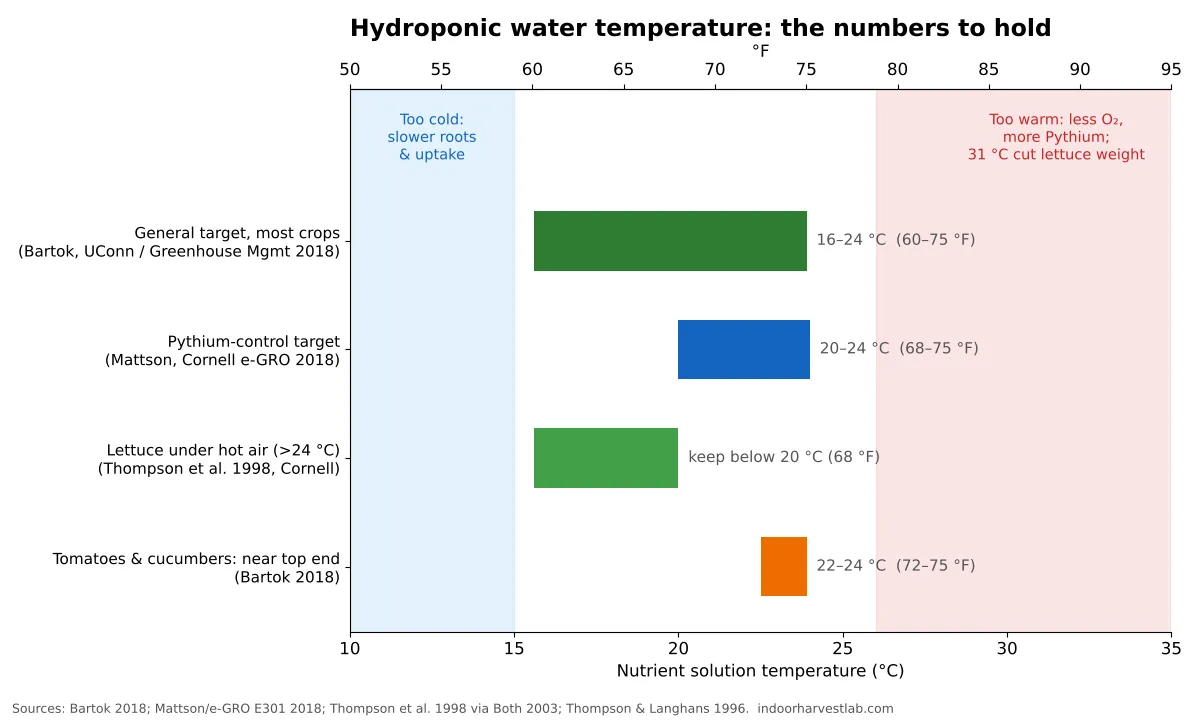
Short answer: the ideal hydroponic water temperature for most crops is about 60–75°F (16–24°C), according to University of Connecticut agricultural engineer John Bartok. Cornell’s Neil Mattson recommends 68–75°F (20–24°C) when Pythium root rot is the main worry. Cool-season greens such as lettuce sit happily at the lower end, while tomatoes and cucumbers do best near 75°F. Above roughly 75°F, the water holds less oxygen and root rot risk climbs; well below 60°F, roots slow down.
This guide pulls together extension guidance and root-zone temperature research into one plan. By the end you’ll know your target number for each crop, how to measure it properly, and seven proven ways to heat or cool a reservoir without wrecking your power bill.
What is the ideal hydroponic water temperature?
There isn’t one magic number, but there is a clear safe band. In a Greenhouse Management column on maintaining solution temperature, Bartok writes that nutrient solution temperature “is generally optimum between 60° F and 75° F.” He adds that lettuce, alstroemeria and strawberries prefer the lower end, while tomatoes, cucumbers and cannabis do best near 75°F.
Cornell’s e-GRO alert on Pythium in hydroponic basil and spinach narrows that to a target root-zone temperature of 68–75°F (20–24°C). That band is chosen with disease in mind, which matters most in deep water culture and rafts where roots sit in the solution all day.
Here are the numbers worth taping to the side of your reservoir.
| What you’re managing | Target | Source |
|---|---|---|
| General nutrient solution range | 60–75°F (16–24°C) | Bartok, UConn / Greenhouse Management, 2018 |
| Pythium-focused root-zone target | 68–75°F (20–24°C) | Mattson, Cornell e-GRO E301, 2018 |
| Lettuce when air is hot (above 75°F / 24°C) | Keep solution below 68°F (20°C) | Thompson et al. 1998, summarised by Both (Cornell/Rutgers) |
| Tomatoes, cucumbers | Near 75°F (24°C) | Bartok, 2018 |
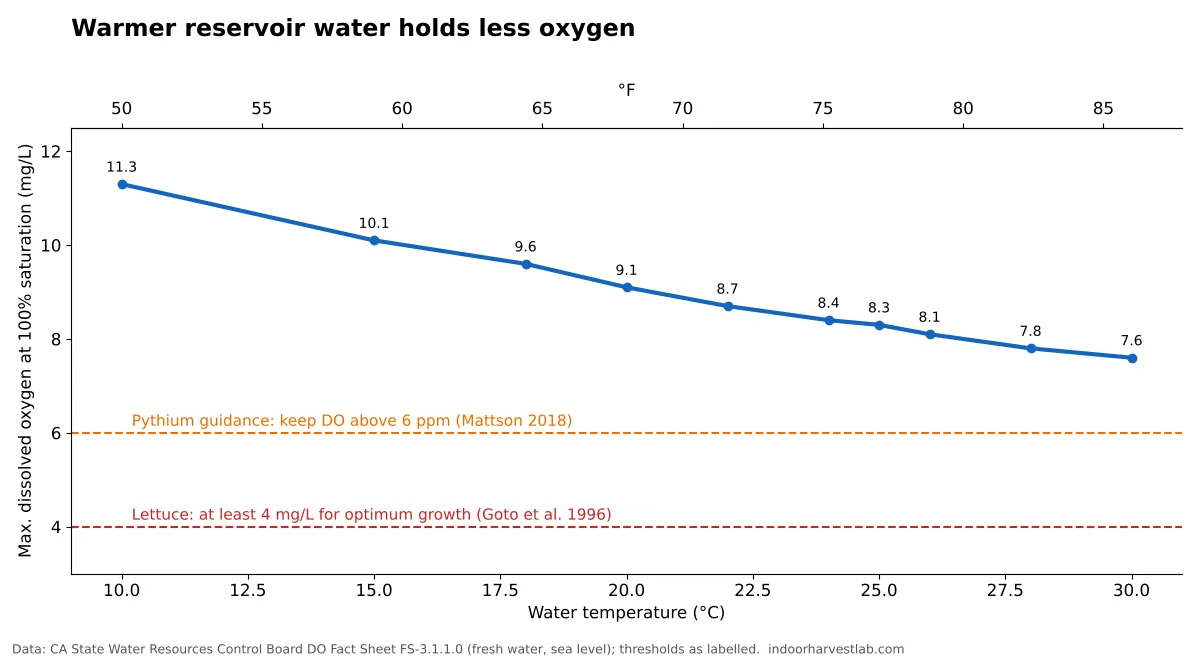
| Dissolved oxygen (DO) | Above 6 ppm; ideally saturated, about 8–9 ppm | Mattson, 2018 |
| DO floor for lettuce | At least 4 mg/L; severe stress below 2 mg/L | Goto et al. 1996, summarised by Both |
| Max DO the water can hold | 9.1 mg/L at 68°F (20°C); 8.3 at 77°F (25°C); 7.6 at 86°F (30°C) | CA Water Boards DO fact sheet |
Hydroponic water temperature by crop and system
System design changes how much the number matters. Roots that hang in water (DWC, rafts, Kratky) feel every degree. Roots in a drained medium or a thin film (NFT, Dutch buckets) get more air, so they tolerate a slightly warmer solution, but the channel or pipe can heat up fast.
| Crop or system | Aim for | Why |
|---|---|---|
| Lettuce, spinach, other leafy greens | Lower half of 60–75°F (16–24°C); below 68°F (20°C) in hot rooms | Cool roots kept lettuce quality up under hot air (Thompson et al. 1998) |
| Strawberries | Lower end of 60–75°F | Bartok lists strawberries with lettuce as cool-preferring |
| Basil and spinach rafts with Pythium history | 68–75°F (20–24°C) | Cornell’s Pythium-focused target |
| Tomatoes, cucumbers | Near 75°F (24°C) | Warm-season crops; root-zone heating helped tomato roots in cold air (Kawasaki et al. 2014) |
| Deep water culture and Kratky | Tighter control; stay out of the 75°F+ zone | Roots depend entirely on oxygen dissolved in the water |
| NFT, ebb and flow, Dutch buckets | Same targets; watch channel temperature in sun or under lights | Thin films and small volumes warm and cool quickly |
Why reservoir temperature matters: oxygen, roots and Pythium
Hydroponic water temperature sounds like a comfort setting. In practice it’s closer to a master switch, because it moves three things at once: how much oxygen the water can hold, how hard the roots are working, and which pathogens are winning.
Warm water holds less oxygen
This is plain physics. Fresh water at sea level can hold about 11.3 mg/L of oxygen at 50°F (10°C), 9.1 mg/L at 68°F (20°C), 8.3 mg/L at 77°F (25°C) and only 7.6 mg/L at 86°F (30°C), according to the California State Water Resources Control Board DO fact sheet. Bartok also notes that above 75°F evaporation of the solution speeds up, which concentrates the salts you’re trying to keep stable.
The cruel twist is that roots breathe faster when they’re warm. So a hot reservoir gives roots less oxygen exactly when they want more. That squeeze is why so many summer root problems look like nutrient problems at first.
Pythium likes both extremes
Cornell’s e-GRO alert explains that lower temperatures favour Pythium dissotocum and higher temperatures favour Pythium aphanidermatum. Using a water chiller to bring spinach ponds down to about 68°F reduced, but did not completely eliminate, P. aphanidermatum. In other words, cooler water is a strong lever, not a cure. If you’re already fighting brown, slimy roots, read our hydroponic root rot guide alongside this one.
Cold water slows roots down
When hydroponic water temperature falls below the target band, the risk flips. Roots grow and take up water and nutrients more slowly, so plants stall even though the solution looks perfect on the EC meter. In winter this is the most common hidden cause of slow growth in garages, basements and unheated sunrooms.
What the research says about root-zone temperature
Several controlled studies have changed hydroponic water temperature while holding the air steady. Together they show why the 60–75°F band works and where its edges are.
| Study | Crop and setup | Key finding |
|---|---|---|
| Thompson & Langhans, 1996 (HortScience) | Lettuce ‘Ostinata’; air and water at 17, 24 and 31°C | Heaviest heads at 24°C air / 24°C water; 31°C water reduced quality and dry weight. At 17°C air, weight peaked at 24°C water and was lowest at 31°C. |
| Thompson et al. 1998, summarised by Both | Lettuce, Cornell deep-flow system | Quality lettuce even with air above 24°C, but only if the solution was kept below 20°C (68°F). |
| Levine et al., 2023 (Annals of Botany) | Red leaf lettuce; root zone at 15, 25 or 35°C for 13 days | 25°C gave the highest shoot and root dry weight. 35°C cut growth but raised pigments; 15°C fell in between. |
| Hayashi et al., 2024 (Frontiers in Plant Science) | Red leaf lettuce; air at 17, 22, 27 and 30°C | Holding the root zone 3°C above air temperature improved growth and nutritional compounds at all four air temperatures. |
| Oklahoma State University, 2024 (HortScience 59(2)) | NFT lettuce; chilled vs. ambient water in a warm greenhouse | Chilled water averaged 22.7°C vs. 24.3°C ambient and did not increase shoot fresh weight, though some leaf nutrients rose. |
| Kawasaki et al., 2014 (J. Japan. Soc. Hort. Sci.) | Tomato in NFT at low air temperature | Root-zone heating (minimum 16.6°C vs. 5.8°C unheated) increased root growth after 7 days and shoot growth after 21 days. |
Read those results together and a pattern appears. Very warm water (around 31–35°C) hurts lettuce. Very cold water (5–15°C) holds plants back. In the middle, the gains from fine-tuning are real but modest: the Oklahoma State chilling trial found no fresh-weight boost when the water was only about 1.6°C cooler on average.
The Japanese studies add a useful twist. In tightly controlled plant factories, a root zone slightly warmer than the air helped lettuce. That’s a reminder that the target is a band, not a single ideal number, and that air and water temperature work as a pair.
How to measure reservoir temperature properly
Most hydroponic water temperature problems are found late because nobody was looking. A cheap probe thermometer and a two-minute routine fix that.
Step 1: Measure where the roots are
Put the probe in the solution at root depth, not just under the surface. Surface water warms first under lights and cools first at night.
Step 2: Check at the warmest and coldest times
Read it once at the end of the light period and once just before lights come on. The gap between those two readings tells you more than any single number. A min/max thermometer or a cheap logging sensor does this for you.
Step 3: Log it next to pH and EC
Write temperature down every time you check pH and EC. Most EC meters compensate for temperature automatically, so the meter may show it anyway; just record the number.
Step 4: Watch the floor and the lights
A reservoir standing on concrete or tile can sit several degrees colder than the room in winter, and one under a hot light or in a sunny window can run well above it in summer. Check those spots before you buy any equipment.
7 proven ways to control hydroponic water temperature
Start with the cheapest passive fixes to keep your hydroponic reservoir temperature steady. Most home systems never need more than the first two or three steps.
1. Insulate the reservoir (winter and summer)
Insulation slows heat flow both ways, so it helps in every season. Wrap the tote or bucket in foam board or reflective insulation, and add a lid. Bartok mentions 1-inch pipe insulation for exposed lines. Lift the reservoir off a cold floor on a sheet of foam or a wooden pallet.
2. Make the reservoir bigger
A larger volume of water changes temperature more slowly. That’s why a 5-gallon bucket in a cold room swings more than a 30-gallon tote. If space allows, upgrading the reservoir is often cheaper than heating or chilling a small one.
3. Use a submersible aquarium heater for cold rooms
For small home systems, a thermostatic aquarium heater is the simplest fix. Set it at the low end of your crop’s range, keep it fully submerged, and don’t let it touch roots or plastic walls.
To size it, use Bartok’s formula: gallons × 8.33 × temperature rise (°F) = Btu needed. For a 20-gallon reservoir you want 10°F warmer, that’s 20 × 8.33 × 10 = 1,666 Btu, or about 490 watt-hours (1 watt-hour = 3.412 Btu). A 100 W heater would need around five hours to do that, before heat losses, which is why insulation and a lid matter so much.
4. Use the room’s own heat and light
In winter, keep the reservoir in the warmest place you can, ideally inside the conditioned part of the house rather than a garage. Lights add heat too, so placing the tank inside a grow tent can lift water temperature a little without extra hardware.
5. Shade it and keep it away from heat sources (summer)
Keep the reservoir out of direct sun and away from light ballasts, pumps and walls that bake in the afternoon. An opaque, light-coloured tank also limits algae growth, which competes for oxygen.
6. Add aeration, and use the ground’s coolness
Aeration doesn’t cool water much, but it keeps oxygen close to whatever saturation level the temperature allows. Our air stone guide covers sizing. For larger setups, Bartok notes that tanks in contact with the ground, or buried, can be cooled by 50°F soil, and that buried pipe loops can draw on 50–55°F soil 6–8 feet down.
7. Install a water chiller when nothing else works
A chiller is the only tool that can hold water below room temperature reliably. It’s worth it in hot climates, for DWC or raft systems with a Pythium history, and for lettuce grown in rooms that stay above 75°F. Bartok puts the energy demand at roughly 1.5 horsepower per ton of cooling (12,000 Btu/hour) for larger systems, so size it to the reservoir and insulate first to keep the running cost down.
| Method | Season | Rough cost | Best for |
|---|---|---|---|
| Insulation and a lid | Both | Low | Every system; do this first |
| Bigger reservoir | Both | Low to medium | Small buckets that swing a lot |
| Aquarium heater | Winter | Low | Garages, basements, cold floors |
| Room heat and grow-light heat | Winter | Free | Tents and indoor shelves |
| Shade and relocation | Summer | Free | Sunny windows, hot ballasts |
| Aeration and ground contact | Summer | Low to medium | DWC, larger tanks |
| Water chiller | Summer | High | Hot rooms, rafts with Pythium history |
Troubleshooting: symptoms of the wrong water temperature
Hydroponic water temperature problems rarely announce themselves. They usually show up as roots, wilting or slow growth, so use this table to connect the symptom to the cause.
| What you see | Likely temperature link | What to do |
|---|---|---|
| Brown, slimy roots and a musty smell | Warm water, low oxygen, Pythium | Cool toward 68–72°F, boost aeration, follow our root rot steps |
| Plants wilt in the afternoon but recover at night | Root zone too warm under lights | Shade the tank, add volume; see wilting causes |
| Slow growth in winter, healthy colour, normal EC | Water below about 60°F | Insulate, lift off the floor, add a heater |
| Lettuce bolting or tip burn in summer | Hot air and warm solution together | Cool the solution below 68°F; check tip burn fixes |
| EC creeping up between top-ups | Warm water speeds evaporation | Lid the reservoir, top up with plain water |
| Green film in the tank | Warm water plus light | Opaque, covered reservoir; clean between crops |
From the lab bench
If you remember one idea, make it this: temperature and oxygen are one problem, not two. Every degree you let the reservoir climb shrinks the oxygen ceiling and speeds up root respiration at the same time. That’s why the same DWC setup can be flawless in March and a root-rot nursery in July without any change to the nutrient recipe.
The research also argues against chasing a perfect number. The difference between 20°C and 23°C is small compared with the damage from 31°C or 5°C. So when you manage hydroponic water temperature, spend your effort on stability first: insulation, volume and a lid buy you more than an expensive controller set to a decimal place.
For cold-season growers, the Hayashi and Kawasaki results carry a quiet lesson. Warming the roots can be more efficient than warming the whole room, because the plant’s uptake machinery lives below the surface. A small heater in an insulated tank is often the best-value upgrade a winter grower can make.
Finally, treat chilling as disease insurance rather than a yield booster. Cornell’s spinach trial showed cooler ponds reduced Pythium, while Oklahoma State’s lettuce trial showed little growth gain from modest chilling. If your roots are clean and white at 72°F, you probably don’t need a chiller. If they’re tan at 78°F, you probably do. For the bigger picture of balancing these factors, see our nutrient solution guide.
FAQ
What is the ideal water temperature for hydroponics?
Most crops do best between 60 and 75°F (16–24°C). Cornell recommends 68–75°F (20–24°C) to limit Pythium root rot. Lettuce and other cool-season greens prefer the lower half, while tomatoes and cucumbers do best near 75°F.
Is 80°F too hot for hydroponic water?
Yes, for most crops. At 80°F the water holds only about 8 mg/L of oxygen at full saturation, roots need more oxygen, and warm-water Pythium species are favoured. Bring it back toward 68–75°F with shade, insulation, more volume or a chiller.
What is the ideal hydroponic lettuce water temperature?
Keep it in the lower part of the 60–75°F range. Cornell research found lettuce kept its quality in hot greenhouses only when the solution stayed below 68°F (20°C). In a separate study, lettuce grew best at 24°C water with 24°C air and worst at 31°C water.
Can hydroponic water be too cold?
Yes. Below about 60°F, roots grow and absorb nutrients more slowly, so plants stall. In lettuce, a 15°C root zone gave less growth than 25°C, and heating cold tomato roots improved root and shoot growth.
Do I need a heater for my hydroponic reservoir in winter?
Only if the water falls below your crop’s range. Insulate and lift the reservoir off cold floors first. If it still drops below about 60°F, a submersible thermostatic aquarium heater is the simplest fix for small systems.
Do I need a water chiller for DWC?
Not if your water stays at or below about 75°F and the roots stay white. Consider a chiller if your room stays hot, your roots keep browning, or you grow lettuce or spinach with a history of Pythium.
Does water temperature affect pH and EC readings?
Yes. Temperature changes conductivity, so most EC meters use automatic temperature compensation. Warm water also speeds evaporation, which raises EC between top-ups. Record temperature every time you check pH and EC.
Sources
- Bartok, J. W. Jr. (2018). Maintaining hydroponic solution temperature. Greenhouse Management, March 2018. University of Connecticut.
- Mattson, N. (2018). Pythium root rot on hydroponically grown basil and spinach. e-GRO Edible Alert E301, Cornell University (reprinted by Urban Ag News).
- Thompson, H. & Langhans, R. (1996). Air and water temperature effects on growth of lettuce in a hydroponic system. HortScience 31(4): 586.
- Both, A. J. Ten Years of Hydroponic Lettuce Research. Rutgers University / Cornell CEA program (summarises Thompson et al. 1998 and Goto et al. 1996).
- Levine, C. P. et al. (2023). Controlling root zone temperature improves plant growth and pigments in hydroponic lettuce. Annals of Botany 132(3): 455–470.
- Hayashi, S. et al. (2024). Raising root zone temperature improves plant productivity and metabolites in hydroponic lettuce production. Frontiers in Plant Science 15: 1352331.
- Oklahoma State University, Dept. of Horticulture and Landscape Architecture (2024). Chilled nutrient solution study in NFT lettuce. HortScience 59(2): 255.
- Kawasaki, Y., Matsuo, S., Kanayama, Y. & Kanahama, K. (2014). Effect of root-zone heating on root growth and activity, nutrient uptake, and fruit yield of tomato at low air temperatures. J. Japan. Soc. Hort. Sci. 83(4): 295–301.
- California State Water Resources Control Board, Clean Water Team (2004). Dissolved Oxygen Fact Sheet FS-3.1.1.0(DO).