
You picked a strawberry, admired the tiny yellow specks on its skin and thought, “Those are seeds. Why not grow my own?” Or maybe you bought a packet of alpine strawberry seeds, sowed them three weeks ago, and the tray is still bare. Either way, you’ve run into the same thing: strawberry seeds don’t behave like tomato or lettuce seeds.
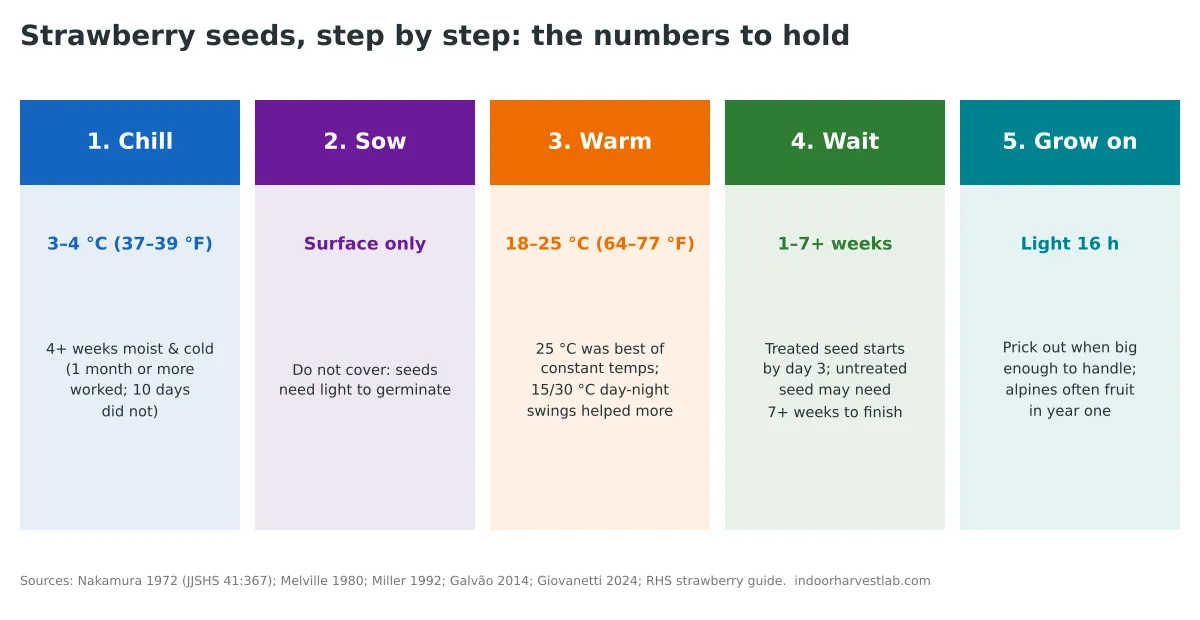
Short answer: Strawberry seed germination is slow and uneven because the seeds are naturally dormant and sit inside a tough outer coat. For the best results, chill the moist seeds at about 3–4 °C (37–39 °F) for at least four weeks, then sow them on the surface (they need light), keep them at 18–25 °C (64–77 °F), and expect sprouts anywhere from one to seven or more weeks later. Untreated seeds can come up sparsely or not at all.
By the end of this guide, you’ll know why strawberry seeds stall, what five research studies say actually raises germination, a step-by-step indoor method you can run on a windowsill or under a grow light, and how to rescue a tray that’s doing nothing.
Why strawberry seed germination is so slow
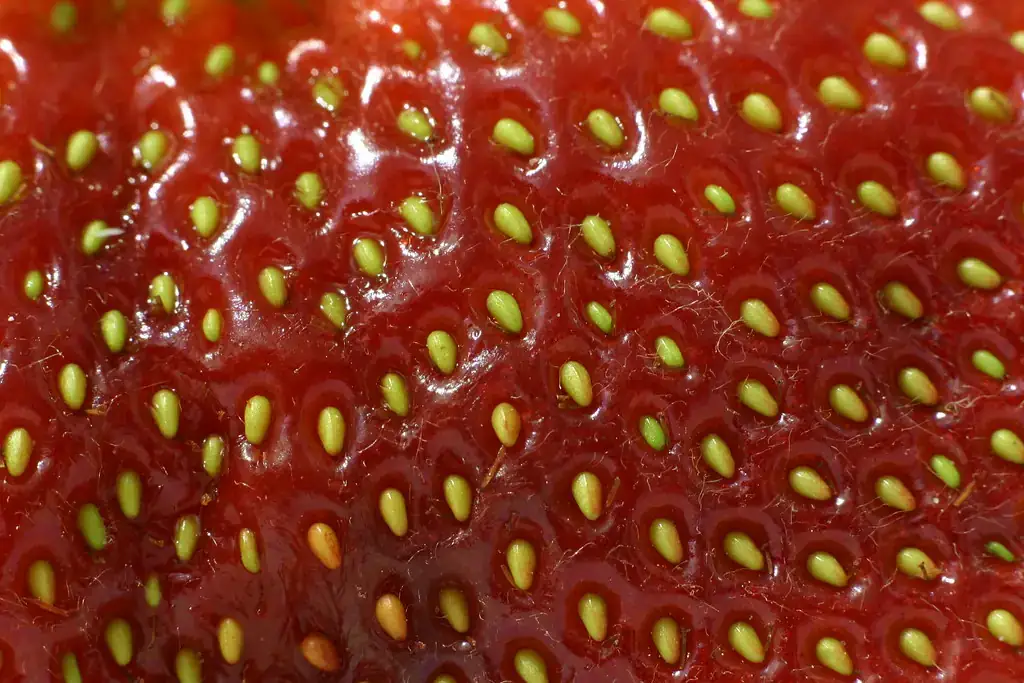
Those “seeds” on the outside of a strawberry aren’t technically seeds. Each speck is an achene, a tiny dry fruit with one seed sealed inside a hard wall. That wall is the first obstacle. It slows the movement of water and oxygen to the embryo, and it physically holds the seedling back.
The second obstacle is dormancy. In a classic study of 13 strawberry varieties, Nakamura (1972) found the seeds showed no loss of dormancy for about 10 months after harvest when simply stored. In other words, waiting doesn’t fix it on its own. Something has to break the dormancy: cold, a damaged coat, or both.
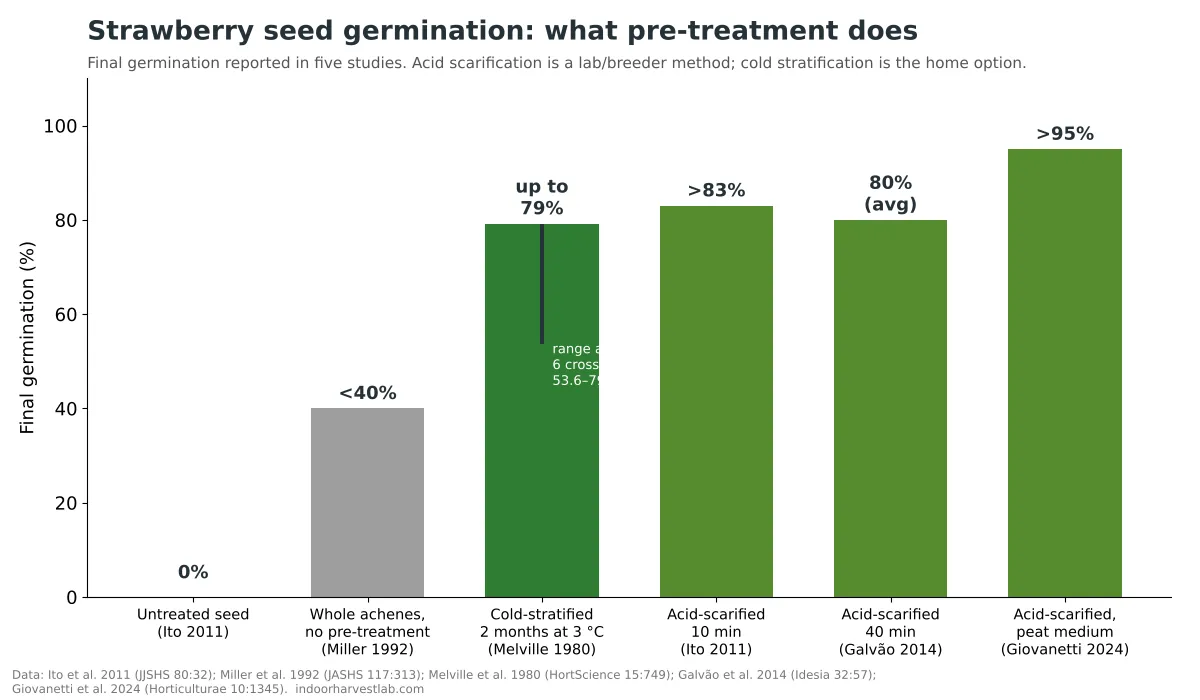
The numbers show how big the gap can be. Ito and colleagues (2011) reported that untreated seed of an F1 hybrid strawberry did not germinate at all in their test, while seed scarified with sulfuric acid reached over 83%. Miller and colleagues (1992) found whole, untreated achenes germinated at under 40%, and took more than seven weeks to reach their maximum.
So if your tray looks empty after two weeks, it’s not necessarily dead. It’s just behaving like a strawberry.
Three things that make strawberry seeds harder than most
- Hard achene wall: limits water uptake and acts as a physical barrier.
- Deep dormancy: seeds need a trigger (usually cold) before they’ll start.
- A light requirement: Nakamura (1972) found germination was “much inhibited in the dark”, so seeds buried under mix often fail.
Numbers to hold for strawberry seed germination
Here’s the one table to save for strawberry seed germination. Every figure comes from a cited source, so you can see where each number came from.
| What | Target | Source |
|---|---|---|
| Cold stratification temperature | 3–4 °C (37–39 °F) | Melville et al. 1980 (3 °C); Miller et al. 1992 (4 °C) |
| Cold stratification length | 1 month or more (10 days was not effective) | Nakamura 1972 |
| Longest cold period used for whole achenes | Up to 4 months for maximum germination | Miller et al. 1992 |
| Germination temperature (home guide) | About 18 °C (64 °F) | RHS |
| Best constant temperature tested | 25 °C (77 °F); 15 °C was worst | Nakamura 1972 |
| Alternating temperature | 15/30 °C (59/86 °F) greatly stimulated germination | Nakamura 1972 |
| Lab germination conditions | 24 °C (75 °F), 16 h light, 70 µmol/m²/s | Giovanetti et al. 2024 |
| Light | Required; dark strongly inhibits | Nakamura 1972 |
| First sprouts (scarified seed) | Day 3 | Galvão et al. 2014 |
| First sprouts (untreated seed) | Day 10 | Galvão et al. 2014 |
| Time to maximum (whole, untreated achenes) | More than 7 weeks | Miller et al. 1992 |
| Seed storage before sowing | Dry, at 4 °C (39 °F) | Miller et al. 1992; Giovanetti et al. 2024 |
If you only remember three numbers, make them these: 4 weeks cold, surface-sown in light, and around 20–25 °C. For other crops, our seed germination temperature chart lists the matching numbers.
What the research says about breaking dormancy
Strawberry breeders sow thousands of seeds a year, so there’s a solid body of research on improving strawberry seed germination. Here’s what each method actually achieved, and what it means for you at home.
| Method | Germination reported | Practical at home? | Source |
|---|---|---|---|
| No treatment (F1 hybrid seed) | 0% | Yes, but expect little | Ito et al. 2011 |
| No treatment (whole achenes) | Under 40%, over 7+ weeks | Yes | Miller et al. 1992 |
| Cold stratification, 2 months at 3 °C | 53.6–79.2% depending on cross | Yes: best home option | Melville et al. 1980 |
| Cold treatment of 1 month or more | Effective (10 days was not) | Yes | Nakamura 1972 |
| Potassium nitrate 0.1–0.2% | Most effective chemical tested | Possible, with care | Nakamura 1972 |
| Gibberellin (GA3) 1 µM | Up to 57% total, but stunted seedlings | Not recommended | Miller et al. 1992 |
| Sulfuric acid, 10 min | Over 83% | No: lab only | Ito et al. 2011 |
| Sulfuric acid, 40 min | 80% average | No: lab only | Galvão et al. 2014 |
| Sulfuric acid + peat sowing | Over 95%; over 90% by day 14 | No: lab only | Giovanetti et al. 2024 |
| Cutting each achene, sterile culture | 97–100% in under 2 weeks | No | Miller et al. 1992 |
| Hand abrasion or HCl scarification | No significant gain | Not worth it | Miller et al. 1992 |
What this means for you
Acid scarification clearly wins in the lab. But concentrated sulfuric acid is a dangerous chemical that needs proper protective equipment and disposal, so it has no place on a kitchen counter. The home grower’s tool is cold stratification. It’s slower, but Melville and colleagues (1980) still reached up to 79% germination with two months of moist cold at 3 °C.
The other useful finding is what doesn’t work. Sanding seeds with sandpaper sounds clever, but Miller and colleagues (1992) found hand abrasion gave no significant improvement. Gibberellin raised germination a bit, but the seedlings came up stunted. Your fridge is the better bet.
How to germinate strawberry seeds indoors: step by step
This method turns the strawberry seed germination research above into a routine you can run with a fridge, a tray and a light. It works for alpine strawberries (Fragaria vesca) and for garden strawberry seed (Fragaria × ananassa).
Step 1: Get the right seed
Bought seed from a named alpine or seed-grown variety is the most predictable choice. Seed saved from a supermarket berry will grow, but the Oregon State University Extension notes that seed from a hybrid variety may not grow true to the parent’s taste or size. If you want to save your own, OSU suggests waiting until the berry is starting to become very mushy, then drying the seeds from it.
Ripeness matters too. Miller and colleagues (1992) found achenes from green fruit didn’t germinate at all, while those from white, pink and red-ripe fruit germinated at 13%, 30% and 23% (whole, untreated achenes). So use a fully ripe berry, never an unripe one.
Alpine vs garden strawberries: which seed to choose
Not all strawberry seed behaves the same, and the type you choose shapes what you’ll get.
| Feature | Alpine (woodland) strawberry | Garden strawberry from seed |
|---|---|---|
| Species | Fragaria vesca | Fragaria × ananassa |
| True to type from seed? | Many varieties are grown from seed | Hybrid seed may not match the parent (OSU) |
| Fruiting habit | Day-neutral (UMN) | Depends on variety |
| Runners | Some produce runners, some don’t (RHS) | Usually produce runners (UMN) |
| Yield | Maybe two to three berries per plant per week (UMN) | Larger berries |
| First-year fruit? | Often, per the RHS | Variable |
| Shade tolerance | Tolerates shadier sites (UMN) | Prefers full sun |
For indoor growing, alpine strawberries are the easier route. They stay compact, many don’t send out runners, and they fruit over a long season. If you’d rather start from plants, our guide to growing strawberries indoors covers light, temperature and pollination for plants of any origin.
Step 2: Cold-stratify for at least four weeks
Mix the seeds into a pinch of barely damp seed-starting mix or a folded, damp paper towel. Seal it in a labelled zip bag and put it in the fridge at 3–4 °C (37–39 °F). Leave it for at least four weeks. Nakamura (1972) found a 10-day chill didn’t help, but one month or more did. Melville and colleagues used two months.
Check the bag every week or so. You want it damp, not wet. Mould in the bag usually means too much water.
Want a faster start? You can sow seeds onto a tray, cover the tray with a bag and put the whole tray in the fridge. This avoids handling the tiny seeds twice.
Step 3: Sow on the surface
Fill a shallow tray or cell pack with a fine, light seed mix (our seed starting mix recipe works well). Water it from below first, then scatter the seeds on top. Press them down gently so they touch the mix, but don’t cover them. Light is part of the trigger for strawberry seed germination.
If you prefer to see the roots first, the paper towel germination method works for strawberries too. Just keep the towel in a bright place rather than a dark cupboard.
Step 4: Give warmth and light
Cover the tray with a clear lid to hold humidity. Keep the mix at about 18–25 °C (64–77 °F). The RHS says seeds will germinate at about 18 °C (64 °F); in Nakamura’s tests, 25 °C was the best constant temperature, and 15 °C the worst.
Put the tray under a grow light or in a bright window. A 16-hour light period at about 70 µmol/m²/s was used in the 2024 Horticulturae study.
Step 5: Be patient, and keep it evenly moist
Bottom water so the surface seeds don’t wash around. Expect the first sprouts after one to three weeks, with stragglers for several weeks more. Miller and colleagues (1992) found untreated whole achenes needed more than seven weeks to reach their maximum germination, so don’t throw out a tray at week three.
Once most seedlings are up, start venting the lid. Our guide on when to remove the humidity dome covers the timing.
Step 6: Prick out and grow on
Strawberry seedlings are tiny and slow for the first few weeks. When they’re large enough to handle, prick them out into small pots. The RHS advises potting on and planting out once they have a good root system, and notes alpine strawberries will often start fruiting in their first year.
Strawberry seeds germination time: what to expect week by week
Searchers often want one number for strawberry seeds germination time. The honest answer is a range, because strawberry seed germination depends heavily on whether the seed was pre-treated.
| Week after sowing | What you’ll likely see | Why |
|---|---|---|
| Week 1 | Usually nothing. Scarified lab seed can start by day 3 | Galvão et al. 2014 |
| Week 2 | First sprouts from untreated seed (day 10 in one study) | Galvão et al. 2014 |
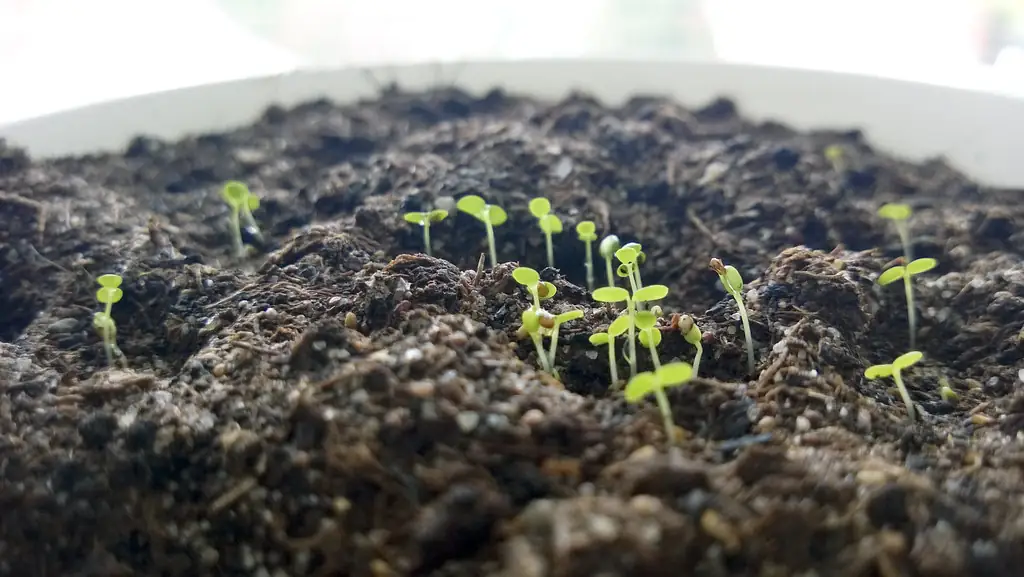
| Weeks 2–3 | Tiny round cotyledons appear; lab-scarified seed is over 90% up by day 14 | Giovanetti et al. 2024 |
| Weeks 3–7 | Stragglers keep emerging, especially without cold treatment | Miller et al. 1992 |
| 7+ weeks | Untreated achenes still reaching their maximum | Miller et al. 1992 |
That long tail is why patience matters so much. A tray that’s 30% up at week three may well finish much higher.
Troubleshooting: strawberry seeds not germinating
When strawberry seed germination fails, the cause is usually one of a handful of things. Use this table to work through it.
| Symptom | Likely cause | What to do |
|---|---|---|
| Nothing after 3 weeks | Dormancy not broken | Put the covered tray back in the fridge for 4 weeks, then return it to warmth |
| Nothing at all, seeds buried | No light reaching seeds | Re-sow on the surface; seeds need light (Nakamura 1972) |
| A few sprouts, then nothing | Normal staggered emergence | Keep going for 6–8 weeks before giving up |
| Seeds from a homegrown berry fail | Fruit not fully ripe | Use fully ripe or overripe fruit (Miller et al. 1992; OSU) |
| Very slow in a cold room | Temperature too low | Move to 18–25 °C; 15 °C gave the worst results (Nakamura 1972) |
| Seedlings collapse at soil line | Damping-off | Increase airflow and reduce surface wetness; see our damping-off guide |
| Fuzzy mould on the surface | Too wet, no airflow | Vent the lid and bottom water only |
| Old packet, poor results | Seed age or poor storage | Store seeds dry and cold; seed viability drops with age and warm storage |
Rescue plan for a tray that’s doing nothing
- Check that the seeds are on the surface, not buried.
- Slip the whole tray, still covered, into a bag and refrigerate it at 3–4 °C for four weeks.
- Move it back to 20–25 °C under 16 hours of light.
- If your space allows, try a day–night swing: warm by day, cooler at night. Nakamura found an alternating 15/30 °C regime greatly stimulated germination.
From the lab bench
Here’s how to read all of this as a grower rather than a breeder.
First, strawberry seed germination is a dormancy problem, not a “bad seed” problem. Most of the failures people describe online (empty trays, a few lonely sprouts) fit the research exactly. Whole, untreated achenes are slow, uneven and often under 40%. That’s the starting point, not a sign you did something wrong.
Second, cold is your best lever, and it’s cheap. The studies that used one to four months of moist cold all reported useful germination. A fridge and a zip bag do the job that breeders sometimes do with acid, just more slowly. If you’re sowing for spring, start stratifying in winter so the chill and the wait don’t eat into the growing season.
Third, don’t bury the seeds. Light sensitivity is a common reason a well-chilled batch still fails. Seeds this small have very little stored energy, and they rely on light as a signal that they’re near the surface. Surface-sow, press in, cover the tray, and let the light reach them.
Fourth, treat strawberry seed germination as a long tail, not a single event. Lab-scarified seed comes up in a burst within two weeks. Home-chilled seed comes up over weeks. Keep the tray evenly moist and warm for at least six to eight weeks before you call it.
Finally, set your expectations on what grows. Hybrid seed is a genetic lottery, which is fine if you enjoy experimenting but frustrating if you want a copy of the berry you ate. Alpine seed is the more reliable path to fruit on a windowsill.
FAQ
How long does strawberry seed germination take?
Expect the first sprouts after about one to three weeks at 18–25 °C, with more seedlings appearing for several weeks after that. In one study, untreated seed first sprouted on day 10, and whole untreated achenes took more than seven weeks to reach maximum germination. Cold stratification beforehand helps make emergence faster and more even.
Do strawberry seeds need cold stratification?
They don’t strictly need it, but it helps a lot. Strawberry seeds are dormant when harvested, and Nakamura (1972) found one month or more of cold treatment was effective while 10 days was not. Chill moist seeds at 3–4 °C (37–39 °F) for at least four weeks before moving them to warmth.
Can you grow strawberries from the seeds of a store-bought strawberry?
Yes, the seeds can germinate, but most supermarket berries are hybrids, and Oregon State University Extension notes such seed may not grow true to the parent’s taste or size. Use a fully ripe berry, since achenes from green fruit did not germinate in research trials, and expect lower, slower germination than with packet seed.
Do strawberry seeds need light to germinate?
Yes. Research on 13 strawberry varieties found germination was much inhibited in the dark. Sow the seeds on the surface of the mix, press them in lightly and leave them uncovered, then place the tray under a grow light or in a bright window.
What temperature do strawberry seeds germinate at?
The RHS says strawberry seeds will germinate at about 18 °C (64 °F). In controlled tests, 25 °C (77 °F) was the best constant temperature and 15 °C the worst, and an alternating 15/30 °C day–night regime stimulated germination further. Aim for 18–25 °C.
Can I germinate strawberry seeds in a paper towel?
Yes. Place stratified seeds on a damp paper towel inside a clear bag or box and keep it warm and in the light, not in a dark cupboard, because strawberry seeds need light. Move each sprouted seed carefully onto the surface of seed mix as soon as its root appears.
How long until strawberries grown from seed produce fruit?
Alpine strawberries are the quickest: the RHS notes they will often start fruiting in their first year. Garden strawberry seedlings vary by variety, and hybrid seed may not produce fruit like the parent berry.
Sources
- Nakamura, S. (1972). Germination of strawberry seeds. Journal of the Japanese Society for Horticultural Science, 41(4), 367–375. doi:10.2503/jjshs.41.367
- Miller, A. R., Scheerens, J. C., Erb, P. S., & Chandler, C. K. (1992). Enhanced strawberry seed germination through in vitro culture of cut achenes. Journal of the American Society for Horticultural Science, 117(2), 313–316.
- Melville, A. H., Galletta, G. J., Draper, A. D., & Ng, T. J. (1980). Seed germination and early seedling vigor in progenies of inbred strawberry selections. HortScience, 15(6), 749–750.
- Ito, Y., Maruo, T., Ishikawa, M., & Shinohara, Y. (2011). Effects of scarification with sulfuric acid and matric priming on seed germination of seed propagation type of F1 hybrid strawberry. Journal of the Japanese Society for Horticultural Science, 80(1), 32–37. doi:10.2503/jjshs1.80.32
- Galvão, A. G., Resende, L. V., Guimarães, R. M., Ferraz, A. K. L., Morales, R. G. F., Marodin, J. C., & Catão, H. C. R. M. (2014). Overcoming strawberry achene dormancy for improved seedling production in breeding programs. Idesia, 32(4), 57–62.
- Giovanetti, G., Marcellini, M., Pergolotti, V., Mecozzi, F., Mezzetti, B., Capocasa, F., & Sabbadini, S. (2024). Standardization of an effective scarification and germination protocol for strawberry seeds that is useful for gamic propagation. Horticulturae, 10(12), 1345. doi:10.3390/horticulturae10121345
- Royal Horticultural Society. How to grow strawberries. RHS Advice.
- Hoover, E. E., Klodd, A., Tepe, E. S., & Foulk, D. Growing strawberries in the home garden. University of Minnesota Extension.
- Oregon State University Extension Service. Can I grow strawberries from seed? Ask an Expert.