
It’s October, the garden strawberries have gone quiet, and the ones in the shop taste like crunchy water. You’ve seen photos of berries hanging off a shelf under purple lights and wondered: is it a gimmick, or could you actually pull it off in a spare corner?
Short answer: yes, you can grow strawberries indoors year-round if you pick a day-neutral variety, give it about 16 hours of strong LED light, keep days around 68–75°F (20–24°C) with cooler nights, and pollinate the flowers yourself. Expect first ripe berries roughly 10 weeks after planting. Skip any of those four pieces and you get a nice-looking leafy plant with no fruit.
Table of Contents
Table of Contents
This guide pulls together controlled-environment research from Arizona State University, the University of Arizona’s hydroponic strawberry programme and several extension services. By the end you’ll know which plants to buy, how much light they really need, how to set up soil or hydroponic containers, and how to fix the problems that stop indoor plants from fruiting.
Can you grow strawberries indoors all year?
You can, but the variety decides almost everything. Strawberries fall into three groups that react very differently to day length and temperature, and only one of them is built for an indoor shelf.
| Type | How it flowers | Indoor fit | Examples |
|---|---|---|---|
| June-bearing (short-day) | Sets flower buds in short, cool autumn days; one big crop a year | Poor. Needs a cold, short-day trigger you can’t easily fake in a living room | ‘Honeoye’, ‘Cambridge Favourite’ |
| Everbearing | Two or three flushes, early summer to early autumn | Fair. Smaller yields and fewer runners than June-bearers (RHS) | ‘Ozark Beauty’, ‘Quinault’ |
| Day-neutral | Flowers whenever temperatures stay roughly 40–85°F, regardless of day length (UNH Extension) | Best choice for year-round indoor fruit | ‘Albion’, ‘Seascape’, ‘Monterey’, ‘San Andreas’ |
| Alpine (Fragaria vesca) | Small, steady crops of tiny aromatic berries | Good for low light and small pots; grows from seed | ‘Mignonette’, ‘Alexandria’ |
The University of New Hampshire describes day-neutral plants as less affected by daylength than June-bearers, flowering whenever temperatures sit roughly between 40°F and 85°F, and usually fruiting within about 10 weeks of planting (UNH Extension). Indoors, you control both the temperature and the clock, so a day-neutral plant can keep cycling through flowers and fruit far longer than it would outdoors.
Here’s the honest catch. A day-neutral plant isn’t a fruit factory. Illinois Extension recorded about 0.5–0.8 lb (roughly 220–345 g) of marketable fruit per plant over a full May-to-October season in a hydroponic tunnel (Illinois Extension). That’s a few bowls per plant, not buckets. Plan on 6–12 plants if you want regular handfuls.
Choosing plants: crowns, plugs or seed?
When you grow strawberries indoors, how you start matters as much as the variety. Strawberries from seed are slow, and most named day-neutral varieties are sold only as plants.
Bare-root crowns (best for most people). Dormant bare-root crowns of ‘Albion’ or ‘Seascape’ are what commercial trials use. The Arizona State vertical-farm study started with bare-rooted ‘Albion’ crowns and had flowers within weeks under the right lighting (Park et al., 2023). Rehydrate the roots briefly in water, trim any that are very long, and plant so the crown sits exactly at the surface. The RHS gives the same depth rule for any strawberry: crown level with the compost (RHS).
Plug plants and potted plants. Garden-centre plants work too, but check the label. Many spring stock plants are June-bearers, which will grow leaves happily indoors and rarely flower. If a label just says “strawberry”, assume it isn’t day-neutral.
Seed (alpine strawberries). Alpine strawberries are the one type that’s worth growing from seed. The RHS notes germination is slow and patchy at about 18°C (64°F) (RHS). If you’ve used our paper towel germination method for other crops, the same trick lets you see which seeds have sprouted before you commit pot space.
The numbers to hold for indoor strawberries
If you want to grow strawberries indoors successfully, know that they’re fussier than lettuce or herbs, because you’re asking them to flower and set fruit, not just make leaves. These are the targets backed by controlled-environment research.
| Factor | Target | Why it matters | Source |
|---|---|---|---|
| Day air temperature | 68–75°F (20–24°C) | Photosynthesis peaks near 20°C (68°F) | U. Arizona CEAC |
| Night air temperature | 50–54°F (10–12°C) | Cool nights support flowering and sugar build-up | U. Arizona CEAC |
| Crown / root-zone temperature | about 64°F (18°C) | Reported optimum crown temperature | U. Arizona CEAC |
| Heat that stops flowering | above about 85°F (29°C) days; 75–78°F (24–26°C) nights | Flowering halts and runners take over | UNH; U. Delaware Ext. |
| Photoperiod | 16 hours | Earlier flowers and far more fruit than 12 h | Park et al. 2023 |
| PPFD at canopy | 300–450 µmol/m²/s | More growth; yield plateaued in this range | Park et al. 2023 |
| DLI | about 17–26 mol/m²/day | 16 h × 300–450 µmol/m²/s | Park et al. 2023 |
| Nutrient solution pH | 5.5–6.0 (root zone 6.0–6.5) | Above pH 7 young leaves yellow from iron lockout | U. Arizona CEAC |
| Nutrient solution EC | 1.0–2.2 mS/cm (500–1,100 ppm on the 500 scale) | Strawberries are salt-sensitive; start low | U. Arizona; OSU HLA-6722 |
| Root volume | at least 2 L (about ½ gallon) of substrate per plant | Smaller pots restrict roots and yield | U. Arizona CEAC |
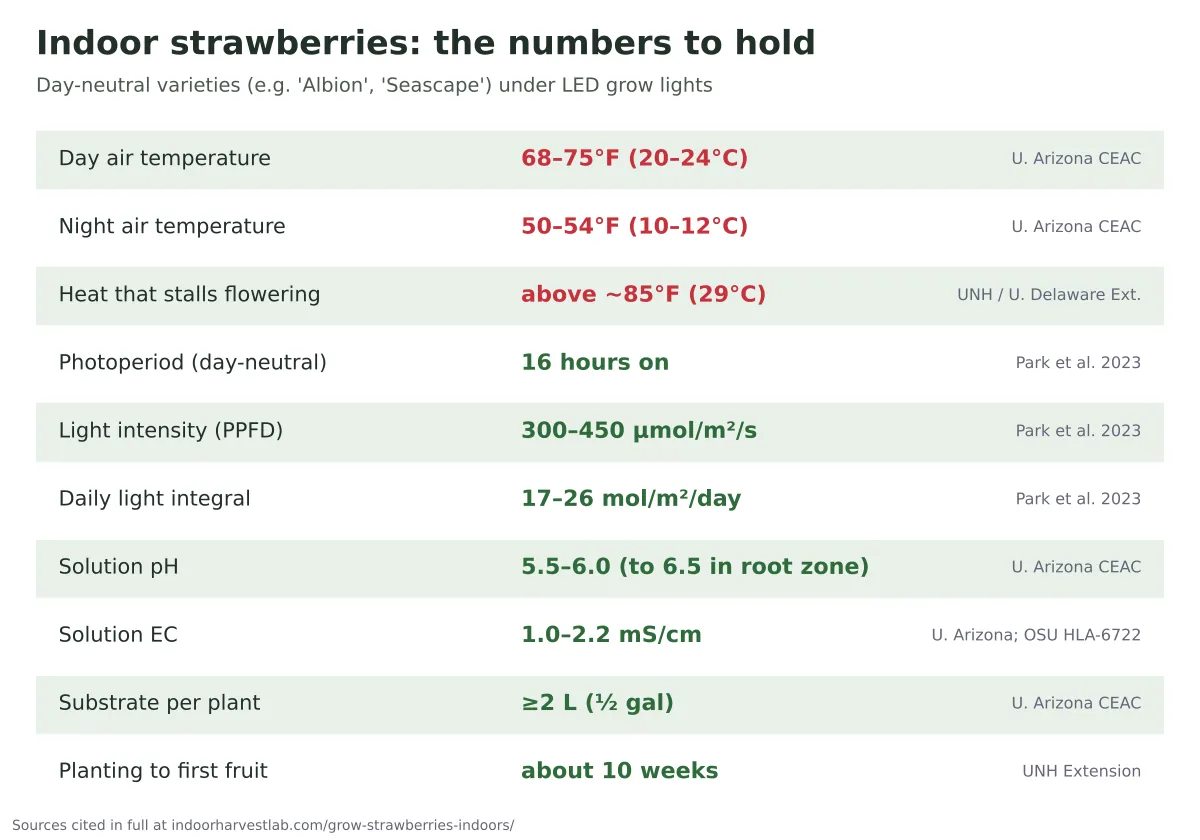
Two of these surprise people. First, the night drop: the University of Arizona’s greenhouse keeps days at 20–24°C but nights at only 10–12°C (U. Arizona CEAC). A cool spare room or a spot near a window at night actually helps. Second, strawberries want a much weaker nutrient solution than tomatoes. Arizona’s strawberry recipe runs at about 1.0 dS/m (mS/cm), versus about 2.4 for tomatoes (U. Arizona irrigation guide). Oklahoma State lists 1.8–2.2 mS/cm and pH 6.0 for strawberry (OSU HLA-6722), so treat 1.0 as a safe start and 2.2 as an upper limit. If you’re converting meter readings, our ppm to EC conversion guide explains the 500 vs 700 scales.
Light: how to grow strawberries indoors under LEDs
If one thing separates fruiting indoor strawberries from leafy ones, it’s light. A windowsill in winter simply doesn’t deliver enough. That’s where most failed attempts go wrong.
What the research found
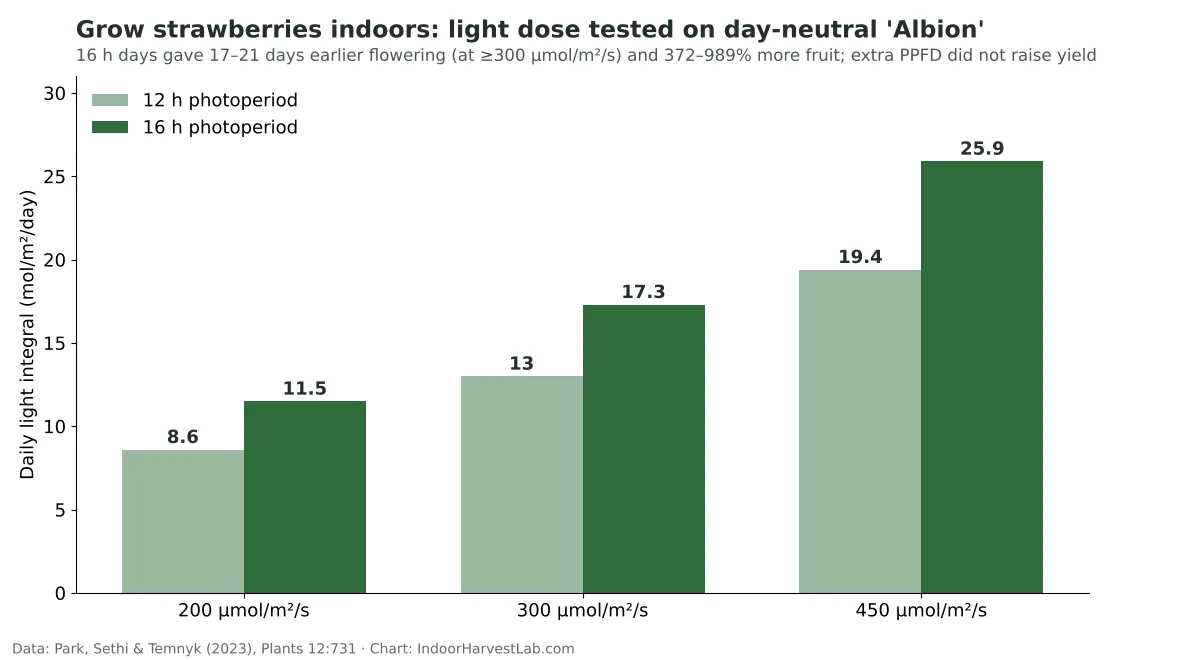
Arizona State researchers grew day-neutral ‘Albion’ in a hydroponic vertical farm under white, blue and red LEDs at 21°C, testing 12- and 16-hour days at about 200, 300 and 450 µmol/m²/s (Park, Sethi and Temnyk, 2023). The results were striking:
- Photoperiod mattered most. Under 16-hour days, total fruit production was 372–989% higher than under 12-hour days, and fruit number was 365–1,220% higher.
- Flowers came sooner. At 300 µmol/m²/s or more, 16-hour plants flowered 17–21 days earlier.
- More light grew bigger plants, not more fruit. Raising PPFD from 200 to 450 increased crown diameter and shoot mass, but yield wasn’t significantly different across intensities.
- Fruit set improved. At each intensity, 50–70% more plants produced fruit under 16 hours.
Practical light setup
Translate that into home terms: run your light for 16 hours a day on a timer, and aim for roughly 300 µmol/m²/s at the top of the leaves. That gives a DLI of about 17 mol/m²/day. Going up to 450 µmol/m²/s builds sturdier crowns, which may pay off over a longer season, but don’t expect it to double your berries.
- Use a full-spectrum white LED. The study used white plus red and blue; most quality white grow lights cover this.
- Measure, don’t guess. A PAR meter or a calibrated phone app gives you PPFD at canopy height. Hang height changes intensity dramatically.
- Mind the heat. Strong lights in a small tent can push leaf temperatures above the 85°F zone where flowering stalls.
For context on how hard it is to reach these numbers through glass in winter, see our guide to growing tomatoes indoors, which deals with the same light gap for another fruiting crop.
Soil pots or hydroponics: setting up your plants
Both work to grow strawberries indoors. Hydroponics gives faster, more controllable growth; pots of potting mix are more forgiving if you’re away for a weekend. Here’s how they compare.
| Setup | Best for | Pros | Watch-outs |
|---|---|---|---|
| Pots with peat-free potting mix | Beginners, 2–6 plants | Forgiving; easy to feed with liquid fertiliser | Fungus gnats; uneven watering |
| Coir/perlite pots with drip or hand-fed solution | Growers wanting commercial-style results | Matches university setups; good aeration | Need to check runoff EC and pH |
| Deep water culture (DWC) | Small shelves; the ASU study used DWC | Fast growth; simple | Crown must stay dry above the water; keep roots cool |
| Vertical towers / NFT | Many plants in little floor space | Space-efficient; looks great | Pump failure dries roots fast |
Step 1: Choose the right container
Give each plant at least 2 litres (about half a gallon) of substrate. The University of Arizona found taller containers drain and aerate better than shallow ones at the same volume (U. Arizona substrate guide). A pot of about 7 inches (18 cm) per plant, or a window-box trough with plants about 8 inches (20 cm) apart as the RHS suggests, works well.
Step 2: Use an airy mix
Strawberry roots hate sitting wet. In Arizona’s trials, 100% coir restricted growth and yield, while mixes with more perlite performed best. Their current mix is 50% perlite, 25% coir and 25% peat (U. Arizona). At home, a peat-free potting mix with a generous handful of perlite gets you close.
Step 3: Plant at the right depth
Set the crown, the stubby point where leaves emerge, exactly at the surface. Too deep and it rots; too high and the roots dry out. In hydroponic net pots, the crown should sit above the water line with only roots reaching down.
Step 4: Water and feed
The University of Arizona irrigates hydroponic strawberries 6–12 times a day in small doses, with 30–40% of the water draining out to prevent salt build-up (U. Arizona). In pots, water when the top inch is dry and let excess drain. The RHS advises feeding container strawberries every two weeks, switching to a high-potassium feed once flower buds appear (RHS).
Running hydroponics? Our deep water culture guide covers the reservoir setup, and the hydroponic EC chart shows where strawberries sit relative to other crops.
Hand-pollinating indoor strawberries
Indoors there are no bees and no wind, so when you grow strawberries indoors this step is on you. Skip it and you’ll see flowers drop or produce small, lumpy fruit.
Why lumpy? A strawberry is a swollen receptacle studded with dozens of achenes, the “seeds” on the outside. Each fertilised achene signals the flesh around it to grow. In a Japanese plant-factory trial, the best-shaped berries had about 80% of their achenes fertilised, while the most misshapen grade had only 30–44% (Nishimoto et al., 2023).
How to do it
- Wait until the flower is fully open and the yellow anthers are dusty with pollen, usually late morning.
- Use a soft, small paintbrush (the RHS recommends exactly this) or a cotton swab.
- Swirl gently over the whole yellow centre for about five seconds, covering all sides of the cone. The Japanese trial used five seconds of circular motion per flower.
- Move from flower to flower; strawberries are self-fertile, so pollen from the same plant works.
- Repeat every day or two while flowers remain open.
Done carefully, hand pollination works well: in that trial, 46 of 50 hand-pollinated flowers set fruit, and 88% of the crop by weight was marketable (Nishimoto et al., 2023). A small clip-on fan on a low setting also helps shake pollen loose between brushings.
Troubleshooting: why your indoor strawberries won’t fruit
When strawberries misbehave indoors, the symptoms usually point straight to the cause. Work down this table before changing several things at once.
| Symptom | Likely cause | What to do |
|---|---|---|
| Lots of leaves, no flowers | June-bearing variety, or days shorter than ~14–16 h | Switch to a day-neutral variety; set lights to 16 h |
| Flowering stops; runners everywhere | Too hot (days above ~85°F or warm nights) | Lower light height or add airflow; aim for 68–75°F days |
| Small, misshapen, seedy berries | Incomplete pollination | Brush every open flower for ~5 seconds, daily |
| Flowers turn brown and drop | No pollination, or heat/drought stress | Hand-pollinate; check root-zone moisture |
| Young leaves yellow with green veins | Iron lockout from high pH (above 7) | Bring solution pH to 5.5–6.0 |
| Brown, crispy leaf edges | EC too high / salt build-up | Flush with plain water; drop EC toward 1.0 mS/cm |
| Tiny flies around pots | Fungus gnats in wet media | Let surface dry; use yellow sticky traps and BTi |
| White powder on leaves | Powdery mildew in still, humid air | Increase air movement; remove affected leaves |
The heat link is the one people miss. University of Delaware Extension notes strawberries stop flowering and switch to runners at around 80–86°F daytime and 75–78°F at night, depending on cultivar, and that day-neutral types resume flowering once temperatures drop back (U. Delaware Extension). A grow tent with a powerful light and no fan can hit that range easily.
If you raise your solution pH or see crispy edges, our guides on lowering pH in hydroponics and getting rid of fungus gnats walk through fixes step by step.
Runners: pinch or keep?
Runners are long stems that root new baby plants. Indoors, they pull energy away from fruit and clutter the shelf. Pinch them off as they appear unless you want new plants. Day-neutral varieties make fewer runners than June-bearers anyway, which is one more reason they suit indoor growing.
From the lab bench
Let’s interpret what the research really tells anyone trying to grow strawberries indoors, because the numbers can mislead if you read them too literally.
Photoperiod beats intensity, within reason. The most useful result from the Arizona State work is that 16-hour days made a huge difference while extra PPFD mostly built bigger plants. For a home grower, that means a modest light on a long timer usually beats a powerful light on a short one. It also means you can save electricity: 300 µmol/m²/s for 16 hours is roughly where the study’s yield gains were already captured.
But remember the limits of one study. That trial tested one cultivar, at one temperature, with flowering data from two replications. The 12-hour treatments also got less total light than the 16-hour ones at the same intensity, so day length and daily light dose overlap. I’d treat 16 hours as a strong rule of thumb, not a law of nature.
Strawberries are salt-shy fruiters. Most people assume fruiting crops need a strong nutrient mix. Strawberries break that pattern. The fact that the University of Arizona keeps root-zone EC at or below 1.0 dS/m tells you their roots are sensitive. If your plants look scorched, the fix is almost always less fertiliser, not more.
Cool nights are a feature, not a flaw. Indoor growers often keep plants warm around the clock. Commercial strawberry greenhouses deliberately drop to 10–12°C overnight. If your grow space cools down at night, that’s working in your favour.
Set realistic yield expectations. Half a pound to three-quarters of a pound per plant per season is what an extension tunnel trial recorded. Indoor strawberries are about flavour, freshness and the fun of picking ripe fruit in January, not about saving money on groceries.
FAQ
Can strawberries grow indoors without grow lights?
Only weakly. A bright south-facing window in summer may produce a few berries, but in autumn and winter natural light is far below the 300 µmol/m²/s for 16 hours that drove strong fruiting in research. Alpine strawberries cope best with lower light.
How long does it take to grow strawberries indoors?
Day-neutral plants started from bare-root crowns usually fruit within about 10 weeks of planting, according to UNH Extension. Under 16-hour lighting, flowering can come 17 to 21 days sooner than under 12-hour days.
What is the best strawberry variety to grow indoors?
Choose a day-neutral variety such as Albion, Seascape, Monterey or San Andreas. They flower regardless of day length as long as temperatures stay roughly between 40°F and 85°F. Alpine strawberries are a good option from seed.
Do indoor strawberries need to be pollinated?
Yes. Without bees or wind, use a soft paintbrush to swirl gently over each open flower’s yellow centre for about five seconds. Poor pollination leaves achenes unfertilised and causes small, misshapen berries.
How many hours of light do indoor strawberries need?
About 16 hours per day. In an Arizona State University study, 16-hour days produced 372 to 989 percent more fruit than 12-hour days for the day-neutral variety Albion.
Can you grow strawberries indoors from store-bought fruit?
You can sprout the seeds, but supermarket berries are usually hybrids, so seedlings won’t match the parent and can take a long time to fruit. Buying bare-root day-neutral crowns or alpine strawberry seed is much more reliable.
How long do indoor strawberry plants keep producing?
The RHS suggests replacing strawberry plants every three to four years as vigour declines. Indoors, many growers replace day-neutral plants after one or two heavy fruiting cycles for the best yields.
Sources
- Park, Y., Sethi, R. and Temnyk, S. (2023). Growth, flowering, and fruit production of strawberry ‘Albion’ in response to photoperiod and photosynthetic photon flux density of sole-source lighting. Plants, 12(4), 731.
- University of Arizona CEAC. Hydroponic Strawberry Information Website: Environmental Control.
- University of Arizona CEAC. Hydroponic Strawberry Information Website: Irrigation.
- University of Arizona CEAC. Hydroponic Strawberry Information Website: Substrates.
- Dunn, B. and Singh, H. Electrical Conductivity and pH Guide for Hydroponics (HLA-6722). Oklahoma State University Extension.
- University of New Hampshire Extension. Growing fruits: Day-neutral strawberries in New Hampshire: Variety selection and production tips.
- Johnson, G. (2022). Strawberry flowering, runner formation and heat. University of Delaware Weekly Crop Update.
- Nishimoto, Y., Lu, N., Ichikawa, Y., Watanabe, A., Kikuchi, M. and Takagaki, M. (2023). An evaluation of pollination methods for strawberries cultivated in plant factories: robot vs hand. Technology in Horticulture, 3, 19.
- Royal Horticultural Society. Strawberries: grow your own.
- Aly, B. (2023). Hydroponic day-neutral strawberry production observations. University of Illinois Extension.