
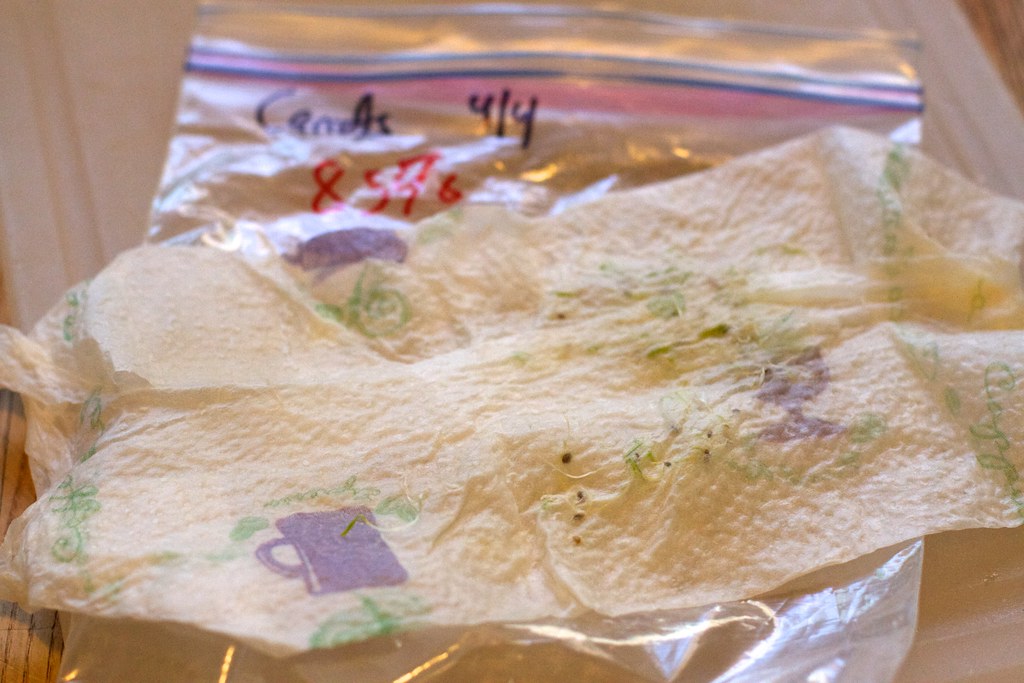
Short answer: paper towel germination means rolling 10 seeds in a damp (not dripping) paper towel, sealing the roll in a plastic bag, keeping it warm at about 68–70 °F, and counting how many sprout after the crop’s normal test period: roughly 6 days for radish, 7 for lettuce, 10 for cabbage-family crops and 14 for tomato and carrot. Extension services use the count to decide what to do with old seed: 8 or more out of 10 is fine, 7 out of 10 means sow thicker, and below 4 out of 10 means buy fresh seed.
A paper towel germination roll does two jobs. It is a cheap viability test before you waste a tray of potting mix on dead seed, and it is a way to pre-sprout slow or expensive seeds so that only living ones go into cells. The steps below cover both, with the test periods and temperatures that seed labs use, the mistakes that make seeds rot, and what to do with the sprouts afterwards.
Table of Contents
What paper towel germination is good for (and what it isn’t)
Paper towel germination separates the question “is this seed alive?” from everything else that can go wrong in a seed tray: cold mix, planting too deep, drying out or fungus gnats. On a towel you can see every seed, so a poor result points to the seed itself rather than to your setup.
Use it when:
- You have old packets. Seed stored for several years loses vigor. UW–Madison Extension’s Dane County office lists typical storage life as about 1 year for onion, 2 years for corn and pepper, 3 for beans, carrots and peas, 4 for beets, squash, tomato and watermelon, and 5 for broccoli, cabbage, cucumber, lettuce, radish and spinach (UW–Madison Extension, Dane County).
- You saved your own seed and have no germination rate printed on a packet.
- Seed is expensive or scarce, and you want to plant only sprouted seeds, one per cell.
- A crop is slow to emerge and you want to know whether to wait or resow.
Paper towel germination is less useful for seed you broadcast thickly, such as microgreens. It also does not measure vigor well: a seed can root on a towel yet be too weak to push through mix.
What you need
- Plain, unprinted paper towels (UW–Madison suggests a half sheet of undyed towel).
- A zip-top plastic bag, or a jar or cup if you use the upright roll method.
- A marker and a spray bottle.
- A warm, steady spot out of direct sun; the top of the refrigerator is the classic choice in both the Brooklyn Botanic Garden and Oregon State guides.
- Ten seeds per paper towel germination test, or 100 for a lab-grade result.
Paper towel germination step by step
This is the method used by the University of Alaska Fairbanks Cooperative Extension Service in its wet paper towel germination test (UAF Extension FGV-00249), with the home-garden sample size used by Illinois, Wisconsin and Oregon State Extension.
- Take a fair sample. Count out 10 seeds at random. UAF stresses not to pick out damaged-looking seeds, because that inflates the result. Use 100 seeds (ten rolls of ten) if the decision matters, such as a large bag of cover crop or a pricey hybrid.
- Wet the towel. Moisten it until it is thoroughly damp, then squeeze or tip off the excess. UW–Madison describes the target as “very moist but not dripping”. Standing water is the main cause of rot.
- Space the seeds. Lay the seeds in a line along one edge, about an inch apart so roots do not tangle. For small seeds, a second damp towel laid on top keeps them in contact with moisture.
- Roll and bag. Roll the towel loosely but with good seed contact, and slide it into a plastic bag. UW–Madison suggests closing the bag about 70% of the way to leave a little air exchange; UAF seals it in a container that holds moisture. Either works if the towel stays damp.
- Label it. Write the crop, variety, start date and the date to count.
- Keep it warm. Seed labs test most vegetables at 68–70 °F, and Illinois Extension recommends a spot above 70 °F. The exceptions are lettuce and spinach, which prefer it cooler (see the table below).
- Check every 2–3 days. Open the roll, mist if the towel is drying, and look for mold. Oregon State’s Food Hero guide checks moisture every 2 days.
- Count at the end of the test period. Count seeds with a healthy root. The UAF test is stricter for field crops: it only counts seedlings with shoots longer than 1½ inches plus a strong root, because weak sprouts rarely make it in cold soil.
- Work out the percentage. Germinated seeds × 100 ÷ seeds tested. Eight of 10 is an 80% paper towel germination rate.

How long to wait: test periods and temperatures by crop
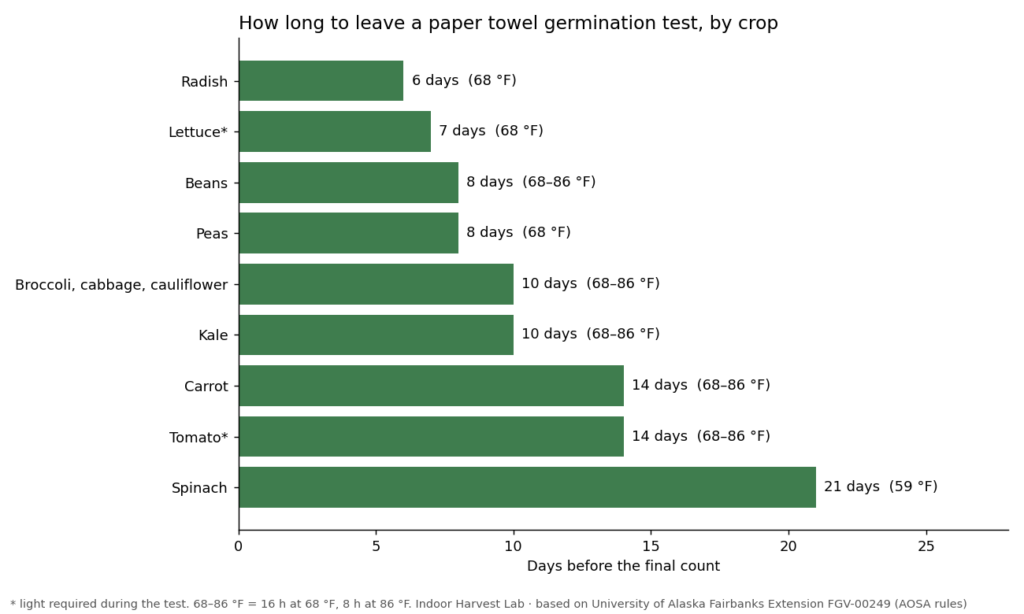
The most common paper towel germination mistake is giving up too early. Official seed tests (the Association of Official Seed Analysts rules summarized by UAF) run for a fixed number of days at a set temperature. Where two temperatures are listed, the lab alternates them: 16 hours at the lower one and 8 hours at the higher one.
| Crop | Test temperature | Final count (days) | Special notes (UAF table) |
|---|---|---|---|
| Radish | 68 °F | 6 | none |
| Lettuce | 68 °F | 7 | needs light; for dormant seed, chill at 50 °F for 3 days or test at 59 °F |
| Beans | 77 °F or 68–86 °F | 8 | none |
| Peas | 68 °F | 8 | hard seeds may not absorb water |
| Broccoli, cabbage, cauliflower, Brussels sprouts | 70 °F or 68–86 °F | 10 | dormant seed: 41 °F for 3 days, add light |
| Kale | 70 °F or 68–86 °F | 10 | as for cabbage |
| Carrot | 70 °F or 68–86 °F | 14 | none |
| Tomato | 70 °F or 68–86 °F | 14 | light during the test |
| Spinach | 59 °F | 21 | keep the towel on the dry side |
For crops not in the table, use the “days to emerge” on the packet, or check at 7–10 days as Illinois Extension recommends. Most paper towel germination tests finish between 3 days and 3 weeks, according to the Brooklyn Botanic Garden. Our seed germination temperature chart lists the minimum, optimum and maximum temperatures for common vegetables if your room is cooler or warmer than 68 °F.
Light and warmth during paper towel germination
For most seeds, paper towel germination works in the dark. Penn State Extension notes that most seeds germinate best in the dark, while a few species, such as begonia, primula and coleus, need light (Penn State Extension, Seed and Seedling Biology). Among vegetables, the UAF table flags lettuce and tomato as needing light during an official test.
For light-needing seeds, leave the roll loose in a clear bag on a bright shelf or under a seedling light, out of direct sun that would cook the bag. The University of Minnesota’s seed starting guide makes the same point for trays: light-needing seeds are barely covered, and seeds that need darkness go under newspaper or in a dark bag until they sprout (UMN Extension).
Lettuce is the crop most likely to fail from heat rather than age. A 2024 review in Plants reports that the optimum germination temperature for most lettuce varieties is 15–22 °C (59–72 °F), and that high temperatures stop germination, a response called thermoinhibition, which reverses once the seed cools (Wei et al. 2024, Plants 13:2051). So a lettuce paper towel germination test sitting on a warm fridge top in summer can read as “dead” when the seed is fine. Test lettuce in a cooler room, or at 59 °F as the UAF table allows.
Reading the result: what the count tells you
Extension guides agree on how to read a paper towel germination count, though the cut-offs differ a little:
| Seeds sprouted (of 10) | What it means | What to do | Source |
|---|---|---|---|
| 10 | Excellent | Sow at the normal rate | Oregon State Food Hero |
| 8–9 | Good | Normal rate, or one extra seed per cell for key crops | UW–Madison (80%+ is excellent) |
| 7 | Usable | Sow thicker than normal | Illinois (70–90%: sow thicker) |
| 4–6 | Poor | Plant extra seeds per hole, use as microgreens, or replace | Oregon State; UW–Madison |
| 0–3 | Very poor | Buy fresh seed | UW–Madison (below 40%) |
Illinois Extension is stricter than Wisconsin: it suggests buying new seed below 70% (Illinois Extension, Ferree 2017). A practical rule is to follow Illinois for crops you transplant one per cell, where every empty cell costs space under the lights, and Wisconsin for crops you sow thickly. The Brooklyn Botanic Garden’s rule of thumb is simple: at 50% germination, double the sowing rate.
Ten seeds is a small sample: one seed changes the result by 10 points, and UAF notes the test becomes more reliable as the sample grows. If a paper towel germination result sits on a cut-off, run a second roll before throwing a packet away.
Pre-sprouting seeds to plant: moving sprouts into cells
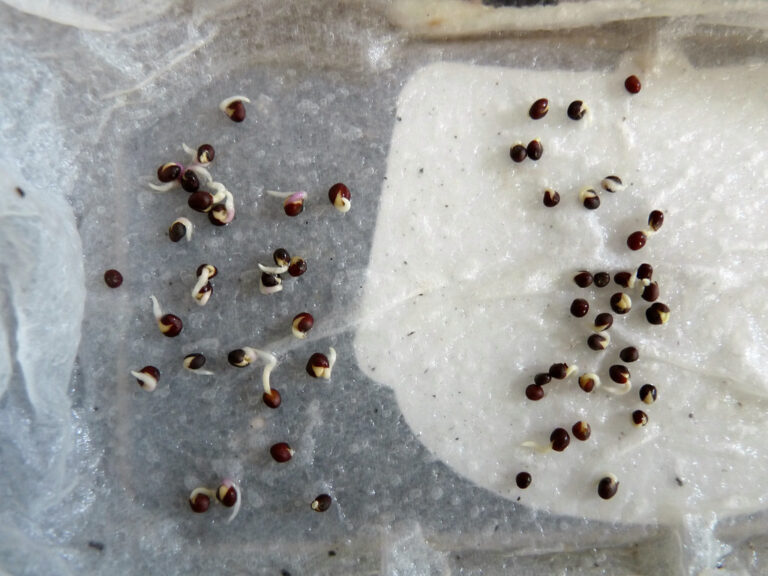
Illinois Extension and Oregon State both suggest planting the sprouts from a successful test, and paper towel germination is also used on purpose to pre-sprout seed before sowing.
- Move them early. Transplant as soon as the root (the radicle, the first structure to emerge from the seed, according to Penn State) is visible. A short root survives handling far better than a long one that has grown into the towel fibres.
- Lift by the seed, not the root. Use tweezers or a damp toothpick under the seed coat.
- Plant root side down. Oregon State’s guide specifies this. Make a hole in moist mix with a pencil, lower the root in and cover the seed to the normal depth: about twice the seed’s width, per UMN.
- If a root has grown into the towel, tear off the scrap of paper and plant it with the seed. Illinois Extension recommends planting sprouted seeds with the towel still attached rather than pulling them free.
- Give light straight away. Pre-sprouted seeds emerge within a day or two, so put the tray under lights at once. Our guides on grow light distance and hours of light for seedlings cover the setup; a sprout that pushes up in a dark room will be leggy within days.

Before paper towel germination, large seeds such as beans, peas and corn can be soaked for a few hours or overnight before rolling, but the Brooklyn Botanic Garden advises no more than 24 hours. Illinois Extension also mentions a quick float test for these three crops (sinkers kept, floaters discarded), but it is a rough screen, not a germination count.
Paper towel germination mistakes to avoid
- A soaking-wet towel. UAF lists rotting seed as the sign of a sample that was too wet. Squeeze the towel before use, and pour off water from the jar method after an hour, as the Brooklyn Botanic Garden does.
- A towel that dries out. The other failure in the UAF list: seeds that start and then stall. Seal the bag better or mist every 2–3 days.
- Testing lettuce or spinach warm. Both are tested cool (68 °F and 59 °F), and lettuce shuts down in heat.
- Letting sprouts grow long. Roots that grow through the towel tear when you pull them out. Check daily once the first seeds crack.
- Printed or scented towels. Use plain, undyed towels, as UW–Madison advises.
- Ignoring fuzzy mold. A few moldy dead seeds are normal. If mold spreads, remove the dead seeds, rinse the rest and start a fresh towel; mold on the roll can follow sprouts into the tray, where it adds to the risk of damping-off.
- Using paper towel germination for every seed. For fresh, cheap seed, sowing straight into mix is faster.
Where this applies
Paper towel germination works the same anywhere, but the room does not. In a cool house in winter (below about 60 °F), warm-season seeds such as tomato and pepper will sprout slowly or not at all, so move the bag to a warmer spot or onto a seedling heat mat set low. In a hot apartment in summer, cool-season crops (lettuce, spinach) may refuse to sprout; test them in the coolest room or in a basement.
If you grow hydroponically, paper towel germination is a handy way to check seed before loading rockwool cubes or plugs, and pre-sprouted seed can go straight into plugs root side down. For microgreens, a low result simply means a heavier sowing rate; our seeding density chart gives the normal grams per tray to adjust from.
Between tests, UMN recommends buying no more seed than you will use in two or three years and keeping packets airtight in a cool place, ideally the refrigerator.
FAQ
How many days does paper towel germination take?
In paper towel germination, most vegetable seeds show roots in 3–10 days at 68–70 °F. For a proper count, wait the full test period: 6 days for radish, 7 for lettuce, 8 for beans and peas, 10 for cabbage-family crops, 14 for tomato and carrot, and 21 for spinach (UAF Extension).
Should paper towel germination be done in the dark?
For most seeds it does not matter, and many germinate best in the dark. Lettuce and tomato need light in the official test, so keep those rolls in a clear bag in a bright spot, out of direct sun.
Is paper towel germination better than planting in soil?
It is better for testing and for sorting scarce seed, because you see every seed. For routine sowing, planting straight into mix is simpler.
Can I plant seeds that sprouted on the towel?
Yes. Plant them root side down as soon as the root appears, and cover to the normal depth. If the root has grown into the paper, plant the torn piece of towel with it.
What paper towel germination rate is acceptable?
Eighty percent or more is excellent. Between about 40% and 70%, sow thicker. Below 40% (Wisconsin) or 70% (Illinois), most extension guides say to buy fresh seed.
Related guides: seed germination temperature chart · damping-off in seedlings · leggy seedlings · more in Germination.
Sources
- University of Alaska Fairbanks Cooperative Extension Service. Procedures for the Wet Paper Towel Germination Test (FGV-00249), with crop test periods from AOSA Rules for Testing Seeds.
- Ferree, R. (2017). Test Seed Viability. University of Illinois Extension.
- Johnson, L. A. (2023). Testing Seed Viability. UW–Madison Extension, Dane County.
- O’Brien, M. (2020). Germination Test: Are Your Old Seeds Still Good? Brooklyn Botanic Garden.
- Oregon State University Extension, Food Hero (2021). Will Your Seeds Grow Plants?
- DuPont, S. T. Seed and Seedling Biology. Penn State Extension.
- University of Minnesota Extension. Starting seeds indoors.
- Wei, J., et al. (2024). Advance in the Thermoinhibition of Lettuce (Lactuca sativa L.) Seed Germination. Plants 13(15): 2051.
Featured image: “What's Germinating, Doc” by cogdogblog, CC BY 2.0.