
You’ve watched the videos: goldfish gliding under a bed of lettuce, the whole thing humming along with no bottles of fertilizer in sight. Then you read a hydroponics forum where people grow the same lettuce with a bucket, a pump and a bag of powdered nutrients. Both look like magic, which is why the aquaponics vs hydroponics question is so hard to settle. Only one of them will fit your space, your budget and the amount of attention you can give it every day.
Short answer: In the aquaponics vs hydroponics choice, hydroponics feeds plants a measured mineral solution, while aquaponics feeds them fish waste that bacteria turn into nitrate. Hydroponics is faster to start, easier to tune (pH 5.5–6.5) and simpler indoors. Aquaponics gives you fish as a second crop and fewer fertilizer purchases, but it runs at a compromise pH near 7, needs weeks of cycling and usually needs calcium, potassium and iron added. Research shows yields are broadly similar when both are managed well.
By the end of this guide you’ll know how the two systems differ in chemistry, start-up time, daily work, yield and cost, which numbers to hold for each, and a simple way to decide which one belongs in your home. If you’re brand new to soilless growing, what hydroponics is and how it works is a good two-minute primer first.
The core difference in one sentence: both systems grow plants with their roots in water or an inert medium instead of soil, but they get their nutrients from different places, and that single choice changes almost everything else.
In hydroponics, you dissolve fertilizer salts in water to make a complete nutrient solution. You control every element. Two living things matter: your plants, and the microbes you mostly try to keep out of the reservoir.
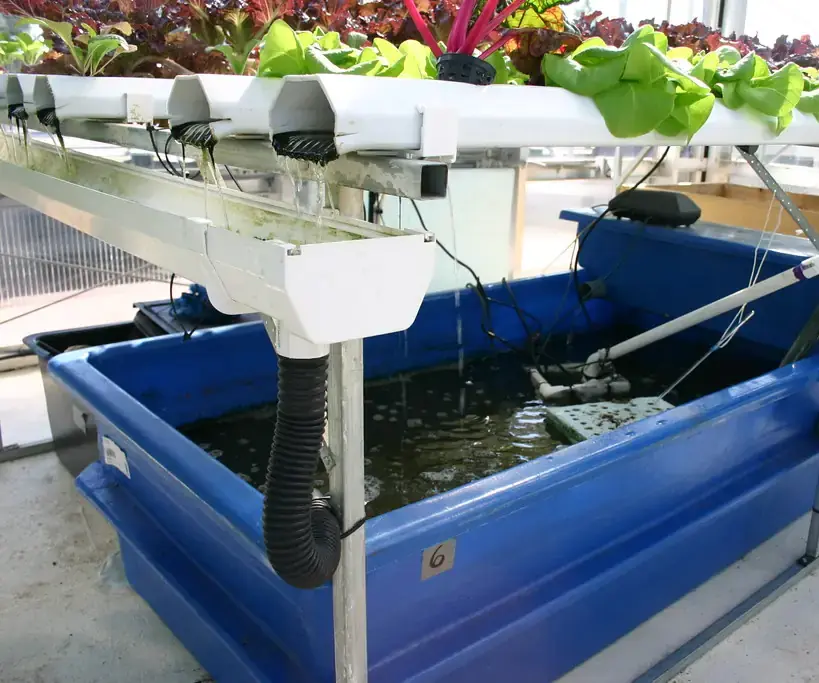
In aquaponics, you feed fish. Fish excrete ammonia, nitrifying bacteria convert that ammonia to nitrite and then nitrate, and plants take up the nitrate and clean the water that flows back to the fish. UF/IFAS Extension (HS1252) describes this as a system of three organisms (fish, plants and bacteria) that each need their own conditions. That’s the source of both the beauty and the headaches.
Here’s the honest summary of hydroponics vs aquaponics: hydroponics is a chemistry project; aquaponics is a small ecosystem. Ecosystems are rewarding, but they’re slower to start and slower to correct when something drifts.
Aquaponics vs Hydroponics Side by Side: The Comparison Table
This aquaponics vs hydroponics table pulls together the practical differences that matter most for a home grower. Each number is from the extension or research source named in the row.
| Factor | Hydroponics | Aquaponics |
|---|---|---|
| Nutrient source | Mineral fertilizer salts, mixed to a recipe | Fish feed → fish waste → bacteria → nitrate; fish feed supplies 10 of the 13 plant nutrients in adequate amounts (UVI) |
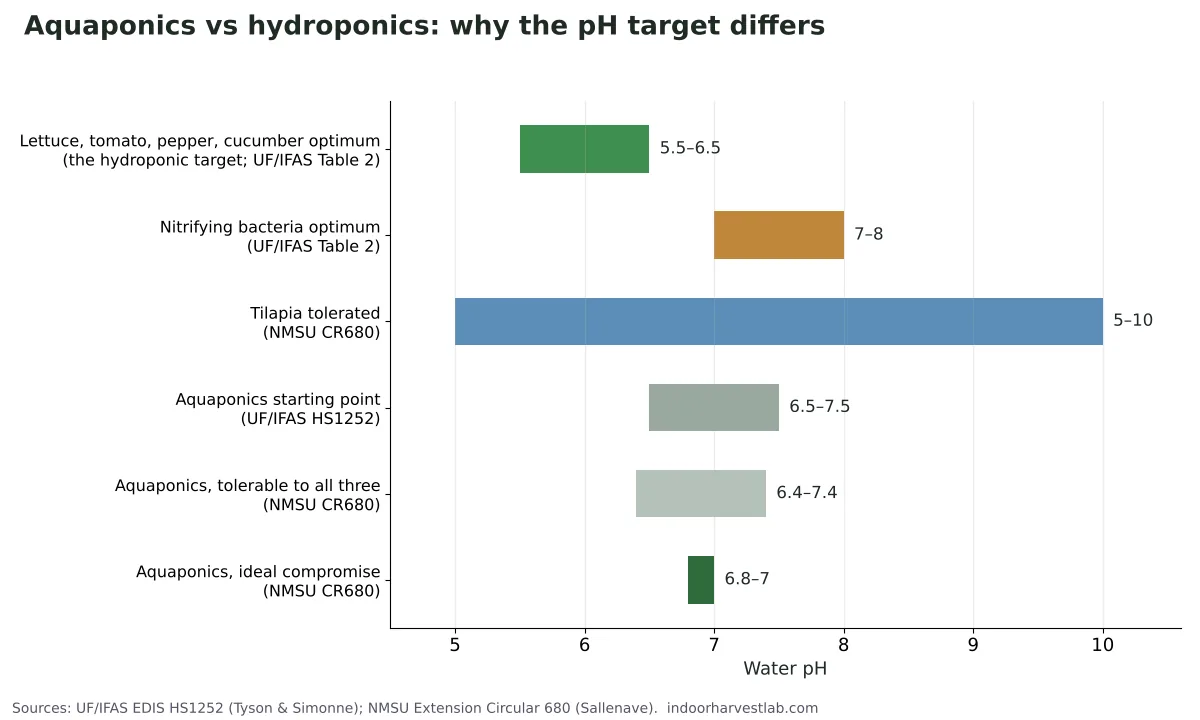
| Target pH | 5.5–6.5 for lettuce, tomato, pepper and cucumber (UF/IFAS Table 2) | 6.8–7.0 ideal, 6.4–7.4 tolerable (NMSU); 6.5–7.5 as a starting point (UF/IFAS) |
| Salt level (EC) | Usually 1.5–2.5 dS/m, lower for leafy greens (UF/IFAS) | Can run at about one-third of hydroponic levels and still feed plants (Rakocy, cited by UF/IFAS) |
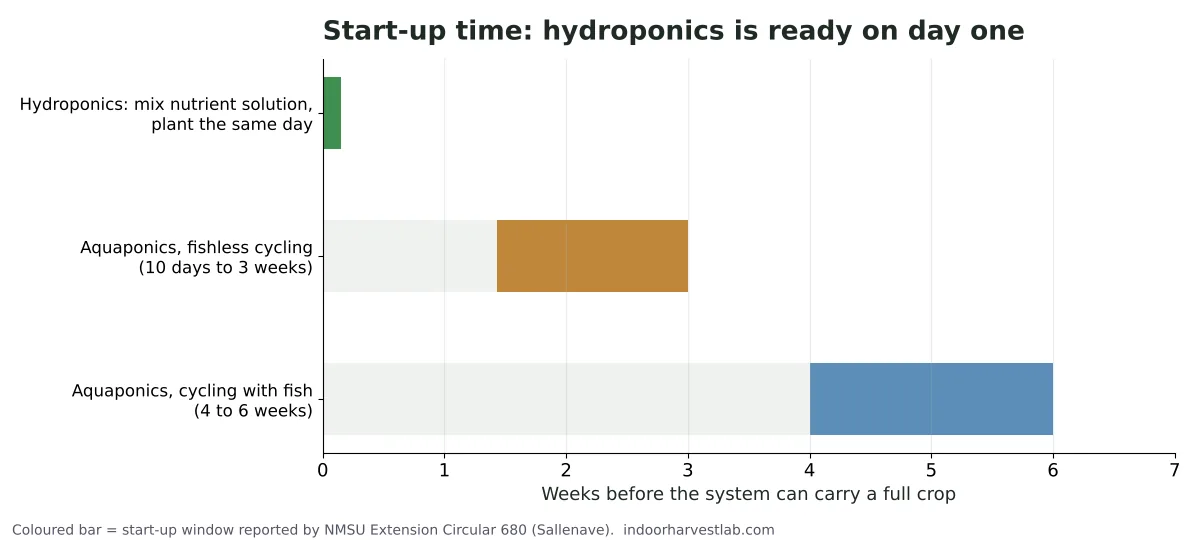
| Start-up time | Same day: mix solution and plant | 10 days–3 weeks fishless cycling, or 4–6 weeks with fish (NMSU) |
| Usual supplements | None beyond the recipe | Calcium, potassium and iron (UVI; UF/IFAS); chelated iron at 2 mg/L every 3 weeks (NMSU) |
| Pest control | Labelled products possible, with care | No pesticides or fish therapeutants: biological control only (UVI) |
| Daily checks | pH and EC a few times a week; water level | pH daily, plus ammonia, nitrite, nitrate, oxygen and fish feeding (NMSU; OSU) |
| Water temperature | Set by the crop | A compromise: fish, plants and bacteria each prefer different ranges (NMSU) |
| Second product | None | Edible or ornamental fish |
| Biggest failure risk | pH or EC drift, warm reservoirs, root rot | Ammonia or nitrite spikes, oxygen loss in a power cut, fish losses |
Notice the pattern. Hydroponics wins on control and speed. Aquaponics wins on inputs (you buy fish feed instead of a full fertilizer program) and on producing protein. Neither is “better” in the abstract; they suit different growers.
Numbers to Hold: Aquaponics vs Hydroponics Water Targets
This is where most aquaponics beginners get caught out. In hydroponics you tune the water for one organism, the plant. In aquaponics you’re juggling three, and their ideal ranges don’t overlap neatly.
| Parameter | Hydroponics target | Aquaponics target | Source |
|---|---|---|---|
| pH | 5.5–6.5 | 6.8–7.0 ideal; 6.4–7.4 tolerable | UF/IFAS Table 2; NMSU CR680 |
| Nitrifying bacteria pH optimum | Not relevant | 7.0–8.0; nitrification basically stops below pH 6 | UF/IFAS; NMSU |
| Water temperature | Lettuce 65–75°F (18–24°C); tomato 80–85°F (27–29°C) by day | 65–85°F (18–29°C) for most systems; 81–84°F (27–29°C) for tilapia | UF/IFAS Table 2; NMSU CR680 |
| Total ammonia nitrogen (TAN) | Not a concern | Below 1 ppm | NMSU CR680 |
| Nitrite | Not a concern | Below 1 ppm | NMSU CR680 |
| Nitrate | Set by recipe | 5–150 ppm; OSU advises not exceeding 140 ppm | NMSU CR680; OSU HLA-6729 |
| Dissolved oxygen | Keep roots aerated | Above 5 ppm (5 mg/L) in fish tank and root zone | NMSU CR680; UVI |
| Alkalinity | Not usually tracked | 100 ppm CaCO3 or above | NMSU CR680 |
| EC | 1.5–2.5 dS/m (lower for greens) | About one-third of hydroponic levels | UF/IFAS HS1252 |
Why does pH matter so much more in aquaponics? Two reasons. First, New Mexico State University Extension (Circular 680) notes that nitrification constantly releases acid, so pH falls every day and must be checked daily. Second, pH controls how much ammonia is in its toxic form. UF/IFAS reports that at 82°F (28°C), the toxic un-ionized share of total ammonia is about 0.2% at pH 6.5, 2% at pH 7.5 and 18% at pH 8.5, roughly a tenfold jump for each pH unit.
That’s why you’ll see aquaponic growers aiming for the low 7s while hydroponic growers sit near 6. If you want to see crop-by-crop hydroponic targets, our hydroponic pH chart and hydroponic EC chart list them in detail.
Aquaponics vs Hydroponics Yield: What the Research Shows
Online, you’ll find bold aquaponics vs hydroponics yield claims in both directions. The peer-reviewed evidence is calmer and more useful.
The meta-analysis: no significant overall difference
A Ayipio et al. (2019) meta-analysis pooled studies that grew the same crops in aquaponics and conventional hydroponics. Average yield was somewhat lower in aquaponics, but the difference was not statistically significant. The type of aquatic animal, the hydroponic system design and, especially, nutrient supplementation explained much of the variation. Studies that supplemented the aquaponic water tended to show higher aquaponic yields than hydroponics. The authors also flag a caution: the analysis was unweighted, so the overall figure should be read carefully.
Lettuce: equal, or better with top-ups
In a controlled lettuce trial, Delaide et al. (2016) found that plain aquaponic water and a hydroponic solution produced similar growth. When the aquaponic water was complemented with minerals up to hydroponic levels, shoot weight rose by about 39% on average over both. Root weight was also higher in both aquaponic treatments than in hydroponics, which the authors link to microbes and dissolved organic matter in fish-system water.
Spinach and pH: the compromise has a cost
Vandam et al. (2017) grew spinach in hydroponics at pH 5.8, hydroponics at pH 7.0 and aquaponics at pH 7.0 (with chelated iron added). Aquaponic yield matched the standard hydroponic treatment, even though its nutrient balance was less than ideal. More recently, Wang et al. (2023) grew six leafy crops with tilapia at pH 6.0, 6.5 and 7.0. Lower pH increased plant fresh and dry mass for every crop, without hurting fish biomass, feed conversion or ammonia-oxidizing bacteria, and the authors suggest pH 6 as a better aquaponic target than the traditional 7.0–7.2.
| Study | Crop | Main finding |
|---|---|---|
| Ayipio et al. 2019 (meta-analysis) | Various food crops | Aquaponic yield slightly lower on average, not statistically significant; supplementation raised aquaponic yields |
| Delaide et al. 2016 | Lettuce | Aquaponics ≈ hydroponics; complemented aquaponics +39% shoot weight |
| Vandam et al. 2017 | Spinach | Aquaponics at pH 7.0 matched hydroponics at pH 5.8 |
| Wang et al. 2023 | Six leafy greens and herbs | pH 6.0 gave more plant mass than 6.5 or 7.0 without harming fish or nitrifiers |
The takeaway: well-run aquaponics can match hydroponics for leafy greens. The gap appears when the aquaponic water runs short of potassium, calcium or iron, or when pH sits too high for nutrient uptake. Hydroponics simply makes those variables easier to get right.
Start-Up Time and Daily Work: The Hidden Difference
This is the part most aquaponics vs hydroponics comparisons skip, and it’s often the deciding factor for people growing in a kitchen or spare room.
Hydroponics: plant on day one
A deep water culture bucket or an NFT channel is ready as soon as the solution is mixed and pH-adjusted. Routine care is checking pH and EC, topping up water and changing the reservoir on a schedule (see how often to change hydroponic water).
Aquaponics: grow the bacteria first
Before an aquaponic system can carry a crop, you need a working colony of nitrifying bacteria. NMSU puts fishless cycling (adding pure ammonia) at 10 days to 3 weeks, and cycling with fish at 4 to 6 weeks. Oklahoma State University Extension (HLA-6729) advises allowing at least four weeks of nitrification before growing anything, and treats the system as cycled when nitrate reaches 40–50 ppm while ammonia and nitrite sit at 0–0.25 ppm.
After that, the routine includes daily pH checks, regular ammonia, nitrite and nitrate tests, feeding the fish, removing solids and watching oxygen. The University of the Virgin Islands aquaponics program notes that at least 25% of the feed given to fish becomes solid waste (dry weight), and NMSU puts it at 0.25–0.30 lb of solids per pound of feed. Those solids have to be filtered out before they coat roots and use up oxygen.
Power cuts are a different kind of emergency
If a hydroponic pump stops, plants wilt over hours. If an aquaponic air pump stops, fish can run out of oxygen much faster. UF/IFAS recommends having backup pumps and generators ready, and in an oxygen emergency to stop feeding and boost aeration until levels return above 4 ppm.
Nutrients, Supplements and Pest Control Compared
What fish feed can and can’t supply
Fish feed is a surprisingly complete fertilizer, but not a perfect one. UVI and UF/IFAS both state that calcium, potassium and iron are not supplied in adequate amounts. The standard fix is to raise pH with calcium hydroxide and potassium hydroxide (alternating the two, as NMSU recommends) and to add chelated iron. NMSU suggests 2 mg/L of chelated iron (DTPA form) every three weeks or as needed.
Nitrogen supply depends on how much you feed. UF/IFAS gives a useful rule: about 10% of the protein in fish feed becomes ammonia nitrogen in the water, so 1 kg of 30%-protein feed yields roughly 27.6 g of nitrogen per day. For design, UVI recommends a feeding-rate ratio of 60–100 g of feed per square metre of raft area per day (2–3 oz per square yard) for leafy crops.
Pest control is far more limited in aquaponics
In hydroponics, you can use labelled pest-control products when needed, following the label. In aquaponics, UVI is blunt: pesticides must not be used because they aren’t approved for fish culture, and fish therapeutants shouldn’t be used either because they can harm beneficial bacteria and be absorbed by vegetables. Biological control is the only option. For an indoor grower fighting fungus gnats or aphids, that’s a real constraint.
Cost, Space and Scale: What It Takes at Home
Exact prices vary too much by country and supplier to quote honestly in an aquaponics vs hydroponics cost comparison, so here’s how the costs compare in structure rather than dollars.
| Cost item | Hydroponics | Aquaponics |
|---|---|---|
| Containers | Reservoir and grow bed or channels | Fish tank plus grow bed(s), often a sump |
| Equipment | Pump or air pump, timer, pH/EC meter | Water pump, air pump, solids filter, often a heater, test kits, ideally backup power |
| Ongoing inputs | Nutrient concentrate, pH adjusters | Fish feed, Ca(OH)2/KOH, chelated iron |
| Living stock | Seeds only | Seeds plus fish |
| Footprint | Can be as small as one bucket | Needs room for a tank sized to the plant area |
Scale matters, too. UF/IFAS describes a classic lettuce–tilapia raft design that uses about 7.3 square units of plant area for every unit of fish-tank surface. OSU’s beginner guideline is to stock about 1 lb of fish (harvest weight) per 8–10 gallons of tank water, and never more than 0.5 lb per gallon. In other words, a few fish in a small aquarium can only support a modest bed of herbs or greens.
Temperature can quietly add cost. UF/IFAS notes that tilapia stop feeding at 60°F (16°C) and lethal temperatures begin at 50°F (10°C), so a cool basement in winter may need a tank heater. Hydroponic reservoirs only need to suit the plants.
Commercially, aquaponics is still a small, mixed-success business. In an international survey of 257 commercial aquaponic growers, Love et al. (2015) found tilapia was the most common fish (69% of respondents), and profitability was linked to treating aquaponics as a primary income, larger sales and greater know-how. For a hobby grower, that’s a reminder that aquaponics rewards experience.
If you’re weighing whether soilless growing pays off at all, our guide is hydroponics worth it? walks through the costs and savings in more depth.
From the Lab Bench: How to Choose Between Them
Strip away the marketing and the aquaponics vs hydroponics choice comes down to one question: do you want to manage water chemistry, or a living system? Hydroponics asks you to be a good chemist. Aquaponics asks you to be a patient fish keeper who also understands chemistry.
The research reasoning is fairly clear. Plants don’t care where nitrate came from; they care whether every nutrient is present at a usable pH. Hydroponics delivers that by design. Aquaponics delivers most of it as a by-product of feeding fish, then leaves you to patch the gaps (potassium, calcium, iron) and to keep pH in a range that’s slightly too high for best nutrient uptake. The newer work by Wang and colleagues suggests that gap can be narrowed by running aquaponics nearer pH 6, which is a useful direction for experienced growers.
A practical rule of thumb: if your main goal is the most lettuce, basil or tomatoes per square foot with the least daily attention, start with hydroponics. If you enjoy keeping fish, want an educational system for children or a classroom, or want to cut fertilizer purchases and are happy to test water daily, aquaponics is a rewarding project. Many people do both, in that order: learn pH and EC with a simple Kratky jar first, then move to fish once those numbers feel familiar.
| If this sounds like you… | Choose |
|---|---|
| Small apartment, little daily time, want fast results | Hydroponics |
| You travel often or can’t check water daily | Hydroponics |
| Growing fruiting crops that need high EC (tomato, pepper) | Hydroponics (or decoupled aquaponics) |
| You already keep an aquarium and enjoy it | Aquaponics |
| Teaching biology or the nitrogen cycle | Aquaponics |
| You want to avoid buying bottled nutrients | Aquaponics, accepting Ca, K and Fe top-ups |
| You want edible fish as well as greens | Aquaponics |
Five steps to start, whichever side of aquaponics vs hydroponics you choose
- Pick the crop first. Leafy greens and herbs suit both systems; heavy feeders like tomatoes are easier in hydroponics.
- Buy test gear before plants. A pH meter for both; add an ammonia, nitrite and nitrate kit for aquaponics.
- Start small. One DWC tote, or one fish tank feeding one grow bed of clay pebbles.
- Cycle or calibrate. Mix and pH-adjust the hydroponic solution; or cycle the aquaponic system until ammonia and nitrite are near zero and nitrate is rising.
- Log your numbers. Record pH, EC or nitrate and temperature weekly so you can spot drift before plants show it.
FAQ
Is aquaponics better than hydroponics?
In aquaponics vs hydroponics, neither is better in every case. Hydroponics is easier to control and faster to start, while aquaponics adds fish and cuts fertilizer purchases. A 2019 meta-analysis found aquaponic yields were slightly lower on average but not significantly different from hydroponics.
Which is easier for beginners, aquaponics or hydroponics?
Hydroponics. You can plant on the day you mix the solution, and you mainly track pH and EC. Aquaponics needs weeks of bacterial cycling and daily checks of pH, ammonia, nitrite, oxygen and fish health.
Do aquaponic plants grow slower than hydroponic plants?
Not necessarily. A lettuce study found similar growth in aquaponic and hydroponic water, and 39% more shoot weight when the aquaponic water was topped up with minerals. Slow growth usually traces to low potassium, calcium or iron, or pH that is too high.
What pH should aquaponics run at compared with hydroponics?
Hydroponic crops do best around pH 5.5–6.5. Aquaponics traditionally runs at 6.8–7.0 (6.4–7.4 is tolerable) so fish, plants and nitrifying bacteria all cope, though recent research suggests pH 6 can raise plant yields without harming fish.
Can you use hydroponic nutrients in aquaponics?
Only selectively. Extension guides recommend adding calcium and potassium as hydroxides to raise pH, chelated iron, and at start-up a quarter-strength hydroponic formula. Avoid adding full-strength products, which can stress fish.
Is aquaponic produce organic?
Aquaponics uses no synthetic fertilizer for nitrogen, but organic certification depends on your country’s rules and the inputs you use, including fish feed and supplements. Pesticides are not used in aquaponics because they can harm the fish.
What fish are used in home aquaponics?
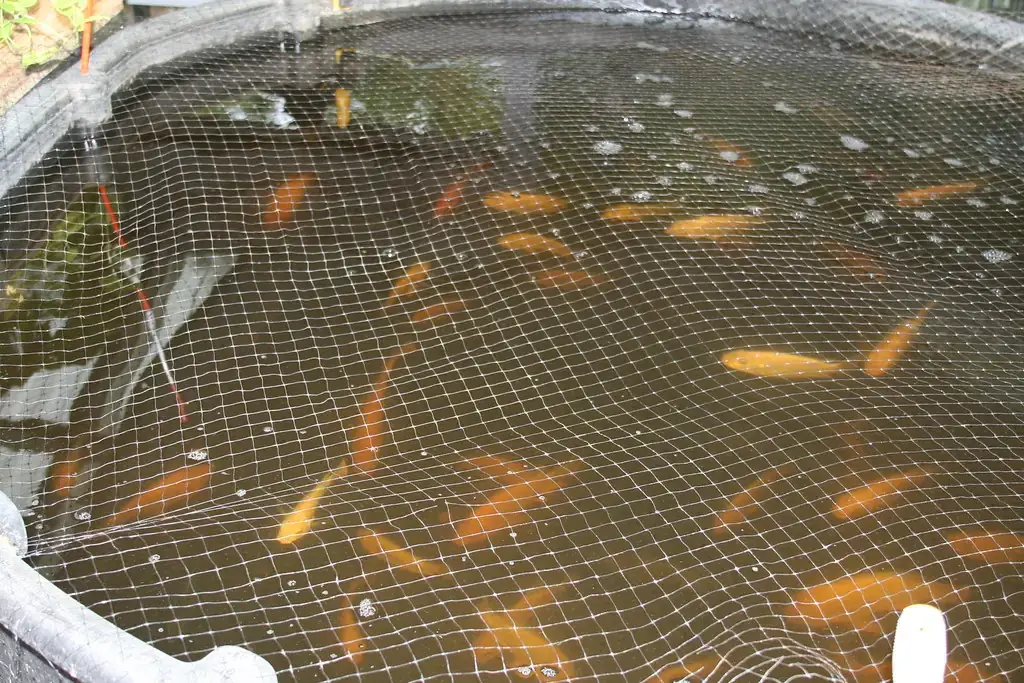
Tilapia is the most common commercial choice, but it needs warm water and stops feeding below 60°F (16°C). Goldfish, koi, bluegill and catfish are also used; match the species to your water temperature.
Sources
- Tyson, R. V. and Simonne, E. H. (2014). A Practical Guide for Aquaponics as an Alternative Enterprise. UF/IFAS Extension, HS1252. journals.flvc.org/edis
- Sallenave, R. (rev.). Important Water Quality Parameters in Aquaponics Systems. New Mexico State University Cooperative Extension Service, Circular 680. pubs.nmsu.edu
- Deer, C., Hu, B., Dunn, B. and Dusci, J. (2021). Nitrification and Maintenance in Media Bed Aquaponics. Oklahoma Cooperative Extension Service, HLA-6729. pods.okstate.edu
- Rakocy, J. Principles of aquaponics. University of the Virgin Islands Agricultural Experiment Station, Aquaponic Systems. uvi.edu
- Ayipio, E., Wells, D. E., McQuilling, A. and Wilson, A. E. (2019). Comparisons between aquaponic and conventional hydroponic crop yields: a meta-analysis. Sustainability 11(22): 6511. doi.org/10.3390/su11226511
- Delaide, B., Goddek, S., Gott, J., Soyeurt, H. and Jijakli, M. H. (2016). Lettuce (Lactuca sativa L. var. Sucrine) growth performance in complemented aquaponic solution outperforms hydroponics. Water 8(10): 467. doi.org/10.3390/w8100467
- Vandam, D. A., Anderson, T. S., de Villiers, D. and Timmons, M. B. (2017). Growth and tissue elemental composition response of spinach (Spinacia oleracea) to hydroponic and aquaponic water quality conditions. Horticulturae 3(2): 32. doi.org/10.3390/horticulturae3020032
- Wang, Y.-J., Yang, T. and Kim, H.-J. (2023). pH dynamics in aquaponic systems: implications for plant and fish crop productivity and yield. Sustainability 15(9): 7137. doi.org/10.3390/su15097137
- Love, D. C., Fry, J. P., Li, X., Hill, E. S., Genello, L., Semmens, K. and Thompson, R. E. (2015). Commercial aquaponics production and profitability: findings from an international survey. Aquaculture 435: 67–74. doi.org/10.1016/j.aquaculture.2014.09.023