
No soil, no garden bed, not even a pot of compost: just a jar of water on the kitchen counter with a lettuce seedling floating on top, roots dangling bare into the liquid. It looks like a science trick, yet this is how most supermarket lettuce is grown. How can a plant live with no soil at all? Once you have seen roots growing straight in water, the whole idea of hydroponics clicks.
Short answer: What is hydroponics? It is growing plants without soil: the roots sit in, or are regularly wetted by, a nutrient-rich water solution while an air pump, an air gap or a flooding cycle supplies the oxygen soil would normally provide. University of Nevada, Reno Extension describes it as gardening without soil that can save up to 90% of the water of conventional growing, and a peer-reviewed comparison found hydroponic lettuce produced about 11 times more per unit area than field lettuce. Light is still required: plants need five to six hours per day at minimum.
People asking what is hydroponics usually want three things: a plain definition, an explanation of how plants can live without soil, and a sense of whether the hype is real. This guide gives all three, with the system types, the honest downsides, and links to detailed build guides on this site for each method.
Table of Contents
What is hydroponics, exactly?
The word comes from the Greek “hydro” (water) and “ponos” (labor): water doing the work. University of Nevada, Reno Extension defines hydroponics as growing plants in a water-based nutrient solution rather than soil, indoors or outdoors, in anything from a jar on a windowsill to a commercial greenhouse.
The plant does not notice the difference. Oklahoma State University Extension explains that there is no physiological difference between a plant grown in soil and one grown hydroponically: in soil, nutrients must first be decomposed into inorganic elements and exchanged into the soil solution before roots can absorb them, while in hydroponics the roots are simply bathed in a solution that already contains those elements. The uptake process inside the root is identical (OSU Extension, HLA-6442).
So a working definition of what is hydroponics: a way of growing where water carries nutrients to the roots, oxygen is supplied deliberately instead of accidentally, and an inert medium (or nothing at all) holds the plant upright. Everything else, the pumps, channels and timers, is plumbing in service of those three jobs.
The four jobs soil does (and how hydroponics replaces them)
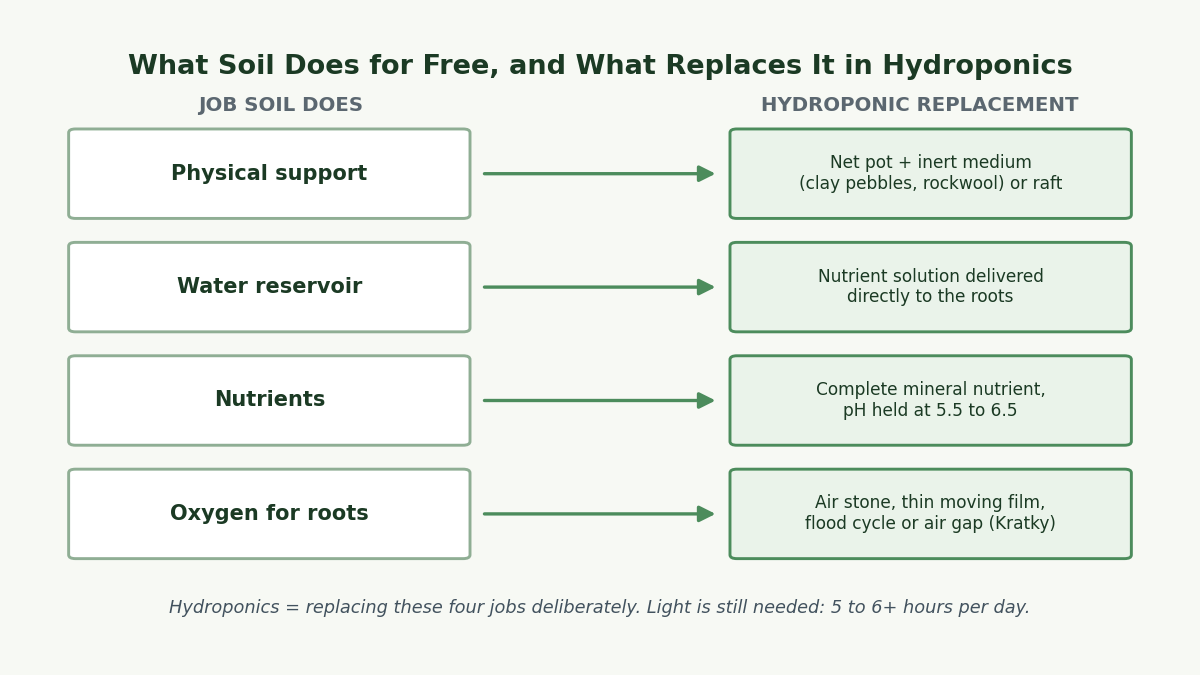
Soil feels free and simple, but it is actually doing four jobs at once. Hydroponics works because it replaces each one deliberately:
- Physical support. Soil anchors roots. Hydroponic systems replace it with net pots and an inert medium such as rockwool, clay pebbles, perlite or coco coir, or with a floating raft that holds the plant above the solution.
- Water. Soil holds a reservoir of moisture that roots must chase. In hydroponics the water comes to the root, either continuously (deep water culture, NFT) or on a timer (ebb and flow, drip).
- Nutrients. Soil releases nutrients slowly and unpredictably. In hydroponics you dissolve a complete fertilizer directly in the water and hold the pH in the band where roots absorb it best, typically 5.5 to 6.5 (UF/IFAS Extension).
- Oxygen. Roots respire and suffocate in stagnant water. Soil’s air pockets handle this for free. Hydroponic systems supply oxygen with an air pump and air stone, a falling film of thin moving water, a flood-and-drain cycle, or a widening air gap as the plant drinks (the Kratky method).
What hydroponics does not replace is light. University of Nevada, Reno notes plants still need five to six hours of light per day, which indoors means a grow light on a timer. If you are planning around a window or LEDs, our guides to light requirements and grow light distance cover the numbers.
The six main types of hydroponic systems
Extension services classify the systems two ways: water culture (roots touch only solution) versus medium culture (an inert substrate supports the roots), and open (solution used once) versus closed (solution recirculated) (University of Nevada, Reno Extension). For a home grower it is easier to learn six named designs. Each is a different hardware answer to what is hydroponics: same four jobs, different plumbing. Here is what each one is, in one paragraph each, with a link to the full guide where we have one.
1. Wick system (the simplest)
A fabric wick draws nutrient solution up from a reservoir into the growing medium by capillary action. No pump, no electricity, no moving parts. Oklahoma State calls the wick system by far the simplest type of hydroponic system. It suits small herbs and greens but cannot keep up with thirsty plants. Our wick system guide covers when it works and its limits.
2. Deep water culture, DWC (the beginner workhorse)
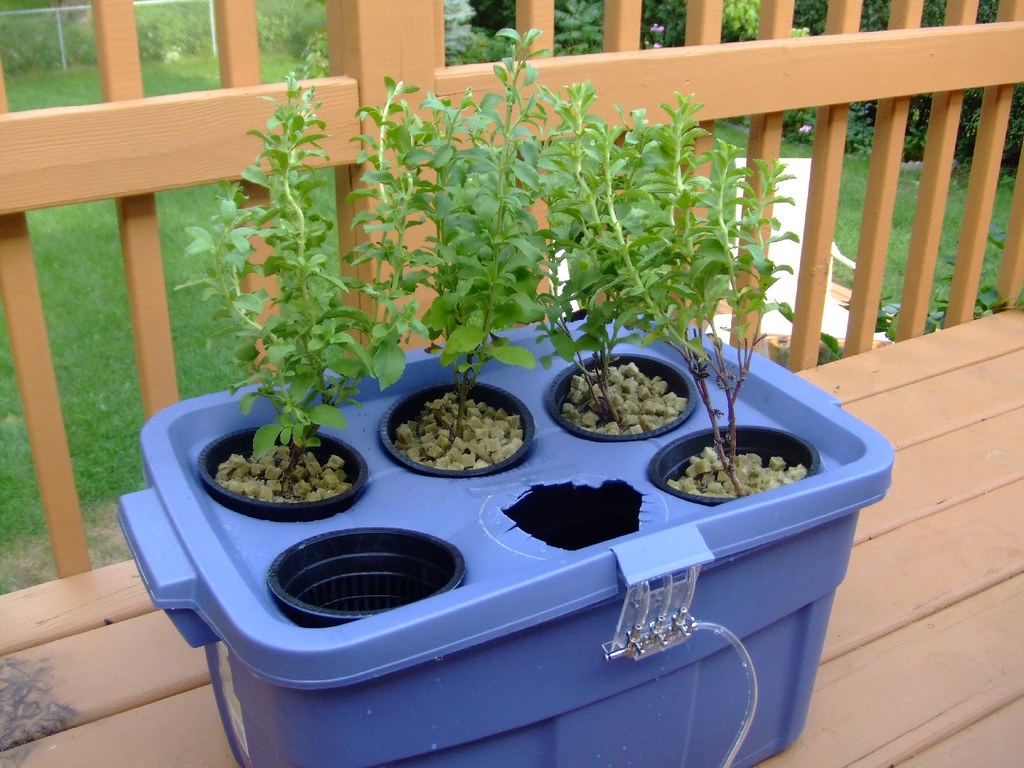
Plants sit in net pots on a lid or floating raft with their roots hanging directly into aerated solution. An aquarium air pump and air stone keep the roots oxygenated. UF/IFAS notes buckets or plastic bins, fish-tank bubblers and net pots make DWC budget-friendly for home growers, and recommends changing the solution every one to two weeks. Our deep water culture setup guide walks through air and water temperature.
3. Kratky method (no pump at all)
A passive variant of DWC developed by Dr. Bernard Kratky at the University of Hawaii. The container starts full; as the plant drinks, the water level drops and leaves an air gap that supplies oxygen to the upper roots. Done right, a lettuce grows from transplant to harvest with no refills and no electricity (UF/IFAS Extension). See our step-by-step Kratky method.
4. Nutrient film technique, NFT (the commercial leafy-green standard)
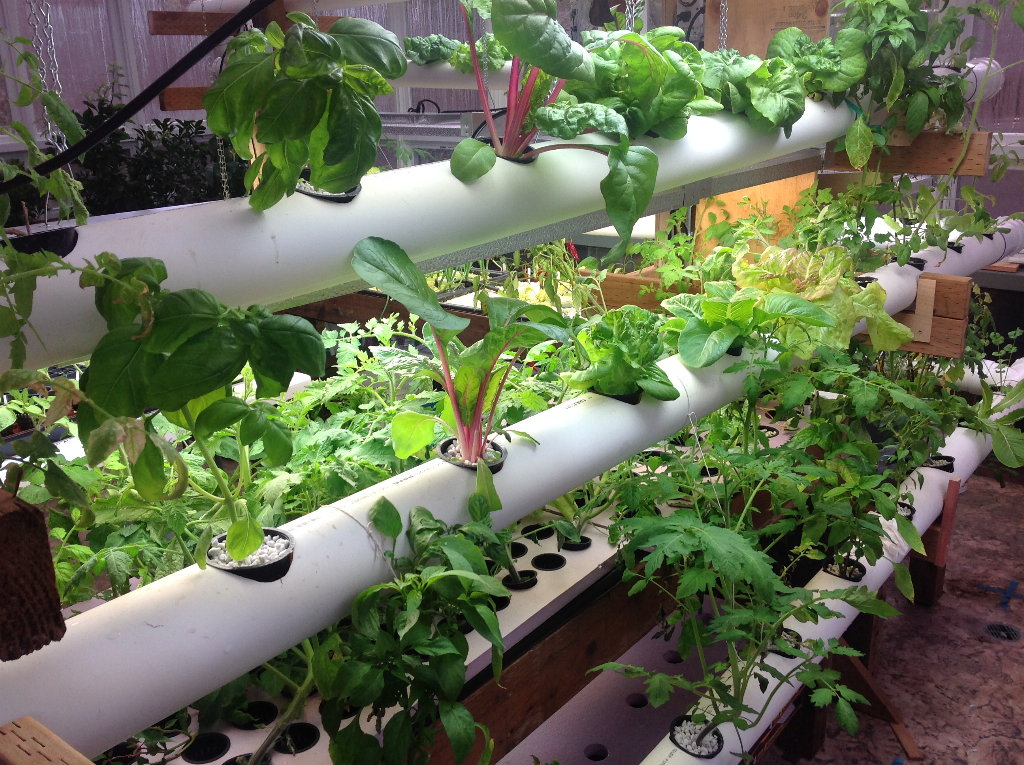
A shallow, continuous film of solution flows down sloped channels, wetting the lower roots while the upper roots breathe air. Water-efficient and scalable, but the roots dry fast if the pump stops. Our NFT guide covers channel slope, flow rate and the best crops.
5. Ebb and flow (flood and drain)
A pump on a timer floods the grow tray with solution several times a day, then lets it drain back to the reservoir. The flooding feeds the roots; the draining pulls fresh air into the medium. Works for larger plants in clay pebbles or rockwool. Our ebb and flow guide covers flood timing.
6. Drip and aeroponics (the advanced end)
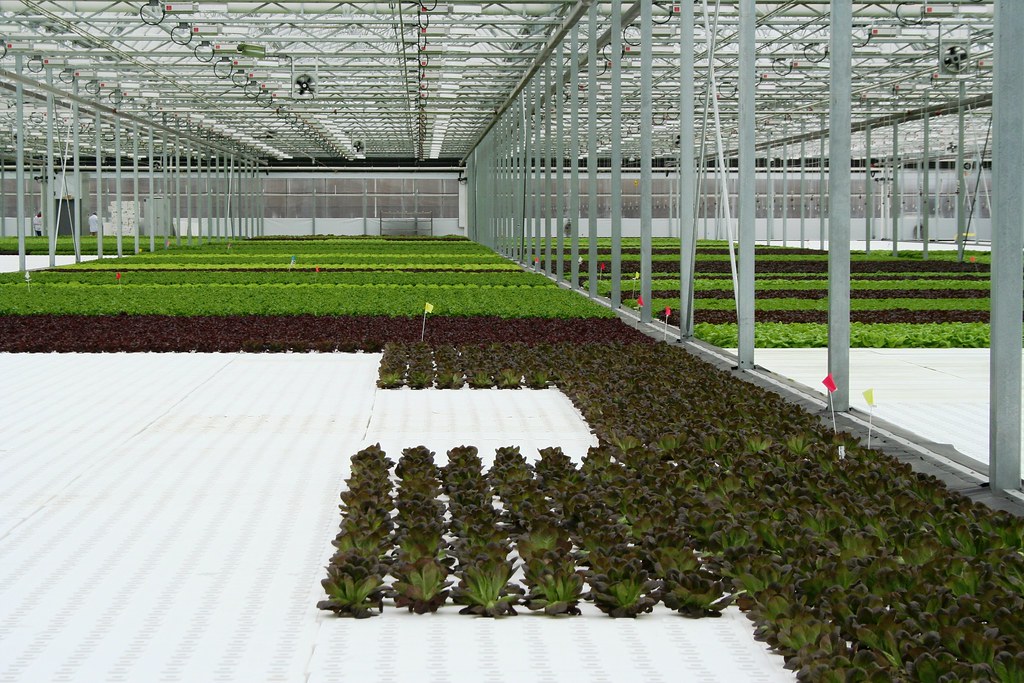
Drip systems, the most widely used type in the world according to Oklahoma State, deliver solution to each plant base through small emitters and dominate commercial production. Aeroponics suspends the roots in air and mists them with solution every few minutes; it gives the highest oxygen exposure but the least margin for pump failure. Towers are a vertical drip or aeroponic variant (see our tower garden review).
| System | Moving parts | Electricity | Best crops | Skill level |
|---|---|---|---|---|
| Wick | None | None | Herbs, small greens | Easiest |
| Kratky | None | None | Lettuce, leafy greens, herbs | Easiest |
| DWC / raft | Air pump | Low | Lettuce, greens, basil | Beginner |
| NFT | Water pump | Low | Leafy greens, herbs | Intermediate |
| Ebb and flow | Pump + timer | Low | Greens plus larger fruiting plants | Intermediate |
| Drip / aeroponics | Pump + timer (+ misters) | Moderate | Tomatoes, peppers, cucumbers | Advanced |
What you can grow hydroponically (and what not to bother with)
What is hydroponics good for growing? The reliable winners are fast, shallow-rooted crops: lettuce and leafy greens, basil, mint, cilantro, spinach, kale, arugula, plus microgreens and sprouts. UF/IFAS recommends NFT and DWC for lettuce, leafy greens and herbs, and ebb and flow or drip for larger fruiting plants. Lettuce is the classic crop for a reason: in Cornell’s controlled-environment trials, a marketable 150-gram lettuce head was produced in 35 days from seed under a daily light integral of 17 mol/m² (Cornell CEA Lettuce Handbook).
Fruiting crops (tomatoes, peppers, cucumbers, strawberries) grow very well hydroponically but demand stronger light, pollination by hand indoors, and higher nutrient strength; they are a second-season project, not a first. Root crops and corn are the poor fits: they need depth or bulk that water systems do not provide economically. For crop-by-crop nutrient targets, see our hydroponic EC chart. Our guide to growing strawberries indoors walks through exactly that second-season project, from day-neutral varieties to hand pollination.
Why growers choose hydroponics: the numbers
Once people understand what is hydroponics, the next question is why bother. The documented advantages, with sources:
- Water. Recirculating systems use up to 90% less water than conventional growing (University of Nevada, Reno Extension). A peer-reviewed lettuce comparison put it even starker: about 20 liters of water per kg of hydroponic lettuce versus 250 liters per kg for conventional field production.
- Yield per area. The same study (Barbosa et al., 2015, International Journal of Environmental Research and Public Health) found hydroponic lettuce yielded about 41 kg/m² per year against 3.9 kg/m² in the field, roughly 11 times more, thanks to year-round cycles of about 30 days each.
- Yield per plant. A USDA Economic Research Service review of protected culture reports romaine lettuce at about 1.64 kg per plant in DWC and 1.32 kg per plant in NFT trials, with around 50 plants per square meter in hydroponic layouts (USDA ERS, EIB-264).
- Speed and control. Greater control over growing conditions gives increased yields and faster growth, and produce can be grown anywhere year-round (UNR Extension).
- No weeding, no soil-borne pests, no crop rotation. Materials can be reused, and plants can be spaced close and stacked vertically (UNR Extension).
The honest downsides
A fair answer to what is hydroponics includes the costs. Oklahoma State Extension lists them plainly: initial and operational costs are higher than soil culture, skill and knowledge are needed to operate a system properly, and some diseases such as Fusarium and Verticillium can spread quickly through shared solution. UNR adds the same caveats.
Two more realities worth knowing before you buy anything. First, energy: the Barbosa comparison found greenhouse hydroponic lettuce required about 82 times more energy per kg than field lettuce, almost all of it for lighting and climate control. Sunlight is free; a plugged-in system is not. Second, dependence: in pump-driven systems the roots can dry or suffocate within hours of a power cut, which is why we recommend beginners start with a passive method and why every active system deserves a backup plan (see our root rot guide for what low oxygen does to roots).
What you need to start
UNR Extension lists six requirements for hydroponic growing: light, air, water, nutrients, heat and space. Translated into a shopping list for a first lettuce system:
- A container or channel (opaque, to keep light off the solution and stop algae).
- Net pots and an inert medium (rockwool cubes or clay pebbles).
- A complete hydroponic nutrient, mixed per label (our mixing guide).
- A way to oxygenate: air pump and stone for DWC, or nothing for Kratky and wick.
- Light: a bright window for herbs, or an LED grow light for 12 to 16 hours a day for greens.
- A pH test method and a way to adjust it, holding the solution between 5.5 and 6.5 (UF/IFAS).
Start with one lettuce crop in a jar or tote. Once you have harvested it, you will understand more about what is hydroponics than any article can teach, including this one.
What not to do
- Do not start with tomatoes or peppers. Master lettuce and basil first; fruiting crops punish beginner mistakes.
- Do not let light reach the nutrient solution. Algae follows, and it competes for oxygen (see algae prevention).
- Do not assume tap water is always fine. Hardness, chlorine and chloramine all matter; check tap water for hydroponics before mixing.
- Do not run DWC without the air pump, even “for a few hours”. Roots suffocate faster than you expect.
- Do not mix nutrients by guesswork. Measure by grams, track EC, and change the solution every one to two weeks in small systems (UF/IFAS).
- Do not believe “set it and forget it” for anything except a correctly sized Kratky container. Every other system needs daily eyes.
Where this applies
The definitions and system mechanics in this guide apply anywhere. What is hydroponics like outdoors? It works in warm months without lights but needs shade cloth or cooling in hot climates, because warm solution holds less oxygen. Indoors, the limiting factor is almost always light, not water. In hard-water areas, read the tap water guide before choosing nutrients. And if your electricity is unreliable, favor passive systems (wick, Kratky) over pumps.
FAQ
What is hydroponics in one sentence? Growing plants with their roots in a nutrient-rich, oxygenated water solution instead of soil.
What is hydroponics best for at home? Leafy greens, herbs, microgreens and sprouts: fast crops that repay the setup within weeks. Fruiting crops work too, once you have strong light and a season of experience.
Is hydroponic produce safe and healthy to eat? Yes. Oklahoma State Extension notes there is no physiological difference between plants grown hydroponically and in soil; the roots absorb the same inorganic elements either way. Home systems also avoid soil-borne contamination and pesticide residues.
Does hydroponics need sunlight? Plants need light, not specifically sunlight. UNR Extension gives a minimum of five to six hours of light per day; indoors, an LED grow light on a timer replaces the sun. Greens under LEDs grow on the same schedule as greenhouse crops.
Is hydroponics organic? Not in the USDA certification sense: most hydroponic nutrient salts are synthetic minerals, and organic certification of hydroponics has been debated for years. Home growers can buy organic-based liquid nutrients, but they clog more and feed less predictably than mineral salts.
What is hydroponics’ biggest advantage over soil? Water and space. Recirculating systems use up to 90% less water (University of Nevada, Reno Extension), and because crops pack closer and stack vertically, a spare closet can outproduce a garden bed.
Can you do hydroponics without a pump? Yes. Wick systems and the Kratky method are fully passive, which is why we recommend them as first projects.
How much does it cost to start hydroponics? A Kratky jar costs under $25; a small DIY tote for 9 to 12 plants runs about $100. We break down costs, yields and payback time in Is Hydroponics Worth It at Home?
Related guides
Kratky Method: How to Grow Lettuce Without a Pump · Deep Water Culture (DWC) for Beginners · How Often to Change Hydroponic Water · Browse all in Getting Started
Sources
- University of Nevada, Reno Extension. Hydroponics: A Brief Guide to Growing Food Without Soil.
- Oklahoma State University Extension. Hydroponics (HLA-6442).
- UF/IFAS Extension, Lee County. Hydroponic Production Methods: A Comparative Overview of Basic Systems.
- UF/IFAS Extension, St. Lucie County. Kratky Hydroponic Method: A Simple Way to Grow Plants Without Soil.
- Cornell University Controlled Environment Agriculture. Cornell CEA Lettuce Handbook.
- Barbosa, G.L. et al. (2015). Comparison of Land, Water, and Energy Requirements of Lettuce Grown Using Hydroponic vs. Conventional Agricultural Methods. International Journal of Environmental Research and Public Health, 12(6).
- USDA Economic Research Service (2025). Trends, Insights, and Future Prospects for Production in Controlled Environment Agriculture (EIB-264).
Featured image: diagram by Indoor Harvest Lab, based on the system classifications in the University of Nevada, Reno and Oklahoma State University Extension publications above.