
The videos make it look effortless: lush lettuce in a plastic tote, no weeding, no watering can, harvests in a few weeks. Then you price the pumps, lights and nutrients, and a $3 bag of salad greens starts to look reasonable. So which is it: money pit or money saver? Here is the honest math.
Short answer: Is hydroponics worth it? For leafy greens and herbs, usually yes. A DIY deep water culture tote for 9 to 12 plants costs about $100 to build (University of Georgia Extension via The Spruce) and runs on roughly $65 a year of electricity and nutrients.
That tote produces about 24 pounds of lettuce a year, near $2.70 per pound in running costs, below the $3.29 per pound average US retail price for romaine (Bureau of Labor Statistics, August 2026), though the $100 hardware takes years of steady harvests to repay on lettuce alone. As a pure money saver against the cheapest iceberg lettuce ($1.47 per pound), it is not worth it. For freshness, year-round harvests and growing in no garden space, it usually is.
The honest answer to is hydroponics worth it depends on three things: what you grow, what you pay for electricity, and what you would otherwise spend on greens. This guide puts real numbers on each, with a full worked example, so you can decide before buying anything.
Table of Contents
What “worth it” actually means
People ask is hydroponics worth it for four different reasons, and they have different answers:
- Money. Does the harvest undercut grocery prices after hardware and running costs? Sometimes, and the crop decides.
- Space. Is it worth it when you have no garden? Almost always yes, because the alternative is growing nothing at all.
- Freshness and quality. Lettuce cut thirty seconds before dinner, and herbs that never wilt in the fridge, are a real return that no price comparison captures.
- Learning and enjoyment. A working system teaches plant nutrition faster than any book. That value is personal.
Money is the only one of the four we can compute, so most of this guide is the money math. Keep the other three in mind while you read it.
Upfront costs: three honest tiers
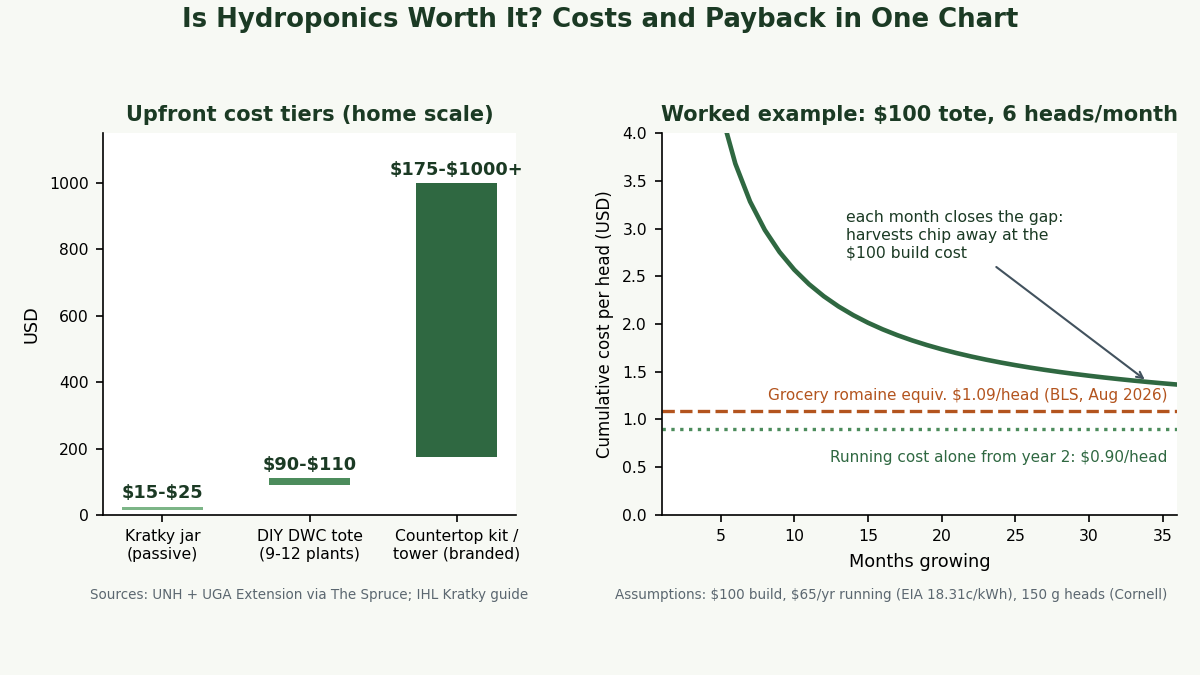
The first variable in is hydroponics worth it is what you pay to get started. Extension horticulturists quoted by The Spruce put home systems into clear price bands (The Spruce, with University of New Hampshire and University of Georgia Extension):
| Setup | Typical cost | Capacity | Best for |
|---|---|---|---|
| Kratky jar or bucket (passive, no pump) | Under $25 | 1 to 2 plants | Trying hydroponics, herbs, one lettuce at a time |
| DIY deep water culture tote | About $100 | 9 to 12 plants | Lettuce and greens for a household |
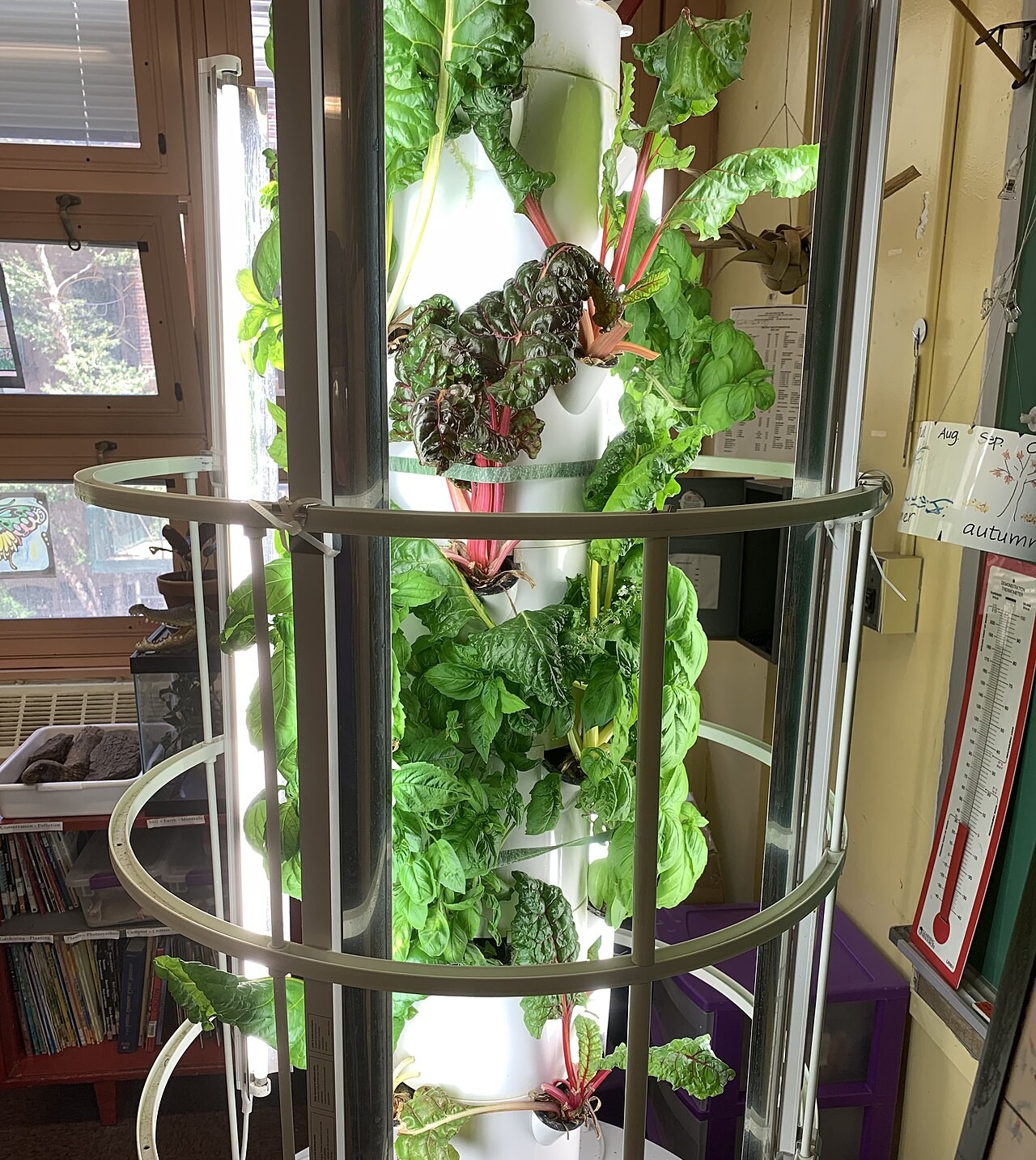
| Countertop kit or indoor tower | $175 to $1,000+ | 6 to 30 plants | Convenience, looks, built-in lights |
Two things stand out. First, the DIY tier is dramatically cheaper per plant than branded kits: you pay for a tote, net pots, an air pump and nutrients, not for industrial design. Second, the ongoing maintenance is modest either way: UGA Extension estimates about 6% of the initial system cost per year in parts and supplies, on top of nutrients and electricity.
The real running costs
Running costs decide is hydroponics worth it more than the sticker price, because they repeat every year. For a small indoor DWC tote with one LED light, the arithmetic looks like this, using the US average residential electricity price of 18.31 cents per kWh (US Energy Information Administration, July 2026):
- Light. A 40-watt LED panel on 14 hours a day uses 0.56 kWh daily, about 204 kWh a year: roughly $37.
- Air pump. A 5-watt aquarium pump running continuously uses about 44 kWh a year: roughly $8.
- Nutrients. Budget $15 to $25 a year at lettuce scale; a concentrated nutrient goes a long way in a 5-gallon reservoir (see our nutrient mixing guide).
- Water. Essentially negligible: recirculating hydroponics uses up to 90% less water than soil growing (University of Nevada, Reno Extension), and a small system drinks a few gallons a week.
- Seeds, net cups, pH supplies. About $10 to $15 a year once you own the pH kit.
| Item | Yearly energy or use | Yearly cost at 18.31 c/kWh |
|---|---|---|
| 40 W LED, 14 h/day | 204 kWh | About $37 |
| 5 W air pump, 24 h/day | 44 kWh | About $8 |
| Nutrient concentrate | Lettuce-strength mixes, 26 reservoir refills | $15 to $25 |
| Seeds, cups, pH reagents | 72 heads worth | $10 to $15 |
Total: roughly $70 to $85 a year for a lit indoor tote, or under $25 a year for a passive Kratky setup on a bright windowsill with no electricity at all. Is hydroponics worth it at these running costs? Only the harvest side of the ledger can say, so let us price that next.
What you actually harvest
The third variable in is hydroponics worth it is yield, and here the trial data is kind. In Cornell University’s controlled-environment work, a marketable 150-gram lettuce head grows from seed in 35 days under a daily light integral of 17 mol/m² (Cornell CEA Lettuce Handbook). A USDA Economic Research Service review of protected-culture trials reports romaine yields around 1.64 kg per plant in deep water culture and 1.32 kg in nutrient film technique, at densities near 50 plants per square meter (USDA ERS, EIB-264).
Scale matters too. A peer-reviewed comparison found hydroponic lettuce produced about 41 kg per square meter per year against 3.9 kg in conventional field production, roughly 11 times more per unit area, because hydroponic crops pack close, grow fast and cycle year-round (Barbosa et al., 2015, International Journal of Environmental Research and Public Health). That is why a closet shelf can genuinely supply a salad habit.
Fruiting crops raise the stakes and the costs. Tomatoes, peppers and strawberries grow beautifully in water but need far stronger light and months longer per cycle, which changes the electricity math. Our guides to tower gardens and EC ranges by crop cover those details. If strawberries are the crop you are pricing up, our guide to growing strawberries indoors has the light and pollination numbers you would be working with.
The payback math, lettuce by lettuce
Here is the worked example we promised, with every assumption on the table so you can swap in your own numbers.
The setup: a $100 DIY DWC tote with 9 net pots, one 40 W LED on 14 hours a day, growing lettuce on Cornell’s 35-day cycle. Allowing cleaning gaps between cycles, 8 cycles a year is realistic: 72 heads, about 24 pounds of lettuce annually.
The grocery comparison: US average retail prices in August 2026 were $3.29 per pound for romaine and $1.47 for iceberg (US Bureau of Labor Statistics). Twenty-four pounds of romaine-equivalent lettuce is worth about $79 a year.
The running cost: about $65 a year ($45 electricity, $20 nutrients and supplies).
The verdict per head: on running costs alone, each head costs about $0.90 from year two onward ($65 divided by 72 heads), comfortably below the $1.09 grocery equivalent. Counting the $100 build in the cumulative total, the per-head cost starts near $2.50 in year one and glides down toward the store price for several years, crossing it only with steady long-term harvests.
That is the honest center of is hydroponics worth it: the system beats grocery romaine on running costs quickly, but the hardware pays itself back slowly on plain lettuce, and much faster if you grow basil or currently buy premium packaged greens. Fresh basil illustrates why: it retails by the fraction of an ounce, so even a single productive plant displaces several plastic clamshells a month. Real savings, measured in seasons, not weeks.
When is hydroponics worth it?
Is hydroponics worth it for you? It usually is, if any of these describe you:
- You buy greens or herbs every week. Rolling harvests of lettuce, basil and cilantro are exactly the crops where home hydroponics undercuts store prices, and extension horticulturists name them as the worthwhile crops (The Spruce, citing UNH and UGA Extension).
- You have no garden. A spare closet, shelf or corner with an LED replaces a yard. The 11-times yield per area advantage (Barbosa 2015) belongs entirely to people with no soil to begin with.
- You want salads in January. Year-round cycles are the structural advantage: produce grown anywhere, any season (UNR Extension).
- You value freshness over cents. A head cut at 6 pm beats any bagged green on quality, and nothing spoils in the crisper.
- You enjoy the hobby itself. If tending the system is fun rather than a chore, the running costs buy you produce plus entertainment.
Is hydroponics worth it as a first step into indoor growing? Yes, with a caveat: start at the cheap tier. Our DWC setup guide and Kratky walkthrough are built for exactly that.
When it is not worth it
An honest is hydroponics worth it has to name the losing cases too:
- If your benchmark is the cheapest grocery lettuce. Against $1.47 iceberg, no plugged-in system wins on money. The BLS floor price is simply too low.
- If you want root vegetables or corn. Extension specialists call these impractical for home hydroponics (The Spruce): the economics and the hardware both fail.
- If you travel constantly. Pumped systems need a watching brief; a week away with a failed pump is a dead crop. Passive Kratky jars are the exception.
- If you already have good garden soil and time. Oklahoma State Extension notes upfront and operating costs are higher than soil culture (OSU Extension, HLA-6442). A sunny raised bed grows lettuce for seed money.
- If you will not measure. pH and EC drift quietly; growers who will not test weekly end up blaming the method.
One more honesty note: the energy ledger. The Barbosa comparison found greenhouse hydroponic lettuce took about 82 times more energy per kilogram than field lettuce, mostly lighting and climate control. Hydroponics trades energy for land and water. If your goal is the lowest-footprint salad and you have a sunny yard, soil wins that trade; if you have neither land nor water to spare, hydroponics wins it.
What not to do
- Do not buy a $500 kit as your first system. Learn on $25 to $100 of hardware, then upgrade once you know what you like growing.
- Do not count lettuce you will not eat. Payback math only works on groceries you actually buy today.
- Do not forget electricity in the budget. The light, not the pump, dominates: about 80% of the power bill in our example.
- Do not start with fruiting crops to “make it pay”. Tomatoes indoors need serious light; lettuce pays back faster on weak light.
- Do not ignore water quality. Hard or chloraminated tap water quietly skews nutrient balance; check our tap water guide first.
- Do not assume “hydroponic” on a kit means “no work”. Every system needs weekly pH checks and reservoir changes (see how often to change the water).
Where this applies
The math here uses US averages: 18.31 cents per kWh and national retail lettuce prices. Your numbers will move the answer. Electricity in the 12-cent states makes every lit system about a third cheaper to run; at 30 cents or more, passive window systems pull further ahead. Grocery prices move the other side of the ledger: where fresh greens are expensive or travel far, payback shortens. The structure of the calculation, setup cost plus running cost against grocery value, works anywhere; swap in your utility rate and your receipt prices.
FAQ
Is hydroponics worth it for beginners? Yes, at the cheap tier. A sub-$25 Kratky jar or a $100 tote teaches the method with almost nothing at risk. Beginners lose money only when they start with a premium kit and a difficult crop.
Is hydroponics worth it compared with growing in soil? Per square foot and per gallon of water, hydroponics wins clearly (about 11 times the yield per area, 90% less water). Per dollar and per kilowatt-hour, soil wins when you have a sunny garden. Indoors with no garden, hydroponics has no soil competitor to beat.
How long does a hydroponic system take to pay for itself? On running costs alone, our worked example (a $100 tote growing lettuce under a 40 W light) undercuts store romaine from the second year. Recovering the $100 build cost against the cheapest grocery lettuce takes several seasons of steady harvests; against premium packaged greens or herbs it comes much sooner. Passive no-light systems can pay back within a single season.
Does hydroponics use a lot of electricity? A small lit system uses about 250 kWh a year, roughly $45 at the US average rate: comparable to running a second refrigerator’s light circuit. Passive systems use none.
Is an expensive hydroponic kit worth it over DIY? Only for convenience and looks. Extension estimates put DIY at about $100 for 9 to 12 plants versus $175 to $1,000 or more for branded units of similar capacity. The plants cannot tell the difference.
Is hydroponics worth it for strawberries and tomatoes? It can be, but the math tightens. Fruiting crops need two to three times the light intensity of lettuce and months per cycle, so the electricity line doubles while harvest weight per pot stays similar. Grow them because you want vine-ripe fruit in February, not to beat grocery prices.
Is hydroponics worth it in an apartment or rental? It is arguably the best case: no landlord permission needed, no soil mess, and a tote or tower leaves with you. This is the situation where the space answer, not the money answer, decides.
Related guides
What Is Hydroponics? How Soil-Free Growing Actually Works · Kratky Method: How to Grow Lettuce Without a Pump · Deep Water Culture (DWC) for Beginners · How to Grow Lettuce Indoors Under Lights · Browse all in Getting Started
Sources
- The Spruce, with University of New Hampshire Extension (Suzanne Ebba) and University of Georgia Extension (Wayne Westerfield). Are Hydroponic Gardens Cost-Effective?.
- US Bureau of Labor Statistics. Average Retail Food and Energy Prices, US and Midwest (lettuce prices, August 2026).
- US Energy Information Administration. Electric Power Monthly (average residential price, July 2026).
- Cornell University Controlled Environment Agriculture. Cornell CEA Lettuce Handbook.
- USDA Economic Research Service (2025). Trends, Insights, and Future Prospects for Production in Controlled Environment Agriculture (EIB-264).
- Barbosa, G.L. et al. (2015). Comparison of Land, Water, and Energy Requirements of Lettuce Grown Using Hydroponic vs. Conventional Agricultural Methods. International Journal of Environmental Research and Public Health, 12(6).
- University of Nevada, Reno Extension. Hydroponics: A Brief Guide to Growing Food Without Soil.
- Oklahoma State University Extension. Hydroponics (HLA-6442).
Featured image: chart by Indoor Harvest Lab, built from the BLS, EIA, Cornell and UGA Extension figures cited above.