
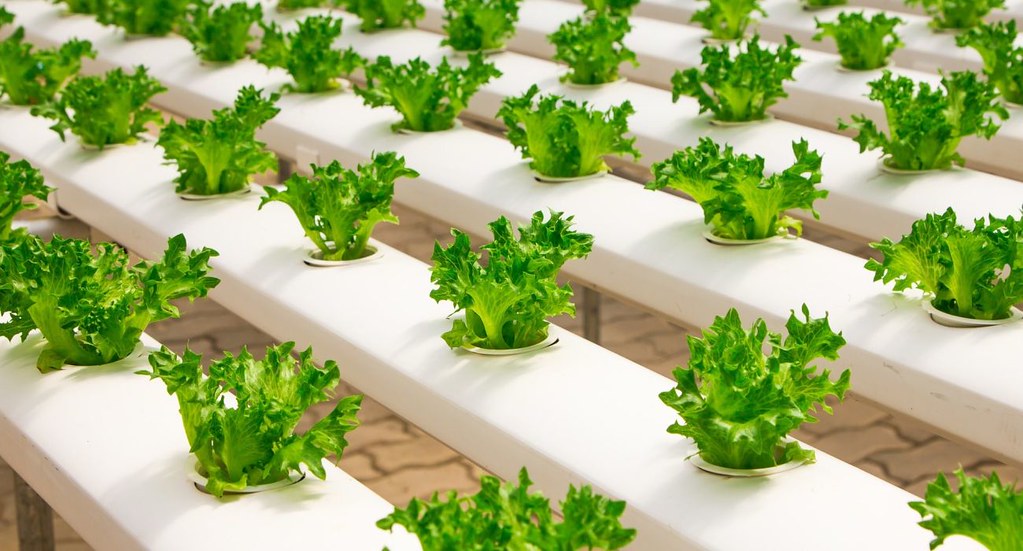
Short answer: NFT hydroponics (nutrient film technique) grows plants in sloped channels where a thin, constantly flowing film of nutrient solution runs past the roots and drains back to a reservoir. Cornell’s CEA program recommends a channel slope of 1 to 4% (1 to 4 inches of drop over an 8-foot channel), a pump that delivers at least 10 liters per hour for every plant, and 8-inch spacing for head lettuce or about 4 inches for small herbs. NFT hydroponics suits lettuce, basil and other leafy greens; it is a poor fit for tomatoes and other long-lived vining crops.
This guide explains how an NFT system works, how to set the slope and flow rate, which crops do well, and the maintenance habits that prevent the two classic failures: dry channels and warm, oxygen-poor water.
Table of Contents
How NFT hydroponics works
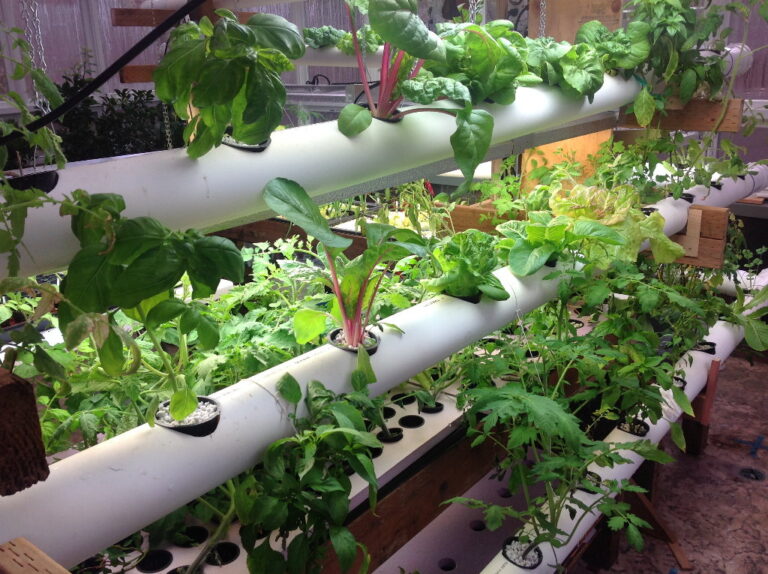
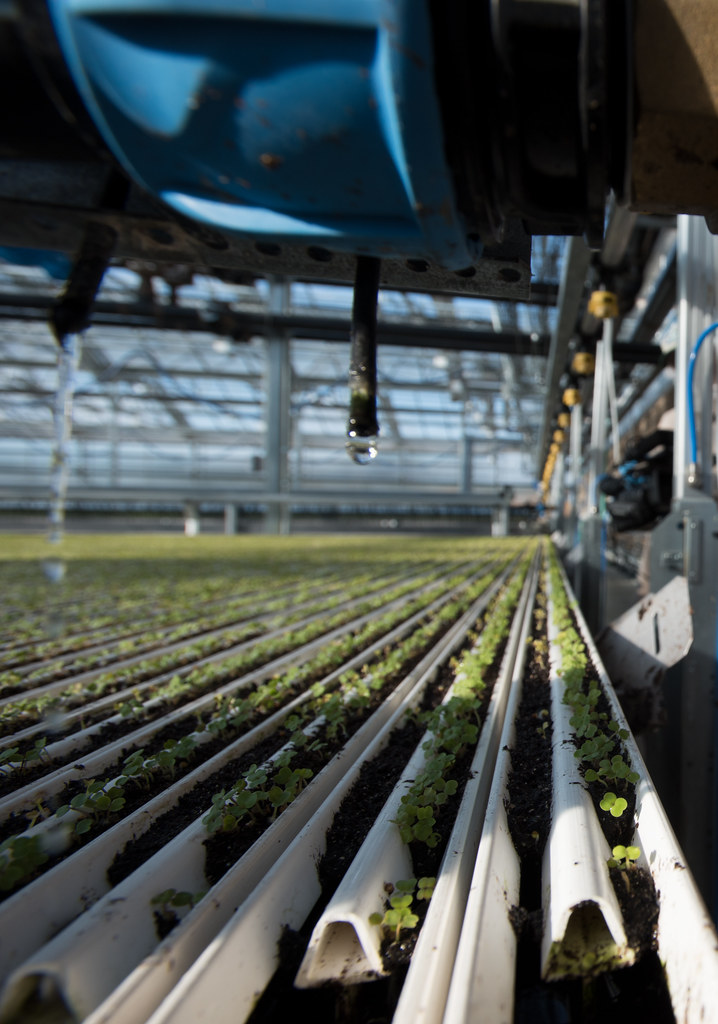
An NFT hydroponics system has four parts: a reservoir, a pump with tubing, one or more channels (also called gullies or gutters) that hold the plants, and a light. The pump lifts nutrient solution to the high end of each channel. The solution flows downhill as a shallow film, the roots sit in that film with their upper parts in moist air, and the solution drains back into the reservoir to be pumped again.
Because the film is thin, roots get oxygen from the air around them as well as from the moving water. That is the key difference from deep water culture, where roots hang in a deep, aerated tub, and from the Kratky method, where nothing moves at all.
NFT hydroponics vs deep water culture vs Kratky
| Feature | NFT hydroponics | Deep water culture | Kratky |
|---|---|---|---|
| Water around roots | Thin moving film | Deep, aerated reservoir | Still water, falling level |
| Pump or air pump | Water pump, runs constantly | Air pump and air stone | None |
| If power fails | Channels drain; roots can dry quickly | Roots stay in solution | No effect |
| Leak risk | Higher (many fittings) | Low | Very low |
| Solution volume per plant | Small | About 1 gallon per plant at home | Fixed by container |
| Best for | Leafy greens, herbs cut repeatedly | Lettuce, basil, kale | Single harvest of greens |
Yield differences between NFT hydroponics and deep water systems are small. In an Iowa State study of 35 basil cultivars, Walters and Currey found no difference in the first run and only a 2.6 g fresh-weight edge for deep flow in the second, against an NFT plant average of 24.4 g. They concluded that cultivar mattered more than system, and that NFT may suit herbs harvested repeatedly because the channels sit at a comfortable working height.
A 2025 HortScience study compared four systems for lettuce and arugula. Lettuce performed well in both deep water culture and NFT; deep water culture gave the highest yield and water-use efficiency, while NFT gave a more balanced performance. The NFT reservoir for lettuce also showed the widest swings in its readings, which is a reminder that small NFT reservoirs need closer monitoring.
What you need for NFT hydroponics
The parts list below follows Cornell CEA’s Guide to Home Hydroponics for Leafy Greens, which built and tested home NFT and deep water systems.
- Reservoir with a lid: opaque, so light cannot reach the solution and feed algae. Larger volumes buffer pH, EC and temperature better. Plan for about 100 mL of water loss per plant per day (Cornell’s figure for head lettuce), or roughly 0.7 liters per plant per week.
- Pump: able to move at least 10 liters per hour per plant, at the height it must lift the water.
- Tubing: a ½ to 1 inch manifold, with ¼ inch feeder lines to each channel; Cornell found narrower feeders sometimes clogged.
- Channels: commercial NFT channels or food-safe PVC pipe with end caps, drilled for net cups or rockwool cubes.
- Return line: wide PVC pipe from the low ends back to the reservoir.
- Frame, light and timer, rockwool cubes, seeds and nutrients.
NFT hydroponics channel slope
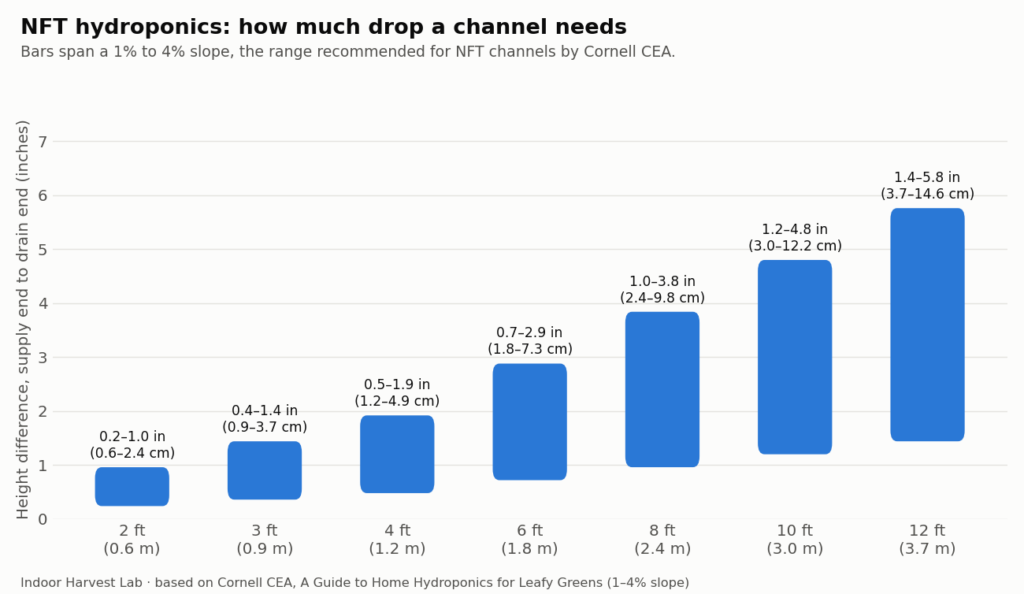
Cornell’s guide gives a slope of 1 to 4% for NFT channels. On an 8-foot (96-inch) channel that means the supply end sits 1 to 4 inches higher than the drain end. Flat channels let water pool, especially once roots fill the channel, which creates low-oxygen and low-nutrient pockets.
Steeper, within that range, can help oxygen. In a 2011 HortScience study, López-Pozos and colleagues grew tomatoes in 14-meter NFT channels in a warm climate and found 5% more dissolved oxygen at a 4% slope than at 2%. Oxygen limited yield at midday, and the steeper slope gave the best results. For a short home NFT hydroponics channel, 2 to 3% is a practical middle: enough fall to keep water moving, not so much that the film races past small seedling roots.
NFT hydroponics flow rate: how much water per channel
The Cornell guide sizes the pump at a minimum of 10 liters per hour per plant, based on commercial systems. That scales simply:
| Plants in the system | Minimum flow (L/h) | Approx. gallons per hour | Approx. L/min |
|---|---|---|---|
| 6 | 60 | 16 | 1.0 |
| 12 | 120 | 32 | 2.0 |
| 24 | 240 | 63 | 4.0 |
| 48 | 480 | 127 | 8.0 |
For NFT hydroponics pumps, remember that labels give flow at zero lift, so buy a pump rated well above your target and turn it down. In Cornell’s own shelf system, a small aquarium-style pump rated at 95 gallons per hour ran on its lowest setting of 35 gallons per hour, which suited a single 2-foot channel of herbs.
More flow is not always better. In a 2021 Horticulturae study on Swiss chard, growth improved as flow increased up to an ideal rate for the container, then declined when flow went beyond it. The goal in NFT hydroponics is a shallow, steady film, not a stream deep enough to cover the root mat.
How to set up NFT hydroponics in 8 steps
- Build the frame first. A table, shelf or A-frame works. Leave room below the low end for the reservoir and return pipe.
- Set the slope. Shim the supply end 1 to 4% higher than the drain end (see the chart above) and check with a level.
- Drill planting holes. Use 8-inch centers for head lettuce and about 4 inches for small herbs; with lettuce in a 4-inch channel, plant every other hole.
- Plumb the supply. Place the pump in the reservoir and run a manifold with ¼ inch feeders to the high end of each channel.
- Plumb the return. Run a wide PVC return from each low end back into the reservoir, and cover the reservoir with a lid or foam board.
- Test with water only. Run the system for a day and check every joint for drips before adding nutrients or plants.
- Mix the nutrient solution. Match EC and pH to your crop using our hydroponic EC chart; lettuce, for example, is listed at EC 1.2 to 1.8 and pH 6.0 to 7.0 by Oklahoma State. Adjust pH after the nutrients are in (see how to lower pH in hydroponics).
- Transplant. Set seedlings in rockwool cubes or net cups so the bottom touches the film. Run the pump continuously until harvest.
Best crops for NFT hydroponics
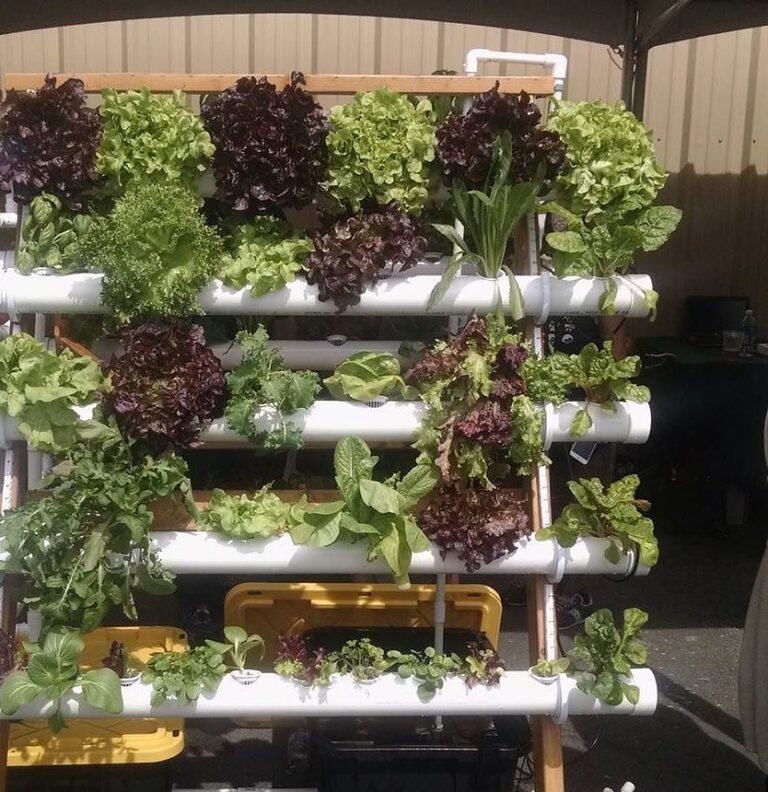
Cornell describes NFT as a strong choice for leafy greens and herbs, and advises against vine crops such as tomatoes for home NFT hydroponics, because their long-lived roots can clog the channel, disrupt flow and create low-oxygen conditions. Commercial growers do run NFT tomatoes in long channels, but that takes careful management.
| Crop | Suggested spacing | EC (mS/cm) | pH | Notes |
|---|---|---|---|---|
| Lettuce | 8 in | 1.2–1.8 | 6.0–7.0 | The classic NFT crop |
| Basil | 4 in | 1.0–1.6 | 5.5–6.0 | Good for repeated cutting |
| Parsley | 4 in | 1.8–2.2 | 6.0–6.5 | Cut-and-come-again herb |
| Pak choi | 8 in | 1.5–2.0 | 7.0 | Oklahoma State lists a higher pH |
| Spinach | 8 in | 1.8–2.3 | 6.0–7.0 | Pythium-prone, per Cornell |
Spacing follows Cornell’s home guide (8 inches for larger heads, about 4 inches for small herbs); EC and pH ranges are from the Oklahoma State University fact sheet HLA-6722.
Water temperature in NFT hydroponics
In NFT hydroponics, thin films warm up fast under lights, and warm water holds less oxygen. Two Oklahoma State studies measured this in NFT systems. For lettuce, Thakulla and colleagues found that solution held at 21.1 °C (70 °F) gave 15% more shoot fresh weight than unregulated water that ranged from 20 to 26.5 °C; cooler 18.3 °C water gave sweeter lettuce (higher °Brix) but less growth. For basil, Hendrickson and colleagues recommended 27.5 °C (about 81 °F) for most cultivars; plants at 27.5 and 31 °C had more leaves and root mass than at 23 °C.
So lettuce and basil prefer different water: aim for about 21 °C for lettuce and do not worry if basil channels run warmer. Keep the reservoir shaded and lidded, and in warm rooms consider a larger reservoir or a chiller.
NFT hydroponics mistakes to avoid
- Flat or sagging channels. Water pools, roots sit in stale solution and oxygen drops. Support long channels along their length.
- Undersized pumps. Size for at least 10 L/h per plant at the real lift height, not the label maximum.
- Ignoring leaks. Cornell names leaks at pipe joints as the main NFT problem. Use PVC cement on joints you will not take apart and thread tape on the rest.
- No plan for power cuts. NFT channels drain once the pump stops, and Cornell warns that plants can quickly suffer drought stress. A battery backup or a quick manual refill plan protects young plants.
- Clear or light-colored reservoirs. Light reaching the solution feeds algae, which clogs feeders.
- Vining crops in small channels. Tomato and cucumber roots can block the flow.
- Skipping sanitation. The University of Connecticut e-GRO alert on Pythium in lettuce advises starting every crop with a clean system, keeping dissolved oxygen at 6 mg/L or more and avoiding extreme water temperatures. One infected plant can spread root rot to every channel sharing the water.
NFT hydroponics maintenance schedule
Cornell’s quick guide for home NFT hydroponics suggests checking pH and EC once or twice a week and topping up the reservoir every one to two weeks, or sooner as plants grow. Check feeder lines and channel ends for root mats and clogs each week, clear roots from the return pipe, and look at roots when you harvest: healthy roots are white with plenty of fine root hairs, while brown tips and a “rat-tail” core are signs of Pythium, according to e-GRO. After each crop, empty, clean and sanitize channels, tubing and reservoir.
Where this applies
These NFT hydroponics numbers suit indoor and greenhouse growing anywhere. The main local variable is heat. In hot rooms, sunny windows or warm climates, channels heat quickly, so use a steeper slope within the 1 to 4% range, lids on the reservoir, and shading or cooling; López-Pozos found oxygen became limiting at midday in a warm climate. In cool basements, the risk is the opposite: lettuce grew best at about 21 °C in the Oklahoma State trial, so very cold water may slow growth. Where power cuts are common, deep water culture is the more forgiving system.
See more hydroponic systems guides.
FAQ
What slope should an NFT channel have?
Between 1 and 4%, per Cornell CEA: 1 to 4 inches of drop for every 100 inches of channel, or about 1 to 4 inches over an 8-foot channel.
What flow rate does NFT hydroponics need?
At least 10 liters per hour per plant, according to Cornell’s home guide. Twelve lettuce plants need about 120 L/h, or roughly 2 liters per minute.
Can you grow tomatoes in NFT hydroponics?
Commercial growers do, but for home systems Cornell advises against it because tomato roots clog channels and reduce oxygen. A larger container system is usually easier for them.
Is NFT hydroponics better than deep water culture?
Yields were similar in both published comparisons cited above. Choose deep water culture if leaks or power cuts worry you, and NFT if you want waist-height channels and small solution volumes.
Sources
- Cornell CEA. A Guide to Home Hydroponics for Leafy Greens.
- Walters, K.J. and Currey, C.J. (2015). Hydroponic greenhouse basil production: comparing systems and cultivars. HortTechnology 25(5).
- Hutchinson, G.K., Rubio Ames, Z., Nemali, K. and Ferrarezi, R.S. (2025). Arugula and lettuce responses to greenhouse hydroponic systems. HortScience 60(4).
- López-Pozos, R. et al. (2011). The effects of slope and channel nutrient solution gap number on the yield of tomato crops by a nutrient film technique system under a warm climate. HortScience 46(5).
- Baiyin, B. et al. (2021). Effect of the flow rate on plant growth and flow visualization of nutrient solution in hydroponics. Horticulturae 7(8).
- Thakulla, D. et al. (2021). Nutrient solution temperature affects growth and °Brix parameters of seventeen lettuce cultivars grown in an NFT hydroponic system. Horticulturae 7(9).
- Hendrickson, T. et al. (2022). Effects of elevated water temperature on growth of basil using nutrient film technique. HortScience 57(8).
- Raudales, R.E. and McGehee, C. (2016). Pythium root rot on hydroponic lettuce. e-GRO Alert, University of Connecticut.
- Dunn, B. and Singh, H. Electrical Conductivity and pH Guide for Hydroponics (HLA-6722). Oklahoma State University Extension.
Featured image: “Nutrient Film Technique” by pabloportugues91, Public Domain Mark.