
You open a packet of tiny round seeds that look like poppy seeds’ bigger cousins. Ten days later you’re snipping a tray of crisp, mild green shoots that taste like the stem of a fresh broccoli head, minus the cabbage funk. No garden, no pests, no waiting for a head to form. That’s the appeal of broccoli microgreens, and why they’re the microgreen nutrition researchers study more than almost any other.
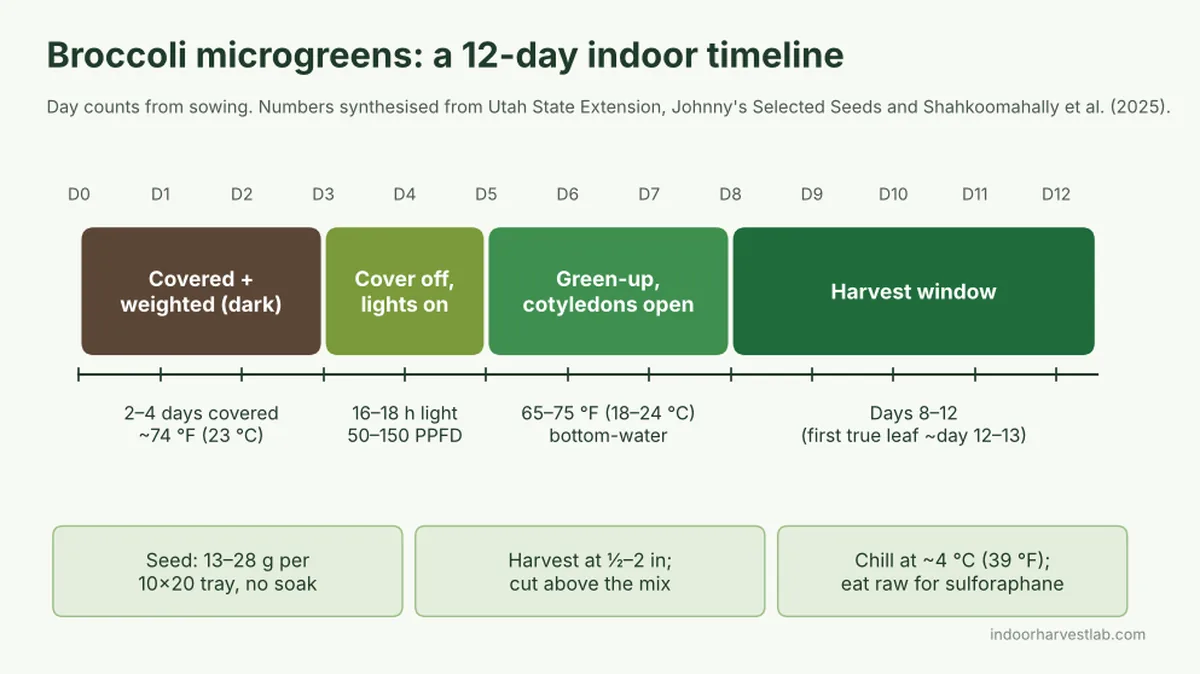
Short answer: broccoli microgreens are broccoli seedlings (Brassica oleracea var. italica) cut 8–12 days after sowing, when the two seed leaves are open and the first true leaf is just appearing. Sow 13–28 g of unsoaked seed per 10×20-inch tray, keep it covered for 2–4 days at about 74 °F (23 °C), then grow under 16–18 hours of light. They’re a rich, raw source of glucoraphanin, the compound your body turns into sulforaphane.
This guide pulls the numbers from Utah State and Penn State extension work, seed-company yield trials and the growing pile of controlled-environment research on broccoli into one plan. By the end you’ll know how much seed to use, how much light broccoli really needs (less than you’d think), when to cut, how to store the harvest, and what the science does and doesn’t say about broccoli microgreens vs sprouts. If you’ve already grown radish microgreens, broccoli will feel familiar, just a little slower and a lot milder.
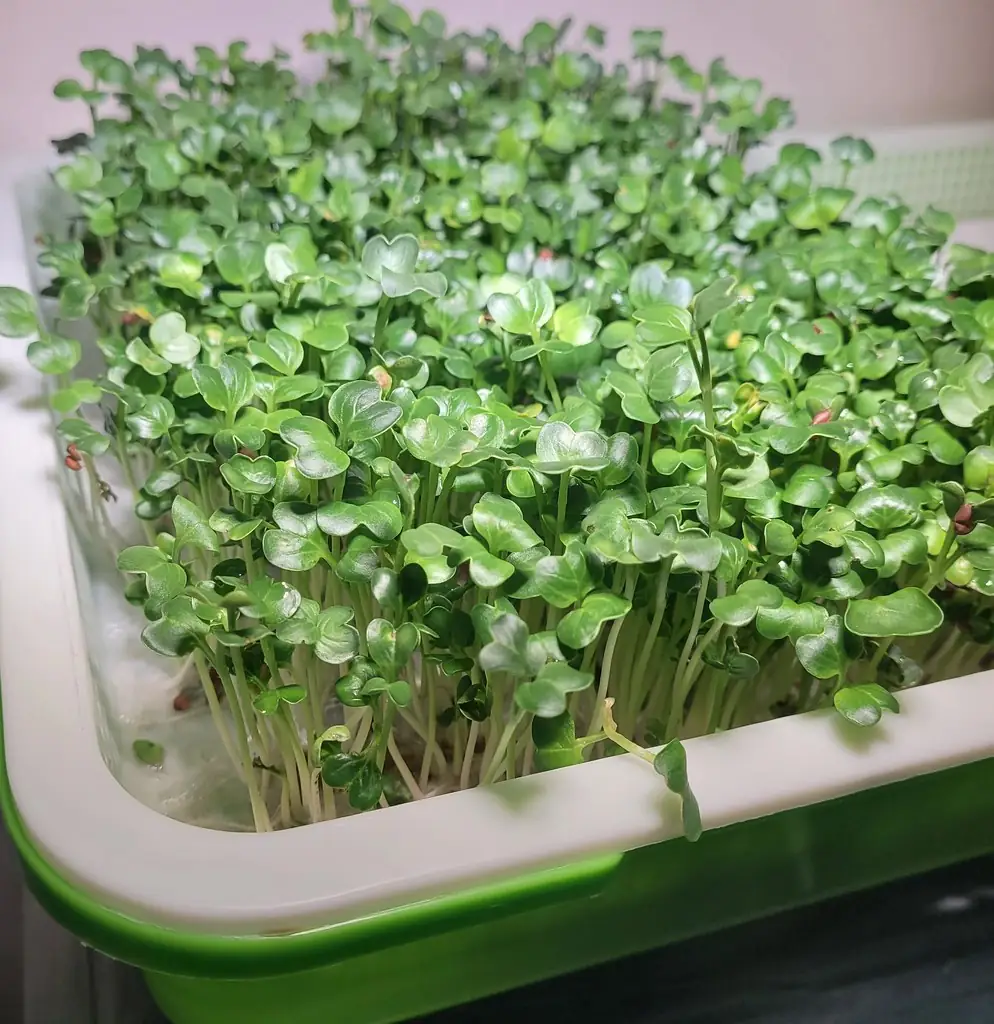
Broccoli earns its spot for three reasons: it’s easy, it’s mild, and it’s unusually well studied.
On the easy side, the seed doesn’t need soaking, germinates quickly and fits the standard brassica routine. Utah State University Extension lists broccoli at 28 g of seed per 1020 tray, no presoak, 2–4 days covered and 8–12 days to harvest. That’s the same rhythm as kale and only a couple of days slower than radish.
On flavor, Johnny’s Selected Seeds describes it simply as “mild broccoli flavor” with dark green leaves and long stems. That makes it the microgreen to hand someone who says they don’t like microgreens. It disappears into a sandwich, smoothie or omelet without the bite of radish or mustard.
And on nutrition, broccoli has decades of research behind it. In 1997, Johns Hopkins researchers reported that 3-day-old broccoli sprouts contained 10–100 times more glucoraphanin than the mature vegetable. More recently, an Oregon State University feeding study found that broccoli microgreens carry glucoraphanin at levels similar to sprouts, and that people who ate them excreted sulforaphane metabolites much like sprout eaters do. We’ll unpack what that means later.
Broccoli microgreens numbers to hold
Before the steps, here are the figures that matter. Every number comes from the sources listed at the end.
| What | Target | Source |
|---|---|---|
| Seed per 10×20 tray | 13 g (Johnny’s yield trial) to 28 g (Utah State) | Johnny’s; USU Extension |
| Seeds per pound | ~127,700 (≈280 per gram) | Johnny’s |
| Presoak | None | USU Extension |
| Covered (dark) time | 2–4 days | USU Extension |
| Germination temperature | ~74–75 °F (23–24 °C) | USU Extension; Johnny’s |
| Growing temperature | 65–75 °F (18–24 °C); 72 °F lights on, 68 °F lights off | Johnny’s; USU Extension |
| Light hours | 16–18 h per day | Shahkoomahally et al. 2025; USU Extension |
| Light intensity (PPFD) | 50–150 µmol/m²/s; 50–100 gave the most fresh weight | Shahkoomahally et al. 2025 |
| Days to harvest | 8–12 (≈12.5 at first true leaf) | USU Extension; Johnny’s |
| Harvest height | ½–2 inches | Johnny’s |
| Cold storage | ~39 °F (4 °C) | Bouranis et al. 2023; Shahkoomahally et al. 2025 |
One quick sanity check ties these together. At about 280 seeds per gram, 28 g is roughly 7,800 seeds. Spread over a 10×20-inch tray (about 0.13 m²), that’s around 60,000 seeds per square metre, close to the 66,000 seeds/m² used in the University of Florida-led light study. So the extension rate and the research rate agree. Johnny’s lighter 13 g rate gives a sparser stand with bigger individual seedlings, which suits harvesting at the first true leaf.
How to grow broccoli microgreens step by step
Here’s the full routine, written for a 10×20-inch tray. For smaller containers, scale the seed by area; our microgreens seeding density guide has the per-square-inch math.
Step 1: Prepare the tray and medium
Use a shallow tray with drainage holes nested inside one without. Utah State’s method is simple: pre-moisten coconut coir until it feels like a wrung-out sponge, add about 2 quarts to the tray, then set it in a solid tray holding 2 cups of water for 30 minutes and pour off what’s left. Seed-starting mix and hydroponic grow mats work too. Hemp and felt mats are the cleanest option if you want to skip soil entirely.
Step 2: Weigh and spread the seed
Weigh 13–28 g of seed. Start near 20 g if you’re unsure, then adjust next round. Scatter it evenly so seeds sit roughly ⅛–¼ inch apart, as Johnny’s recommends for brassicas, and press them gently into the surface for good contact. Mist lightly. Don’t soak broccoli seed first; it’s small, it wets quickly, and soaked seed clumps.
Step 3: Cover, weight and keep it dark
Place another tray directly on the seed and add 2–5 pounds of weight. Utah State explains why: the weight keeps seeds in contact with the medium, so roots are forced down instead of lifting the seed up. Leave it in contact for about half the dark period, until roots are clearly pushing in. Then flip the top tray so it covers without touching. The seedlings stretch a little in the dark, which gives you longer, cleaner stems to cut. Our microgreens blackout period guide covers the timing in more detail.
Step 4: Turn on the lights
After 2–4 days, uncover and move the tray under lights. Utah State runs lights 18 hours on, 6 off, on a timer. Research chambers often use 16 hours. Either works. A south-facing window can do the job in summer, but in October-to-February light, a simple LED shop light or grow light is far more reliable. Keep air moving with a gentle fan.
Step 5: Water from below
From here on, bottom-water: pour water into the lower tray and let the medium wick it up. Johnny’s advises bottom watering or misting so the mix doesn’t splash onto the seedlings, and keeping moisture even without letting the medium dry out. Wet leaves and stagnant air are exactly what mold wants.
Step 6: Harvest at the right moment
Broccoli has a forgiving harvest window. Cut as soon as the seed leaves are fully open for the most tender texture, or wait for the first true leaf for a little more bulk, which is when Johnny’s measured its 12.5-day average. Use clean, sharp scissors and cut just above the medium. Johnny’s notes most microgreens are harvested at ½–2 inches. Harvest in the morning or after the lights have been on a few hours, when the plants are fully turgid, and avoid cutting right after watering.
Step 7: Store the harvest and plan the next tray
Keep the harvest cold and dry. The Oregon State study held broccoli microgreens at 4 °C (39 °F) for six days with no significant loss of glucoraphanin. In the University of Florida light study, bagged broccoli microgreens kept high quality after 4 and 12 days at 4 °C, with yellowing appearing later, more so in microgreens grown under high light. Don’t wash before storing; wash just before eating and pat dry.
Broccoli microgreens don’t regrow usefully after cutting, because you remove the growing point. Sow a fresh tray every 4–5 days for a steady supply. If you want variety, try them alongside sunflower microgreens or pea shoots, which bring crunch and sweetness to balance broccoli’s mildness.
Light and temperature: what broccoli microgreens really need
This is where broccoli surprises people. You don’t need a powerful grow light.
A 2025 study led by University of Florida researchers grew broccoli microgreens on felt mats under white LEDs from 50 to 150 µmol/m²/s PPFD, on a 16-hour photoperiod, and harvested on day 13. The trays under 50, 75 and 100 µmol/m²/s produced the highest fresh weight. As light dropped, stems got longer. Higher light (100–150) gave more chlorophyll, carotenoids and anthocyanins, while lower light (50–75) gave more vitamin C and total phenolics. And microgreens grown at 50–75 kept their quality better in cold storage, with fewer yellow leaves after weeks in the fridge.
A companion study from the same group found that total glucosinolates were similar across 50, 100 and 150 µmol/m²/s of white light. Adding far-red light raised total glucosinolates. A separate 2023 study in Food Chemistry found that blue LED light increased glucoraphanin and total glucosinolates in broccoli microgreens.
| PPFD (µmol/m²/s) | What the research saw in broccoli microgreens | Practical takeaway |
|---|---|---|
| 50–75 | High fresh weight, longer stems, more vitamin C and phenolics, best shelf life | A cheap LED shop light 6–12 inches above the tray is enough |
| 100 | High fresh weight plus more pigment | A good all-round target |
| 150 | Most chlorophyll and anthocyanin; more yellowing in storage | No yield gain; costs more electricity |
Temperature matters as much as light. Johnny’s gives an ideal germination soil temperature of 75 °F (24 °C), a growing range of 65–75 °F (18–24 °C), and warns that temperatures above 75 °F can increase disease and inhibit germination. Utah State holds 74 °F during germination, 72 °F with lights on and 68 °F with lights off. In a cold winter room, a seedling heat mat under the tray during the dark phase makes germination far more even.
Broccoli microgreens vs sprouts: which should you grow?
This is the most-searched comparison, and the honest answer is that they’re two different foods grown two different ways.
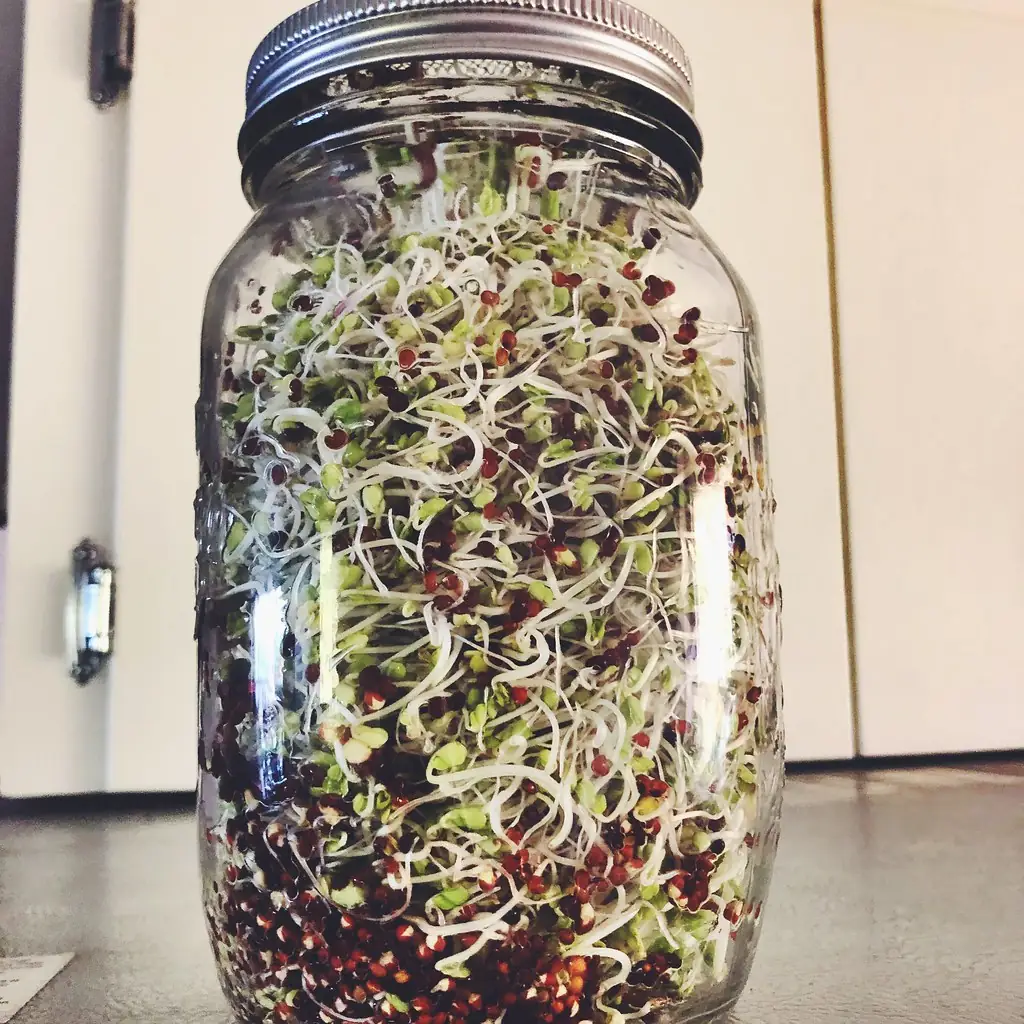
Sprouts are germinated seeds grown in water, usually in a jar, for a few days. You eat the whole thing: seed, root and shoot. Microgreens are grown in a medium under light for 8–12 days, and you cut and eat only the shoots and seed leaves.
| Broccoli sprouts | Broccoli microgreens | |
|---|---|---|
| Age at harvest | ~3–5 days | 8–12 days |
| Grown in | Water, in a jar or sprouter, no light needed | Coir, soil mix or a mat, under light |
| Part eaten | Whole seedling, including seed and root | Stems and leaves cut above the medium |
| Glucoraphanin | 10–100× the mature vegetable (3-day sprouts, Fahey et al. 1997) | Similar range to sprouts (~13 vs 16.6 µmol/g in Bouranis et al. 2023’s comparison) |
| Flavor and texture | Crunchy, slightly sharp | Mild, leafy, broccoli-stem flavor |
| Food-safety note | Raw sprouts carry a well-known risk; FDA advises higher-risk groups to avoid them raw | Lower-contact growing, but clean seed and handling still matter |
The safety row deserves a plain explanation. As University of Connecticut food-safety specialists put it, sprouts grow best in the same conditions as the bacteria that cause foodborne illness: warm, moist and nutrient-rich, often for days at room temperature. That’s why FoodSafety.gov advises children, older adults, pregnant women and people with weakened immune systems to avoid raw sprouts of any kind. Microgreens share some of that overlap, since both start from seed in humid conditions, but you harvest only the part above the medium. A review in the International Journal of Food Microbiology compared the two and flagged seed quality, irrigation water and handling as the key control points for microgreens.
So which should you grow? If you want the highest glucoraphanin per bite in the shortest time and you’re comfortable with sprout hygiene, sprouts are hard to beat; our guide to growing sprouts in a jar shows the method. If you want a leafy green that tastes better, holds up in a salad and still carries a comparable glucoraphanin load, grow broccoli microgreens. Many people do both.
Broccoli microgreens benefits: what the research actually shows
Broccoli microgreens get a lot of health claims online. Here’s what’s measured and where the evidence stops.
Glucoraphanin and sulforaphane
Broccoli doesn’t contain much free sulforaphane. It stores glucoraphanin, a glucosinolate, and keeps it apart from an enzyme called myrosinase. As Oregon State’s Linus Pauling Institute explains, when plant cells are damaged by chopping or chewing, myrosinase meets the glucosinolate and converts it into isothiocyanates such as sulforaphane. Cooking inactivates myrosinase; light steaming for under 5 minutes keeps some of it working.
In the Oregon State feeding study, 11 healthy adults ate a single 16 g (0.56 oz) serving of 10-day-old broccoli microgreens. The microgreens held about 13 µmol/g of glucoraphanin, stable after 6 days at 4 °C, and the participants’ urine showed sulforaphane metabolite profiles similar to those reported for broccoli sprouts. The authors concluded broccoli microgreens are a significant source of sulforaphane. That’s a small, single-serving study, so it shows the compound gets absorbed, not that eating microgreens prevents any disease.
Minerals
A 2017 study in Frontiers in Nutrition grew broccoli microgreens in compost and hydroponically at home-scale. Regardless of method, the microgreens had more magnesium, manganese, copper and zinc than the mature vegetable per unit weight. The compost-grown ones averaged 1.73 times the mature vegetable across eight minerals. The author also estimated that growing a nutritionally equivalent amount of broccoli as microgreens would take 158–236 times less water than field production in California’s Central Valley.
You’ll see claims about blood sugar, weight and inflammation. Those come from mouse and cell-culture studies using broccoli microgreen juice or extracts. They’re interesting leads, but they aren’t evidence that eating a handful of microgreens does the same in people. Treat broccoli microgreens as a nutrient-dense vegetable, not a supplement.
How to keep the sulforaphane
The practical takeaway is easy: eat them raw, and chew them well. Add them to a finished dish rather than cooking them in it. Sprinkling a handful on soup after it comes off the heat, or blending them into a smoothie, keeps the myrosinase intact.
Troubleshooting broccoli microgreens
Most problems trace back to moisture, airflow or temperature. Use this table to match what you see with the likely cause.
| What you see | Likely cause | What to do |
|---|---|---|
| Patchy, uneven germination | Seed lifted by roots; uneven moisture; cold room | Weight the cover for the first half of the dark period; use a heat mat to hold ~74 °F |
| Long, floppy, pale stems | Too long in the dark or too little light | Uncover at 2–4 days; lower the light; 50–100 PPFD is plenty |
| Gray-white web over seeds and stems, musty smell | Mold from wet surface and still air | Bottom-water only, add a fan, reduce seed rate; see our microgreens mold guide |
| Fine white fuzz on roots only, no smell | Root hairs (normal) | Mist it; root hairs collapse when wet, mold doesn’t |
| Stems collapse at the base | Damping-off in a cold, wet tray | Discard the tray, sanitize, use fresh medium and keep it warmer |
| Yellow leaves in the fridge | Ageing; possibly very high light | Store at ~4 °C, dry, in a closed container; eat within a week or two |
| Seed hulls stuck on leaves | Normal for broccoli | Brush off by hand or swish in cool water before eating |
From the lab bench
A few reasoned rules of thumb from the research above.
Spend your money on seed, not watts. The light work on broccoli is consistent: 50–100 µmol/m²/s gives as much fresh weight as 150, better shelf life and similar total glucosinolates. For a home grower, that means a modest LED fixture close to the tray beats an expensive high-output panel. If you already own a strong light, raise it.
Seed rate is a quality dial, not just a yield dial. At 28 g per tray, you get a dense mat of cotyledons that should be cut on the early side before it gets crowded and damp. At 13 g, each seedling has room to reach the first true leaf. Pick one goal and stick with it for a few rounds so you can compare.
Plants make glucosinolates partly as a defence response. That’s why stresses like blue light, UV-B, far-red and calcium sprays raise glucosinolate levels in research trials. A 2021 study found pre-harvest UV-B raised glucoraphanin, and a 2015 study found a pre-harvest 10 mM calcium chloride treatment raised glucosinolates. These are lab treatments, not home recipes, but the principle is useful: a healthy, unstressed tray grown cool and well-lit is a good tray, and you don’t need to chase supplements.
Food safety starts at the seed. Buy seed sold specifically for sprouting or microgreens from a supplier that tests it, use clean water and trays, and keep your hands and scissors clean. It’s the same discipline commercial growers follow, scaled down to a kitchen.
Broccoli microgreens FAQ
How long do broccoli microgreens take to grow?
Usually 8–12 days from sowing. Utah State Extension keeps them covered for 2–4 days, then grows them under 18 hours of light. Johnny’s averaged 12.5 days when harvesting at the first true leaf.
How much broccoli seed do I need for a 10×20 tray?
Between 13 g (Johnny’s yield-trial rate) and 28 g (Utah State Extension). The higher rate gives a dense mat to cut early; the lower rate suits harvesting at the first true leaf.
Do you need to soak broccoli seeds for microgreens?
No. Utah State lists no presoak for broccoli. The seed is small and wets quickly, so sow it dry and mist the surface.
Are broccoli microgreens better than broccoli sprouts?
Neither is simply better. Sprouts are eaten at about 3 days and are very high in glucoraphanin. A 2023 Oregon State study found broccoli microgreens had glucoraphanin in a similar range to sprouts, with a milder, leafier taste.
Do broccoli microgreens contain sulforaphane?
They contain glucoraphanin, which turns into sulforaphane when the leaves are chewed or chopped. In an 11-person feeding study, a 16 g serving produced sulforaphane metabolites in urine similar to those seen after eating broccoli sprouts.
Do broccoli microgreens regrow after cutting?
No. Cutting removes the growing point, so you won’t get a useful second crop. Sow a new tray every 4–5 days for a steady supply.
How do you store broccoli microgreens?
Keep them unwashed, dry and cold at about 4 °C (39 °F) in a closed container. Research found their glucoraphanin stayed stable for 6 days at 4 °C, and quality stayed high for 12 days.
Sources
- Beck, S. (2025, updated 2026). Grow Your Own Microgreens. Utah State University Extension.
- Di Gioia, F. (updated 2026). A Step-By-Step Guide for Growing Microgreens at Home. Penn State Extension.
- Johnny’s Selected Seeds. Broccoli microgreen seed (product and growing information).
- Shahkoomahally, S., Ortiz, I., Zhu, H., Turner, E., Li, Z., & Sun, J., et al. (2025). Effect of low light intensity with supplemental far-red light on growth, yield and quality of broccoli microgreens. Food Science & Nutrition. doi:10.1002/fsn3.70542
- Li, Z., Shahkoomahally, S., Yang, et al. (2025). Metabolomics and molecular networking approach for exploring the effect of light intensity and quality on the chemical profile and accumulation of glucosinolates in broccoli microgreen. Journal of Agricultural and Food Chemistry. doi:10.1021/acs.jafc.4c12826
- Demir, K., Sarıkamış, G., & Çakırer Seyrek, G. (2023). Effect of LED lights on the growth, nutritional quality and glucosinolate content of broccoli, cabbage and radish microgreens. Food Chemistry, 401, 134088. doi:10.1016/j.foodchem.2022.134088
- Fahey, J. W., Zhang, Y., & Talalay, P. (1997). Broccoli sprouts: an exceptionally rich source of inducers of enzymes that protect against chemical carcinogens. PNAS, 94(19), 10367–10372. doi:10.1073/pnas.94.19.10367
- Bouranis, J. A., Wong, C. P., Beaver, L. M., Uesugi, S. L., Papenhausen, E. M., Choi, J., et al. (2023). Sulforaphane bioavailability in healthy subjects fed a single serving of fresh broccoli microgreens. Foods, 12(20), 3784. doi:10.3390/foods12203784
- Weber, C. F. (2017). Broccoli microgreens: a mineral-rich crop that can diversify food systems. Frontiers in Nutrition, 4, 7. doi:10.3389/fnut.2017.00007
- Linus Pauling Institute, Oregon State University. Isothiocyanates. Micronutrient Information Center.
- Riggio, G. M., Wang, Q., Kniel, K. E., & Gibson, K. E. (2019). Microgreens: a review of food safety considerations along the farm to fork continuum. International Journal of Food Microbiology, 290, 76–85. doi:10.1016/j.ijfoodmicro.2018.09.027
- University of Connecticut Food Safety. Seed and Bean Sprouts.
- Lu, Y., Dong, W., Yang, T., Luo, Y., & Chen, P. (2021). Preharvest UVB application increases glucosinolate contents and enhances postharvest quality of broccoli microgreens. Molecules, 26(11), 3247. doi:10.3390/molecules26113247
- Sun, J., Kou, L., Geng, P., Huang, H., Yang, T., Luo, Y., & Chen, P. (2015). Metabolomic assessment reveals an elevated level of glucosinolate content in CaCl₂ treated broccoli microgreens. Journal of Agricultural and Food Chemistry, 63(6), 1863–1868. doi:10.1021/jf504710r
More easy, fast varieties live in our microgreens varieties section.