
You soaked a handful of black striped seeds, spread them on soil, and four days later the tray looks like a crowded bus stop: pale stems standing shoulder to shoulder, each one still wearing its seed hull like a hat. Will they green up? When do you cut them? And how do you get rid of all those shells?
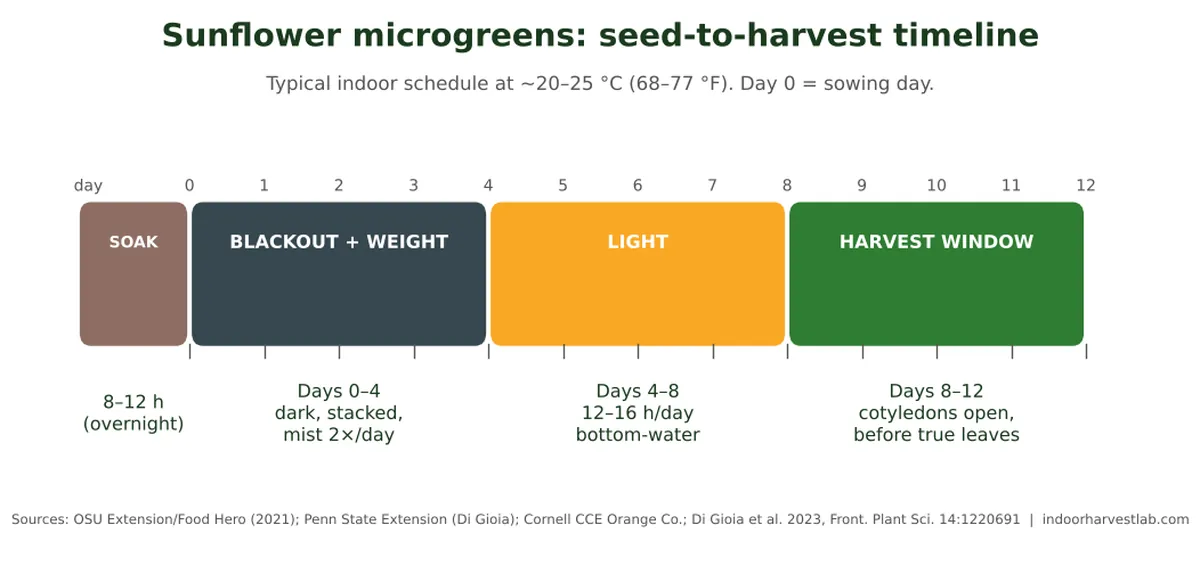
Short answer: sunflower microgreens are black oil sunflower seeds soaked for 8–12 hours, sown in a single dense layer, kept dark and weighted for about 3–4 days, then grown under light until the two cotyledon leaves open, usually 8–12 days after sowing. Cut them just above the soil before true leaves form, when they are roughly 2–4 inches tall. Kept warm (about 65–78 °F) and watered from below, one tray gives you a large bowl of crunchy, nutty greens in under two weeks.
This guide pulls together university extension advice and controlled-environment research into one plan. By the end you’ll know how much seed to use per tray, the exact day-by-day schedule, how to deal with hulls and mold, and what the nutrition studies actually found. If you’re new to microgreens in general, our guide to microgreens seeding density is a good companion read.
Why sunflower microgreens are worth a tray
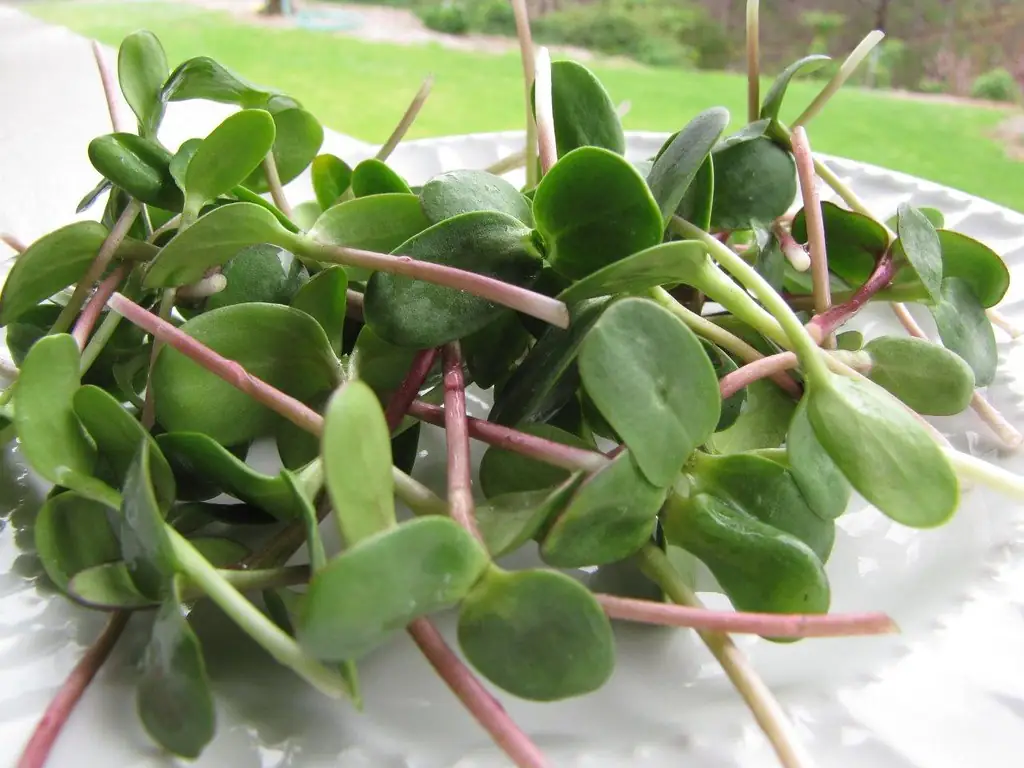
Most microgreens are delicate, and that’s what makes sunflower microgreens different: a tray of broccoli or amaranth gives you fine, feathery greens that wilt fast. Sunflower is the opposite. The shoots are thick, juicy and crunchy, with a mild, nutty flavor that Cornell Cooperative Extension sums up in one word: “nutty” (CCE Orange County). Oregon State lists sunflower among the “mild” microgreens, alongside peas and kale (OSU Extension).
There’s a yield reason to grow sunflower microgreens too. In a USDA-ARS and Penn State study of 17 microgreen species grown side by side, sunflower was ready in just 10 days, had the heaviest individual shoots (about 390 mg each) and the highest dry matter (about 9.4%), and ranked third for fresh yield at roughly 1.66 kg per square meter (Di Gioia et al., 2023). In plain terms: fewer days, more food, and greens that actually feel substantial on the plate.
The trade-off? The seeds behind sunflower microgreens are big, so you need more seed per tray than with small-seeded crops, and the hulls take a little management. Both are easy once you know the routine.
Sunflower microgreens numbers to hold
Pin this table of sunflower microgreens targets above your shelf. Every figure comes from an extension publication or peer-reviewed study listed in the Sources section; the per-tray seed and yield figures are our own calculations from the research numbers, explained below the table.
| What | Target | Source |
|---|---|---|
| Seed type | Raw, untreated black oil sunflower seed (not fungicide-treated or pelleted) | UT Extension |
| Soak time | 8–12 hours (sunflower: about 10 h) | Penn State Extension |
| Germination temperature | 75–80 °F (24–27 °C) for warm-season crops such as sunflower | UT Extension |
| Growing temperature | 65–78 °F (18–26 °C) | UT Extension |
| Blackout / cover | Until sprouted, about 3–4 days | OSU Extension |
| Light hours | About 15 h/day; research chambers used 16 h | OSU Extension; Balik et al., 2025 |
| Light intensity (research) | 350 µmol/m²/s PPFD for 16 h (≈20 mol/m²/day DLI) | Balik et al., 2025 |
| Lamp distance | As close as 3–4 in (7.5–10 cm) above the shoots | OSU Extension; CCE Orange Co. |
| Seeding density (research) | 1 seed per cm² (≈75 g / 2.6 oz per 10×20 in tray*) | Di Gioia et al., 2023 |
| Days to harvest | 8–12 days after sowing (10 days in trials) | CCE Orange Co.; Di Gioia et al., 2023 |
| Harvest height | About 1–4 in (2.5–10 cm), cotyledons open | UT Extension |
| Yield (research) | ≈1.66 kg/m² (≈210 g / 7.5 oz per 10×20 in area*) | Di Gioia et al., 2023 |
| Fridge storage | About 40 °F (4 °C); a few days up to about a week | UT Extension; Illinois Extension |
A note on that seed figure. Seed companies often describe sunflower density loosely (one layer, side by side), so the research value of one seed per square centimeter is a useful anchor. Weigh 75 g for your first tray, look at the coverage, and adjust by 10–15 g up or down next time.
How to grow sunflower microgreens step by step
Here’s the full procedure for sunflower microgreens, from dry seed to salad bowl. The timeline chart below shows how the phases line up, so you can plan a harvest for a specific day.
Step 1: Buy the right seed
Use black oil sunflower seed sold for sprouting or microgreens. The University of Tennessee is blunt about this: buy raw seed “that has not been treated with fungicides or pelleted” (UT Extension W346-J). Bird-feeder seed is tempting because it’s cheap, but it isn’t produced or tested as a food crop, so skip it. Buy only a few months’ supply and store it cool and dry, as UT also advises.
Why black oil and not striped or hulled kernels? Black oil seed is the standard microgreen type (it’s what the 2023 USDA-ARS trial used), and its hulls are thinner than striped confection seed. Hulled kernels have lost their protective coat, so they’re more prone to rot than to sprout well; that’s seed-biology reasoning rather than a trial result, but it’s a good reason to stick with whole black oil seed.
Step 2: Soak for 8–12 hours
Big seeds drink a lot of water before they wake up. Penn State Extension recommends soaking seeds for 8–12 hours and soaking sunflower and pea for about 10 hours, then rinsing a couple of times (Penn State Extension). Oregon State simply says to soak large seeds such as sunflower overnight “for quick, even sprouting.”
Use cool to room-temperature water, at least three times the seed volume, because the seeds swell. Don’t push past roughly 12 hours: waterlogged seeds can run short of oxygen, which is exactly the opposite of what you want.
Step 3: Prepare the tray
Fill a tray with drainage holes with 1–2 inches of moist seed-starting mix, the depth UT and Cornell both recommend. Commercial seedling mixes are “generally free of pathogens,” UT notes, which is why you should never use garden soil, manure or compost (CCE Orange County). Prefer no soil at all? Hemp or coco mats work too; see our guide to growing microgreens without soil.
Step 4: Sow one dense layer
Drain and rinse the seeds, then spread them so they touch but don’t pile up. Clumps and double layers are where mold starts, because air can’t move between them. Press the seeds gently into the surface with your palm. UT notes that large seeds such as sunflower are often covered with about ¼ inch of mix to stop them drying out; many growers instead rely on a weighted cover, described next.
Step 5: Blackout and weight for 3–4 days
Cover the tray to block light and hold in moisture. Oregon State suggests foil or a dinner plate for small containers and says to mist every 12 hours; the cover comes off once seeds have sprouted, “around 3 to 4 days” (OSU Extension). For a standard tray, Penn State and Illinois Extension both describe stacking another tray on top of large seeds such as sunflower and pea to weight them down.
The weight matters more than it seems. It keeps seeds in firm contact with the mix, so roots anchor instead of lifting, and the shoots push up evenly against resistance. Our deeper dive on the microgreens blackout period explains the physiology.
Step 6: Move into light
When the shoots are 1–2 inches tall, pale yellow and pushing the cover up, uncover them and give them light. Oregon State suggests a lamp as close as 3 inches above the plants and about 15 hours a day; Cornell suggests about 4 inches for a fluorescent tube. Pale stems turn green within a day or two. For LED settings, see our microgreens light requirements guide.
Step 7: Bottom-water every day
After germination, UT says bottom watering is best “because it keeps stems and leaves dry and reduces disease risk.” Pour water into a solid tray underneath, let the mix wick it for 10–15 minutes, then pour off the rest. Don’t leave the tray sitting in water. Lift the tray: if it feels light, it’s time to water.
Step 8: Harvest at the cotyledon stage
Cut with clean scissors just above the soil when the two seed leaves are fully open and before the first true leaves appear, typically 8–12 days after sowing (CCE Orange County). Wait too long and sunflower microgreens become stringy and bitter. Our guide on how to harvest microgreens covers cutting, drying and storage in detail.
Dealing with sunflower hulls (without losing your mind)
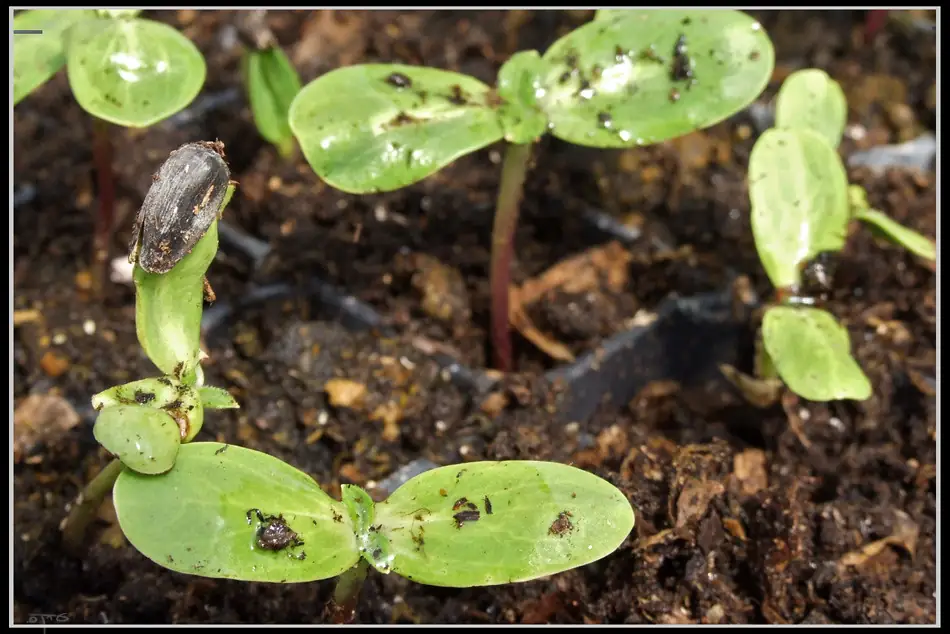
Hulls are the single biggest complaint about growing sunflower microgreens, and they’re mostly preventable. You’ve grown a perfect tray, and half the cotyledons are still clamped inside black shells. The good news: most hulls fall off on their own if the first week goes right.
Here’s the reasoning behind each fix:
- Soak fully. A well-hydrated hull is softer and splits more cleanly as the cotyledons expand.
- Weight the blackout tray. As shoots push up against resistance, the friction scrapes many hulls off before you even uncover the tray.
- Keep the canopy humid for the first day of light. A dry hull hardens and grips the leaves. A light misting of the tops on day 4–5 keeps hulls pliable.
- Brush, don’t pick. Run your flat palm across the canopy a few times. Loosened hulls drop to the soil surface, where they’re easy to leave behind at harvest.
- Rinse after cutting. Any stragglers float off in a bowl of cold water.
Sowing too densely makes hulls worse, since stacked seeds hold each other’s shells in place. If one tray is a hull nightmare, reduce seed by about 10% next round before you change anything else.
Troubleshooting: sunflower microgreens problems and fixes
Most failed trays of sunflower microgreens come down to too much water, too little air or too little light. UT Extension lists exactly those, plus over-seeding and extreme temperatures, as the root causes of microgreen problems. Use this table to match the symptom to the fix.
| What you see | Likely cause | What to do |
|---|---|---|
| White fuzz on stems near the soil | Usually root hairs, not mold (fuzzy, even, disappears when misted) | Mist it: root hairs collapse, mold doesn’t. See our microgreens mold guide. |
| Grey-white web spreading over seeds | Mold from wet, crowded, still conditions | Remove the patch or the tray, sow thinner, add a small fan, bottom-water only |
| Stems collapse at soil line | Damping-off (Pythium, Phytophthora) | Discard; wash trays; use fresh mix; avoid overwatering |
| Patchy, uneven germination | Seeds dried out, soaked too briefly, or no weight | Soak 8–12 h, weight the cover, mist every 12 h |
| Long, pale, floppy shoots | Light too weak or too far away | Lamp 3–4 in above canopy, ~15 h/day |
| Seeds sour-smelling or slimy | Over-soaked or sitting in water | Cap soak at 12 h, rinse well, never leave tray in standing water |
| Hulls stuck on leaves | Dry hulls, light weight, overcrowding | Mist tops, weight blackout, sow ~10% less |
| Leaves bitter and tough | Harvested late, true leaves forming | Cut at cotyledon stage, day 8–12 |
Two internal guides go deeper here: microgreens mold vs root hairs and damping-off in seedlings.
Sunflower microgreens nutrition and food safety
What the research shows
Health claims about microgreens are everywhere online, so let’s stick to measured numbers. Two recent studies analysed sunflower microgreens directly, and they agree on some things and disagree on others.
| Nutrient (per 100 g fresh weight) | Di Gioia et al., 2023 (greenhouse, fiber mats) | Balik et al., 2025 (growth chamber, peat) |
|---|---|---|
| Zinc | 0.75 mg, highest of 17 species | not compared here* |
| Copper | 0.24 mg, highest of 17 | not compared here* |
| Phosphorus | 66 mg, highest of 17 | not reported in comparable form |
| Magnesium | 39 mg, 2nd of 17 | 46 mg |
| Calcium | 42 mg, lowest of 17 | 145 mg, highest of 6 |
| Potassium | 101 mg, lowest of 17 | within 187–416 mg range for 6 species |
| Vitamin C | not measured | 67.6 mg, 3rd of 6 |
| Nitrate | 458.6 mg/kg, lowest of 17 | 77.3 mg/kg, among the lowest |
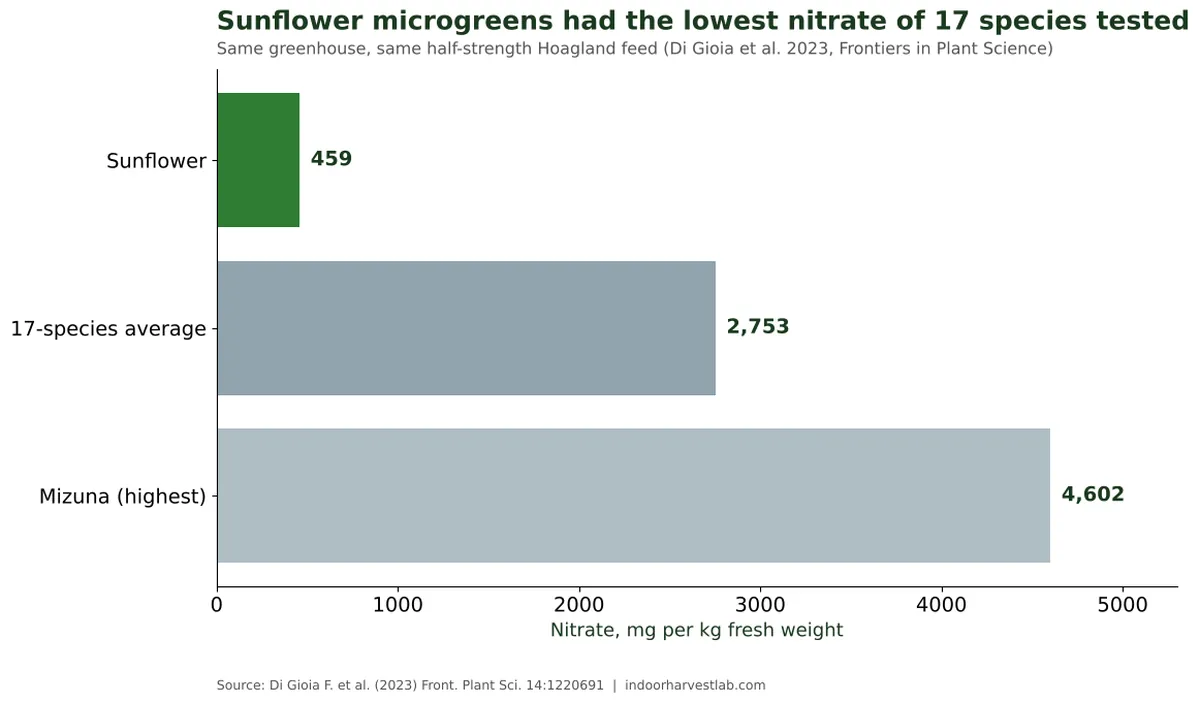
Three findings stand out. First, sunflower was the only species in the 17-crop trial that was a good source of zinc; the authors note that most other microgreens supplied only a small fraction of the adult zinc requirement (Frontiers in Plant Science). Second, sunflower was the only species in the “low nitrate” class (under 500 mg/kg), and the 2025 study also found very low nitrate (Scientific Reports). Third, vitamin C came in at about 67.6 mg per 100 g of fresh greens.
Why does calcium swing from lowest to highest between the two studies? The growing system. The first trial used felt mats and a half-strength feed with no micronutrients; the second used a peat-based mix with a calcium-containing nutrient solution. Microgreens largely reflect what they’re fed in their short lives, which is useful to know if you grow on bare mats with plain water.
Food safety and storage
Sunflower microgreens, like all microgreens, are grown warm and humid, which suits bacteria as well as plants. A 2026 survey of 122 commercial microgreen samples detected Salmonella in sunflower and radish, and in lab trials Salmonella reached about 7.7 log CFU/g in sunflower growing substrate (Food Research International, 2026). That’s not a reason to panic; it’s a reason to follow basic hygiene.
- Buy seed sold for sprouting or microgreens, from a supplier that tests lots.
- Use fresh, bagged seed-starting mix or new mats, never garden soil, compost or manure (Cornell CCE).
- Wash trays with soap and water between crops (CCE; UT).
- Water from below so leaves stay dry, and wash hands before harvest.
- Refrigerate at about 40 °F (4 °C). UT says microgreens keep from a few days up to a couple of weeks depending on species; Illinois Extension suggests about a week wrapped in damp paper towel in a sealed bag.
Cornell suggests waiting to wash microgreens until you use them, which helps them last longer; UT suggests washing off any mix before storage. A practical compromise: shake off loose soil at harvest, store dry, and rinse right before eating.
From the lab bench
Here’s how to read this research if you want better trays of sunflower microgreens, not just more of them.
Seed weight is the hidden variable. In the 2023 trial a sunflower seed weighed about 58 mg, many times heavier than a typical brassica seed. That reserve is why sunflower can produce a heavy shoot in 10 days with almost no fertilizer: the cotyledons are largely living off stored oil and protein. It also means your yield is capped by seed quality. Germination in the 2023 trial was 90%; a cheap lot at 70% wastes nearly a third of your seed and gives rot organisms a free meal.
Density is a trade-off, not a target. For sunflower microgreens, one seed per square centimeter gave a high area yield in the Frontiers trial, but density also sets the microclimate. Thicker sowing means less airflow and more stuck hulls. If you’re fighting mold, cut density before you blame the seed.
Low nitrate is a genuine advantage. Leafy microgreens like mizuna and arugula can accumulate several thousand mg/kg of nitrate. Sunflower’s low figure probably reflects how short its growth period is and how much it relies on seed reserves rather than absorbed nitrogen. For anyone eating microgreens daily, that makes sunflower a sensible base for the bowl.
Gentle stress can help, but leave it to the lab. A 2026 hydroponic study found that a low salt level (25 mM NaCl) raised sunflower microgreen shoot fresh yield by about 59%, while 75–100 mM cut growth (BMC Plant Biology, 2026). That’s a classic hormesis curve, and it’s fascinating, but the safe window is narrow and home water already varies in sodium. For a kitchen grower, clean water, good light and correct density are the dependable levers.
FAQ about sunflower microgreens
How long do sunflower microgreens take to grow?
Usually 8–12 days from sowing. In a USDA-ARS study, sunflower was ready in 10 days, tied for the fastest of 17 species. Expect 3–4 days in blackout and 4–8 days under light.
How long should I soak sunflower seeds for microgreens?
Soak them for 8–12 hours; Penn State Extension uses about 10 hours for sunflower. Rinse well afterwards and avoid soaking much longer than 12 hours, which can leave seeds waterlogged.
How much seed do I need for a 10×20 tray?
Research sowing at one seed per square centimeter works out to roughly 75 g (2.6 oz) of black oil sunflower seed for a 10×20 inch tray. Start there and adjust by 10–15 g based on coverage.
Do sunflower microgreens regrow after cutting?
No. Cutting removes the growing point and most of the leaf area, so sunflower microgreens don’t produce a useful second harvest. Compost the roots and sow a fresh tray.
Can I use birdseed to grow sunflower microgreens?
It’s not recommended. Birdseed isn’t produced or tested as human food. University of Tennessee Extension advises buying raw seed that hasn’t been treated with fungicides, ideally sold for sprouting or microgreens.
Are sunflower microgreens healthy?
Studies found sunflower microgreens were the best zinc source of 17 microgreen species, had very low nitrate, and contained about 67.6 mg of vitamin C per 100 g. Nutrient levels change with how they’re grown.
Why are my sunflower microgreens falling over?
Floppy shoots usually mean light is too weak or too far away, or the tray is too wet. Move the lamp to 3–4 inches above the canopy, give about 15 hours of light, and bottom-water only.
Sources
- Di Gioia F., Hong J.C., Pisani C., Petropoulos S.A., Bai J., Rosskopf E.N. (2023). Yield performance, mineral profile, and nitrate content in a selection of seventeen microgreen species. Frontiers in Plant Science 14:1220691. doi:10.3389/fpls.2023.1220691
- Balik S., Elgudayem F., Dasgan H.Y., Kafkas N.E., Gruda N.S. et al. (2025). Nutritional quality profiles of six microgreens. Scientific Reports 15:6213. doi:10.1038/s41598-025-85860-z
- Bumgarner N., Metallo R. (2017). The Tennessee Vegetable Garden: Small-scale Microgreen Production (W 346-J). University of Tennessee Extension. PDF
- Oregon State University Extension Service / Food Hero (2021). Microgreens. extension.oregonstate.edu
- Di Gioia F. A Step-By-Step Guide for Growing Microgreens at Home. Penn State Extension. extension.psu.edu
- Cornell Cooperative Extension Orange County. Growing Microgreens. PDF
- Ferguson W. (2021). Growing Microgreens (lesson plan). University of Illinois Extension. PDF
- Salmonella in microgreens: quantitative modeling of Salmonella Enteritidis in a controlled environment system (2026). Food Research International 119209. doi:10.1016/j.foodres.2026.119209
- Salt eustress modulates physiological responses and enhances yield, nutritional quality, and antioxidant capacity in sunflower microgreens (2026). BMC Plant Biology. doi:10.1186/s12870-026-09786-y