
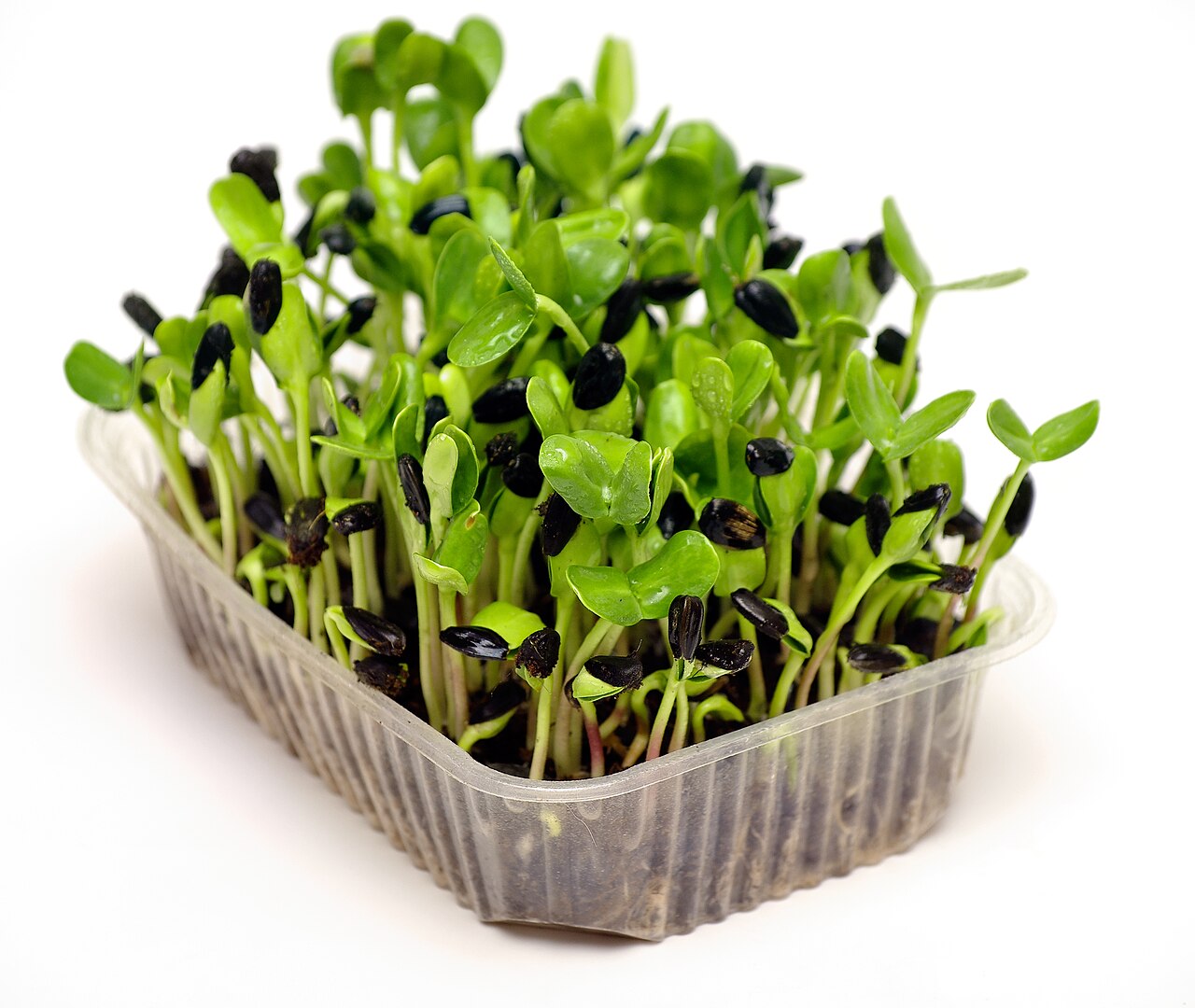
Short answer: The microgreens blackout period is the time you keep a freshly sown tray covered and dark, usually 2 to 5 days, until most seeds have germinated. Utah State University Extension gives 1–2 days for arugula, kale and radish, 2–4 days for broccoli, 3 days for pea and sunflower, 4–7 days for basil and 7–14 days for cilantro. Covering keeps seed moist and in contact with the medium and makes stems stretch a little; end it when roots have anchored and shoots are pushing against the cover, then give 16 to 18 hours of light.
Blackout is one of the most copied and least explained steps in microgreen growing. Done right, it gives even germination and taller, easier-to-cut stems. Done wrong, it gives pale, floppy trays or mould. This guide explains what the dark actually does, how long to keep each crop covered, and when to skip it.
Table of Contents
What the blackout period does
A seedling that germinates in darkness follows a different growth program from one in light. It puts its energy into stretching the stem (the hypocotyl) upward to find light, keeps its seed leaves folded and pale, and does not make chlorophyll yet. Plant biologists call this etiolation. Microgreen growers use a short, controlled dose of it on purpose.
Covering the tray does three useful jobs:
- Even germination. A cover holds humidity at the seed surface, so seeds do not dry out between waterings. Virginia Tech’s microgreen production guide (SPES-756) says germinating in the dark “is needed or beneficial” for several common species.
- Root anchoring. A weighted cover keeps big seeds such as pea and sunflower pressed into the medium so the roots grow down instead of lifting the seed.
- A bit of stretch. Longer stems are easier to harvest and keep leaves clear of the growing mat.
How much taller do stems get?
University of Guelph researchers measured it. In Kong and Zheng (2021, Canadian Journal of Plant Science), sunflower and arugula were covered with an upside-down black tray for the first 5 days after seeding, then grown under continuous LED light at about 100 µmol·m⁻²·s⁻¹. Dark treatment made hypocotyls 26% longer in sunflower and 28% longer in arugula.
Microgreens blackout period by crop
The table below comes from Table 1 of Grow Your Own Microgreens by Stephen Beck, Utah State University Extension. “Covered time” is the blackout period, counted from sowing, at a germination temperature of 74 °F.
| Crop | Seed per 10×20 tray | Presoak | Blackout period | Days to harvest |
|---|---|---|---|---|
| Arugula | 10 g | No | 1–2 days | 6–8 |
| Kale | 28 g | No | 1–2 days | 8–12 |
| Radish | 42 g | No | 1–2 days | 8–12 |
| Broccoli | 28 g | No | 2–4 days | 8–12 |
| Pea | 150 g | 6 hours | 3 days | 8–10 |
| Sunflower | 48 g | 12 hours | 3 days | 9–10 |
| Mesclun mix | 28 g | No | 3–5 days | 12–14 |
| Basil | 28 g | No | 4–7 days | 12–16 |
| Cilantro | 28 g | No | 7–14 days | 21–28 |
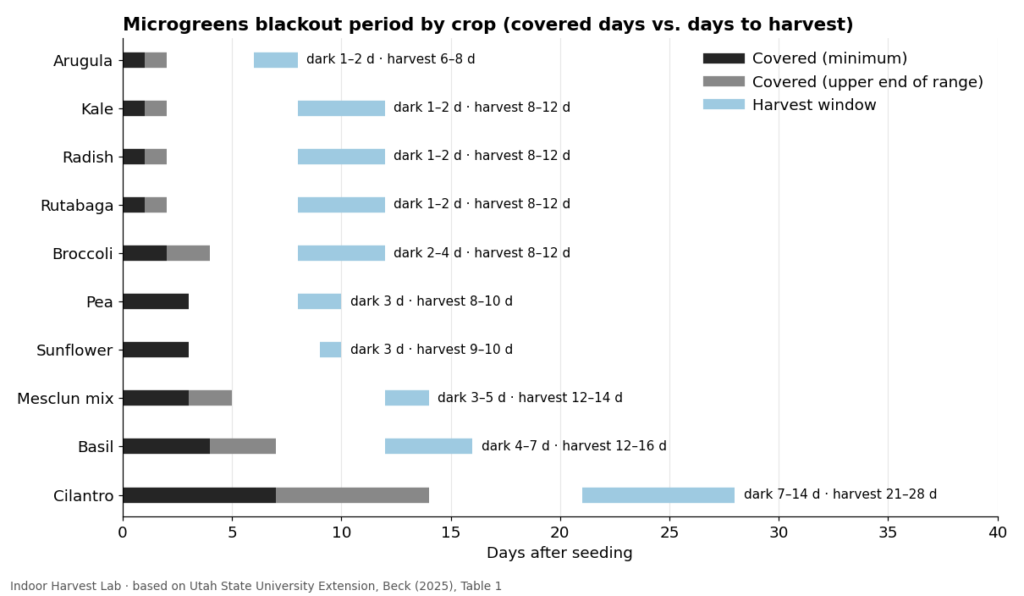
Notice the pattern: fast brassicas need only a day or two, big seeds need about three days under weight, and slow crops such as basil and cilantro stay covered longer simply because they take longer to germinate. For seed amounts in more detail, see our microgreens seeding density chart.
Does a longer blackout period help or hurt?
It depends on seed size. The same Guelph study found opposite results in the two crops:
| Effect of 5 days dark | Sunflower (large seed) | Arugula (small seed) |
|---|---|---|
| Stem (hypocotyl) length | +26% | +28% |
| Fresh yield | +13% | −24% |
| Cotyledons | 14% more succulent | About 25% smaller |
| Cotyledon colour | Not affected | Not affected |
A sunflower seed carries enough food to stretch in the dark and still build big leaves. A tiny arugula seed runs out of reserves, so 5 days of dark cost it leaf size and yield. Note that 5 days is well beyond the 1–2 days USU suggests for arugula. The practical lesson: keep the dark phase short for small seeds and use the longer end only for large seeds.
How to do a blackout period, step by step
- Presoak big seeds. USU soaks pea for 6 hours and sunflower for 12 hours. Small brassica seeds go on dry.
- Pre-moisten the medium. USU adds 2 cups of water under a coir-filled 10×20 tray for 30 minutes, then drains any excess.
- Sow evenly at the rate for your crop.
- Cover and weight. Place a second 10×20 tray directly on the seed with something flat and heavy on top. USU suggests 2–5 pounds, for example plywood cut to fit. Penn State Extension’s home growing guide recommends weight for pea and sunflower to keep seed in contact with the medium, and notes it helps the hulls come off the leaves.
- Keep it warm. USU germinates at 74 °F. Penn State’s Growing Microgreens page gives 60–75 °F soil temperature for germination.
- Lift the weight halfway. USU leaves the weighted tray in contact for half the blackout period, removing it once roots are clearly pushing into the medium. Then turn the top tray upside down so it covers without touching the seedlings.
- Check daily. Look for dry patches and mould. Water from below if the surface is drying.
- End the blackout period when most seeds have germinated. Virginia Tech says to uncover “when a majority of the seedlings have germinated,” typically 2 to 5 days depending on species.
- Turn on the lights. USU runs lights 18 hours on, 6 off, at 72 °F with lights on and 68 °F with lights off.
Signs the blackout period is over
- Most seeds have split and rooted into the medium.
- Shoots are lifting the upturned cover tray.
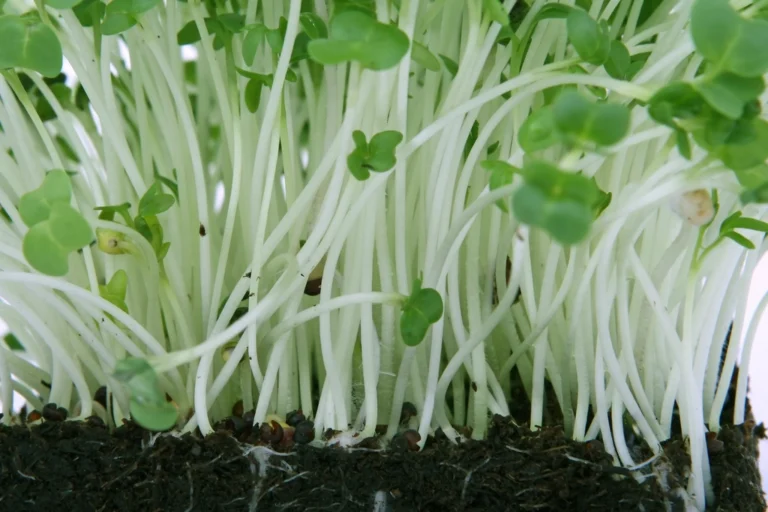
- Stems are pale yellow-white and standing upright.
- The crop has reached the upper end of its covered time in the table.
Light after the blackout period
Pale seedlings green up quickly once exposed. In classic studies on etiolated barley, maize, pea and soybean, Mathis and Burkey (1987, Plant Physiology) found that chlorophyll accumulated faster between 4 and 8 hours of light, after an initial delay. A yellow tray is usually noticeably greener within about a day. In the Guelph trial, cotyledon colour at harvest was the same with or without the dark treatment.
How much light afterwards? Virginia Tech recommends a daily light integral (DLI) of 9 to 16 mol·m⁻²·d⁻¹; their own setup uses 18 hours at about 250 µmol·m⁻²·s⁻¹ (DLI 16.2). Penn State calls microgreens a low-light crop, with a DLI below 20. For converting light hours and intensity into DLI, see how many hours of light seedlings need and grow light distance.
Humidity and mould during the blackout period
Darkness, warmth, moisture and still air are also what mould likes. No study we found shows that blackout itself causes mould, but the conditions overlap. Penn State notes that damping-off is favoured by warm, humid conditions and advises watering only when needed and allowing drainage. Virginia Tech gives common humidity levels for microgreens of 50% to 70% and recommends fans for airflow. USU says plants need constant airflow from a gentle fan.
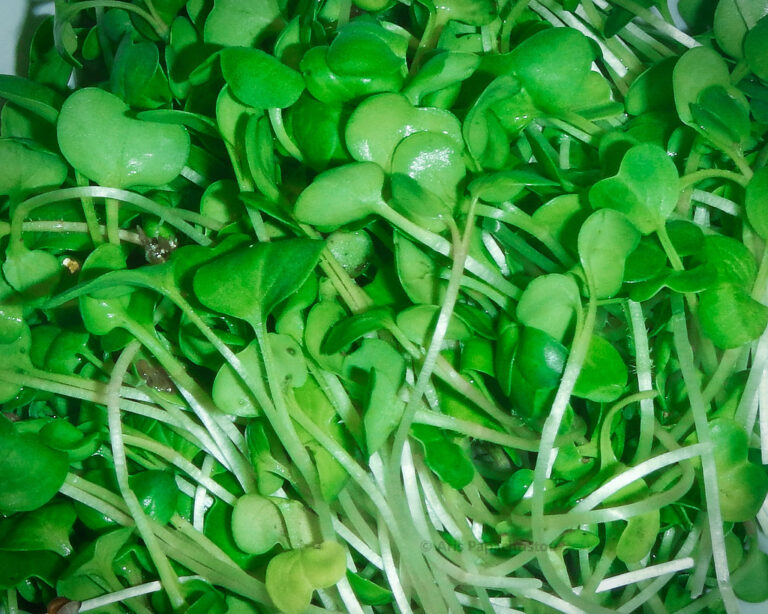
Practical steps: do not sit trays in standing water, use a clean cover tray, uncover on time, and start the fan as soon as the blackout period ends. White fuzzy root hairs on radish and broccoli are normal and are often mistaken for mould; our microgreens mold guide shows how to tell the difference.
Crops that need little or no blackout period
Some small seeds germinate better with light. Utah State’s Starting Vegetable Seeds Indoors names basil among seeds that require light to germinate and advises pressing them onto the surface rather than burying them. The same university’s microgreens table still lists 4–7 covered days for basil. A reasonable middle path: sow basil on the surface, cover it with a tray that does not press on the seed (or a humidity dome), and keep it evenly moist; it is a slow crop either way.
For fast brassicas such as arugula, kale and radish, 1–2 days covered is enough, and the Guelph arugula result suggests longer is not better.
Blackout period mistakes to avoid
- Leaving small seeds in the dark too long. Five days of dark cut arugula yield by 24% in the Guelph study.
- Skipping the weight on pea and sunflower. Seeds get pushed up, roots dry out and hulls stick to the leaves.
- Weighting all the way through. Lift the weight once roots are in the medium, as USU does, so shoots can stand up.
- Letting the surface dry. Dry seed during blackout means patchy germination.
- Keeping it soggy and airless. Warm, wet, still air favours damping-off.
- Uncovering by the calendar alone. Use the table as a guide, but end the blackout period when most seeds are up.
- Weak light afterwards. Stretched seedlings under dim light keep stretching and fall over; see leggy seedlings for the same effect in transplants.
Where this applies
The day counts assume a warm room near 74 °F, as in the USU guide. In a cooler room, germination slows and the blackout period stretches toward the upper end of each range; a heat mat or warmer shelf brings it back. In very dry indoor air (winter heating), trays dry faster, so check twice a day. In humid climates, lean toward the short end and more airflow. The approach is the same whether you grow on soil, coco or mats; for soilless options see microgreens without soil.
FAQ
Do microgreens need a blackout period?
Not all of them. Large seeds such as pea and sunflower clearly benefit from a weighted blackout period. Small brassicas need only a day or two, and light-favouring seeds like basil can germinate uncovered if kept moist.
What happens if the blackout period is too long?
Stems get long, pale and weak, and small-seeded crops lose leaf size and yield, as the arugula in the Guelph study did after 5 days.
Why are my microgreens yellow after blackout?
That is normal. Seedlings grown in the dark have no chlorophyll yet. Under good light they green within about a day.
Can I use a blackout dome instead of a stacked tray?
Yes. Virginia Tech mentions a blackout dome or plastic cover. For big seeds, still add weight for the first part of the blackout period.
Related guides: all microgreens growing guides · seeding density · microgreens mold · microgreens light requirements
Sources
- Beck, S. Utah State University Extension. Grow Your Own Microgreens (Table 1).
- South, K. et al. (2026). Virginia Tech. SPES-756, Introduction to Microgreen Production in Indoor Vertical Farms and Greenhouses.
- Di Gioia, F. Penn State Extension. A Step-by-Step Guide for Growing Microgreens at Home.
- Penn State Extension. Growing Microgreens.
- Kong, Y., Zheng, Y. (2021). Early-stage dark treatment promotes hypocotyl elongation associated with varying effects on yield and quality in sunflower and arugula microgreens. Canadian Journal of Plant Science 101: 954–961.
- Mathis, J.N., Burkey, K.O. (1987). Regulation of light-harvesting chlorophyll protein biosynthesis in greening seedlings: a species comparison. Plant Physiology 85: 971–977.
- Crump, Beddes, Caron, Oliveira (2025). Utah State University Extension. Starting Vegetable Seeds Indoors.
Featured image: “Sunflower microgreens 01” by Pannet, CC BY 4.0.