
You sprinkle a pinch of small brown seeds on a tray on Sunday night. By Tuesday the tray is lifting its own lid, and by the following weekend you’re snipping a peppery, pink-stemmed crop onto your eggs. That’s not a best-case story. It’s the normal pace of radish microgreens, and it’s why so many people start here.
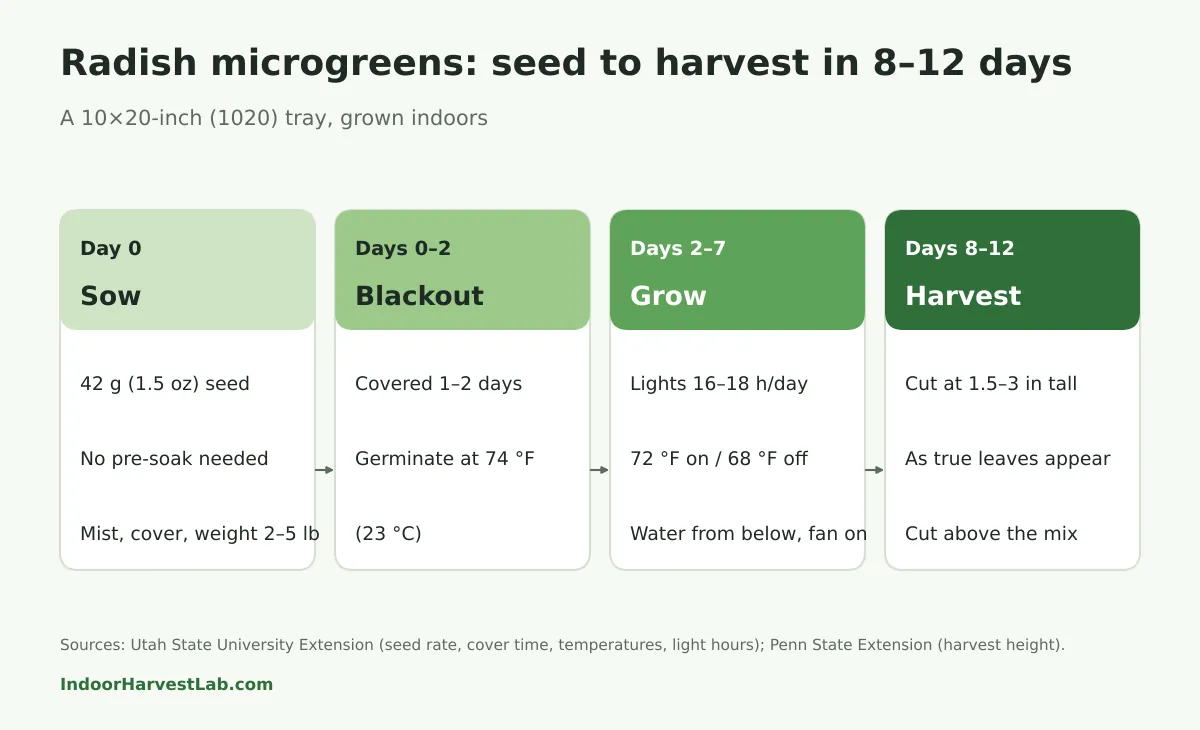
Short answer: radish microgreens are the fastest, most forgiving microgreen you can grow indoors. Sow about 42 g (1.5 oz) of unsoaked radish seed per 10×20-inch tray, keep it covered and weighted for 1–2 days at about 74 °F (23 °C), then grow it under 16–18 hours of light. Most trays are ready to cut 8–12 days after sowing, when the shoots are 1.5–3 inches tall.
This guide pulls the numbers from Utah State and Penn State extension work and recent controlled-environment research into one plan. By the end you’ll know which radish to buy, how much seed to use for any container, how much light radish really needs, how to tell harmless root hairs from mold, and why the purple ones sometimes stay green. If you’ve already grown sunflower microgreens or pea shoots, radish will feel easy: smaller seed, no soak, faster finish.
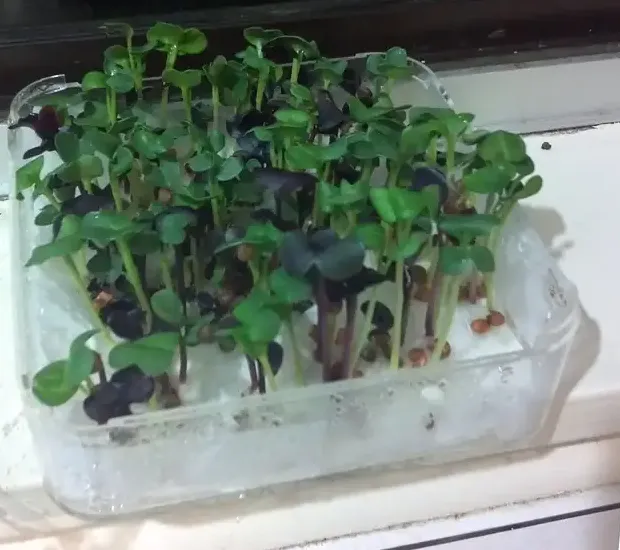
Why radish microgreens are the best first crop
Radish (Raphanus sativus) is a member of the cabbage family, and its seed is unusually vigorous. It doesn’t need soaking, it germinates in a day or two, and it grows fast enough to outrun most mold problems. Utah State University Extension puts radish at 8–12 days from sowing to harvest, with only 1–2 days under cover (USU Extension).
It’s also cheap. In Utah State’s January 2026 cost table, seed for one 10×20 tray worked out to about $0.88 for a green ‘Champion’ type and $1.95 for a purple type, buying seed at the 5-lb rate. That’s one of the lowest cost-per-tray figures in their whole list.
And the flavour is the hook. Utah State describes radish microgreens as nutty and spicy. That bite comes from isothiocyanates, the same sulfur compounds that make a mature radish sharp. In a 2024 study of 14 brassica microgreens, radish had the largest leaf area of the group and, along with broccoli, the highest isothiocyanate levels (Bafumo et al., 2024).
Which radish variety should you grow?
All of them grow the same way. What changes is colour, and a little of the heat. Here’s how the common microgreen radishes compare, using only what the sources say about each.
| Variety | What it looks like | Worth knowing | Source |
|---|---|---|---|
| Green types (‘Champion’, Daikon) | Green leaves, white to pale stems | Green daikon microgreens had the highest tocopherol (vitamin E) levels of 25 microgreens tested; Daikon averaged 121.8 g per tray in Penn State trials | Xiao et al., 2012; Penn State Extension |
| Purple types (‘Red Rambo’) | Dark purple leaves and stems | Sold as one of the fastest-growing microgreens; colour comes from anthocyanins | Johnny’s Selected Seeds; Silva et al., 2025 |
| Pink-stem types (‘Rioja Improved’) | Green leaves, pink-red stems | Used in an ENEA LED study harvested 8 days after sowing | Garegnani et al., 2024 |
| Black radish | Green to bronze leaves | Showed the highest antioxidant (DPPH) capacity of six microgreens in a 2025 comparison | Balik et al., 2025 |
If you’re new, start with a green daikon or ‘Champion’ type. It’s cheaper, and it shows you clearly when something’s off. Grow purple ‘Red Rambo’ once your light setup is dialled in, because purple colour depends on light (more on that below).
Radish microgreens: numbers to hold
Pin this table near your shelf. Every number comes from an extension publication or a peer-reviewed study listed in the Sources section.
| What | Target | Source |
|---|---|---|
| Seed per 10×20 in (1020) tray | 42 g (about 1.5 oz) | USU Extension |
| Pre-soak | None needed | USU Extension |
| Covered (dark + 2–5 lb weight) | 1–2 days | USU Extension |
| Germination temperature | 74 °F (23 °C) | USU Extension |
| Growing air temperature | 72 °F (22 °C) lights on, 68 °F (20 °C) lights off | USU Extension |
| Medium germination range (general microgreens) | 60–75 °F (16–24 °C) | Penn State Extension |
| Light hours | 18 h on, 6 h off (USU); 16–24 h tested for radish | USU Extension; Shibaeva et al., 2022 |
| Light intensity tested for radish | 100–300 µmol/m²/s PPFD (yield highest at 300) | Hernández-Adasme et al., 2026 |
| Daily light integral | Microgreens are a low-light crop: DLI below 20 mol/m²/day | Penn State Extension |
| Fertilizer (if any) | 50–100 ppm nitrogen is generally enough; little or none may be needed | Penn State Extension |
| Harvest height | 1.5–3 inches (4–8 cm) | Penn State Extension |
| Days to harvest | 8–12 days | USU Extension |
| Yield | Daikon averaged 121.8 g (0.27 lb) per tray in a 2-week cycle | Penn State Extension |
| Storage | About 41 °F (5 °C), in the dark | Penn State Extension |
How much seed for a smaller container?
Utah State’s 42 g is for a standard 1020 tray, which is nominally 10 × 20 inches, or about 200 square inches. That works out to roughly 0.2 g of seed per square inch. Scale by area:
- 5 × 5 in clamshell or takeout box (25 sq in): about 5 g, roughly a level teaspoon and a half.
- 10 × 10 in half tray (100 sq in): about 21 g.
- 10 × 20 in full tray (200 sq in): 42 g.
These are simple area conversions of Utah State’s rate, not separate trial results. Seed lots vary in size, so treat them as a starting point and adjust after your first tray. Our microgreens seeding density guide explains how to fine-tune a rate by counting germination.
How to grow radish microgreens, step by step
This is Utah State’s tray method, with Penn State’s watering advice added. It assumes a 1020 tray with drainage holes nested inside one without holes.
Step 1: Pre-moisten the growing medium
Utah State uses about 2 quarts of coconut coir per 1020 tray, wetted until it feels like a wrung-out sponge. Pour about 2 cups of water into the solid tray underneath. Level and lightly firm the surface so seeds sit evenly.
Prefer to skip the mix? Radish grows well on hemp or fibre mats too. In a 2026 study, radish grown hydroponically under blue light reached its peak phenolic, glucosinolate and vitamin C levels on day 9 (Rana et al., 2026). See growing microgreens without soil for mat options.
Step 2: Weigh and spread the seed
Weigh 42 g of seed for a full tray. Scatter it evenly so seeds touch but don’t pile up. Don’t soak radish: Utah State lists no pre-soak, and soaked radish seed clumps and is harder to spread. Mist the surface once.
Use seed sold for microgreens or sprouting, not garden seed that has been treated. Penn State advises avoiding pesticide-treated seed because the seed coat can stay on the seedling and end up on your plate.
Step 3: Cover and weight for 1–2 days
Set an empty 1020 tray on top of the seed and add 2–5 lb of weight, as Utah State recommends. The weight forces roots down into the mix and helps the seedlings shed their seed coats. Keep it at about 74 °F (23 °C). After roughly half the covered time, Utah State flips the top tray so it becomes a lid that no longer touches the seedlings. Our microgreens blackout period guide explains why this dark phase matters.
Step 4: Uncover and move to light
When the seedlings are pushing up the lid (usually by day 2), uncover them and put them under light. They’ll be yellow at first. That’s normal: chlorophyll forms within a day of light exposure. Utah State runs lights 18 hours a day on a timer, with 72 °F (22 °C) during the day and 68 °F (20 °C) at night, and a gentle fan running constantly.
Step 5: Water from below
Penn State recommends sub-irrigation: water the tray from underneath so the leaves stay dry. At home, pour water into the solid bottom tray, let the mix wick it up for a few minutes, then pour off the excess. Water only when the tray feels light. Wet foliage plus still air is the classic recipe for mold and damping-off.
Step 6: Harvest at 8–12 days
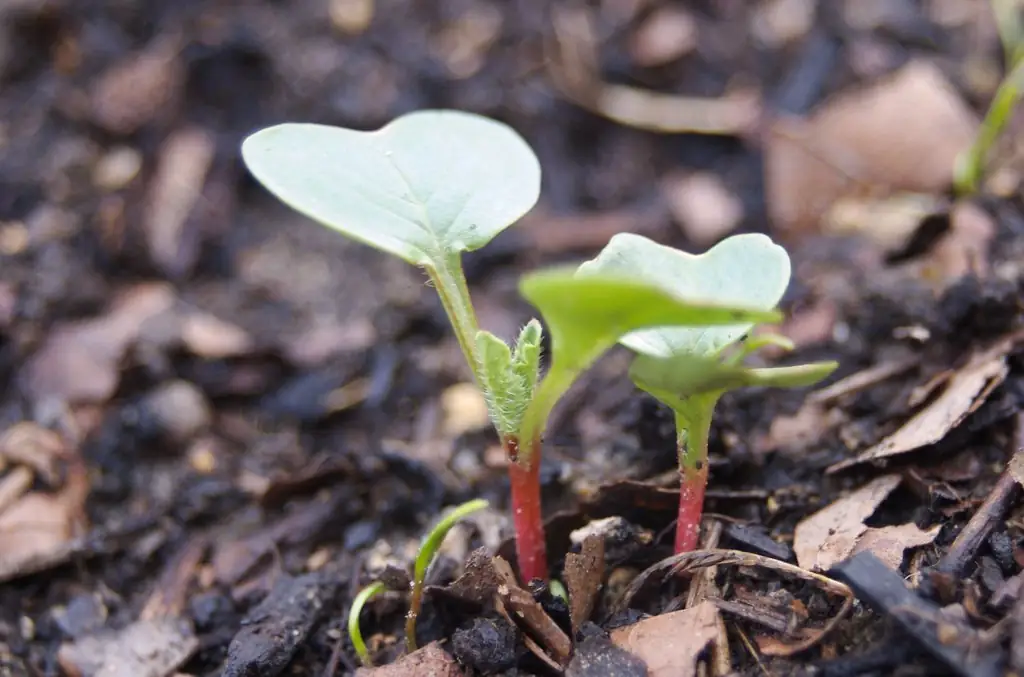
Cut when the shoots are 1.5–3 inches tall, around when the first true leaf begins to show between the two heart-shaped seed leaves. Utah State says to harvest as soon as you begin to see the first true leaves, or sooner.
Light for radish microgreens: PPFD, DLI and hours
Here’s the thing most guides skip: radish will grow on a bright windowsill, but in October and November it stretches, flops and stays pale. A cheap LED shelf light fixes that. The real question is how much.
Penn State calls microgreens a low-light crop, with a daily light integral (DLI) below 20 mol/m²/day. Radish-specific studies have tested light intensities (PPFD) of 100–300 µmol/m²/s. In a 2026 vertical-farm study, yield and dry matter of both green and purple radish microgreens were highest at 300 µmol/m²/s under the most red-heavy LED spectrum (Hernández-Adasme et al., 2026). For the background on these units, see microgreens light requirements.
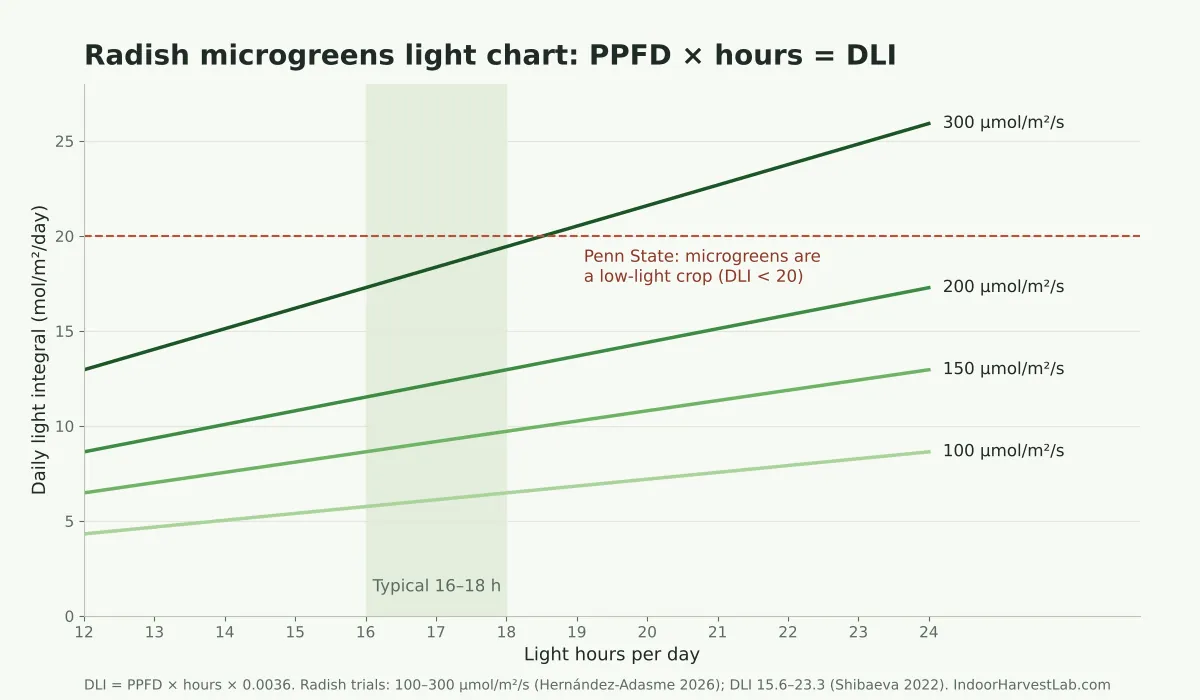
The chart shows why hours matter as much as brightness. DLI is simply PPFD × hours × 0.0036. At 150 µmol/m²/s for 18 hours you get about 9.7 mol/m²/day; at 200 µmol/m²/s for 18 hours, about 13. Both sit comfortably below Penn State’s ceiling.
| PPFD (µmol/m²/s) | 16 h DLI | 18 h DLI | What it means for radish |
|---|---|---|---|
| 100 | 5.8 | 6.5 | Lower end of tested range; fine, but expect taller, softer stems |
| 150 | 8.6 | 9.7 | A practical home target for a shelf LED |
| 200 | 11.5 | 13.0 | Sturdier shoots, deeper colour on purple types |
| 300 | 17.3 | 19.4 | Highest yield and dry matter in Hernández-Adasme et al. (2026) |
Longer days, more colour
In a growth-chamber study, radish grown under 24-hour continuous light (DLI 23.3) had significantly higher fresh and dry weight than radish under a 16-hour photoperiod (DLI 15.6), with no visible leaf damage. Continuous light also raised anthocyanin and flavonoid levels (Shibaeva et al., 2022). That’s why ‘Red Rambo’ grown in dim light often looks muddy green: anthocyanin is partly a light response.
Does the spectrum matter?
Somewhat, but less than intensity at home. Radish fresh and dry weight rose under red + blue + far-red and blue + far-red LEDs in one study, and glucoraphenin, the main glucosinolate in radish, was highest under blue light (Demir et al., 2023). An Italian space-farming trial found the best radish biomass under a mix of 40% blue, 20% green and 40% red (Garegnani et al., 2024). A good full-spectrum white LED covers all of this.
One trade-off worth knowing: in a Penn State and USDA study, higher light (up to 400 µmol/m²/s) raised flavonoids and phenolic acids in radish microgreens but lowered amino acids and glucosinolates (Poudel et al., 2025). More light means more yield and colour, not more of everything.
Harvesting, yield and storage
Use sharp scissors or a long knife and cut just above the surface of the mix, holding a handful of stems at a time.
- Harvest dry. Skip watering for the last 12 or so hours so leaves aren’t wet when they go into a container.
- Expect a modest weight. Penn State’s Daikon averaged 121.8 g (0.27 lb) per tray over a 2-week greenhouse cycle. Radish is light compared with pea shoots or sunflower, because the seeds are small.
- Chill fast. Penn State stores microgreens at about 41 °F (5 °C) in the dark. In a postharvest study, radish microgreens kept in a vented PET clamshell at 5 °C lost less weight and had fewer microbes than those stored in a plastic bag (Ghoora and Srividya, 2020).
- Rinse right before eating, not before storage, so the leaves don’t sit wet.
Do radish microgreens regrow?
Not in any useful way. When you cut above the mix, you remove the shoot tip, which sits between the seed leaves. With nothing left to grow from, the stub won’t produce a second crop the way pea shoots can. Compost the mat and start a new tray. If you want continuous harvests, sow a small tray every 4–5 days.
Radish microgreens troubleshooting: symptoms and fixes
Most radish problems come from three things: too much water, too little air movement, or too little light. Here’s how to read the tray.
| What you see | Likely cause | What to do |
|---|---|---|
| White fuzz on the roots near the base, 1–2 days after uncovering | Root hairs (normal). They’re white, soft and feathery and grow out from each root. | Nothing. They’re a sign of healthy roots looking for water. |
| Grey or white web spreading across seeds and stems, with a musty smell | Mold, favoured by overwatering and still air | Remove the tray if it’s widespread. Next time, water from below, run a fan and keep humidity around 40–60%. |
| Stems collapsing at the base in patches | Damping-off (often Pythium or Rhizoctonia) | Discard affected areas, clean trays, reduce water. Penn State found damping-off was the main disease in their trials. |
| Tall, pale, floppy shoots | Too little light, or left covered too long | Uncover by day 2, raise light to 150–200 µmol/m²/s, and run 16–18 h. |
| ‘Red Rambo’ looks green or muddy | Low light reduces anthocyanin | More light intensity or longer days (see the light section). |
| Patchy, uneven germination | Seed piled up, dry spots, or old seed | Spread evenly, firm the mix, mist after sowing, keep weighted; test seed on a paper towel. |
| Seed hulls stuck on leaves | Not enough weight during blackout | Use 2–5 lb of weight; brush off hulls by hand before harvest. |
The root-hair confusion catches almost everyone with radish, because radish makes dramatic, fluffy root hairs. Mold doesn’t radiate neatly from the base of each seedling; it spreads across surfaces and smells musty (HortiDaily, 2024). If you’re still unsure, our microgreens mold guide has photos of both.
One food-safety note: never grow microgreens in manure-based compost or compost teas. When researchers grew radish microgreens in vermicompost spiked with E. coli O157:H7, Salmonella and Listeria, the pathogens transferred to the harvested greens at 5.6–7.1 log CFU/g (Işık et al., 2025). Use clean coir, a peat-based seed mix or a fibre mat.
From the lab bench
Radish microgreens are a nice illustration of a seed doing most of the work. Everything the seedling needs for the first week is stored in those two cotyledons. Your job isn’t to feed it. It’s to keep it from wasting that energy on stretching, and to keep fungi from getting there first.
That’s why the short blackout matters. Seedlings in the dark pour energy into stem elongation, searching for light. Radish is so fast that 1–2 days is enough to get uniform emergence; a third day mostly buys you long, weak hypocotyls. Move it to light the moment the lid starts lifting.
The light research also tells a useful story. Higher PPFD reliably increases yield and dry matter, but it shifts the plant’s chemistry. Under strong light, radish invests in protective flavonoids and phenolics, and glucosinolates can drop. For a home grower, a moderate target of 150–200 µmol/m²/s for 16–18 hours (a DLI of roughly 9–13) gives you compact, well-coloured shoots without chasing the ceiling.
Finally, the spiciness. Radish microgreens are rich in glucosinolates, which turn into isothiocyanates when you chew. In a 2025 digestion study, ‘Red Rambo’ showed markedly higher sulforaphene after simulated digestion than Daikon (Silva et al., 2025). If you want the strongest bite, grow a purple type under good light and eat it raw.
Radish microgreens FAQ
How long do radish microgreens take to grow?
Usually 8–12 days from sowing. Utah State Extension keeps radish covered for 1–2 days, then grows it under 18 hours of light until the shoots are about 1.5–3 inches tall.
Do you need to soak radish seeds for microgreens?
No. Utah State lists no pre-soak for radish. Soaked radish seed tends to clump, so sow it dry and mist the surface after spreading.
How much radish seed do I need for a 10×20 tray?
About 42 g (1.5 oz) per 10×20-inch tray, according to Utah State Extension. That is roughly 0.2 g per square inch, so a 5×5-inch container needs about 5 g.
Do radish microgreens regrow after cutting?
No. Cutting above the mix removes the growing tip between the seed leaves, so the stems won’t produce a useful second crop. Sow a fresh tray every 4–5 days for a steady supply.
Is the white fuzz on radish microgreens mold?
Usually not. Radish makes lots of white, feathery root hairs that grow out from each root. Mold spreads like a web across seeds and stems and smells musty.
Are radish microgreens good for you?
They are nutrient-dense. Green daikon microgreens had the highest vitamin E (tocopherol) levels of 25 microgreens tested, and black radish showed the highest antioxidant capacity of six microgreens in a 2025 study.
Why are radish microgreens spicy?
Radish microgreens contain glucosinolates that break down into isothiocyanates when you chew. A 2024 study found radish and broccoli microgreens had the highest isothiocyanate levels of 14 brassicas.
Sources
- Beck, S. (2025, updated 2026). Grow Your Own Microgreens. Utah State University Extension.
- Sánchez, E., & Berghage, R. (updated 2025). Growing Microgreens. Penn State Extension.
- Di Gioia, F. (updated 2026). A Step-By-Step Guide for Growing Microgreens at Home. Penn State Extension.
- Hernández-Adasme, C., et al. (2026). Optimization of light spectrum and intensity to enhance growth and metabolite profiles in green and purple radish microgreens cultivated in a vertical farming system. Journal of the Science of Food and Agriculture, 106(5), 3118–3129. doi:10.1002/jsfa.70447
- Shibaeva, T. G., Sherudilo, E. G., Rubaeva, A. A., & Titov, A. F. (2022). Continuous LED lighting enhances yield and nutritional value of four genotypes of Brassicaceae microgreens. Plants, 11(2), 176. doi:10.3390/plants11020176
- Poudel, P., Jeffries, K. A., Bai, J., Dorado, C., Rosskopf, E., & Di Gioia, F. (2025). Radish microgreen metabolomic profile in response to zinc biofortification and light intensity. Journal of Agricultural and Food Chemistry, 73(27), 16996–17013. doi:10.1021/acs.jafc.5c03574
- Demir, K., Sarıkamış, G., & Çakırer Seyrek, G. (2023). Effect of LED lights on the growth, nutritional quality and glucosinolate content of broccoli, cabbage and radish microgreens. Food Chemistry, 401, 134088. doi:10.1016/j.foodchem.2022.134088
- Garegnani, M., et al. (2024). Non-destructive real-time analysis of plant metabolite accumulation in radish microgreens under different LED light recipes. Frontiers in Plant Science, 14, 1289208. doi:10.3389/fpls.2023.1289208
- Rana, P., Thakur, P., Kumar, S., & Dhiman, A. (2026). Photoregulation and substrate synergy mediated biofortification of radish (Raphanus sativus L.) microgreens: a dual factor approach. Plant Science, 371, 113312. doi:10.1016/j.plantsci.2026.113312
- Xiao, Z., Lester, G. E., Luo, Y., & Wang, Q. (2012). Assessment of vitamin and carotenoid concentrations of emerging food products: edible microgreens. Journal of Agricultural and Food Chemistry, 60(31), 7644–7651. doi:10.1021/jf300459b
- Balik, S., Elgudayem, F., Dasgan, H. Y., Kafkas, N. E., & Gruda, N. S. (2025). Nutritional quality profiles of six microgreens. Scientific Reports, 15, 6213. doi:10.1038/s41598-025-85860-z
- Bafumo, R. F., et al. (2024). Optimal Brassicaceae family microgreens from a phytochemical and sensory perspective. Food Research International, 193, 114812. doi:10.1016/j.foodres.2024.114812
- Silva, M., et al. (2025). Digestion of organosulfur compounds of two radish microgreen cultivars grown under different light treatments. Food Research International, 217, 116831. doi:10.1016/j.foodres.2025.116831
- Ghoora, M. D., & Srividya, N. (2020). Effect of packaging and coating technique on postharvest quality and shelf life of Raphanus sativus L. and Hibiscus sabdariffa L. microgreens. Foods, 9(5), 653. doi:10.3390/foods9050653
- Işık, S., Sülük, K., Moreira, J., & Topalcengiz, Z. (2025). Assessment of vermicompost compositions containing cattle, sheep, and poultry manures for contamination risk of microgreens by foodborne pathogens. Food Microbiology, 132, 104842. doi:10.1016/j.fm.2025.104842
- HortiDaily (2024). Demystifying the fuzz in a microgreen tray.
- Johnny’s Selected Seeds. Radish, Red Rambo microgreen seed (product description).
More radish-family and fast-growing varieties live in our microgreens varieties section.