
Short answer: a good starting seeding density for a standard 10×20 (1020) tray is about 10 to 14 g of seed for small brassicas such as broccoli, kale, arugula and cabbage, 22 to 29 g for radish, 5 to 6.5 g for basil, and 23 to 31 g for beet and chard, based on Johnny’s Selected Seeds’ 2017 yield trial. Large seeds need far more: Utah State University Extension lists 48 g for sunflower and 150 g for pea. Treat any microgreens seeding density as a starting point and adjust after one or two trays.
Seeding density is the single setting that most affects how much a tray yields, how evenly it grows and how easily it molds. This guide puts the published numbers side by side, explains why they disagree, and shows how to scale them to any tray or container you own.
Table of Contents
Microgreens seeding density chart (grams per 10×20 tray)
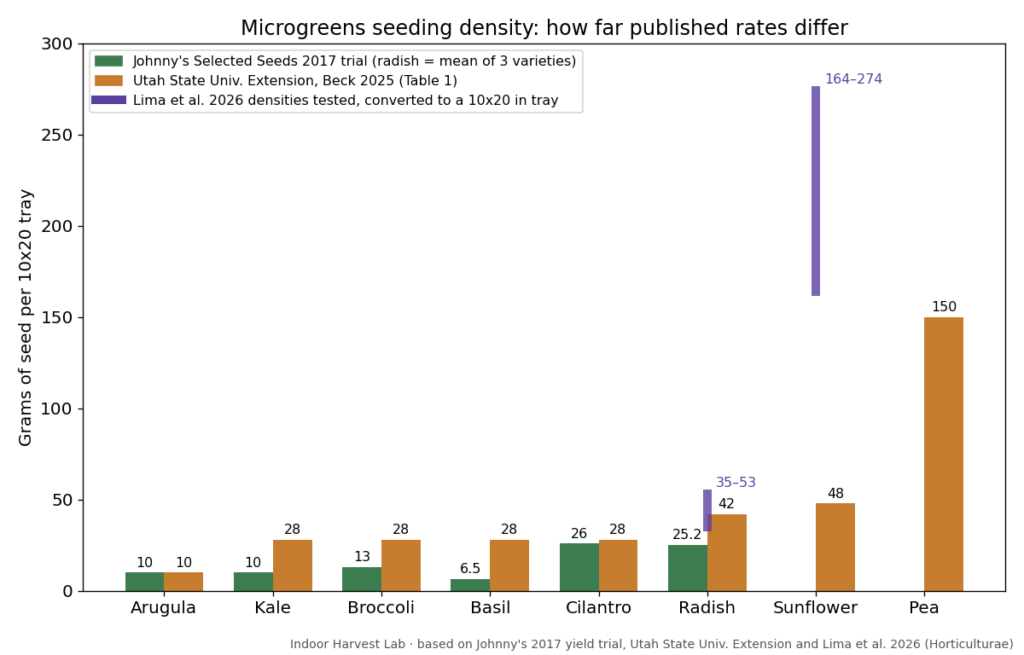
The most complete public dataset is the Johnny’s Selected Seeds 2017 microgreens yield trial. Johnny’s research team sowed 29 varieties in 1020 flats filled with germination mix, seeded each at least three times between mid-August and late October, weighed the seed used per flat, and harvested at the first true-leaf stage. The table shows their averages beside the rates in Utah State University Extension’s microgreens guide (Stephen Beck, 2025).
| Crop | Johnny’s average seed per tray (g) | Johnny’s average yield per tray (oz) | Johnny’s days to harvest | USU seed per tray (g) |
|---|---|---|---|---|
| Arugula | 10 | 10 | 14 | 10 |
| Kale, Red Russian | 10 | 11 | 13.5 | 28 (kale) |
| Broccoli | 13 | 11.5 | 12.5 | 28 |
| Red cabbage | 10.5 | 8.5 | 13.5 | – |
| Mizuna | 9.5 | 10 | 12 | – |
| Tokyo Bekana | 14 | 15 | 10 | – |
| Radish, Hong Vit | 28.5 | 11.5 | 9.5 | 42 (radish) |
| Radish, Red Arrow | 24.5 | 10 | 8 | 42 |
| Radish, Daikon | 22.5 | 8 | 8 | 42 |
| Beet, Bull’s Blood | 23 | 7.5 | 17 | – |
| Chard, Bright Lights | 31.5 | 9.5 | 16.5 | – |
| Cilantro | 26 | 6 | 20 | 28 |
| Amaranth, Garnet Red | 7.5 | 6.5 | 17 | – |
| Basil, Italian Large Leaf | 6.5 | 7.5 | 19 | 28 (basil) |
| Basil, Dark Opal | 5 | 6 | 25.5 | 28 |
| Sorrel, Red Veined | 3.5 | 6.5 | 24 | – |
| Sunflower | not trialed | – | – | 48 (soak 12 h) |
| Pea | not trialed | – | – | 150 (soak 6 h) |
Johnny’s rounds its numbers to the nearest half and warns that yield varies widely with technique, growing system, conditions, harvest stage and seed lot. Use the chart to choose a first seeding density, not as a fixed rule; the right seeding density for your shelf is the one your own notes confirm.
Why published seeding density numbers disagree
Look across the two columns and the gaps are large. Utah State’s broccoli and kale rate (28 g) is more than double Johnny’s (10 to 13 g), and its basil rate (28 g) is more than four times higher. Both sources are credible, so the difference is not an error. It reflects three real variables.
- Harvest stage. Johnny’s harvested at the first true leaf and notes that seeding density should change with the stage you want: sow more thickly for a cotyledon-stage cut, and fewer seeds if you want larger plants, to allow more air flow and slower depletion of water and fertility.
- Seed size and seed lot. Penn State’s microgreens seed density calculator, developed by Francesco Di Gioia, uses average seed weights from earlier experiments and notes that these may change from batch to batch.
- Growing system. Soil mix, mats, light level, temperature and how full a tray you want all shift the best rate. Virginia Tech’s SPES-756 advises testing seed density to find what works for your facility, system, substrate and crop.
Research rates can run higher still. In a 2026 vertical-farm study in Horticulturae, Lima and colleagues tested sunflower at 1,275 to 2,125 g/m², radish at 272 to 408 g/m², and green and red cabbage at 126 to 235 g/m². Converted to a 10 x 20 inch tray (about 0.129 m²), that is roughly 164 to 274 g of sunflower, 35 to 53 g of radish and 16 to 30 g of cabbage per tray. Their sunflower range is several times Utah State’s 48 g, which shows how much commercial systems push seeding density for weight.
How to calculate seeding density for any tray
A seeding density can be written as seeds per area or grams per tray. Penn State Extension’s ABCs of microgreens gives a simple method that works for any container, and its calculator automates it:
- Pick a target seed count per area. The article gives an optimal range of 1 to 6 seeds per cm², with fewer for large seeds and more for small ones.
- Multiply by the tray area. Total seeds = seed density × tray area.
- Correct for germination. Adjusted seeds = total seeds ÷ germination rate (for example, divide by 0.90 for 90% germination).
- Convert to weight. Divide by the number of seeds per gram, which you can get from the seed packet or by counting and weighing a small sample.
If you already have a gram rate for a 1020 tray, the shortcut is to scale by area. A nominal 1020 tray is 10 x 20 inches, or 200 square inches.
| Container | Area (sq in) | Share of a 1020 tray | Broccoli (13 g base) | Radish (25 g base) | Sunflower (48 g base) | Pea (150 g base) |
|---|---|---|---|---|---|---|
| 10 x 20 in (1020) | 200 | 1 | 13 g | 25 g | 48 g | 150 g |
| 10 x 10 in | 100 | 1/2 | 6.5 g | 12.5 g | 24 g | 75 g |
| 5 x 10 in | 50 | 1/4 | 3.3 g | 6.3 g | 12 g | 38 g |
| 5 x 5 in | 25 | 1/8 | 1.6 g | 3.1 g | 6 g | 19 g |
The radish base of 25 g is the mean of Johnny’s three radish varieties. No kitchen scale? Penn State’s growing microgreens page says one tablespoon of brassica seed weighs about 11 to 12 g, so a broccoli tray takes a little over a tablespoon. Weigh at least once, though; large seeds pack very differently.
What seeding density does to yield and quality
A higher seeding density usually means more weight per tray, up to a point. In the Lima 2026 study, seeding density outweighed light intensity: raising density increased yield by 22 to 52% across species, while the lowest light level tested (50 µmol/m²/s) was enough for most crops. The best yields were about 7.9 kg/m² for sunflower at 1,700 g/m², 4.9 kg/m² for radish at 408 g/m², about 3.8 kg/m² for green cabbage at 235 g/m², and 2.7 kg/m² for red cabbage at 180 g/m². Red cabbage did best at the middle density, a reminder that the highest seeding density is not always the most productive.
Weight is not the only measure. Crowded stands are harder to dry out between waterings, and Johnny’s links lighter sowing to better air flow. That matters because damp, still air is the main driver of fuzzy growth; our guide to microgreens mold covers how to tell mold from harmless root hairs and how to prevent it.
| Sign | Likely seeding density problem | Next tray |
|---|---|---|
| Bare patches, soil visible between plants | Too sparse or uneven spreading | Add 10–20% seed; spread in two passes |
| Thick mat that stays wet, musty smell, fuzz at the base | Too dense for your air flow | Cut seed 10–20%; add a small fan |
| Seeds stacked or heaving the cover up in clumps | Too dense or uneven | Spread wider; press seed into contact with the surface |
| Uneven heights, a slower “understory” in the tray | Dense sowing of small seed | Harvest a day or two later, or sow slightly less |
Johnny’s saw that last pattern in its amaranth trays: with thick sowing an understory grew more slowly, and a few extra days let those plants catch up.
How to sow at the right seeding density: step by step
- Choose your base rate. Start from the chart above for your crop. For crops Johnny’s did not trial, use the Utah State rate or your supplier’s recommendation.
- Scale to your container. Use the area table, then weigh the seed on a kitchen scale that reads to 0.1 g for small trays.
- Soak large seeds. Utah State soaks pea seed for 6 hours and sunflower for 12 hours. Small brassicas and radish need no soak.
- Prepare a level, moist surface. Fill and firm the medium or wet the grow mat so seed lies flat. Our guide to growing microgreens without soil covers mats, coco and hydroponic trays.
- Spread in two passes. Sprinkle half the seed lengthwise and half crosswise for an even cover, then mist.
- Cover for the blackout period. Utah State’s covered times are 1 to 2 days for arugula, kale and radish, 3 days for pea and sunflower, 4 to 7 days for basil and 7 to 14 days for cilantro.
- Record everything. Johnny’s stresses taking notes, and a seeding density log is the fastest way to improve: seed weight, date, harvest day and yield. After two or three trays your own numbers will beat any chart.
Seeding density mistakes to avoid
- Copying one number for every crop. Johnny’s rates run from 3.5 g (sorrel) to 31.5 g (chard) per tray, and pea needs 150 g. Seed size changes everything.
- Measuring seeding density by volume only. A tablespoon of brassica seed is about 11 to 12 g, but a tablespoon of basil or sunflower weighs something else entirely.
- Ignoring germination rate. An old seed lot at 70% germination needs noticeably more seed to give the same stand.
- Sowing very thick in a still, humid room. Heavy seeding density works in commercial racks with fans; at home it often ends in mold.
- Changing several things at once. Adjust seeding density by 10 to 20% per trial so you can see the effect.
- Harvesting on a fixed day. Johnny’s found some crops, such as marigold, gained a lot of weight when left a day or two longer.
Where this applies
The gram rates above assume a nominal 10 x 20 inch tray. Real inside dimensions differ by brand, and Penn State’s 10 to 15 g guideline refers to a 12 x 20 inch, 10-row seeding tray. Measure your own tray and scale by area. Metric growers can work directly from Penn State’s 1 to 6 seeds per cm².
Results also shift with season and setup. Johnny’s trial ran in a greenhouse from late summer into autumn and recorded that a hot week sped growth but reduced uniformity; under indoor lights, temperature and moisture are easier to control. Seed lots vary everywhere, so recheck your seeding density whenever you open a new bag. More guides for home growers are in our microgreens growing guides, and if you start transplants too, see how many hours of light seedlings need.
FAQ
How many grams of seed do I need for a 1020 tray of microgreens?
About 10 to 14 g for most small brassicas, 22 to 29 g for radish and 5 to 6.5 g for basil in Johnny’s trial. Utah State lists 48 g for sunflower and 150 g for pea.
How many seeds per square inch should I sow?
Penn State gives 1 to 6 seeds per cm² as the optimal range, fewer for large seeds and more for small ones. Its calculator converts that to grams for your tray.
Do I need to soak microgreen seeds before sowing?
Only the large ones. Utah State soaks pea for 6 hours and sunflower for 12 hours; its rates for arugula, broccoli, kale and radish use dry seed.
How much does a tray of microgreens yield?
In Johnny’s trial most crops yielded 5.5 to 15 oz per 1020 tray at the first true leaf. Penn State’s unlit two-week trays yielded from about 47 g (cilantro) to 201 g (red mustard).
Sources
- Johnny’s Selected Seeds (2017). Microgreens yield trial: comparison chart for 29 popular varieties and trial summary and discussion.
- Beck, S. (2025). Grow your own microgreens. Utah State University Extension.
- Sánchez, E. and Berghage, R. Growing microgreens. Penn State Extension.
- Di Gioia, F. The ABCs of microgreens and Microgreens seed density calculator. Penn State Extension.
- Virginia Cooperative Extension. Introduction to microgreen production in indoor vertical farms and greenhouses (SPES-756).
- Lima, F. M. de, et al. (2026). Seeding density outweighs light intensity in microgreens yield on a vertical farming system. Horticulturae 12(9): 1149.
Featured image: “Micro field of micro greens” by Nick Saltmarsh, CC BY 2.0.