
You pressed a few tomato seeds into a tray last weekend, set it on the windowsill, and now you lift the dome every morning hoping to see a green loop. Nothing yet. Is the seed dead, did you bury it too deep, or is the room simply too cold?
Short answer: germinating tomato seeds is easy once the mix is warm. Sow seed ¼ inch (6 mm) deep in a sterile, soilless mix, keep it evenly moist, and hold the mix at 75–85°F (24–29°C); at those temperatures tomato seed usually emerges in about 6–8 days. In a cool 59°F (15°C) room the same seed takes about two weeks, and at 50°F (10°C) it can take six.
This guide pulls the university numbers into one place: a soil-temperature chart, a “numbers to hold” table, a step-by-step sowing method, the light-or-dark question answered with the actual research, how to save and sprout seed from a tomato you grew or bought, and a troubleshooting table for bare trays. By the end you’ll know when to sow, how warm to keep things and exactly what to change if nothing has happened after ten days.
How Long Do Tomato Seeds Take to Germinate?
Tomato is one of the most forgiving crops you can start from seed, which is why it’s the first thing many people grow under lights. But “forgiving” doesn’t mean fast in every room. Temperature sets the clock almost on its own.
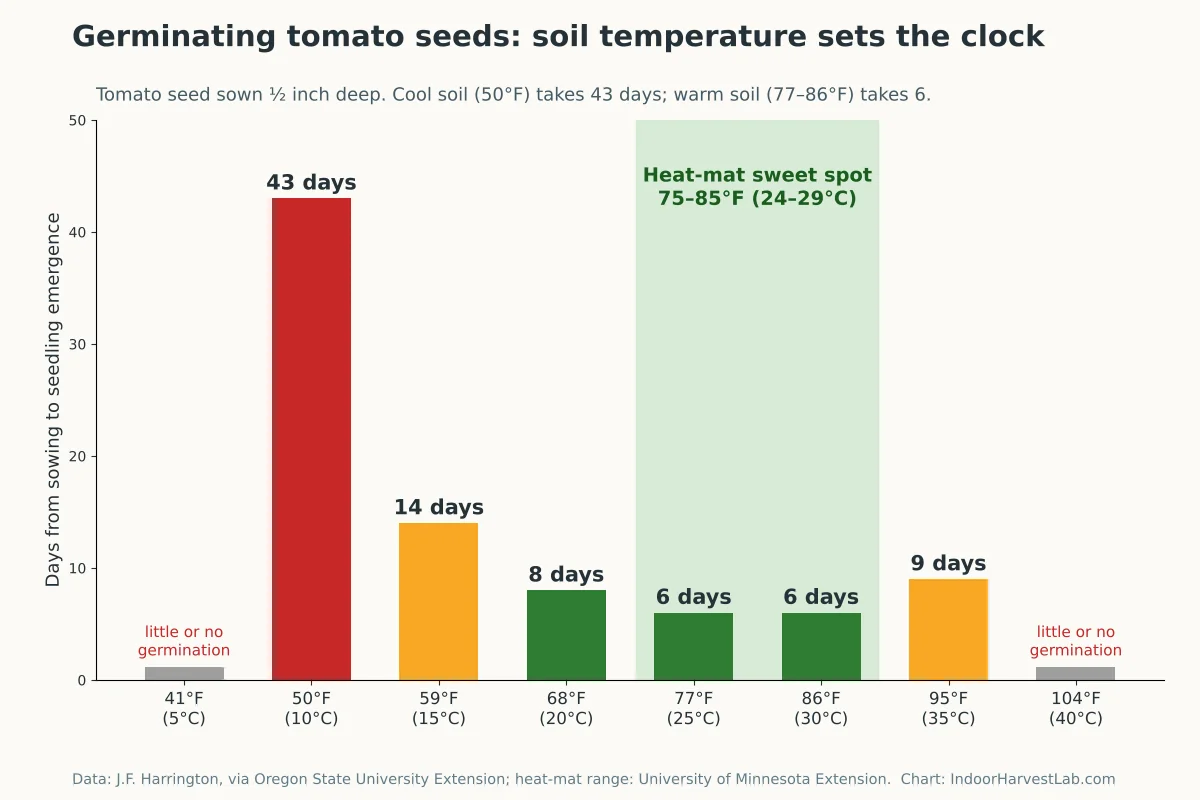
The classic data come from J.F. Harrington’s soil-temperature trials at UC Davis, republished by Oregon State University Extension. Tomato seed sown ½ inch deep took 43 days to appear at 50°F (10°C), 14 days at 59°F (15°C), 8 days at 68°F (20°C) and just 6 days at 77–86°F (25–30°C). Push it to 95°F (35°C) and it slows to 9 days; at 104°F (40°C) there was little or no germination at all.
| Soil temperature | Days to seedling emergence | What it means for you |
|---|---|---|
| 41°F (5°C) | Little or no germination | Unheated garage or cold porch: don’t bother |
| 50°F (10°C) | 43 | Germination is possible but painfully slow; rot and fungus gnats get there first |
| 59°F (15°C) | 14 | A cool winter room; seed is fine, just slow |
| 68°F (20°C) | 8 | Normal living-room temperature; works without a mat |
| 77°F (25°C) | 6 | Fastest: heat-mat range |
| 86°F (30°C) | 6 | Fastest: top of the useful range |
| 95°F (35°C) | 9 | Too hot; germination slows down again |
| 104°F (40°C) | Little or no germination | Seed is being cooked, not encouraged |
Two numbers from the same OSU table are worth memorising. The minimum soil temperature for tomato germination is 50°F (10°C) and the maximum is 95°F (35°C), with an optimum of 85°F (29°C). That’s a far wider window than peppers have, which is why tomatoes in a mixed tray come up first. Our guide to germinating pepper seeds shows the two crops side by side.
Iowa State University Extension gives a practical range for home growers: 70–75°F (21–24°C) air temperature and 6–12 days to germinate. That lines up neatly with Harrington’s figures: the warmer end of that range gets you the 6-day result, the cooler end the 8–12-day result.
The Numbers to Hold When Germinating Tomato Seeds
Here are the targets for germinating tomato seeds in one table. Every figure comes from the university and peer-reviewed sources listed at the end, so print it and tape it near your seed shelf.
| What | Target | Source |
|---|---|---|
| Sowing depth | ¼ inch (6 mm); ¼–½ inch is fine | UMN; Iowa State |
| Growing medium | Sterile, soilless germination mix | UMN |
| Mix temperature until emergence | 75–85°F (24–29°C) on a heating mat | UMN |
| Optimum soil temperature | 85°F (29°C); optimum range 60–85°F (16–29°C) | Harrington via OSU |
| Minimum / maximum | 50°F (10°C) / 95°F (35°C) | Harrington via OSU |
| Days to germinate | 6–12 days at 70–75°F; 6 days at 77–86°F | Iowa State; Harrington via OSU |
| Light during germination | Not needed; cover the seed (germinates in darkness) | Iowa State; Appenroth et al. 2006 |
| Soil temperature after emergence | About 70°F (21°C) | UMN |
| Seedling air temperature | 65–70°F (18–21°C) by day, a few degrees cooler at night | Iowa State |
| Seeding density in flats | No more than 6–8 seeds per square inch | OSU EC 1333 |
| Pot up at first true leaves | Into containers at least 2–3 inches across | OSU EC 1333 |
| Sowing to transplant size | 5–6 weeks (UMN, Iowa State); 5–7 weeks (Iowa State table); 5–8 weeks (OSU) | UMN; Iowa State; OSU |
When to start tomato seeds
For a garden crop, count back from your planting-out date, not forward from today. University of Minnesota Extension and Iowa State both say to sow tomatoes indoors 5–6 weeks before you plan to set plants outside, after frost danger has passed. UMN adds a warning that’s easy to ignore in January: plants started earlier are difficult to manage and don’t necessarily give you earlier or better harvests.
| If you plant outside around… | Sow tomato seed around… |
|---|---|
| Late April | Mid- to late March |
| Mid-May | Early April |
| Early June | Late April |
Growing tomatoes as an indoor crop instead? Then the calendar matters far less than your light. You can sow any week of the year, including right now in November, as long as the seedlings go straight under a strong grow light. Our guide to growing tomatoes indoors in winter covers what happens after germination.
How to Germinate Tomato Seeds Step by Step
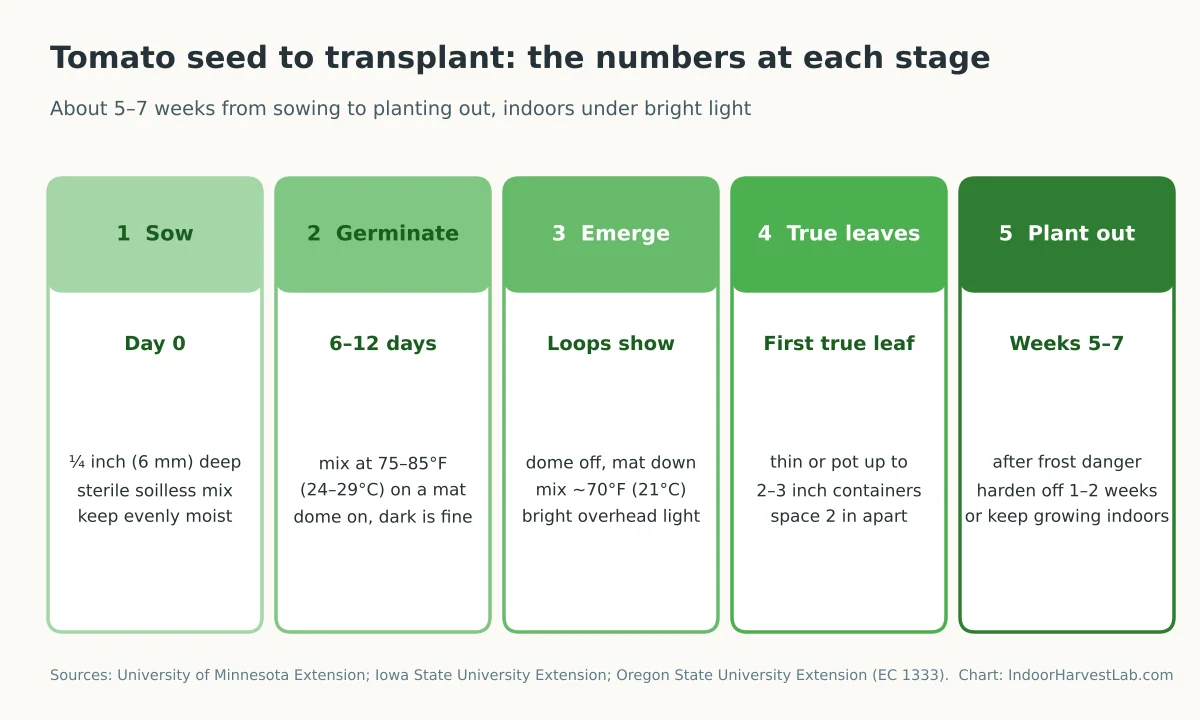
This is the standard extension method for germinating tomato seeds, written so you can follow it at the bench. The why behind each step is what saves you when something goes wrong.
Step 1: Check your seed
A packet that has spent a few summers in a warm kitchen drawer may not be at full strength. If you’re unsure, run a quick 10-seed test on a damp paper towel before you commit a whole tray. Our guide on how long seeds last shows how to read the result.
Step 2: Fill cells or a flat with sterile, soilless mix
UMN calls for a sterile, soilless germination mix. Sterile matters because the warm, wet conditions that make tomato seed germinate fast are also ideal for the fungi that cause damping-off. Moisten the mix before you fill the cells, so it’s damp like a wrung-out sponge rather than dripping. Want to blend your own? See our seed starting mix recipe.
Step 3: Sow ¼ inch deep, and not too thick
Drop one or two seeds per cell and cover them with ¼ inch (6 mm) of mix, the depth UMN recommends; Iowa State’s general rule for dark-germinating seed is ¼–½ inch. If you’re sowing into an open flat to prick out later, Oregon State’s tomato guide suggests no more than 6–8 seeds per square inch. Any thicker and the roots tangle, which makes transplanting slow and damaging. Firm the surface lightly so every seed sits in full contact with moist mix.
Step 4: Add gentle bottom heat
This is the single biggest lever. UMN advises a heating mat that keeps the flat at 75–85°F (24–29°C) until seedlings emerge. Measure the mix, not the air: push a probe thermometer into a cell. UMN also flags the catch: heat mats dry the mix out faster, so check moisture every day.
Step 5: Cover to hold moisture and wait about a week
Oregon State recommends covering flats with a plastic dome until plants are up. The dome keeps the top layer from drying while seeds swell. If the surface starts to lighten in colour, water from below rather than splashing the top.
Step 6: The moment you see loops, change everything
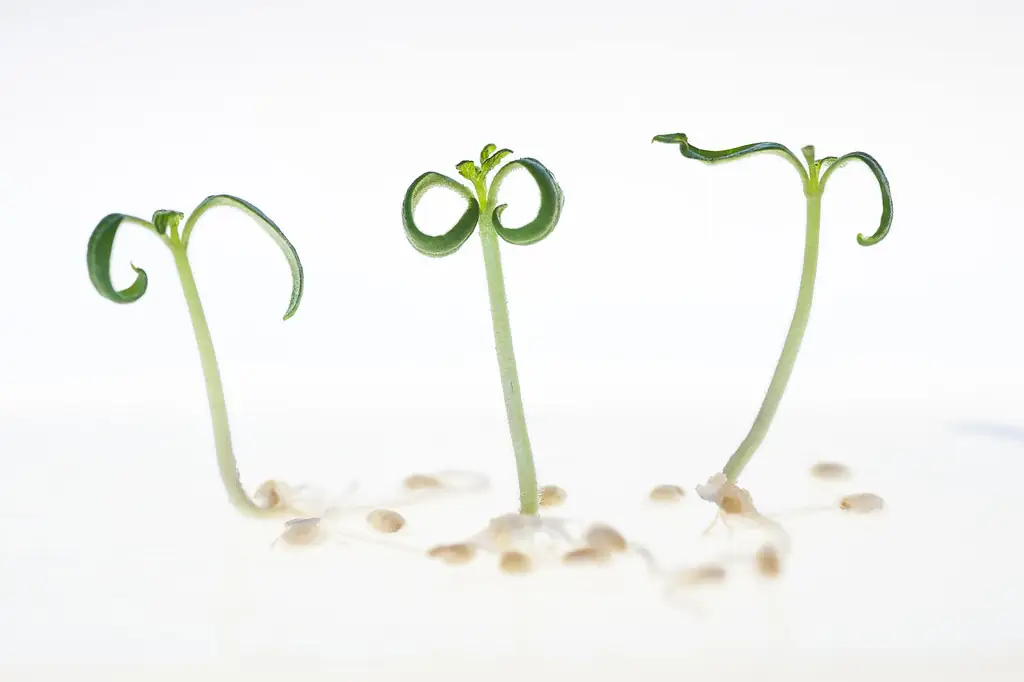
As soon as the first hooked stems break the surface, take the dome off, turn the mat down or off, and get the seedlings under bright overhead light. UMN puts the ideal soil temperature after emergence at about 70°F (21°C) and stresses that without bright light directly overhead, the stems stretch and lean. This is the hour when most tomato seedlings go leggy, not the week before.
Step 7: Thin or pot up at the first true leaves
Once true leaves appear, UMN says to thin or transplant so seedlings stand about 2 inches apart; Oregon State suggests moving them into containers at least 2–3 inches across. Tomato seedlings handle being moved well, so this is the right time to choose your strongest plants. Oregon State then feeds them once a week with a complete fertilizer.
Do Tomato Seeds Need Light to Germinate?
No, and this is where a lot of online advice goes wrong. Iowa State lists tomato as a “D” crop: one that germinates in darkness and should be covered with ¼–½ inch of mix. The lab research goes further.
In a study in Plant, Cell & Environment, Appenroth and colleagues (2006) found that tomato seeds germinate after rehydration in complete darkness. Strong continuous red light (38 µmol m⁻² s⁻¹) actually inhibited germination, while very weak red light stimulated it. The authors suggest this is an adaptation: a seed sitting on the soil surface in full sun is in a poor spot to sprout, while a seed under a layer of soil gets only a trickle of light. An earlier study in Planta by Shichijo and colleagues (2001) also found tomato seed germinated readily in the dark at 25°C (77°F) and was suppressed by prolonged far-red light.
Translated to your tray: cover the seed, and don’t leave an uncovered tray under a strong grow light to “help” it along. Light becomes essential only once the seedling breaks the surface.
Germinating tomato seeds in a paper towel
Germinating tomato seeds in a paper towel first is useful for old seed, rare heirlooms or seed you saved yourself, because you see exactly which seeds are alive before they take up space on the heat mat. It suits tomato well, since the seed doesn’t need light anyway.
- Fold the seeds into a paper towel that’s damp, not dripping, and slip it into a zip-top bag.
- Keep the bag in the same warm band you’d use for trays, 75–85°F (24–29°C). On top of a heat mat with a folded towel underneath works well.
- Check daily from about day 3. Pot each seed as soon as a short white root tip shows, root pointing down, ¼ inch deep.
- Handle the seed by its coat, never by the root. A snapped root tip usually means a lost seedling.
The trade-off is handling: seeds left too long weave their roots into the towel fibres. Our full guide to paper towel germination covers timing for other crops too.
What about germinating tomato seeds in water?
You’ll see “soak first” advice everywhere. None of the extension guides used here call for soaking tomato seed: it germinates well when sown into moist, warm mix. A short soak won’t hurt, but leaving seed submerged for days deprives it of oxygen, so if you soak, keep it brief and sow the same day.
Germinating Tomato Seeds From a Tomato You Grew or Bought
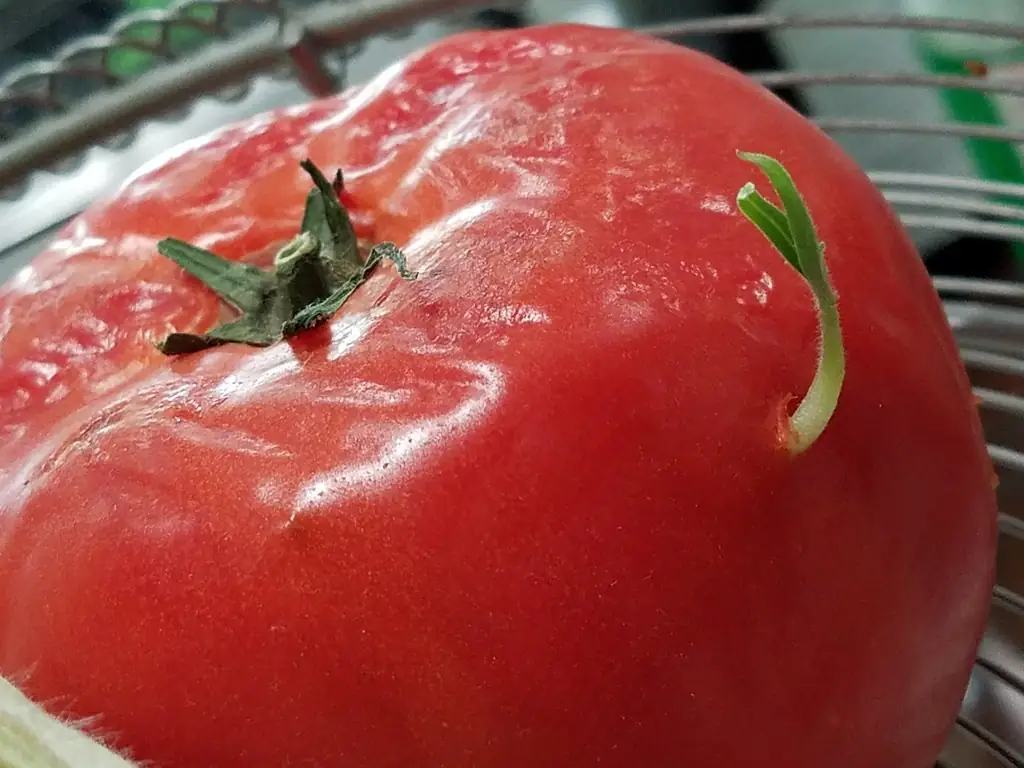
The autocomplete box is full of people asking whether they can sprout seeds straight from a fruit. You can, and sometimes the fruit beats you to it: an overripe tomato occasionally germinates its own seeds inside the fruit, as in the photo below.
Before you start, check what kind of tomato it is. University of Minnesota Extension explains that open-pollinated varieties such as ‘Brandywine’ and ‘San Marzano’ come true from seed, while hybrids such as ‘Big Boy’, ‘Beefmaster’ and ‘Early Girl’ produce viable seed that grows into unpredictable plants. Oregon State’s tomato guide says the same about F1 hybrids, and supermarket tomatoes are often hybrids. The seed will still germinate; just don’t expect the same fruit.
How to clean tomato seed by fermenting it
- Let the fruit ripen fully, then scoop out the seeds with the gel around them (UMN).
- Put the seeds and gel in a glass jar with some water.
- Stir or swirl twice a day. The mixture ferments, and good seed should sink to the bottom within about five days.
- Pour off the liquid and floating debris, rinse the seeds and spread them on paper towels to dry.
Once fully dry, the seed can be stored and sown exactly like packet seed. If you want to sow it straight away, rinse well and use the step-by-step method above.
Tomato Seeds Not Germinating? Troubleshooting Table
When germinating tomato seeds goes wrong, the cause is almost always on this short list. Work down it before you give up and resow.
| What you see | Most likely cause | What to do |
|---|---|---|
| Nothing after 10 days in a cool room | Mix around 59°F (15°C) or lower; tomato takes about 14 days there and 43 days at 50°F | Add a heat mat and hold the mix at 75–85°F. Don’t resow yet. |
| Nothing after 2 weeks on a heat mat | Old or badly stored seed, or seed sown too deep | Run a 10-seed paper towel test; sow at ¼ inch, 2 seeds per cell. |
| Nothing, and the mat is very hot | Mix above 95°F (35°C); germination slows and fails near 104°F | Use a thermostat probe in the mix; aim for 75–85°F. |
| Seeds on the surface, uncovered, not sprouting | Strong continuous light can inhibit tomato germination | Cover with ¼ inch of mix; light only after emergence. |
| Mix dried out on the mat | Heat mats dry the mix fast | Keep a dome on; check daily; water from below. |
| Seedlings came up, then collapsed at the soil line | Damping-off fungi in wet, unsterile conditions | Use fresh sterile mix and clean trays; vent the dome; see our damping-off guide. |
| Seedlings came up tall, pale and leaning | Not enough light directly overhead after emergence | Remove the dome, cut the heat to ~70°F, move the light closer. |
| Seeds from a store tomato never came up | Seed not cleaned or dried, or immature fruit | Use fully ripe fruit; ferment, rinse and sow in warm mix. |
If seedlings toppled over at the base, read our guide to damping-off in seedlings before you sow the next tray, because the same mix and trays can carry the problem forward.
From the Lab Bench
Read the Harrington data as a curve, not a list, and it tells you something useful: going from 68°F to 77°F saves only two days, while going from 59°F to 68°F saves six, and 50°F to 59°F saves nearly a month. In other words, the biggest wins come from getting a cold tray out of the cold. If your house sits at 68–70°F in winter, a heat mat is a nice speed-up for tomatoes, not a necessity. If your seed shelf is in a 55°F basement, it’s the whole game.
Notice too that sources disagree slightly on the “best” temperature. Oregon State’s tomato bulletin calls 60–70°F the best soil temperature, UMN’s heat-mat target is 75–85°F, and Harrington’s optimum is 85°F. These aren’t contradictions. The lower figure is a safe, all-round number that also suits young plants; the higher figures are about speed of emergence. Run warm until you see loops, then drop to about 70°F, and you get the best of both.
The light research is the other quiet lesson. Tomato seeds behave like seeds that “want” to be buried: darkness is fine, strong continuous light holds them back. So the classic beginner mistake of scattering tomato seed on the surface under a bright LED, the way you’d sow lettuce, works against the seed’s own biology. Cover it, keep it warm and evenly moist, and save the light for the seedling.
Finally, when germinating tomato seeds for the garden, resist the urge to start too early. Tomato seedlings grow fast. Sown in January for a May planting, they’ll outgrow their pots and the light long before the garden is ready, which is exactly why UMN and Iowa State settle on 5–6 weeks.
FAQ
How long does it take tomato seeds to germinate?
At 77–86°F (25–30°C) soil temperature, tomato seed emerges in about 6 days. Iowa State gives 6–12 days at 70–75°F. In a cool 59°F (15°C) room it takes about 14 days, and at 50°F (10°C) about 43 days (Harrington data via Oregon State University Extension).
What temperature is best for germinating tomato seeds?
The optimum soil temperature is about 85°F (29°C), with germination possible from 50°F to 95°F (10–35°C). University of Minnesota Extension recommends holding the mix at 75–85°F (24–29°C) on a heating mat until seedlings emerge, then about 70°F (21°C).
Do tomato seeds need light or dark to germinate?
They germinate in darkness. Iowa State lists tomato as a crop to cover with ¼–½ inch of mix, and lab studies found tomato seed germinates in complete darkness while strong continuous light can inhibit it. Give light as soon as the seedlings emerge.
How deep should I plant tomato seeds?
About ¼ inch (6 mm) deep in a sterile, soilless mix, as University of Minnesota Extension recommends. Iowa State’s general range for dark-germinating seed is ¼–½ inch.
Can I germinate tomato seeds without a heat mat?
Yes. In a room at 68°F (20°C), tomato seed emerged in about 8 days in Harrington’s trials, only two days slower than on a mat. Below about 60°F it slows sharply, so use a mat or a warmer spot in a cold house.
Can I germinate seeds from a store-bought tomato?
Yes. Scoop out ripe seeds with their gel, ferment them in a jar of water for a few days, rinse and dry, then sow. Many supermarket tomatoes are hybrids, so the plants may not match the fruit you saved them from.
When should I start tomato seeds indoors?
About 5–6 weeks before you plan to plant outside after the last frost, according to University of Minnesota and Iowa State extensions. For an indoor crop under grow lights, you can sow at any time of year.
Sources
- Harrington, J.F. Soil Temperature Conditions for Vegetable Seed Germination. Oregon State University Extension Service. https://extension.oregonstate.edu/gardening/techniques/soil-temperature-conditions-vegetable-seed-germination
- Oregon State University Extension Service. Grow Your Own Tomatoes and Tomatillos (EC 1333). https://extension.oregonstate.edu/catalog/ec-1333-grow-your-own-tomatoes-tomatillos
- University of Minnesota Extension. Growing Tomatoes in Home Gardens. https://extension.umn.edu/vegetables/growing-tomatoes
- University of Minnesota Extension. Saving Vegetable Seeds. https://extension.umn.edu/planting-and-growing-guides/saving-vegetable-seeds
- Iowa State University Extension and Outreach. Germination Requirements for Annuals and Vegetables. https://yardandgarden.extension.iastate.edu/how-to/germination-requirements-annuals-and-vegetables
- Iowa State University Extension and Outreach. When Should I Sow Tomato Seeds Indoors? (updated April 2024). https://yardandgarden.extension.iastate.edu/faq/when-should-i-sow-tomato-seeds-indoors
- Appenroth, K.J., Lenk, G., Goldau, L. and Sharma, R. (2006). Tomato seed germination: regulation of different response modes by phytochrome B2 and phytochrome A. Plant, Cell & Environment 29(4): 701–709. https://doi.org/10.1111/j.1365-3040.2005.01455.x (via PubMed)
- Shichijo, C., Katada, K., Tanaka, O. and Hashimoto, T. (2001). Phytochrome A-mediated inhibition of seed germination in tomato. Planta 213(5): 764–769. https://doi.org/10.1007/s004250100545 (via PubMed)