
You sowed a tray of peppers ten days ago. The tomatoes you planted the same weekend are already standing up on their seed leaves, but the pepper cells still look like plain, damp mix. Did the seed fail? Did you bury it too deep? Or is something else going on?
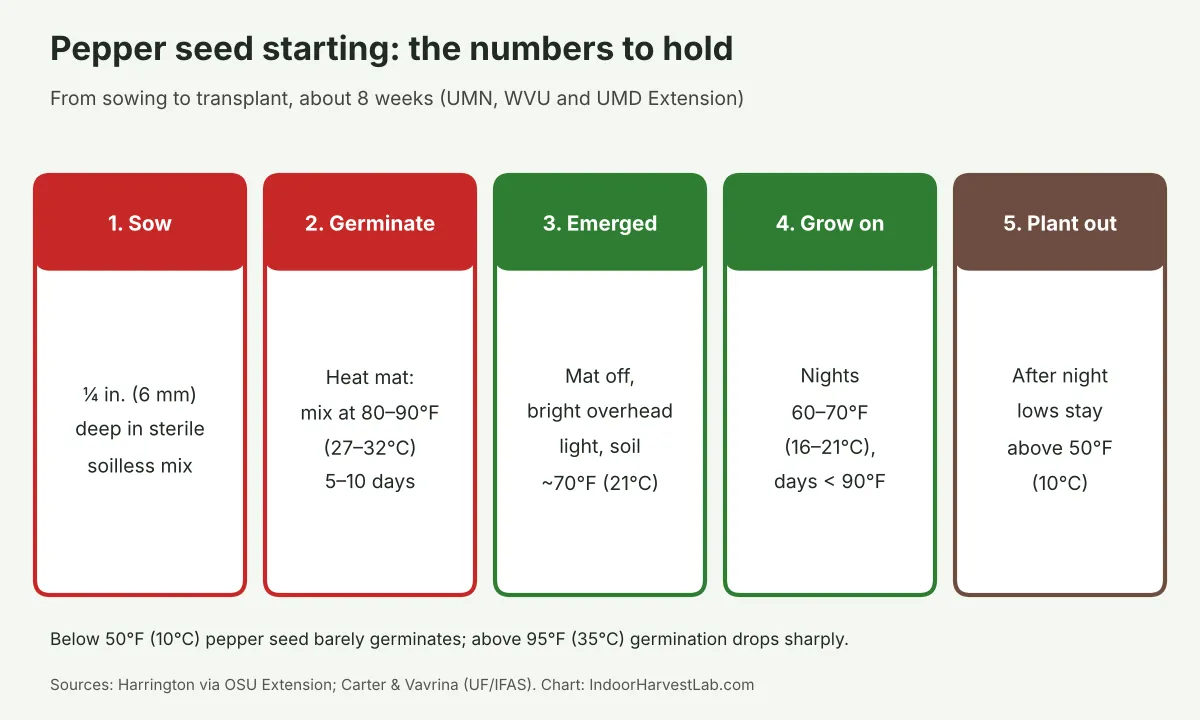
Short answer: germinating pepper seeds is mostly a temperature job. Keep the mix at about 80–90°F (27–32°C), sow ¼ inch (6 mm) deep in a sterile soilless mix, and keep it evenly moist; most pepper seed then comes up in roughly 5–10 days. In a cool room at 59°F (15°C) the same seed can take 25 days, and below 50°F (10°C) it barely germinates at all.
This guide puts the research numbers in one place: a soil-temperature chart, a step-by-step sowing method, a paper-towel option for old or precious seed, and a troubleshooting table for when the tray stays bare. By the end you’ll know exactly when to start, how warm to keep things, and what to change if nothing has happened after two weeks.
Why Germinating Pepper Seeds Takes Longer Than Tomatoes
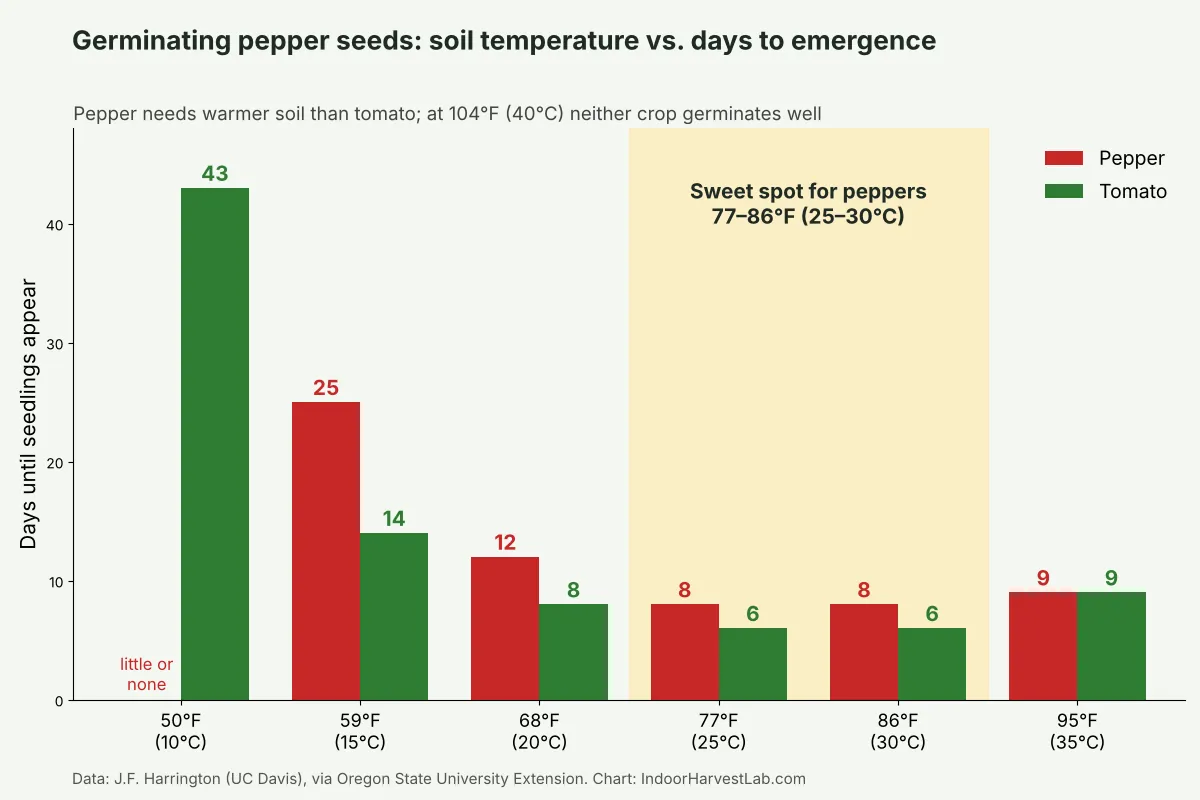
Peppers and tomatoes are cousins, so it’s natural to expect them to behave the same. They don’t. In the classic soil-temperature data compiled by J.F. Harrington at UC Davis and published by Oregon State University Extension, pepper needs at least 60°F (16°C) in the soil, with an optimum of 85°F (29°C). Tomato will germinate at 50°F (10°C).
The gap shows up most in cool rooms. At 68°F (20°C), a normal living-room temperature, pepper took 12 days to emerge versus 8 for tomato. At 59°F (15°C) the gap widened to 25 days versus 14. That is why the pepper cells look empty while the tomatoes are already up: the seed is alive, it’s just running slowly in the cold.
| Soil temperature | Pepper: days to emerge | Tomato: days to emerge |
|---|---|---|
| 50°F (10°C) | Little or no germination | 43 |
| 59°F (15°C) | 25 | 14 |
| 68°F (20°C) | 12 | 8 |
| 77°F (25°C) | 8 | 6 |
| 86°F (30°C) | 8 | 6 |
| 95°F (35°C) | 9 | 9 |
| 104°F (40°C) | Little or no germination | Little or no germination |
Two things jump out for anyone germinating pepper seeds. First, warming the mix from 68°F to 77°F cuts the wait by about a third. Second, there is a ceiling: pushing to 95°F gains nothing, and at 104°F germination fails. More heat is not always better. Our seed germination temperature chart gives the same numbers for other vegetables if you’re starting several crops on one mat.
The Numbers to Hold When Germinating Pepper Seeds
Before the step-by-step, here are the targets for germinating pepper seeds in one table. Every figure comes from the university sources listed at the end; print it and tape it near your seed-starting shelf.
| What | Target | Source |
|---|---|---|
| Sowing time | About 8 weeks before planting outside (before your last frost date) | UMN, WVU, UMD Extension |
| Sowing depth | ¼ inch (6 mm) | UMN, WVU Extension |
| Growing medium | Sterile, soilless germination mix | UMN, WVU Extension |
| Mix temperature until emergence | 80–90°F (27–32°C) on a heat mat | UMN, WVU Extension |
| Optimum germination temperature | 85°F (29°C); range 65–95°F (18–35°C) | Harrington via OSU Extension |
| Minimum / maximum | 60°F (16°C) / 95°F (35°C) | Harrington via OSU Extension |
| Typical days to germinate | 5–10 days at about 80°F | UMD Extension |
| Soil temperature after emergence | About 70°F (21°C) | UMN, WVU Extension |
| Night air for seedlings | 60–70°F (16–21°C); avoid days above 90°F (32°C) | UMN, WVU Extension |
| Germination water salinity | Keep below 3 dS/m (EC 3.0) | NMSU Chile Task Force |
| Plant out | After night lows stay above 50°F (10°C) | UMN, WVU Extension |
When to Start Pepper Seeds Indoors
Count back from the date you plan to set plants outside, not from today. University of Minnesota Extension and West Virginia University both advise starting pepper seed about eight weeks before planting out, and WVU notes that this is earlier than you’d normally start tomatoes. University of Maryland Extension lists the same eight weeks before the last frost date.
Outdoor transplanting waits for warm nights: both UMN and WVU say to plant out only after nighttime lows stay above 50°F (10°C). So the practical sum is: find the week your nights reliably clear 50°F, subtract eight weeks, and that’s your sowing week.
| If nights stay above 50°F (10°C) from… | Sow pepper seed around… |
|---|---|
| Mid-April | Mid-February |
| Early May | Early March |
| Late May | Late March |
| Early June | Early April |
Growing peppers as indoor plants rather than for the garden? Then the calendar matters less than your light setup. You can sow any time, and if you already have plants from last summer, our guide to overwintering peppers indoors shows how to keep them going instead of starting from scratch.
How to Germinate Pepper Seeds Step by Step
This is the standard extension method for germinating pepper seeds, laid out so you can follow it at the bench. The why behind each step matters more than the gear.
Step 1: Check your seed
Old seed is the quiet cause of many bare trays. If your packet has been open in a warm kitchen drawer for a few years, run a quick 10-seed test first; our guide on how long seeds last explains how. A low score tells you to sow extra seeds per cell rather than wait on seed that was never going to come up.
Step 2: Fill cells with a sterile, soilless mix
Both UMN and WVU call for a sterile, soilless germination mix. Sterile matters because the warm, wet conditions peppers need are also ideal for the fungi behind damping-off. Moisten the mix before you fill the cells so it is damp like a wrung-out sponge, not dripping. Want to blend your own? Our seed starting mix recipe covers the ratios.
Step 3: Sow ¼ inch deep
Place one or two seeds per cell and cover them with ¼ inch (6 mm) of mix, the depth both UMN and WVU recommend. Pepper seed doesn’t need light to germinate, so covering it is fine. Firm the surface gently so the seed sits in contact with moist mix all around.
Step 4: Add bottom heat
Bottom heat is the single biggest lever in germinating pepper seeds. Set the tray on a seedling heat mat and aim for 80–90°F (27–32°C) in the mix, as UMN and WVU advise. Measure the mix, not the air: push a probe thermometer into a cell. A mat with a thermostat probe is worth the extra cost, because the research shows germination falls off above 95°F (35°C).
Step 5: Cover to hold moisture, then wait
A clear humidity dome or plastic wrap keeps the surface from drying out while seeds swell. Check daily. Water from below if the top starts to lighten in color; our guide to bottom watering seedlings explains how long to leave the tray in water.
Step 6: The moment you see loops, change the setup
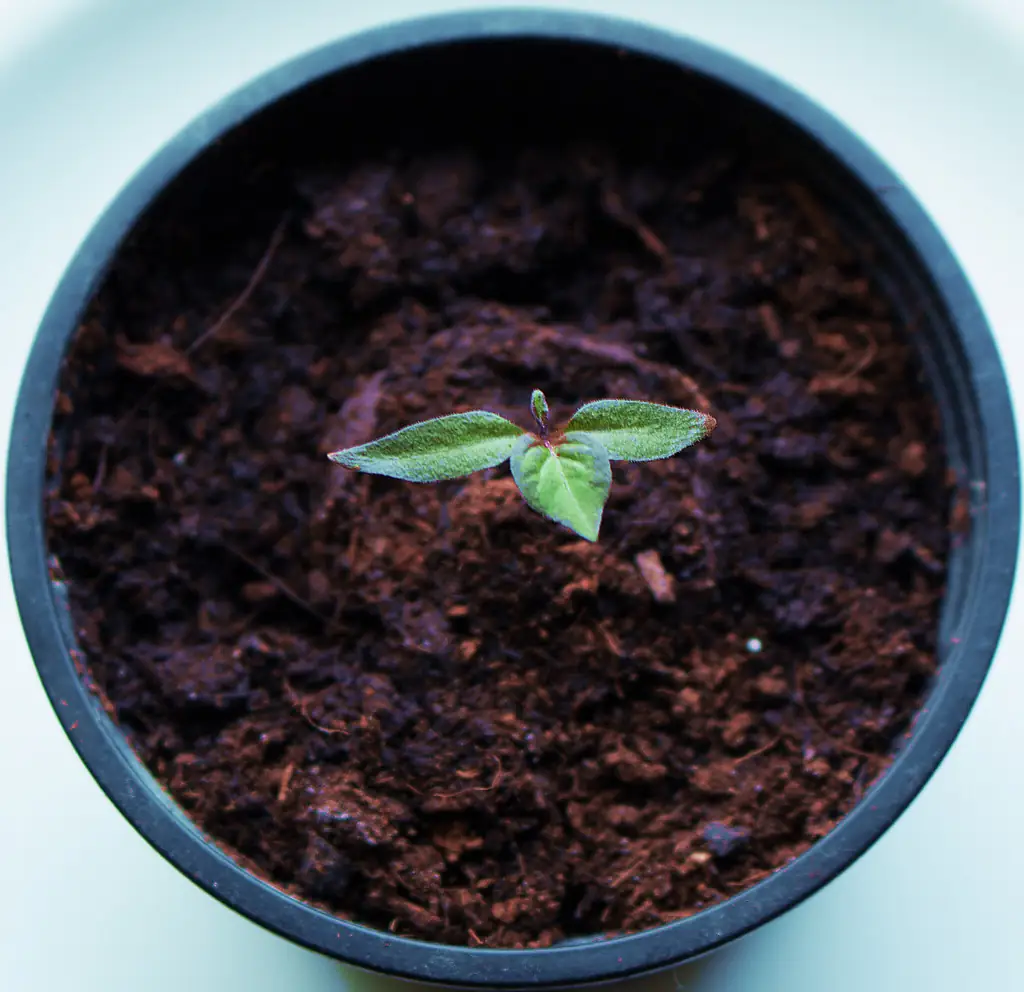
As soon as the first hooked stems break the surface, take the dome off, turn the heat mat down or off, and get the seedlings under bright overhead light. WVU and UMN say a soil temperature of about 70°F (21°C) is ideal at this stage. If you’re unsure about timing, see when to remove the humidity dome.
The Paper Towel Method for Old or Expensive Pepper Seed
Sowing straight into cells is the simplest way of germinating pepper seeds. But if you’re working with rare chili seed, a packet of unknown age, or seed you saved yourself, pre-sprouting in a damp paper towel lets you see what’s alive before it takes up space on the heat mat.
- Fold the seeds into a damp (not dripping) paper towel and slip it into a zip-top bag.
- Keep the bag warm, in the same 80–90°F band you’d use for trays. On top of a heat mat with a folded towel underneath works well.
- Check daily from day 3. Pot each seed as soon as a white root tip shows, root pointing down, ¼ inch deep.
- Handle the root tip by the seed coat, never by the root. A broken radicle usually means a dead seedling.
The trade-off is handling. Seeds left too long tangle their roots into the towel. Our full guide to paper towel germination walks through the method with timing for other crops.
Pepper Seeds Not Germinating? Troubleshooting Table
When germinating pepper seeds goes wrong and a tray stays bare past two weeks, the cause is usually one of a short list. Work down this table before you give up and resow.
| What you see | Most likely cause | What to do |
|---|---|---|
| Nothing after 10–14 days in a cool room | Mix below 70°F; at 59°F (15°C) pepper takes about 25 days | Add a heat mat; hold the mix at 80–90°F. Don’t resow yet. |
| Nothing after 3 weeks on a heat mat | Old or poorly stored seed | Run a 10-seed paper towel test; sow 2–3 seeds per cell or buy fresh seed. |
| Patchy emergence, some cells empty | Uneven moisture or depth; mat warmer at the center | Check depth (¼ in.), probe several cells, bottom-water evenly. |
| Seed rotting, mix smells sour | Mix kept too wet, often in a cool room | Use fresh sterile mix, moist not soggy; raise temperature. |
| Very low germination with heat mat on max | Mix above 95°F (35°C) | Use a thermostat; aim for 80–90°F. |
| Seedlings up, then collapse at the soil line | Damping-off | See our damping-off guide; improve airflow, water from below. |
| Seedlings tall, thin and leaning | Not enough overhead light | Lower the light; see leggy seedlings. |
Heat stress is real, especially for cayenne types
A study from the University of Florida’s Southwest Florida Research and Education Center (Carter and Vavrina) tested jalapeño and cayenne cultivars across temperatures. The jalapeño cultivars germinated at close to 100% from 20 to 30°C (68–86°F). At 35°C (95°F), results split: the jalapeños ranged from 48% to 82%, while both cayenne cultivars fell below 25%. At 40°C (104°F), no cultivar topped 1%.
The practical lesson: a heat mat without a thermostat can cook a tray, particularly under a dome in a warm room. The cultivars also differed sharply under the same conditions, so it’s normal for one variety to come up well while another lags on the same mat.
Salty water slows germination too
A New Mexico State University report (Flynn et al., 2002) found chile seed did not germinate at all at a constant 10°C (50°F). At 15°C (59°F), 15 days passed before any seed began to germinate. At 20°C (68°F), every chile type reached 90% of its maximum germination within 12 days. Salinity mattered as well: water at or above 7 dS/m cut germination by up to 19% at 20°C and up to 27% at 15°C. The authors recommended a seedbed below 3 dS/m. Hard well water or a dose of fertilizer in the germination water can push you toward that range, so use plain water until seedlings are up.
From Sprout to Transplant: Caring for Pepper Seedlings
Germinating pepper seeds is only the first hurdle. The next eight weeks decide whether you get stocky transplants or stretched, pale ones.
Light
UMN and WVU both say to give seedlings bright overhead light, warning that without it the stems stretch and lean. UMD Extension adds that natural light from a window is seldom enough for strong seedlings. In practice, that means a grow light a few inches above the leaves; our grow lights for seed starting buyer’s guide explains what to look for.
Temperature
Once seedlings are up, cool things down. WVU warns that dry soil, daytime temperatures above 90°F, or nights below 60°F or above 70°F can weaken plants. A cool basement shelf is fine for germinated seedlings as long as nights stay in that 60–70°F band.
Hardening off and planting out
UMN and WVU describe the same routine: set plants outside in a spot with wind protection and a couple of hours of sun, gradually increase their sun over one to two weeks, and bring them in if nights drop below 55°F (13°C). Transplant only once night lows stay above 50°F (10°C).
From the Lab Bench: What the Data Says About Pepper Germination
Read the germination tables side by side and one pattern stands out: pepper has a narrow comfortable band. Harrington’s data, the NMSU chile report and the UF jalapeño trial all point to the same window, roughly 77–86°F (25–30°C). Below it, the wait stretches fast. Above about 95°F, many seeds simply stop.
That’s why, when germinating pepper seeds, a heat mat earns its place more than for almost any other home-grown vegetable. It turns a 12- to 25-day gamble in a cool room into an 8-day routine. But the UF results are a good reminder that the mat is a tool, not a cure-all. A thermostat that keeps the mix at the low-to-mid 80s °F is the safer target than “as hot as it goes.”
The other lesson is about patience. At 68°F, seed that hasn’t shown after a week isn’t dead; the data say it should take about 12 days. A common mistake is resowing or dumping a tray too early. Hold your nerve until about day 14 on a mat, or day 25 in a cool room, before you judge the seed. Then test a few on a paper towel to decide whether to resow.
Finally, variety matters. In the NMSU trial, four chile types grown under identical conditions finished anywhere from about 75% to 98% germination after 21 days at 68°F. If one variety lags, it may simply be that variety, so sow a few extra seeds of anything slow or precious.
FAQ
How long do pepper seeds take to germinate?
At about 80°F (27°C) most pepper seed germinates in 5–10 days (University of Maryland Extension). In Harrington’s data, pepper took 8 days at 77–86°F (25–30°C), 12 days at 68°F (20°C) and 25 days at 59°F (15°C).
What temperature is best for germinating pepper seeds?
The optimum soil temperature is about 85°F (29°C), with a workable range of 65–95°F (18–35°C). Extension guides recommend holding the mix at 80–90°F (27–32°C) on a heat mat until seedlings emerge.
Do pepper seeds need light to germinate?
No. Extension guides recommend covering pepper seed with ¼ inch (6 mm) of mix, so it germinates in darkness. Light becomes essential the moment seedlings break the surface.
Can I germinate pepper seeds without a heat mat?
Yes, but germinating pepper seeds without bottom heat is slower. In Harrington’s data, pepper took 12 days at 68°F (20°C) and 25 days at 59°F (15°C). Find the warmest stable spot you have, such as the top of a refrigerator, and check the mix temperature with a thermometer.
Should I soak pepper seeds before planting?
None of the extension guides we used call for soaking. Pepper seed germinates well when sown ¼ inch deep in moist, warm mix. If you want to check viability first, the paper towel method pre-sprouts seed while showing you which seeds are alive.
Why are my pepper seeds not germinating?
The usual causes are cool mix (below about 70°F), old or poorly stored seed, mix that is too wet, or a heat mat running above 95°F (35°C). Check the mix temperature first, then test a few seeds on a damp paper towel.
When should I start pepper seeds indoors?
About eight weeks before you plan to plant outside, which UMN and WVU tie to nighttime lows staying above 50°F (10°C).
Sources
- Harrington, J.F. Soil Temperature Conditions for Vegetable Seed Germination. Oregon State University Extension Service (published 2013, reviewed 2024). https://extension.oregonstate.edu/catalog/soil-temperature-conditions-vegetable-seed-germination
- Carter, A.K. and Vavrina, C.S. High Temperature Inhibits Germination of Jalapeño and Cayenne Pepper. University of Florida/IFAS Southwest Florida Research and Education Center (2001). https://swfrec.ifas.ufl.edu/docs/pdf/veg-hort/transplant/trans_temp1.pdf
- Flynn, R., Phillips, R., Ulery, A., Kochevar, R., Liess, L. and Villa, M. Chile Seed Germination as Affected by Temperature and Salinity. New Mexico Chile Task Force Report 2, New Mexico State University (2002). https://pubs.nmsu.edu/research/horticulture/CTF2/index.html
- Schuh, M. and Tong, C. Growing Peppers in Home Gardens. University of Minnesota Extension (reviewed 2026). https://extension.umn.edu/vegetables/growing-peppers
- Jett, L.W. and Brabham, B. Growing Peppers. West Virginia University Extension, WV Garden Guide. https://extension.wvu.edu/lawn-gardening-pests/gardening/wv-garden-guide/growing-peppers-in-west-virginia
- University of Maryland Extension. Starting Seeds Indoors (updated February 2026). https://extension.umd.edu/resource/started-seed-indoors