
It’s a grey November afternoon and you’ve finally opened the shoebox. Half a packet of tomatoes from two summers ago. Onion seed you can’t date at all. A lettuce mix with “packed for 2023” stamped on the flap. The new catalogs are about to land, and you’d rather not pay twice for seed you already own.
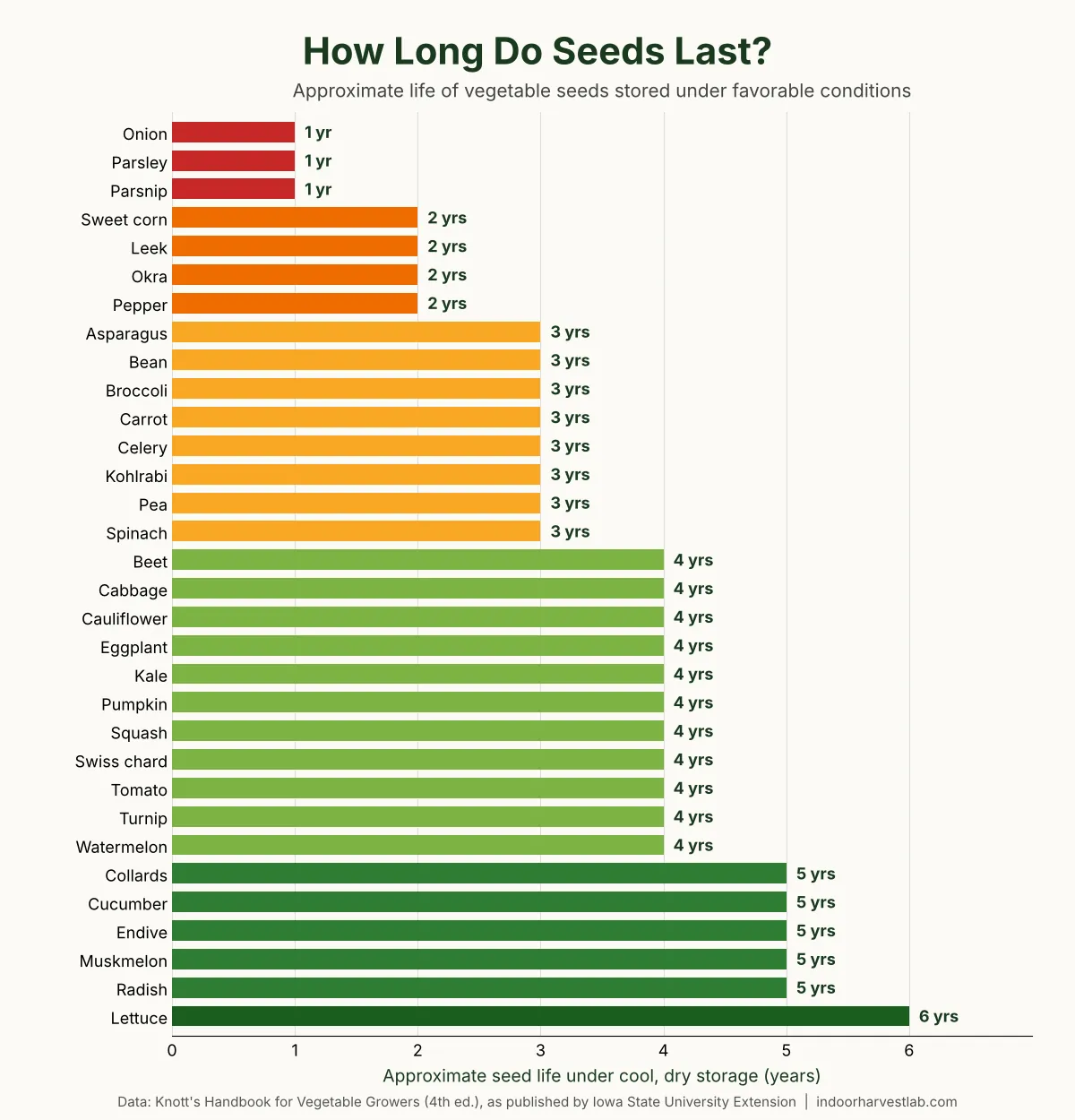
Short answer: so, how long do seeds last? Most vegetable seeds stay usable for 2 to 5 years when they’re kept cool and dry. Onion, parsley and parsnip are the exceptions and are best bought fresh every year, while cucumber, melon, radish and lettuce can go 5 years or more. Storage matters as much as age: seed held dry and below 40 °F (4 °C) can last far longer than the same seed left in a warm, humid shed.
By the end of this guide you’ll be able to look up any packet in a 37-crop seed viability chart, store what you keep so it actually lasts, and run a 10-seed test that tells you in about a week whether an old packet is worth a spot under your lights.
How Long Do Seeds Last? Seed Viability Chart for 37 Crops
Here’s the thing most charts won’t tell you: the numbers are not expiry dates. They’re the number of years a seed lot can be expected to still germinate well if it was stored properly. The “typical” column below comes from the table that Iowa State University Extension adapted from Knott’s Handbook for Vegetable Growers, which University of Illinois Extension also uses. The “range” column shows how far other extension charts (Colorado State, Iowa State’s 2023 guide and Purdue) stray from it.
The last column is one you rarely see on gardening sites. It’s the minimum germination percentage from the “Federal and Colorado minimum germination” table published by Colorado State University Extension. Packets sold in Colorado must germinate at or above it, so it tells you roughly how good that seed had to be on day one, which changes how you should read an old packet.
| Crop | Typical seed life (years) | Range across extension charts | Minimum germination for sale (%) |
|---|---|---|---|
| Onion | 1 | 1 | 70 |
| Parsley | 1 | 1 | 60 |
| Parsnip | 1 | 1 | 60 |
| Leek | 2 | 2 | 60 |
| Okra | 2 | 2 | 50 |
| Pepper | 2 | 2 | 55 |
| Sweet corn | 2 | 2 | 75 |
| Asparagus | 3 | 3 | 60 |
| Bean | 3 | 3 | 70 |
| Broccoli | 3 | 3–5 | 75 |
| Carrot | 3 | 3 | 55 |
| Celery | 3 | 3 | 55 |
| Chinese cabbage | 3 | 3 | 75 |
| Kohlrabi | 3 | 3 | 75 |
| Pea | 3 | 3 | 80 |
| Spinach | 3 | 3–5 | 60 |
| Beet | 4 | 4 | 65 |
| Brussels sprouts | 4 | 4 | 70 |
| Cabbage | 4 | 4–5 | 75 |
| Cauliflower | 4 | 4–5 | 75 |
| Eggplant | 4 | 4 | 60 |
| Fennel | 4 | 4 | n/a |
| Kale | 4 | 4 | 75 |
| Mustard | 4 | 4 | n/a |
| Pumpkin | 4 | 4 | 75 |
| Rutabaga | 4 | 4 | 75 |
| Squash | 4 | 3–4 | 75 |
| Swiss chard | 4 | 4 | 65 |
| Tomato | 4 | 4 | 75 |
| Turnip | 4 | 4 | 80 |
| Watermelon | 4 | 4 | 70 |
| Collards | 5 | 5 | n/a |
| Cucumber | 5 | 5 | 80 |
| Endive | 5 | 5 | 70 |
| Muskmelon | 5 | 5 | 75 |
| Radish | 5 | 4–5 | 75 |
| Lettuce | 6 | 1–6 | 80 |
“n/a” means the crop isn’t in Colorado State’s table. Years assume cool, dry storage.
A quick way to remember it: alliums and the carrot-family herbs die young (onion, leek, parsley, parsnip), peppers and sweet corn are a two-year proposition, and the cabbage family, tomatoes and the cucurbits are the long-haulers.
Why the charts disagree (look at lettuce)
Lettuce is the awkward one. Colorado State lists it at 1 year. Iowa State’s current guide says 5. The Knott’s-based tables say 6. They can’t all be right, can they?
They can, because they aren’t measuring the same thing. A “years” figure depends on the storage conditions the author assumed and on how much germination loss they’d tolerate. University of Delaware Extension, writing for commercial growers who need near-perfect stands, is stricter still: onion under 1 year, sweet corn and spinach storing poorly beyond 1 year, beans, peas and peppers about 2, and tomatoes, eggplant, cole crops and cucurbits about 3.
At the other extreme, a German genebank study kept 18 crop species at ordinary room conditions (about 20 °C and 50% relative humidity) for up to 26 years. Nagel and Börner (2010) report that pea, common bean and maize seed lots still held some viability after 23, 21 and 19 years, while chive seed survived only 5 years and lettuce 7. “Still some life in the lot” is a long way from “worth sowing”, though. Treat the chart as the window for good germination, not the moment the last seed dies.
What about flower and herb seeds?
Purdue Extension publishes one of the few flower lists. Under favorable conditions it gives:
| Expected storage life | Annual flowers |
|---|---|
| 1 year | Aster, coleus, geranium, pansy, phlox, salvia, verbena, vinca |
| 2 years | Dahlia, hollyhock, impatiens, marigold, petunia |
| 3 years | Cosmos, hibiscus, lobelia, nicotiana |
| 4 years | Ageratum, alyssum, celosia, dianthus, poppy |
| 5 years | Calendula, nasturtium, zinnia |
Culinary herbs are thinly covered. Parsley (1 year) and fennel (4 years) are in the extension tables, and chives were the shortest-lived species in the genebank study above. Basil, cilantro and most other herbs simply aren’t in the charts cited here, so don’t trust a number someone made up for them. Test the packet instead; if you’re growing chives indoors or starting parsley, buy parsley seed fresh each year and don’t sit on chive seed for long.
What Actually Ages a Seed: Heat and Moisture
A common mistake is to think of a seed as inert, like a grain of sand with instructions inside. It isn’t. A dry seed is alive and slowly spending its reserves, and the two things that speed up the spending are warmth and moisture.
Seed scientists boil this down to two rules of thumb, quoted by University of Delaware Extension: for each 1% increase in seed moisture, seeds lose half of their storage life, and for each 9 °F (5 °C) increase in temperature, they lose half again. The effects stack. That’s why a packet in a hot garage ages several times faster than one in the fridge.
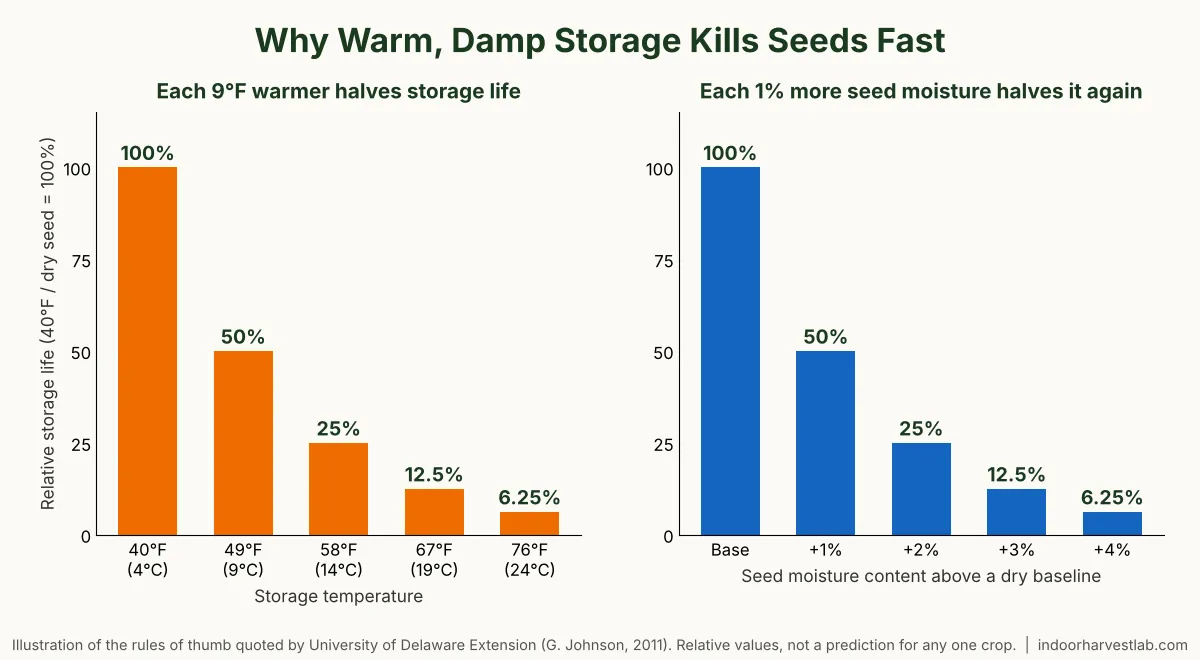
Moisture is the sneakier of the two, because seeds trade water with the air around them. Colorado State gives a vivid pair of numbers: at 15% relative humidity, seed dries down to about 6% moisture and stores safely for several years, but at 90% relative humidity it only dries to about 19%, and germination will be poor after a single year.
From this comes the handiest rule in seed storage, repeated by Delaware and by Johnny’s Selected Seeds: the storage temperature in °F plus the percent relative humidity should add up to less than 100. A 50 °F room at 50% humidity sits right on the line; a 40 °F fridge with the seed sealed away from damp air passes easily. A 72 °F kitchen at 55% humidity scores 127, which is why the drawer next to the stove is such a poor seed bank.
Why do onion and parsnip fade so quickly while peas last? The genebank study offers one clue: seeds that store their energy mainly as oil tended to be shorter-lived than starchy ones. You can’t change what a seed is made of. You can change where it sleeps, and that’s the half of “how long do seeds last” that is in your hands.
How to Store Seeds So They Last Longer
If the real question behind “how long do seeds last” is “how do I make mine last longer”, the answer is short. Good storage isn’t complicated, but the order matters. Dry first, seal second, chill third. Chilling damp seed, or sealing it while it’s still moist, does more harm than leaving it in the packet on a shelf.
Step 1: Make sure the seed is dry
Bought seed arrives dry. Home-saved seed doesn’t. Iowa State calls drying “the most important step”: put the seed in labeled paper envelopes, place an equal amount of silica gel in a separate envelope, and seal both in a clean glass jar. After one to two weeks the seed should be dry and the silica gel can come out. Don’t use a food dehydrator, which runs too warm.
Colorado State’s target for long storage is seed below 8% moisture, reached by drying at 100 °F (38 °C) for six hours and never hotter. No microwave. One caution: beans and peas shouldn’t be dried quite so hard, because over-dried legumes turn into “hard seed” that won’t take up water. If that happens, Colorado State suggests exposing them to humid air for two weeks before planting.
Step 2: Seal it in something moisture-proof
Paper packets breathe, which is fine for a season and bad for five. Keep seed in its original packet (the label is your record), then put the packets inside a sealed glass jar or can. Colorado State prefers sealed cans or jars to plastic bags, and Iowa State points out that glass also keeps out mice and insects.
Add a desiccant to mop up the moisture you seal in. University of Minnesota Extension suggests one to two tablespoons of powdered milk, which absorbs moisture for about six months; Purdue adds that uncooked rice works too, with a paper towel between it and the seed. Write the swap date on the lid.
Step 3: Keep it cold and steady
Minnesota’s ideal is 32–41 °F (0–5 °C), which is simply the back of a household refrigerator. Colorado State says below 40 °F. A cool closet or root cellar is second best. A greenhouse, garage or potting bench is worst.
What about the freezer? Sources split, and the split is instructive. Colorado State allows a refrigerator or deep freezer for seed in moisture-proof containers, and Delaware says freezing works very well if seeds are dry. Purdue tells home gardeners to use the refrigerator, not the freezer. The safe reading: freeze only seed you’ve deliberately dried; otherwise the fridge is the lower-risk choice.
Step 4: Open the jar the right way
Cold seed pulled into a warm room collects condensation, exactly the moisture you worked to keep out. Illinois and Johnny’s both say to let the sealed container come to room temperature before you open it. Take out what you need, reseal, and put it straight back.
Numbers to hold
| What | Target | Source |
|---|---|---|
| Storage temperature | Below 40 °F (4 °C); 32–41 °F (0–5 °C) is ideal | Colorado State; Univ. of Minnesota |
| Temperature + humidity rule | °F + % relative humidity under 100 (e.g. 50 °F + 50%, or 40 °F + 60%, is the limit) | Univ. of Delaware; Johnny’s |
| Long-term storage | About 40 °F and 30% relative humidity for most seeds | Univ. of Delaware |
| Seed moisture for long storage | Below 8% (beans and peas slightly higher) | Colorado State |
| Drying home-saved seed | 100 °F (38 °C) for 6 hours, never hotter; or 1–2 weeks sealed with an equal amount of silica gel | Colorado State; Iowa State |
| Powdered-milk desiccant | 1–2 tablespoons per jar; replace about every 6 months | Univ. of Minnesota |
| Moisture penalty | Each +1% seed moisture halves storage life | Univ. of Delaware |
| Heat penalty | Each +9 °F (5 °C) halves storage life | Univ. of Delaware |
| Germination test temperature | 70–80 °F (21–27 °C) | Iowa State |
| Germination test size | 10 seeds minimum; 20 is better, 50–100 best | Univ. of Illinois; Iowa State |
| Keep / replace line | 90%+ very good; 70–80% acceptable for small, plentiful seed; 50% or less not worth using | Iowa State |
How to Test Old Seeds Before You Sow
You don’t have to guess. A germination test costs a paper towel and about a week, and Iowa State recommends running it roughly a month before planting on any seed that’s more than a year old. That gives you time to reorder. It’s the same technique described in our guide to paper towel germination, used here as a measuring tool.
Step 1: Count out the seeds
Illinois Extension’s home version uses 10 seeds, which makes the maths trivial. Iowa State prefers at least 20 picked at random (“50 is better, 100 is best”), because small samples are noisy. With a nearly empty packet, 10 is fine. With a big bag of pea or microgreen seed, use more.
Step 2: Roll them in a damp towel
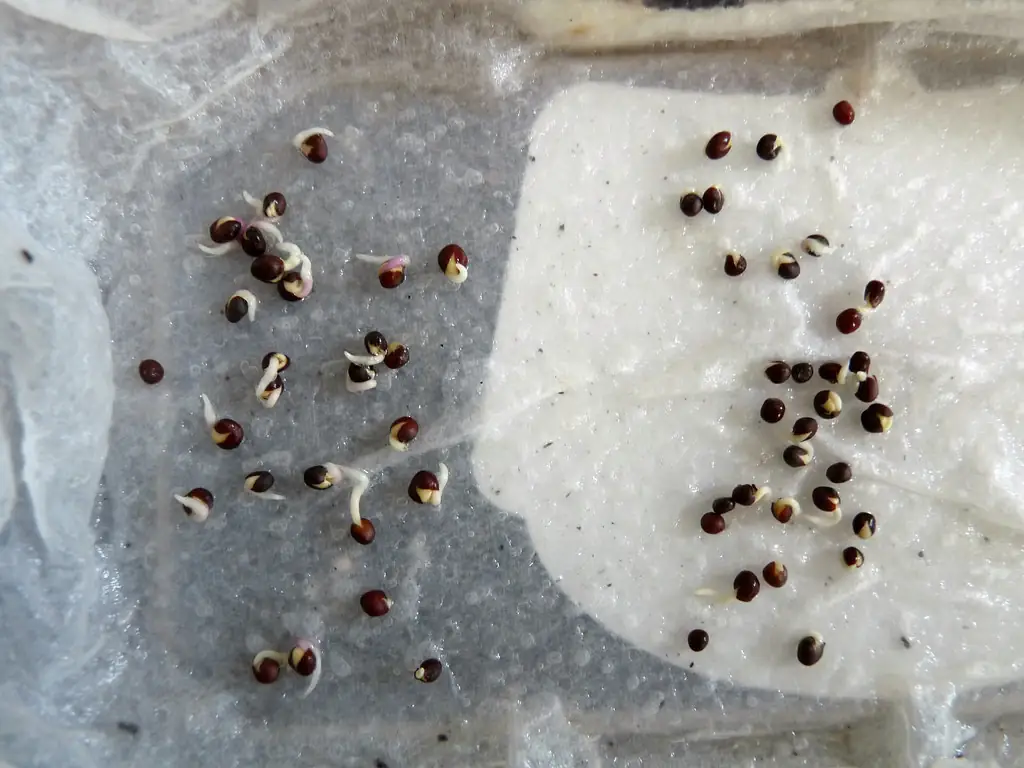
Spread the seeds on several layers of pre-moistened paper towel so they don’t touch, then roll or fold it up. Damp, not dripping: seeds sitting in a puddle rot rather than sprout. Slide the roll into a plastic bag or lidded container and label it with the crop, the date and the days to germination printed on the packet.
Step 3: Keep them warm
Put the bag somewhere that stays 70–80 °F (21–27 °C). Light isn’t needed. If your house runs cool in winter, the top of the fridge or a seedling heat mat set low will do; our seed germination temperature chart shows why a cold room makes even good seed look dead.
Step 4: Count and do the sum
Check after two or three days, then daily. A seed counts as germinated once a root or seed leaf has pushed out. When sprouting has clearly stopped, divide the number germinated by the number tested. Eight of 10 is 80%. Seventeen of 20 is 85%.
Step 5: Decide
| Result (10-seed test) | Germination | What to do |
|---|---|---|
| 10 of 10 | 100% | Plant as normal. |
| 9 of 10 | 90% | Very good for most species. Plant as normal or add a few spares. |
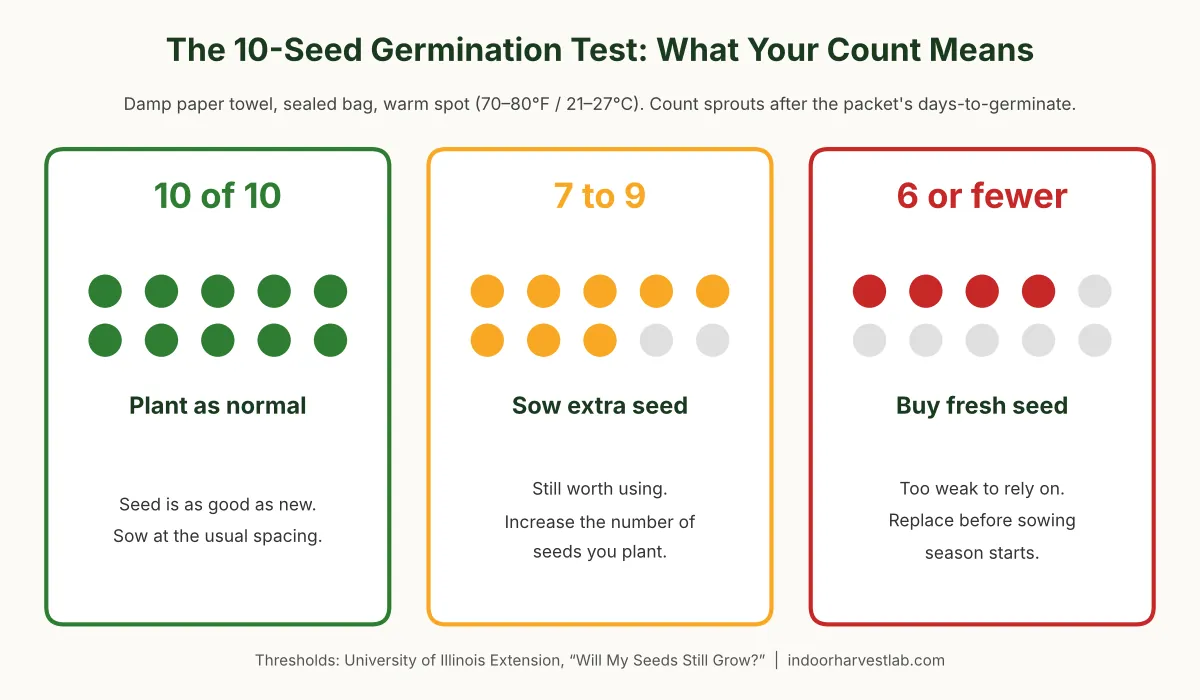
| 7–8 of 10 | 70–80% | Acceptable, especially for small, plentiful seed. Sow extra: two seeds per cell instead of one. |
| 6 or fewer | 60% or less | Buy fresh seed. Illinois draws the line at 6 of 10; Iowa State says 50% or lower is not worth using for nearly all species. |
Compare your number with the fourth column of the big chart, too. The standard for peppers and carrots is only 55%, while lettuce, peas and cucumbers must reach 80%. A three-year-old pepper packet testing at 60% hasn’t collapsed. It may be close to where it started, and Iowa State’s advice is that seed still relatively close to its original rate is worth sowing.
One honest limitation: a towel test flatters seed. It measures whether seeds can sprout in perfect warmth and moisture, not whether they have the vigor to push through mix and grow away quickly. Illinois notes that vigor declines before germination percentage does. So if a lot scrapes through at 70%, expect slower, less even seedlings and give them your best conditions.
Reading Packet Dates and Fixing Common Seed-Storage Mistakes
Do seeds expire on the date stamped on the flap? No. A “packed for” year tells you the season the packet was sold for, and Iowa State notes that seed is often sold with the germination rate at the time of packaging printed on it. Neither is a use-by date. Add the chart’s years to the packed-for year as a first guess, then let the towel test overrule it.
If you transfer seed to other containers, Purdue’s minimum label is the plant name and the year you bought it. Future you will not remember.
| What you see | Likely cause | What to do |
|---|---|---|
| Nothing sprouts in the test, seeds turn mushy | Dead seed, or towel too wet | Retest once with a barely damp towel; if it repeats, discard. |
| Only 5–6 of 10 sprout, slowly | Aged seed losing vigor | Sow thickly this season or replace; don’t store it another year. |
| Seeds sprouted inside the storage jar | Moisture got in | Discard. Illinois notes seeds that germinate in storage won’t grow the next year. |
| Mold on stored seed or packets | Sealed while damp, or humid storage | Discard moldy lots; dry the rest with fresh desiccant before resealing. |
| Old beans or peas swell slowly or not at all | Over-dried “hard seed” | Leave them in humid air for two weeks before planting (Colorado State). |
| Fridge-stored seed fails after a good first year | Jar opened cold, condensation each time | Warm the sealed jar to room temperature before opening. |
| Good test result, poor emergence in trays | Low vigor, or cold wet mix | Warm the root zone and sow shallow in a light mix. |
That last row catches people out every spring. Weak, slow seedlings from old seed spend longer at the vulnerable stage, which is when damping off strikes. A fresh, well-drained seed starting mix, warmth at the roots and a decent light close overhead give borderline seed its best chance.
And if the packet fails outright? Don’t compost the lot just yet. Seed that’s too patchy for neat rows of transplants can still be scattered thickly for baby greens or microgreens, where gaps don’t matter; our microgreens seeding density guide explains how to adjust the sowing rate.
From the Lab Bench
Ask a seed scientist how long do seeds last and you’ll get a curve rather than a number. The professional way to think about seed age is as a slope, not a cliff. A seed lot doesn’t go from 95% to zero on its fourth birthday. The genebank data describe a sigmoid curve: a long plateau where almost everything germinates, then a steepening slide. The charts are really telling you where the plateau usually ends under decent storage.
That has two practical consequences. First, where a lot sits on the curve matters more than its age. Two tomato packets from the same year can test very differently if one lived in a fridge and the other in a conservatory. The halving rules explain why: 18 °F warmer and a couple of percent damper is, by those rules of thumb, a sixteen-fold difference in ageing rate. That is why this guide leans on testing rather than on dates.
Second, the slide starts with vigor, not with the headline number. Before seeds fail to germinate at all, they germinate more slowly and less evenly. For an indoor grower that shows up as a tray where half the cells are up on day five and the rest straggle in over two weeks, which makes light height and watering a compromise for everyone. With short-lived, slow species such as onion, parsley and parsnip, buying fresh every year is cheap insurance against a wasted month.
A sensible rule set, then. Replace the one-year crops annually. Test anything past the midpoint of its chart life. Spend your storage effort on the seed that’s expensive or hard to replace, such as hybrid tomatoes, peppers and saved heirlooms, and don’t agonise over a dollar packet of radish. And remember that a refrigerator jar with a spoonful of milk powder is doing the same job as a seed bank, just on a smaller budget: dry and cold, in that order.
How Long Do Seeds Last: FAQ
How long do seeds last in packets?
Most vegetable seeds last 2 to 5 years in their original packets if the packets are kept cool and dry. Onion, parsley and parsnip are good for about 1 year, peppers and sweet corn about 2, tomatoes about 4, and cucumbers, radishes and lettuce 5 or more. Paper packets let humidity in, so put them inside a sealed jar for anything you plan to keep beyond a season.
Do seeds expire?
Not on a fixed date. The year on a packet is the season it was packed for, not a use-by date. Seeds lose germination gradually, and how fast depends mostly on storage temperature and moisture. A germination test tells you more than the date does.
How long do seeds last in the freezer or fridge?
Colorado State University Extension says storage can be extended to 10 or more years when seed is dried below 8% moisture and kept below 40 °F in a moisture-proof container. A refrigerator at 32–41 °F is ideal for home growers. Freezing works well only if the seed is truly dry, so the fridge is the safer default.
How do I test old seeds for germination?
Place 10 to 20 seeds on a damp paper towel, roll it up, seal it in a plastic bag and keep it at 70–80 °F. Count the sprouted seeds after the days to germination listed on the packet, then divide by the number tested. All 10 means plant normally, 7 to 9 means sow extra, and 6 or fewer means it’s best to buy new seed.
Which vegetable seeds last the longest and the shortest?
In extension charts, lettuce, cucumber, muskmelon, radish, endive and collards last longest at about 5 to 6 years. Onion, parsley and parsnip are shortest at about 1 year, followed by leek, okra, pepper and sweet corn at about 2 years.
Can I plant 10-year-old seeds?
You can try, but test them first. Most vegetable seed kept at room conditions will be past its useful life by then, although seed stored dry and cold can still be good. In one genebank study at room temperature, pea and bean seed lots retained some viability for more than 20 years while chive seed lasted only 5.
Should I sow old seed more thickly?
Yes, if it still tests at roughly 70% or better. University of Illinois Extension advises increasing the number of seeds you plant when 7 to 9 out of 10 sprout. Sow two seeds per cell and thin the extras. Below about 50% germination, Iowa State says seed is not worth using for nearly all species.
Sorting seed is the first job of the indoor season. For what comes next, browse the rest of our germination guides.
Sources
- Ells, J.E., Bass, L.N., & Whiting, D. (1992; reviewed August 2025). Storing Vegetable and Flower Seeds (Fact Sheet 7.221). Colorado State University Extension.
- Steil, A. (reviewed December 2023). How to Store Seeds and Test Germination Rates. Iowa State University Extension and Outreach, Yard and Garden.
- Iowa State University Extension (1999). Life expectancy of vegetable seeds. Horticulture and Home Pest News, April 2, 1999, p. 33. Table modified from Maynard, D.N. & Hochmuth, G.J., Knott’s Handbook for Vegetable Growers, 4th ed. (1997).
- University of Illinois Extension (2021). Will My Seeds Still Grow? Seed Viability and Germination (PDF infosheet).
- Lerner, R. (2020). Storing Leftover Garden Seed. Purdue University Consumer Horticulture, Indiana Yard and Garden.
- Johnson, G. (2011). Storing Vegetable Seed. University of Delaware Cooperative Extension, Weekly Crop Update, May 6, 2011.
- MacKenzie, J., & Grabowski, M. (reviewed 2024). Saving vegetable seeds. University of Minnesota Extension.
- Johnny’s Selected Seeds. Seed Viability & Seed Storage Guidelines. Grower’s Library.
- Nagel, M., & Börner, A. (2010). The longevity of crop seeds stored under ambient conditions. Seed Science Research, 20(1), 1–12. doi:10.1017/S0960258509990213