
Short answer: To grow mint indoors, start from a cutting or a nursery plant (mint seed often does not come true to type), pot it in a 12 to 16 inch container with drainage holes and moist, rich potting mix, and give it a bright south- or west-facing window or a grow light for 14 to 16 hours a day. Keep rooms at about 65 to 70 °F by day, water when the surface starts to dry, feed lightly every two weeks, and cut stems often. Frequent cutting keeps mint indoors bushy and stops it flowering, which lowers leaf flavour.
Mint is one of the easiest herbs to keep going on a windowsill or under lights, but it is also one of the thirstiest and most vigorous. This guide covers which mint to choose, light targets in hours and PPFD, pots and mix, watering, feeding, harvesting and the pests that show up on mint indoors. The advice is drawn from university extension services and controlled-environment research listed at the end.
Table of Contents
Which mint to grow indoors
Clemson University’s Home & Garden Information Center describes mint as a very large group with many species and cultivars, including spearmint (Mentha spicata), peppermint (Mentha × piperita), apple mint, pineapple mint, ginger mint and Corsican mint (Clemson HGIC). All of them can grow as mint indoors; the choice is mostly about flavour.
| Mint | Best use | Indoor notes |
|---|---|---|
| Spearmint | Tea, salads, sauces | Vigorous, bright green; the classic kitchen mint |
| Peppermint | Tea, desserts | Stronger menthol flavour; spreads by runners |
| Apple mint | Fruit salads, drinks | Softer, fuzzy leaves; mild flavour |
| Pineapple mint (variegated) | Garnish | Utah State notes variegated mints may scorch in full sun |
The simplest way to start mint indoors is to buy a plant or take a cutting of a mint you already like. Utah State University Extension warns that “plants grown from seed often fail to be true to type” because mints hybridise freely (USU Extension, Buckland and Drost), and Clemson says the same. A cutting gives you exactly the flavour of the parent plant.
Light for mint indoors
Light is the factor that decides whether mint indoors stays compact and aromatic or turns thin and pale. North Carolina State’s plant database lists garden mint for full sun (6 or more hours of direct sun) to partial shade (2 to 6 hours) (NC State Extension). Penn State Extension adds that most herbs need about 6 hours of direct sun, and that herbs short of light become thin and spindly, with smaller leaves and a reduced aroma (Penn State Extension).
- Window: a south- or west-facing window is best, as Clemson recommends for indoor herbs. East windows work in summer but are weak in winter.
- Grow light: Penn State suggests herbs 6 to 12 inches below two 40-watt cool-white fluorescent tubes for 14 to 16 hours a day. With LEDs, follow the maker’s distance and check PPFD.
How much light: the research numbers
A 2023 modelling study grew spearmint ‘Spanish’ across daily light integrals (DLI) of 6.1 to 19.4 mol/m²/day and mean temperatures of 23.0 to 35.1 °C. Raising light from the lowest to the highest DLI added about 60 g of fresh mass per plant at 23 °C, but only about 32 g at 35 °C (Walters, Tarr and Lopez 2023, PLOS ONE). In other words, more light pays off most when the room is not hot, which suits mint indoors in a normal home.
A 2025 controlled-environment study grew peppermint, spearmint and apple mint at about 170 µmol/m²/s for 12 hours a day (a DLI near 7.3) and harvested 23.1 to 48.1 g per plant, with spearmint under violet LEDs giving the highest yield (Jadwisieńczak et al. 2025, Agronomy). That shows mint indoors can be productive at modest light, even if more light grows more leaf.
The table converts DLI targets into the PPFD a light must deliver at leaf level (DLI = PPFD × hours × 0.0036).
| Target DLI (mol/m²/day) | 12 h lights | 14 h lights | 16 h lights |
|---|---|---|---|
| 6 (bare minimum; low end of the Walters range) | 139 PPFD | 119 PPFD | 104 PPFD |
| 12 (good home target) | 278 PPFD | 238 PPFD | 208 PPFD |
| 19.4 (top of the Walters range) | 449 PPFD | 385 PPFD | 337 PPFD |
The middle row is a practical target for mint indoors: 200 to 250 PPFD for 14 to 16 hours. For hanging heights by light type, see the grow light distance guide, and for timer settings the hours of light guide.
Temperature and humidity for mint indoors
Penn State recommends keeping herbs in rooms of at least 65 to 70 °F by day and 55 to 60 °F at night. Mint handles cool rooms well; NC State lists garden mint as hardy in USDA zones 4a to 9b. A cooler night may even help flavour: in a classic Oregon State growth-chamber study, cool nights combined with full daytime light raised menthone in peppermint oil, and long days increased growth (Burbott and Loomis 1967, Plant Physiology).
Penn State also stresses a balance between humidity and air movement for indoor herbs. Grouping pots or using a pebble tray raises humidity; a small fan improves airflow if the air is damp. For mint indoors, airflow matters because rust and leaf spot are the common fungal problems, according to NC State.
Pots and potting mix for mint indoors
Mint indoors still spreads by runners, and its stems root wherever they touch soil (NC State). Indoors this is an advantage: the pot contains it. The University of Maryland Extension suggests a container about 12 to 16 inches in diameter (UMD Extension).
- Drainage: Penn State advises containers with a drainage hole and a free-draining potting mix.
- Mix: Utah State says mint prefers rich, moist, slightly acidic soil; NC State gives a pH range of 6.0 to 8.0. A peat- or coir-based potting mix with some compost fits both.
- Width over depth: runners grow sideways, so a wide pot or trough fills faster than a narrow deep one.
- One mint per pot: mint crowds out slower herbs, so give it its own container.
How to grow mint indoors step by step
- Get a start. Buy a healthy potted mint, or cut a healthy stem tip a few inches long from a plant you like. Illinois Extension notes that mint is propagated by stem or root cuttings (Illinois Extension).
- Root the cutting. Strip the lower leaves and set the stem in moist potting mix, or in a glass of water until white roots appear. Keep it in bright, indirect light.
- Pot it up. Plant into a 12 to 16 inch pot of moist, rich mix with a drainage hole. Set a store-bought plant at the same depth it grew before.
- Place it in the light. Use a south- or west-facing window, or put it under a grow light on a timer for 14 to 16 hours.
- Water when the surface dries. Penn State’s rule for herbs is to water when the mix starts to dry out. Mint likes steady moisture, but Utah State warns that overwatering promotes root and leaf diseases, including rust. Empty the saucer after watering.
- Feed lightly. Penn State suggests a low dose of water-soluble fertiliser every 2 weeks for indoor herbs. Pale new growth on a well-lit plant is the sign to feed; soft, floppy growth is the sign to ease off.
- Cut early and often. Start harvesting once stems reach 3 to 4 inches (Utah State) and keep cutting (see the next section).
- Turn the pot. On a windowsill, rotate it a quarter turn every few days so it grows evenly.
- Divide it. Illinois Extension recommends dividing mint every 3 to 4 years to keep it vigorous. Indoors, a crowded, root-bound pot is the signal: split the root ball and replant the healthiest piece in fresh mix.
Harvesting mint indoors
Mint indoors rewards cutting. Illinois Extension: “the more frequently the stems are cut the more new growth is produced.” The University of Maryland says regular harvesting encourages bushy, full growth, and Clemson advises harvesting leaves frequently to encourage growth and prevent flowering.
- Where to cut: cut a stem just above a pair of leaves. Two new shoots grow from that node, so each cut doubles the tips.
- How much: take a few stems at a time from a small plant; a large, well-lit pot of mint indoors can be cut back harder and will regrow.
- Remove flower spikes: Illinois and Utah State both advise pinching flowers as they appear. Utah State explains that if mint blooms, “the oil content in the leaves decreases and is less flavorful”. Research on peppermint found leaf monoterpenes rose steadily until flowering began, then fell quickly (Burbott and Loomis 1969, Plant Physiology).
- For drying: Illinois and Maryland both say leaves for drying are best taken just as flowers begin to appear.
- Storing fresh sprigs: Illinois Extension notes fresh mint keeps 3 to 7 days, or about a week in the fridge, dry and wrapped in plastic.
Pests and problems on mint indoors
Mint indoors escapes many garden pests, but a few thrive in warm, still rooms. Clemson’s houseplant pest fact sheet describes the usual suspects and their non-chemical controls (Clemson HGIC houseplant pests):
| Problem | What you see | What to do |
|---|---|---|
| Spider mites | Pale speckling on leaves, fine webbing, bronzed leaves | Spray leaf undersides forcefully with water; insecticidal soap |
| Whiteflies | Tiny white insects that flutter up; sticky, yellowing leaves | Wash the plant; soap spray on lower leaf surfaces |
| Aphids | Clusters on tips; curled, sticky new growth | Pinch off or wash off; insecticidal soap |
| Fungus gnats | Small flies around moist, peaty mix | Let the surface dry between waterings; no standing water in saucers |
| Rust or leaf spot | Orange pustules or dark spots on leaves | Cut off affected stems, water at the base, improve airflow |
| Leggy, pale stems | Long gaps between leaves, small leaves | More light or longer light hours; cut back to force new shoots |
Rinse any spray residue off before eating the leaves, and always read the label of an insecticidal soap to confirm it is allowed on edible herbs.
Mistakes to avoid with mint indoors
- Starting from seed and expecting a named flavour. Mint seed often does not come true to type.
- A small pot with no drainage. Mint dries out fast in small pots and rots in pots without holes.
- A dim spot. Low light gives spindly stems and weak aroma, the most common reason mint indoors disappoints.
- Letting it flower. Flowering lowers leaf oil content and flavour.
- Soggy mix. Moist is good; waterlogged invites root problems, fungus gnats and rust.
- Planting it with other herbs. Its runners crowd them out; see the basil indoors guide for a herb that needs its own warm pot.
Where this applies
These steps work in any climate, because the pot sits inside. What changes is the window. At higher latitudes, winter sun is weak and short, so a grow light is the difference between growth and survival for mint indoors from late autumn to early spring.
In hot climates, a sunny west window can overheat a small pot; move it back from the glass in summer, since the Walters study showed spearmint gains less from extra light when temperatures are high. In very dry, heated homes, spider mites are more likely, so check leaf undersides weekly. If you would rather try herbs without soil, a simple water-culture setup is explained in the Kratky method. More herbs are covered in the indoor herbs section, including cilantro indoors.
FAQ
Is mint easy to grow indoors?
Yes. Mint indoors is one of the easier herbs, as long as it gets strong light, a roomy pot and steady moisture. It regrows quickly after cutting.
How much sunlight does indoor mint need?
About 6 hours of direct sun, or 14 to 16 hours under a grow light. NC State lists 2 to 6 hours as partial shade, which mint tolerates but grows more slowly in.
Can mint grow in just water?
For mint indoors, stem cuttings root readily in water and can be kept there for a while, but a plant grown long term in plain water runs short of nutrients. Move rooted cuttings to potting mix, or use a hydroponic nutrient solution.
Why is my indoor mint leggy?
Leggy mint indoors almost always means too little light. Move it to a brighter window or add a grow light, then cut the long stems back to a leaf pair so new, compact shoots form.
Should I let my mint flower?
No, if you grow mint indoors for leaves. Flowering reduces leaf oil and flavour, so pinch flower spikes as they appear.
Sources
- Buckland, K., and Drost, D. (2020). How to Grow Mint in Your Garden. Utah State University Extension.
- Mint. University of Illinois Extension, Herb Gardening.
- Growing Mint in a Home Garden (updated 2026). University of Maryland Extension.
- Garden Mint, Mentha spicata. North Carolina Extension Gardener Plant Toolbox.
- Herbs (2019). Clemson Cooperative Extension, Home & Garden Information Center.
- Scott, J. M., and Williamson, J. (2021). Common Houseplant Insects & Related Pests. Clemson HGIC.
- Sánchez, E. S., and Kinley, E. (2024). Growing Herbs Indoors. Penn State Extension.
- Walters, K. J., Tarr, S. T., and Lopez, R. G. (2023). Modeling purple basil, sage, spearmint, and sweet basil responses to daily light integral and mean daily temperature. PLOS ONE.
- Jadwisieńczak, K. et al. (2025). Effect of Light on the Yield and Nutrient Composition of Selected Mint Species Grown in a Controlled Environment. Agronomy 15(8): 1959.
- Burbott, A. J., and Loomis, W. D. (1967). Effects of light and temperature on the monoterpenes of peppermint. Plant Physiology 42: 20–28.
- Burbott, A. J., and Loomis, W. D. (1969). Evidence for metabolic turnover of monoterpenes in peppermint. Plant Physiology 44: 173–179.
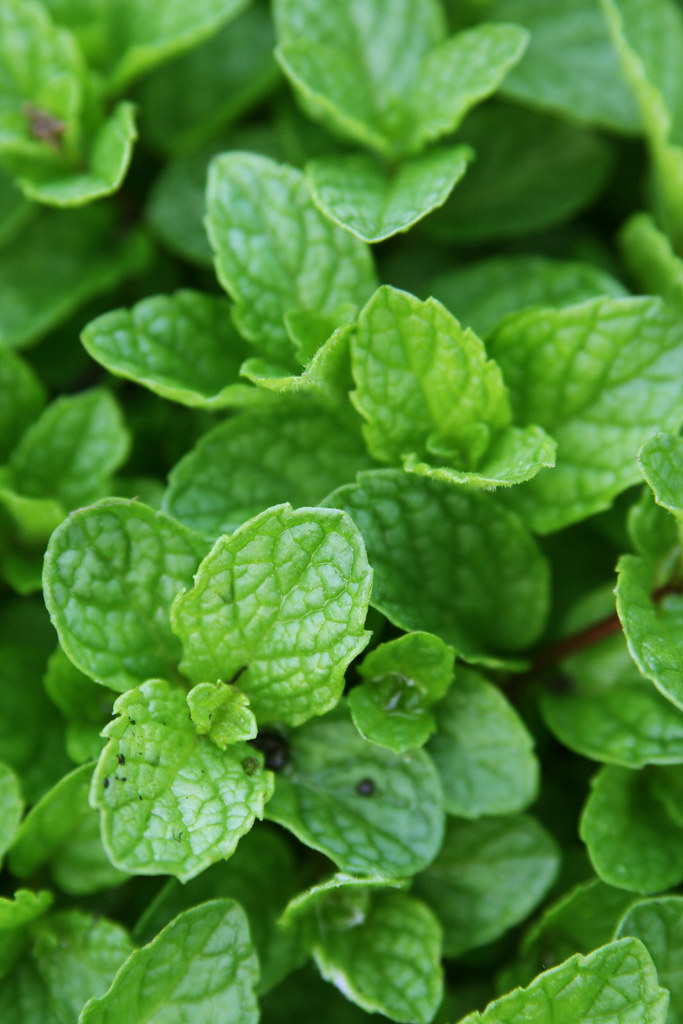
Featured image: “薄荷” by alberth2, CC BY-SA 2.0.