

Short answer: To grow cilantro indoors without early bolting, sow seed directly in a deep pot (it has a taproot and dislikes transplanting), keep the room at about 65–70°F by day and 55–60°F at night, give it 14–16 hours of grow light (a 2024 trial recommended 200 µmol/m²/s for 16 hours), start cutting at about 6 inches, and re-sow every 2–3 weeks. Heat and long days trigger flowering, and no variety holds forever, so cilantro indoors works best as a series of short crops.
Cilantro is the leaf of Coriandrum sativum; the seeds are sold as coriander. It is a cool-season herb, and that one fact explains most indoor failures. Below are the settings, steps and varieties that extension services and researchers recommend, with sources at the end.
Table of Contents
Why cilantro bolts (and why indoors helps)
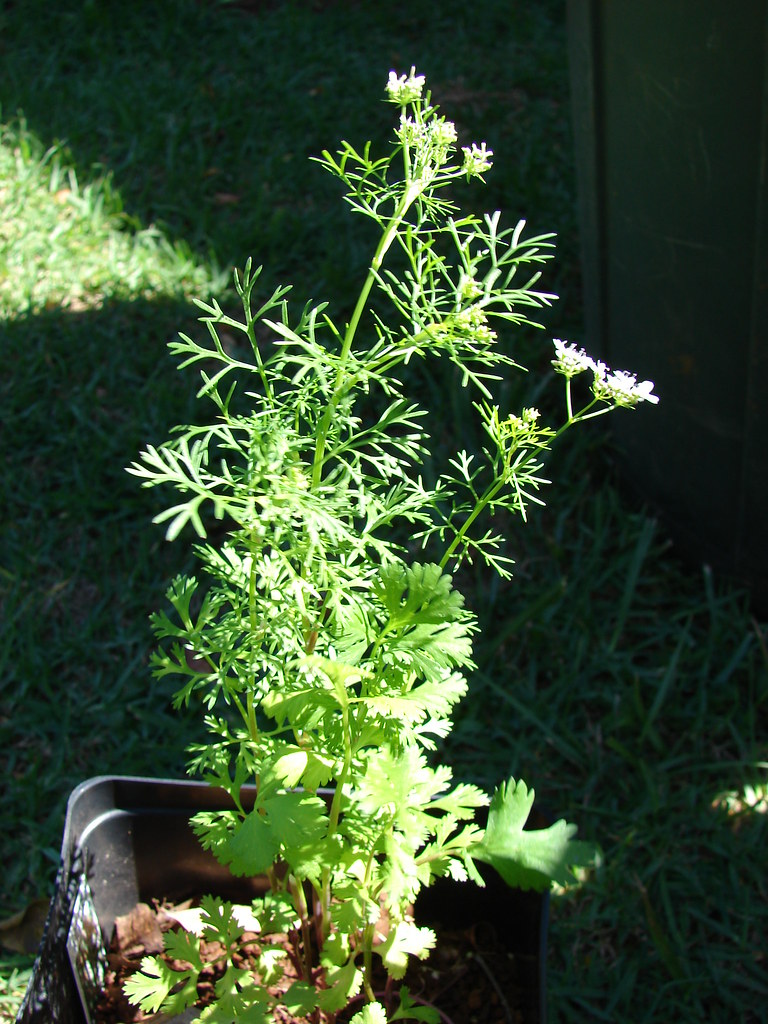
Bolting means the plant stops making broad leaves and sends up a flower stalk with thin, feathery foliage. Flavor changes and leaf harvest is over. Oregon State University Extension says “both temperature and day length influence flowering and seed set”: in mid-summer heat, cilantro can bolt within four to six weeks, while in cooler spring or fall weather with shorter days it keeps making leaves for weeks or months (Oregon State University Extension). Penn State Extension puts it more bluntly: at “the first sign of hot temperatures,” cilantro flowers and sets seed (Penn State Extension, Cilantro).
Growing cilantro indoors gives you control over both triggers. You set the temperature with the room you choose and the day length with a timer. You cannot stop a plant from eventually flowering, but you can push that point well past the harvest window.
Cilantro indoors at a glance
| Factor | Target | Source |
|---|---|---|
| Room temperature | 65–70°F day, 55–60°F night (general indoor herbs) | Penn State Extension |
| Soil temperature | Below 75°F in containers; seeds germinate at 55–68°F soil | Utah State; Oregon State |
| Window light | Tolerates low light: 2–6 hours of direct sun | Penn State Extension |
| Grow light | 14–16 h/day; 200 µmol/m²/s for 16 h recommended in a controlled trial | Penn State; Wang et al. 2024 |
| Sowing depth | ¼–½ inch | Wisconsin; Clemson; Utah State |
| Re-sowing interval | Every 2–3 weeks (Penn State: every 2–4 weeks) | Wisconsin; Penn State |
| Start harvest | About 4–6 inches tall | Utah State; Wisconsin; Penn State |
| Soil pH | 6–7 | Clemson HGIC |
Light for cilantro indoors
On a windowsill, cilantro indoors is one of the easier herbs to keep going. Penn State lists it with chives and lemon balm as herbs that “can tolerate low light levels and only need 2 to 6 hours of direct sunlight,” compared with 6 hours for most herbs (Penn State Extension, Growing Herbs Indoors). A south-facing window gives the most light in winter.
Under lamps, cilantro indoors does better still. Penn State’s general herb advice is to place plants 6 to 12 inches below two 40-watt cool white fluorescent tubes for 14 to 16 hours a day. With LEDs, a 2024 study gives specific numbers. Wang and colleagues grew coriander at 24°C (75°F) under three intensities (133, 200 and 400 µmol/m²/s) and three day lengths (8, 16 and 24 hours). An 8-hour day cut yield by 26.5 to 42.0 percent compared with 16 hours, 133 µmol/m²/s was too weak, and 24-hour lighting added yield but used electricity inefficiently. Their recommendation was 200 µmol/m²/s for 16 hours (Wang et al. 2024, Horticulturae).
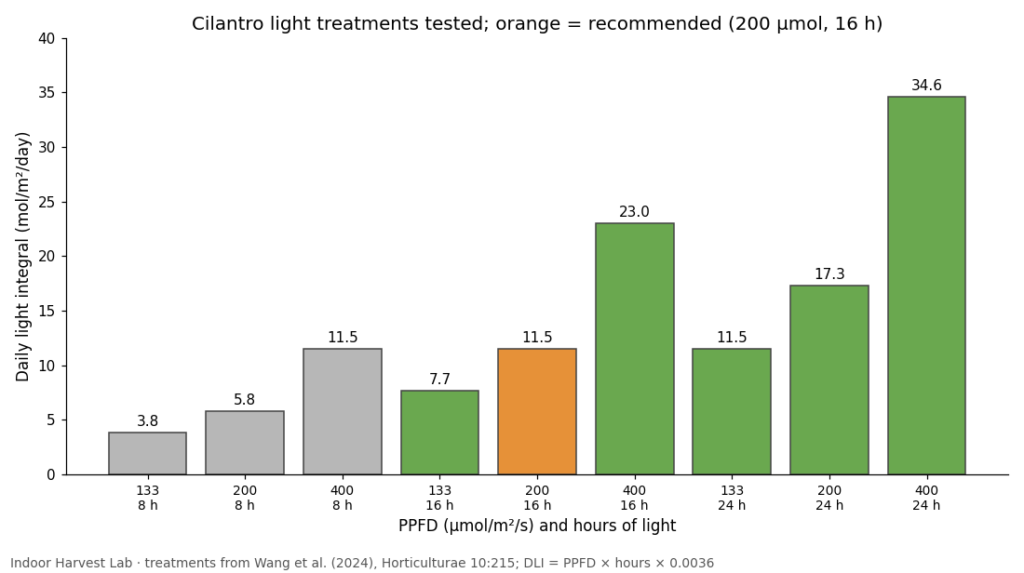
That recommendation equals a daily light integral of about 11.5 mol/m²/day (200 × 16 × 0.0036). Because day length is also a flowering signal for cilantro, there is little reason to run lights beyond 16 hours. Weak light shows up as pale, thin, stretched stems that flop over, the same problem covered in our leggy seedlings guide. For lamp height, see grow light distance, and for timer settings, hours of light.
Temperature: the main bolting trigger you control
Heat is the bolting trigger every source agrees on, and it is the one that catches most people growing cilantro indoors. Utah State University Extension advises that containers be kept where soil stays “below 75°F” and recommends mulch to keep soil cool outdoors (Utah State University Extension). For indoor herbs in general, Penn State suggests rooms of at least 65 to 70°F during the day and 55 to 60°F at night.
For cilantro indoors, the warm spots are easy to miss: a sunny south window in the afternoon, the top of the refrigerator, near a radiator or heating vent, or right under a hot lamp. Keep cilantro indoors in the coolest bright spot you have. Check the soil with a thermometer if plants sit close to any fixture.
How to grow cilantro indoors, step by step
- Choose a deep pot with drainage. Cilantro has a long taproot and “does not transplant well” (University of Wisconsin–Madison Extension). Sow where the plants will grow. A deep pot suits the taproot better than a shallow tray. Use a free-draining potting mix; Penn State stresses a drainage hole for all indoor herbs.
- Prepare the seed. Each “seed” is a small round fruit. UF/IFAS notes it “has a hard seed which may need to be cracked or scarified before planting” (UF/IFAS EDIS HS584). Gently cracking the husks is optional.
- Sow ¼ to ½ inch deep. Wisconsin and Clemson recommend ¼ to ½ inch. Keep the mix evenly moist and cool; Oregon State gives 55–68°F soil for germination. Utah State notes seeds can take about 21 days to germinate, so do not give up too early.
- Thin for leaves. For a leaf crop, Wisconsin thins to 3–6 inches apart and Utah State to about 2 inches. In a pot, a small cluster of plants is fine; Utah State even suggests growing plants close together as one way to slow bolting.
- Turn on the light. Once seedlings appear, give 14–16 hours of light, or place the pot in your brightest cool window. Turn window pots every few days.
- Water and feed lightly. Water when the surface starts to dry; never leave the pot standing in water. Penn State suggests “a low dose of water-soluble fertilizer every 2 weeks” for indoor herbs.
- Start harvesting at 4–6 inches. Penn State recommends cutting about one-third of the plant at soil level each time once plants reach 6 inches.
- Sow the next pot. Start a new pot every 2–3 weeks so a fresh one is ready when the first begins to bolt.
Best slow-bolt cilantro varieties
Seed catalogs sell several slow-bolting types, and choosing one is the easiest upgrade for cilantro indoors. Extension services name these:
| Variety | What extension says |
|---|---|
| ‘Calypso’ | Slowest to bolt (Penn State); slow-bolting (Wisconsin) |
| ‘Leisure’ | 28–40 days to harvest, heat tolerant (Penn State); slow-bolting (Wisconsin, Utah State) |
| ‘Santo’ | Darker leaves, uniform flavor (Penn State) |
| ‘Slow Bolt’ / ‘Slo Bolt’ | About 50 days to maturity (Penn State); slow-bolting (Wisconsin, Utah State) |
| ‘Cruiser’, ‘Marino’ | Slow-bolting (Wisconsin) |
| ‘Confetti’ | Fern-like leaves, used for baby-leaf harvest (Penn State) |
Keep expectations realistic. Wisconsin Extension warns that “none hold well under high temperatures and long days.” A slow-bolt variety buys time; cool conditions and succession sowing do the rest when you grow cilantro indoors.
Harvesting cilantro indoors
Harvesting cilantro indoors is simple. Wisconsin says leaves can be picked “any time after the plants are about 6 inches tall but before they bolt,” and gives 45 to 80 days for a leaf crop. You can harvest in two ways:
- Cut and come again. Take the outer, older stems, about one-third of the plant at a time (Penn State). The center keeps growing.
- Whole-pot cut. Cut the whole bunch about an inch above the soil. Wisconsin notes the plants can regrow for a second cutting.
Penn State’s storage advice for cut cilantro: rinse, pat dry, wrap loosely in plastic and refrigerate for up to one week. Once a stalk with fine, lacy leaves appears, harvest what is left quickly. You can let one pot flower and ripen coriander seed, but Wisconsin puts seed at 100 days or more.
Cilantro indoors troubleshooting
Most problems with cilantro indoors trace back to heat, light or roots. Use this table to match what you see with the likely cause.
| What you see | Likely cause | What to do |
|---|---|---|
| Tall central stalk, fine feathery leaves, white flower buds | Bolting from heat or long days | Harvest the remaining leaves now; move the next pot somewhere cooler; keep lights at 16 h or less |
| Pale, thin stems that lean and flop | Too little light | Brighter window or a grow light for 14–16 h; the 2024 trial found 133 µmol/m²/s too weak |
| No seedlings after 10 days | Slow, hard-coated seed or soil too warm or cold | Wait; Utah State notes germination can take about 21 days. Keep soil at 55–68°F (Oregon State) |
| Seedlings collapse at the soil line | Damping-off in cold, wet mix | Let the surface dry slightly between waterings; improve airflow |
| Plants stall after repotting | Disturbed taproot | Sow directly in the final pot next time |
Cilantro indoors mistakes to avoid
- Buying a nursery transplant and repotting it. The taproot is easily disturbed (Oregon State and Wisconsin both warn against transplanting), so direct sowing is the safer route.
- Sowing in a shallow tray. Fine for a microgreen harvest, but full-size cilantro indoors needs root depth.
- A hot, sunny sill in summer. The bright spot is often the warmest spot. Heat is the main bolting trigger.
- Running lights 20–24 hours. In the Wang trial, 24-hour light used electricity inefficiently, and long days are one flowering trigger.
- Waiting for one pot to last all year. Every plant eventually flowers. Re-sow every 2–3 weeks.
- Soggy mix. Seedlings in cold, wet mix are prone to damping-off. Water from below or lightly from above and let the surface dry a little.
Where this applies
These cilantro indoors settings apply to any home with a cool room and either a bright window or a grow light. In hot climates or summer, indoor growing is often the only way to get leafy cilantro, because outdoor plants bolt within weeks; a cool, air-conditioned room with a lamp works better than a hot window. In cold, dark winters at higher latitudes, the window alone may give too little light, and a lamp for 14–16 hours makes the difference. The temperature targets are the same everywhere. If you already grow basil indoors, note the difference: basil wants warmth, cilantro wants cool. Check our seed germination temperature chart for other crops, and see all indoor herb guides.
FAQ
Can you grow cilantro indoors year-round?
Yes. Cilantro indoors works year-round as a series of crops rather than one plant. Sow a new pot every 2–3 weeks, keep the room cool and give 14–16 hours of light.
Why is my cilantro indoors so leggy?
Thin, pale, stretched stems usually mean too little light. Move the pot to a brighter window or add a grow light. In the Wang trial, 133 µmol/m²/s was too weak for good growth.
Does cutting cilantro stop it from bolting?
Regular cutting keeps you harvesting leaves before the plant turns to flowering, but extension sources name heat and long days as the triggers. Harvesting does not reset them.
How long does cilantro take to grow indoors?
Leaves are ready in about 45–80 days from sowing (Wisconsin); ‘Leisure’ is listed at 28–40 days (Penn State). In the Wang trial under LEDs, plants were harvested 38 days after sowing.
Related guides: growing mint indoors · basil indoors · all indoor herb guides
Sources
- Penhallegon, R., Myers, J. Oregon State University Extension. How to grow cilantro for leaves — or coriander seeds. 2023.
- Mahr, S. University of Wisconsin–Madison Extension. Cilantro/Coriander (Coriandrum sativum).
- Miller, C., Drost, D. Utah State University Extension. Cilantro/Coriander in the Garden. 2018.
- Smith, M.L. Penn State Extension. Cilantro, a Unique Culinary Herb. 2024.
- Sánchez, E.S., Kinley, E. Penn State Extension. Growing Herbs Indoors. 2024.
- Burgess, L. Clemson Cooperative Extension HGIC. The Cilantro-Coriander Connection. 2021.
- Stephens, J.M. UF/IFAS Extension. Cilantro—Coriandrum sativum L. (HS584).
- Wang, F., Gao, Q., Ji, G., Wang, J., Ding, Y., Wang, S. 2024. Effects of light intensity and photoperiod on morphological development and photosynthetic characteristics of coriander. Horticulturae 10:215.
Featured image: “Coriander seedlings” by apapac, CC BY 2.0.