
You brought the rosemary in before the first frost, set it on a sunny windowsill, and for a few weeks it looked fine. Then the needles at the base started going crisp and grey, the tips drooped, and by January you were holding a pot of brittle sticks. What went wrong? You are in good company: rosemary is the herb that extension specialists single out as hard to keep alive indoors.
Short answer: To grow rosemary indoors, give it the brightest spot you have (a south-facing window or a grow light running 14–16 hours a day), keep it cool at roughly 55–65°F (13–18°C), and let the top inch of mix dry before you water, but never let the root ball dry out completely. Use a fast-draining mix in a pot with drainage holes, keep air moving to prevent powdery mildew, and skip fertilizer in winter. Most indoor rosemary dies from too little light combined with the wrong watering, not from cold.
Table of Contents
- Numbers to Hold When You Grow Rosemary Indoors
- Light: The Make-or-Break Factor
- Watering, Soil and Feeding: Stop the Two Ways Rosemary Dies
- Temperature and Bringing Rosemary In for Winter
- Rosemary Problems Indoors: Symptoms and Fixes
- Growing Rosemary From Cuttings (Skip the Seeds)
- From the Lab Bench
- FAQ
- Sources
This guide pulls together what Penn State, Illinois, Wisconsin, Arkansas and NC State Extension, the RHS and Michigan State propagation research actually say. By the end you’ll know the exact numbers to hold, how to move a garden plant inside without shocking it, how to read a struggling plant, and how to root cuttings so you always have a spare.
Rosemary (Salvia rosmarinus, formerly Rosmarinus officinalis) is a woody Mediterranean shrub. The RHS notes the genus changed from Rosmarinus to Salvia, so you’ll see both names on plant tags. In the ground it can reach 4–6 feet, according to University of Illinois Extension. That’s a big, sun-loving plant you’re asking to live in a pot by a window.
Its home climate explains why it’s tricky to grow rosemary indoors. It’s built for bright light, cool winters, fast-draining soil and moving air. A winter living room offers the opposite: weak light, warm dry air, and a pot that stays wet because the plant isn’t growing fast enough to use the water.
Janet Carson of the University of Arkansas Cooperative Extension puts it bluntly: bringing rosemary inside for winter is difficult, because warm, dry indoor air is hard on it, and overwatering is “a death knell.” Penn State Extension agrees that overwintering indoors is difficult, naming low light and incorrect watering (too little or too much) as the reasons.
The good news? Once you know those two failure points, the fixes are simple: more light than you think, less warmth than you’d expect, and watering based on checking the pot, not the calendar.
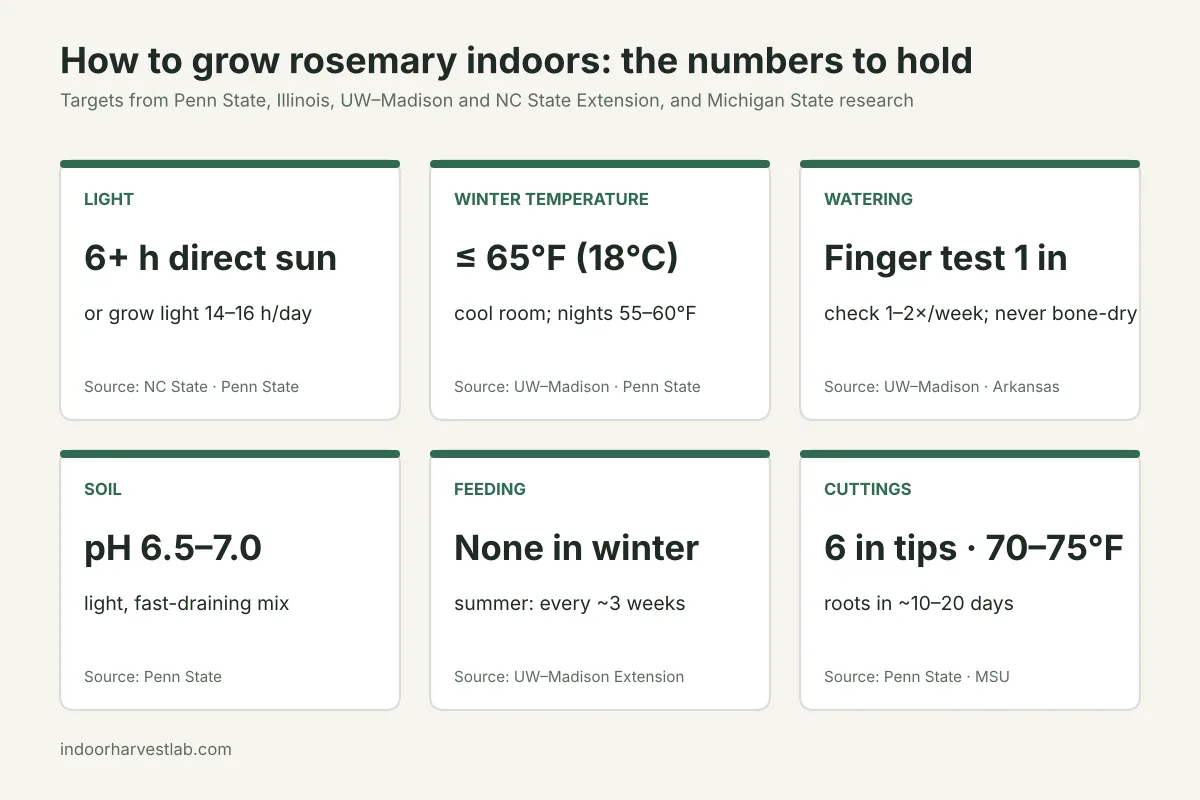
Numbers to Hold When You Grow Rosemary Indoors
Here’s the cheat sheet. Every figure comes from the sources linked in the right-hand column, so you can check it yourself.
| What | Target | Source |
|---|---|---|
| Window light | 6+ hours of direct sun; south-facing window | NC State, Penn State |
| Grow-light hours | 14–16 hours a day | Penn State (herbs indoors) |
| Fluorescent tube distance | 6–12 in (15–30 cm) above the foliage | Penn State (herbs indoors) |
| Winter room temperature | Cool; spot should not exceed about 65°F (18°C) | UW–Madison Extension Kenosha |
| General indoor herb range | 65–70°F (18–21°C) day, 55–60°F (13–16°C) night | Penn State (herbs indoors) |
| Watering check | Finger test about 1 in (2.5 cm) deep, once or twice a week | UW–Madison Extension Kenosha |
| Soil pH | 6.5–7.0, light and well-drained | Penn State |
| Fertilizer | None in winter; water-soluble feed about every 3 weeks in summer | UW–Madison Extension Kenosha |
| Bring indoors | 2–3 weeks before the first fall frost | Penn State |
| Cutting rooting temperature | Bottom heat 70–75°F (21–24°C) | Penn State |
| Cutting rooting light (DLI) | About 11–15 mol·m⁻²·d⁻¹ after callusing | Michigan State (Kohler & Lopez) |
| Outdoor hardiness | USDA zones 8–10; ‘Arp’ and ‘Madeline Hill’ to zone 7 or 6b with protection | Penn State |
Notice there’s a slight split on pH. Penn State lists 6.5–7.0, while NC State’s plant toolbox describes slightly acidic soil. A standard peat- or coir-based potting mix with added perlite lands close enough to both. Drainage matters far more than a few tenths of a pH unit.
Light: The Make-or-Break Factor
If you want to grow rosemary indoors successfully, fix light first. NC State lists rosemary for full sun, meaning six or more hours of direct sunlight a day. Illinois Extension notes that growth slows in the low-light days of winter, even in a sunny spot. A north window or a shelf across the room simply won’t sustain it.
Window growing
Use your brightest south-facing window (north-facing in the Southern Hemisphere), as Penn State recommends. Set the pot as close to the glass as you can, and turn it a quarter turn every few days so all sides get light. West is the next best choice. East usually isn’t enough in midwinter.
Grow-light growing
In many homes, especially in northern winters, a grow light is what turns rosemary from surviving into growing. Penn State’s indoor herb guide suggests 14–16 hours a day, with fluorescent tubes 6–12 inches above the plants. LED fixtures are more efficient and run cooler, which matters because the UW–Madison Extension Kenosha office specifically recommends supplemental light “that doesn’t emit heat” for rosemary.
If you have a light meter or a PPFD reading from the manufacturer, you can work out daily light integral (DLI). Virginia Cooperative Extension’s DLI guide gives the formula: DLI = PPFD × 3,600 × hours ÷ 1,000,000. At 200 µmol·m⁻²·s⁻¹ for 16 hours, that’s about 11.5 mol·m⁻²·d⁻¹. Our guides to growing herbs indoors in winter and how many hours of light seedlings need walk through the maths in more detail.
Watering, Soil and Feeding: Stop the Two Ways Rosemary Dies
Here’s the trap. Rosemary hates wet roots, so people underwater it. But a rosemary root ball that dries out completely often can’t recover, because the fine roots die and the needles brown afterwards, sometimes days later. You need to sit between those two extremes.
How to water rosemary indoors
- Check the pot once or twice a week by pushing a finger about an inch into the mix, the method UW–Madison Extension Kenosha recommends.
- If it feels dry at that depth, water thoroughly until water runs out of the drainage holes.
- Empty the saucer after 15 minutes. Carson warns that standing water in winter will shorten the plant’s life.
- If it still feels cool and damp, wait and check again in a few days.
- Lift the pot after watering and again when it’s dry. Pot weight quickly becomes your fastest moisture gauge.
Penn State’s indoor herb guidance sums it up: rosemary “should dry out slightly between waterings.” Slightly is the key word.
Soil and pot choice
Use a light, well-drained mix. Penn State notes rosemary performs poorly in wet or poorly drained soil. A good recipe is two parts potting mix to one part perlite or coarse grit. Avoid garden soil, which packs down in a pot and holds too much water.
Choose a pot with drainage holes, only a size or so larger than the root ball. Terracotta breathes and dries faster. Penn State notes clay pots dry out quickly, which is a benefit if you tend to overwater and a risk if you forget to check. Plastic suits people who travel or run dry heating all winter.
One more detail from Illinois Extension: rosemary doesn’t transplant well from the ground. If you grow it outdoors in summer and want to bring it in, keep it in a container year-round so you never have to dig it up.
Humidity
Illinois Extension notes that dry indoor air causes brown leaf tips and die-back, and suggests setting pots on pebble-filled saucers of water and misting. Penn State’s herb guide adds the counterweight: too much humidity invites root rot and fungal problems. A pebble tray plus a small fan is a balanced setup. You raise humidity around the leaves without leaving the foliage wet.
Feeding, harvesting and pruning
Harvesting is pruning, so do it with the plant’s shape in mind. Snip the soft green tips a few inches long, cutting just above a pair of leaves. New shoots will branch from below the cut, giving a bushier plant.
Don’t cut back into bare, woody stems. Rosemary tends to be slow to sprout from old wood, so a hard winter haircut can leave stubs that never regrow. In low light, take only what you need and let the plant hold on to its foliage. Those needles are its solar panels.
When you grow rosemary indoors, feeding follows the season. UW–Madison Extension Kenosha says not to fertilize in winter and to use a water-soluble fertilizer about every three weeks in summer. Penn State’s indoor herb guide warns that feeding more often can dull aroma and flavour, so a light hand gives you better-tasting rosemary too.
Growing a whole herb shelf? Rosemary pairs well, in terms of conditions, with sage and thyme, but not with basil or mint, which want warmer temperatures and more water. Group plants by their thirst.
Temperature and Bringing Rosemary In for Winter
Most herbs want a warm room. Rosemary is the exception. Illinois Extension calls for a “cool (even cold)” location indoors, and UW–Madison Extension Kenosha says the spot shouldn’t exceed 65°F. An unheated spare room, a cool porch with windows, or a bright basement under lights often beats the kitchen.
Why cool? In low winter light, a warm plant burns through its sugars faster than it can make new ones. Cooler temperatures slow that down, so the plant can coast through short days. The same Wisconsin article notes that even a garage can work if it stays above freezing, provided the plant gets light.
Step 1: Time the move
Penn State recommends bringing pots indoors 2–3 weeks before the first fall frost. Don’t wait for the first freeze warning. A gradual change from outdoor to indoor light is easier on the plant than an emergency rescue.
Step 2: Inspect and clean
Check stems and the undersides of needles for aphids, mealybugs, whiteflies and spider mites, all of which Penn State lists as indoor problems. Rinse the foliage with a gentle spray of water. Remove any decorative foil from holiday plants, as Carson advises, because foil wraps hold drained water against the roots.
Step 3: Choose the spot
Pick the brightest, coolest location you have. Add a grow light if the window gets fewer than six hours of direct sun.
Step 4: Ease up on water and food
An indoor plant in short days uses far less water than it did in July. Switch to the finger-test routine above, and stop fertilizing until spring.
Step 5: Move it back out
Penn State advises moving pots outdoors in spring after the danger of frost has passed. Give it a week of partial shade first so the needles adjust to full sun.
If you’re bringing in other tender plants at the same time, our guide to overwintering peppers indoors uses the same step-down approach.
Rosemary Problems Indoors: Symptoms and Fixes
When rosemary goes wrong, it usually tells you clearly, if you know what to look for. Use this table to match the symptom to its most likely cause.
| What you see | Most likely cause | What to do |
|---|---|---|
| Needles brown and crisp from the base up; mix bone dry | Root ball dried out completely | Water thoroughly; trim dead stems; check pot more often |
| Tips browning, mix wet, plant wilts anyway | Root rot from overwatering (Penn State notes browning tips as a sign) | Unpot and check roots; trim brown mushy roots; repot in fresh, gritty mix |
| White powdery coating on needles | Powdery mildew from poor air circulation and high humidity (NC State) | Add a fan; space plants; remove badly affected tips |
| Long, pale, floppy stems | Not enough light | Move to a brighter window or add a grow light for 14–16 h |
| Fine webbing, speckled dull needles | Spider mites | Rinse foliage; raise humidity slightly; isolate the plant |
| Sticky needles, white cottony clusters | Mealybugs or aphids | Wipe or rinse off; repeat weekly until clear |
| Small flies around the pot | Fungus gnats breeding in wet mix | Let the top inch dry; see our fungus gnat guide |
| Grey fuzzy mould on dense growth | Botrytis (NC State lists it as common) | Remove affected parts; improve airflow; water less |
Powdery mildew: the indoor classic
Penn State describes rosemary as prone to powdery mildew and recommends adequate airflow between plants. NC State links it to poor circulation and high humidity. Indoors, that’s crowded windowsills, steamy kitchens and still air. A small clip-on fan on low, pointed near (not directly at) the plant, is often the whole fix.
Rescuing a dried-out or overwatered plant
First, figure out which problem you have. Tip the plant out of its pot. White, firm roots mean the roots are alive; water carefully and wait. Brown, soft roots that pull apart mean rot. Cut those back to healthy tissue, repot in fresh, fast-draining mix, and water lightly.
Be realistic. If most of the needles have gone brown and brittle, the roots probably died first. That’s the moment to take cuttings from any green tips that are left (see below).
Growing Rosemary From Cuttings (Skip the Seeds)
If you want more plants to grow rosemary indoors, seed isn’t the easy route. Penn State notes low viability and slow germination make rosemary difficult from seed, and named cultivars don’t come true. Illinois Extension adds that seedlings may take years to become usable plants. Cuttings, on the other hand, root easily, according to Illinois Extension.
Step 1: Take the cutting
Cut a 6-inch section of stem tip, as Penn State describes. Choose a healthy, non-flowering shoot with fresh green growth.
Step 2: Prepare it
Strip the needles from the lower half and dip the cut end in rooting hormone. Penn State uses both steps.
Step 3: Stick it in a fast-draining mix
Michigan State researchers rooted ‘Arp’ rosemary cuttings in a 50:50 mix of soilless substrate and coarse perlite (Kohler and Lopez, Produce Grower). That’s easy to copy at home in a small pot or cell tray.
Step 4: Give it warmth and the right light
Penn State recommends bottom heat of 70–75°F (21–24°C), which a seedling heat mat provides. In the Michigan State work, air and root zone were held at 73°F (23°C). Cuttings were shaded to a DLI of about 5 for the first five days of callusing, then moved to brighter light.
Light matters during rooting. Across a DLI range of about 3–16 mol·m⁻²·d⁻¹, rosemary cuttings’ root dry mass rose by 449% and shoot dry mass increased up to 53% at a DLI near 14. The researchers suggested 11–15 mol·m⁻²·d⁻¹ after callusing. Keep the mix lightly moist, never soggy; our damping-off guide explains why wet, still conditions rot young stems.
Step 5: Be patient
Penn State gives 10–20 days for roots to form. Michigan State notes that slow-rooting herbs such as rosemary need at least 3 weeks under the recommended light. Expect 2–4 weeks. Tug gently: resistance means roots. Pot up into a 4-inch container once roots fill the cell.
A practical tip: take a few cuttings each autumn before the move indoors. If the mother plant struggles, you’ve got backups.
From the Lab Bench
Let’s step back and look at what the research and extension advice add up to, because a few rules of thumb fall out of it.
Think of light and water as one problem. A plant’s water use tracks its photosynthesis. Under weak winter light, rosemary barely transpires, so a pot that dried in two days in summer can stay wet for ten. That’s why both Penn State and Arkansas flag “incorrect watering” and low light together. Add a grow light and the plant starts drinking again, which makes watering more forgiving.
Cool is a feature, not a compromise. When light is limited, respiration (sugar use) rises with temperature, while photosynthesis is capped by light. Keeping rosemary near 55–65°F narrows that gap. It’s the same logic commercial growers use when they lower greenhouse temperatures on dull days.
Borrow numbers carefully. There isn’t a widely published DLI target for mature potted rosemary. The Michigan State 11–15 figure is for rooting cuttings, and the Virginia Tech table lists high-light herbs such as basil at 15–25. Rosemary is a full-sun Mediterranean shrub, so treating it like a high-light herb is a sound working assumption. Aim as high as your setup reasonably allows, and let leaf colour and new growth tell you whether it’s enough.
One honest caveat. Carson’s Arkansas advice is not to try to keep rosemary indoors year-round, and that’s sensible for a window-only setup. Under good lights in a cool room, many growers do keep it going. But the plant is happiest when it spends summer outside. If you can, treat indoors as a winter holding pattern rather than a permanent home.
Pick the right plant. Upright types are a better indoor bet than trailing ones. Carson notes upright forms reach 3–4 feet, while prostrate forms grow 8–10 inches tall but are less winter hardy. ‘Arp’ and ‘Madeline Hill’ are the cold-tolerant names to look for; the RHS rates ‘Madeline Hill’ H4, down to about −10 to −5°C, which makes it forgiving in a chilly porch or garage.
FAQ
Can rosemary grow indoors year-round?
It can survive indoors year-round under a strong grow light in a cool room, but extension specialists such as the University of Arkansas’s Janet Carson advise against relying on a window alone. The plant does best when it spends summer outdoors and winter inside.
How often should I water rosemary indoors?
Check rather than following a schedule. UW–Madison Extension Kenosha suggests a finger test about an inch deep once or twice a week. Water thoroughly when it feels dry, empty the saucer, and never let the root ball dry out completely.
Why is my indoor rosemary turning brown?
Browning usually means a watering problem. Crisp grey-brown needles on a dry pot point to drought; browning tips on a wet pot point to root rot, which Penn State lists as a sign of overwatering. Check the roots to tell them apart.
How much light does rosemary need indoors?
NC State lists rosemary for full sun, six or more hours of direct light a day. Indoors, use your brightest south-facing window or a grow light for 14–16 hours a day, the range Penn State gives for indoor herbs.
What temperature is best for indoor rosemary?
Cool. Illinois Extension recommends a cool, even cold, location, and UW–Madison Extension Kenosha says the spot should not exceed about 65°F (18°C). Nights of 55–60°F (13–16°C) suit it well.
Can I grow rosemary indoors from seed?
You can, but it’s slow. Penn State notes low viability and slow germination, and Illinois Extension says plants may take years to become usable. Stem cuttings root in about 10–20 days according to Penn State, so they are the faster route.
Can you grow rosemary in water?
Cuttings may form roots in water, but extension guides root rosemary in a fast-draining mix such as the 50:50 substrate and perlite used in Michigan State research. Roots formed in a well-drained mix adapt to a pot more easily than water roots.
Sources
- Penn State Extension. Herb Garden Plants: Rosemary.
- Penn State Extension. Growing Herbs Indoors.
- University of Illinois Extension. Herb Gardening: Rosemary.
- University of Wisconsin–Madison Extension, Kenosha County (2020). Holiday Rosemary.
- Carson, J. B. (2017/2018). Rosemary. University of Arkansas Cooperative Extension, Arkansas Democrat-Gazette column.
- NC State Extension Gardener Plant Toolbox. Salvia rosmarinus.
- Royal Horticultural Society. Salvia rosmarinus ‘Madeline Hill’ (Ro).
- Kohler, A., and Lopez, R. G. Rooting herb cuttings: why daily light integral matters. Produce Grower (Michigan State University research).
- Stallknecht, E. (2025). Calculating and Using Daily Light Integral (DLI): An Introductory Guide. Virginia Cooperative Extension, SPES-720.