
You carry the last basil pot inside in October, set it on the sunniest windowsill you have, and within three weeks it looks defeated: leggy stems, pale leaves, new growth at a standstill. The same plant that exploded all summer now just sulks. What does winter actually take away from indoor herbs, and how do you give it back?
Short answer: growing herbs indoors in winter works when you replace the light the season takes away, keep the room at about 60–70°F (16–21°C), and water and feed less than you would in summer. Most kitchen herbs need at least six hours of direct sun or 12–16 hours under a grow light placed 6–12 inches above the leaves. Pick compact herbs, check them for pests before they come inside, and harvest little and often so they keep branching until spring.
Table of Contents
Table of Contents
If you are growing herbs indoors in winter for the first time, this guide turns that short answer into numbers you can actually set: daily light targets for each herb, how many hours to run a light, the temperatures that matter, and a symptom table for when things go wrong. Every figure is traced to a university extension service or a peer-reviewed study listed at the end.
Why winter is hard on indoor herbs
Winter takes away the one resource herbs use most: light. Short days and a low sun angle mean far less light reaches a windowsill, and the window glass, screens and frames remove more. Virginia Cooperative Extension notes that even an open field in Virginia drops from a daily light integral (DLI) of about 40–45 mol·m⁻²·d⁻¹ in July to roughly 15–20 in December, and that greenhouse glazing alone cuts 30–50% of the light that does arrive (Stallknecht, 2025). A house window is usually worse than a greenhouse roof because it lets light in from one side only.
Heating adds a second problem. University of Illinois Extension points out that home heating dries the air and the potting mix quickly, so indoor herbs often need more attention to moisture in winter, even though they are growing more slowly (Illinois Extension, 2015). The result is the classic winter pattern: pale, stretched stems, small leaves, and a plant that dries out fast at the surface while its roots stay cold and wet below.
None of this means you should give up. It means the plan has to start with light and then match water, feeding and temperature to the slower growth that winter light allows.
Best herbs for growing indoors in winter
Not every herb is worth the window space. Extension services agree on a short list of compact herbs that cope with indoor conditions, and they flag a few to avoid. Penn State Extension names chives, basil and cilantro as strong choices, and advises against horseradish, fennel and lovage because of their large root systems (Penn State Extension). University of Maryland Extension adds the tender perennials that will not survive a cold winter outdoors: rosemary, bay, lemon verbena, oregano and marjoram (UMD Extension).
| Herb | Indoor difficulty in winter | Light need | Watering style | Notes |
|---|---|---|---|---|
| Chives | Easy | Tolerates 2–6 h direct sun | Keep evenly moist | A light frost before lifting induces a rest period (UMD) |
| Parsley | Easy–moderate | DLI 10–15 | Keep evenly moist | Lowest DLI target of the common herbs (VT) |
| Mint | Easy | 6 h sun or grow light | Keep evenly moist | Vigorous; give it its own pot |
| Thyme, oregano, marjoram | Moderate | 6 h sun or grow light | Let dry slightly between waterings | Mediterranean; dislikes wet roots (PSU) |
| Sage | Moderate | 6 h sun or grow light | Let dry slightly between waterings | Cooler rooms are acceptable (see temperature section) |
| Rosemary | Moderate–hard | Brightest window or light | Let dry slightly between waterings | Tender perennial; bring in before frost (UMD) |
| Cilantro | Moderate | DLI 15–20 | Keep evenly moist | Short-lived; sow small batches |
| Basil | Hardest | DLI 15–25 | Never let it dry out completely | Damaged below 50°F (10°C) (PSU) |
If you only have a windowsill, start with chives, parsley and mint. If you have a grow light, basil and cilantro become realistic. For crop-specific detail, see our guides to growing basil indoors, growing cilantro indoors and growing mint indoors.
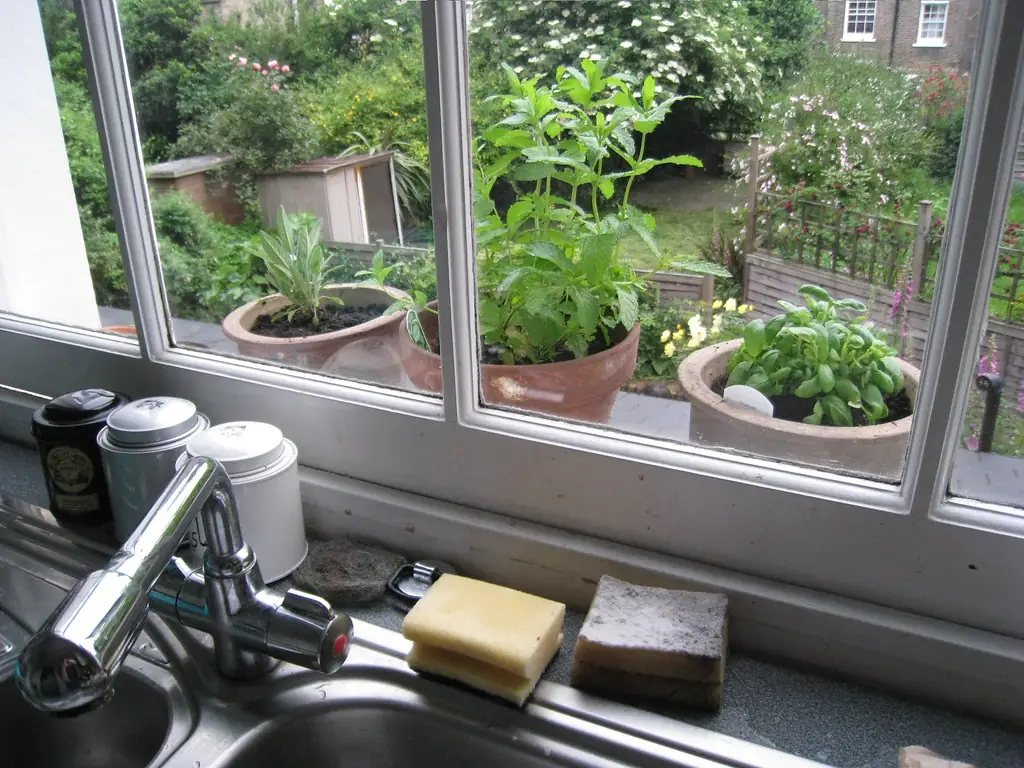
Numbers to hold for growing herbs indoors in winter
These are the targets worth writing on a sticky note by your plants. Where sources give slightly different numbers, the table shows the range and who said what.
| Factor | Target | Source |
|---|---|---|
| Day temperature | 65–70°F (18–21°C); 60–70°F (16–21°C) acceptable | Penn State; Illinois Extension |
| Night temperature | 55–60°F (13–16°C), or about 10°F cooler than day | Penn State; NC State |
| Basil minimum | Above 50°F (10°C) | Penn State |
| Window sun | At least 5–6 h direct sun; south or west exposure | UMD; NC State; Illinois Extension |
| Grow-light hours | 12–16 h per day | Illinois Extension (12–14 h); Penn State and UMD (14–16 h) |
| Light distance (fluorescent) | 6–12 in (15–30 cm) above the plants | Penn State; Illinois Extension |
| DLI targets | Parsley 10–15; cilantro 15–20; basil 15–25 mol·m⁻²·d⁻¹ | Virginia Tech SPES-720 |
| Pot size | At least 6 in (15 cm) wide, with a drainage hole | Illinois Extension |
| Potting mix | 2 parts soilless mix : 1 part perlite | UMD Extension |
| Fertilizer | Every 2 weeks at a low dose; 100–200 ppm, or ¼–½ label rate | Penn State; Illinois Extension; NC State |
| When to bring plants in | Before frost, when nights fall to 40–50°F (4–10°C) | UMD; Minnesota Extension |
Light: the step that decides success
Light is the limiting factor for nearly every winter herb, so it deserves the most planning. Penn State Extension sets the bar at six hours of direct sun for most herbs, while lemon balm, chives and cilantro tolerate two to six (Penn State Extension). In practice, few winter windows deliver six direct hours, which is why supplemental lighting matters so much.
Step 1: Use your brightest window first
Choose a south- or west-facing window; Illinois Extension calls these the sunniest exposures in most homes (Illinois Extension, 2015). Put the plants as close to the glass as possible, clean the glass, and turn the pots a quarter turn every few days so stems do not lean toward the light.
Step 2: Add a grow light if the herbs stretch
If new stems are long and pale with wide gaps between leaves, the plant is short of light. Extension advice for fluorescent tubes is to hang them 6–12 inches above the foliage and run them 12–16 hours a day. LED fixtures differ widely in output, so the more reliable way to set them is by measured light intensity (PPFD) at leaf level, then by hours. Our guide to grow light distance explains how to measure and adjust it.
Step 3: Convert light intensity into a daily dose
The daily light integral is the total light a plant receives in a day. Virginia Cooperative Extension gives the conversion: DLI = PPFD × 3,600 × hours ÷ 1,000,000. For example, a light delivering 200 µmol·m⁻²·s⁻¹ at the leaves for 14 hours gives 200 × 3,600 × 14 ÷ 1,000,000 ≈ 10.1 mol·m⁻²·d⁻¹. That meets the low end of parsley’s 10–15 target but falls short of basil’s 15–25.
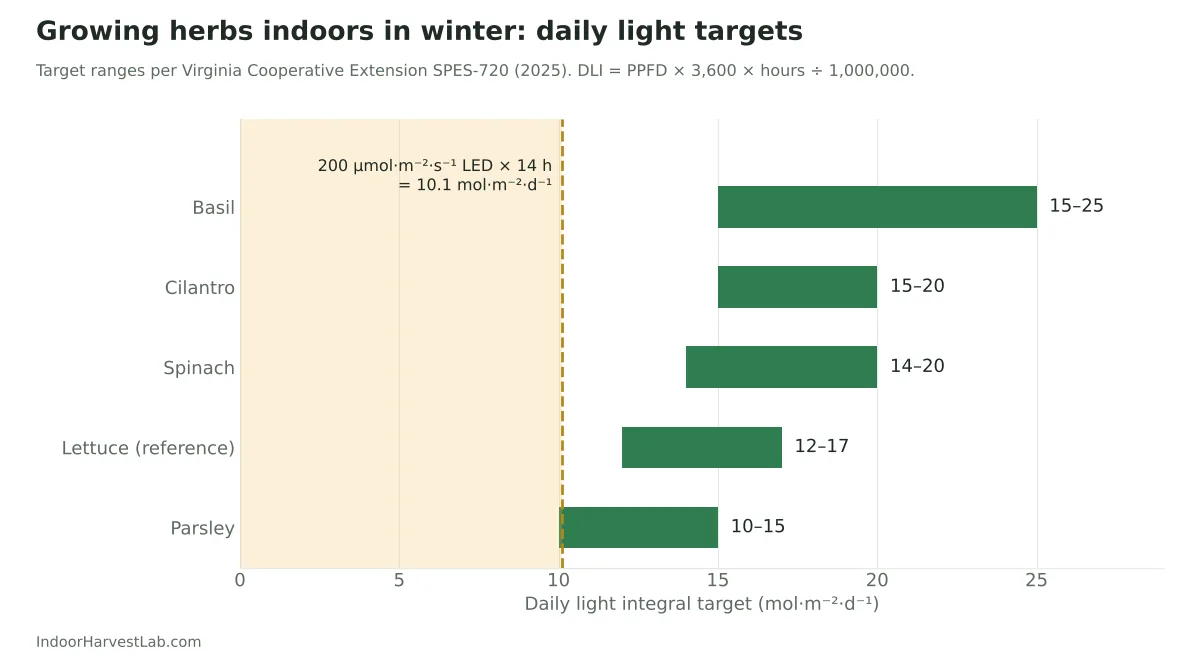
Run the formula in reverse and you can see why basil is the hardest winter herb. Hitting a DLI of 15 needs about 13.9 hours at 300 µmol·m⁻²·s⁻¹, but about 20.8 hours at 200. Since extension advice tops out at 16 hours a day, the practical fix for a hungry herb is a brighter light or a closer light, not an endless photoperiod. For the logic behind photoperiods, see our article on how many hours of light seedlings need.
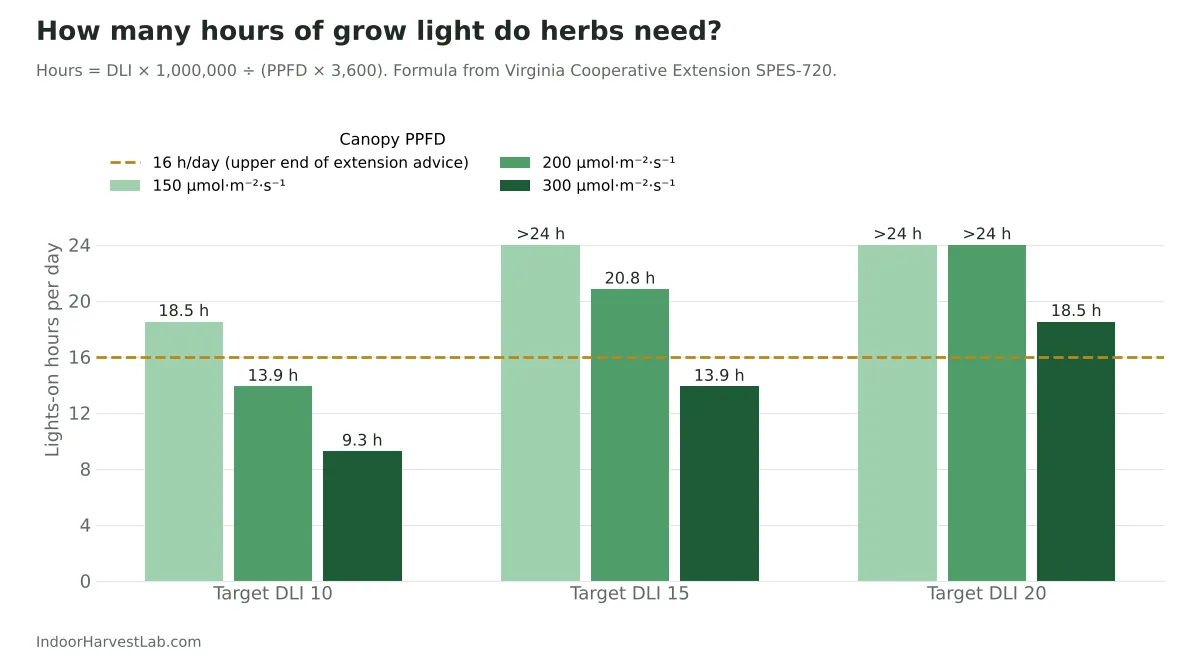
| Canopy PPFD (µmol·m⁻²·s⁻¹) | Hours for DLI 10 | Hours for DLI 15 | Hours for DLI 20 |
|---|---|---|---|
| 150 | 18.5 | 27.8 (not achievable) | 37.0 (not achievable) |
| 200 | 13.9 | 20.8 | 27.8 (not achievable) |
| 300 | 9.3 | 13.9 | 18.5 |
Temperature: match warmth to the light you have
Most extension sources aim for 65–70°F (18–21°C) during the day and 55–60°F (13–16°C) at night (Penn State Extension; NC State Extension). Keep pots away from cold glass at night, drafty doors and the direct blast of a heating vent.
Research from Michigan State University adds an important nuance: the best temperature depends on how much light the plant gets. In hydroponic greenhouse trials, the optimum mean daily temperature for sage fresh mass fell from 27.5°C to 23.5°C (81.5°F to 74.3°F) as DLI rose from 6 to 18 mol·m⁻²·d⁻¹, and for spearmint it fell from 30.4°C to 27.8°C (Walters, Tarr and Lopez, 2023). Sweet basil was the outlier, with its optimum climbing from 32.6°C to 35.5°C. A companion study found that for dill grown cool (about 9.7–13.9°C), raising the DLI from about 8 to 15.5 did not increase fresh mass, and the authors advised lowering temperature when light is low (Walters and Lopez, 2021).
Those optimum temperatures come from commercial greenhouses and are warmer than a home needs to be. The practical lesson is the direction: in a dim spot, a cooler room is not a problem for parsley, sage, mint or thyme; basil wants both the most light and the warmest spot you have.
Watering, humidity and feeding in winter
Water by herb type, not by calendar
Penn State Extension splits herbs into two groups. Bay, marjoram, oregano, sage, thyme and rosemary should dry out slightly between waterings, while basil should never be allowed to dry out completely (Penn State Extension). NC State Extension suggests checking that the mix is dry at least an inch down before watering, then watering until it drains and letting the pot drain fully (NC State Extension).
Raise humidity around the plants
Heated air dries leaves and potting mix. Illinois Extension recommends grouping plants together, setting them on a shallow tray of pebbles and water, or running a humidifier nearby (Illinois Extension, 2021). Pair that with gentle air movement; the same source suggests a small fan to reduce the spread of disease.
Feed lightly
Slow winter growth needs little fertilizer. Recommendations include a low dose of water-soluble fertilizer every two weeks (Penn State), a solution of 100–200 ppm (Illinois Extension, 2015), or ¼ to ½ of the label rate (NC State). Illinois Extension also warns that overfeeding can reduce flavor, which is the whole point of growing herbs.
How to bring garden herbs inside before frost
Lifting established plants is the fastest route to a harvest when growing herbs indoors in winter, but it is also the most common way to bring pests indoors. Follow this sequence.
Step 1: Time it by night temperature
University of Minnesota Extension advises bringing plants inside when nights fall to 40–50°F (4–10°C) (Minnesota Extension). Bring tender herbs such as rosemary, bay and lemon verbena in before the first frost. Chives, mint and tarragon are different: UMD notes that a light frost tends to induce a rest period in them before they go indoors. If you would rather start a tropical crop from scratch, growing ginger indoors from a store-bought rhizome also works on a warm windowsill through winter.
Step 2: Inspect and treat for pests
Check stems, leaf undersides and the soil surface for aphids, spider mites, mealybugs, scale and fungus gnats. Minnesota Extension suggests applying a houseplant insecticide about three weeks before the final move, used according to its label.
Step 3: Pot into fresh mix
Move each plant into a pot at least 6 inches wide with a drainage hole, using a free-draining mix such as two parts soilless potting mix to one part perlite. Trim any damaged growth.
Step 4: Quarantine
Keep newly moved herbs away from your existing houseplants for a while so any pests you missed cannot spread. Expect some yellowing or leaf drop as plants adjust to lower light; Minnesota Extension notes most plants recover with good care.
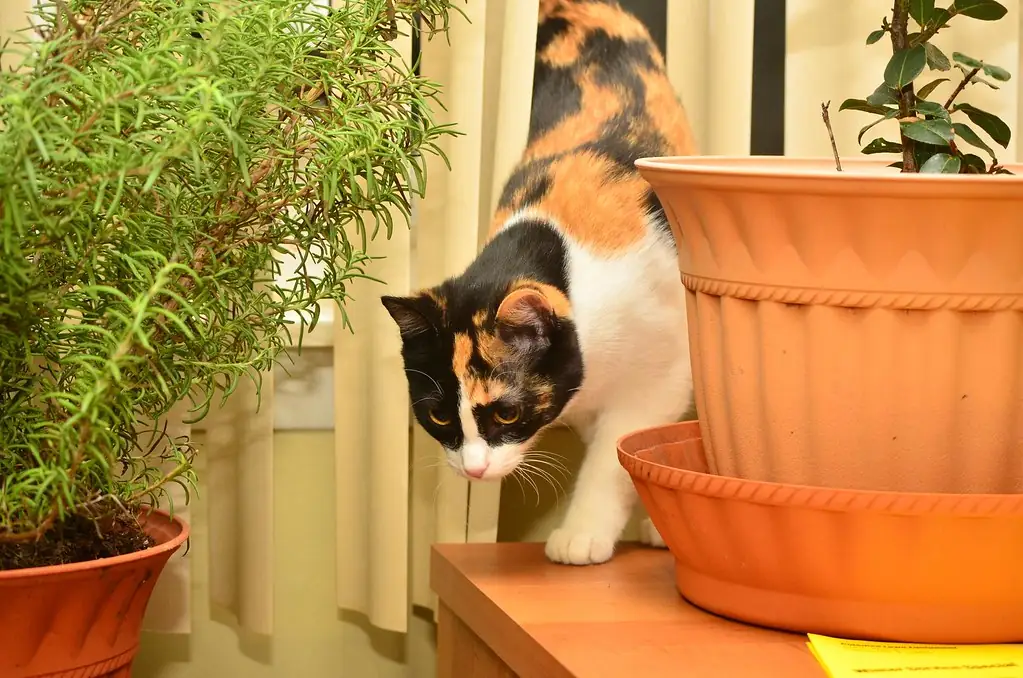
Troubleshooting problems when growing herbs indoors in winter
| Symptom | Most likely cause | What to do |
|---|---|---|
| Long, pale, floppy stems | Too little light | Move to the brightest window; add or lower a grow light |
| Leaf drop right after moving indoors | Adjustment to lower light | Keep conditions steady; prune lightly once new growth starts |
| Basil leaves blacken or collapse | Chilling below 50°F (10°C) | Move away from cold glass and drafts |
| Crispy leaf edges | Dry, heated air | Group plants, add a pebble tray or humidifier |
| Wilting with wet soil, mushy stems | Overwatering, cold roots | Let the top inch dry; check drainage |
| Tiny flies over the soil | Fungus gnats | Let soil dry between waterings; yellow sticky traps; Bti product per label |
| Fine webbing, speckled leaves | Spider mites | Isolate, rinse foliage, treat per label |
| Weak flavor | Low light or overfeeding | Raise light; cut fertilizer back |
Fungus gnats are the most common indoor complaint. Minnesota Extension recommends avoiding overwatering, letting soil dry between waterings, and combining yellow sticky traps with a soil-applied Bti (Bacillus thuringiensis israelensis) product.
Harvesting so winter herbs last until spring
Harvesting is also pruning. Illinois Extension advises cutting a few inches down the stem rather than picking individual leaves, which encourages branching (Illinois Extension, 2021). In winter, take smaller harvests, because the plant regrows slowly under weak light. Pinch flower buds off basil to keep it leafy.
Short-lived herbs such as cilantro and dill are better treated as repeat sowings than as single plants. Sow a small pot every few weeks so one batch is always coming on. If you have leftover space under the same light, indoor lettuce pairs well with herbs because its DLI target (12–17) is similar.
From the lab bench
Reading these sources together, the most useful idea for growing herbs indoors in winter is that light, temperature and water are linked rather than separate settings. Low light limits how much sugar a plant makes. Warmth speeds respiration and stem growth. When warmth is high and light is low, the plant tends to stretch rather than build leaf mass. That is consistent with the Michigan State finding that optimum temperatures for sage and spearmint shifted downward as light rose, and with the advice to run cooler when light is scarce.
The second point concerns basil. The research optimum for sweet basil sits well above normal room temperature, and its DLI target is the highest of the common herbs. Treat basil as the herb that gets the best light and the warmest shelf, and accept smaller harvests in midwinter. Perennial Mediterranean herbs such as thyme, oregano and sage are more forgiving and work well in a cool, bright room.
Finally, the DLI formula shows why a cheap, low-output light run for 18–20 hours is not a real substitute for a brighter fixture. Measuring PPFD once with a meter or phone-based estimate, then setting hours from the table above, removes most of the guesswork. Explore more herb guides in our Indoor Herbs section.
FAQ
Can you grow herbs indoors in winter without a grow light?
Yes, if you have a south- or west-facing window that gets at least five to six hours of direct sun. Chives, parsley and mint cope best with window light. Basil and cilantro usually stretch without added light.
How many hours of light do herbs need indoors in winter?
Extension services recommend 12–16 hours under grow lights. The better approach is to aim for a daily light integral: about 10–15 mol·m⁻²·d⁻¹ for parsley and 15–25 for basil, which you can calculate from your light’s PPFD.
What temperature is best for indoor herbs in winter?
Aim for 65–70°F (18–21°C) during the day and 55–60°F (13–16°C) at night. Keep basil above 50°F (10°C) and away from cold window glass.
Which herbs are easiest to grow indoors in winter?
Chives, parsley and mint are the easiest. Thyme, oregano, sage and rosemary do well in a bright, cool room. Basil is the hardest because it needs the most light and warmth.
How often should I water indoor herbs in winter?
Water when needed, not on a schedule. Let rosemary, thyme, sage, oregano and bay dry slightly between waterings, and keep basil, parsley and chives evenly moist. Check that the mix is dry about an inch down before watering drier herbs.
Should I fertilize herbs indoors in winter?
Lightly. Use a dilute water-soluble fertilizer about every two weeks, at 100–200 ppm or one quarter to one half of the label rate. Overfeeding can reduce flavor.
When should I bring herbs inside for winter?
Bring them in before frost, when night temperatures drop to about 40–50°F (4–10°C). Check for pests first and keep the plants apart from houseplants for a while.
Sources
- Penn State Extension. Growing Herbs Indoors.
- University of Illinois Extension (2021). Herbs all winter: grow them indoors.
- University of Illinois Extension (2015). Tips on Growing Herbs Inside for the Winter.
- NC State Extension, Union County Center (2021). Growing Herbs Indoors.
- University of Maryland Extension. Growing Herbs in Containers and Indoors.
- University of Minnesota Extension. Bringing houseplants in for winter.
- Stallknecht, E. (2025). Calculating and Using Daily Light Integral (DLI): An Introductory Guide. Virginia Cooperative Extension, SPES-720.
- Walters, K.J., Tarr, S., and Lopez, R.G. (2023). Modeling purple basil, sage, spearmint, and sweet basil responses to daily light integral and mean daily temperature. PLOS ONE 18(11): e0294905.
- Walters, K.J., and Lopez, R.G. (2021). Modeling growth and development of hydroponically grown dill, parsley, and watercress in response to photosynthetic daily light integral and mean daily temperature. PLOS ONE.