
Short answer: yes, you can grow microgreens without soil. Spread seed on a pre-moistened hemp, jute (burlap) or coco coir mat in a tray, keep it covered and dark for 1–3 days, then grow under lights, watering from below. Most small-seeded crops are ready in 6–14 days. Plain water works, but a weak nutrient solution (Virginia Tech runs EC 1.0 mS/cm at pH 5.9) usually gives heavier trays.
Growing microgreens without soil is cleaner, lighter and easier to fit on a kitchen shelf than trays of potting mix. The research also shows it can match soilless peat mixes on yield. Below you will find how the common mats compare in published trials, whether to feed, seeding rates, a step-by-step method, and the food-safety points that matter most.
Table of Contents
Can you grow microgreens without soil?
Yes. Commercial indoor farms grow microgreens without soil every day. Virginia Tech’s extension guide to indoor microgreen production (SPES-756) lists the mat options in use: bamboo, burlap, coir, hemp, jute, rockwool, silicone and steel mesh. Its own team grows carrot, broccoli, mizuna, radish and beet microgreens on hemp and burlap mats.
Why do microgreens without soil work so well? A microgreen lives mostly on the food stored in its seed and is cut before it needs much from the root zone. That is why a thin mat of fibre that holds water and gives roots something to grip is enough. What the mat cannot supply is nutrients, which is where feeding comes in (covered below).
Best mats for microgreens without soil: how they compare
No single medium wins for every crop. Trials show the ranking changes with species, but some patterns are consistent.
| Medium | Water holding | What trials found | Good for |
|---|---|---|---|
| Hemp mat | High; needs less frequent watering (Virginia Tech) | Tallest shoots and highest fresh and dry weight in one or both runs for five brassicas and radish, though lowest shoot nitrogen (Li et al. 2021) | Beginners; brassicas, radish |
| Jute or burlap | Lower; needs more frequent watering (Virginia Tech) | Jute-kenaf mat matched peat for rapini yield (Di Gioia et al. 2017); jute beat MicroMat for basil (Li et al. 2024) | Cheap, compostable; basil, rocket |
| Coco coir (loose or mat) | High | Gave the most chlorophyll in rocket in a floating system (Negri et al. 2021) | Larger seeds, longer crops |
| Recycled textile mat | Medium | Matched peat for rapini yield (Di Gioia et al. 2017) | Rapini, brassicas |
| Polyester pad (e.g. Sure to Grow) | Medium | 13.1% less rapini yield than peat, textile and jute-kenaf (Di Gioia et al. 2017) | Reusable-tray setups |
| Rockwool, silicone, steel mesh | Varies | Listed as options by Virginia Tech; no home-scale yield data found | Hydroponic screen trays |
What studies of microgreens without soil measured
- Rapini on four media. In an Italian study led by Francesco Di Gioia (Di Gioia et al. 2017), peat, a recycled textile mat and a jute-kenaf mat averaged 1,502 g/m². The polyester Sure to Grow pad yielded 13.1% less. Peat-grown shoots held twice the nitrate (1,959 vs 940 mg/kg fresh weight), and peat was the only medium with detectable E. coli on the shoots.
- Five brassicas on four pads. Mississippi State researchers (Li et al. 2021) compared Biostrate, hemp, micro-mat and jute. Hemp gave the tallest shoots and the highest fresh and dry weight in one or both runs. Radish out-yielded broccoli, cabbage, kale and mustard.
- Herbs on four mats. A follow-up (Li et al. 2024) found jute beat MicroMat for basil yield in both runs, while leek and parsley yielded about the same on all four mats.
- Floating hydroponics. Italian researchers grew basil and rocket on coir, vermiculite and jute floating on half-strength Hoagland solution (Negri et al. 2021). Yields ran from 1,655 to 3,370 g/m² in 12–16 days; rocket on jute was highest.
- Burlap and water only. A 2024 study grew seven crops on burlap with distilled water and harvested on day 9 (Gunjal et al., Scientific Reports). Radish ‘Sango’ grew tallest at 5.66 cm, and flaxseed gave the highest fresh yield.
The practical takeaway for microgreens without soil: hemp is the forgiving choice because it holds the most water; jute and burlap are cheaper but dry faster; coir suits growers who want a slightly deeper root zone.
Do microgreens without soil need nutrient solution?
Seeds carry enough food to germinate, but not always enough to finish a heavy crop, and a bare mat adds nothing. That is the main difference between microgreens without soil and trays in a fertilized mix. The evidence points to a light feed after germination.
- Penn State Extension (Growing Microgreens) says little or no fertilizer is needed; 50–100 ppm nitrogen is generally enough, and they use 100 ppm N from a 20-10-20 fertilizer. Plants on clear water grew but sometimes showed iron deficiency.
- Virginia Tech recommends hydroponic microgreen systems run at EC 1.0 mS/cm or more and pH 5.5–6.0, starting after most seeds have germinated and continuing to harvest.
- Mississippi State gave a single feed of 100 mg/L N around day 7, when covers came off, which generally increased height and weight.
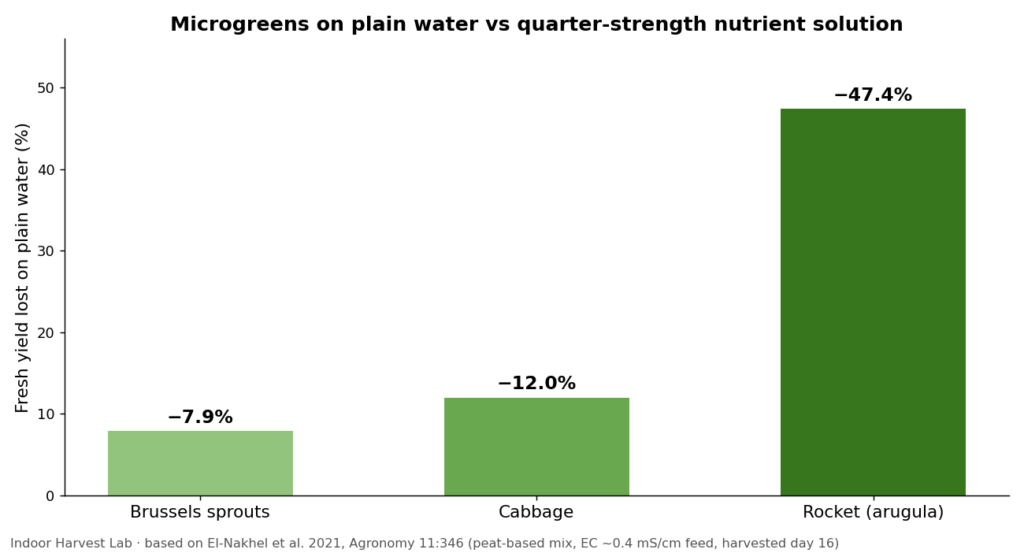
- Italian researchers (El-Nakhel et al. 2021) grew three brassicas in a peat-based mix and compared quarter-strength Hoagland (EC about 0.4 mS/cm) with distilled water. Without nutrients, yield fell 7.9% in Brussels sprouts, 12.0% in cabbage and 47.4% in rocket.
If you already grow hydroponically, feed microgreens without soil with your usual nutrient at a fraction of full strength and check it with an EC pen. Our hydroponic EC chart and ppm to EC guide explain the readings.
How to grow microgreens without soil: step by step
- Set up the tray. Use a standard 10×20 inch (1020) tray with a solid tray underneath for bottom watering, or a hydroponic screen tray over a reservoir.
- Pre-soak the mat. Wet the hemp, jute or coir mat thoroughly and let excess water drain. Virginia Tech soaks burlap in diluted hydrogen peroxide before use.
- Weigh the seed. Penn State uses 10–15 g per 1020 tray for small seeds (a tablespoon of brassica seed is about 11–12 g). Utah State’s rates are heavier; see the table below. Soak sunflower 12 hours and peas 6 hours first (Utah State).
- Sow evenly. Scatter seed in a single, even layer over the mat and mist the surface.
- Cover for the blackout. Stack an empty tray on top or cover it. Utah State covers most crops for 1–3 days and basil for 4–7; Penn State’s home guide weights pea and sunflower seeds during germination.
- Uncover and light. Virginia Tech uncovers after 2–5 days. Put the tray under lights; Utah State runs 18 hours a day.
- Water from below. Pour water or dilute nutrient solution into the bottom tray and let the mat wick it up, then drain the excess. Penn State notes sub-irrigation keeps leaves dry and helps prevent disease.
- Feed once greening starts, at the rates in the section above.
- Harvest with clean scissors just above the mat when the first leaves are open (times below).
Seeding rates and harvest days for microgreens without soil
| Crop | Seed per 1020 tray (Utah State) | Pre-soak | Days to harvest (Virginia Tech) |
|---|---|---|---|
| Arugula | 10 g | No | 6–14 |
| Broccoli | 28 g | No | 8–13 |
| Kale | 28 g | No | 8–14 |
| Basil | 28 g | No | not listed |
| Radish | 42 g | No | 6–10 |
| Sunflower | 48 g | 12 hours | 9–12 |
| Pea | 150 g | 6 hours | not listed |
Rates vary between sources: Penn State’s 10–15 g per tray is lighter than Utah State’s figures, and a Virginia Tech thesis found carrot seeded above 73 g/m² developed fungal infections. Start near the lower end with microgreens without soil, where airflow at the base is limited. For crop-by-crop gram rates and how to scale them to any container, see our microgreens seeding density chart. Penn State also offers a seed density calculator.
Light, temperature and airflow for microgreens without soil
- Light: Virginia Tech gives a daily light integral of 9–16 mol/m²/day and runs about 250 µmol/m²/s for 18 hours (DLI 16.2). Penn State keeps DLI below 20. Our grow light distance guide helps you set the height.
- Temperature: Virginia Tech grows at 60–70 °F (16–21 °C). Utah State germinates at 74 °F, then runs 72 °F with lights on and 68 °F with lights off.
- Humidity and air: Virginia Tech targets 50–70% relative humidity; Utah State runs a constant gentle fan.
Mats stay wetter at the surface than a mix, so airflow matters more when you grow microgreens without soil. Fuzzy white growth can be mould or harmless root hairs; our microgreens mold guide shows how to tell them apart.
Food safety for microgreens without soil
Microgreens are eaten raw, so hygiene matters as much as yield. Growing microgreens without soil removes one source of contamination, but not all of them.
- Risk level. University of Nevada, Reno Extension (Moe 2020) found no known US outbreaks linked to microgreens from 1998 to 2017, against more than 50 for sprouts and baby greens. That record is a reason for care, not complacency: the crop is still eaten raw.
- Seed. UNR notes seed can carry pathogens, so buy from a supplier that cleans its seed.
- Water. Penn State (Ensuring Food Safety in Microgreens Production) says irrigation water must be free of E. coli; municipal water doesn’t need testing.
- Hands and media. Wash hands for at least 30 seconds, and buy coir, hemp mats and peat from reputable suppliers (Penn State).
- Mats are not automatically safer. When researchers deliberately contaminated media, transfer to sunflower shoots was 5.29 log CFU/g from a Biostrate mat versus 2.64 from peat; for peas it was 1.53 versus 0.00 (Deng et al. 2021). Clean seed, water and hands matter more than the medium.
What not to do
- Don’t flood the mat. Microgreens without soil sit right on the wet surface. Standing water on the surface invites damping-off, which Virginia Tech names as the main disease (Pythium or Phytophthora).
- Don’t water from above once shoots are up. Bottom watering keeps leaves dry.
- Don’t sow too thickly. Dense trays trap humidity at the base.
- Don’t reuse a mat full of old roots. Penn State recommends fresh growing media each cycle.
- Don’t use untested well or rain water for a crop you will eat raw.
- Don’t feed at full strength. Penn State’s 50–100 ppm N and Virginia Tech’s EC 1.0 are far below what a mature lettuce crop gets.
Where this applies
Growing microgreens without soil works in any home with indoor lights. In humid climates or rooms without airflow, choose lighter seeding and a fan, and consider jute or burlap, which dry faster than hemp. In dry, heated rooms, hemp or coir holds moisture longer between waterings. If your home uses a private well, test it for E. coli before growing microgreens without soil, as Penn State and UNR both set that standard for irrigation water.
FAQ
Do microgreens grow better in soil or without soil?
Not necessarily. Microgreens without soil can match a peat mix: in the Di Gioia rapini trial, peat, textile and jute-kenaf mats gave similar yields, and only the polyester pad fell behind. Crop choice mattered more than medium in most studies.
What is the easiest mat for microgreens without soil?
Hemp. It holds the most water, so it forgives a missed watering, and it gave the tallest, heaviest brassica shoots in the Mississippi State trial.
Do microgreens without soil need fertilizer?
They grow on water alone, but yield can drop; rocket lost 47.4% in one study. A weak feed of 50–100 ppm nitrogen, or about EC 1.0, from about day 5–7 is enough.
How long do microgreens without soil take to grow?
About the same as in a mix: radish 6–10 days, broccoli 8–13, sunflower 9–12, per Virginia Tech.
Browse more tray guides in our microgreens growing guides.
Sources
- South, K. et al. Introduction to Microgreen Production in Indoor Vertical Farms and Greenhouses (SPES-756). Virginia Cooperative Extension.
- Sánchez, E. and Berghage, R. Growing Microgreens. Penn State Extension.
- Di Gioia, F. A Step-by-Step Guide for Growing Microgreens at Home. Penn State Extension.
- Stoltzfus, K. and Fronk, T. Ensuring Food Safety in Microgreens Production. Penn State Extension, 2025.
- Beck, M. Grow Your Own Microgreens. Utah State University Extension, 2025.
- Di Gioia, F. et al. Physicochemical, agronomical and microbiological evaluation of alternative growing media for the production of rapini (Brassica rapa L.) microgreens. J. Sci. Food Agric. 97, 2017.
- Li, T., Lalk, G. T., Arthur, J. D., Johnson, M. H. and Bi, G. Shoot production and mineral nutrients of five microgreens as affected by hydroponic substrate type and post-emergent fertilization. Horticulturae 7:129, 2021.
- Li, T., Arthur, J. D., Bi, G. and White, S. Hydroponic Fiber Mats Altered Shoot Growth and Mineral Nutrient Composition of Five Herbal Microgreens. Horticulturae 10:1298, 2024.
- Negri, M., Bulgari, R., Santoro, P. and Ferrante, A. Evaluation of different growing substrates for microgreens production. Acta Horticulturae 1305, 2021.
- Gunjal, M. et al. Assessment of bioactive compounds, antioxidant properties and morphological parameters in selected microgreens cultivated in soilless media. Scientific Reports 14:23605, 2024.
- El-Nakhel, C. et al. Nutrient Supplementation Configures the Bioactive Profile and Production Characteristics of Three Brassica L. Microgreens Species Grown in Peat-Based Media. Agronomy 11:346, 2021.
- Deng, W., Misra, G. M., Baker, C. A. and Gibson, K. E. Persistence and Transfer of Foodborne Pathogens to Sunflower and Pea Shoot Microgreens during Production in Soil-Free Cultivation Matrix. Horticulturae 7:446, 2021.
- Moe, K. Microgreens and Produce Safety. University of Nevada, Reno Extension, 2020.
Featured image: “Free microgreen sprouts image” by rawpixel, CC0.