
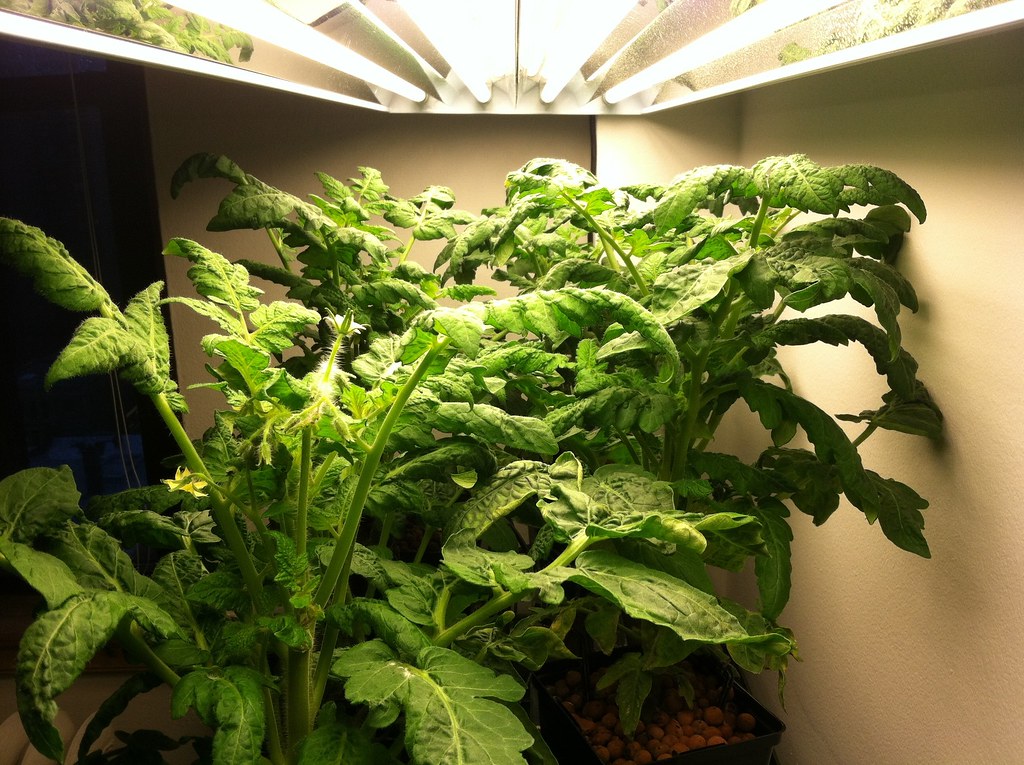
Short answer: you only need cal-mag in hydroponics when your base nutrient and your water together fall short on calcium (Ca) or magnesium (Mg). Cornell’s published recipes for lettuce and herbs deliver about 90–140 ppm calcium and 24–47 ppm magnesium, and fruiting-crop recipes about 170–176 ppm calcium and 48–60 ppm magnesium. Cal-mag earns its place with reverse osmosis (RO), distilled or rain water, with one-part fertilizers designed for hard tap water, and with heavy feeders such as tomatoes. With a complete two-part nutrient mixed in moderately hard tap water, extra cal-mag usually just raises EC.
This guide explains what a cal-mag supplement actually contains, how to tell whether your system is short, which symptoms point to calcium or magnesium (and which look similar but are not), and how to calculate a dose from calcium nitrate or Epsom salt if you prefer to mix your own.
Table of Contents
What cal-mag is (and what it is not)
“Cal-mag” is a product category, not a single formula. Most bottles supply calcium and magnesium, often in nitrate form, and many add a little iron or other micronutrients. Because formulas differ, the label is the only reliable guide: look for the percentage of calcium, magnesium and nitrogen, since every gram of a nitrate-based cal-mag also adds nitrogen.
The two plain fertilizer salts that do the same job are calcium nitrate and magnesium sulfate (Epsom salt). Penn State Extension lists fertilizer-grade calcium nitrate as 15.5-0-0 with 19% calcium, and magnesium sulfate at 9.1% magnesium. Most hydroponic “A and B” nutrient sets already contain calcium nitrate in the A part, which is why many growers never need a separate cal-mag bottle.
Calcium and magnesium are both macronutrients. Calcium builds cell walls and cannot move from old leaves to new ones once it is inside the plant, so shortages show on the newest growth. Magnesium sits at the center of the chlorophyll molecule and does move, so shortages show on older leaves first.
How much calcium and magnesium hydroponic crops need
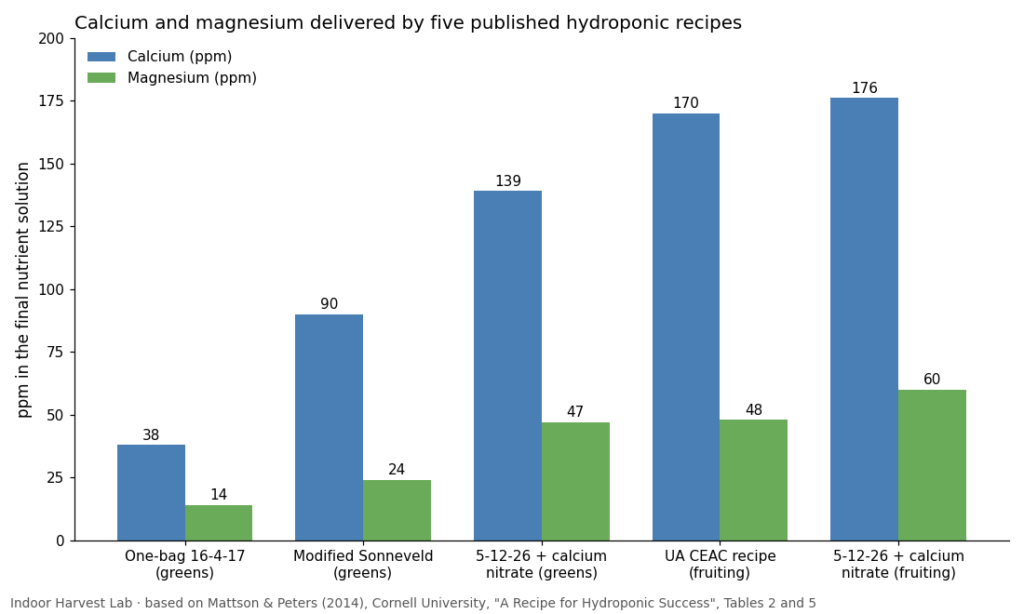
Published recipes give a useful benchmark for judging whether you need cal-mag in hydroponics. The table below comes from Cornell University’s “A Recipe for Hydroponic Success” (Mattson and Peters, 2014), with commercial averages from Ryan Dickson (University of Arkansas, 2018).
| Recipe or guideline | Crop | Calcium (ppm) | Magnesium (ppm) |
|---|---|---|---|
| One-bag 16-4-17 hydroponic fertilizer | Lettuce, herbs, greens | 38 | 14 |
| Modified Sonneveld solution | Lettuce, herbs, greens | 90 | 24 |
| 5-12-26 plus calcium nitrate (two-bag) | Lettuce, herbs, greens | 139 | 47 |
| Average of 4 commercial recipes (Dickson) | Leafy greens and herbs | 100 | 31 |
| University of Arizona CEAC recipe | Tomato, cucumber, pepper | 170 | 48 |
| 5-12-26 plus calcium nitrate (fruiting rate) | Tomato, cucumber, pepper | 176 | 60 |
| Dickson’s guideline for fruiting crops | Fruiting crops | more than 150 | more than 50 |
Notice the first row. Cornell explains that the one-bag 16-4-17 formula “works well for water types with an alkalinity in the range of 40 ppm to 200 ppm.” Water with that much alkalinity usually carries its own calcium and magnesium, so the fertilizer supplies less. Mix the same product in RO water and you get only 38 ppm calcium and 14 ppm magnesium, which is exactly the situation where cal-mag helps.
For magnesium specifically, Cornell’s Neil Mattson recommends about 40 ppm for most plants and 60 ppm for basil in e-GRO Alert E303 (2018), with a calcium to magnesium ratio near 2:1 and a potassium to magnesium ratio near 4:1.
When you need cal-mag (decision table)
| Your setup | Need cal-mag? | Why |
|---|---|---|
| RO, distilled or rain water plus a complete two-part nutrient | Check the label; often a small top-up | Pure water adds no Ca or Mg, so the nutrient must supply all of it |
| RO, distilled or rain water plus a one-part nutrient made for tap water | Usually yes | These formulas count on the water for part of the Ca and Mg |
| Tap or well water with a lab analysis showing Ca and Mg | Only if the total falls below the targets above | Cornell advises counting water-borne Ca, Mg and S in the recipe |
| Softened tap water | Do not use it; switch water | Softeners swap Ca and Mg for sodium |
| Tomatoes, peppers, cucumbers in fruit | Often yes | Fruiting recipes run higher in Ca and Mg than greens recipes |
| Lettuce with tipburn but a normal nutrient solution | Probably not | Tipburn is usually an environment problem (see below) |
Cornell’s recipe fact sheet puts the first step plainly: begin with a laboratory analysis of your water. It notes that high alkalinity often comes with “considerable levels of Ca, Mg and S,” and that you should be prepared to supply these nutrients through your fertilizer program if your water lacks them. On softened water, an Ask Extension expert warns that the sodium it contains interferes with a plant’s water balance and can kill plants.
Signs your hydroponic plants need calcium or magnesium
Cornell researchers starved hydroponic lettuce and arugula of single nutrients and photographed the results. Their descriptions are the clearest reference for home growers deciding whether cal-mag is the fix.
Calcium deficiency: new growth first
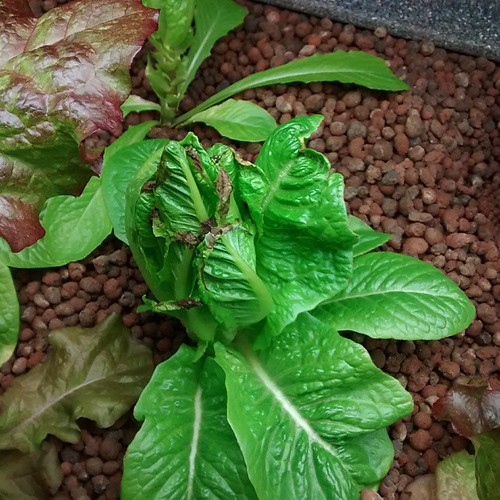
In hydroponic lettuce (Mattson and Merrill, 2015), scattered dead spots appeared on young leaves within the first week, followed by browned, distorted leaf edges; the growing tip was dead by the third week. In arugula (Mattson and Merrill, 2017), young leaves turned yellow and brown from the base and became strap-like, and roots turned markedly brown within two weeks.
Magnesium deficiency: old leaves first
In the lettuce trial, mature leaves showed light yellowing between the veins (interveinal chlorosis) about 10 days after magnesium was removed, then dead leaf edges; by three weeks all lower leaves were affected. Arugula showed the same pattern within two weeks. In basil, E303 describes interveinal yellowing on mature leaves that spreads to younger ones, with reddish-brown dead patches in advanced cases.
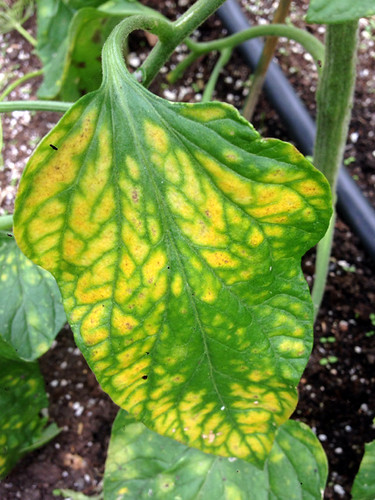
The Cornell authors add an important caution: several deficiencies look alike, so a tissue test is needed to confirm them, and a solution analysis catches problems before plants show them.
Lettuce tipburn and blossom-end rot: why more cal-mag rarely fixes them
Both disorders involve calcium, and both send growers looking for cal-mag in hydroponics. In most cases, though, the solution already has enough calcium; the plant simply cannot move it to fast-growing tissue.
For lettuce, Mattson’s e-GRO Alert on tipburn (2015) says inner-leaf tipburn is rarely caused by a lack of calcium in the root zone. Calcium travels with the water the plant transpires, so high humidity, poor air movement and very fast growth starve the inner leaves. Cornell’s research found tipburn often appears when the daily light integral exceeds 17 mol/m²/day with vertical airflow fans, or 12 mol/m²/day without them. The fixes are airflow, lower humidity and not overdriving the light, while making sure the recipe carries adequate calcium (the Cornell leafy-greens recipe uses 90 ppm).
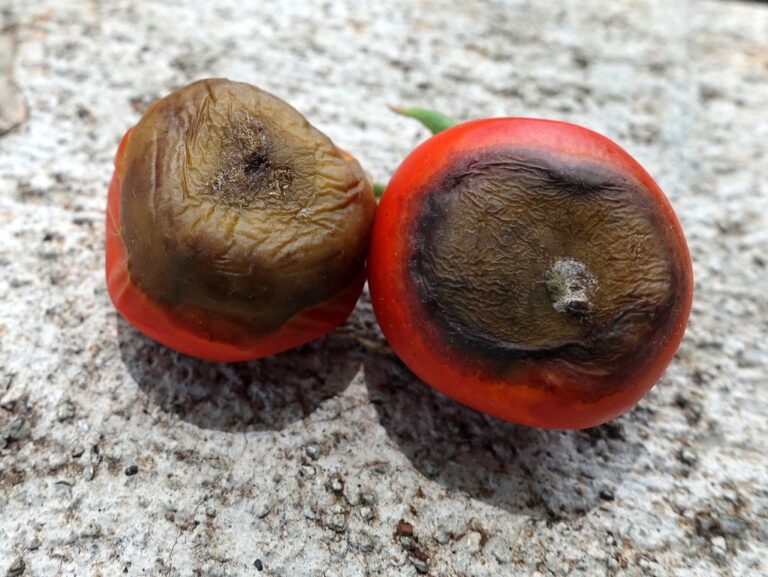
Blossom-end rot on tomatoes and peppers is similar. UConn’s Home Garden Education Office explains that it usually appears even when calcium is present, because water supply problems keep calcium from reaching the fruit. A review by Saure (2014, Scientia Horticulturae) goes further, arguing that low fruit calcium is a result of blossom-end rot rather than its cause, with stresses such as salinity, drought, heat and high light as triggers. In hydroponics that points to steady EC, stable water supply and moderate temperatures before extra calcium.
How to dose cal-mag or make your own
If your label math or water test shows a shortfall, top up in small steps. Commercial cal-mag bottles list their own rates; follow the label and start at the low end. If you mix plain salts instead, this table shows how much to add to raise calcium or magnesium by a set amount. It uses 19% calcium for calcium nitrate (Penn State) and 9.9% magnesium for pure Epsom salt (MgSO₄·7H₂O); the Epsom figures match Mattson’s E303 rate of 8.14 oz per 100 gallons for 60 ppm.
| Goal | Salt | Per 10 liters | Per US gallon | Also adds |
|---|---|---|---|---|
| +10 ppm Mg | Epsom salt | 1.0 g | 0.38 g | about 13 ppm sulfur |
| +20 ppm Mg | Epsom salt | 2.0 g | 0.77 g | about 26 ppm sulfur |
| +30 ppm Mg | Epsom salt | 3.0 g | 1.15 g | about 40 ppm sulfur |
| +20 ppm Ca | Calcium nitrate (15.5-0-0) | 1.05 g | 0.40 g | about 16 ppm nitrogen |
| +40 ppm Ca | Calcium nitrate (15.5-0-0) | 2.1 g | 0.80 g | about 33 ppm nitrogen |
| +60 ppm Ca | Calcium nitrate (15.5-0-0) | 3.2 g | 1.20 g | about 49 ppm nitrogen |
The math behind it: ppm = grams per liter × percent of the element × 10. Use a scale that reads to 0.1 g; kitchen spoons are too rough at these amounts.
Step-by-step: adding cal-mag to a reservoir
- Know your water. Use a water lab report, or your utility’s water quality report, for calcium and magnesium. RO and distilled water count as zero.
- Read the base nutrient label. Work out the ppm of Ca and Mg it delivers at your mixing rate, and compare the total with the targets above.
- Calculate the gap. Aim for the leafy-greens range (about 90–140 ppm Ca, 25–50 ppm Mg) or the fruiting range (about 150–180 ppm Ca, 50–60 ppm Mg), keeping Ca:Mg near 2:1.
- Fill the reservoir with water first, then add the cal-mag or calcium nitrate and stir until dissolved, then the base nutrient parts one at a time. Never combine concentrates: Cornell and MU Extension both warn that calcium reacts with phosphate and sulfate to form insoluble sludge.
- Measure EC and pH. Cal-mag adds salts, so EC rises. Keep the total within your crop’s range on our hydroponic EC chart, then adjust pH last.
- Watch new and old leaves for a week or two. Existing damage will not reverse; judge success by the leaves that grow after the change.
For the full mixing sequence with A and B parts, see our guide to making a hydroponic nutrient solution.
Cal-mag mistakes to avoid
- Adding cal-mag by default. On top of a complete nutrient in hard water, it only pushes EC up and can tip the balance: E303 notes that excess calcium or potassium can inhibit magnesium uptake.
- Mixing concentrated calcium with Epsom salt or phosphate. Keep calcium in its own stock or add it to the full reservoir separately.
- Using softened water. It trades useful calcium and magnesium for sodium.
- Ignoring pH. E303 lists a root-zone pH below 5 among the causes of magnesium deficiency. Correct pH before adding more magnesium; our guides on how to raise pH in hydroponics and lower pH in hydroponics cover the details.
- Treating tipburn with more calcium. Fix airflow, humidity and light intensity first.
- Reading ppm from a meter as calcium. An EC or TDS pen measures total salts, not calcium or magnesium; see our ppm to EC conversion guide.
Where this applies
Whether you need cal-mag depends mostly on local water. Hard, alkaline tap or well water often already carries a useful share of calcium and magnesium, while RO, distilled and rain water carry almost none. Cornell notes that many closed-system growers filter their water with RO because source water EC should ideally be under 0.25 mS/cm for recirculating systems; those growers must supply every milligram of calcium and magnesium from fertilizer.
Crop and system matter too. Recirculating systems such as a hydroponic tower or deep water culture reuse the same solution, so shortages build up between changes, while fruiting crops draw far more calcium and magnesium than lettuce. More reading is in the nutrients, pH and EC section.
FAQ
Do I need cal-mag with RO water in hydroponics?
Often, yes. RO water contains almost no calcium or magnesium, so unless your nutrient is a complete two-part formula that supplies both at the levels above, a cal-mag top-up is usually needed.
Can I use Epsom salt instead of cal-mag?
Epsom salt supplies only magnesium (and sulfur). If calcium is also short, pair it with calcium nitrate, and add the two to the reservoir separately.
Does lettuce need cal-mag?
Not if the recipe already supplies around 90 ppm calcium and 25–50 ppm magnesium. Lettuce tipburn is usually caused by humidity, poor airflow or excessive light rather than a calcium shortage in the solution.
Should cal-mag go in before or after the base nutrients?
Add it to the full volume of water first and stir, then add the base nutrient parts one at a time. The key rule is never to mix calcium with sulfate or phosphate concentrates.
Sources
- Mattson, N. and Peters, C. (2014). A recipe for hydroponic success. Cornell University.
- Penn State Extension. Hydroponics systems: nutrient solution programs and recipes.
- Dickson, R. (2018). Managing nutrient solutions for hydroponic crops. University of Arkansas, New England Greenhouse Conference.
- Mattson, N. (2018). Magnesium deficiency of hydroponic and container basil. e-GRO Alert E303.
- Mattson, N. and Merrill, T. (2015). Symptoms of common nutrient deficiencies in hydroponic lettuce. e-GRO.
- Mattson, N. and Merrill, T. (2017). Symptoms of common nutrient deficiencies in hydroponic arugula. e-GRO.
- Mattson, N. (2015). Tipburn of hydroponic lettuce. e-GRO Alert 4(31).
- University of Missouri Extension. Hydroponic nutrient solutions (G6984).
- Saure, M.C. (2014). Why calcium deficiency is not the cause of blossom-end rot in tomato and pepper fruit: a reappraisal. Scientia Horticulturae.
- UConn Home Garden Education Office (2025). Put an end to blossom-end rot.
- Ask Extension. Water softeners for watering.
Featured image: “Hydroponic tomato plants” by dane brian, CC BY-SA 2.0.