
You reach into the channel to harvest a butterhead and stop short: the youngest leaves in the heart of the head have brown, scorched edges, as if someone singed them. The outer leaves are perfect, your EC is on target, and the cal-mag bottle is right there. So what is burning those leaf edges, and why is it always the inner leaves?
Short answer: lettuce tip burn is a calcium-delivery problem, not usually a calcium shortage. The young leaves in the centre of the head grow faster than water (and the calcium it carries) can reach them, so their edges die and turn brown. The most reliable fix is to move air down into the heart of the plant, then slow growth slightly by trimming light, keeping EC moderate and choosing tolerant varieties. Adding more cal-mag rarely helps on its own.
Table of Contents
Table of Contents
This guide explains why lettuce tip burn happens in hydroponic and indoor systems, how to tell it apart from nutrient burn, and the numbers that research groups at Cornell, Ohio State, the University of Delaware and the USDA have tested. If you grow butterhead or romaine in deep water culture or NFT channels, this is the disorder most likely to cost you a harvest.
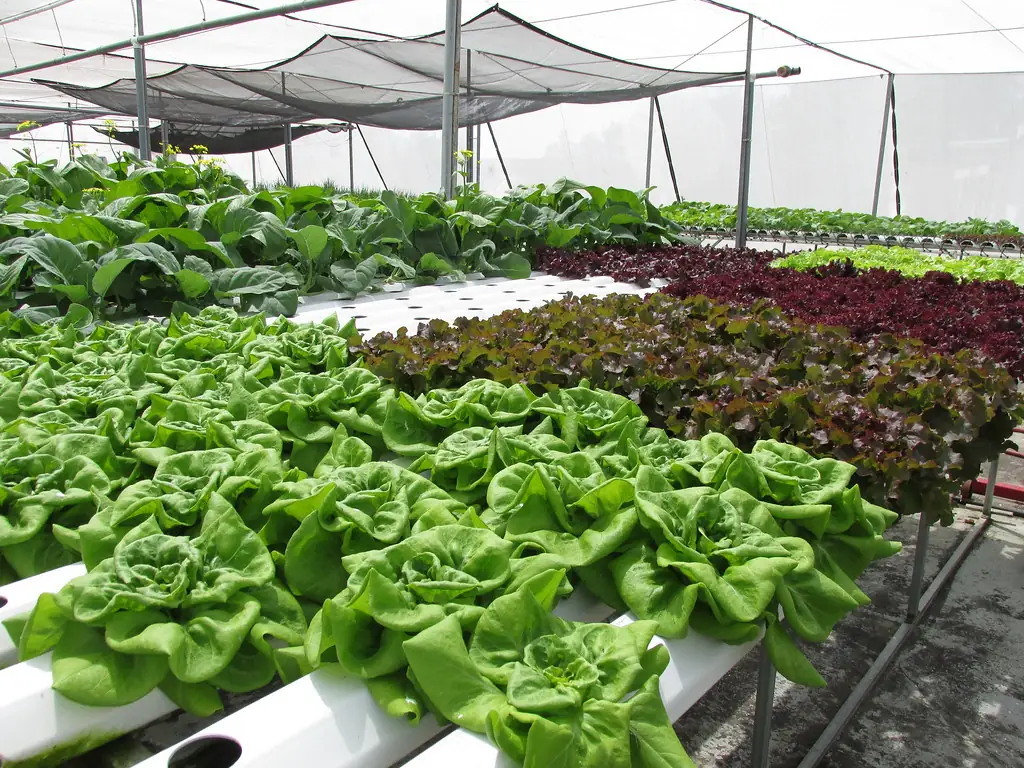
What Is Lettuce Tip Burn?
Lettuce tip burn is a physiological disorder, not a disease. Cornell CEA specialist Neil Mattson describes it as necrotic brown spots on the edges of young leaves in the centre of the head, caused by an inadequate calcium supply to the growing point (Mattson, 2016). No fungus or bacterium starts it, so sprays aimed at pathogens will not touch it.
It matters commercially because buyers judge the whole crop. A 2025 HortScience review notes that packers may reject a lot when as few as 5% of plants are affected (Ertle and Kubota, 2025). For a home grower the loss is smaller, but a brown, papery heart still means trimming most of the head.
Inner lettuce tip burn vs. outer edge burn
UMass Extension separates two patterns (UMass Extension). Inner tipburn hits young, developing leaves and is linked to a local calcium shortage. Outer-edge burn on older leaves is tied to high soluble salts in the root zone. The two have different fixes, so where the browning sits is your first clue.
Why Lettuce Tip Burn Happens: The Calcium Transport Problem
To understand lettuce tip burn, start with calcium. It travels from the roots to the leaves almost only in the xylem, pulled along by transpiration. Once it is deposited in a leaf it does not move back out through the phloem. That means each leaf gets calcium only in proportion to the water it loses.
Outer leaves are open to light and air, so they transpire freely and collect plenty of calcium. The tightly wrapped inner leaves sit in still, humid air, transpire very little and grow fast. Their new cell walls need calcium, and when supply lags behind growth, margins collapse (Ertle and Kubota, 2025; Moosavi-Nezhad and Meng, 2025).
Conditions that tip the balance
Rutgers vegetable agent Rick VanVranken lists the classic risk factors: high light, high CO2, low air circulation and high humidity, all of which speed growth while slowing transpiration from the heart (Rutgers Plant & Pest Advisory, 2023). He also notes that dry nights can raise risk in some cases, because they reduce the root pressure that pushes calcium into enclosed leaves at night.
Utah State researchers grew lettuce under very high light and found tipburn first appeared around day 14 in ‘Buttercrunch’ and around day 16 in ‘Waldmann’s Green’ (Frantz et al., 2004). When they piped air directly onto the growing point, tipburn disappeared in ‘Waldmann’s Green’ and nearly disappeared in ‘Buttercrunch’. That one experiment captures the whole problem: the plant had calcium, but the heart could not pull it in.
| Factor | Effect on inner-leaf calcium | Risk direction |
|---|---|---|
| High light / high DLI | Faster growth raises calcium demand at the growing point | ↑ risk |
| High CO2 | Faster growth and partly closed stomata | ↑ risk |
| Still air over the canopy | Thick boundary layer; inner leaves barely transpire | ↑ risk |
| High daytime humidity | Lower transpiration pull | ↑ risk |
| Dry nights | Less root pressure to push calcium into enclosed leaves | ↑ risk (in some cases) |
| Downward airflow onto the heart | Thins the boundary layer and drives transpiration | ↓ risk |
| Tolerant cultivar | Genetic differences in calcium handling | ↓ risk |
How to Identify Tip Burn (and Rule Out Look-Alikes)
Lettuce tip burn usually shows up late, in the last one to two weeks before harvest, when heads are growing fastest. Peel back the outer leaves: early damage is often hidden inside the head, so a plant can look perfect from above.
- Location: margins of young, inner leaves first; older outer leaves stay clean.
- Colour: light tan turning dark brown or black along the edge, sometimes with a thin water-soaked band.
- Texture: dry and papery at first. Soft, slimy or foul-smelling tissue points to secondary rot.
- Pattern: often on many plants at once after a bright, warm or humid spell.
Symptom triage table
| What you see | Most likely cause | First check |
|---|---|---|
| Brown, crispy margins on inner young leaves | Tipburn (calcium delivery) | Airflow into the heart; DLI; growth rate |
| Brown, crispy margins on outer, older leaves | High salts / nutrient burn | EC against an EC chart; top up with water |
| Wilting at midday, brown slimy roots | Root rot / low oxygen | Root health, reservoir temperature, aeration |
| Pale new leaves, no browning | Nitrogen or iron issue, or pH drift | pH 5.5–6.2 and EC |
| Translucent, collapsed patches after cold | Chilling or frost damage | Air temperature at night |
Numbers to Hold for Tipburn-Free Lettuce
These are the setpoints and research values most relevant to lettuce tip burn. Treat the airflow and DLI rows as the levers that matter most; the nutrient rows are about avoiding extra stress, not forcing calcium in.
| Parameter | Target or tested value | What it means | Source |
|---|---|---|---|
| Daily light integral (with good downward airflow) | 17 mol·m⁻²·d⁻¹ | Upper target for head lettuce if air reaches the heart | Mattson 2016 |
| Daily light integral (without good airflow) | 13–14 mol·m⁻²·d⁻¹ | Lower light is needed to stay tipburn-free; crop takes longer | Mattson 2016 |
| Downward air speed over canopy | 0.41 m/s (≈ 81 ft/min) | Eliminated tipburn in almost all plants indoors | Ertle & Kubota 2025 |
| Vertical airflow fans in greenhouse | ≈ 1 m/s (≈ 200 ft/min) | Eliminated or minimised tipburn in summer | Moosavi-Nezhad & Meng 2025 |
| Air temperature, growing-on | 75 °F day / 66 °F night (24 / 19 °C) | Standard Cornell recipe | Mattson 2016 |
| Relative humidity, growing-on | 50–70% | General range for hydroponic leafy greens | Mattson 2016 |
| Nutrient EC | ≈ 1.5 mS/cm (tested range 1.4–2.0) | Lower EC cut tipburn in a sensitive cultivar but cost yield | Mattson 2016; Samarakoon 2020 |
| Nutrient pH | 5.5–6.2 | pH 5.8–6.4 had no effect on tipburn | Samarakoon 2020 |
| Calcium in solution | ≈ 90 ppm (Sonneveld lettuce recipe) | More calcium did not reduce tipburn severity | Mattson 2016; Langenfeld & Bugbee 2026 |
| Dissolved oxygen (DWC) | 3.5–4.0 mg/L vs 2.9 mg/L | Higher DO raised fresh mass 98–139% | Ries et al. 2026 |
| Typical onset | Day 14–16 of fast growth | Scout the heart from week 2 after transplant | Frantz et al. 2004 |
7 Proven Fixes for Lettuce Tip Burn in Hydroponics
The fixes below are ordered by strength of evidence and how directly they attack the cause. Start at the top; most growers need only the first two or three.
1. Blow air down into the heart of the plant
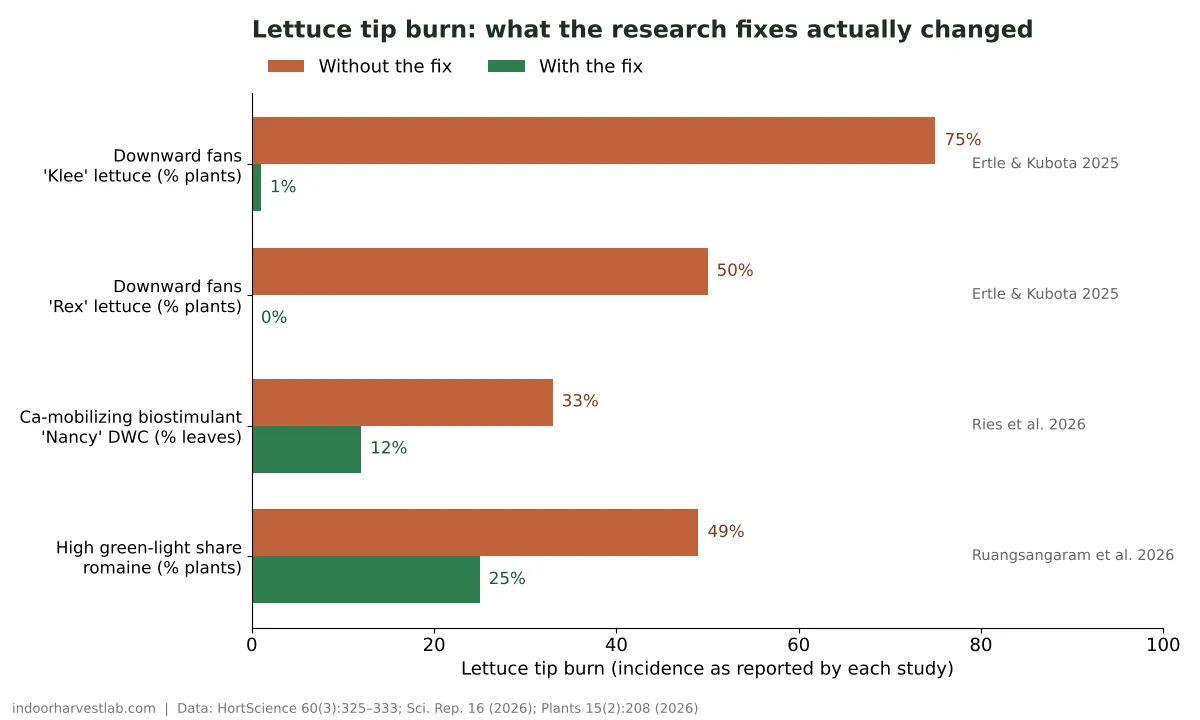
Airflow is the single best-supported fix for lettuce tip burn. In an indoor-farm study at Ohio State, adding box fans that pushed air down over the canopy at an average 0.41 m/s eliminated tipburn in nearly all plants. Without fans, incidence averaged 75% in the sensitive red-leaf ‘Klee’ and 50% in butterhead ‘Rex’ (Ertle and Kubota, 2025). A University of Delaware greenhouse trial using vertical airflow fans at about 1 m/s also eliminated or minimised tipburn (Moosavi-Nezhad and Meng, 2025).
- Aim fans downward or at a steep angle into the canopy, not just across the room.
- You want leaves gently fluttering at the centre of the head, not plants being flattened.
- Clip-on fans on a shelf frame or a small fan hung above a rack works for home setups.
- Run fans for the whole light period; lettuce tip burn develops during fast daytime growth.
2. Match light intensity to your airflow
Light drives growth, and growth drives calcium demand. Mattson recommends a DLI target of 17 mol·m⁻²·d⁻¹ for head lettuce only where airflow is good; without it, 13–14 mol·m⁻²·d⁻¹ is needed to avoid tipburn, at the cost of a longer crop (Mattson, 2016). Indoors, you can trim DLI by dimming the fixture or shortening the photoperiod. In a sunny greenhouse or window, shade cloth does the same job.
Spectrum may matter too. In a Japanese plant-factory study at 200 µmol·m⁻²·s⁻¹, raising the green share of the light reduced tipburn in romaine from 49% to 25% and increased calcium in inner leaves, although fresh weight fell 7% at 80% green and 25% at 100% green. The authors judged a 60% green share the best balance (Ruangsangaram et al., 2026). Most home growers can’t tune spectrum this finely, but full-spectrum white LEDs (which contain plenty of green) are a sensible choice.
If your lettuce grows fast and burns, lower DLI by about 15–20% before you change anything in the reservoir. Our indoor lettuce guide covers light distance and photoperiod in detail.
3. Keep EC moderate, not high
In an NFT study, the tipburn-sensitive ‘Green Butter’ had less tipburn at EC 1.4 mS/cm, but it also yielded 75 g less per head than at 1.8 mS/cm (Samarakoon et al., 2020). The lesson is that EC is a fine-tuning lever: dropping it slows growth and stress, but it is not free. Hold EC around 1.4–1.8 mS/cm for leafy greens and avoid letting it creep higher as water evaporates.
4. Don’t rely on extra cal-mag
Because the root zone usually has plenty of calcium, adding more often does nothing for lettuce tip burn. Utah State researchers raised solution EC from 0.3 to 1.0 mS/cm by replacing solution after every harvest, and the extra calcium did not reduce tipburn severity (Langenfeld and Bugbee, 2026). Keep a balanced recipe with adequate calcium, as covered in our cal-mag guide, but treat airflow as the real fix.
5. Keep the roots well oxygenated
Roots that are short of oxygen take up water poorly, which weakens calcium transport. In deep water culture, raising dissolved oxygen from 2.9 to 3.5–4.0 mg/L increased shoot fresh mass by 98–139% and leaf moisture by 5–7% (Ries et al., 2026). The same study found that a calcium-mobilizing biostimulant worked best when roots were short of oxygen, which suggests poor aeration and tipburn are linked. Use an air stone in every DWC bucket, and keep reservoirs cool.
6. Target foliar calcium carefully (optional)
Spraying calcium puts it directly on the leaves that need it. Calcium chloride sprays at 400 or 800 mg/L calcium, applied twice weekly starting one week after transplant, gave good tipburn control with only a minor yield impact in NFT lettuce (Samarakoon et al., 2020). The catch is that the spray must reach the enclosed inner leaves, and wet foliage, salt residue on equipment and extra humidity are known drawbacks (Ertle and Kubota, 2025). Test on a few plants first and follow the product label.
Commercial calcium-mobilizing biostimulants added to the nutrient solution are another option. At 0.5 mL/L, one product cut tipburn by 94–96% at 21 days and 71–75% at 28 days in greenhouse ‘Rex’ without fans (Moosavi-Nezhad and Meng, 2025). Results are product-specific, so treat this as a tool for setups where fans are impractical.
7. Grow tolerant varieties
Genetics matter as much as any setting when it comes to lettuce tip burn. An Ohio State hydroponic trial of 20 cultivars found tipburn ranging from 0% to 58%, with green romaine ‘Rabello’ showing none and romaine ‘Dragoon’ among the earliest and worst affected (Rutgers, 2023). USDA and UC Davis geneticists have mapped a major tipburn-resistance region on chromosome 5 that explains up to 70% of field variation (Macias-González et al., 2021). Loose-leaf and open types usually burn less than tight heads because more of their leaves are exposed to air.
Lettuce tip burn risk by type and system
Lettuce tip burn risk depends on how enclosed the young leaves are and how fast the system pushes growth. Use this table to set expectations before you plant.
| Lettuce type or system | Relative tipburn risk | Why | Priority fix |
|---|---|---|---|
| Head / butterhead (e.g. ‘Rex’, ‘Buttercrunch’) | High | Inner leaves are enclosed and humid | Downward fans; DLI 13–17 |
| Romaine / cos | Medium to high, cultivar dependent | Upright heart can trap still air | Choose tolerant cultivar; fans |
| Red leaf (e.g. ‘Klee’) | Can be high | ‘Klee’ was chosen as highly sensitive in trials | Fans |
| Loose-leaf / baby leaf | Low | Most leaves exposed to air | Standard care |
| Deep water culture | Medium | Fast growth; low DO raises risk | Air stones, cool water |
| NFT channels | Medium | Fast growth; warm channels in summer | Fans; watch EC creep |
| Kratky | Medium | Oxygen falls as roots fill the jar | Keep an air gap; small fan |
What to Do When You Already See Tip Burn
Leaves already damaged by lettuce tip burn will not turn green again, so the goal is to stop new damage and save the harvest.
Step 1: Confirm it is tipburn
Peel a head. If browning is on inner young leaves while outer leaves are healthy, treat it as tipburn. If it is on outer leaves, check EC first.
Step 2: Add downward airflow today
This is the fastest change you can make and the best-supported one. Even a small fan aimed into the canopy helps.
Step 3: Cut light by 15–20% for the rest of the crop
Dim the light or shorten the photoperiod. You will lose a little speed but keep heads marketable.
Step 4: Check EC, pH, temperature and oxygen
Bring EC back to about 1.4–1.8 mS/cm, keep pH 5.5–6.2, and make sure air stones and pumps are running.
Step 5: Harvest a few days early if needed
Tipburn worsens as heads mature. If the forecast or your setup can’t change quickly, harvesting slightly smaller heads is often better than losing the hearts.
From the Lab Bench
From a plant physiology view, lettuce tip burn is a supply-chain failure rather than a shortage. Calcium can only move where water moves, and the youngest leaves of a lettuce head are built to keep water in. Any setting that speeds growth without speeding water flow to those leaves widens the gap.
That explains why the research lines up so neatly. Downward air thins the boundary layer around the heart, so inner leaves transpire and pull calcium in. Lower light slows the demand side. Extra calcium in the reservoir does little because the bottleneck is transport, not supply. Higher dissolved oxygen keeps roots taking up water, which is why aeration and calcium-mobilising products interact.
There is also a real trade-off. Every lettuce tip burn fix that slows growth also lowers yield to some degree, as the EC and biostimulant data show. Airflow is the exception: it removes the bottleneck without slowing photosynthesis, which is why it is the first thing to fix. Variety choice is the second cheapest lever, because tolerance is strongly genetic.
FAQ
Is lettuce with tip burn safe to eat?
Lettuce tip burn is a physiological disorder, not a disease, so the brown margins are dead plant tissue rather than an infection. Trim off the brown parts. Discard heads where the browned areas have turned soft or slimy, as that indicates secondary rot.
Will adding cal-mag fix lettuce tip burn?
Usually not. Most hydroponic solutions already supply enough calcium, and research at Utah State found that raising solution calcium did not reduce tipburn severity. The problem is moving calcium into enclosed inner leaves, so airflow and moderate light work better.
Can leaves with tip burn recover?
No. Once leaf margins die they stay brown. You can stop new damage by adding downward airflow and reducing light, and new leaves that form afterward should be clean.
Why does tip burn appear just before harvest?
Heads grow fastest in the final one to two weeks, so calcium demand at the growing point peaks. At the same time, the head closes up and inner leaves transpire less, so the supply gap is widest just before harvest.
Does a small fan really help indoors?
Yes. In an Ohio State indoor farm study, fans pushing air down over the canopy at about 0.41 m/s eliminated tipburn in nearly all plants, compared with 50–75% incidence without fans. Aim the fan into the heart of the plants.
What is the difference between tip burn and nutrient burn?
Tipburn starts on young inner leaves and comes from poor calcium delivery. Nutrient burn usually starts on older outer leaves and comes from high EC or salt build-up. Check where the browning is first.
Sources
- Ertle, J. and Kubota, C. (2025). Nighttime blue lighting and downward airflow to manage tipburn in indoor farm lettuce. HortScience 60(3): 325–333. doi:10.21273/HORTSCI18269-24
- Moosavi-Nezhad, M. and Meng, Q. (2025). A calcium-mobilizing biostimulant provides tipburn control comparable to vertical airflow fans in greenhouse hydroponic lettuce ‘Rex’. Frontiers in Plant Science 16: 1701667. doi:10.3389/fpls.2025.1701667
- Ries, J., Park, Y. and Meng, Q. (2026). Active aeration enhances tissue hydration and fresh mass in hydroponic lettuce and modulates calcium-mobilizing biostimulant efficacy. Scientific Reports 16. doi:10.1038/s41598-026-46661-0
- Samarakoon, U., Palmer, J., Ling, P. and Altland, J. (2020). Effects of electrical conductivity, pH, and foliar application of calcium chloride on yield and tipburn of Lactuca sativa grown using the nutrient–film technique. HortScience 55(8): 1265–1271. doi:10.21273/HORTSCI15070-20
- Langenfeld, N. J. and Bugbee, B. (2026). Using mass-balance principles to optimize nutrition of lettuce. Frontiers in Plant Science 17: 1885837. doi:10.3389/fpls.2026.1885837
- Ruangsangaram, T. et al. (2026). High green light substitution reduces tipburn incidence in romaine lettuce grown in a plant factory with artificial lighting. Plants 15(2): 208. doi:10.3390/plants15020208
- Frantz, J., Ritchie, G., Cometti, N., Robinson, J. and Bugbee, B. (2004). Exploring the limits of crop productivity: beyond the limits of tipburn in lettuce. Journal of the American Society for Horticultural Science 129: 331–338. Utah State University Digital Commons
- Macias-González, M. et al. (2021). High-resolution genetic dissection of the major QTL for tipburn resistance in lettuce. G3 11(7). doi:10.1093/g3journal/jkab097
- Mattson, N. (2016). Growing hydroponic leafy greens. GPN, Cornell Controlled Environment Agriculture. PDF
- VanVranken, R. (2023). Timely reminder: conditions a perfect storm for lettuce tip burn. Rutgers Plant & Pest Advisory. Rutgers NJAES
- UMass Extension Greenhouse Crops and Floriculture Program. Hydroponic lettuce tipburn. UMass Amherst