
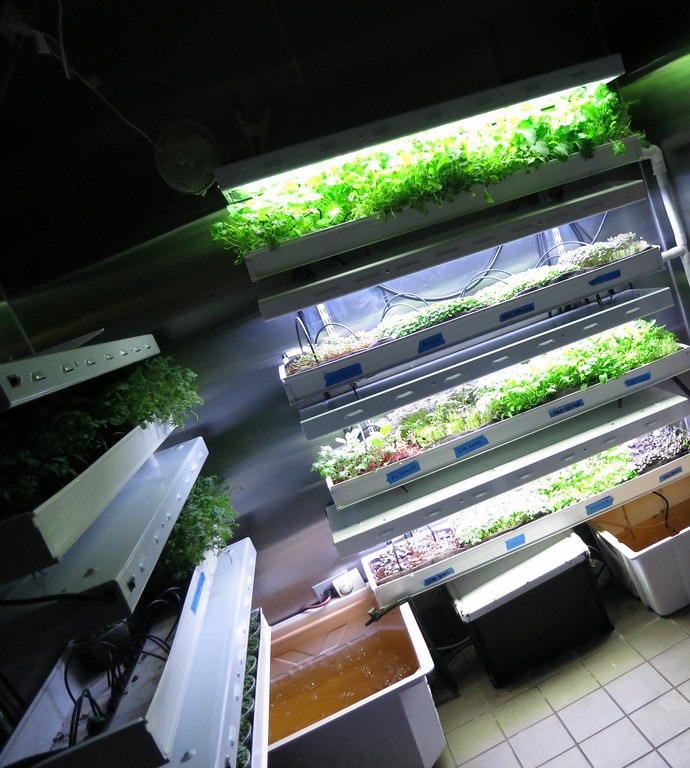
Short answer: Microgreens light requirements are modest. Virginia Tech Extension gives a daily light integral (DLI) of 9 to 16 mol/m²/day as the general target, which you can reach with roughly 150 to 280 µmol/m²/s for 16 hours, or about 140 to 250 µmol/m²/s for 18 hours. Below that range microgreens stretch and pale; above it, yield still climbs in trials, but slowly, and the power bill climbs faster.
This guide turns microgreens light numbers into settings you can use at home: how many hours to run the lamp, how bright it should be at tray level, what changes when you add more light, and when a sunny window is enough. Every figure comes from university extension guides or peer-reviewed trials, listed at the end.
Table of Contents
Microgreens light requirements at a glance
Three numbers describe any microgreens light setup. PPFD (photosynthetic photon flux density, in µmol/m²/s) is how bright the light is at the leaves right now. Photoperiod is how many hours the lamp is on. DLI (daily light integral, in mol/m²/day) is the total light the tray receives in a day, and it is the number that best predicts growth. Purdue Extension defines DLI as the amount of photosynthetic light received each day as a function of intensity and duration (Purdue Extension HO-238).
The conversion that ties microgreens light settings together is simple: DLI = PPFD × hours × 0.0036. A lamp giving 200 µmol/m²/s for 16 hours delivers 200 × 16 × 0.0036 = 11.5 mol/m²/day.
| Setting | Target for microgreens | Source |
|---|---|---|
| Daily light integral (DLI) | 9–16 mol/m²/day (general recommendation) | Virginia Tech SPES-756 |
| Upper bound for a “low-light crop” | DLI below 20 mol/m²/day | Penn State Extension |
| Hours of light | 16–18 h/day in most guides; 18 h on, 6 h dark in Utah State’s home method | Utah State, Virginia Tech |
| Example commercial recipe | ~250 µmol/m²/s × 18 h = 16.2 mol/m²/day | Virginia Tech CEA Innovation Center |
| Low-end recipe for cabbage and Chinese kale | 70–90 µmol/m²/s × 14–16 h | Virginia Tech SPES-756 |
| Range tested in the lab | 100–600 µmol/m²/s × 16 h | Jones-Baumgardt et al. 2019 |
Notice the spread. Microgreens light needs are a range, not a single number, because the crop is harvested so young. Penn State Extension points out that microgreens “will grow under less than ideal conditions because they only need a short growing period” (Penn State Extension, Growing Microgreens).
How many hours of light do microgreens need?
Most published microgreens light schedules run 16 to 18 hours a day. Utah State University’s home guide says to connect the grow light to a timer and run it “18 hours per day,” then keep the tray dark for 6 hours (Utah State University Extension). Virginia Tech’s CEA Innovation Center also uses an 18-hour photoperiod, and the university trials described below used 16 hours.
Microgreens light hours only count after germination and any blackout period. Most microgreen seeds do not need light to sprout, and many growers keep trays covered for the first days so stems stretch evenly before the lamp goes on.
What about running the microgreens light 24 hours? A 2022 trial by Lanoue and colleagues held DLI constant and compared 16-hour and 24-hour lighting on amaranth, collard greens and two basils. Continuous light increased or maintained fresh weight in every crop and cut the electricity cost per gram of harvest by 8 to 38 percent, because the same daily light arrived at a lower, cheaper intensity (Lanoue et al. 2022, Frontiers in Plant Science). That result covers four crops only, so treat 24-hour microgreens light as an option to test, not a rule. For comparison, our guide to hours of light for seedlings explains why transplant seedlings are usually given a dark period.
PPFD: how bright should the microgreens light be?
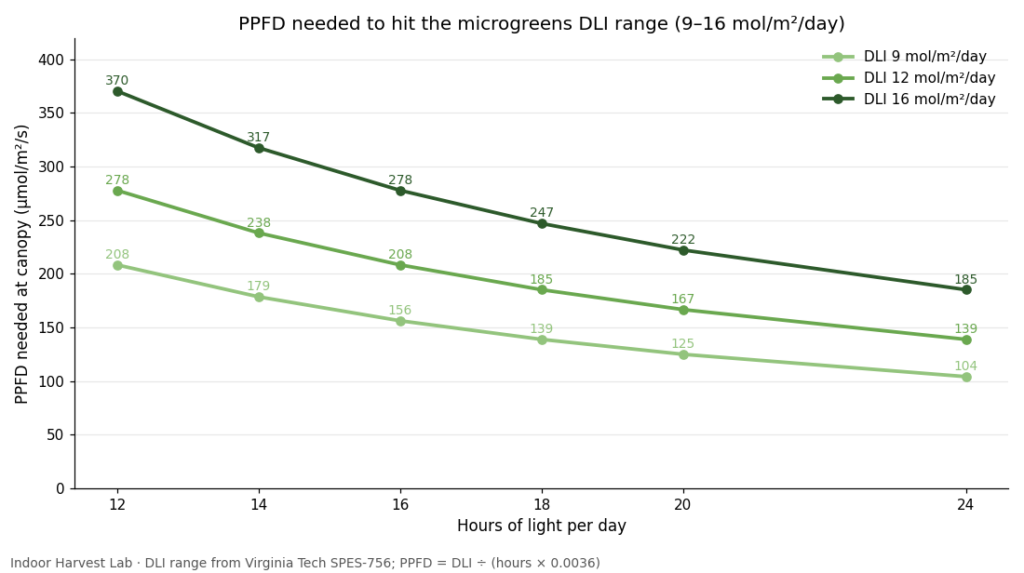
The chart below shows the microgreens light intensity (PPFD) you need at tray level to hit the low, middle and high end of the Virginia Tech DLI range for different day lengths. Longer days let you use a dimmer, cheaper lamp.
| Hours of light | PPFD for DLI 9 | PPFD for DLI 12 | PPFD for DLI 16 |
|---|---|---|---|
| 12 h | 208 | 278 | 370 |
| 14 h | 179 | 238 | 317 |
| 16 h | 156 | 208 | 278 |
| 18 h | 139 | 185 | 247 |
| 24 h | 104 | 139 | 185 |
Values are µmol/m²/s, calculated from DLI ÷ (hours × 0.0036). For a home shelf running 16 hours, a microgreens light that measures about 150 to 280 µmol/m²/s across the tray covers the recommended range.
Microgreens light intensity falls quickly as you raise the lamp and is lower at tray edges than in the middle. If you do not own a quantum (PAR) meter, check the fixture maker’s PPFD map at a stated hanging height, and see our grow light distance guide for how height changes intensity.
What more light does to microgreens
More microgreens light is not only about bigger harvests. It changes shape, color and nutrient content, and not always in the direction you want.
Yield rises, then levels off
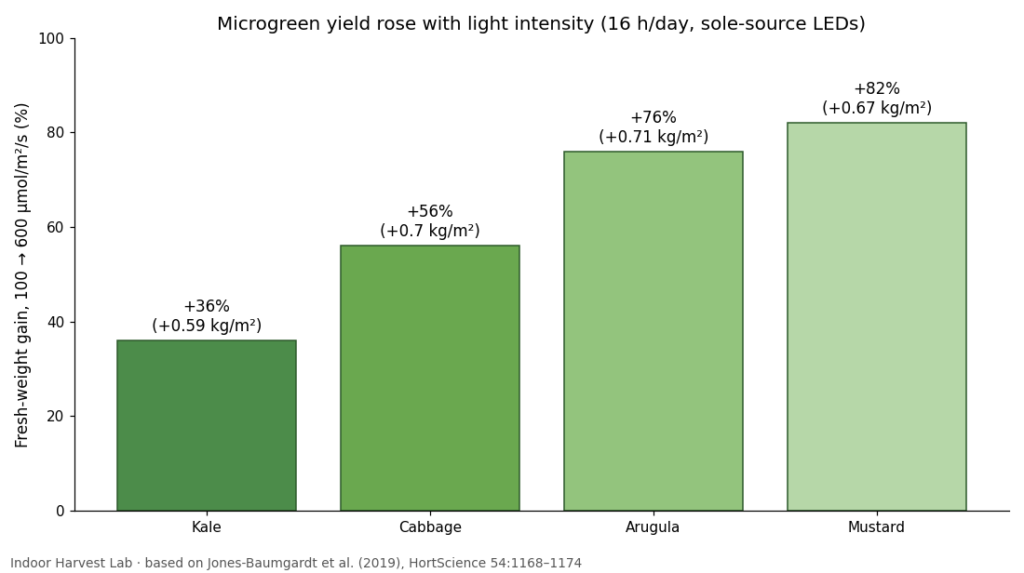
At the University of Guelph, Jones-Baumgardt and colleagues grew kale, cabbage, arugula and mustard under sole-source LEDs from 100 to 600 µmol/m²/s for 16 hours a day. Fresh weight rose by 36 percent in kale, 56 percent in cabbage, 76 percent in arugula and 82 percent in mustard across that range (Jones-Baumgardt et al. 2019, HortScience).
The same group later added LED light to microgreens in a winter greenhouse, from 17 to 304 µmol/m²/s. Fresh weight increased “asymptotically,” meaning each extra unit of light added less than the one before: 15 percent for sunflower, 43 percent for kale, 67 percent for arugula and 61 percent for mustard (Jones-Baumgardt et al. 2020, HortScience). Sunflower, a large-seeded crop, gained the least.
Stems get shorter and thicker
In the 2019 trial, hypocotyl (stem) length fell in a straight line as light increased, in all four crops. A Chilean vertical-farm study found the same pattern at lower intensities: green mustard stems were 6.6 cm at 120 µmol/m²/s and 3.1 cm at 210 µmol/m²/s (Flores et al. 2024, Frontiers in Sustainable Food Systems). Long stems are not always bad, since they make cutting easier, but weak, floppy stems usually mean the microgreens light is too dim.
Color and antioxidants go up, some minerals go down
Higher light raised total phenolics and antioxidant capacity in several Brassica microgreens in the Flores study. At Purdue, Gerovac and colleagues grew kohlrabi, mizuna and mustard at 105, 210 and 315 µmol/m²/s for 16 hours (DLI 6, 12 and 18). Mustard fresh weight rose by up to 34 percent, depending on the LED spectrum, but the concentration of both macro- and micronutrients fell as light intensity increased (Gerovac et al. 2016, HortScience). Brighter is not automatically “more nutritious.”
| Microgreens light level | What trials report | Best for |
|---|---|---|
| Low (about 100–150 µmol/m²/s at 16 h) | Longer stems, larger leaves, lower yield per tray | Tall, easy-to-cut crops; small budgets |
| Medium (about 150–280 µmol/m²/s at 16 h) | Inside the 9–16 DLI range; balanced growth | Most home and small commercial trays |
| High (300–600 µmol/m²/s at 16 h) | Highest yield, short stems, deeper color, more phenolics; lower mineral concentration | Growers selling on weight and color who can pay for the power |
Does light color matter?
For microgreens light, color matters less than intensity for most home growers. The Guelph trials used a blue-to-red ratio of 15:85, and the Purdue trial compared three red-blue mixes, one with green and one with far-red. Spectrum shifted stem length and nutrient content, but the effects depended on the crop. Virginia Tech describes one use of spectrum: basil microgreens grown at 231 µmol/m²/s for 16 hours, then raised to 300 µmol/m²/s with red (638 nm) light for the last three days before harvest (Virginia Tech SPES-756).
A white full-spectrum LED with a published PPFD map is the simplest choice for a microgreens light. It makes the crop look natural, which helps you spot yellowing or mold early.
How to set up microgreens light at home
- Pick your day length. Start with 16 or 18 hours on a plug-in timer. Keep it the same every day.
- Pick a DLI target. Aim for 10 to 14 mol/m²/day, the middle of the 9–16 range.
- Convert to PPFD. At 16 hours you need about 175 to 245 µmol/m²/s; at 18 hours, about 155 to 215. Use the table above.
- Set lamp height. Hang the fixture at the height where the maker’s PPFD map shows your target across the whole tray, not just the center. Measure with a PAR meter if you have one.
- Turn the lamp on after blackout. Uncover trays once stems have lifted, then start the timer. Sow at the right seeding density so leaves are not shading each other.
- Read the crop after 2–3 days. Pale, stretched, leaning stems mean too little light. Very short, dark growth means you are at the high end and could save power.
- Adjust one thing at a time. Change hours or height, not both, and compare the next tray.
Can you grow microgreens on a windowsill?
Sometimes. Utah State says a south-facing window “can also work,” but notes that in winter Utah gets as little as 8 hours of sunlight a day. Outdoor DLI in the United States ranges from about 5 to 60 mol/m²/day depending on season and place, and even a greenhouse “seldom” exceeds 25 because glazing and framing block light (Purdue HO-238). Window glass, screens and walls cut light further, so a windowsill in a dull month can fall well below the 9 mol/m²/day floor.
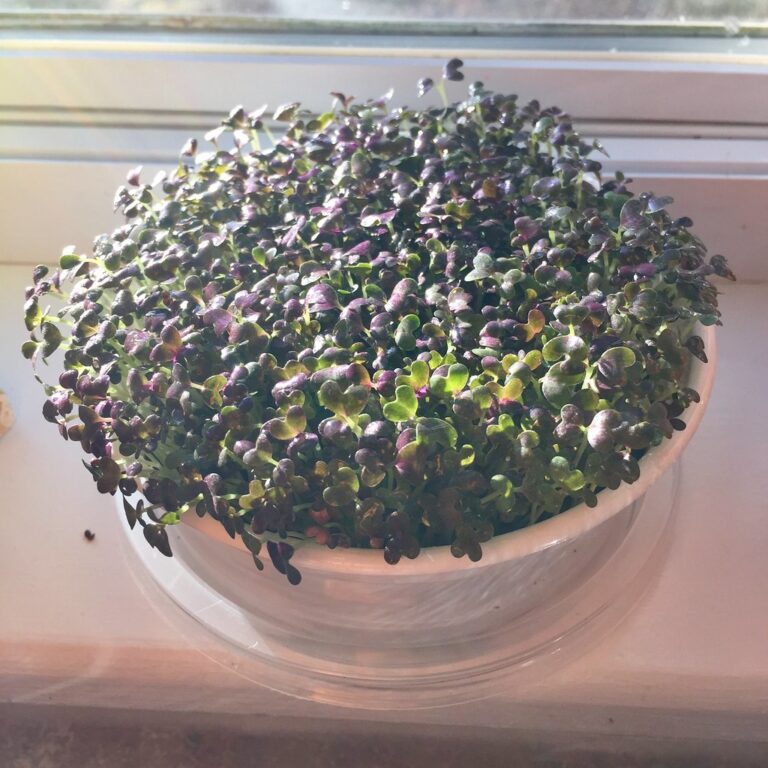
If windowsill trays lean hard toward the glass, turn them daily or add a microgreens light. Fast, short crops such as radish and mustard cope with window light better than slow crops such as basil.
Microgreens light mistakes to avoid
- Judging a lamp by watts. Watts measure power use, not the light reaching the leaves. Compare PPFD at your hanging height.
- Measuring only the center of the tray. Edge plants often get much less light and stretch first.
- Skipping the timer. Irregular microgreens light hours make DLI swing from day to day.
- Chasing maximum light. Trial yields kept rising up to 600 µmol/m²/s, but each step added less. For home trays, the middle of the range is usually the better buy.
- Blaming light for every problem. Fuzzy growth at the base may be root hairs or mold; see our microgreens mold guide. Stretching can also come from warmth and crowding, as in leggy seedlings.
- Lighting during blackout. Light on covered trays wastes power and can make germination uneven.
Where this applies
The microgreens light targets here apply anywhere you grow under lamps, because indoors you set the light. They matter most in winter at higher latitudes, when window light is short and weak. In a sunny greenhouse in summer, natural light may already exceed the range and supplemental lighting adds little. The trials above used Brassica crops, amaranth, basil and sunflower; peas, sunflower and other large-seeded microgreens carry more stored food in the seed and, in the Guelph greenhouse trial, sunflower responded least to extra light. For soil-free trays, see microgreens without soil, and browse more microgreens growing guides.
FAQ
Can microgreens get too much light?
Within the ranges tested, yield did not drop at 600 µmol/m²/s for 16 hours in the Guelph trial, but color became darker and less saturated in cabbage and mustard, and Purdue found lower mineral concentrations at higher light. In practice, cost is the main limit for home growers.
Do microgreens need light to germinate?
Usually not. Most microgreen seeds germinate in the dark, and many growers use a covered blackout stage first. Light matters from the moment trays are uncovered.
Is a regular LED bulb enough for microgreens?
A household bulb is designed to light a room, and its PPFD at tray level is almost never published. A flat panel or bar made for plants, hung at a measured height, is more reliable as a microgreens light.
How many hours of light do microgreens need per day?
Most guides use 16 to 18 hours. Utah State recommends 18 hours on and 6 hours off.
Related guides: when and how to harvest microgreens · blackout period · seeding density
Sources
- Virginia Tech Cooperative Extension. Introduction to Microgreen Production in Indoor Vertical Farms and Greenhouses (SPES-756).
- Penn State Extension. Growing Microgreens.
- Beck, S. Utah State University Extension. Grow Your Own Microgreens.
- Purdue Extension. Measuring Daily Light Integral in a Greenhouse (HO-238).
- Jones-Baumgardt, C., Llewellyn, D., Ying, Q., Zheng, Y. 2019. Intensity of sole-source light-emitting diodes affects growth, yield, and quality of Brassicaceae microgreens. HortScience 54:1168–1174.
- Jones-Baumgardt, C., Llewellyn, D., Zheng, Y. 2020. Different microgreen genotypes have unique growth and yield responses to intensity of supplemental PAR from light-emitting diodes. HortScience 55:156–163.
- Gerovac, J.R., Craver, J.K., Boldt, J.K., Lopez, R.G. 2016. Light intensity and quality from sole-source light-emitting diodes impact growth, morphology, and nutrient content of Brassica microgreens. HortScience 51:497–503.
- Lanoue, St. Louis, Little and Hao. 2022. Continuous lighting can improve yield and reduce energy costs while increasing or maintaining nutritional contents of microgreens. Frontiers in Plant Science.
- Flores, Hernández-Adasme, Guevara and Escalona. 2024. Effect of different light intensities on agronomic characteristics and antioxidant compounds of Brassicaceae microgreens in a vertical farm system. Frontiers in Sustainable Food Systems.
Featured image: “Microgreens busy growing in the moto indoor growroom” by loustejskal.com, CC BY 2.0.